






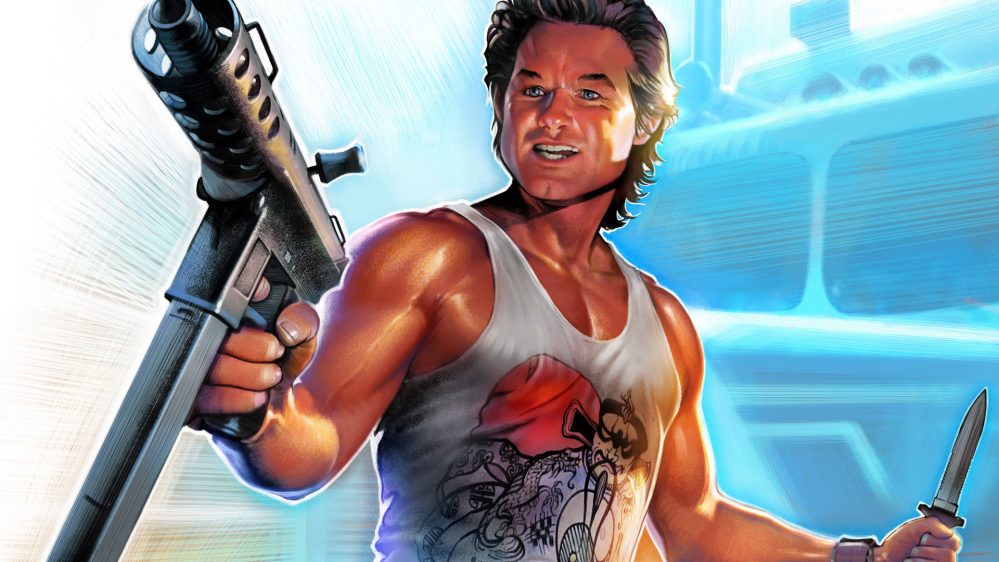
We Got Big Trouble...


Have you paid your dues?
We got the game to the table this weekend. We had played it twice before: once with friend’s copy not too long after the game came out (2017 maybe?), and again at a convention back in March. Our first play didn’t leave much of an impression, but we had a lot of fun at that convention game, which is what prompted me to buy my own copy.
There were two of us playing this time. We chose Jack Burton and Egg Shen as our characters. The game offers a fun way to balance for fewer players: each player gets a companion, which is one of the other characters in the form of a card that adds an extra die to your rolls and gives you a special ability specific to that character. For our game, Egg Shen got Gracie Law as his companion, and Jack Burton got Margo Litzenberger — they seem like some unlikely pairings, but we’ll go with it.
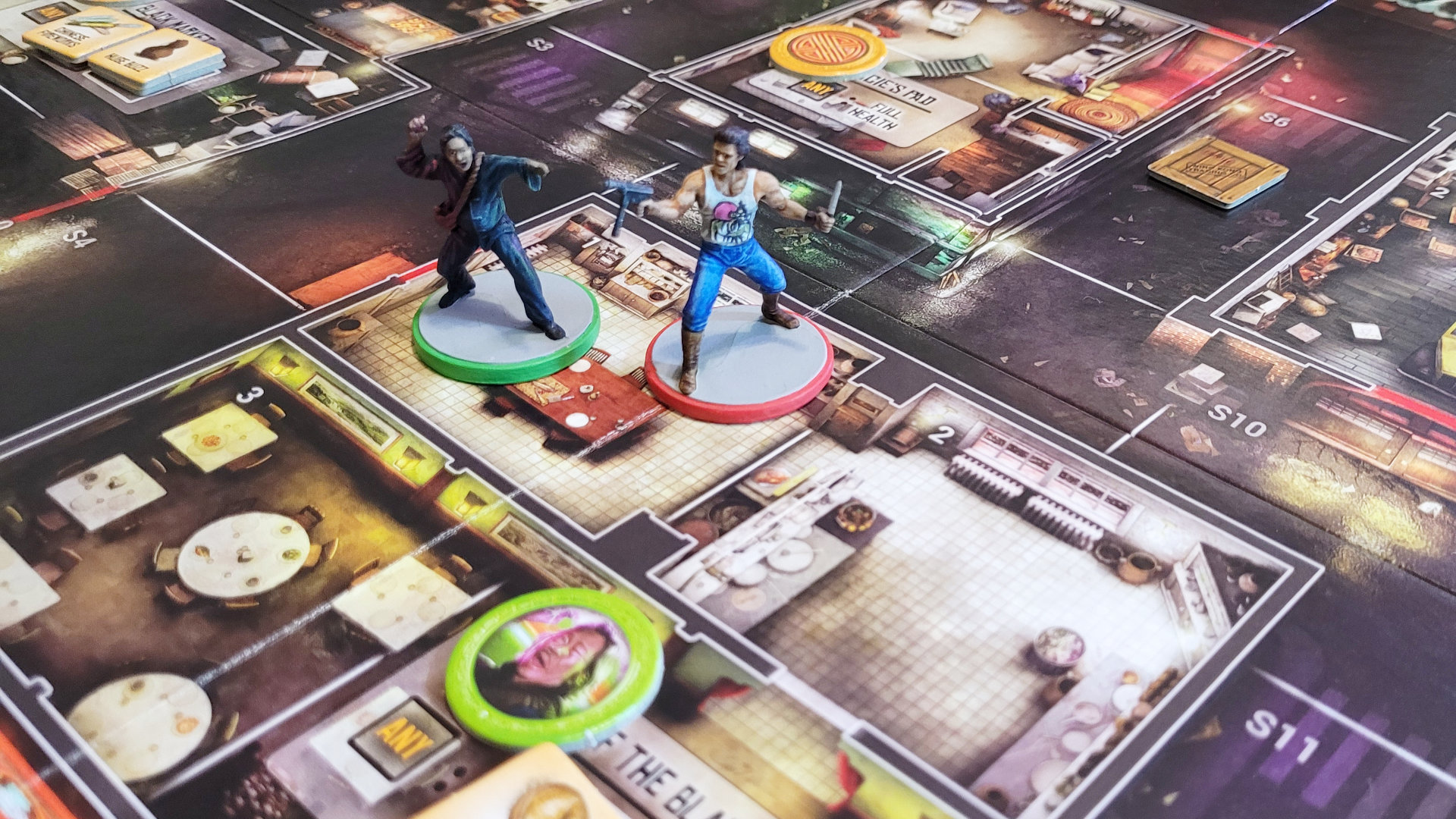 Jack and Egg Shen, ready to brave the streets of Chinatown.
The game plays out in two parts: in the first half, players wander around the board (representing Chinatown), gathering strength and experience by fulfilling quests and fighting low-level bad guys. Quests are generally in the form of “go to this location and roll a test, then go to the next location and roll another test or fight a villain). There were three major quests in our two-player game: one for each character and one centered on one of the major villains — in our case it was Lightning, one of the three storms.
In addition to the major quests, there are always three minor quests in play, which are simple “go to a location, do a thing, get a reward” tasks.
Dice tests and combat are handled the same way. Each player has a small board for their character, and a number of action dice with three different symbols: mind, body and spirit. At the start of your turn you roll the dice, and then to perform actions you slot your dice into the row that corresponds with the symbol rolled. Any die can be used for any action, but each character has certain “epic” slots on their board that make the actions more effective when a die is placed there. Dice have to be placed in slots from left to right, so, for example, Jack Burton has epic slots for his first two dice placed in his body row, so he’s better off when he rolls a lot of body results on the dice. Mind, not so much…
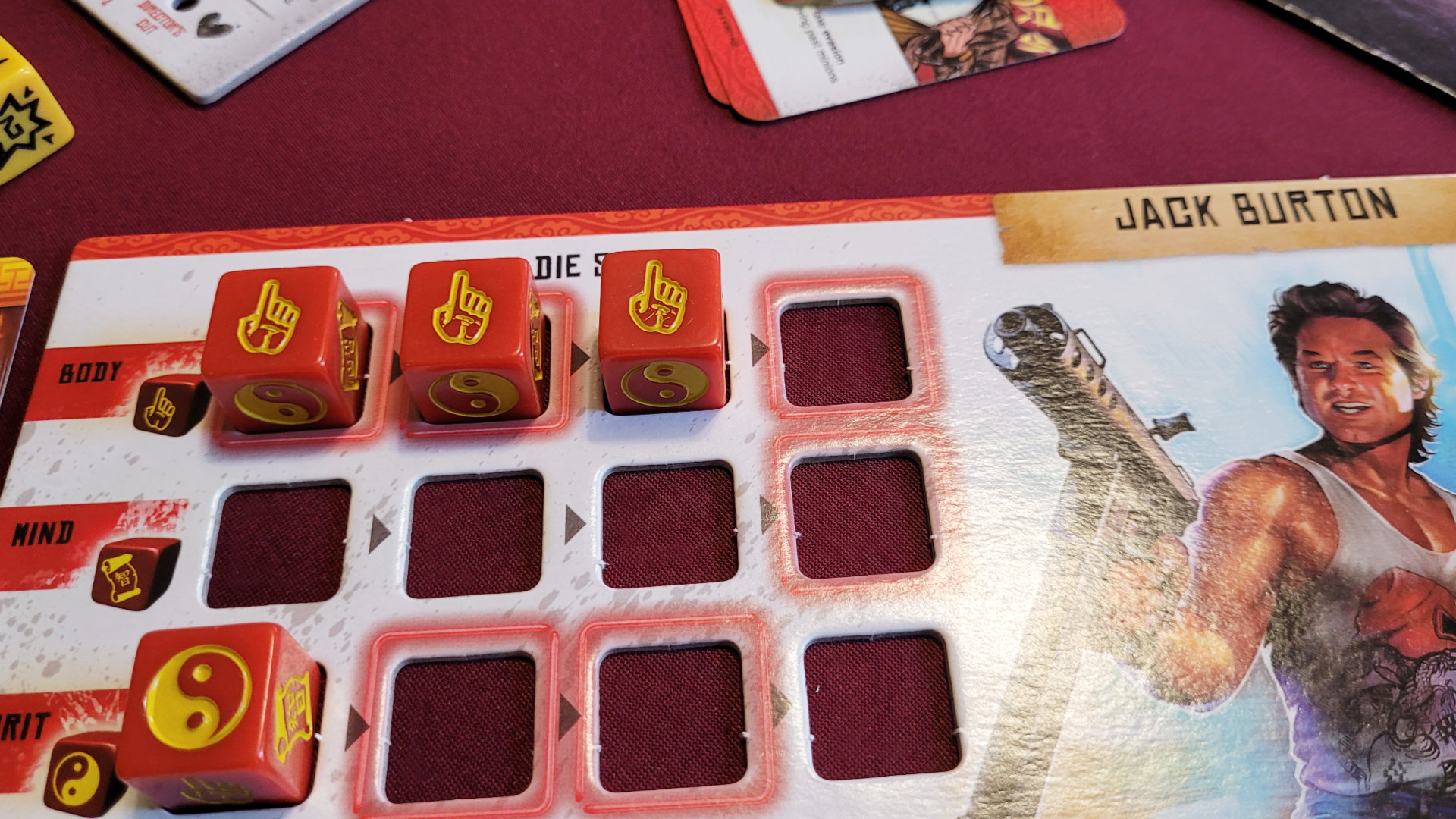 Jack definitely has his strengths and weaknesses.
Players can attack enemies on their turn, and at the end of each round every enemy on the board moves towards the nearest hero and attacks if they manage to get to the same space (or within line of sight if the enemy has a ranged weapon). The board is divided into zones representing different buildings, and one big zone representing the streets — enemies won’t ever move out of the zone they spawned in, so most of them just roam the streets, and the heroes are safe from them unless one or more happen to spawn inside a building (usually as a result of a quest card).
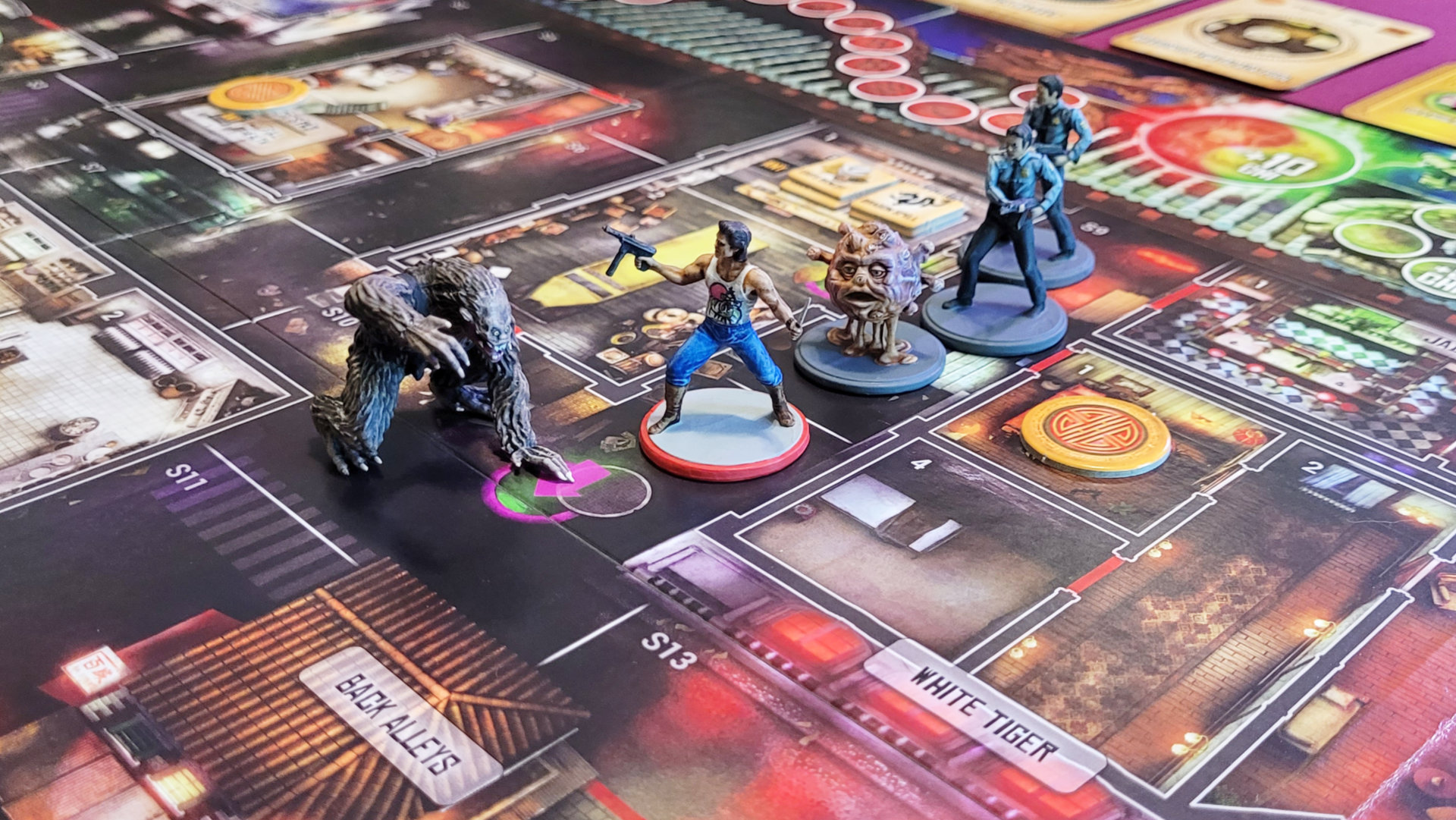 That escalated quickly...
All the while, the Trouble track is counting down, and when it gets to the end, the first part of the game is over and we go to the showdown. The board is flipped over, with the new board representing the three levels of Lo Pan’s hidden fortress. Whether or not the players completed their major quests determines where the heroes start during the showdown, and also what enemies are present and where they spawn. In our game, we defeated Lightning during a quest so he wasn’t on the board for the showdown, but we had plenty of other problems to contend with…
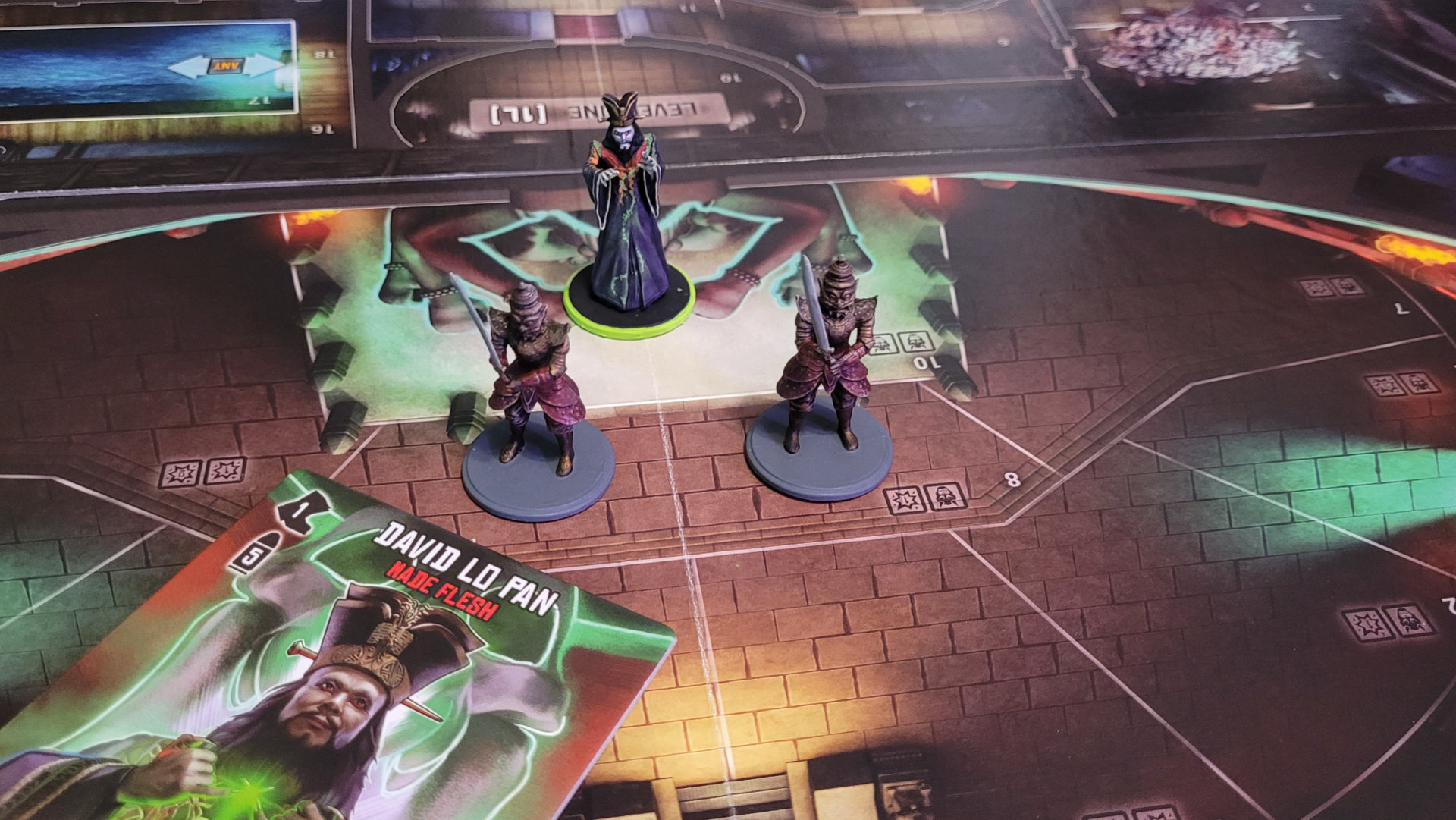 The final battle with Lo Pan and his celestial guards.
The showdown part of the game is much shorter. Players have to complete one or more tasks (depending on the number of players) in order to unlock the elevators and get to the middle level where Lo Pan is lurking. Then he has to be defeated, at which point the players win!
At the convention we played with a full table of 6 players, which was fun but a little chaotic. We enjoyed the game just as much with just the two of us — it scales up and down well and really hits that sweet spot for cooperative games: enough of a challenge that we felt like we accomplished something, but not so difficult that you get frustrated by losing over and over.
All in all we had a great time with the game — the game mechanisms are interesting and well thought out, and it really puts you in the film. We’ll definitely be playing again!