


ORK: Task Force Upyr



Recommendations:
About the Project
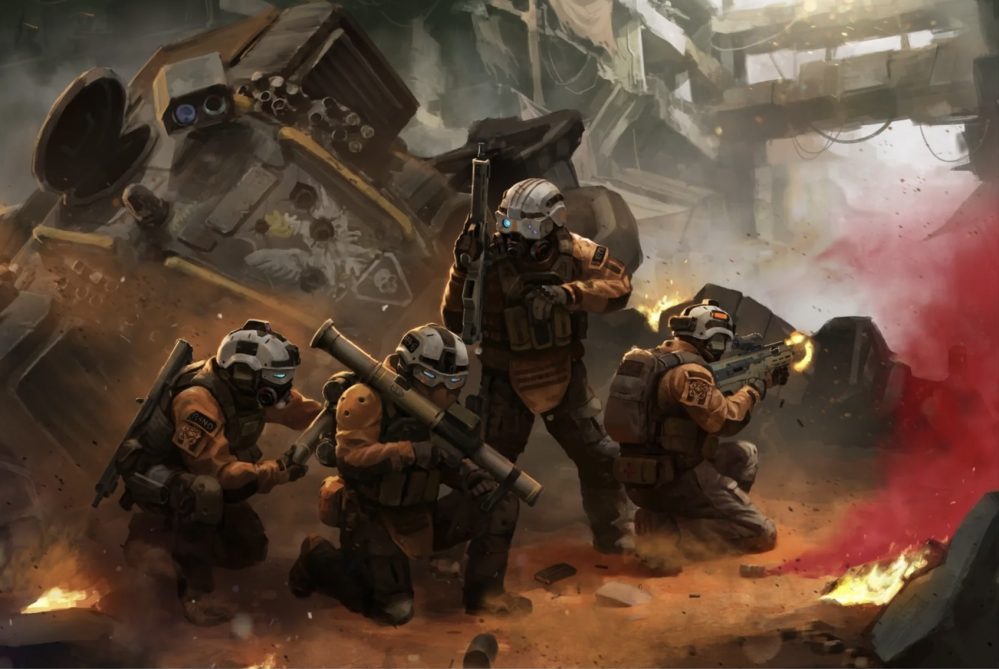
Blkout (yes, that’s how it’s spelled) by Enemy Spotted Studios is a near future, hard sci fi, skirmish game. Or as I call it, Ukraine next week. This project is my attempt to field the PMC called ORK and their task force Upyr.
Related Game: BLKOUT
Related Genre: Science Fiction
This Project is Completed
The Setting
The planet Abol is the first interstellar colony. The government there, collectively referred to as the Authority, is the United Nations of Abol, commonly referred to as just the UN.
As this is a wargame, we need reasons to fight our battles but I won’t bore you with all the lore. Essentially governments, insurgents, Private Military Contractors (PMCs), criminal gangs and religious fanatics are all fighting for control of Abol.
ORK (Rozwiazania Konfliktów Orłów aka Eagle Conflict Solutions) is a PMC having roots back on Earth where many of the operators were recruited from Polish special forces. One of the units of Ork is Task Force Upyr.
Task Force Upyr consists of three units. The Korpus Strazy, the Strzyga Hunters and the Strzyga Assaulters. Each unit has different skill levels, equipment and roles so the goal here is to paint a coherent force but still reflect the individual nature of the units.
As this whole army has only 8 models in it, in theory, this shouldn’t take too long.
First Steps
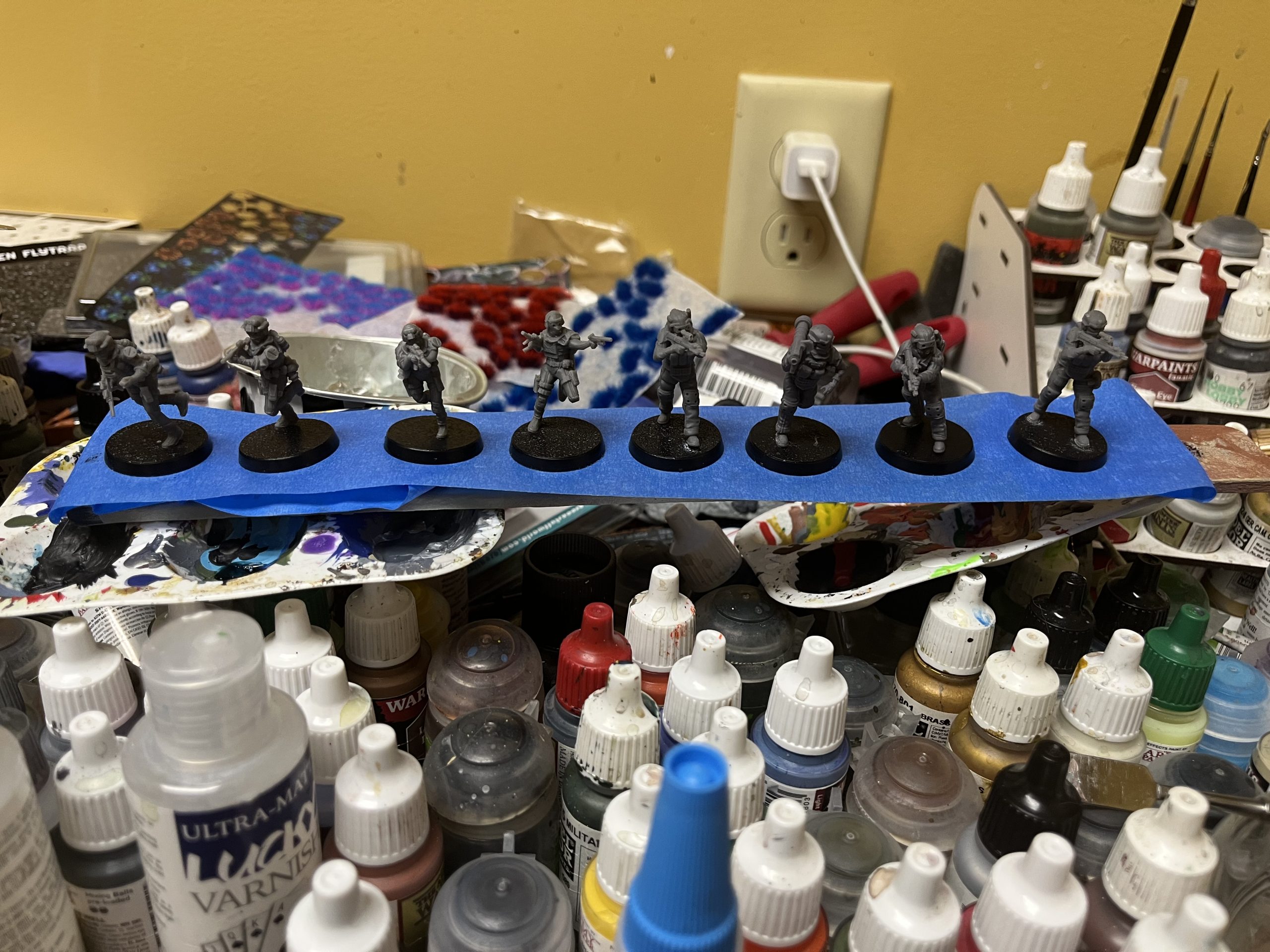 Consisting of one pice, 3D printed minis, I cleaned up the sculptures and super glued them to the plastic bases they were supplied with. I then put some duct tape onto a paint stirring stick prior to priming them.
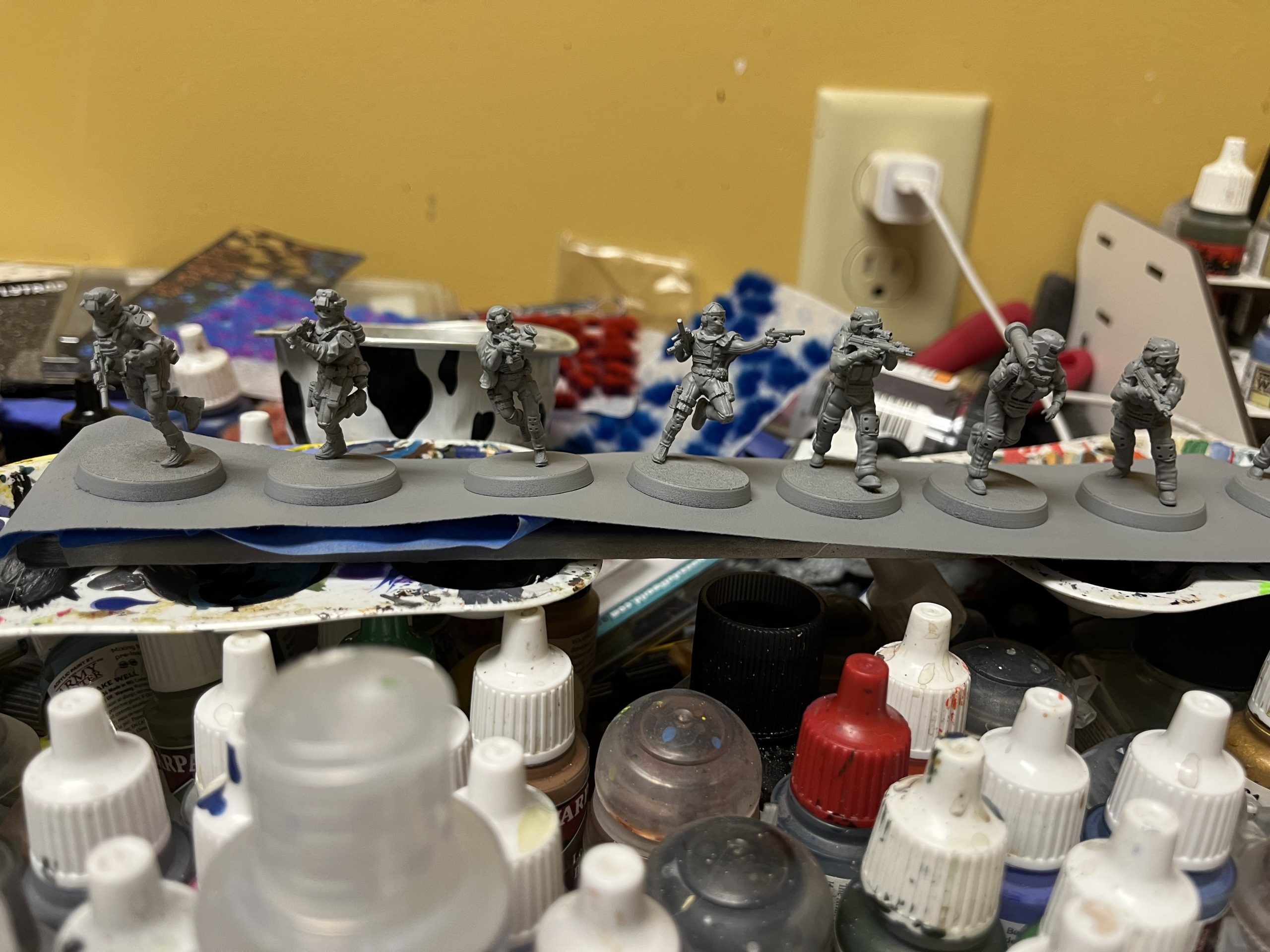 I primed these with Army Painter Ash Grey primer, which has become one of my favorite primer colors.
Black, Grey and White
I started with Army Painter matt black, dry brushed the black with Army Painter Deep Grey and then painted a few areas white for later effects paints. Also, the colors of the Polish flag are red and white, so I’ll need a few areas to be white.
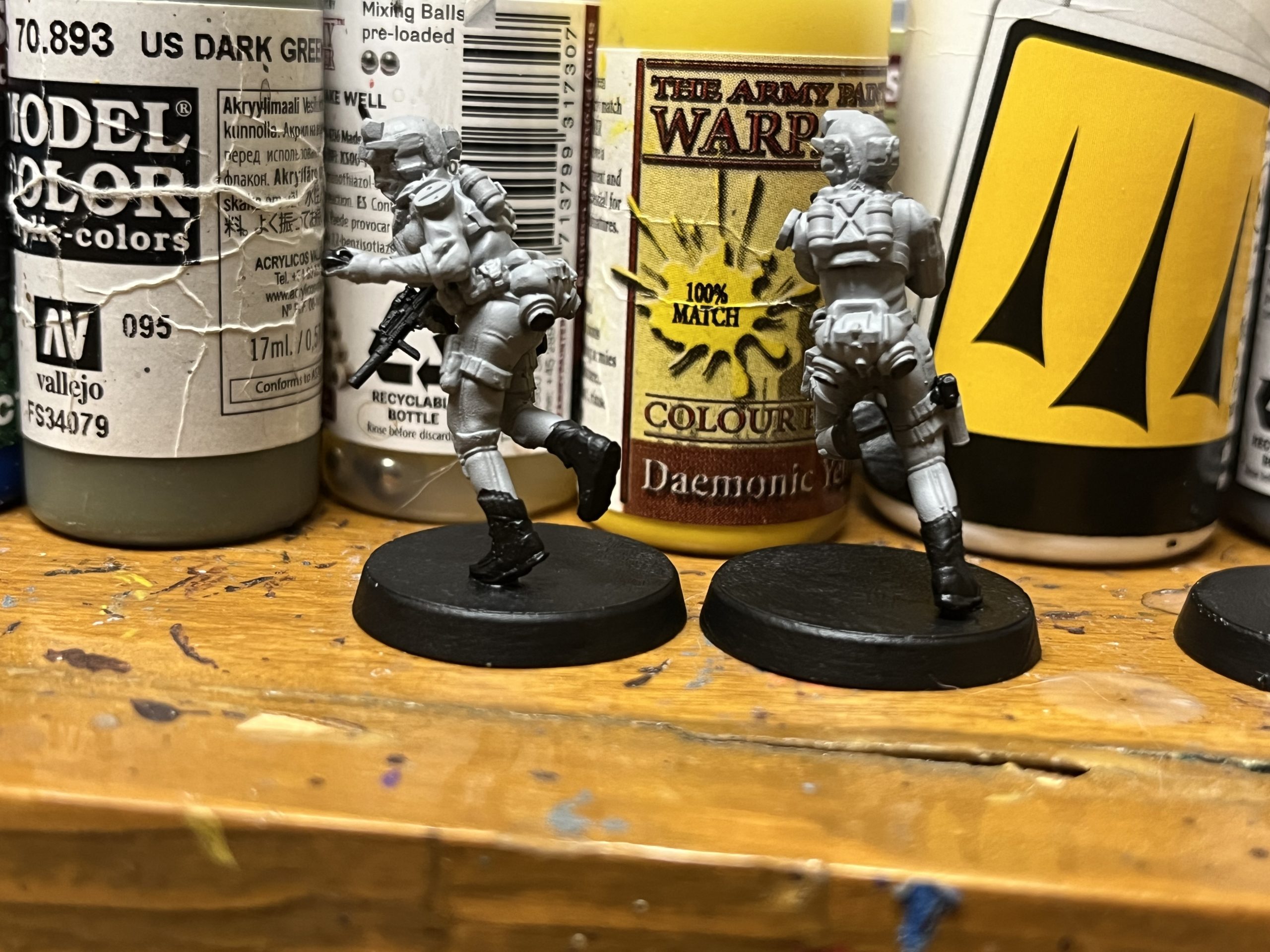 The two man assault unit with black boots, SMGs, pistols and the exhausts of the jump jets.
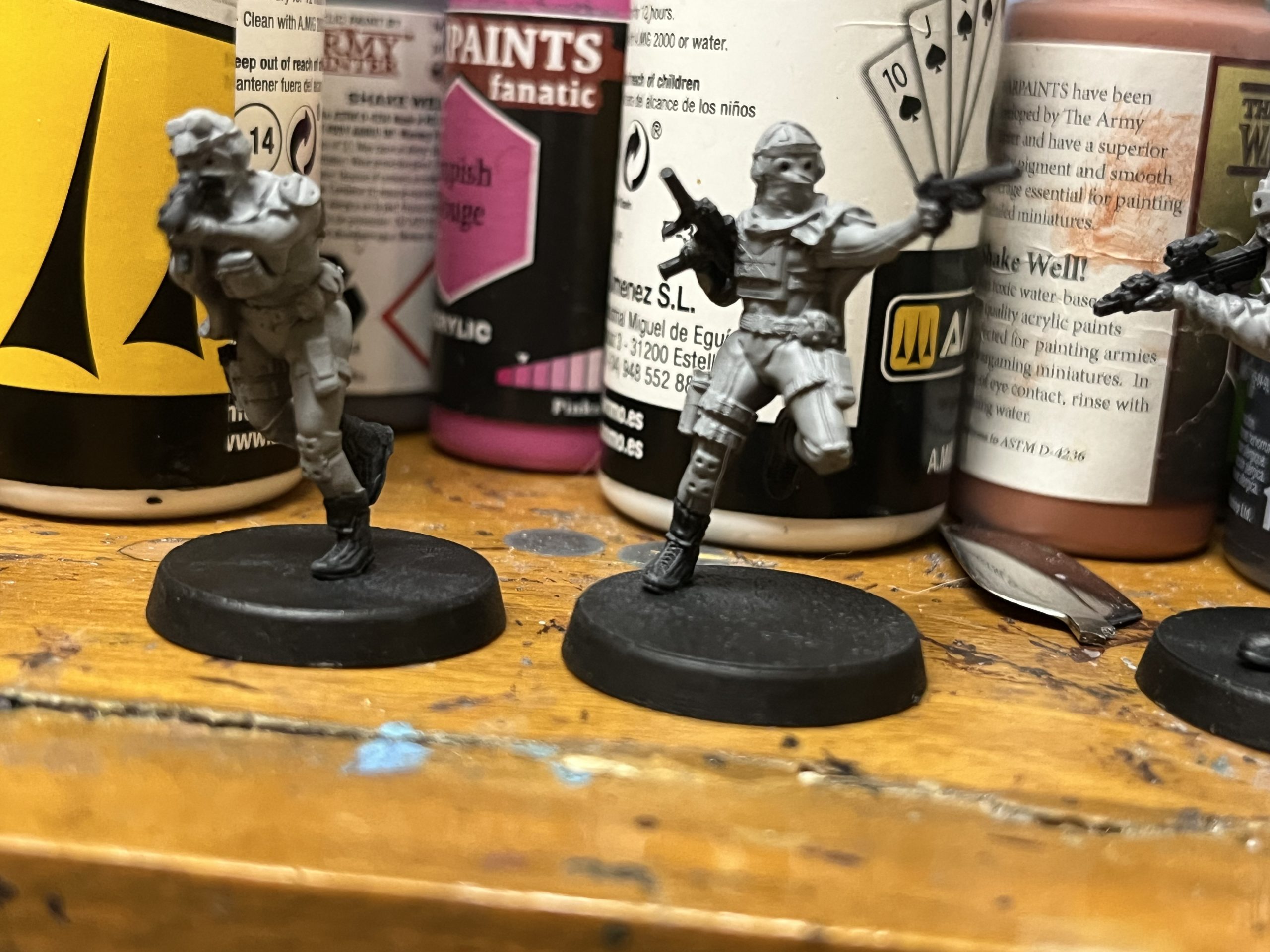 The two man assault unit with the grey dry brushed on the weapons and boots.
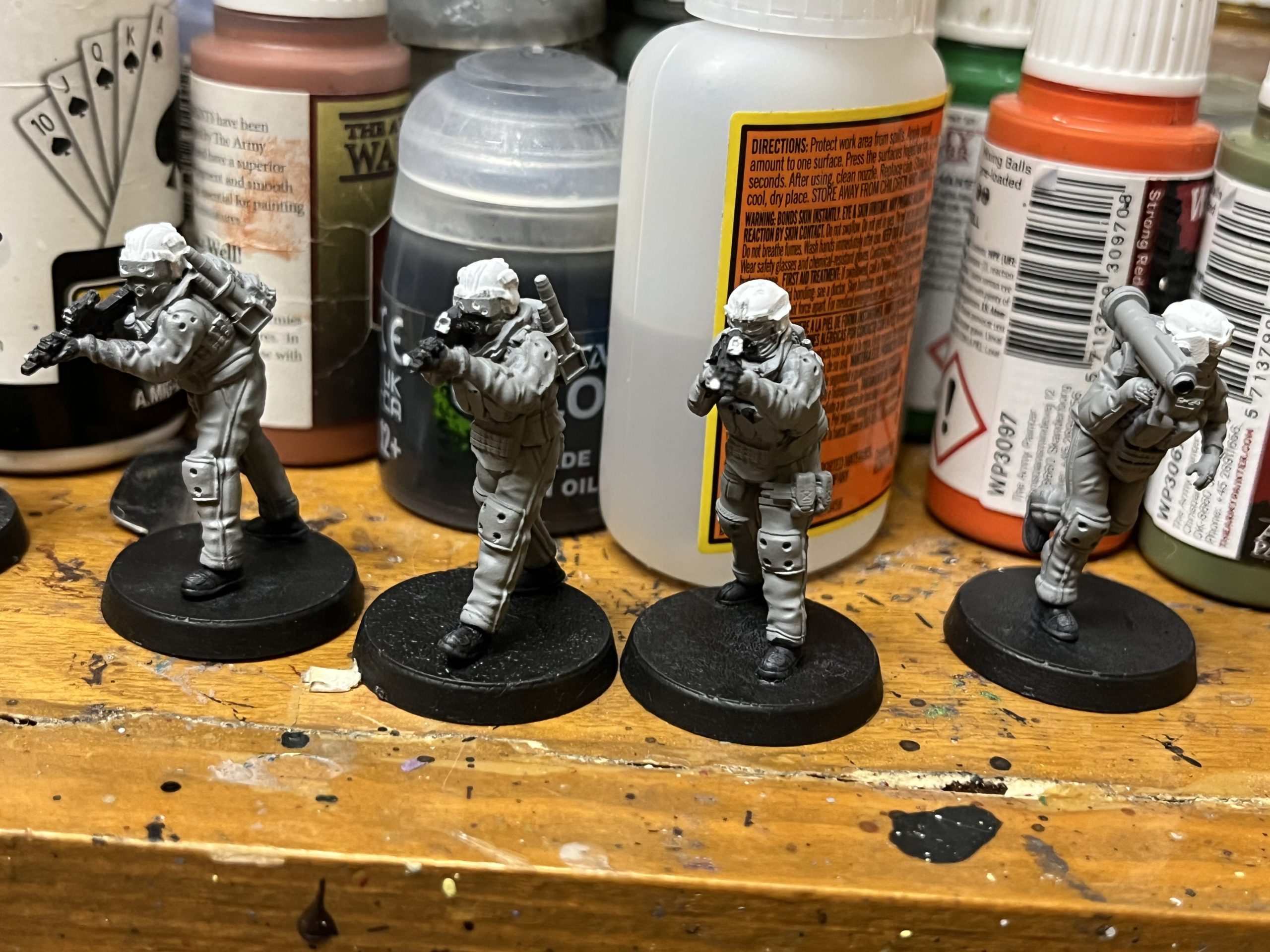 The four man Korpus Strazy (which I believe translates to roughly Corporate Guards or Corporate Security) with white helmets and white optics. Some of those optics will later get some special effects paint and the white should intensify the effect.
General Notes on mistakes and touch ups
Mistakes are inevitable so I do go back and touch up things after I apply a new color. For instance, I want the night vision gear and visible eye masks to stay Ash Grey so after applying the white for the eye recesses I went back and fixed the bleed over. Same for the guns. The optics on them are white but some mistakes occur so I went back and touched things up with some black.
I also did multiple thin coats of white but took the pictures only after the first coat.
 And if you ever see a stray white hair in a photo, it’s this guy’s fault. His name is George.
The air is crunchy
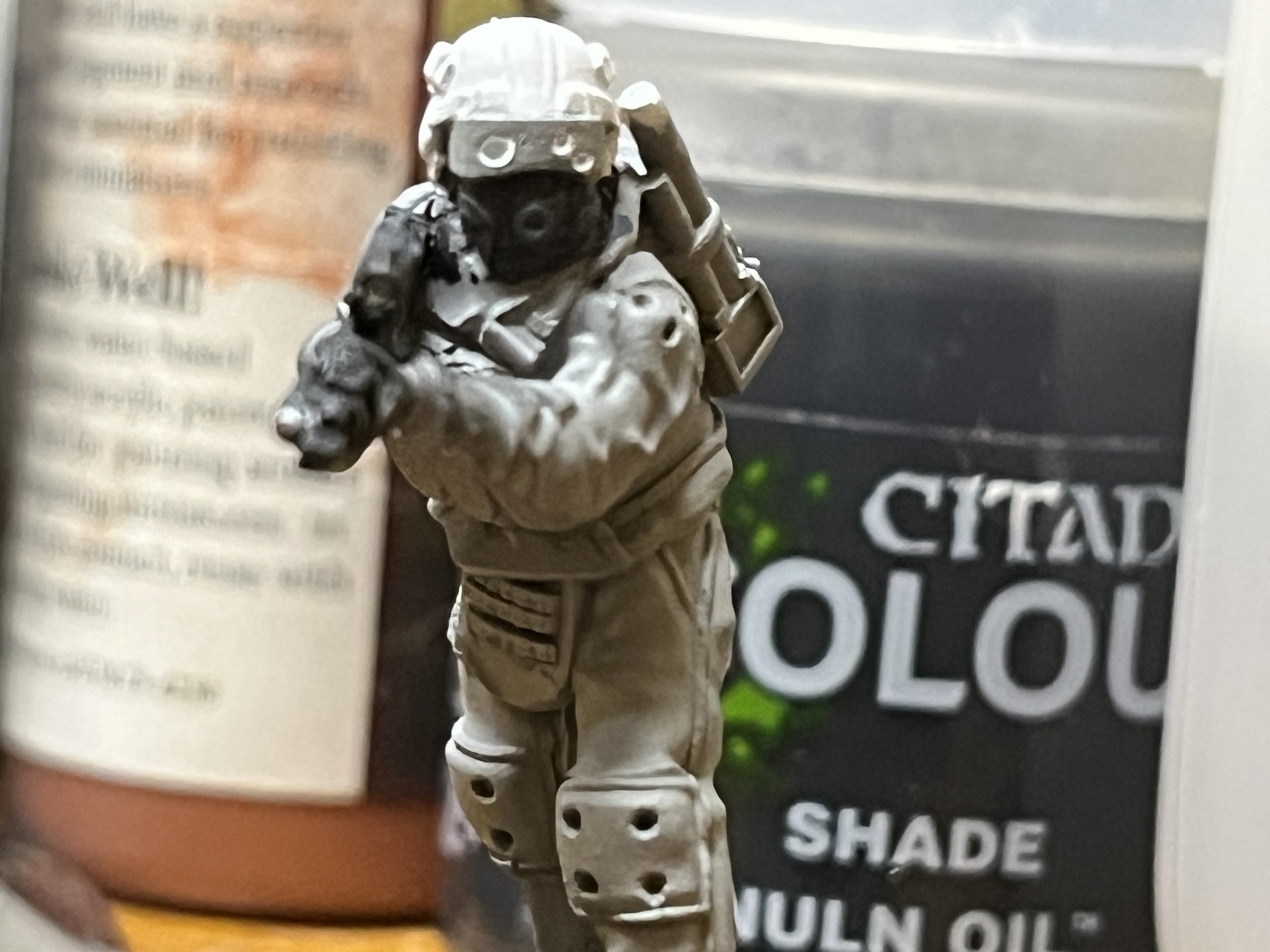 Abol is suitable for humans but it isn’t pleasant. The air is usually dust laden and the dust gets everywhere, including your mouth and lungs. Many individuals wear air filters like this guy. Filter painted Army Painter Deep Gray.
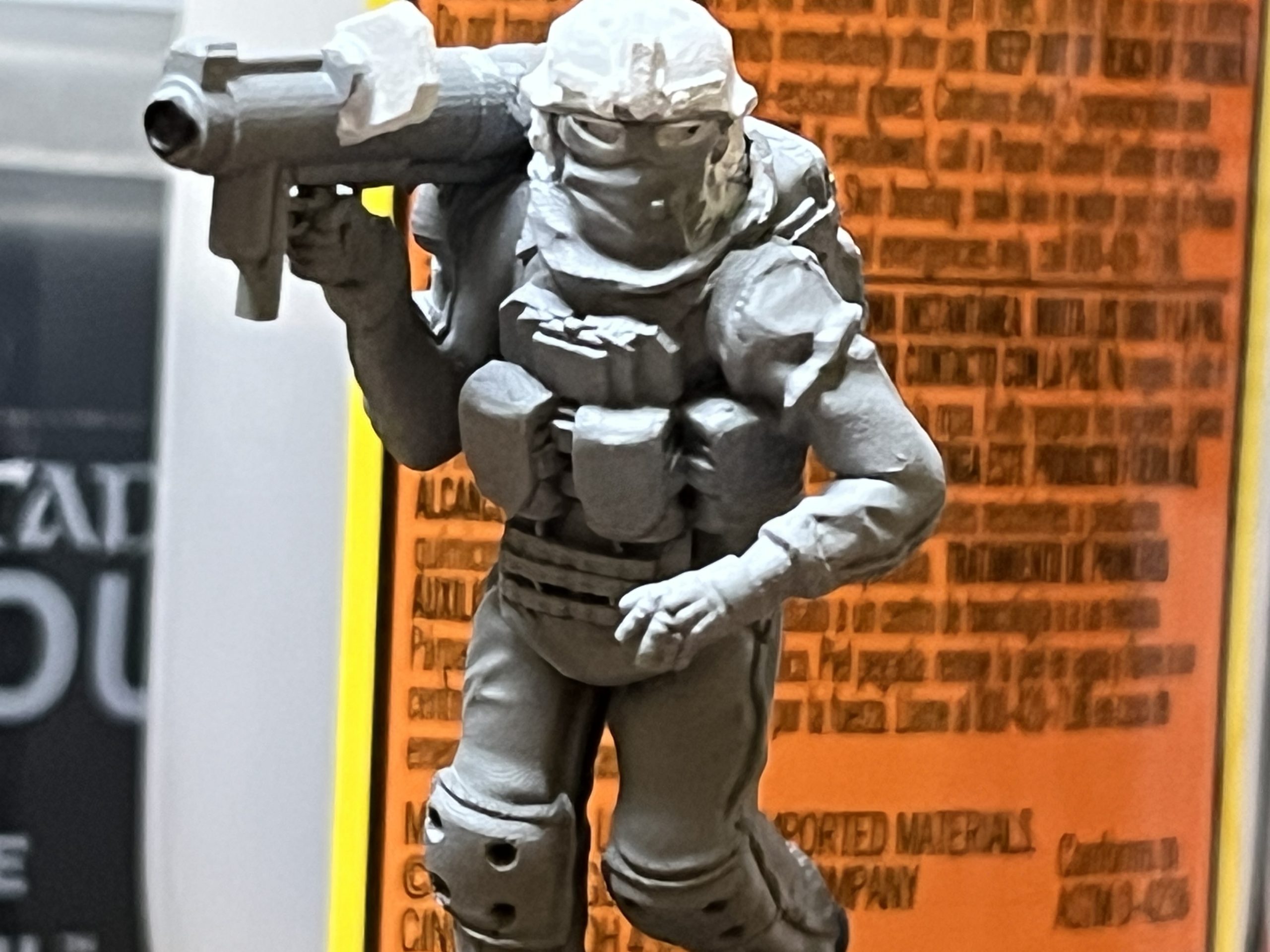 Some people opt to wear simple masks like this guy. Partly to filter out the dust but also partly to conceal his identity. I haven’t decided yet on a color for the cloth masks.
How I decided on my color scheme
I’m trying to accomplish several different things with my color scheme, some of which are competing with each other.
1. Needs to be cool.
2. Needs to be realistic.
3. Needs to aide in gameplay.
4. Needs to tell a story
First, it needs to be cool. Purely subjective but if I like it when I’m done I’ll have accomplished that goal.
Second, it needs to be realistic. Seems odd to say that with a sci fi game but bear with me for a second.
If you look at the minis, they have very recognizable and realistic details on the uniforms, web gear and weapons. And the sci fi elements are either plausible, foreseeable or under development (think Popular Mechanics illustrations accompanied by photos from real world military R&D projects), hence my earlier remark of Ukraine next week.
Third, it needs to aide in gameplay. I need to be able to tell my force from my opponents, I need to be able to ID individual units and finally , I need to be able to spot specific models.
Telling my force from my opponents should be fairly easy as there’s a huge variety of ways to paint the forces. But ESS has a studio army and not a few people paint up their army to match the studio army. So the way I’m going to make my army distinctive is to tell a story.
This force is a PMC that works with the Authority (the collective name of the UN forces of Abol). This means it’s an organized force unlike the Impisi (one of the insurgent forces of Abol). Additionally, this force was raised from Polish special forces. And the national colors of Poland are red and white. So this means it’ll have uniforms and I need to incorporate the Polish colors.
Now modern military gear tends to be pretty drab and designed for concealment. So let’s make as much of it as possible like that. But this is a sci fi setting and so you have lots of high tech gear to be able to spot enemies so maybe camouflage isn’t as important as it used to be so a few spots of color won’t hurt.
So in this force, we have three different units and in Blkout, each soldier acts independently and there is no coherency. So I need to be able to spot models in different parts of the table and be able to recognize them as part of the same unit. So I’m going to incorporate my first bit of story and paint the headgear of the three units in the Polish colors.
The lowest skilled unit is the Korpus Strazy. Being quite new and deferring to white shields everywhere, they get white helmets. And because ORK is affiliated with the UN, and the UN units frequently have elements of white on their gear and vehicles, this seems fitting. Additionally, the original artwork for the Korpus Strazy depicts them as having white helmets and visors.
Assuming you did a good job and got promoted, you’d get bumped up to the next unit, the Hunters. Better skilled than the Korpus, probably having a bit of experience, I’ll give them red headgear.
Finally there are the assaulters, the most elite unit. We’ll give them helmets that are half red and half white. This accomplishes the goal of being able to ID all three units and lean into the Polish roots of the force.
Certain models are designated specialists. They have the same gear as everyone else but carry additional gear that only they can use. Sometimes it’s pretty obvious to tell that the sniper specialist is the only guy carrying the big honking space gun. But sometimes it’s the guy with the electronic warfare gear that fits into an ordinary looking backpack you need to ID. So we’re going to add a bit more color and give a dash of orange to the specialists.
Orange is a bit of an incongruous color so it’ll be distinctive. And as Loyd has pointed out, you almost always see your model from behind so the orange highlight will mostly be on the back of the model, probably the helmet.
If you take a look at the other forces in the game, you’ll notice very few have visible faces on the minis and most have full visors or face masks. This is because the soldiers are mostly seeing a VR display on the inside of their helmets. In my head cannon, the orange highlights aren’t actually visible to the naked eye but rather are Identify Friend/Foe (IFF) tags displayed on your screen. The orange color just indicates an active inquiry letting you know that guy in particular is carrying that special piece of gear.
So far, we’ve incorporated a bit of story and have made some decisions to aide in gameplay, so how do we get some more realism? And can we tell more of a story?
So, one of the things you want to do with miniatures is to bring out details, you need to have contrasting colors. In a uniformed force made up of drab colors, this can be a bit tricky. But, there’s a way to do that and get a bit of realism too. Consider this, when you go to war, you frequently go with what you have rather than what you need or want.
In thinking about the first Gulf War, troops from Germany arrived in the desert with woodland patterned camouflaged uniforms. After a long time, they got desert patterned uniforms. But their web gear was still olive green, so that didn’t match their camo. Then they had to put on their chemical warfare suits because there might be a chemical attack. And those chem warfare suits were in, surprise!, a woodland camo pattern. Doh!
So, we’re going to incorporate realism, story and contrast by giving these guys all different drab, military looking, colors and patterns, but for multiple different environments because it’s a big world with multiple biomes.
Finally, we’re going to make things even harder by basing these guys in a red, iron oxide, arid region.
And then we’re actually going to give them camouflage, but cheap, because we are a PMC and the contract goes to the lowest bidder.
Let’s see if I can pull this off.
Multiple Updates
Place holder
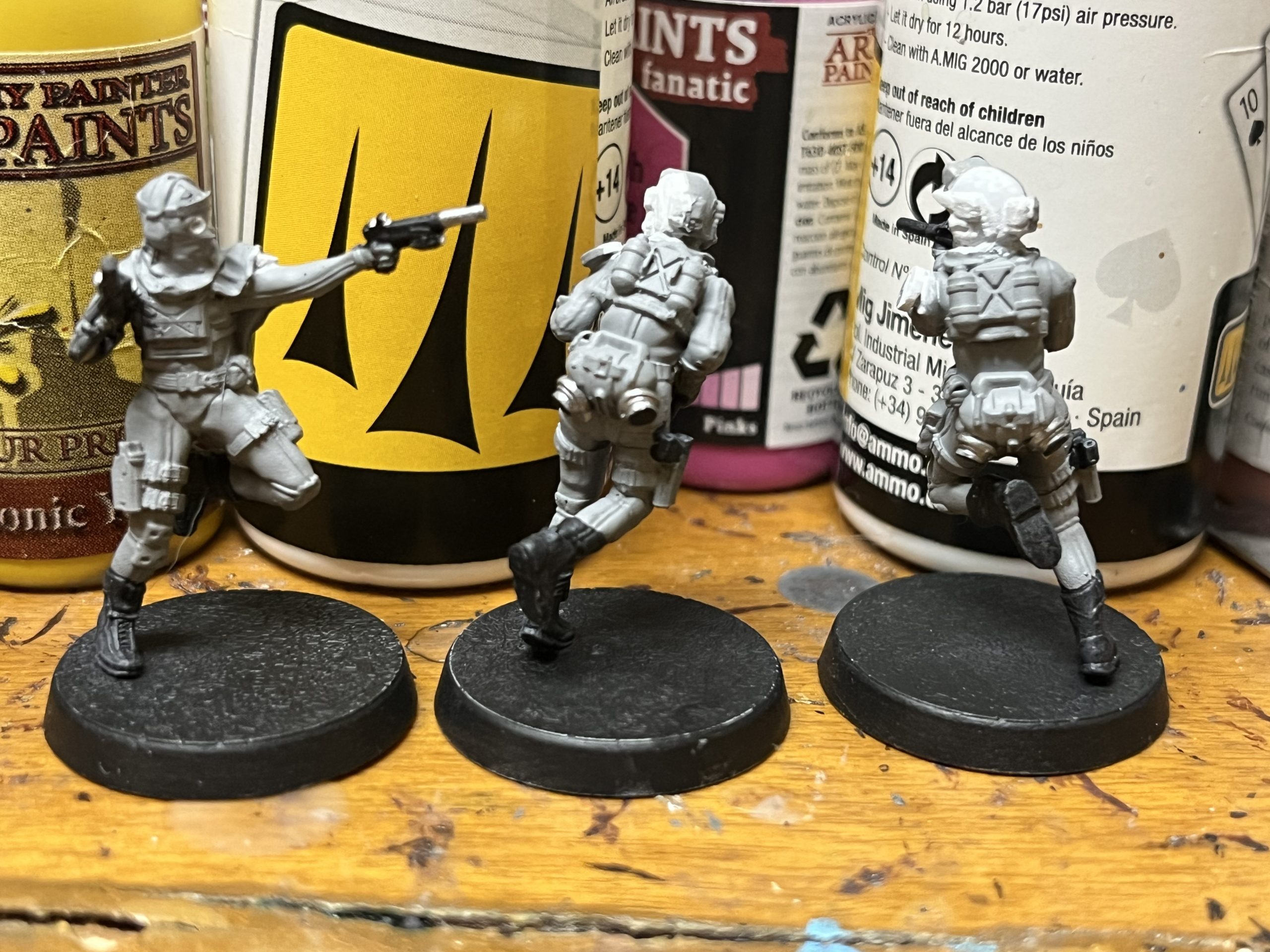 I used some Army Painter Plate Mail Metal for the jump jet exhausts and the pistol silencer.
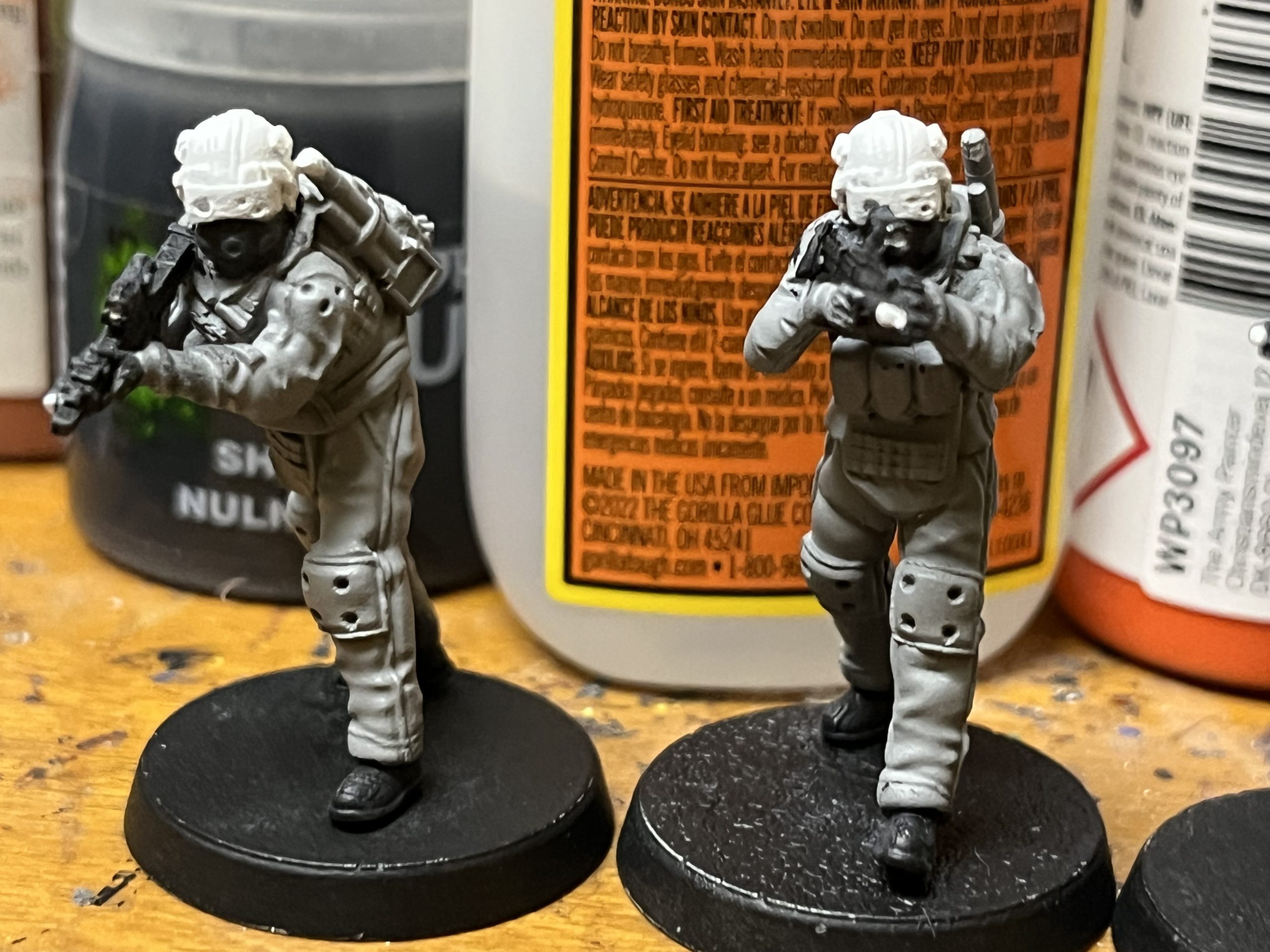 I went back and painted over the Ash Grey visors with Matt White in order to provide greater contrast with the filters and face masks. This also aligns with the original artwork where the visor and helmet were all one color.
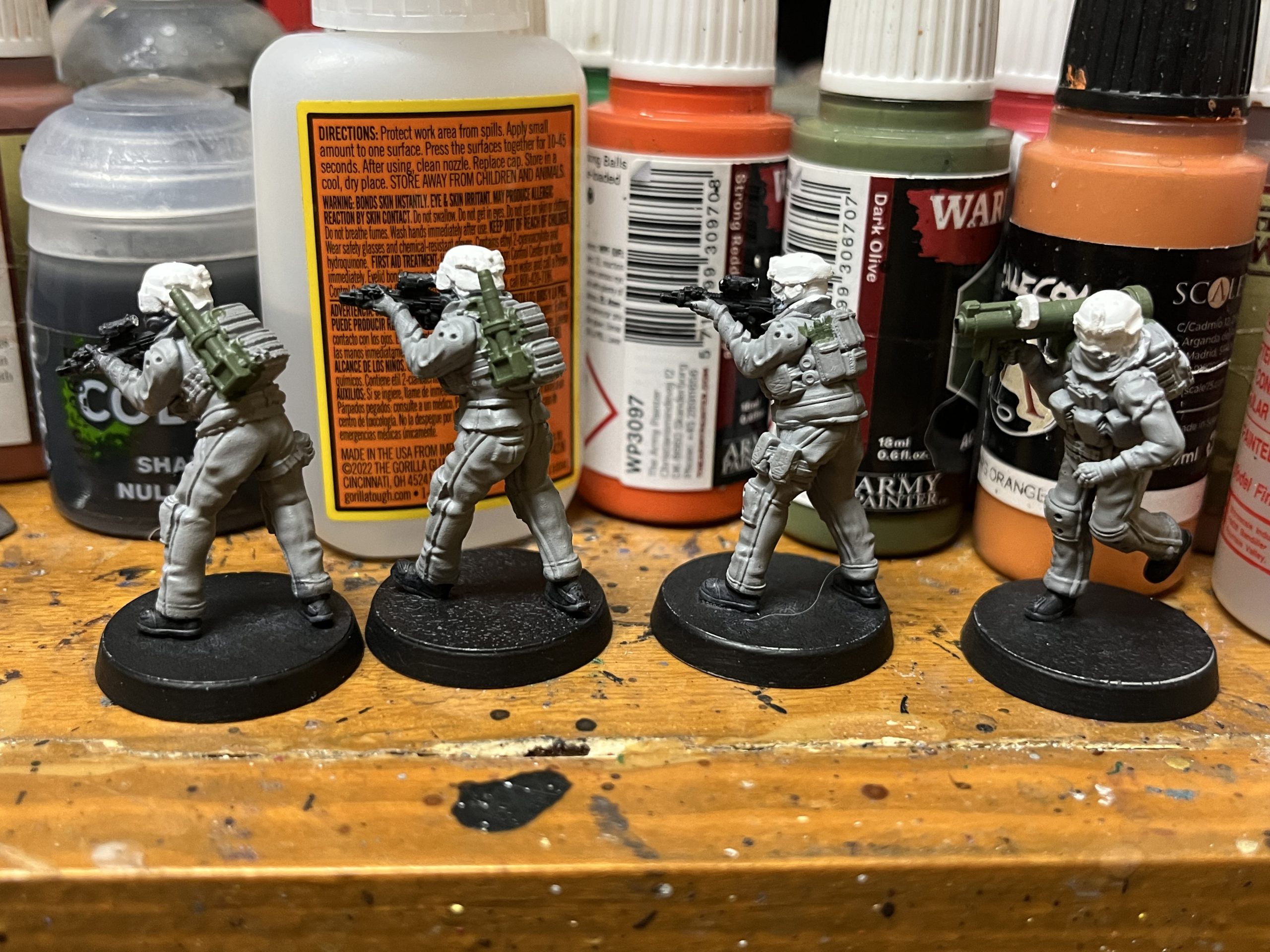 I painted the radios and recoilless rifle Army Painter Woodland Camouflage.
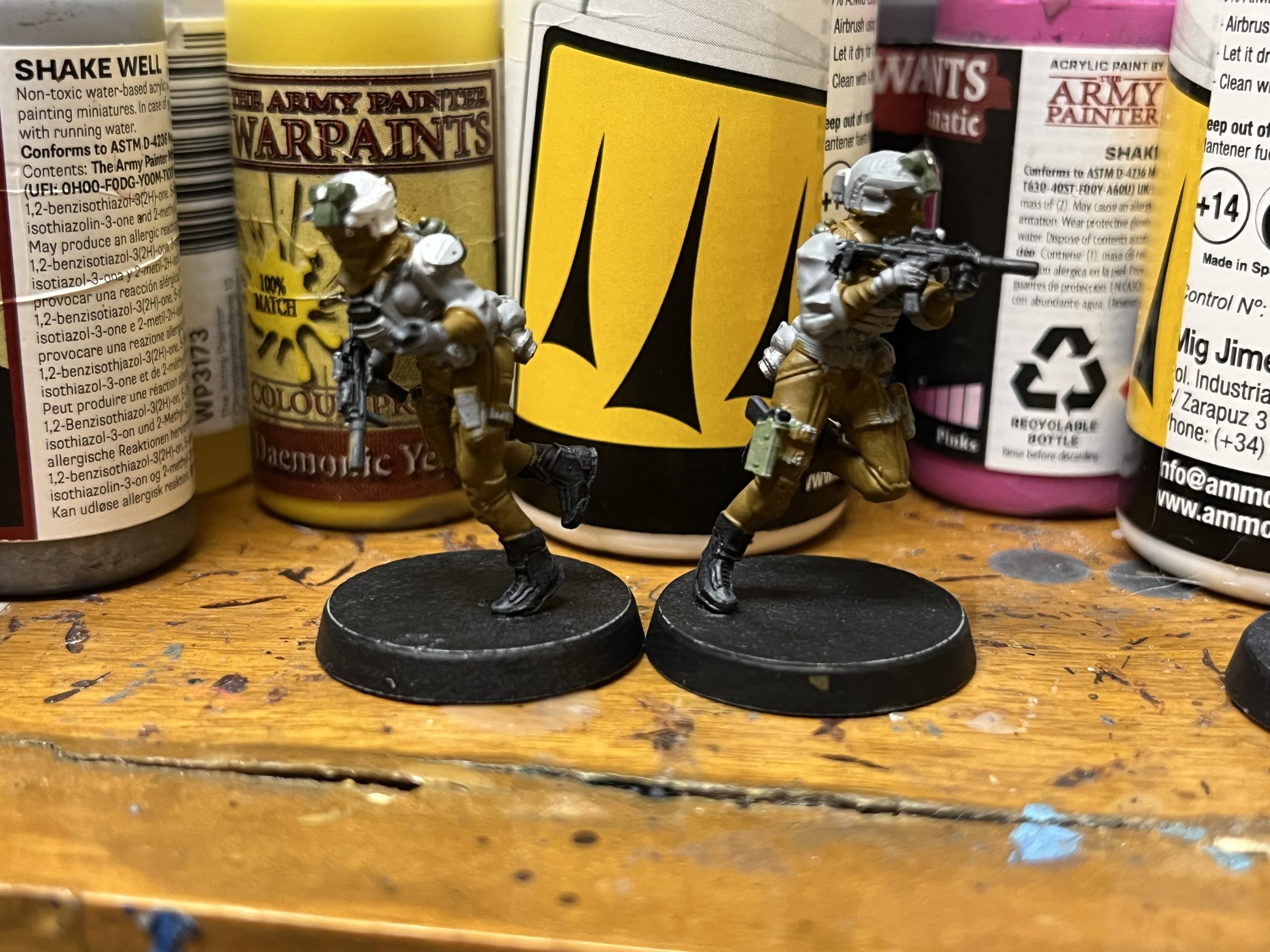 Night vision goggles were also painted Woodland Camouflage, web gear was painted with AP Necrotic Green and the pistol holsters were painted with AP Camouflage Green. Shirts and pants were painted with Vallejo British Uniform.
Group Shot
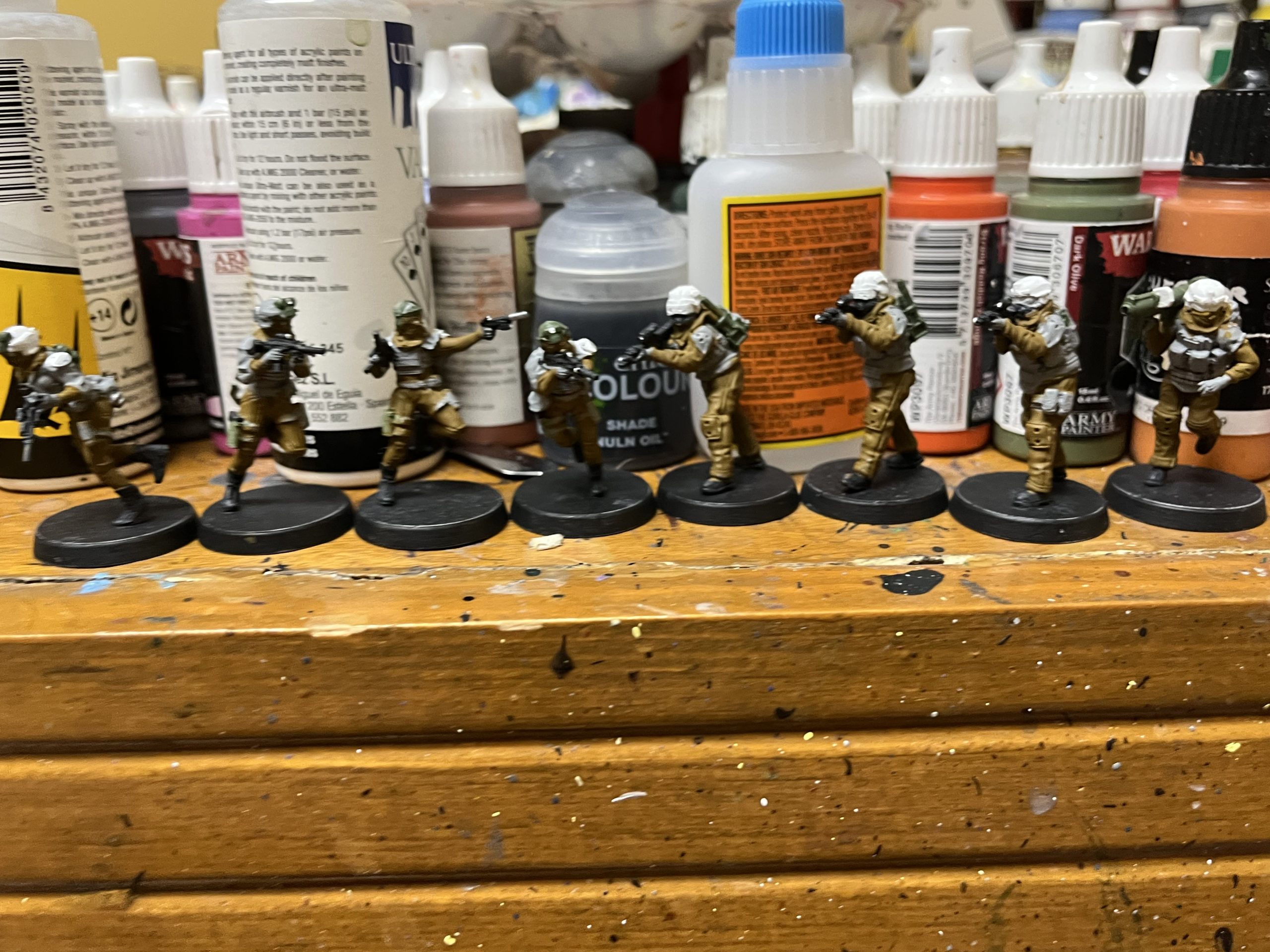 Everyone to date. The general scheme is starting to evolve. The bits that are still light gray are the remaining areas to be finished.