








Persei-Aries War – Oriskany v. Rasmus




Recommendations: 1421
About the Project
After racking up 127 entries, 3500+ recommendations, and 600+ comments, the original Darkstar project thread was getting a little unwieldy. So I'm starting a new one, featuring a new campaign for interested players in the OTT community and beyond. So far we have five players, but there's always room for more!
Ever wonder if you had what it took to command fleet of starships in tactical combat? Darkstar offers that challenge to the hard-core wargamer, with a "Newtonian Physics" movement system, rules for astrophysical objects and phenomena, gravity, and of course dizzying amounts of 26th-century firepower. There are no aliens, no "hyperspace," no planets that look suspiciously like movie studio back lots. Just the old empires of Earth doing what they do best, colonization and kicking the hell out of anyone who gets in their way (i.e., each other).
In addition to starship tactical combat, Darkstar includes rules for carriers and aerospace craft, atmospheric operations, orbital and surface installations, boarding actions, assault landings, and a complete campaign system.
The system is free to download for members of the OTT community, and of course we play almost every weekend with a on-line version with starship commanders around the world! So if you ever want in, you know where to find us!
Related Genre: Science Fiction
This Project is Active
Arab League Joins the War!
FROM: UNITED NATIONS REGIONAL COLONIAL CENTER
18:50 SOL GMT, 02 FEBRUARY 2521
BREAKAUTH: 181072.18J
CLEARANCE: SECRET (NATIONAL)
**UNITED NATIONS COMMUNIQUE**
The Third Hercules War continues to expand as a new faction joins the conflict, cutting into a star system recently abandoned by the defeated Black Dragons of the Khitan-Tunguska Free State and staking a claim along the frontier boundaries of the Hercules Rim.
After two disastrous raids against naval forces and colonies of the United States and Indian Republic, the Black Dragons have effectively been driven out of the war. Fearing retaliation by strong “Coalition of Eagle” forces (United States, Holy Russian Empire, Indian Republic, Corporate Consortium), the Black Dragons abandoned their Khaizan’s Haven colonies at the remote 14 Hercules star system.
This opened a tremendous opportunity for the Coalition of Eagles. Note that two of their major factions (the United States and the Indian Republic) are on the far spinward (“west”) arc of the Hercules Rim warzone, along the border regions with the neighboring Lyra constellation. Having a foothold at 14 Hercules, however (as remote as this might be) would allow the Coalition to apply pressure from both spinward and coreward sides of the Hercules Rim, squeezing the British and Japanese of the “Renkei Alliance” between them. Until now, the only real coreward foothold the Coalition has had in the Hercules Rim has been the Russian Krasnaya Nadhezda colony at 72 Hercules, which is probably why the British and Japanese have hit it three times.
Needless to say, when Indian and American naval forces drive the Black Dragons out of the conflict, they leap immediately to occupy the abandoned Black Dragon colonies at 14 Hercules. But the American Navy stands 60 light-years away at Vega (Alpha Lyra). Only their “Battlegroup Oriskany” can cover that distance fast enough and after two hard-fought battles their ships remain under repair. Indian Navy forces in the Bhogavati colonies at HD 176051 lack the sheer weight for that kind of power projection as of yet. So it falls to the Russians to exploit this opportunity, sending a heavy cruiser battlegroup out of Krasnaya Nadhezda up to 14 Hercules, built around the Slava class heavy cruiser Bagration.
This is a bold move, to say the least. The 14 Hercules system lies at least 10 light-years deep into the “Third Band,” the sparsely-colonized frontier of Known Space. Navies often have warships out this far, but almost never as heavy as the Bagration. This is one of the largest warships to venture this far from Sol, a clear indication of how much the Holy Russian Empire wants this 14 Hercules system.
They are not alone, however. A new faction has been lurking in the wings – with hidden sensors ships, fighter sweeps, and listening posts scattered across the outer systems of the Hercules Rim. This is the Arab League, and they already have a battlegroup in 14 Hercules as well. Last of the Ten Powers to make the leap into interstellar space, the League was forced to set up most of its initial colonies much further out from Sol than the other powers. Naturally, the league remains ever-keen to cut “a homeward path,” establishing new colonies closer to the Earth to mitigate shipping, transit, and tariff costs from their rich frontier colonies back to their terrestrial home nations. The 14 Hercules system presents just such an opportunity.
In early February 2521, an Arab League battlegroup under Captain Rashid al-Maghrebi meets the Bagration and her escorts in the harsh glare of Hercules 14 Beta, second planet of the system, just 0.3 AU from the orange dwarf star. This is not a raid, but an assault in the heart of the system. The “last men standing” here will raise their flag in 14 Hercules, and claim the system for the foreseeable future.
Cruiser Assault into Inner Orbital Zone of Contested System - 14 Hercules (Khaizan’s Haven)
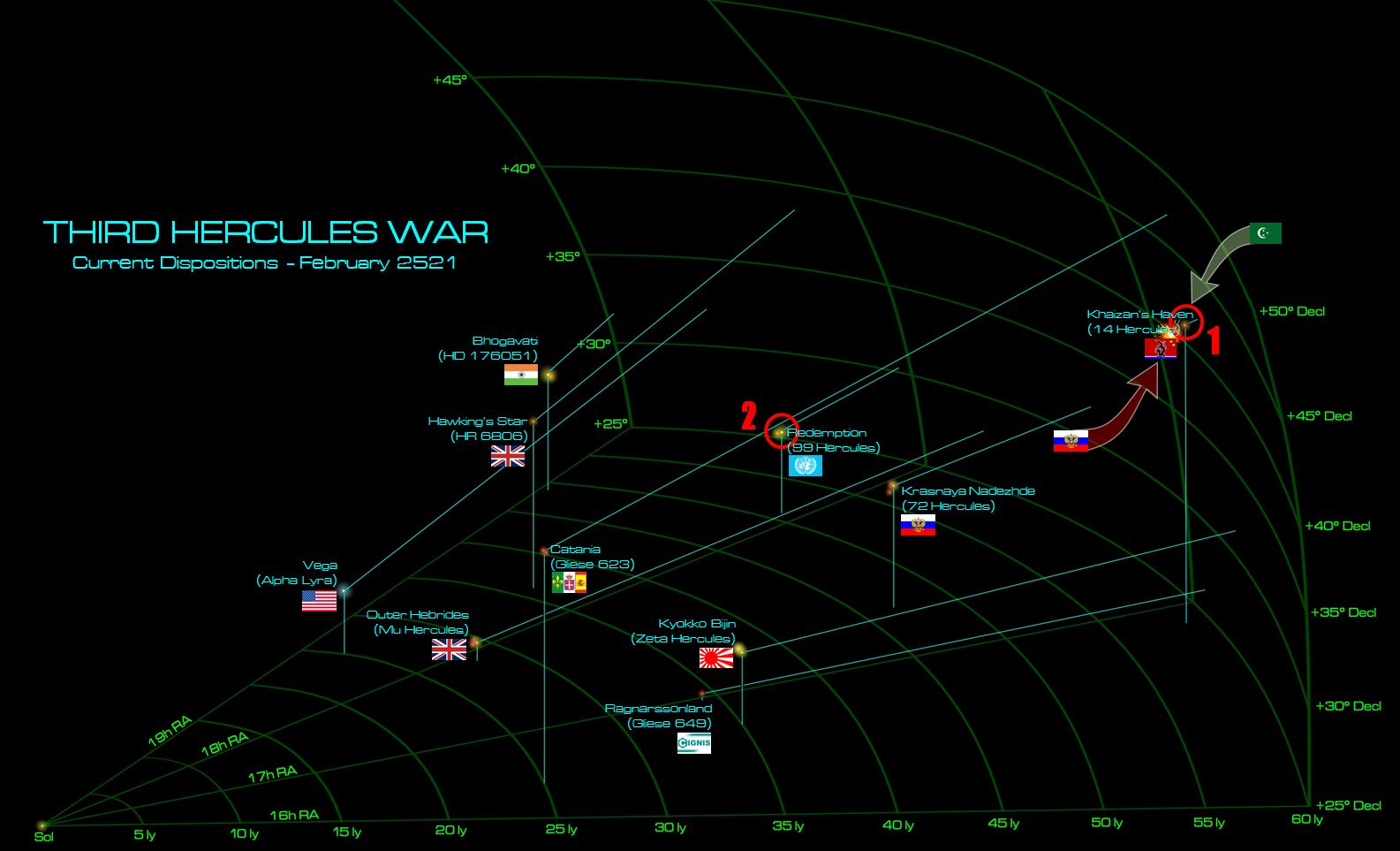 The current disposition of the Third Hercules War. At upper right, we see where the Black Dragons are OUT of the war, vacating their holdings at 14 Hercules (Khaizan’s Haven). The system is up from grabs, and the Holy Russian Empire wants to snatch and hold it ... at least long enough for their American and Indian Republic allies to arrive. But a new faction has been waiting for their moment to jump into this conflict and win a new colony closer to home ... the Arab League.
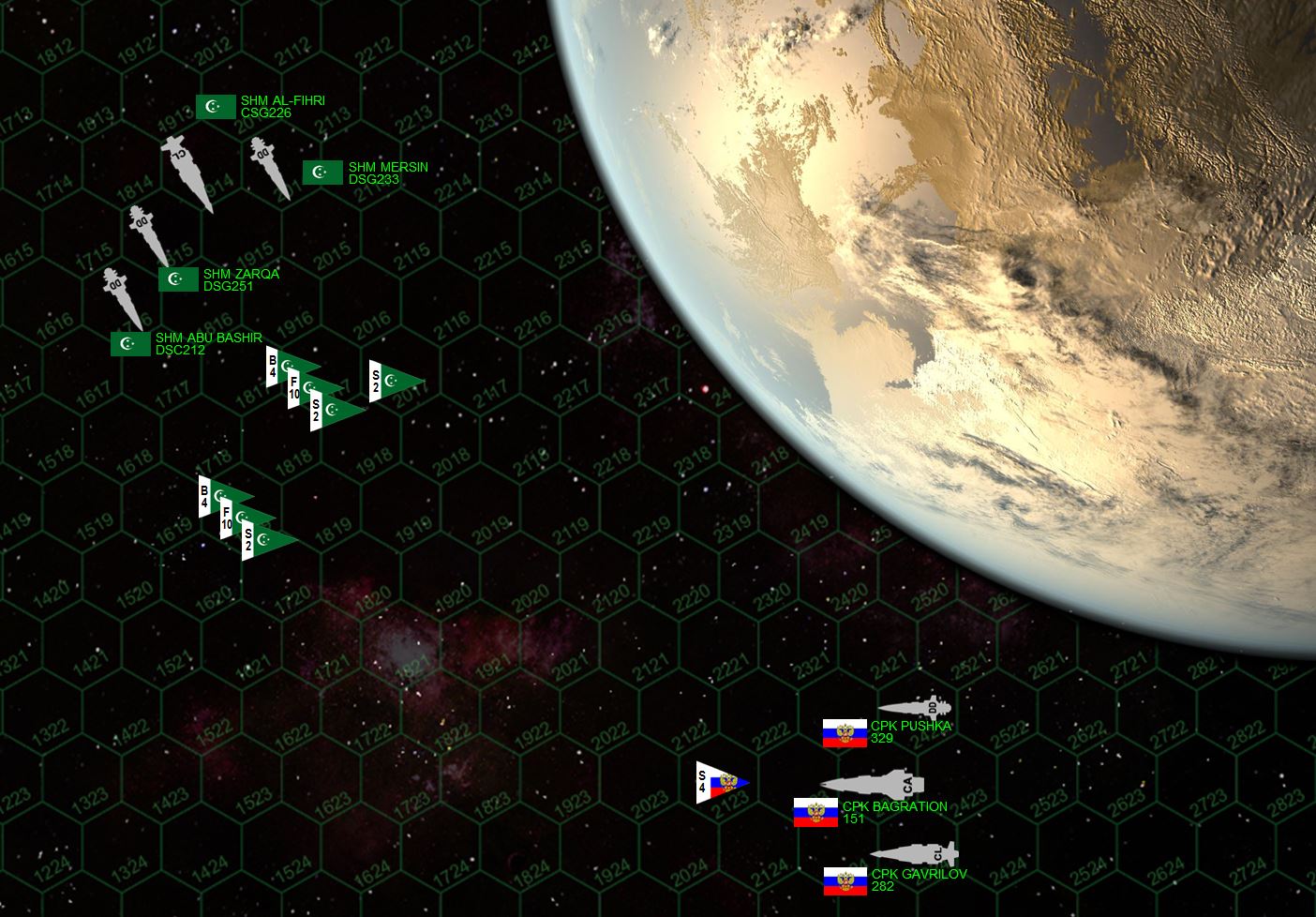 There is the matchup. The battle is 214 points. The Russian battlegroup is fairly straightforward, a gun-heavy cruiser group built around the Slava class heavy Cruiser Bagration, the Kutusov class light cruiser Gavrilov, and the Sovnya class destroyer Pushka. The Arab League’s battlegroup is, well ... unusual. But this is an unusual faction. The flagship is the Almanzor class hybrid cruiser Al Fihri, part light cruiser, part light fleet carrier. There are two Basra class destroyers (Zarqa and Mersin) and the Khalifa class light carrier Abu Bashir. Clearly, the Russians have a huge advantage is size, gunnery, and torpedoes, while the League will have to rely on speed, maneuverability, and above all ... their aerospace strike group.
 The Russians make a fast approach, pushing 36 kilometers per second and using the planet’s gravity to pull them even faster around the day side. The League battlegroup is far more cautious, setting a slow approach, vectoring away from the onrushing foe, all while launching “Mylekinir” (Fire Angel) fighters and “Demkikham” (Vengeance) bombers as quickly as possible from the bays of Al-Fihri and Abu Bashir.
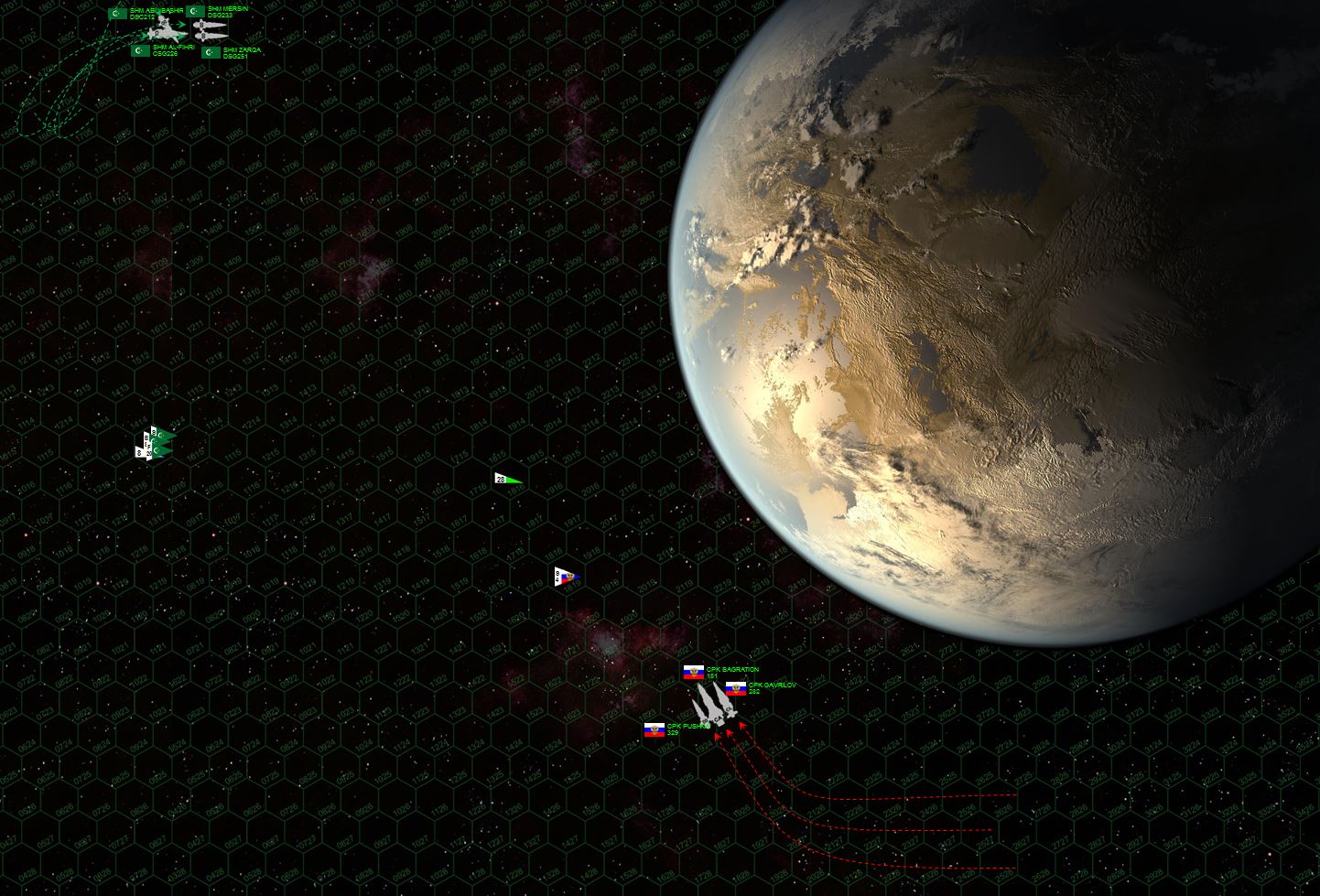 The League continues to deny battle, doubling back over their own wakes while the Russians gravity-pull around 14 Hercules Beta, full retros firing to slow to a proper engagement speed. The Russians want to close the distance as quickly as possible to make the most of their hideously-powerful batteries, but must balance this against the ponderous maneuverability of their heavier vessels, especially the 168,500-ton Bagration.
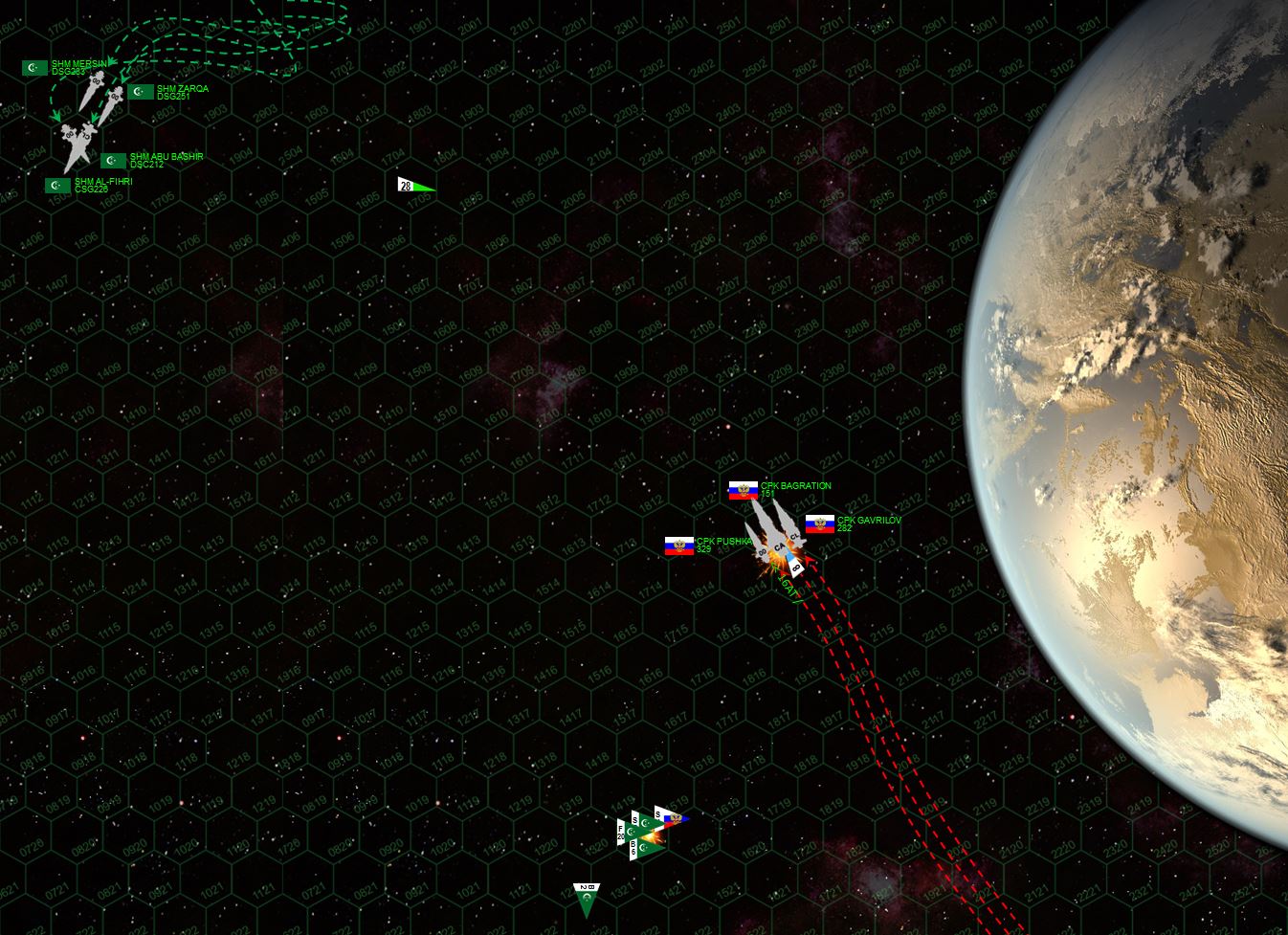 Forward Russian guns are pounding the destroyer Mersin (Commander Hayder al-Bayati), the range continues to spare the League from the worst of Russian wrath. Meanwhile, the League’s aerospace group has positioned itself for a massive strike (even if two bombers are knocked down by Russian scout planes), their aerospace torpedoes and missiles combining with the "Ahrasyfa" (Storm) warheads fired from the light carrier Abu Bashir. Russian mass drivers knock down most of it, and the powerful gravitic shielding of the Bagration absorbs still more. The strike seems like a disappointment, the Bagration shudders but does not fall dark, the fires and decompression damage in her engineering sections significant but manageable. For the League, however, there remains one grim satisfaction ... the Bagration’s aft shields have failed completely.
 While the League warships continue to hedge around the edge of the battlespace, the Russians kick their grav rudders hard to port and power straight up out of the planet’s gravity well, lunging at the Tsar’s enemies. Russian torpedo spreads, far more numerous but much slower than the League’s, have begun to land home on the Al Fihri, while gunnery continues to hammer at the Mersin. Things are bleak for the League here, the bombers and fighters too far from the carriers for immediate recovery, rearming, and launch for a second strike. Furthermore, just eight torpedoes from the Abu Bashir’s second spread can’t hope to get through the Russian mass drivers to score a hit on the mighty Bagration. But as fate would have it, the Russians don’t shoot down ALL of the torpedoes (d6 mass driver rolls for the three ships are 1, 1, and 2). One torpedo gets through ... sailing right through the nonexistent aft shielding, right through the gaping hole left by the previous strike, to detonates INSIDE the ship’s port reactor room. It’s still not enough to cripple the Bagration right away, but this amazing turn of luck has definitely put her in grievous peril.
 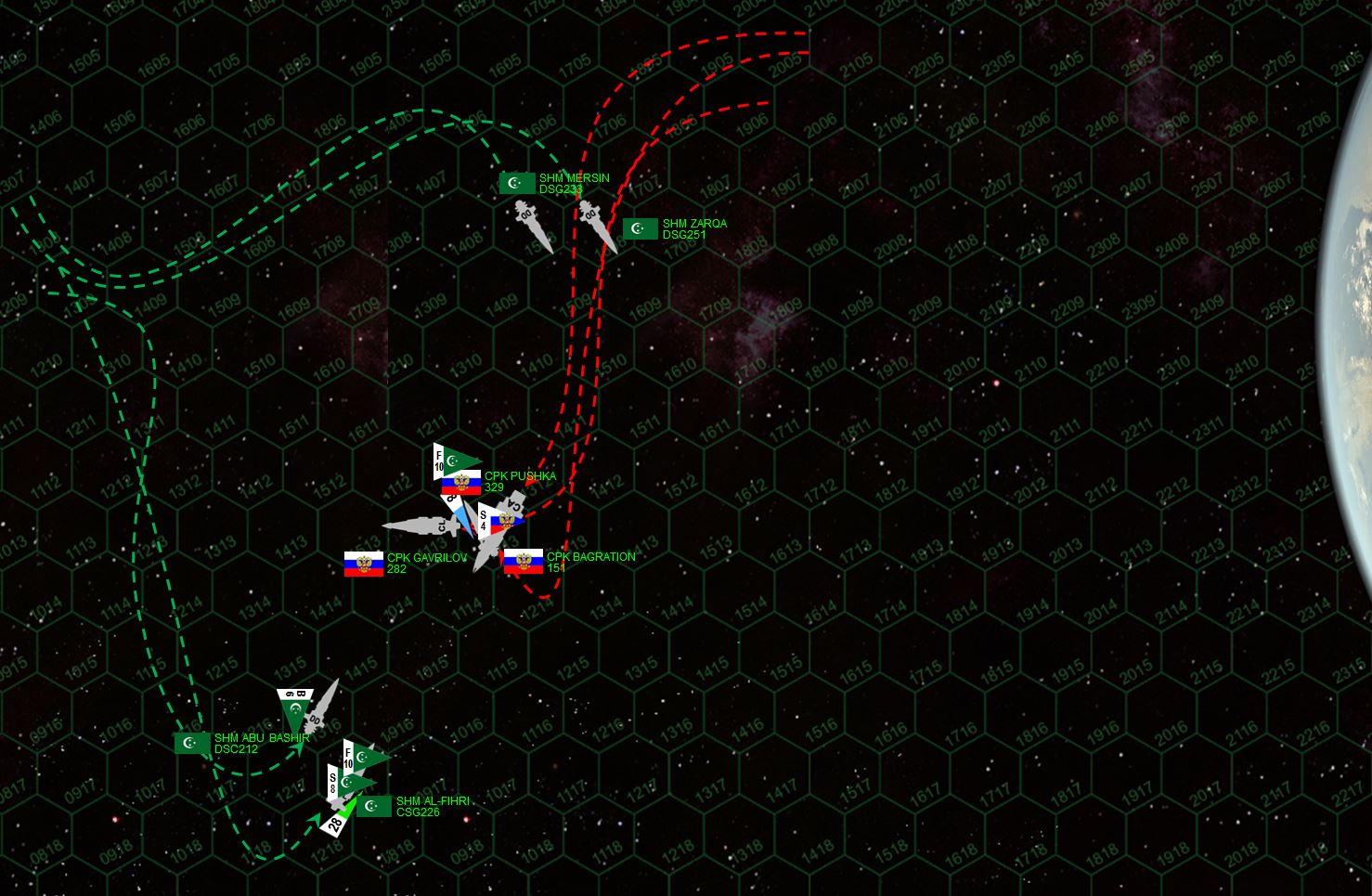 Perhaps shaken by the blow to his flagship, the Russian commander (Captain K. K. Malinovsky) hesitates (i.e., I generally lose initiative here). The Bagration dives toward her foes, while the more nimble League ships break to either side to swarm around the Russian behemoth. The Gavrilov and Pushka bravely stay with their flagship for gunfire support and mass driver defense, the two battlegroups exchanging fire now at just 500 kilometers (3 and 4 hexes). At this range, the power of Russian rail guns, EPCs, and plasma projectors begins to tell, and the Mersin and Abu Bashir take hideous damage. In particular, the Abu Bashir’s fo’c’sle is completely burned off, her forward magazines going up, her bridge hit, all forward hangars wiped out, all torpedoes gone, all forward mass driver turrets ripped away. The core of the ship is torn open, and crew casualties are extreme. Even the newly landed bombers that just docked in the AFT landing bay are not completely unscathed. The Abu Bashir HAS to break off, her skipper (Commander Esmat Jazayeri) hoping to stay in the battle area just long enough to rearm the fleet’s surviving bombers for a decisive second strike.
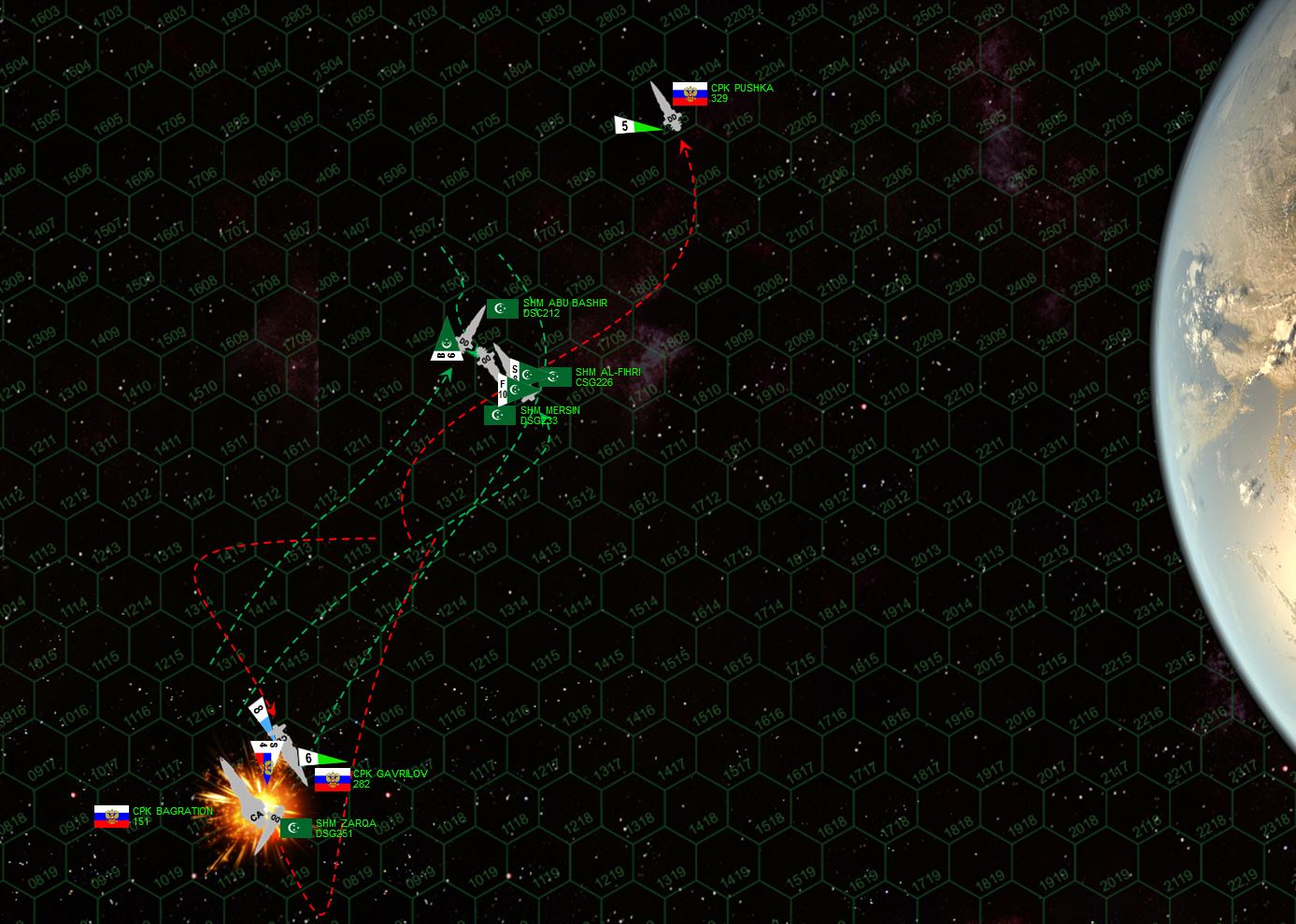 The Battle of 14 Hercules hits a horrific climax. Like a wounded bear, the Bagration lumbers out of the crossfire, trying to keep her fatally-damaged stern away from enemy guns. She succeeds in this admirably. In fact, the only way the League can get to this vulnerability is to send the Basra-class destroyer Zarqa, just 46,700 tons, in a high speed dive straight across the Bagration’s stern. Distance, speed, and geometry means that she has to do this alone (the Mersin has maneuvering thruster damage), and she has to cut this turn to close that she all but collides with the Russian heavy cruiser, putting a point-blank broadside into the Bagration’s ravaged stern at the suicidal distance of just 50 kilometers. The Zarqa reels as she makes her approach, the aft guns of the Bagration ... AND the full broadside of the Gavrilov ... putting up a desperate, cruel counterbarrage that all but rips the ship in half. For the record, in these sixty unbelievable seconds the Zarqa is fighting over SIX TIMES her weight in warships here, AND shoots down all four Russian scout planes. But the Zarqa maintains power just long enough to fire her own broadside. Not only is the Bagration crippled, she actually EXPLODES in a titanic explosion. The blastwave finishes the Zarqa herself, and rips off almost all the armor from the Gavrilov’s fo’c’sle and starboard bow. Well over four hundred people on both sides are killed here, but the Zarqa’s captain, Commander Yasminah al-Qadiri, has - at a stroke – turned the battle for the Arab League.
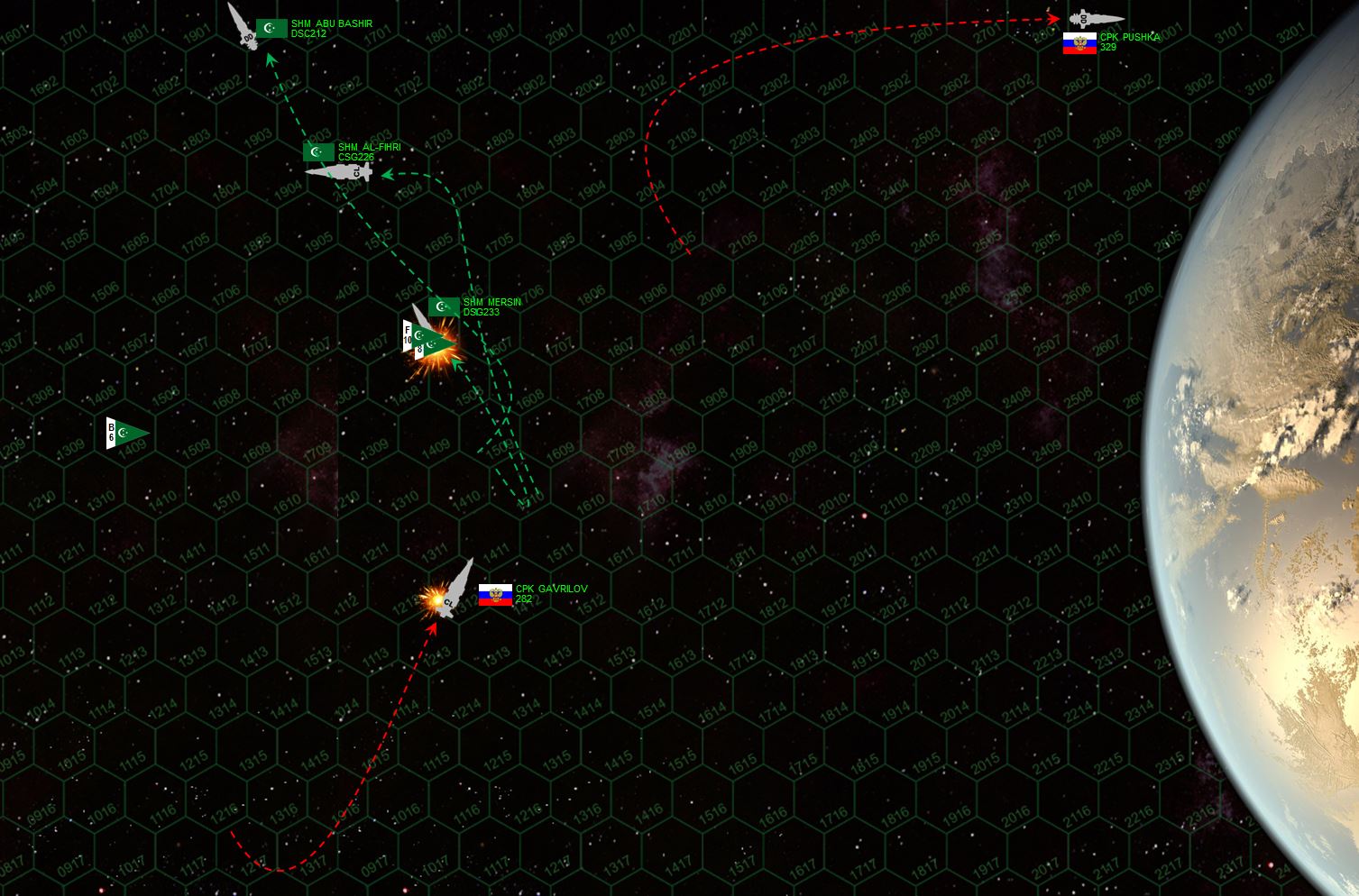 At last the bloodbath begins to wind down. The Abu Bashir has remained operational just long enough to launch her six remaining bombers which has put a torpedo strike into the port quarter of the Gavrilov. The Pushka has also been forced to break off, trying to stay in the battle area just long enough for her torpedoes hit slam home into the stern of the Al Fihri. While the League flagship has lost her entire port engine, she remains operation and continues scoring the Gavrilov with accurate laser fire. With the Bagration exploded and the Pusha fleeing for her life, the light cruiser Gavrilov stands alone. She’s missing huge amounts of armor and has significant systems damage (mass drivers, sensors, maneuvering thrusters) but remains a threat. But it’s not enough. The Mersin miraculously survives, which when combined with the Al Fihri and the remaining fighters and bombers (ten fighters are lost, two bombers), means the Arab League has won this fight.
So that’s it. The score is 90 to 70, an Arab League victory, and enough to claim the 14 Hercules system as a new colony for the League. This is the first defeat the Russians have suffered in the Third Hercules War, and means the Coalition of Eagles will not be able to strike easily from both sides of the Hercules Rim. While the Coalition of Eagles are, on the balance, still winning this war (especially the Russians), the British and Japanese now have a new partner in the Renkei Alliance. The Bagration is gone forever, and so is the Zarqa (judged a total loss and scuttled after the battle). Her skipper, Commander Yasminah al-Qadiri, has survived however, and will take command of a new vessel.
Congrats to @Muakhah on his first Darkstar win!
One Faction Blown Clean Out Of The War!
FROM: UNITED NATIONS REGIONAL COLONIAL CENTER
09:10 SOL GMT, 18 JANUARY 2521
BREAKAUTH: 181072.18J
CLEARANCE: SECRET (NATIONAL)
**UNITED NATIONS COMMUNIQUE**
Developments from the Third Hercules War continue at an ever-faster pace. Just over a week ago, the so-called “Black Dragon” rebels of the self-proclaimed Khitan-Tunguska Free State entered the war from their remove base at Khaizan’s Haven (14 Hercules). They raided the US Navy Base at Port Halsey in the Vega Colony (Alpha Lyra), where their small corvette force was interdicted by the destroyer USS Oriskany. Even while this Black Dragon corvette force was en route, however, a second Black Dragon battlegroup, centered around the Kutusov class light cruiser KTS Chelvnya, had already jumped into a Darkstar wave en route the United Nations mandate in the Redemption (99 Hercules) star system.
There are no American colonies to attack in the Redemption system (in fact this is one of the bones of contention for the Americans in this war), but the Black Dragons were instead targeting potential American allies, the Republic of India and its colony at Svarbageecha (Garden of Heaven), a roughly Venus-sized planet 2.5 AU out from the 99 Her A, the primary F-series main sequence star in this binary system.
India has, on paper, joined the “Coalition of Eagles” with the Americans and Holy Russian Empire against the British and Japanese. However, no military actions have yet been taken by the Indian Navy. That’s about to change as the Black Dragon battlegroup drops out of its Darkstar wave and vectors toward Svarbageecha. Indian naval presence in this system isn’t very powerful, but the two Surat class destroyers and two Asura class frigates available come to general quarters and accelerate into high-speed parabolic orbit of Svarbageecha to intercept the foe.
Why the Black Dragons are attacking the Indians can’t be known for sure. But clearly their campaign against the Americans and Indians (or their entry into the Third Hercules War in general) seems to be designs on the main Indian holding in the region, the Bhogavati Colonies at the HD 176051 system. If India is forced out of the war by the British and the Japanese, and the Black Dragons find themselves on the winning side of the broader conflict, perhaps this “stateless faction” can push for a planet or two in Bhogavati in the peace settlement, thus earning more “bedrock real estate” along the outer Second Band and Frontier regions of Known Space.
Destroyer Interdiction of Cruiser Raid – Svarbageecha Colony, Redemption (99 Hercules) System
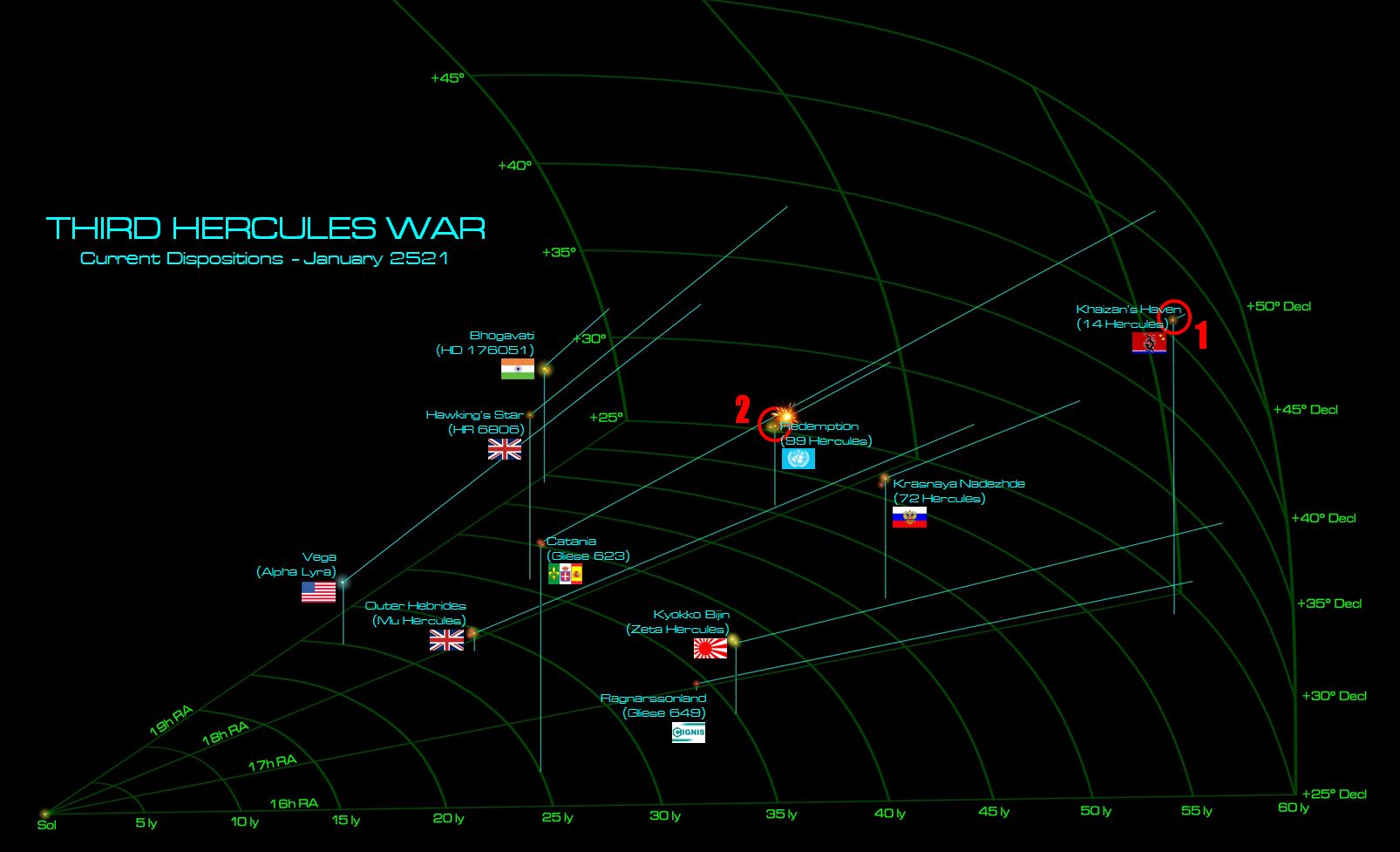 The current state of the Third Hercules War. Again, the Black Dragons, launching sorties out of the “Khaizan’s Haven” holdings at 14 Hercules (“1”) have already failed in a long-range raid against the Americans at the Alpha Lyra colony (Vega, far left). Now, just eight days later, another light cruiser battlegroup has engaged against the Indian Republic at the Redemption UN Mandate (99 Hercules, “2”). It is doubtful whether this second Black Dragon battlegroup even knows what happened at Vega, given the distance between the two systems (28 light-years) and the fact that this second group just spent 21 days in a Darkstar wave en route from 14 Hercules.
 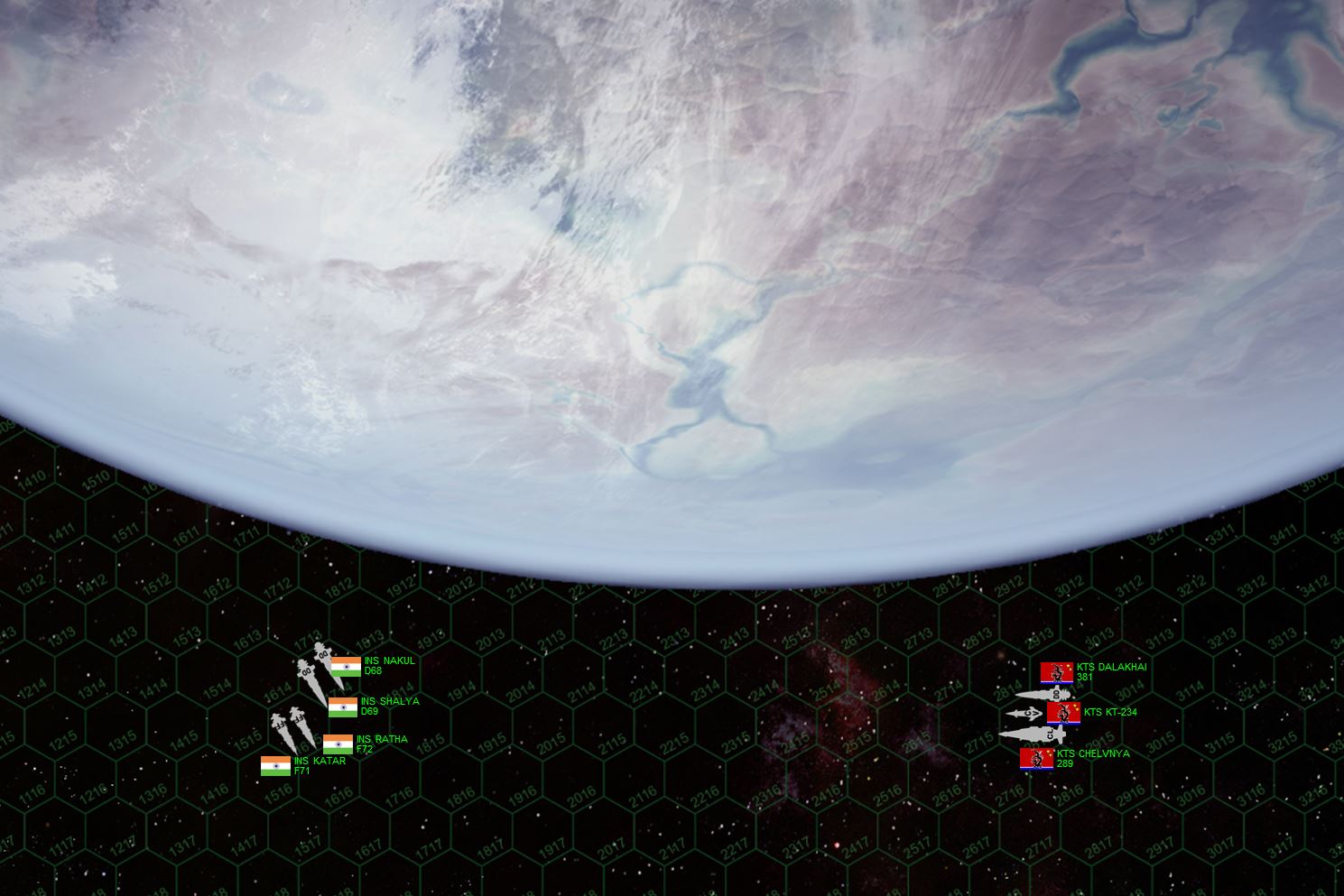 Here is the matchup. We have two Indian Surat-class destroyers and two Asura-class frigates up against a Kutusov-class light cruiser, a Sovnya class destroyer, and a K-56 class torpedo corvette. These three ex-Russian ships and their combat capabilities will be well-known to those who follow Darkstar, but these Indian Republic ships haven’t been on the table since late 2012 (IK Pegasi War). Let’s see how they do! This is a 126-point battle, classified as a “Small Engagement” on the Darkstar Campaign Tables.
 Both battlegroups make their approach. Everyone’s ships are drifting toward he planet slightly (normal terrestrial gravity rules apply). The laser-heavy Indian Navy ships are setting up for a port broadside, while the Black Dragons hope to knock the odds one step in their favor with a wave of 28 P-500 “Plamya” (Flame) Class III torpedoes. Hence they make sure to point directly at the enemy, so both port and starboard bow torpedo racks (and associated targeting systems) can come to bear. The Indians open fire and score no hits (range is still 4500 kilometers at this point), whereas the Black Dragons have no weapons that can reach at all.
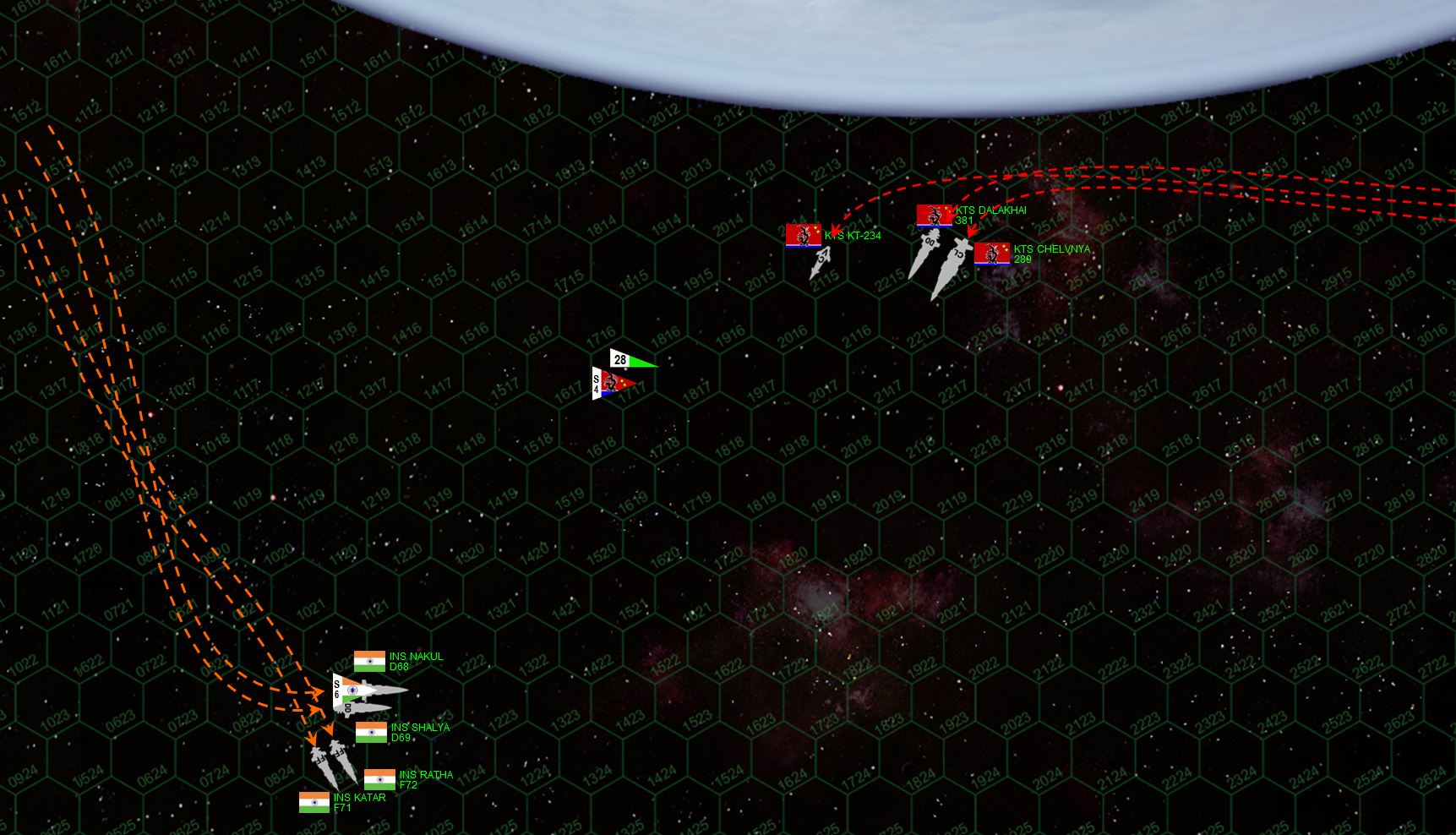 Still being pulled toward the upper atmosphere of Svarbageecha, the Black Dragons turn to port, maintaining torpedo arcs on the Indian warships as they turn lard to starboard, vectoring out of the planet’s immediate gravity well. Their destroyers have lost their broadsides, while the swifter Asura-class frigates maneuver to maintain full gunnery batteries on the approaching foe. Much closer now, the two sides finally start landing blows on each other (Black Dragon rail guns and EPCs and longer-ranged Indian lasers), the destroyers Nakul and Dalakhai taking the worst of it.
 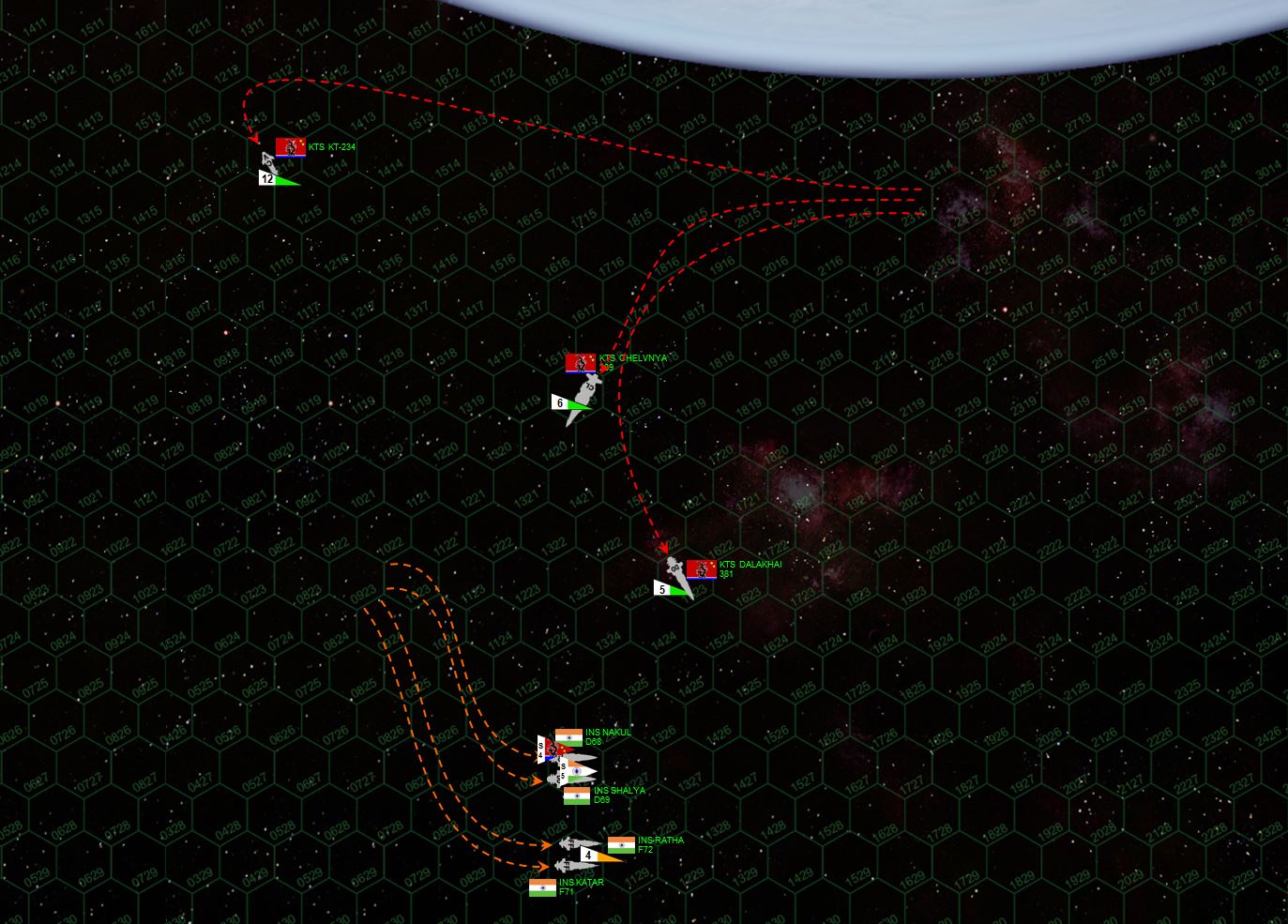 At last the Black Dragon torpedo wave hits, heavily damaged but failing to cripple the Indian destroyer Nakul. This is due in no small part to excellent Indian mass driver point-defense guns, which shot down the vast majority of the Black Dragon torpedoes. The Black Dragons have become perhaps a little too aggressive here, with the cruiser Chelvnya lunging at the Indians too soon, the Indians maneuvering clear, then the destroyer Dalakhai pivoting to put a close-range broadside against the Indians. All the while, the torpedo corvette KT-234 maneuvers to a safe distance to continue showering the Indians with torpedo volleys. The problem is that the Black Dragons are now badly divided, and while the Dalakhai indeed as a broadside on Nakul, every Indian warship also has a broadside on her. The Nakul and Dalakhai are both hideously damaged, yet again ... neither warship is crippled.
 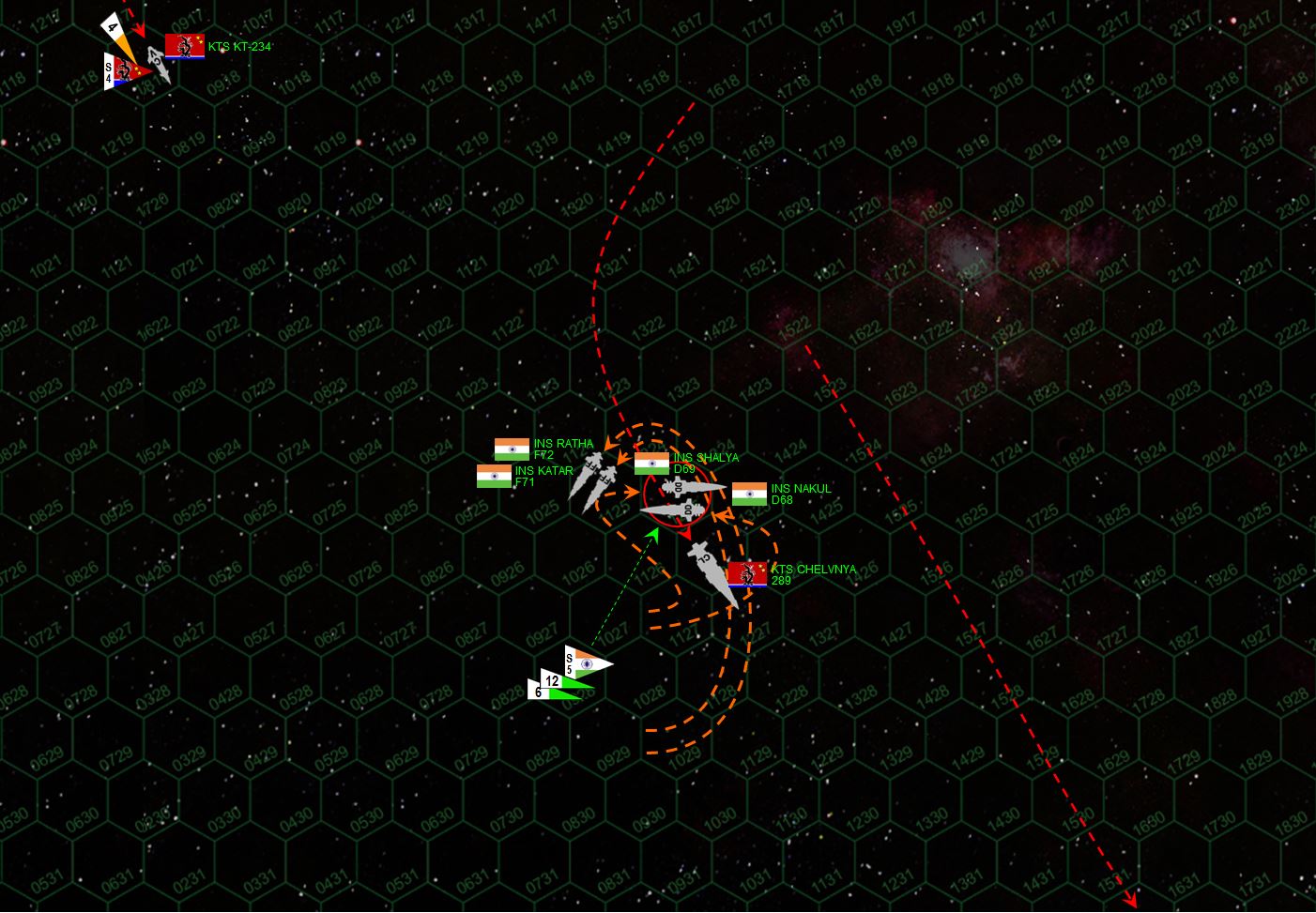 In view of heavy damage to the Dalakhai, the Black Dragons ELECT to get her clear of the battle area. She accelerates on a 150 heading off the table. She is still operational and not forced to “break off” – so there are no victory points for this to the Indian player. However, it does mean that the Dalakhai’s torpedoes, rail guns, and plasma projectors are now off the table as well. The Chelvnya dives at the Indians, who try to form something of a hedgehog against the incoming second wave of Black Dragon torpedoes. The Nakul, with badly-damaged maneuvering thrusters, struggles to make the required turns. A small Indian torpedo wave heads toward the KT-234. There are only a few torpedoes there, but even one hit is enough to heavily damage this small torpedo corvette. Meanwhile, the rapidly-imploding dogfight positively erupts in a series of point-blank broadsides. The slower Chelvnya has been outmaneuvered, and slashing Indian laser hits soon have her stern torn open and her engines and reactors powered down. Crippled and afire, she careens off the table, dead in space. Point-blank Black Dragon rail guns and EPCs, however, have burned open the Nakul to such an extent that the captain of this valiant destroyer is finally compelled to break off the action.
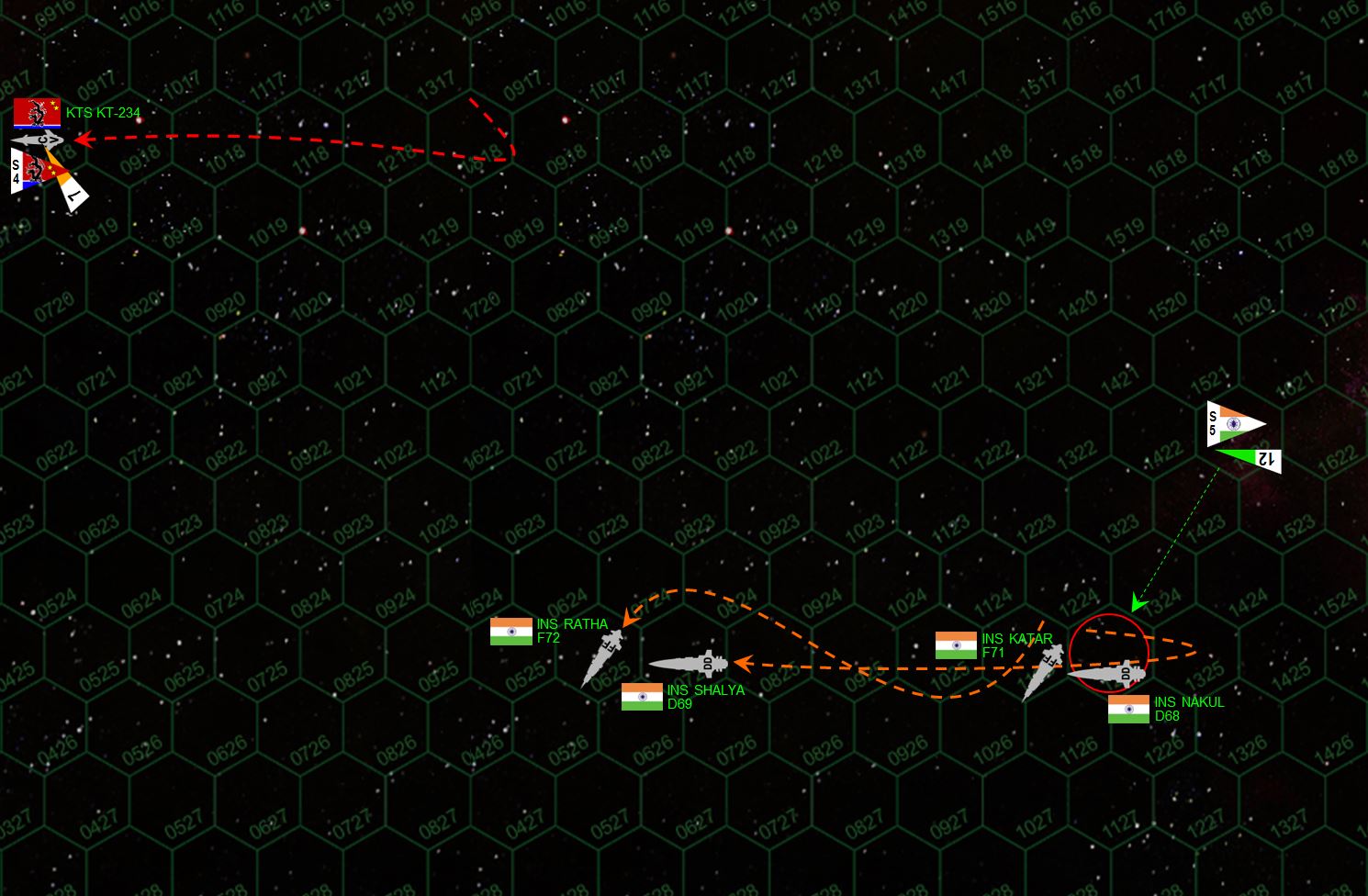 The Black Dragons are obviously, losing this battle. At the moment they are losing by 48 points, just enough to keep this as a “minor Indian victory” on the campaign tables (minor vs. major victory is determined by a 40% victory margin based off the beginning point levels of the game). Once the Indian victory margin goes to +50 points, that’s 40% of the 126 beginning total. The KT-234, the last Black Dragon ship on the table, pivots hard to escape. HOWEVER, she’s been damaged by Indian fire last turn, and as fate would have it, one of the systems hit on the tiny corvette is the maneuvering thrusters. KT-234 can turn to get off the table, she can accelerate to get off the table, but right now she can’t do BOTH. She throws her grav rudder hard to starboard and makes best speed out of the battle area, but she is ONE HEX shy of actually getting off the table. The Indians thus get one more crack at her. The KT-234 also throws a last spread of torpedoes at the Nakul ... if they can CRIPPLE her rather than DRIVE HER OFF, they get “full points” for the destroyer and will keep this a minor victory even if the KT-234 is crippled. As it turns out, both Black Dragon hopes fail. The Nakul and Katar shoot down ALL the Black Dragon torpedoes (even with the Nakul’s sensor damage), while the Ratha and Shalya land long-range laser fire through KT-234’s shields. The KT-234 is crippled, the Nakul is not (only half points for forcing a break-off), so the final score is 88 to 23, a +65 Indian win that now counts as a Major Victory.
 And that’s it. Indeed that maneuvering thruster aboard KT-234 has become a literal "horseshoe nail" that brought down a nation, at least in regards to the Third Hercules War. A MAJOR VICTORY on a Small Engagement is worth +4 campaign points. This, combined with the +2 campaign point victory won by the Americans last week, puts the Black Dragons at -6. Note that this EXCEEDS their “political commitment” (bottom row) for this war, limited to +/- 5. Therefore, the Black Dragons DROP OUT OF THE WAR. And the British and Japanese have LOST this unlikely, apparently unreliable, ally in the Third Hercules War. The Indians, meanwhile, may dropout of the war for al altogether different reason, they have tied their +/-4 political commitment (yes, different factions have different “levels of commitment” to any given conflict). With this one battle, have they met their government’s political and diplomatic goals for involvement in this war? They have it TIED, not EXCEEDED, so we may let them stay in for now (also, Damon might want to keep “working” on these new warships / captains / crews of his). But suffice it to say that the Indian Republic has landed a very heavy blow here, won huge prestige in the UN Mandate of 99 Hercules, knocked one enemy faction clean out of the war, and may be on the brink of receiving “ceasefire orders” as their government wins concessions from either the UN, their British foes, or their American allies.
So will another faction join the war in place of the Black Dragons? We have interest from other players, perhaps the Arab League may swoop in and join the British and Japanese of the Renkei Alliance, depending on what the British and Japanese offer them for their help. As Spock says in Star Trek VI … “In that case, Mister Chekov, it resides in the purview of the diplomats.”
Suffice it to say a major shakeup is in the works for the Third Hercules War.
New Faction Raids American Base at Alpha Lyra
FROM: UNITED NATIONS REGIONAL COLONIAL CENTER
15:45 SOL GMT, 10 JANUARY 2521
BREAKAUTH: 181072.18J
CLEARANCE: SECRET (NATIONAL)
**UNITED NATIONS COMMUNIQUE**
Reports continue to come in from the expanding Third Hercules War, where a new faction seems to have joined the rapidly-worsening conflict. On January 10, a light raiding force of the so-called “Black Dragons” of the self-proclaimed Khitan-Tunguska Free State engaged American forces in the extreme outer reaches of the Vega (Alpha Lyra) star system. Vega is the seat of the Jamison Colonies, a major United States holding in the neighboring Lyra constellation. As the Hercules War continues to heat up, American involvement in the conflict has been based solely out the Jamison Colonies, particularly the Port Halsey naval base.
The Americans have been moderately engaged in several confirmed battles thus far, both in the Russian-held Kransaya Nadhezda (Red Hope) colonies in the 72 Hercules system. The Americans are allied with the Holy Russian Empire in this conflict, having signed the so-called “Coalition of Eagles” accords at the Kayashenko Colony in the UN-chartered “Redemption” system last fall. The most recent of these battles saw the successful repulse of a British invasion effort at Krasnaya Nadhezda. One American warship, the destroyer USS Oriskany, was moderately damaged in this exchange, and set a fast magnitude 12 Darkstar wave back to Port Halsey after the engagement.
The Oriskany required six days of repair after returning (covering the 30 light-years from 72 Hercules in just 10 days). Repairs were completed on January 6, at which time Oriskany joined arriving units of “Task Force Liberty” carrier group, now building up at Alpha Lyra for several weeks.
On January 10, however, American aerospace patrols detected a force of Khitan-Tunguska torpedo corvettes in the extreme outer reaches of Alpha Lyra’s protoplanetary debris disk (Kuiper Belt). These “Black Dragon” rebels have been fighting an extremely brutal war against the Panasian Union and Holy Russian Empire for almost nine years now, and most analysts agree that the Black Dragons see any allies of the Holy Russian Empire as enemies. The Americans also fought two bitter campaigns against the Black Dragons in the recent Xi Scorpio and Scorpion’s Tail Wars, so this torpedo corvette squadron was immediately regarded as a threat.
The USS Oriskany (DSGN-797) was dispatched with orders to find and eliminate this squadron. With her enhanced electronic warfare, ion engine thrust, and Darkstar FTL drives, the Oriskany seemed to be the Navy’s best chance of finding these small, elusive ships as quickly as possible.
Unfortunately, the rest of Task Force Oriskany (destroyers USS Valley Forge, Princeton, light carrier Tarawa, and corvette Daggerfish) were still at 72 Hercules, so the Oriskany would have to tackle this mission alone.
Destroyer Sweep vs. Torpedo Corvette Hunter-Killers - Outer Debris Belt, Alpha Lyra (Vega)
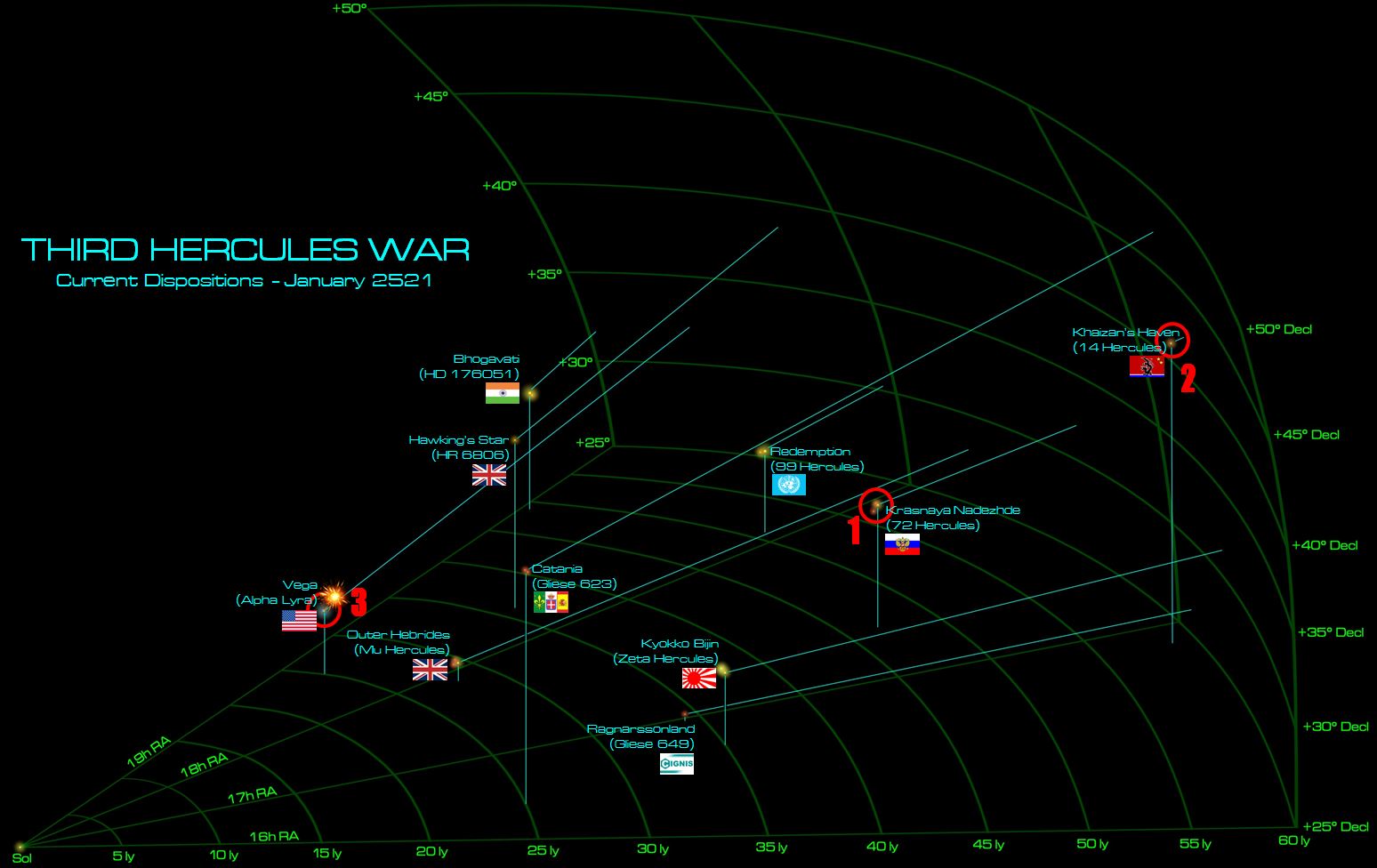 The current state of the Third Hercules War. We can see where most of the recent fighting has been taking place (“1”) at the embattled Russian colony at Krasnaya Nadhezda (72 Hercules). The Black Dragons that launched this incursion are thought to have come from Khaizan’s Haven at 14 Hercules (“2”), a staggering 60 light-years from the American base at Alpha Lyra (“3”). Even with their enhanced 11th-magnitude Darkstar drives, this would have taken at least a month.
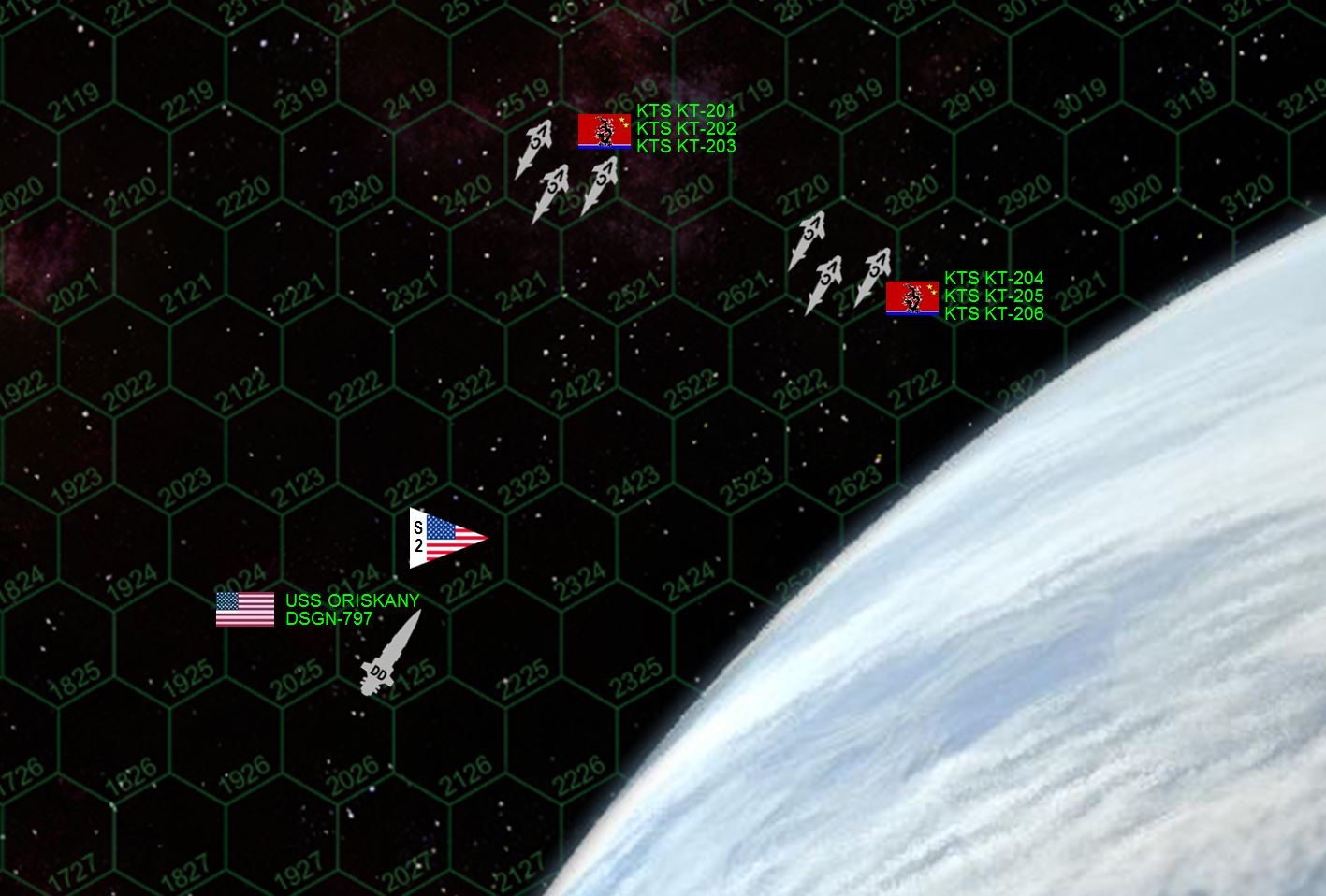 The matchup. Lately we’ve been working on a lot of playtesting for the new pricing model on the corvettes, making their cost in scenario points commensurate with their abilities on the table (especially in large numbers). I’m satisfied the playtesting has confirmed the new models as “fair” – so this battle will be “canon” in the timeline of the Third Hercules War. These are K-56 class torpedo corvettes, originally built for the Holy Russian Empire. Unfortunately, hundreds of Russian and Panasian warships were lost to the Khitan-Tunguska Free State when the Black Dragon revolt started in 2512. When you’re up against the Black Dragons, you’re usually up against Russian- or Chinese-built warships, often heavily modified or upgraded.
 The Oriskany drops out of a short, 4th-mag wave (x8 c) and soon detects the Black Dragon corvettes some 4.5 AU from her position. She lines up a second 1st-mag wave (the speed of light, very slow, very accurate, very hard to detect) and makes a second hop to engagement range. By how the Black Dragons have detected USS Oriskany’s approach as well, and pivot to engage. The battlespace is near a tiny dwarf planet and protoplanetary debris field, which the Black Dragons use to screen their initial approach. The Oriskany wins initiative, and vectors her approach to use the Black Dragons’ cover against them. Note the trailing three corvettes cannot see her, and so cannot launch torpedoes. The Oriskany launches Mark 48 gravitic torpedoes at the lead corvettes, as well as her two E/S-101 Hawkeye class scouts.
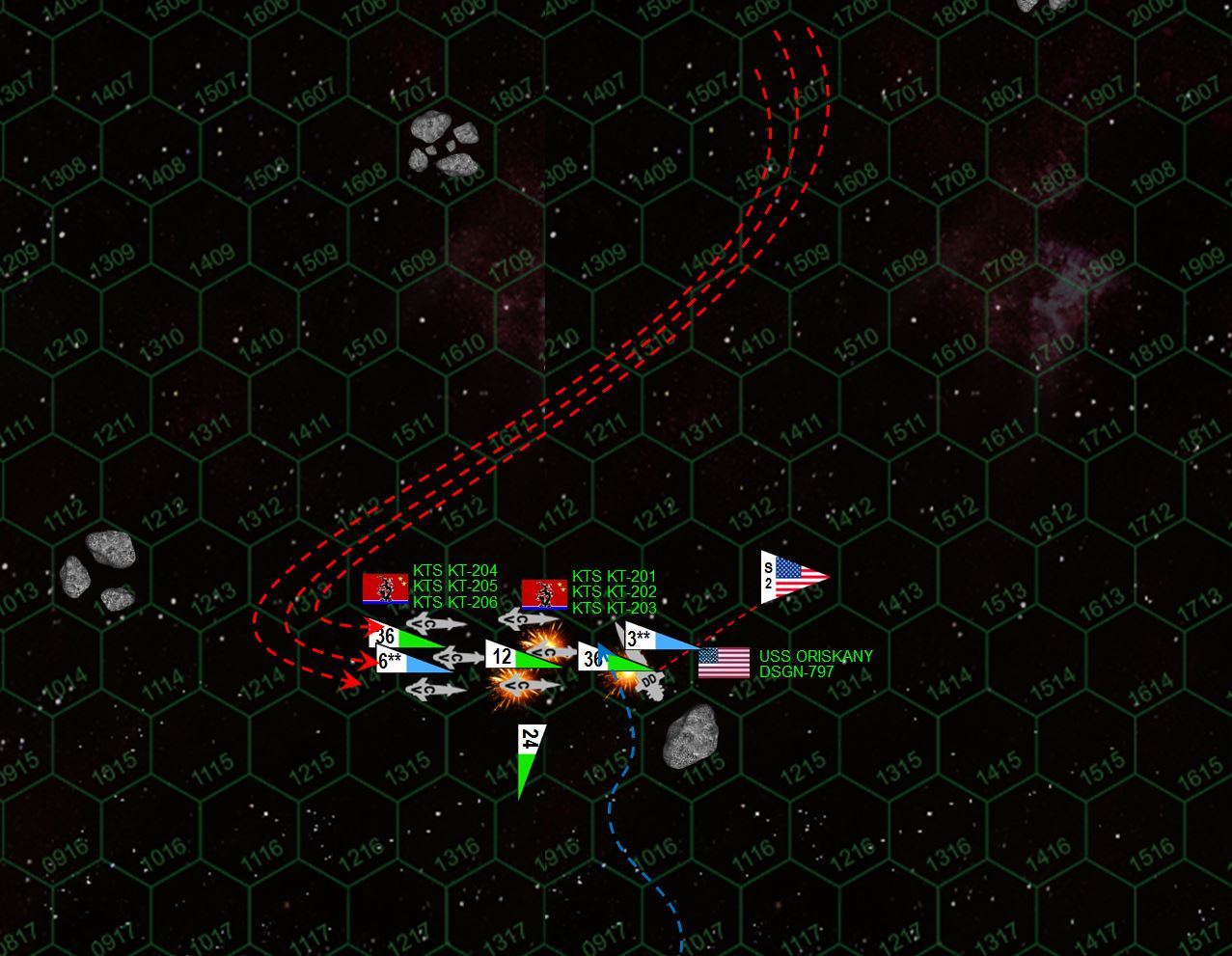 The Oriskany rushes the corvettes, but the Black Dragons anticipate the move. Although the Oriskany is able to use the asteroid in Hex 1115 to screen her stern, the corvette wolf pack rushes her port bow, clearly hoping to target her bridge and forward magazines. No less than 36 P-500 “Plamya” (Flame) warheads make their attack. Seven are shot down by Oriskany’s point-defense guns, one more by a scout. But the Oriskany’s gravitic shielding has been massively upgraded, as has her electronic warfare suites (in game terms she has an 8 shielding vs. torpedoes). Only two P-500s actually hit the ship, knocking out part of Oriskany’s sensor suite and maneuvering thrusters. Plasma guns (10kg caliber) open fire as well, doing even more damage than the torpedoes at this close range. The Oriskany has now lost her portside torpedo tubes. The Black Dragons, meanwhile, shoot down all of Oriskany’s torpedoes. Looks like she’ll have to do this the old fashioned way! A port broadside of 6-MgKv lasers and 5-GW rail guns cripples the KT-202 and KT-203, while KT-201 has her fo’c’sle all but torn off, losing both port and starboard torpedo tunes, her plasma “deck gun”, and forward maneuvering thrusters.
 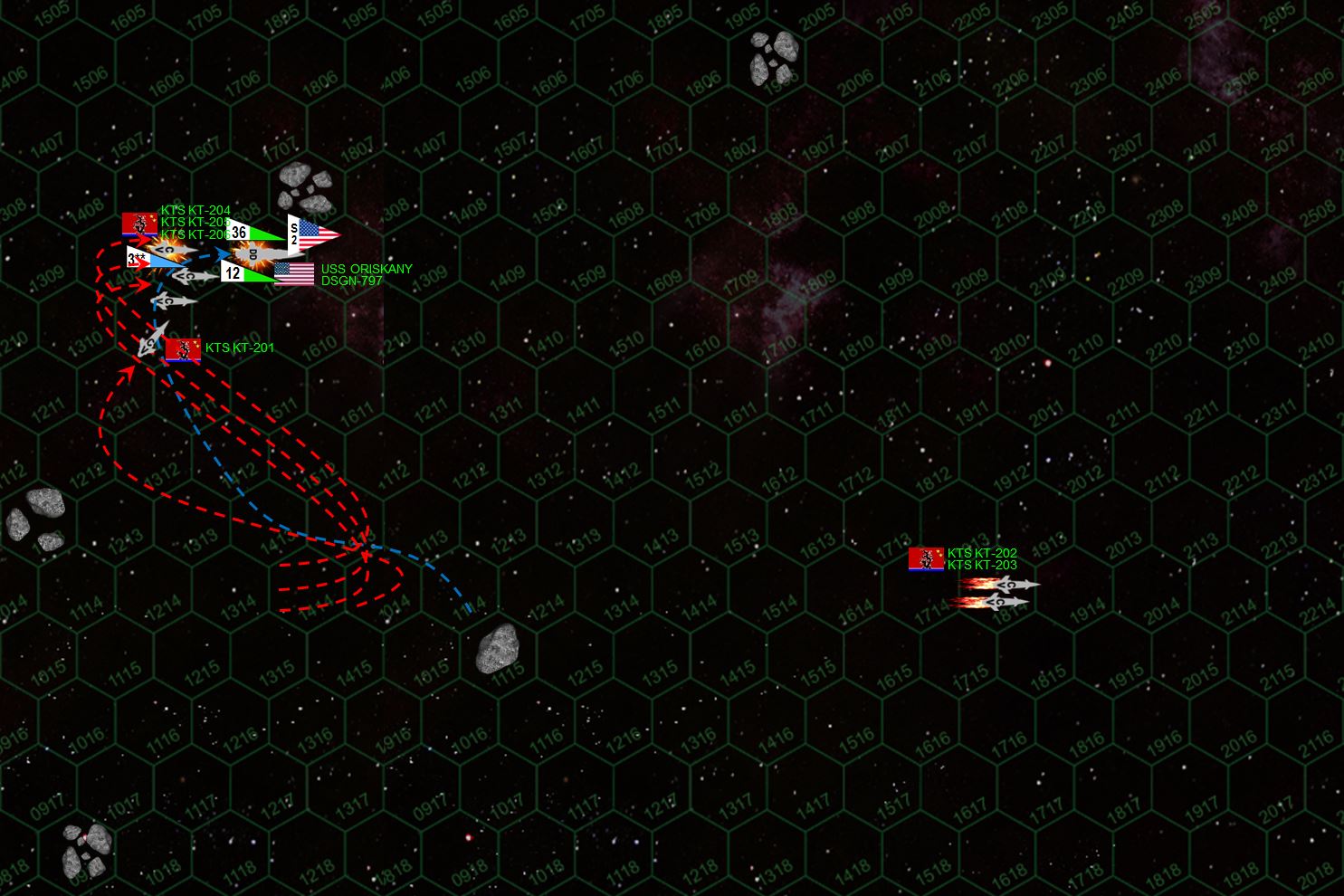 With her maneuverability reduced, Oriskany slows to 15 kilometers per second and jackknifes to starboard, coming to 090 and using another asteroid field to screen her badly-damaged port bow. The Black Dragons swarm in behind her, pelting her stern with (KT-201 was able to launch her twelve P-500s just moments before these mounts were destroyed by the Oriskany’s broadside). Six are shot down, the reduced performance clearly due to the Oriskany’s damaged sensor suite. However, the “Lady O” has always been a lucky ship, and not one Black Dragon torpedo gets through the enhanced shielding and electronic warfare. Only one plasma gun hits, and even this is a glancing burn off the port quarter. This was seriously good luck for the Lady O, she very well could have been crippled here. However, only her aft weapons can now hit, and all guns fire on K-204. Hits are scored on the magazine, forward weapons, bridge ... just hat fast the corvette is crippled.
 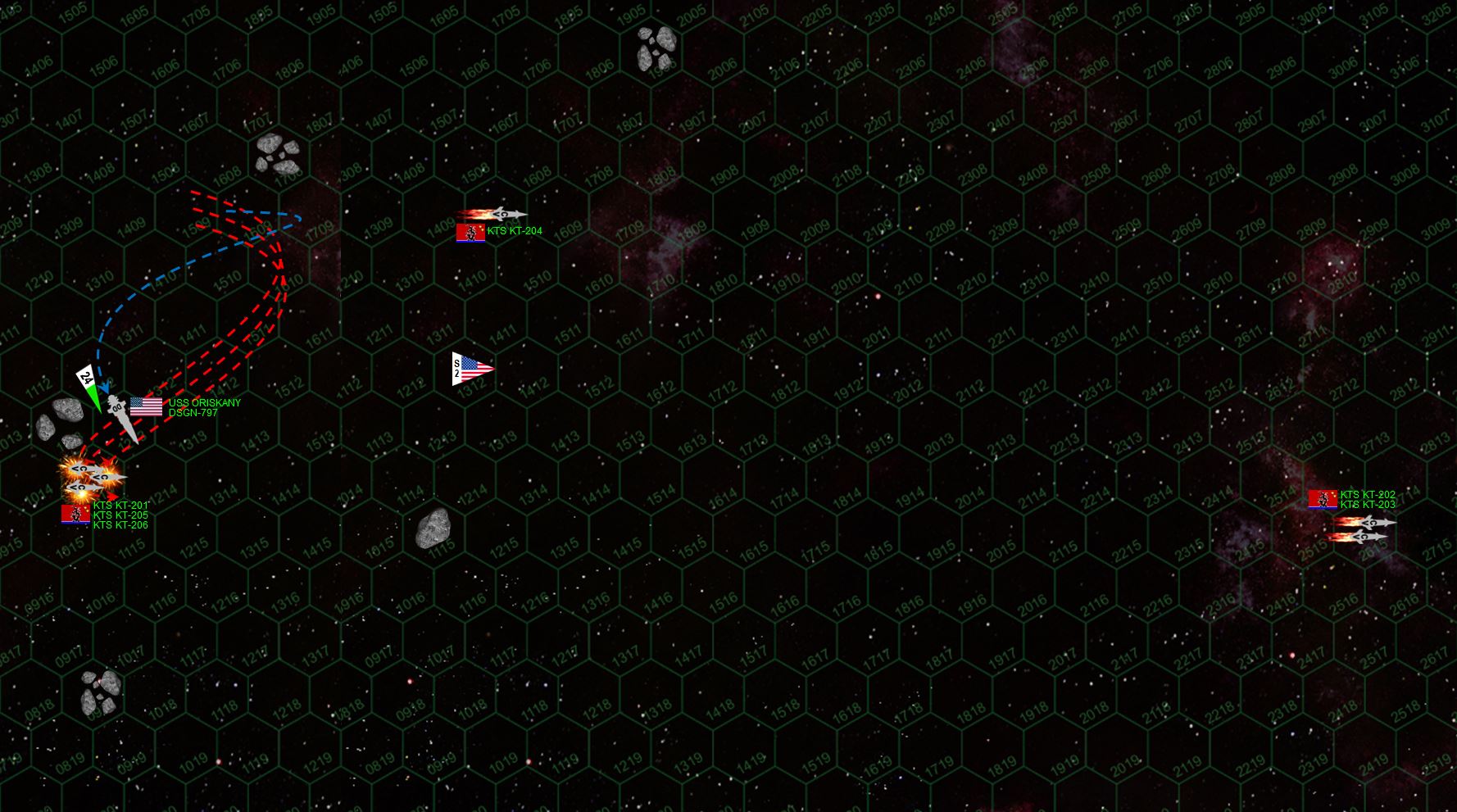 The Oriskany finally wins initiative. As the three surviving Black Dragon corvettes regroup and tuck behind another asteroid, the Oriskany decelerates to 12 kilometers per second, makes three turns (remember her enhanced thrust of 7) and sets up a broadside along her starboard bow. She has no choice has to, she was unable to fire any torpedoes last turn (they’re all mounted forward and the enemy corvettes were all behind her) and she's lost half her launchers anyway. Twenty-four P-500s rush at her stern, seven are shot down. The scouts can't help, since any American scouts would be ruthlessly shot down by Black Dragon point defense guns who have no American torpedoes to shoot at. Two torpedoes hit, damaging the starboard engine and blinding more of Oriskany’s sensors. Plasma hits are also scored on Oriskany’s starboard bow, but the armor on this facing is undamaged and Oriskany shrugs off the hits. The Oriskany’s guns reply, putting three hits on KT-205, crippling her. Four hits land on KT-206, crippling her as well. One hit strikes the previously-mauled KT-201, finishing this last Black Dragon corvette (previously damaged with a hit on the bridge). The Oriskany is technically at a 6+ to lose power (one hit on the starboard engine) so the Black Dragons COULD tie the game here, but they 2 (they needed a 6). The Lady O's luck has held once again.
 Technically this would be counted as a 108-0 Major American Victory (raid victory conditions, all six 18-point corvettes crippled). But the Oriskany is heavy mauled and was honestly very lucky on Turn 3, when those P-500 torpedoes really could have crippled her with hard hits astern. So for campaign purposes it will count as a minor victory on a small battle (+/-2 campaign points for the Americans and Black Dragons). KT-201, 203, and 205 are lost, scuttled before capture by Oriskany's Marine platoon. KT-202, 204, 206 will be recovered and repaired. The Oriskany will require 9 days in port before she is fully spaceworthy again.
 PLAYTESTING: ARE CORVETTES OVERPOWERED IN DARKSTAR?
A week ago we had a great game of Darkstar between @muakhah and @elessar2590 , where we had a Prussian force that included a wolf pack of five Type XII Umfangangriffboote (U-boats, or perimeter attack boats). The game was a Prussian victory and a pretty handy one at that. The Prussian player was more experienced and the Arab League player had some very bad dice rolls, but despite this I started to worry that these torpedo corvettes were overpowered, especially in large numbers.
Well, I did NOT want to change the “large numbers” or the “wolf pack” tactics. With the American Mako class, the Russian K-56 class, and the Prussian Type XII U-boats, we’re clearly going for a “submarine” motif here. Moreover, I WANT them to be a very dangerous threat, especially in large wolfpacks.
So if they’re not overpowered, are they underpriced?
Counting the amount of armor boxes a corvette has compared to a frigate (the next larger ship type), the number of internal component boxes, I started to feel that the base cost for a corvette of 10 was too low. This disparity becomes more pronounced when one considers the curves in the power-weight ratios (smaller ships average more power per ton), making them much better at carrying energy-based weapons like lasers, syglex emitters, and EPCs rather than weight-heavy systems like rail guns and plasma projectors. It also allows much better shielding (shielding arrays weigh about the same regardless of their power, but cost much more power for better systems), to say nothing of targeting systems and CICs (combat information centers).
Long story short, corvettes seem to have “hacked the math” by mounting +2 CICs, very high shielding for their hull size, and deadly-accurate and long-ranged weapons. They punch far above their weight of just 10 points, +20% for an “advanced” design (additional bonus to starting available power).
I went ahead and cranked their cost up to 15. The +20% for advanced power plants thus takes them to 18. With a cost of 18 rather than 12, the Prussians could have only afforded four Type XIIs in that wolf pack instead of five.
Would that have made a difference? To test the new pricing model, I put six re-priced Type XIIs (18 x 6 = 108) up against the USS Oriskany (106 points), +2 additional scouts = 108 points.
I have a sneaking suspicion that the bump in price is not quite enough. I think corvettes as a class are smidge too cheap, hence the increase to base 15 rather then 10, but also the +2 CICs those Type XIIs were carrying were another critical factor. But for now I’ll just test the Type XIIs at 18 points each and see where that takes us.
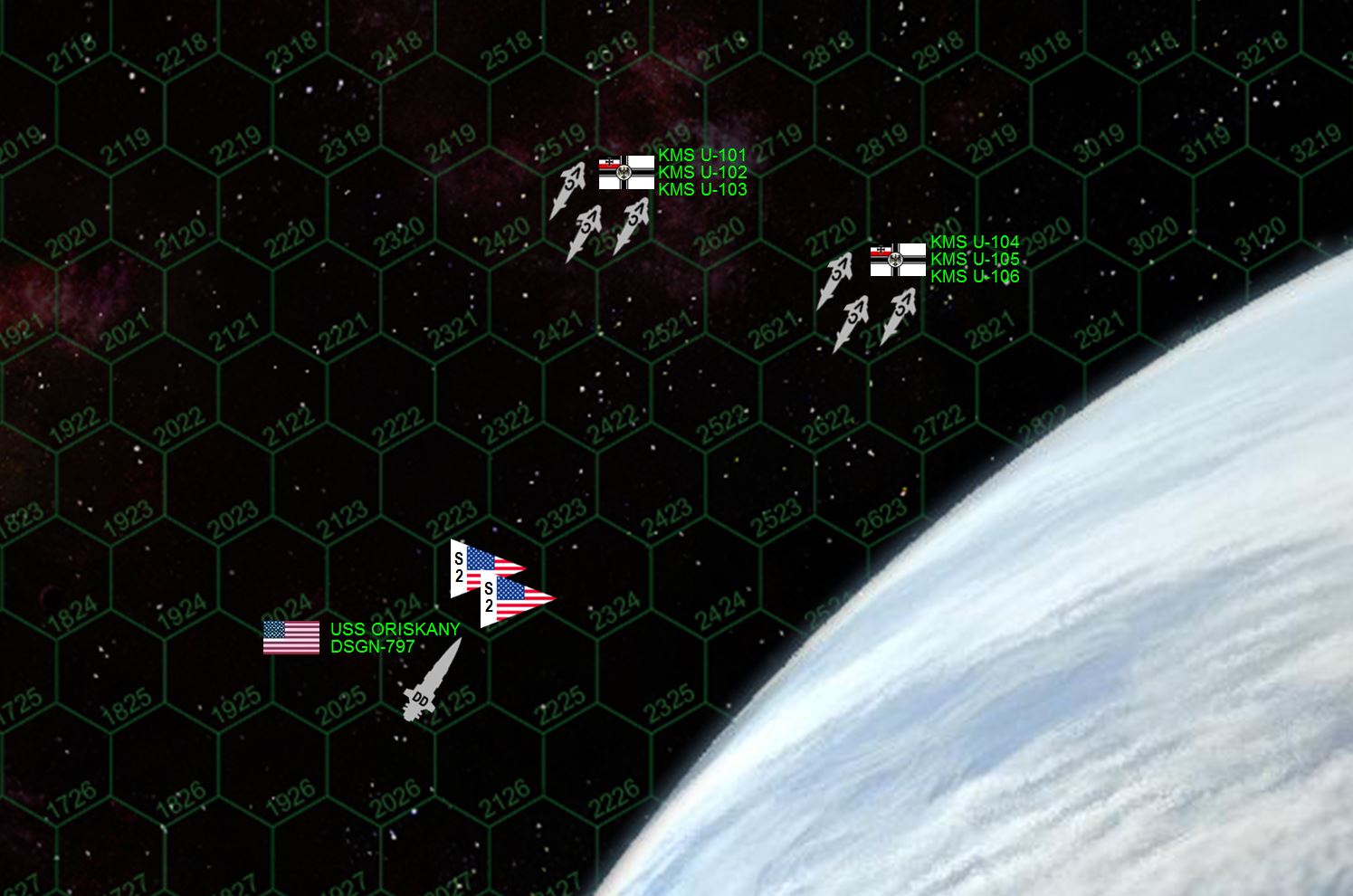 So here’s the match-up. Like I said, I have a feeling the “fix” here isn’t just raising the price on the corvette, but also any ship that carries a +2 or +3 CIC (we’ve run across this before with the uber-advanced pirates and corporate vessels with +3 CICs. The rate of increase will be higher for smaller ships than larger ones, again ... because CICs are a power-heavy system and smaller ships have an easier time with surplus power (compared to their mass) than larger, heavier ships.
 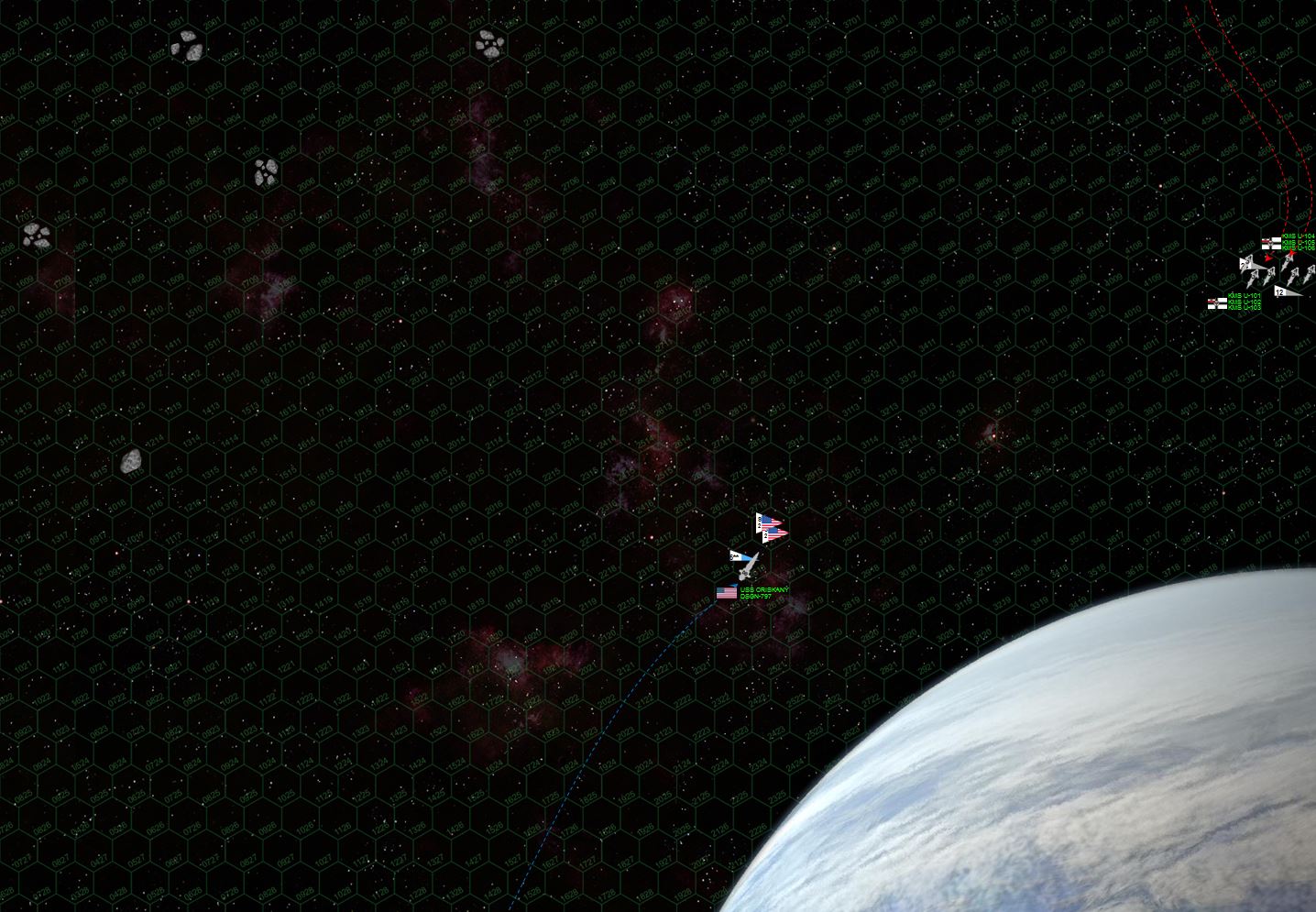 Oriskany wins initiative, and sets course, accounting for gravity, to split the U-boat's forward torpedo arc. She sets approach velocity at 15 (45 kilometers a second), reducing to 8 with her upgraded thrust, accounting for the pull of that small moon. Note that half the U-boats (who had to move first) can now only fire starboard bow torpedo tubes. All U-boats fire deck lasers as 18 hexes (3240 km). All miss. Oriskany scores one 6-MgKv hit on U-101’s starboard bow (gunnery impact upgrade).
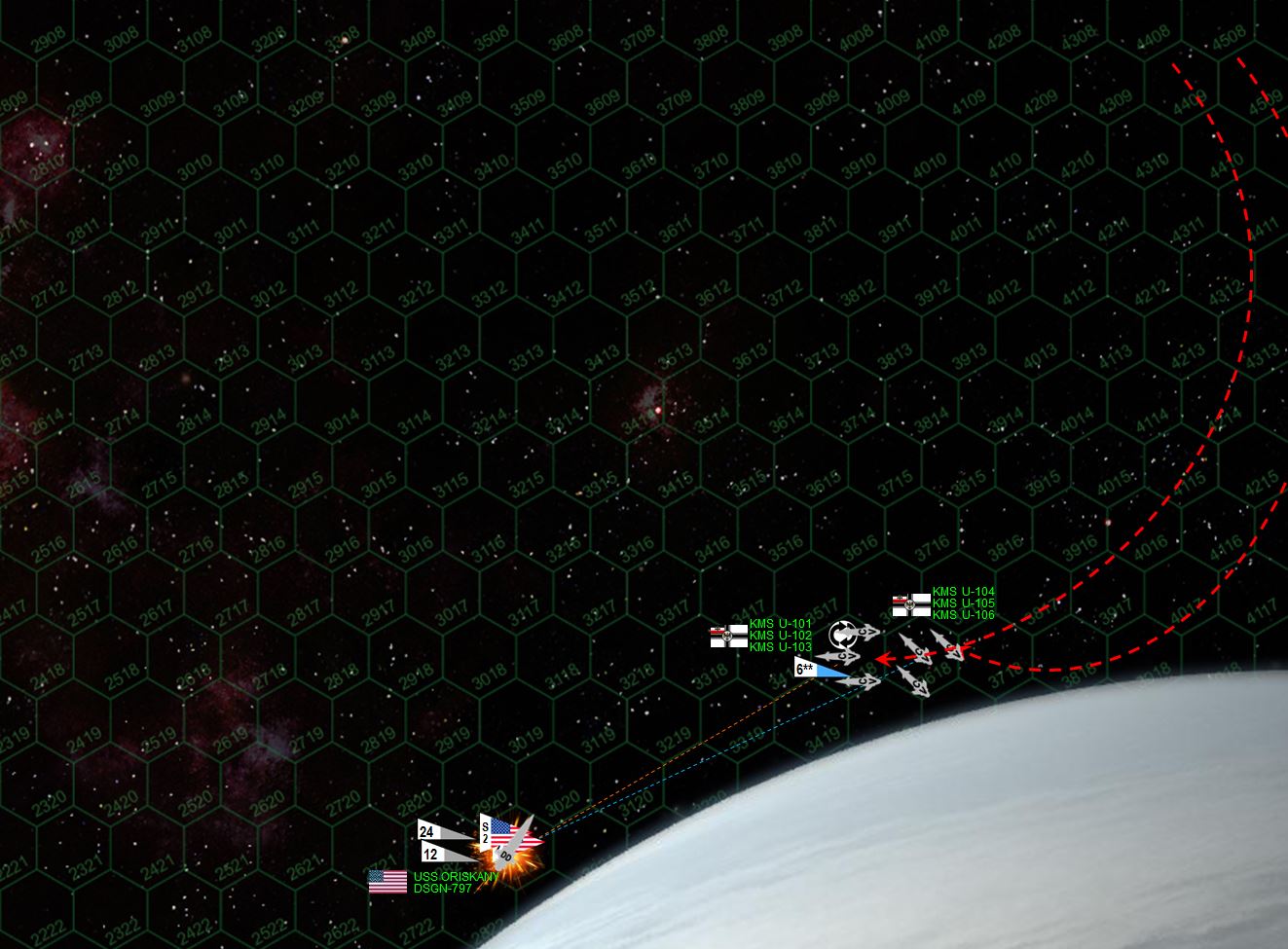 Oriskany wins initiative again. The U-boats go for the moon’s atmosphere, pointing bow tubes in all directions and trying to use the moon’s mass to screen their sterns. Oriskany also decels again to five (15 kps) and dives toward moon, pulling out to use the moon’s curvature to screen from lasers of back U-boats (blue line of fire cannot shoot hrough Hexes 3021 and 3220) and also screening her stern from incoming torpedoes (Hex 2822). She has also carefully placed herself at range 6 to make most of her gunnery impact upgrade. None of it helps. The Oriskany rolls 5 (+3, for CiC plus x2 EW bonuses) on mass drivers, scouts shoot down one more. That only accounts for nine torpedoes out of 36, so she’s hit by 27, five of which get through her double-upgraded shields and electronic warfare suites. Five Class IV torpedoes hit on her port quarter, all but blowing the back third of the ship clean off the hull. First playtest is an epic fail, the Oriskany is crippled without crippling (or even seriously damaging) a single U-boat.
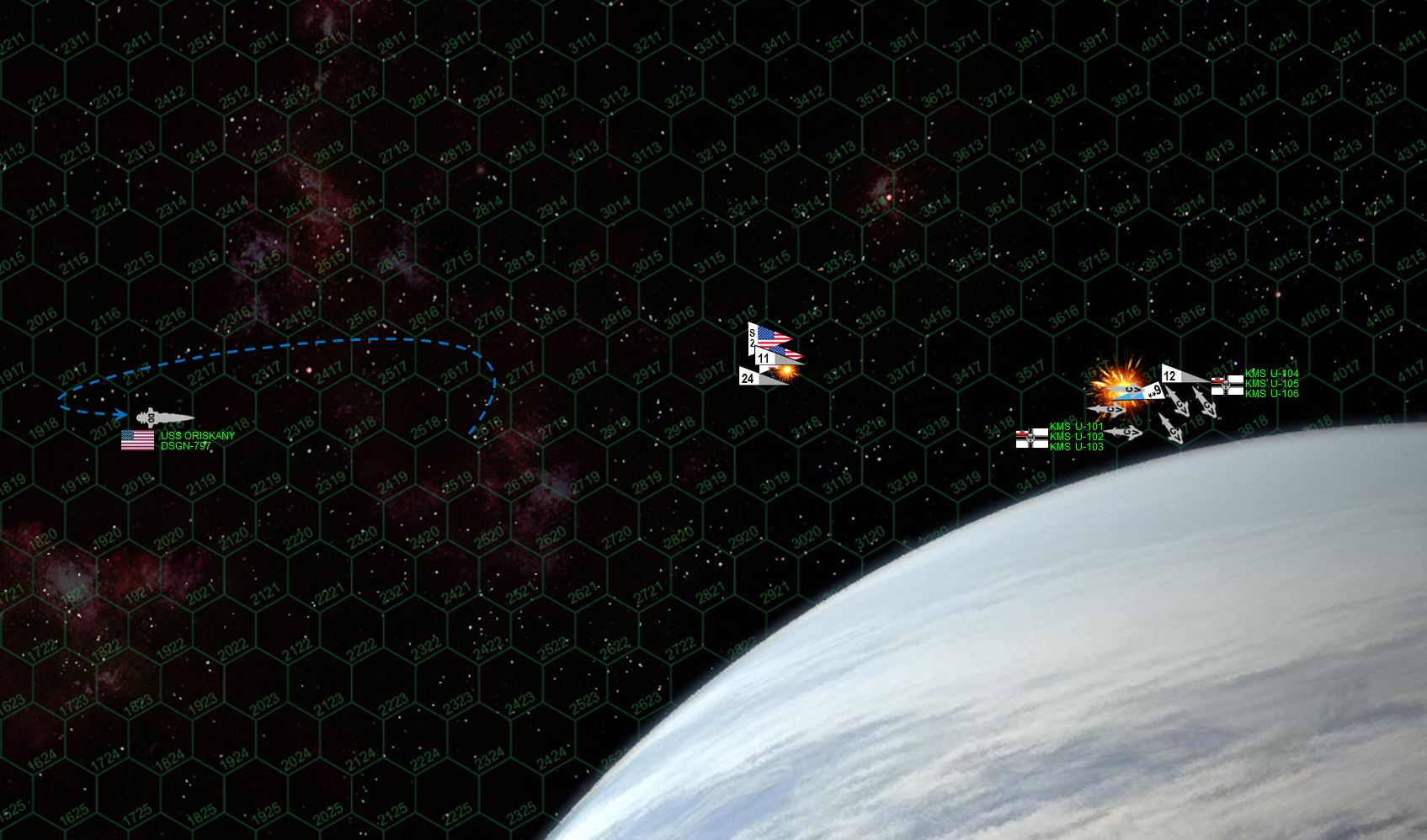 Try two. This time the Oriskany breaks AWAY from the moon. Prussians dive toward the moon, and set up "hedgehog" with forward torpedo tubes in all likely directions. The Oriskany continues backing up, staying out of range of torpedoes, while keeping her own torpedo tubes toward the enemy. The first wave of Prussian torpedoes will not hit his turn, and the Oriskany’s scouts manage to knock one down (her mass drivers cannot hit those torpedoes yet). The Oriskany Mark 48 gravitic torpedoes go in, one gets through mass drivers and hits the shields. U-101 is crippled. Oriskany takes one laser hit forward. Oriskany hits U-102 with two rail guns and one laser, cripples maneuvering thrusters and all forward weapons (including all torpedoes).
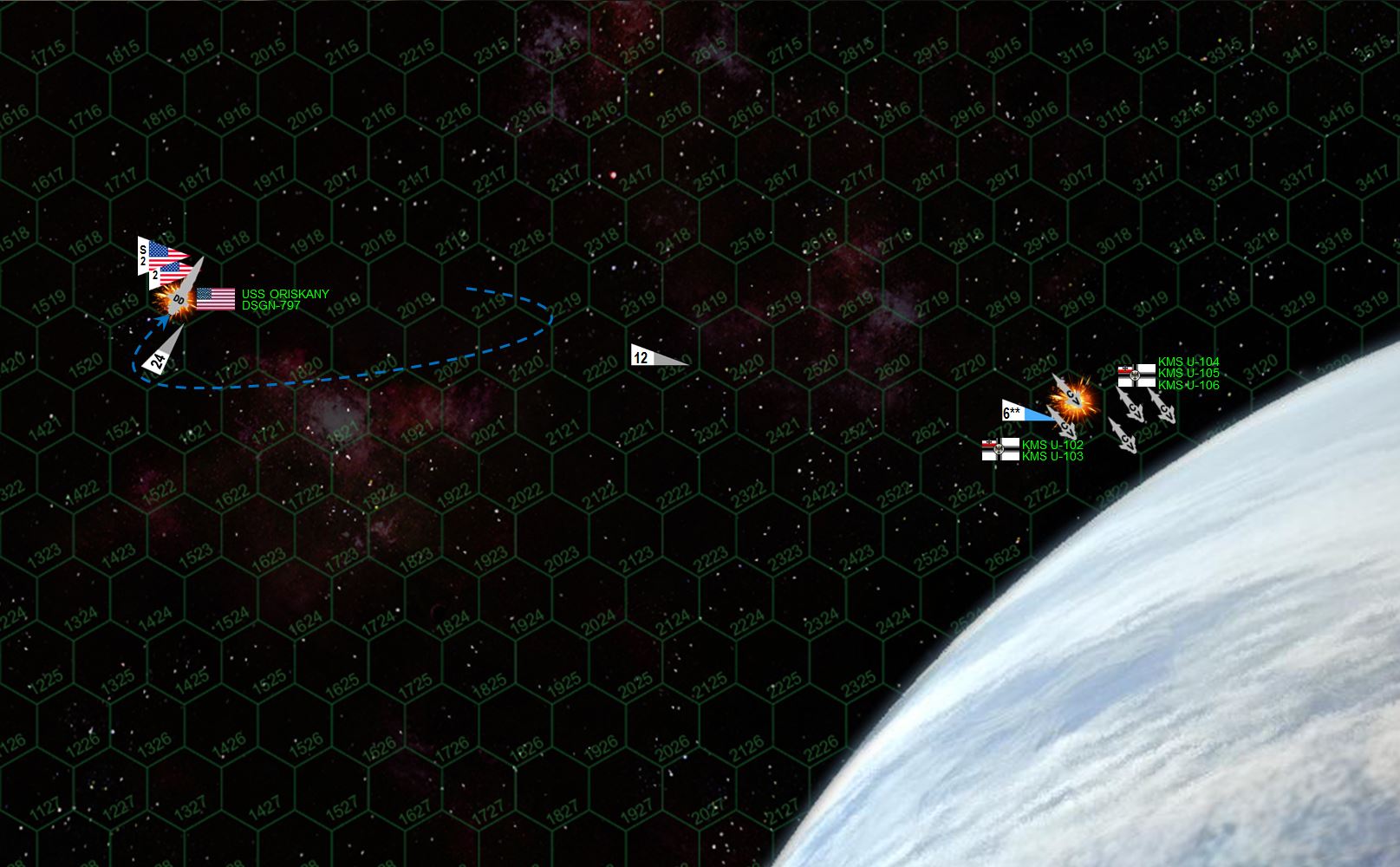 Oriskany wins initiative AGAIN (yes, third tie breaker, but Oriskany has thrust 7 + 2 tactical initiative = d6+9, Prussians have thrust 8 = d6+8). Prussians continue to slipstream along the moon's atmo, protecting their sterns. Oriskany again jack-knifes back away from Prussian torpedoes, but this time must take at least 24 of them (11 went dark with loss of U-101). Seven are shot down by Oriskany’s point defense guns, the scouts miss this time. Seventeen torpedoes hit he shields, four get through, straight up the stern. The Oriskany's cripple number is now 4+, Prussians roll a 3, so the Oriskany remains active ... barely. One of Oriskany's torpedoes gets through and hits U-103 (U-102 has no torpedoes to launch). One more rail gun hit from Oriskany cripples U-103. Rest of Oriskany’s is targeted on the damaged U-102, which loses mass drivers and Port Bow shields. Prussian lasers (only four left) miss.
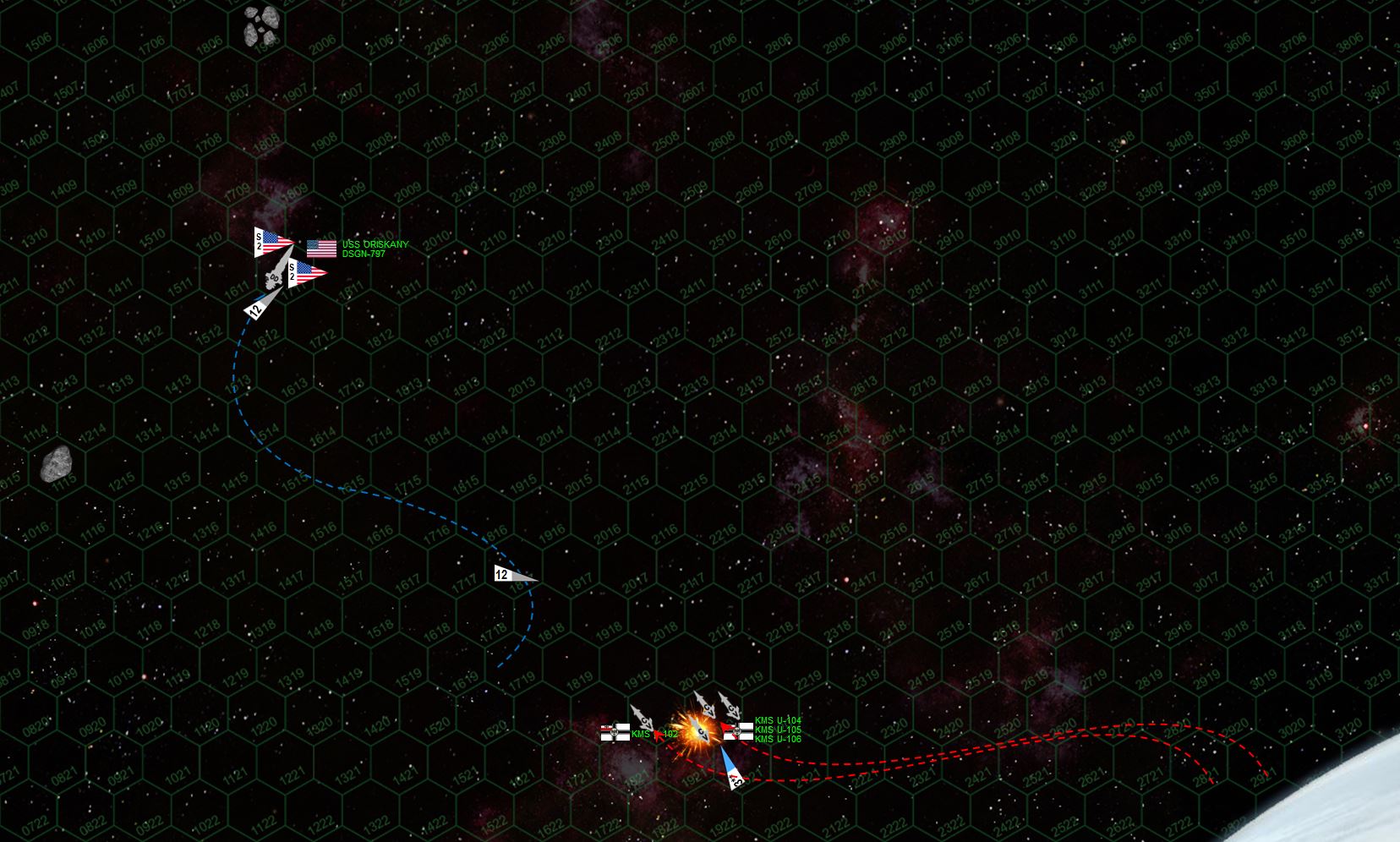 Oriskany finally loses initiative. The thus accelerates and performs an S-turn to port and starboard to back off and break off the battle. Some torpedoes will still catch her. Some will not. Prussians smell blood in the water and finally accelerate away from the moon in a bod to put deck lasers into the Oriskany’s starboard quarter. Five torpedoes are shot down, one hits and gets through the shields, but no additional engine compartments are hit (the hit location is just very lucky for the Oriskany here). One Oriskany torpedo is shot down, one misses, and one hits, crippling the U-104. The Prussian lasers miss. Oriskany’s broadside (minus aft laser mount, lost in a pervious torpedo hit) mostly misses, scoring just two hits on the U-102. This hits the bridge and starboard magazine, but fails to cripple the corvette. Prussians then roll a 99 on the percentile breakoff check (a 01-45 would have meant the ship was compelled to break off the action, giving he Oriskany half points for driving her off). But with a 99, this must be the hardest U-boat crew in the Kriegsmarine! On Turn 05 - Oriskany hauls ass off the table. If this was a raid, it's a 54-0 victory for the Americans. If this was an assault, this is a 54-4 victory for the Prussians. The Oriskany was also insanely lucky a few times on this one.
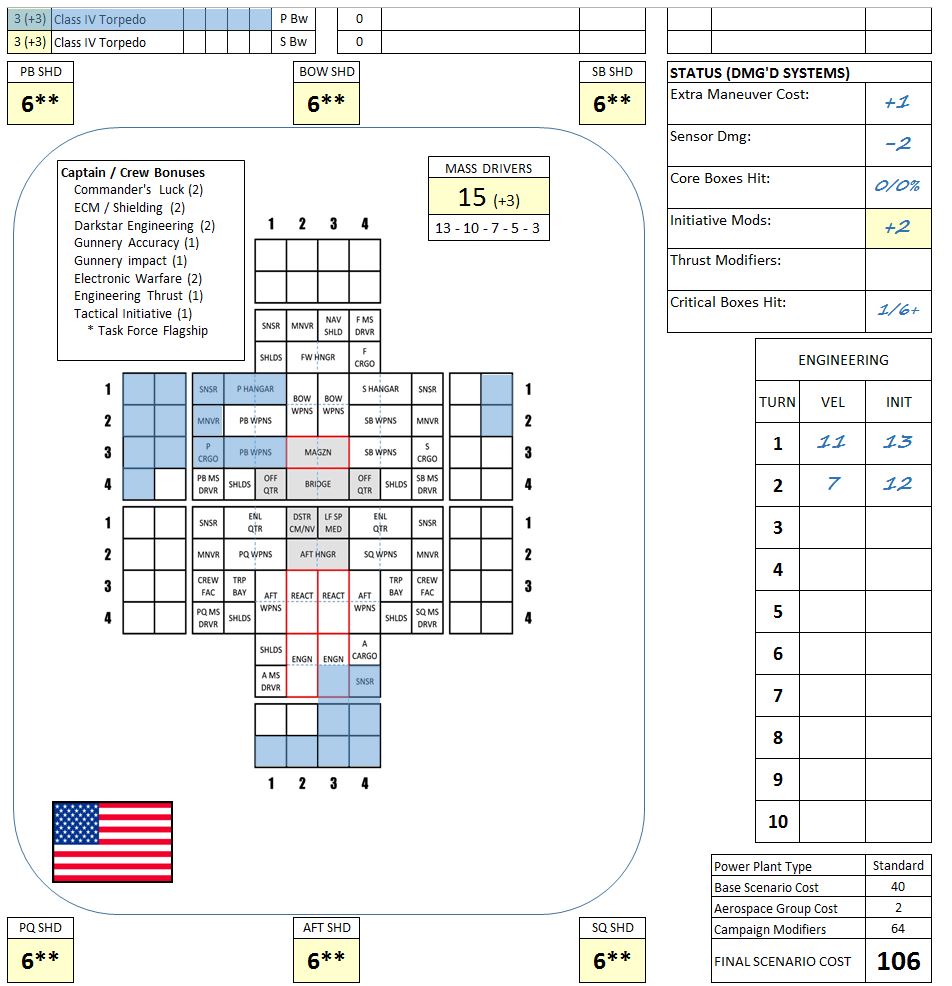
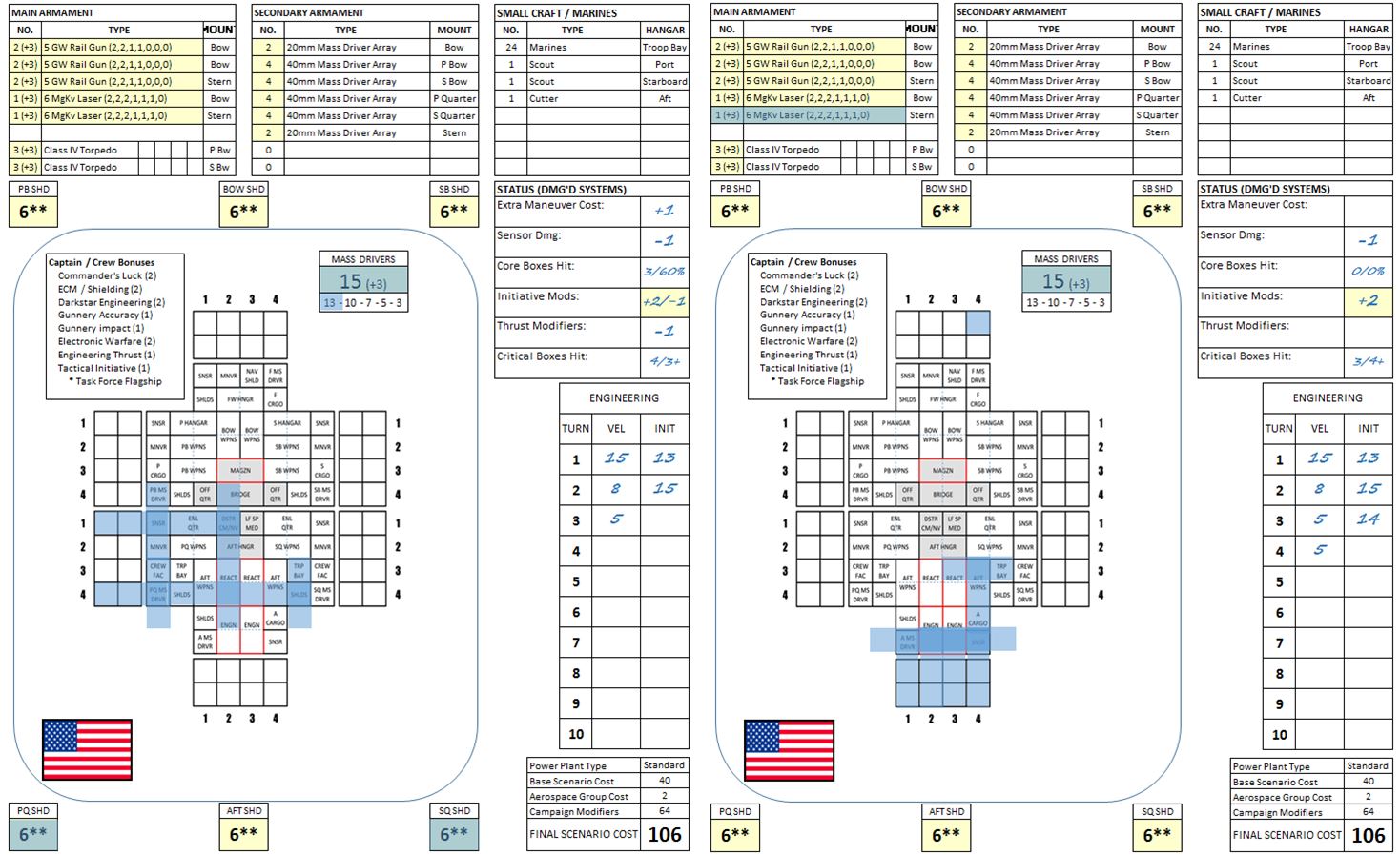 Here are the Warship Record Sheets for the Oriskany on the two play-throughs of this battle. Honestly, although this last battle was a “draw” (American win if it was a raid, Prussian win if it was an assault), I still think the Oriskany vs. six Type XIIs ... the Type XIIs will win most of the time. The Oriskany survived long enough to flee because she was very lucky.
So these Type XIIs are still underpriced. HOWEVER, I don’t think it’s the corvette ship type in general. For instance, Russians K-56s are also 18 points and I am almost sure the Oriskany will wipe the floor with six K-56s, which six Type XIIs (same point cost) will wipe the floor with the Oriskany. The difference is in those CICs. So again, I think I will add a “CIC surcharge” to any ship class that carries an abnormally high CIC (+2 or +3). This will effect many Japanese ships, almost all New Roman ships, Corporate / Pirate ships, and select American and Prussian ships (most notably, the corvette “submarine” classes). The cost of a Type XII will now be 21 (15 base, +3 for advanced, +3 for the advanced CIC). This is a 20% cost adjustment for +2 CICs, 40% adjustment for +3 CICs. This percentage will drop off for larger ship types.
The last test of this theory will come when I test Oriskany against six K-56s. If Oriskany beats the six K-56s at 108 points, even though she couldn’t really beat the six Type XIIs at 108 points, it will be proof that the remaining gap in the math lies in the +2 CIC (which the K-56s do not have).
Fear the Wolfpack!
Last weekend we actually had two community games of Darkstar. After our “campaign game” with players in the US and UK (reviewed earlier in this thread), we then had a supplementary non-campaign game with players in Shanghai and Australia.
So this game isn’t part of the Third Hercules War, but somewhere else deeper into the void, a smaller battle with smaller, faster ships, somewhere along the “Third Band” frontier of Known Space.
A small Prussian battlegroup, built around the Hipper class light cruiser Hohenfreiburg (named for one of Frederick the Great’s victories) and three Emden-class frigates is entering a new star system, somewhere in the Cassiopeia Constellation. Perhaps this is Beta Cassiopeiae, a yellow-white variable giant 54 light-years out, just on the fringe of the Third Band. Their forward screen, made up of a wolfpack of five Type XII umfangangriffboote (perimeter attack boats, or “U-Boats”) has detected potential “claim jumpers,” a battlegroup of the Arab League who believes they already have a claim on this system by a previous treaty.
These Prussians have been in a Darkstar wave for over two months to get here. Since even the fastest courier will take no less than 19 days to return to Earth. Therefore, both battlegroup commanders resolve to settle the issue themselves. The Prussians and Arabs decelerate to attack speeds, vector toward each other, depressurize torpedo tubes, open outer doors, retract bridges, and begin fixing telemetry approaches and firing solutions.
There are no diplomats this far out.
Action stations! We are now “weapons hot!”
Prussians: @elessar2590
Arab League: @muakhah
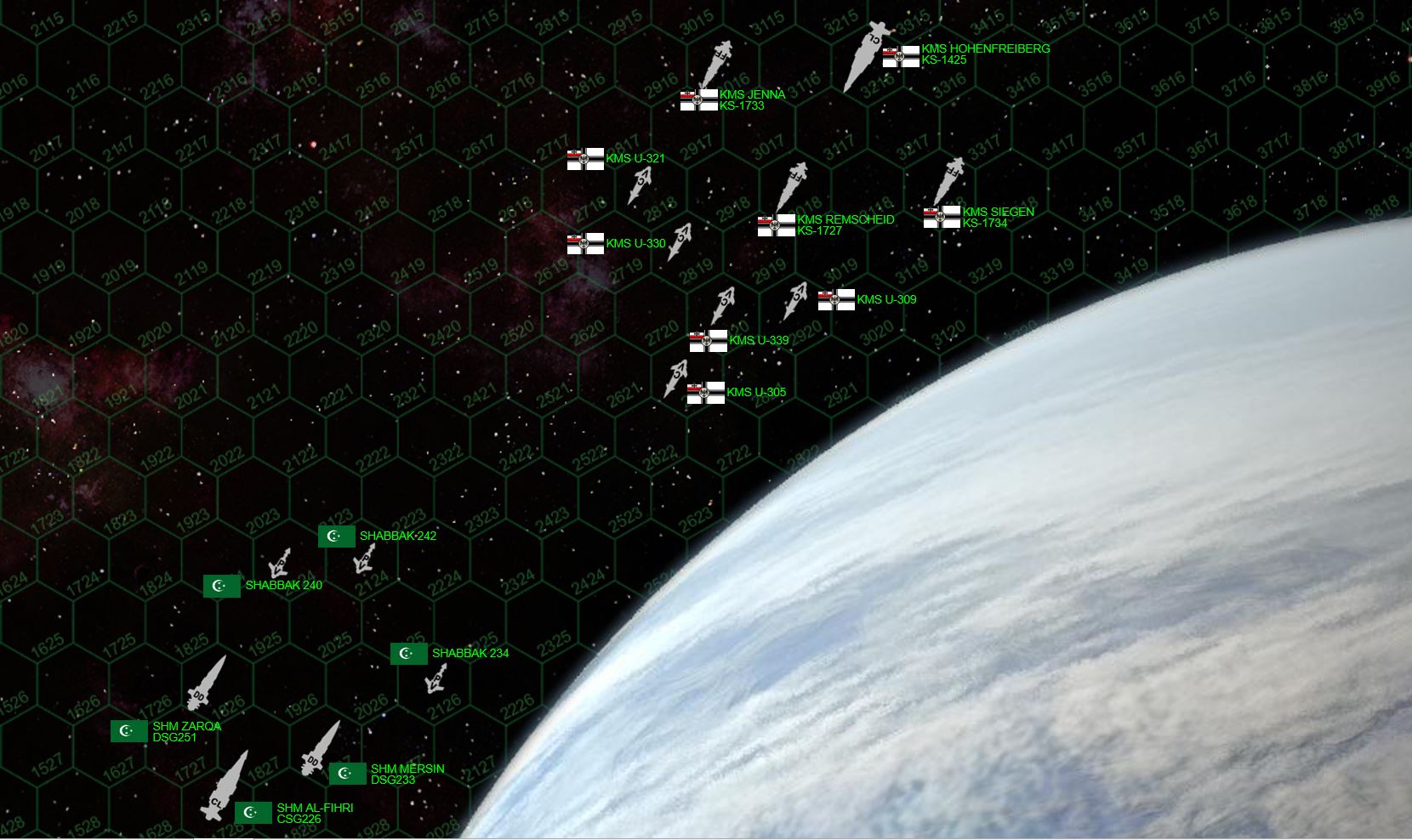 Here is the matchup. This is only a 195-point battle because everyone is “new” (no XP-upgraded ships or crews) and so many of the ships here are so small. This is typical in the Third Band, since larger heavy cruisers and especially battleships (to say nothing of the logistics ships required to support any formation larger than the leanest of battlegroups) take at least three months to get this deep into Known Space. Note the Arab League “Shabbak-201” class gunboats. At just 5300 tons and a crew of 20, they are most analogous to ships like the YT-1300 “Millennium Falcon” (as appears at the Battle of Endor / Ep VI ROTJ) or Firefly class “Serenity.”
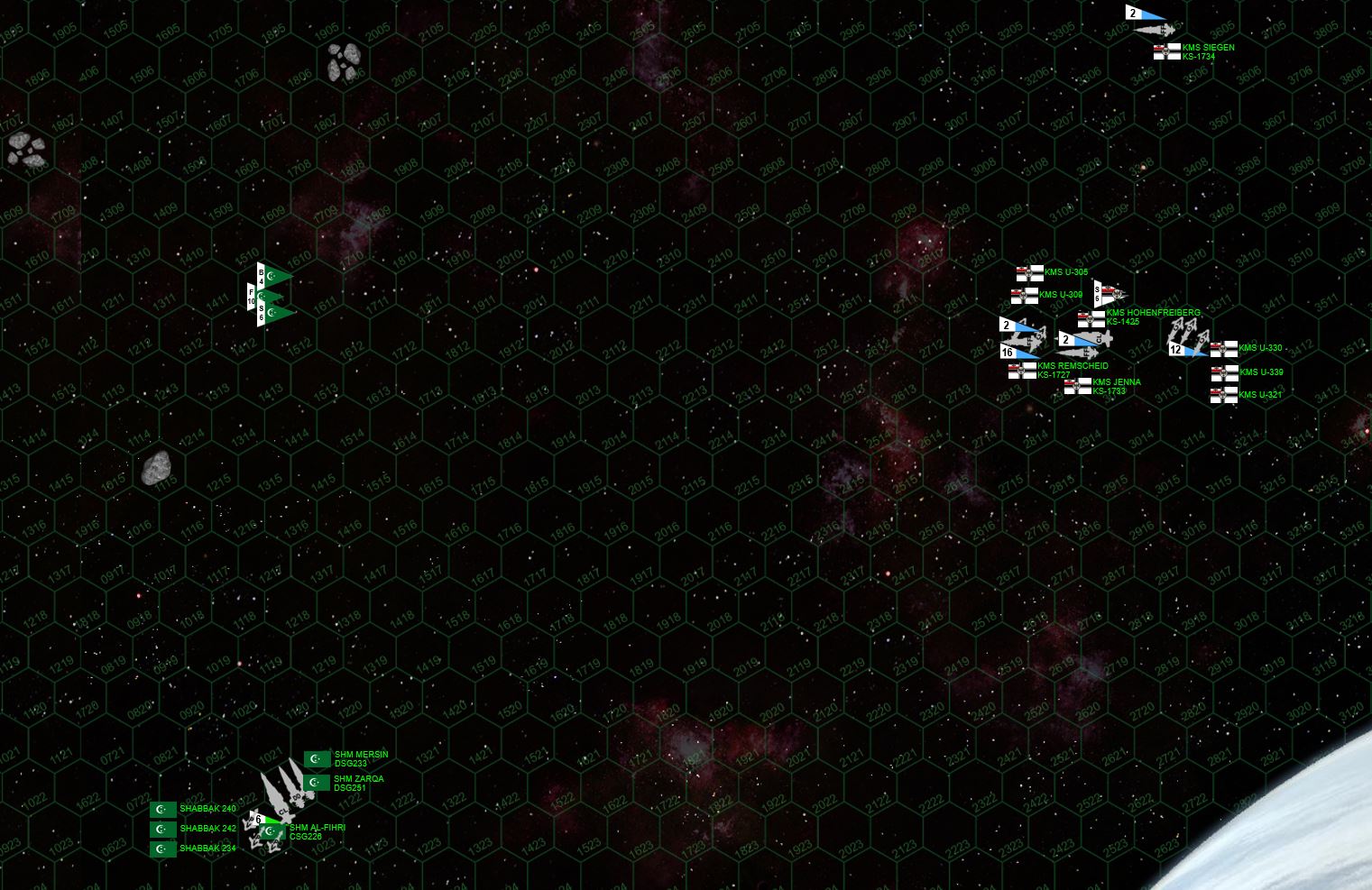 Both battlegroups make their approach, the Prussians approaching from 030 (upper right) and the Arab League from 210 (lower left). The Arab flagship Al-Fihri launches 14 fighters and 4 bombers, a “hybrid” light cruiser that carries a slightly smaller gunnery battery in exchange for a moderate aerospace strike group. The Prussians, for their part, launch “Sternjäger” (Star Hunter) gravitic torpedoes … LOTS of torpedoes. Those Type XII U-boats don’t play around when it comes to these deadly warheads.
 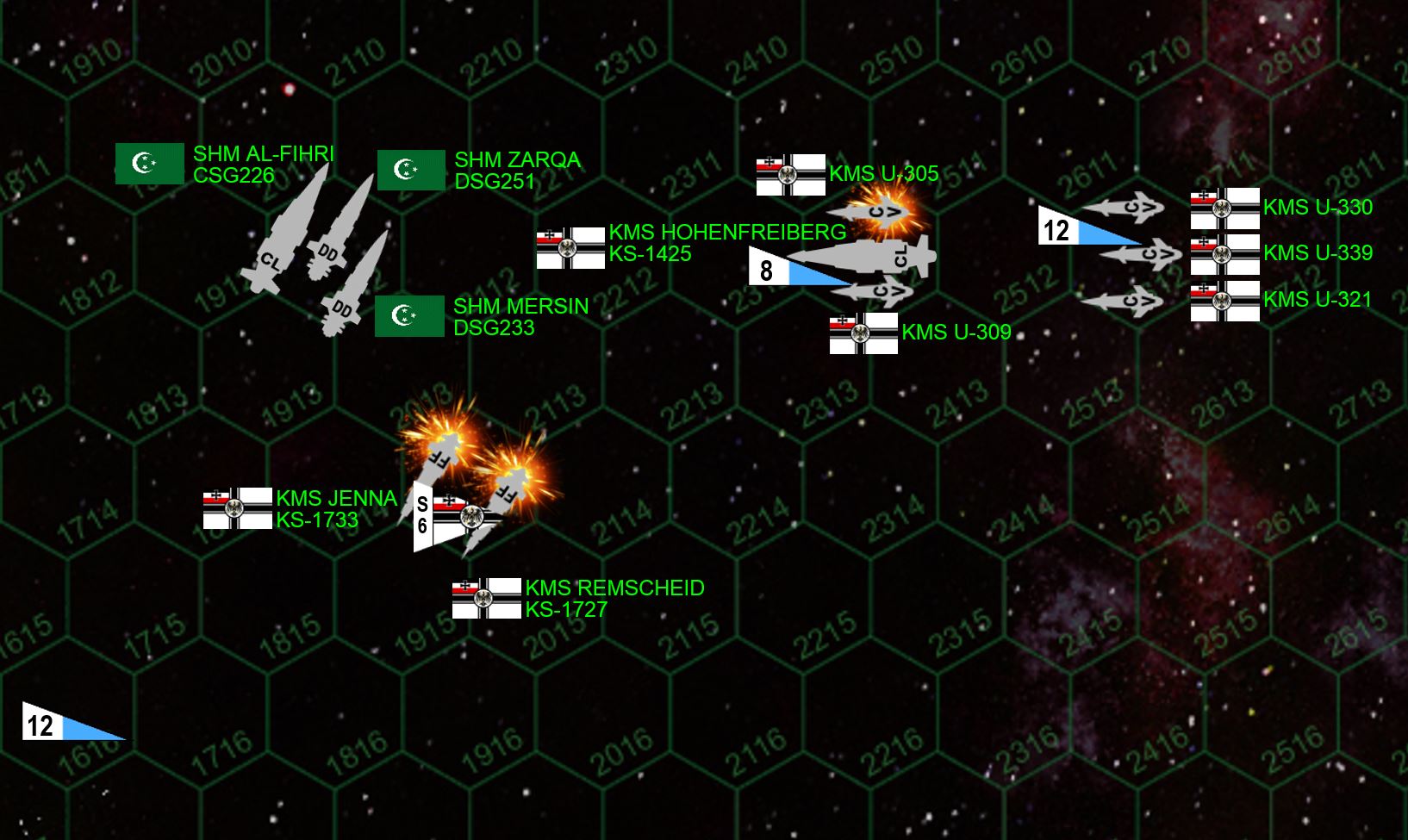 The fleets close and things get brutal on Turn 02 very fast. The Arab ships have proven a little faster than their Prussian foes, and largely won the initiative. As the Hipper-class light cruiser Hohenfreiberg turns to starboard, the Arab hybrid cruiser and two escorting destroyers “cross their T.” The Prussian frigates streak much closer to the Arabs, hoping to put a rail gun broadside into their starboard quarter. But the heavy lasers and EPCs of the Arab ships are much more powerful at this range, and BOTH frigates are quickly crippled by blistering broadsides. The U-305 is also knocked out, drilled by the forward laser arrays of the El Fihri. Prussian torpedoes cannot all reach the Arabs on this turn, so their “Sternjäger” strike is somewhat divided, just enough for Arab point-defense systems to shoot down many of the warheads, and the shields absorb most of what’s left.
 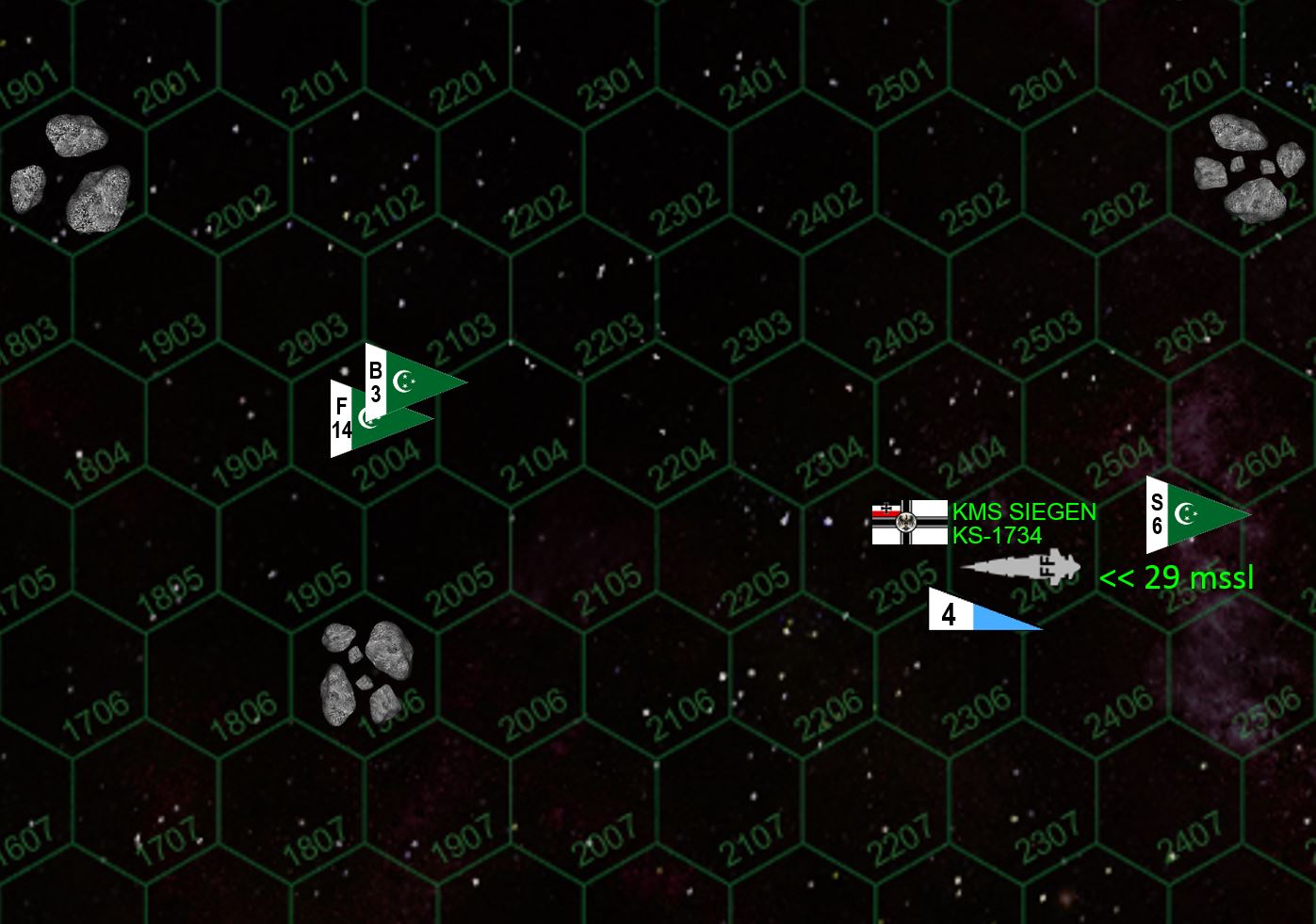 It’s not all going the League’s way. Further away from the moon, the lone Prussian frigate KMS Siegen (Emden class frigates are named for mid-sized cities of Terrestrial Germany) stands tall against the Al Fihri’s aerospace strike. The Arabs have elected to arm their bombers with all missiles rather than torpedoes, giving him many more warheads albeit at a smaller damage profile and less accuracy. The Prussians shoot down some, the shields absorb others, and then just plain get lucky with the location of the hits, perfectly spaced across the Siegen’s aft armor so the armor perfectly absorbs all the damage. Still, at this moment the League is winning the battle, hands down. If they were closer to the table edge they could break off the action right now and claim a legitimate victory in this “raid / skirmish” model game.
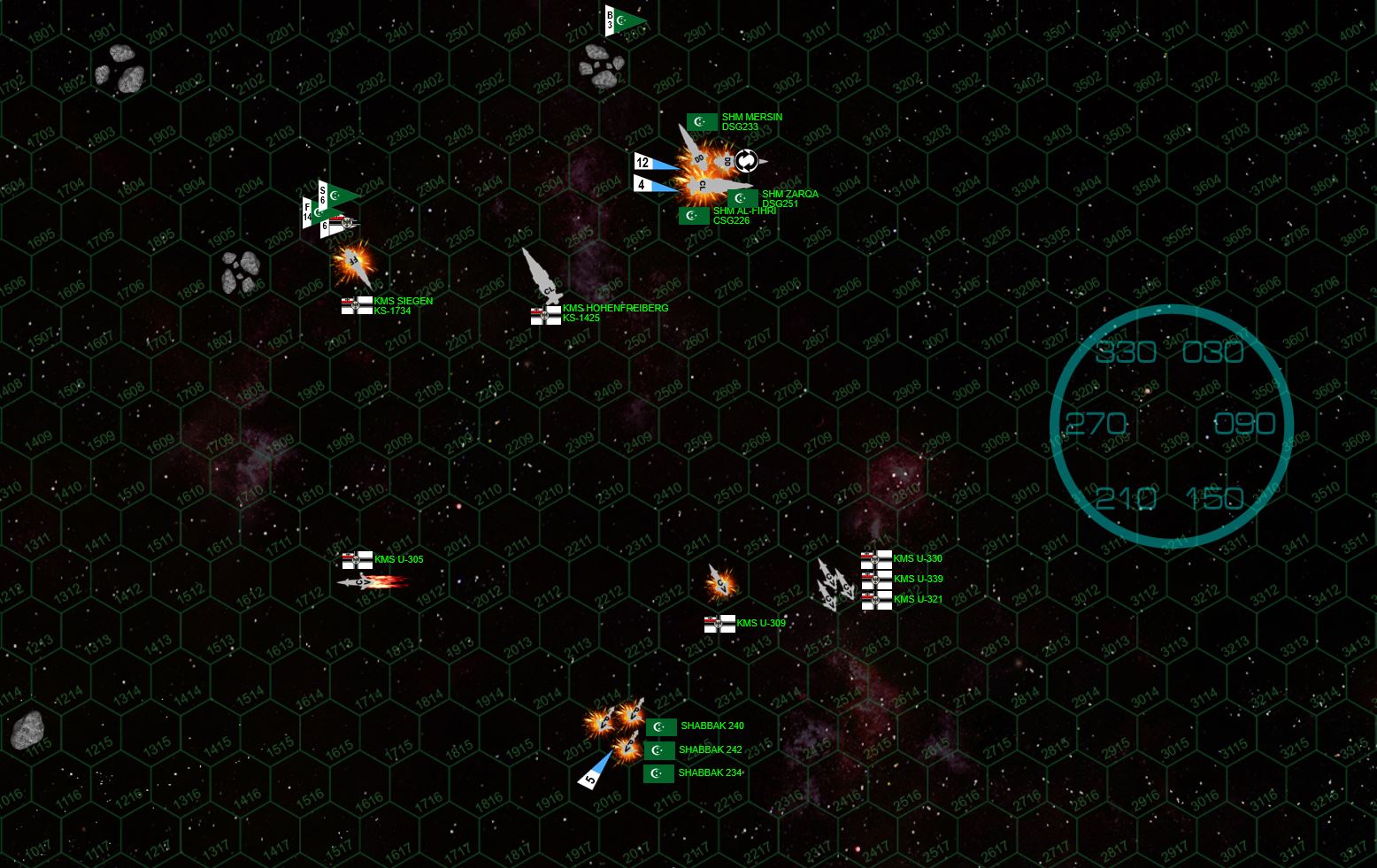 The tide turns, horrifically, on Turn 03. Although they all survived last turn, the Arab cruiser and destroyers were damaged last turn, and those butcher’s bill comes due when the second onslaught of Prussian torpedoes makes its terminal approach. With the Shabbak-201 gunboats too far away to offer mass driver support, the El Fihri, Zarqa, and Mersin are all quickly crippled (although not destroyed). Meanwhile, more Prussian torpedoes howl at the gunboats, many missing but all it takes is one hit to cripple a gunboat with these massive warheads. The Arab battlegroup is this largely tabled, but their fighters manage to strafe and cripple the engines of the Siegen, which is unfortunately aimed at the moon at the moment. The crew abandons ships and the 27,000 ton frigate hits the surface at close to nine kilometers a second, kicking off a blast visible halfway across the star system. Gunnery from the Arab ships also mauls the Hohefreiberg but she survives, which is more than we can say for the U-309.
The battle is over. It’s a major Prussian victory (they’ve destroyed / crippled 174 points of Arab League shipping while sustaining 84 points of losses, giving them a +90 lead, or 46% of the original battle’s points). However, it hasn’t been cheap. Two frigates are crippled and a third is gone forever. Two more U-boats are crippled, U-305 will be recovered but U-309 will in fact be captured by the Arab League while she is adrift. That said, it looks like the Prussians will be calling the shots in Beta Cassiopeiae for the foreseeable future.
There’s some playtesting going on to determine whether these “wolfpacks” of U-boats (or similar classes like the Russian K-56 or American Mako class) are OP. I don’t think they are, but they may be under-priced. So this game might have been slightly unbalanced, I’m thinking with adjusted pricing there should have been only four U-boats, perhaps only three. Still testing.
British Attempt Invasion of Russian Star System
FROM: UNITED NATIONS REGIONAL COLONIAL CENTER
02:30 SOL GMT, 20 DECEMBER 2520
BREAKAUTH: 181072.18J
CLEARANCE: SECRET (NATIONAL)
**UNITED NATIONS COMMUNIQUE**
The Third Hercules War continues – with British, American, and Japanese task forces recommitting to the struggle to control the embattled 72 Hercules star system. These Russian “Krasnaya Nadhezda” (Red Hope) colonies were the subject of a joint Anglo-Japanese raid launched out of the Outer Hebrides (Mu Hercules) and Kyokko Bijin (Zeta Hercules) systems last month, a raid interdicted by the US Navy’s “Oriskany” rapid response task force. Task Force Oriskany was defeated by the raiders, but the British task force (under the flag of Lord Edward Cavendish, HMS Agamemnon) was unable to remain in the Russian system when their Japanese compatriots received orders to return to 72 Hercules to deal with the Russian Admiral Lazarev battlegroup threatening the Japanese Kyokko Bijin colonies in Zeta Hercules. Of course, the Japanese could not know at the time that the Lazarev and her escorts had already pulled out of Zeta Hercules – ironically in response to the same Japanese threat that was now pulling out of 72 Hercules to respond to the Lazarev herself. The end result would almost be comical if not for the gravity of the situation.
Now the British are resolved to break the stalemate. The Lazarev battlegroup, now back at Krasnaya Nadhezda, is still under repair. The Japanese have secured Kyokko Bijin. The American Liberty carrier task force remains en route to their base at Vega (Alpha Lyra). Even if the Oriskany battlegroup can intercept again, there’s no way this small American destroyer force will be at full strength.
Thus, the decision is taken to launch not a raid, but a full-scale assault once again on Krasnaya Nadhezda. HMS Foxhound, a Fearless-class planetary assault cruiser, is loaded with Marines, ground attack aerospace craft, and tanks, and sent in a 10th magnitude Darkstar wave toward the Russian star system. Orders are to take the Russian base at Zyevnaya 21, one many moons orbiting the outer Zyevnaya gas giant.
Yet once again, the next generation transluminal drives of the American Oriskany battlegroup manage to beat the British to 72 Hercules (this small American force has nearly four times the normal FTL speeds of typical warships), and again these troublesome Yanks are in position to intercept. However, British intelligence has correctly surmised that they are nowhere near full strength. With the Lazarev task force still under repair, the Americans’ only help in defending this Russian star system is a brand-new battlegroup built around a Gagarin-class light fleet carrier.
British: Damon
Russians: Rasmus
Americans: Oriskany
Engagement 03: Vanguard Clash to Establish Orbital Zone Control over Gas Giant Moon Base, Zyevnaya 21, Kranaya Nadhezda system (72 Hercules), 20 December 2520
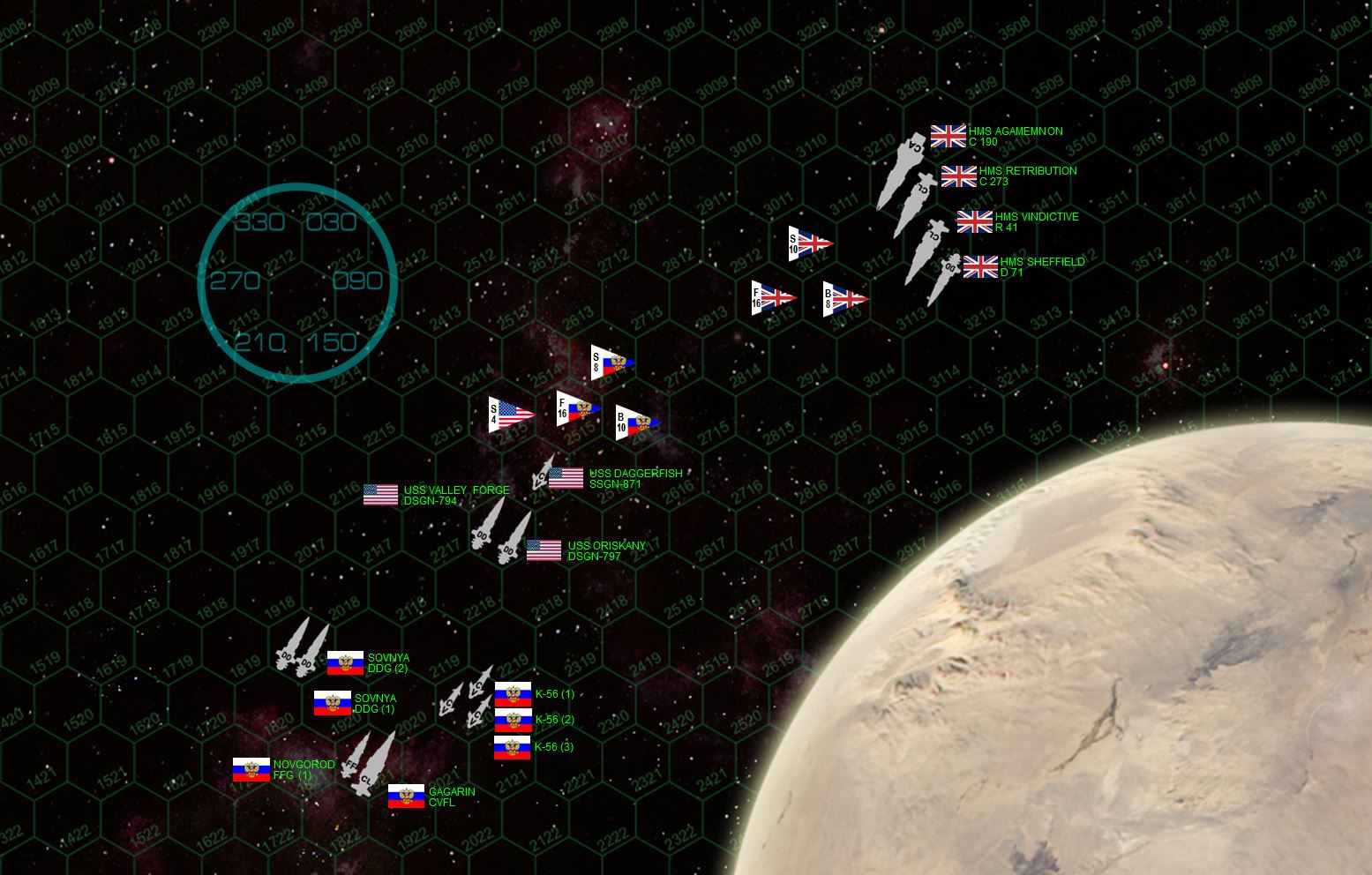 Here is the match up, and this will be a big one. 438 points per side, fourteen ships total, not including dozens of aerospace fighters, bombers, and scouts. Yes, both sides have a light fleet carrier (light cruiser) in this one. The British are naturally greatly outnumbered, but of course we’re talking about highly-upgraded heavy cruisers, and light cruisers against a scratch force of destroyers, frigates, and even corvettes. Then again, those Americans are some of the most experienced commanders in the Darkstar ‘verse, the nigh-legendary Valcour-class destroyers USS Oriskany and Valley Forge, and the Mako-class attack corvette USS Daggerfish. The Americans and Russians have a HUGE advantage in torpedoes and electronic warfare ... the British naturally have a gigantic edge in gunnery. A single hit from HMS Agamemnon can probably break one of those corvettes in half. As is so often the case, the game will come down to who can make the other side play THEIR game. This moon is measured to be the size of Pluto, based on the 180-km/hex scale of the game.
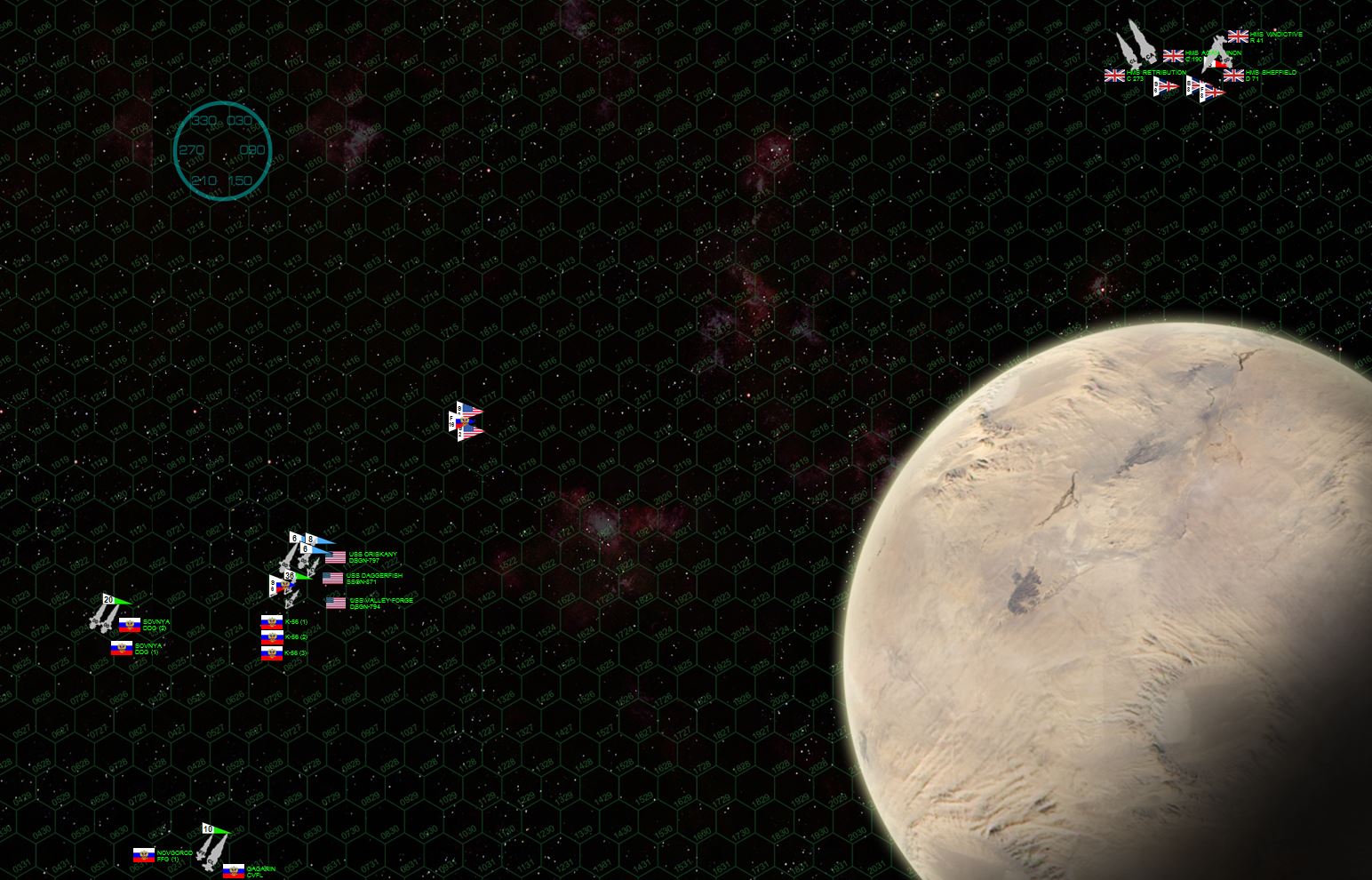 This battle will probably remain much more spread out than some others we’ve seen, with carriers on both sides. The Oriskany battle group will be trying to close somewhat, relying on their upgraded ECM / EW suites and gravitic shielding to protect them from the worst of the British gunfire. They will have to work with the Russians to ensure a coordinated torpedo strike, landing their Mk 48s at the same time as the Massive Russian P-500 strikes, as well as ordinance launched off their Tupolev Tu-97 “Zvesburya” (Star Storm) bombers and Mikoyan-Guyevich MiG-103 “Tunguska” fighters.
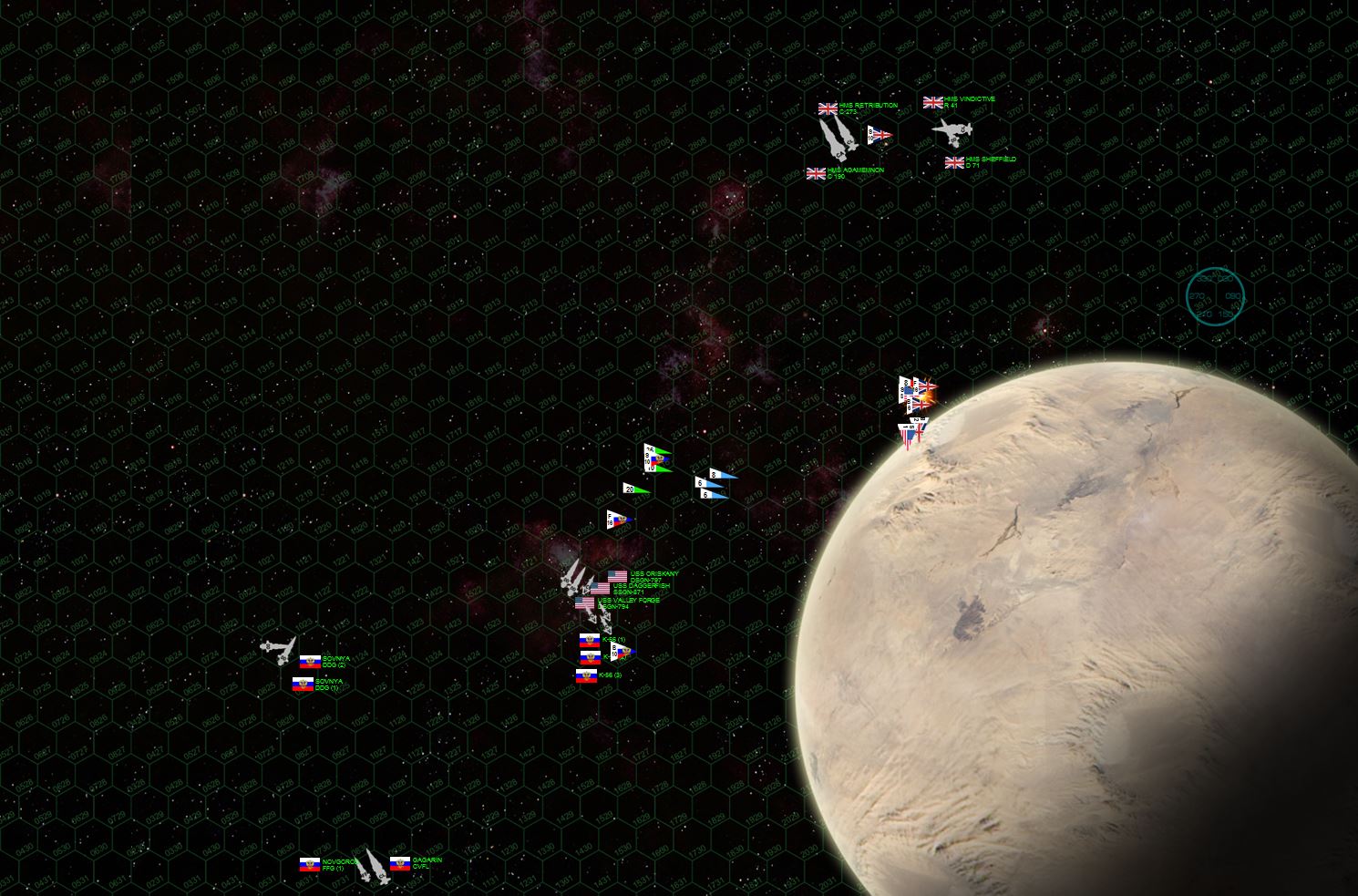 Turn two, and the distance is still so great that no one’s torpedoes have reached their targets. The carriers have finally completed launching their aerospace strike groups, now forming up and heading toward their targets. The Americans hedge closer to Zyevnaya-21, hoping to use the moon to at least partially screen their vulnerable engines and reactors from potential enemy torpedoes. First blood is drawn as American scouts launched from the Oriskany and Valley Forge tangle with British bombers and shoot two of them down, at the loss of one scout. The Novogord class frigate is hanging back with the Russian carrier, the three K-56 class torpedo corvettes hanging with the Americans for concentrated torpedo fire ... while the two Russian destroyers are a little out of position. This is partly due to maneuvering thruster damage on one of the ships, already hit hard by the long-range firepower of HMS Agamemnon and pin-point accuracy of HMS Retribution.
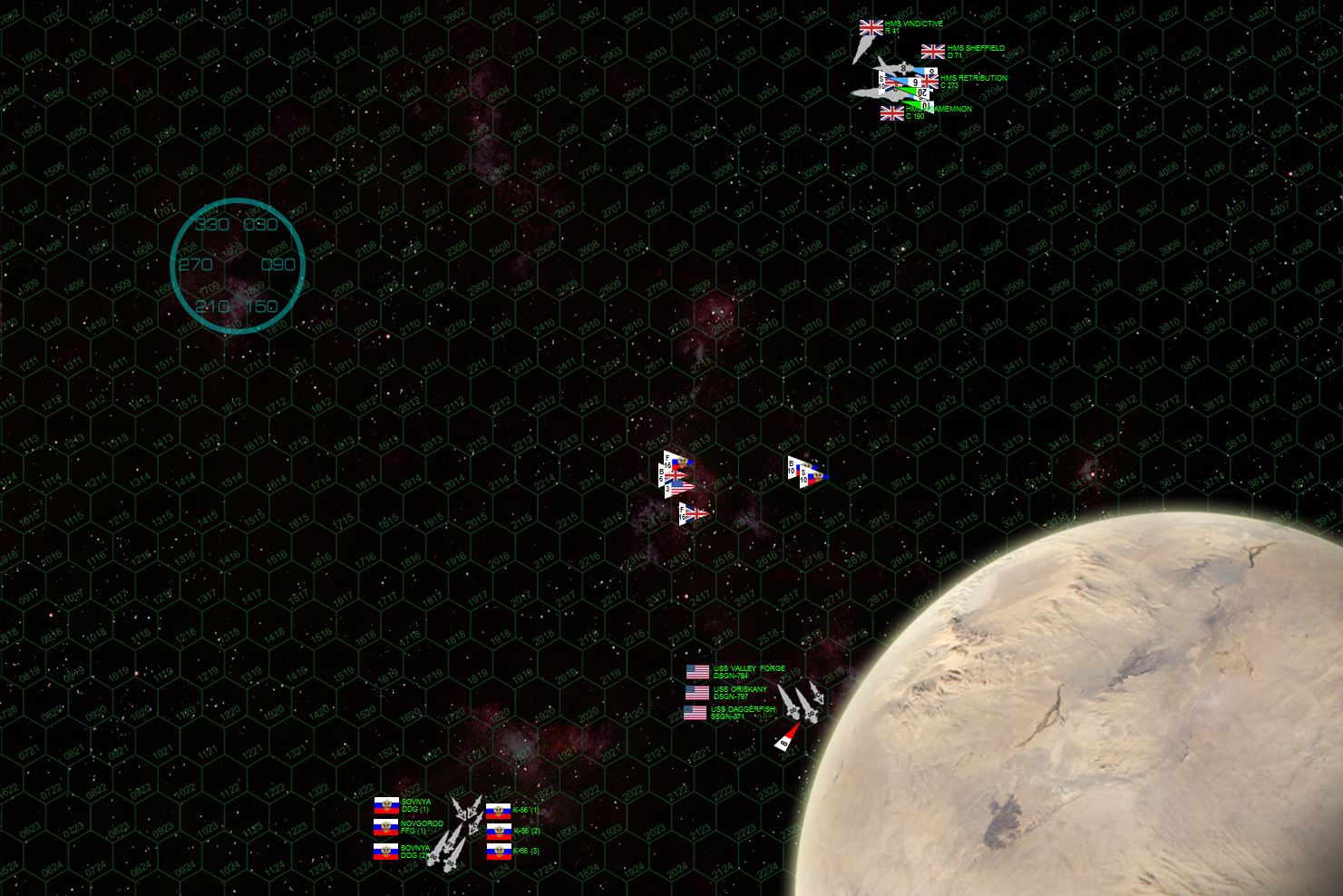 Turn three, a moment of fateful decision. Torpedoes and aerospace strikes have finally reached their targets.
 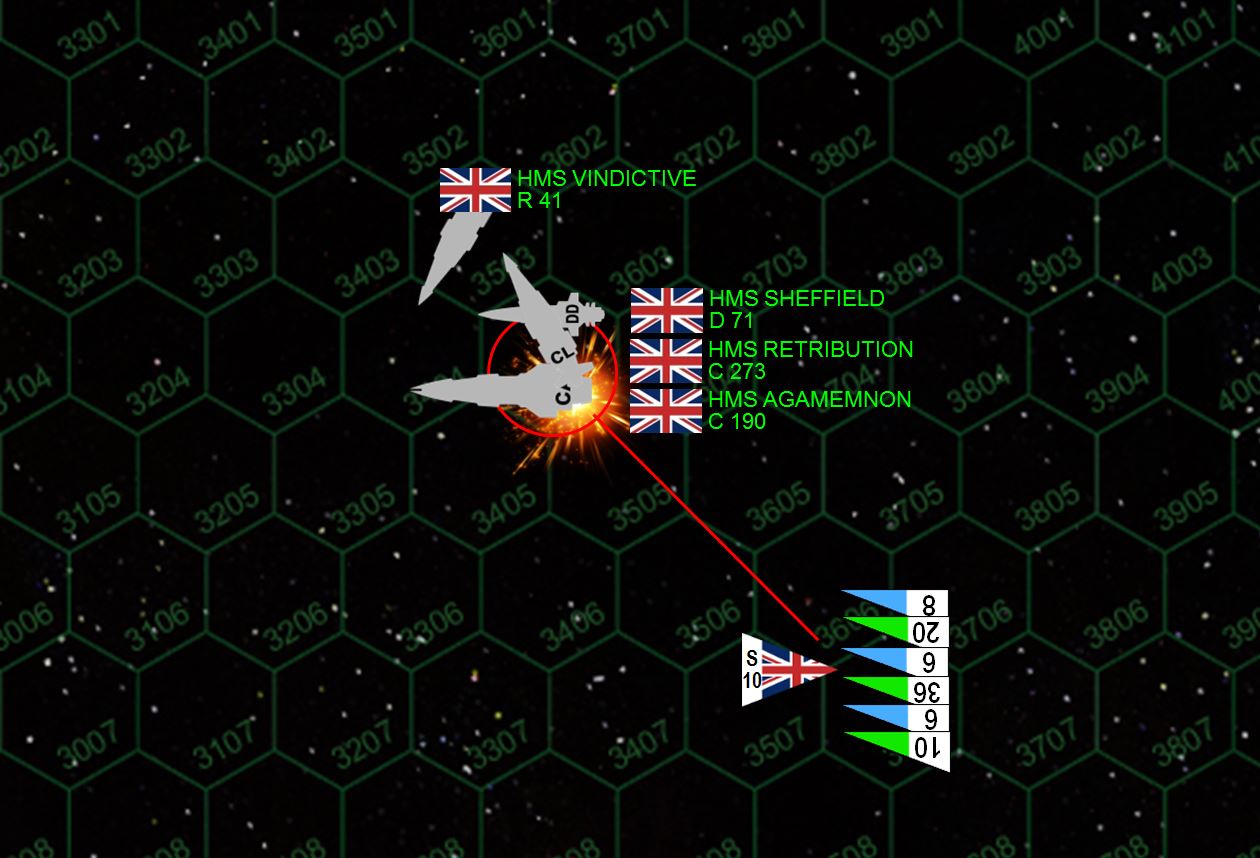 First, the British ships. Admittedly, this Russo-American strike is not all it should be, note there is no aerospace missiles or torpedoes in this mix, they are still too far away. Nevertheless, the sheer numbers of the Russian torpedoes (green) are a terrible threat. The British mass driver defenses opt to shoot for the more accurate American torpedoes, but due to electronic warfare upgrades on the Oriskany and Valley Forge, they are more difficult to hit and it takes pretty much the entire British task force to shoot them all down. Fair enough, but now almost all the Russian torpedoes sail in unopposed. They are inaccurate and the British have upgraded shielding, but what can I say, the Russians have upgraded dice. :D Rasmus has 61 torpedoes hitting on a 10% chance, and gets a lot more than 6.1 hits on the stern on the Agamemnon.
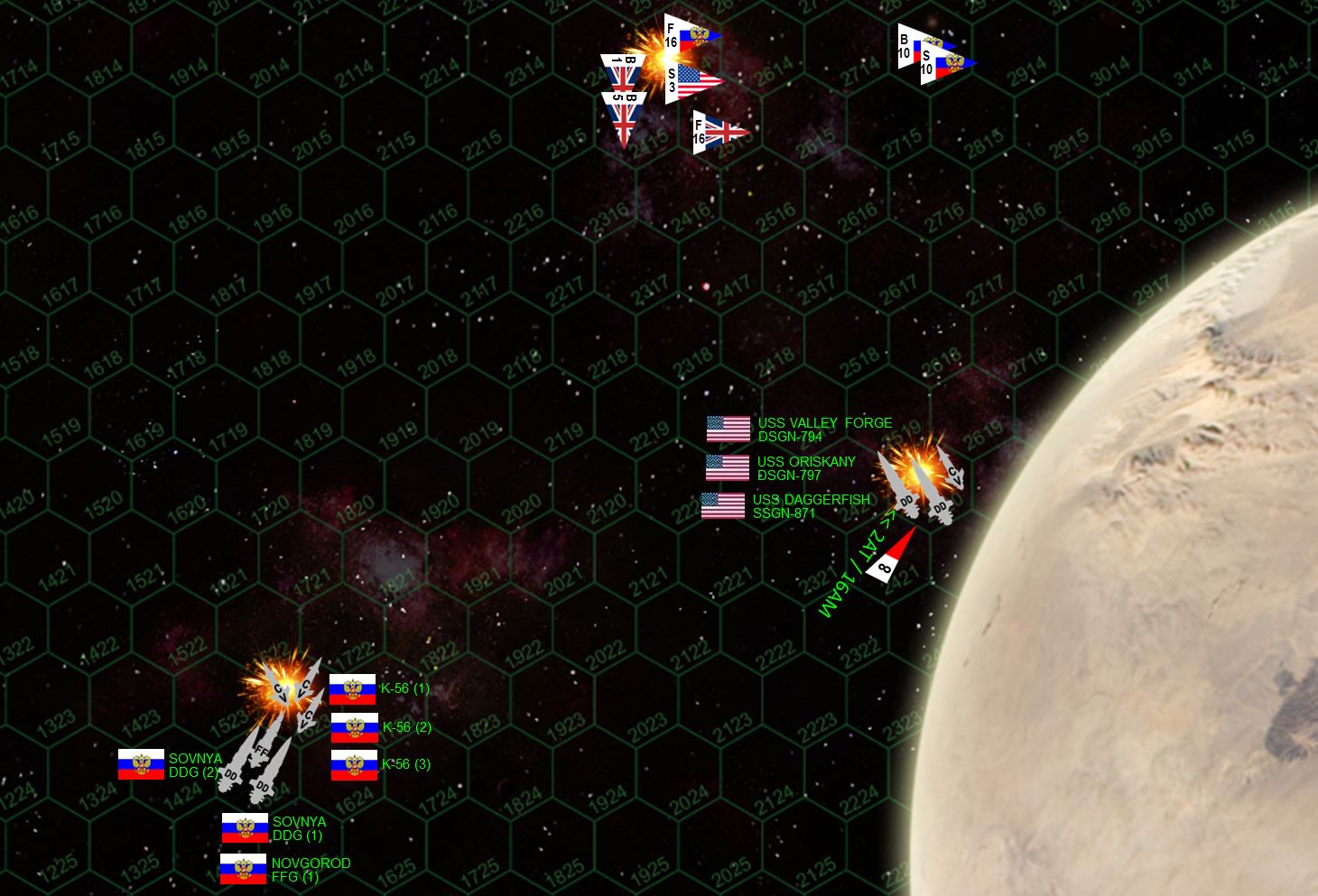 The British strike does not fare as well. They are targeting the American destroyer USS Oriskany. Note the Oriskany’s stern is up against the moon, the torpedoes cannot approach from her stern or starboard quarter. In an attempt to sling around to her port quarter, the bombers must approach too close, and the Oriskany and Valley Forge largely gut the strike before it has a chance to fire. The Oriskany is hit by torpedoes fired from the carrier HMS Vindictive (red 8), and some of the bomber torpedoes and fighter missiles, but it’s not enough to take out the Lady O. However, Brutish gunnery indeed proves fearsome, and one K-56 corvette is already knocked out. By the end of this fire phase / resolution phase, the other two will be crippled as well, one will never fight again (later destroyed by British fighters). Two possible things went wrong here ... that torpedo strike should have gone for the Oriskany’s starboard bow rather than port quarter, the bombers could have released from further out, just enough to remain out of mass driver range. True, the Brits wouldn’t be hitting any engines or reactors, but hits on the Oriskany’s forward magazine or even bridge might have had the same effect. Two, the guns and torpedoes engaged different targets. Yes, three K-56s knocked down means 36 less torpedoes launching, but it they’re only worth 36 points, the Oriskany is worth 106.
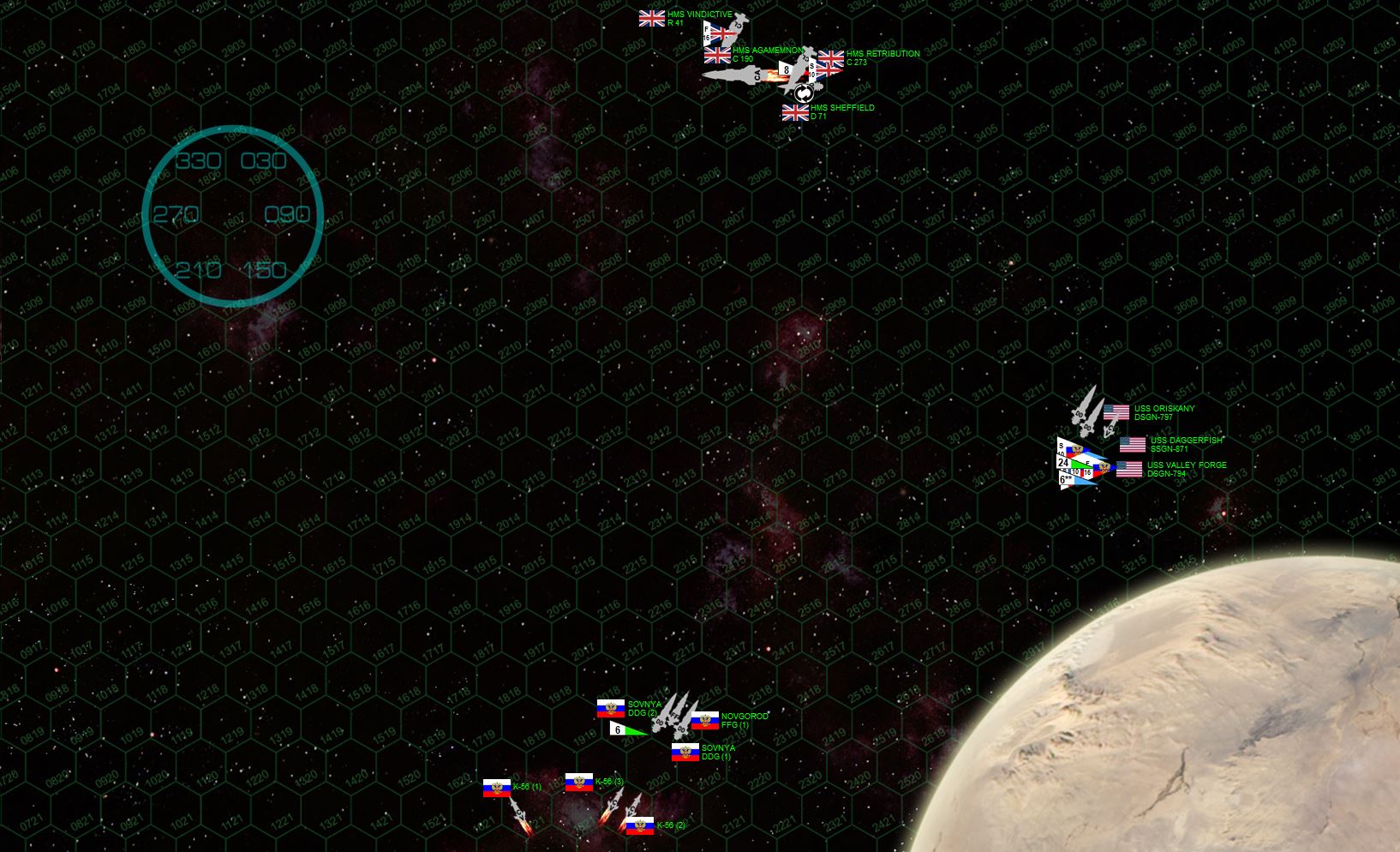 With the Agamemnon now crippled, the Retribution takes over as flagship and carries on the struggle. The Americans (a little peeved that the Russians didn’t stick with them to offer mass driver support), break off on their own and start working around behind the British for broadsides across their sterns. Gunfire against the Oriskany is horrific, and she takes heavy damage along her port bow.
 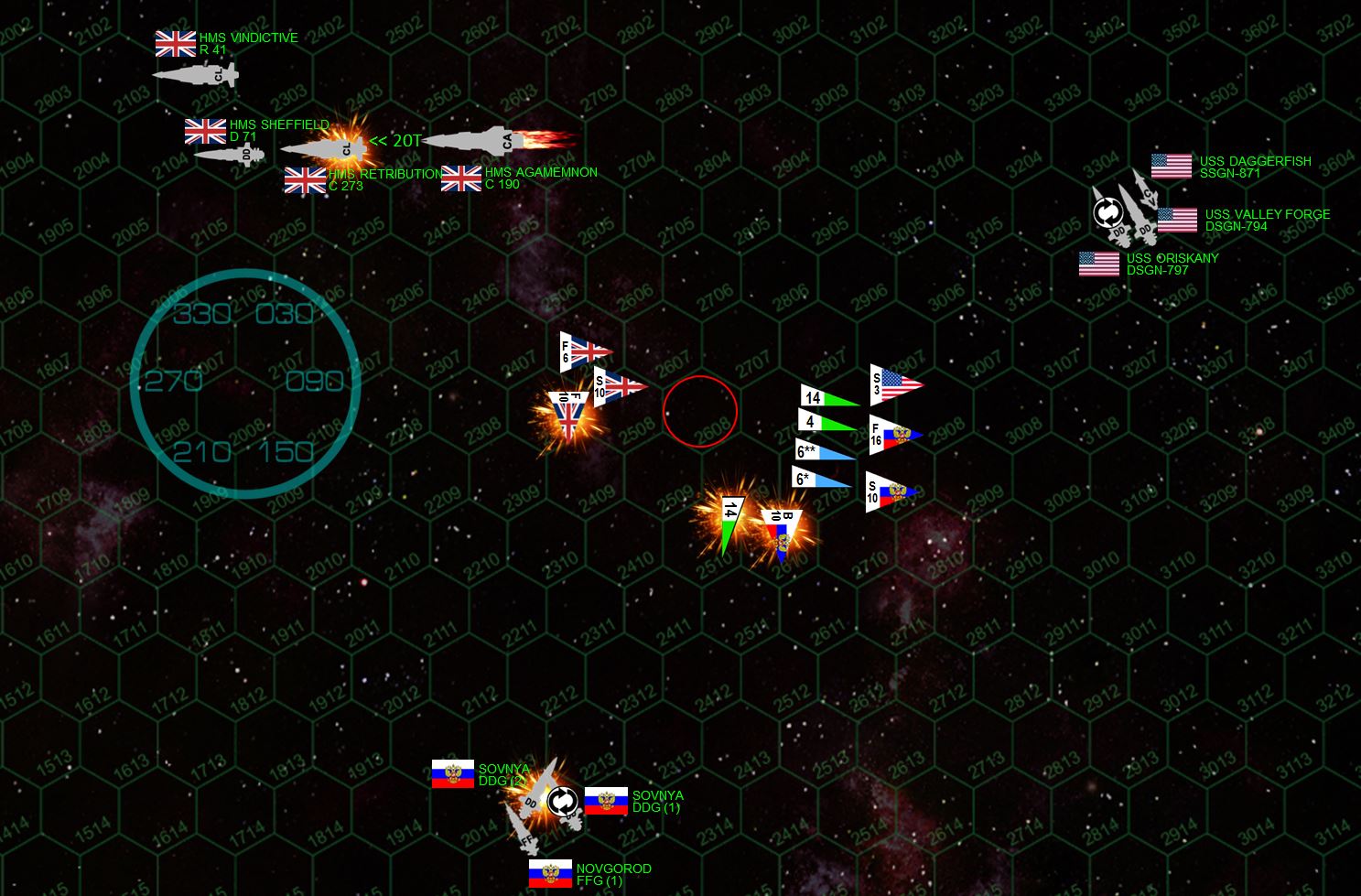 The British are now effectively in a fighting withdrawal, stepping back from the oncoming Russian torpedoes and bombers while the Americans still try to get around behind them. The Oriskany has to roll over on her back to screen his savaged port bow (where she has lost all shielding and her hull is torn open). The British fighters engage Russian bombers and shoot them all down, along with some of their torpedoes (that whole dogfight takes place in Hex 2608). The Russian bombers, once their fate becomes clear, release their ordinance. Not much of their torpedo strike makes it through the Retribution’s mass driver and shields (to avoid losing their aerospace torpedoes completely when the bombers went down, they had to release NOW, not with the main torpedo strike from the destroyers which won’t hit until next turn). American gunnery is also a little disappointing, although to be fair these are destroyers and torpedoes are their main weapon. British gunnery shifts to the Sovnya destroyers. After all, the British have the Sovnyas broadsided, while the Americans have managed to duck in behind them, thus out-of-arc for the forward British batteries. The first Sovnya is shredded by the Sheffield and Retribution, crippled and adrift.
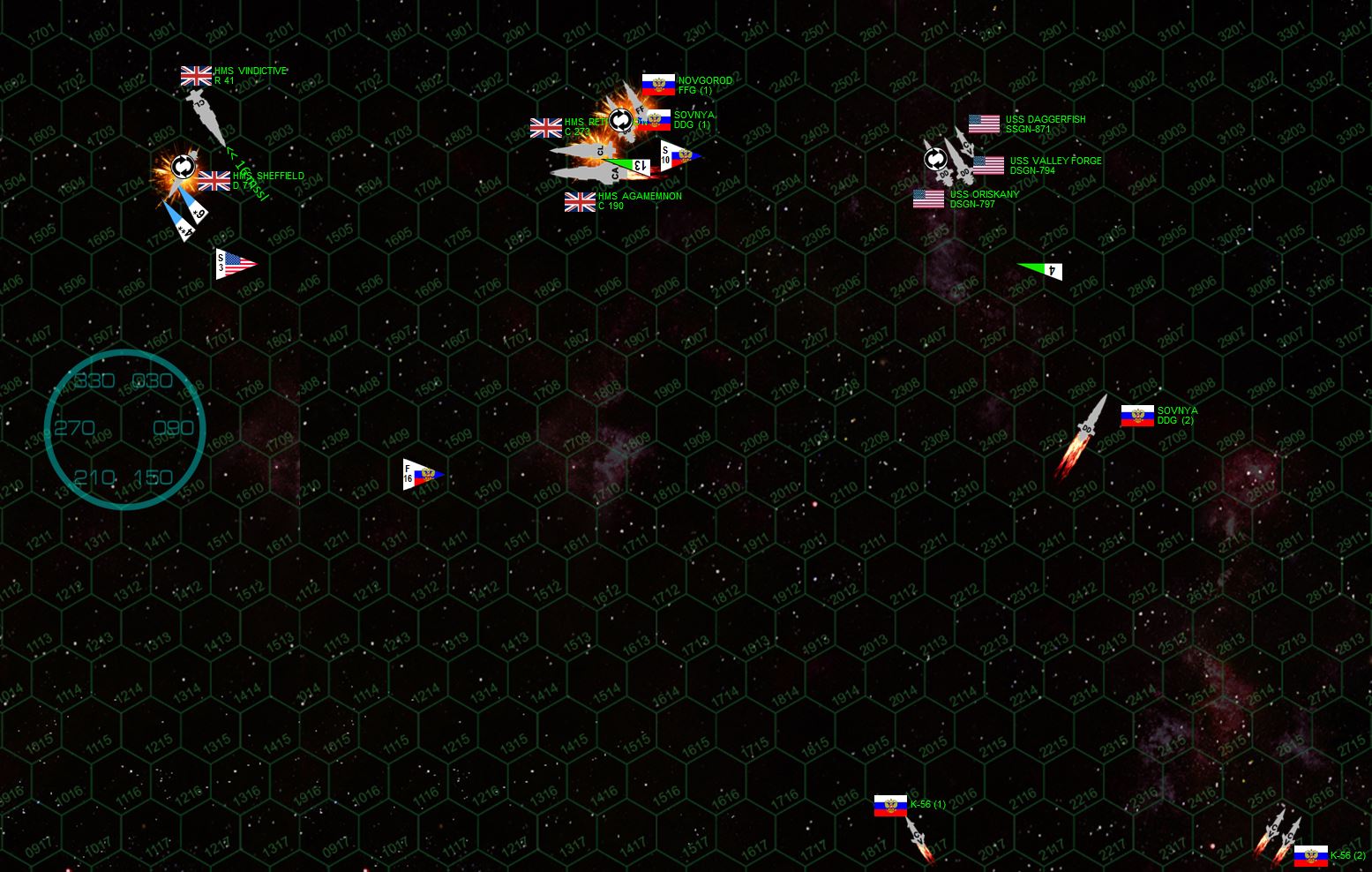 Turn six, and the battle is finally complete. Torpedoes from USS Oriskany and Valley Forge slam into the heavily damaged HMS Sheffield, leaving her afire and dead in space (all torpedoes from the Daggerfish were shot down by the Sheffield and HMS Vindictive). Russian fighters try a missile strike on the Vindictive, but not much gets through the shields. HMS Retribution weathers the worst of the rather disjointed Russian torpedo spread, and the again inaccurate American gunnery. However, the surviving Sovnya class destroyer and Novgorod class frigate have zoomed up for a point-blank broadside on the British light cruiser, and with heavy rail guns and especially plasma accelerators, Russian ships in point-blank broadsides are very, very dangerous. They all but melt off the starboard quarter of the Retribution. But the Retribution gives as good as she gets, with a single broadside crippling both Russian ships.
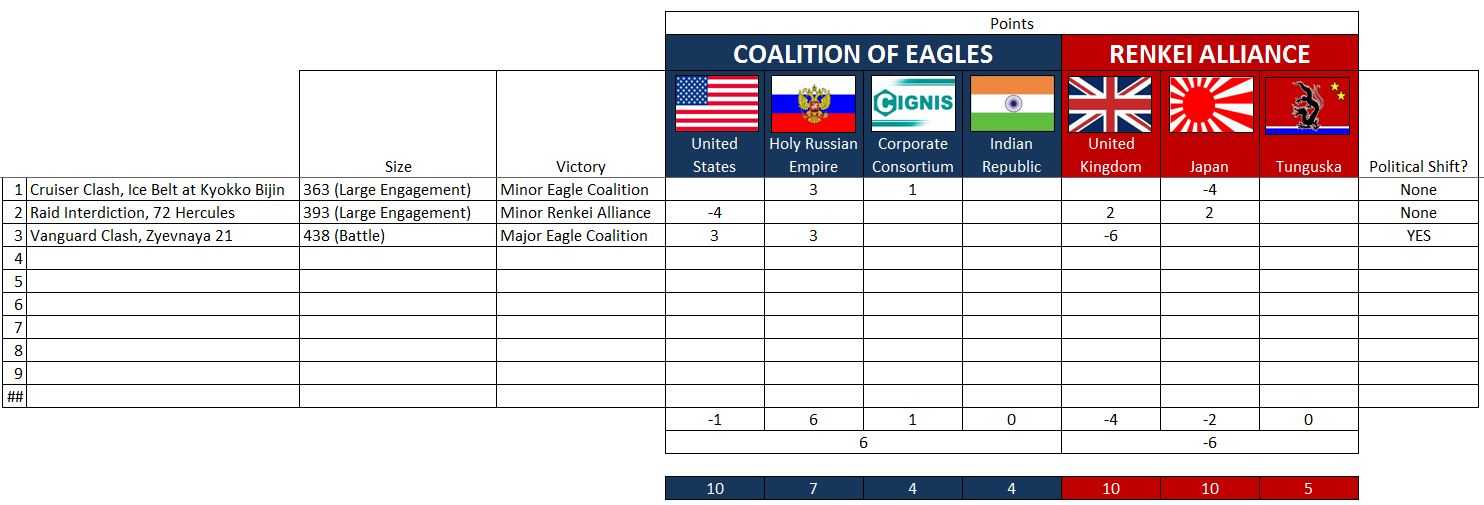 And that’s the battle. The Vindictive has to break off to avoid being destroyed, and since this was an “assault” game, points are assessed based on what remains on the table. The Russians have the carrier, 16 fighters, and a handful of scouts = 77 points. The British have only a few fighters and scouts = 22 points. But the big score is the Americans, which still has the small but very powerful Oriskany battlegroup in play. The Oriskany is badly damaged but still operational, giving them 196 points. Total score is thus 273 to 22, or a +251 margin for the Americans and Russians. This is more than 40% of the starting 438 per side, counting his as a MAJOR victory for the Americans and Russians. Needless to say, the HMS Foxhound falls back to the Outer Hebrides system and the British will be on the defensive for a while. As we can see, for the Americans, they’re still not full recovered from their previous defeat at 72 Hercules, the British seems to have lost a little of their earlier steam, but the Holy Russian Empire is about to declare victory in this war.
New Arab League Warship Class - TWO Darkstar Games today!
We’ll be playing not one but two Darkstar wargames today, with players on four continents. Meanwhile, we’re also ramping up the Arab League for play this evening, so a new light carrier class has been designed into their fleet.
 The Khalifa class light carrier is a newer design for the star caliphates Arab League, in fact the first dedicated carrier class ever developed for this navy. Until the lead ship of this class was commissioned in 2508, the Arab League had always relied on their "hybrid" cruiser fleet, such as Almanzor class light cruisers and Damascus class heavy cruisers, even the Sayf al Qadr (Sword of the Most Powerful) class battleships. These ships traditionally carried a lighter main armament suite in exchange for a partial aerospace fighter and strike complement, allowing each ship to act as a multi-mission platform or a task force as a dedicated carrier strike force. Through the 2480s, 90s, and early 2500s, this unusual doctrine brought Arab task forces startling successes on more than one occasion, so the decision was undertaken to "double down" on the aerospace arm and build a dedicated carrier. The move was not unopposed among some of the League's military leaders, who cited that the hybrid cruisers had been winning with aerospace because the enemy cruiser squadrons they faced simply had no aerospace support, and relatively weak gunnery of Arab cruisers meant that aerospace had to win these encounters by default. Nevertheless, the capabilities of the "Mylekinir" (Fire Angel) fighter and "Demkikham" (Vengeance) bomber are the match of any in Known Space, especially after fleet-wide modernization and refit programs undertaken through the 2510s. The Khalifa class carries plenty of them, surprassing most light carriers and matched only by the American Buford class and Japanese Shimada class. The Khalifa also packs plenty of warhead delivery support, namely the advanced "Ahrasyfa" (Storm) gravitic torpedo in two quadruple racks on the expanded bow, one ventral and one dorsal. Note the unusual layout of these torpedoes, most ships of this type mount them in an "assault configuration" balanced along the port and starboard bows. This, combined with the powerful forward shields, belies the offensive-minded doctrine envisioned for these ships. Like most Arab League ships, the Khalifa's superluminal speeds also outmatch most rivals, all ships capable of at least 11th-magnitude Darkstar waves.
New Warships - Indian Republic
We’ve had some interest in the Indian Republic, and while reviewing their fleet and preparing them for play, I’m finding that the fleet was in need of a refresh and reorganization. So some ship classes have been renamed, designs tweaked, and new warship classes added.
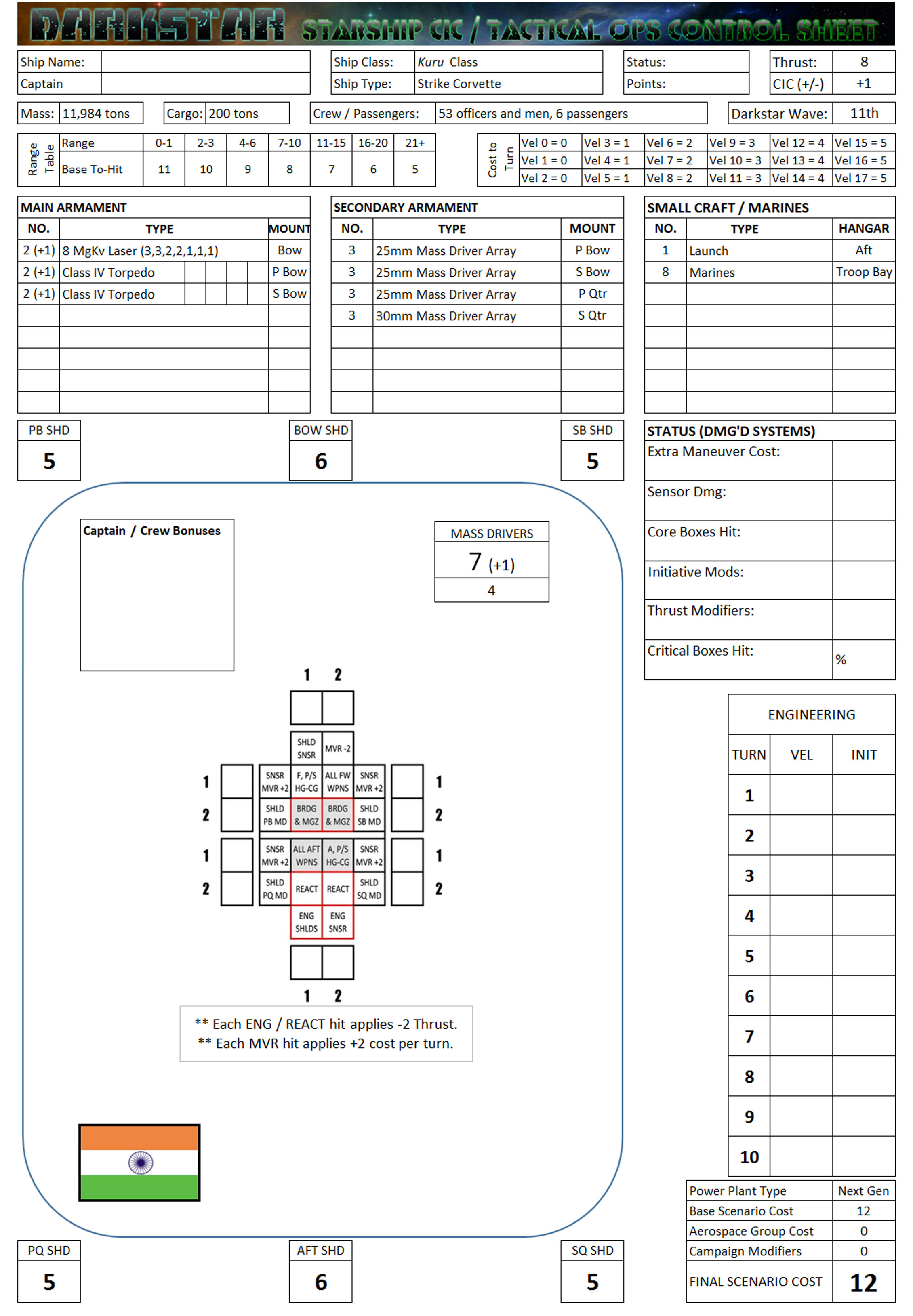 The Kuru class corvette, named for rulers of the ancient Kuru Dynasty of northen India, is the primary attack corvette deployed by the Indian Navy. Especially common in outer Second Band and Frontier star systems and warzones, the Kuru is a sleek yet austere, beautiful yet spartan design. At just under 12,000 tons, these corvettes are light for their type, fast in both sublight and FTL speeds, and able to hit hard with a suprisingly long-range weapon suite. Strictly a strike craft, the Kuru mounts everything forward, including two pair of Katara class gravitic torpedoes and a twin-mounted pair of 8 megakelvin laser emitters. Such a laser array might appear an odd choice for so small a ship (indeed, the entire front half of the ship is basically built around this turret and its powerful capacitors), but remember that such beam-based weapons are the primary and exclusive staple of Indian naval design and doctrine. Whereas most navies tend to think of corvettes as torpedo carriers (the US Mako, Russian K-56, and Prussian Type XII being prominent examples), the Kuru class is a miniature warship, able to snipe at even mid-sized enemy warships at range with their lasers their accuracy enhanced by an advanced CIC and targeting suite. One common tactic is to mass three to five of these ships together in roving packs, the combined weight of their torpedoes usually sufficient to overwhelm the shielding and point-defense of most destroyers, especially once the armor has been scored by laser fire. Several bruising wars against aerospace-heavy powers like the United States (IK Pegasi) and especially the Arab League (the Aquarius War) has also tought the Indian Navy the importance of point-defense, and four triple-mounted 25mm mass drivers ensures that no enemy torpedo volley or aerospace strike group will have a free ride on its way to a Kuru-class target. Commanders who find themselves beset by these ships should take care not to give chase, as they're fast enough to sometimes outrun enemy fighters, torpedoes, and epsecially warships. Another warning is that hit-and-fade attacks by these corvettes are often only diversions for near-suicidal "Kali Squadron" attacks by Sukanya S01 class gunboats. These ships are also sometimes used as high-level couriers or VIP transports, note the accomodations for passengers (several cabins often combined into one "luxury suite" for a Majaraja or other nobility.
 The Vajra class patrol carriers, named for the the celetstial weapons and heroes found the great war chronicles of Hindu mythology, is perhaps one of the most underestimated classes of warship, at least along the Third Band frontier. The swift little Vajras can travel between star systems on eleventh wave Darkstar drives, are respectably shielded, fiercely defend themselves with twin-mounted 20mm mass drivers on all quarters, and mount matching "Arjun" type gravitic torpedo tubes capable of pulling a hole in any ship the Vajra's size. But the Vajra's main weapon, of course, is her small but respectable air group, startlingly impressive for such a small ship. Indeed, these "corvette" class warships can launch as many fighters as most frigate-hulled escort carriers, although complements of bombers and scouts are naturally diminished. Nor can the Vajra launch or recover these aerospace craft quite as fast. Fighters usually consist of the "Chakra" class starfighter, with just one "Nakul" class bomber. Note that for some mission profiles this mix can be altered, with Vajras ditching the scout and carrying just two fighters in exchange for three bombers loaded for strike missions. But usually the fighter complement is carried, since the Vajra is used primarily for patrol, system defense, convoy escort, and screening larger task forces and fleets of the Devanagari, the Indian Navy. Whatever the mix, the Vajra class is capable of streaking into a star system, especially in hunter-killer groups of three or four, launching its aerospace group and torpedoes for a lightning strike, and zipping back out again. Conversely, the Vajra is definitely not a ship at home in toe-to-toe slugging matches, even against gun-armed corvettes or patrol boats they tend to fare poorly. In larger fleet actions they tend to either hang back with the flagships, supporting with mass driver fire or torpedoes, or sweep around an enemy wing to launch fighter strikes against targets of opportunity.
 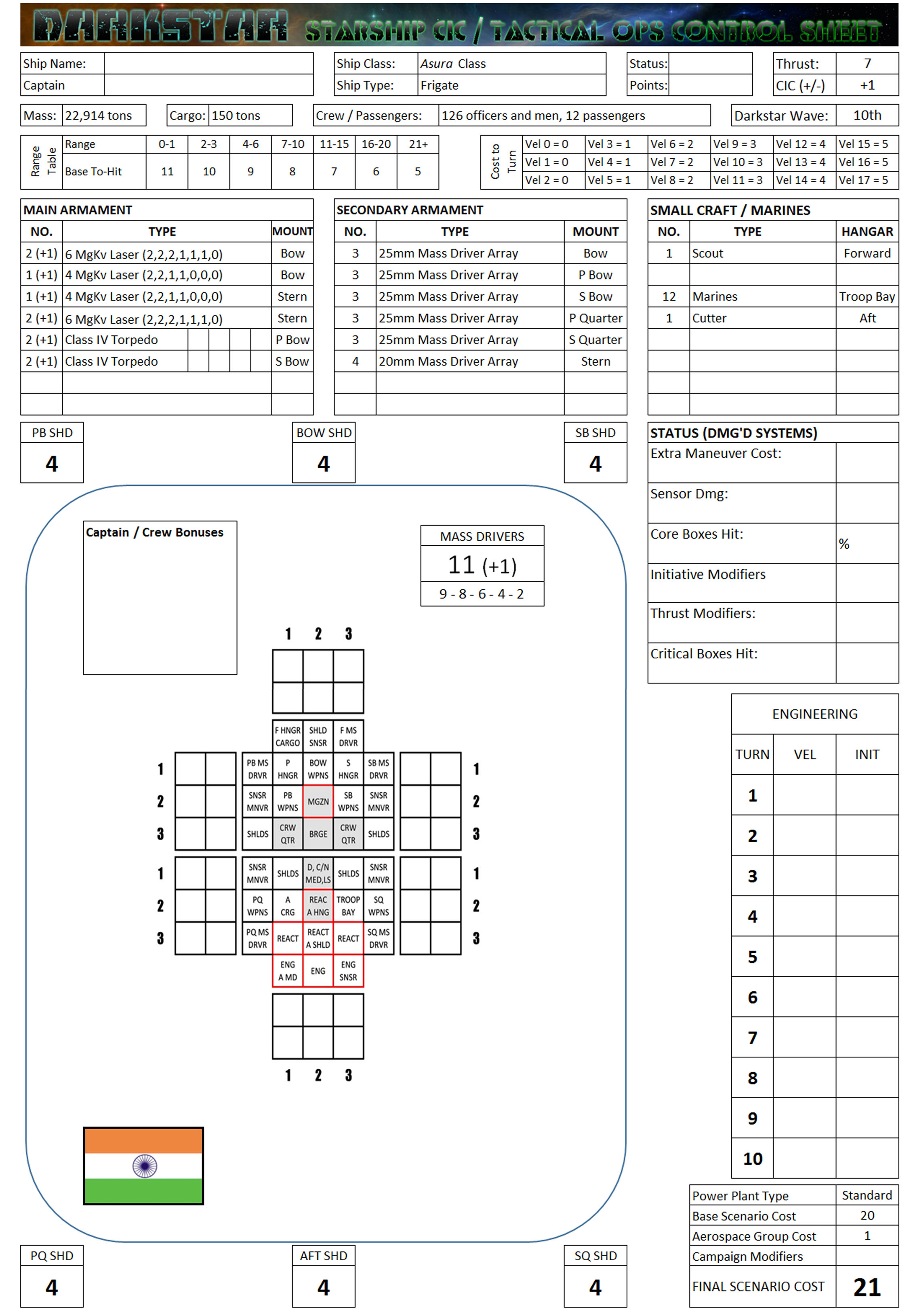 The Asura class frigate, named for a class of dangerous dieties in Hindu mythology, is fairly typical of the warships developed and deployed by the Devanagari, the Indian Navy. Armed almost exclusively with laser weapons, by far the preferred weapon of the Indian Navy, the Asura is thus light for a frigate but not especially fast, as lasers draw much more power than other classes of comparable-caliber weapons. This also means that while Asura frigates are deadly against other small ships or even destroyers, they have a very hard time contributing in a meaningful way against larger ships. For this reason, the Asura class frigates are deployed almost exclusively in the Third Band of Known Space, where cruiser-sized ships are exceedingly rare. Note the expanded cargo bays, vital for any ship that wants to operate this deep into space for extended periods of time. The Asura also has a very large passenger capacity for its class, a common feature aboard all Indian ships. This allows officers and even some senior enlisted men the option to bring members of their family with them on long deployments, and also makes Indian warships very comfortable to serve on, even if it places considerable strain on the Asura's limited available volume. Still, the Asura is a solid design, well-constructed and able to tangle with hostile ships of its own class on a very competitive basis. This is especially true if the Asura is able to keep the enemy at a distance where the range of its lasers arrays can be leveraged to maximum effect.
 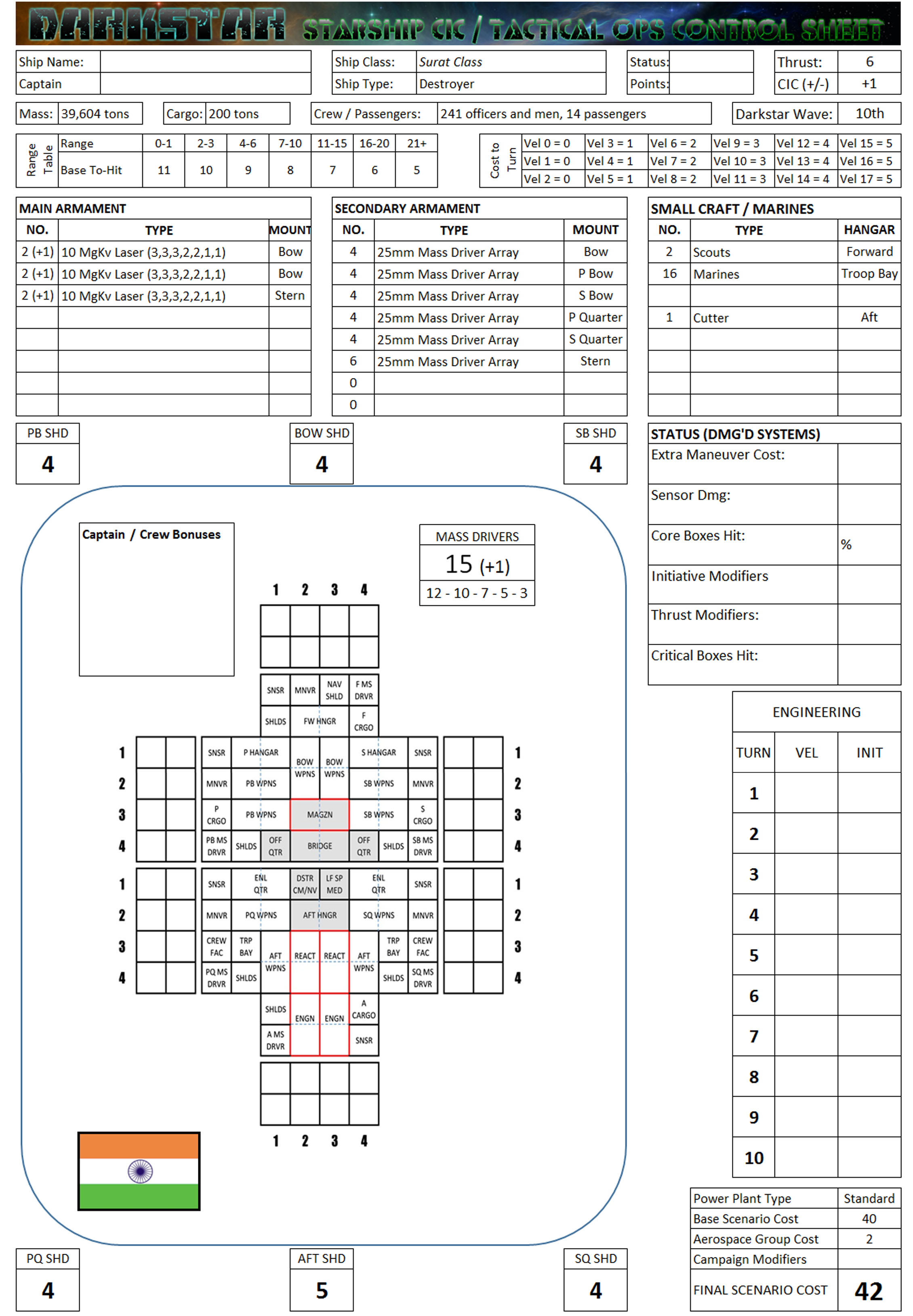 The Surat class destroyer is an older design of the Devanagari, or Indian Navy, but one that the fleet seems unwilling to part with. Production run on these destroyers began over thirty years ago, but their rugged service in fleet support, sector patrol, and open combat has proven solid enough that some shipyards are rumored to still be building upgraded and modernized variants of the class. A big reason for their effectiveness and popularity could be the weapons suite, with no less than six 10 MgKv lasers these destroyers are extremely effective and supporting bigger ships in bigger battles, where fleet commanders prefer to keep longer engagement ranges. With an upgraded sensor, targeting, and command suite, the Surats have kept reasonable pace with the state of electronics warfare, lending further accuracy and effective range to these lasers. The shielding, sublight speed, amass driver defenses, and Darkstar capability -- while unremarkable -- are still solid for the Surat's class. One possible weakness could be the relative lack of secondary armaments, with just four torpedo tubes (torpedoes are usually a destroyer's bread and butter) the Surat becomes something of a "one trick pony" with its powerful lasers. Fortunately for the Surat, that pony has a potent kick. In the seemingly endless (and near-genocidal) 2486-2502 Aquarius War against the Arab League, Surat destroyers suffered somewhat against larger classes of warships, whose larger components are not as easily effected by the pinpoint drilling effect of lasers. Against smaller ships, however, the ships became veritable angels of death. They also picked up the reputations as "executioners," finishing off targets already damaged by bigger ships' rail guns, plasma arrays, and torpedoes. Always in the thick of the action in this war, Surats took heavy losses, but also racked up impressive victory tallies, and the Indian Navy seems intent on continuing production on this venerable class, albeit on a limited basis. They are named after mid-sized cities of the terrestrial Indian Republic.
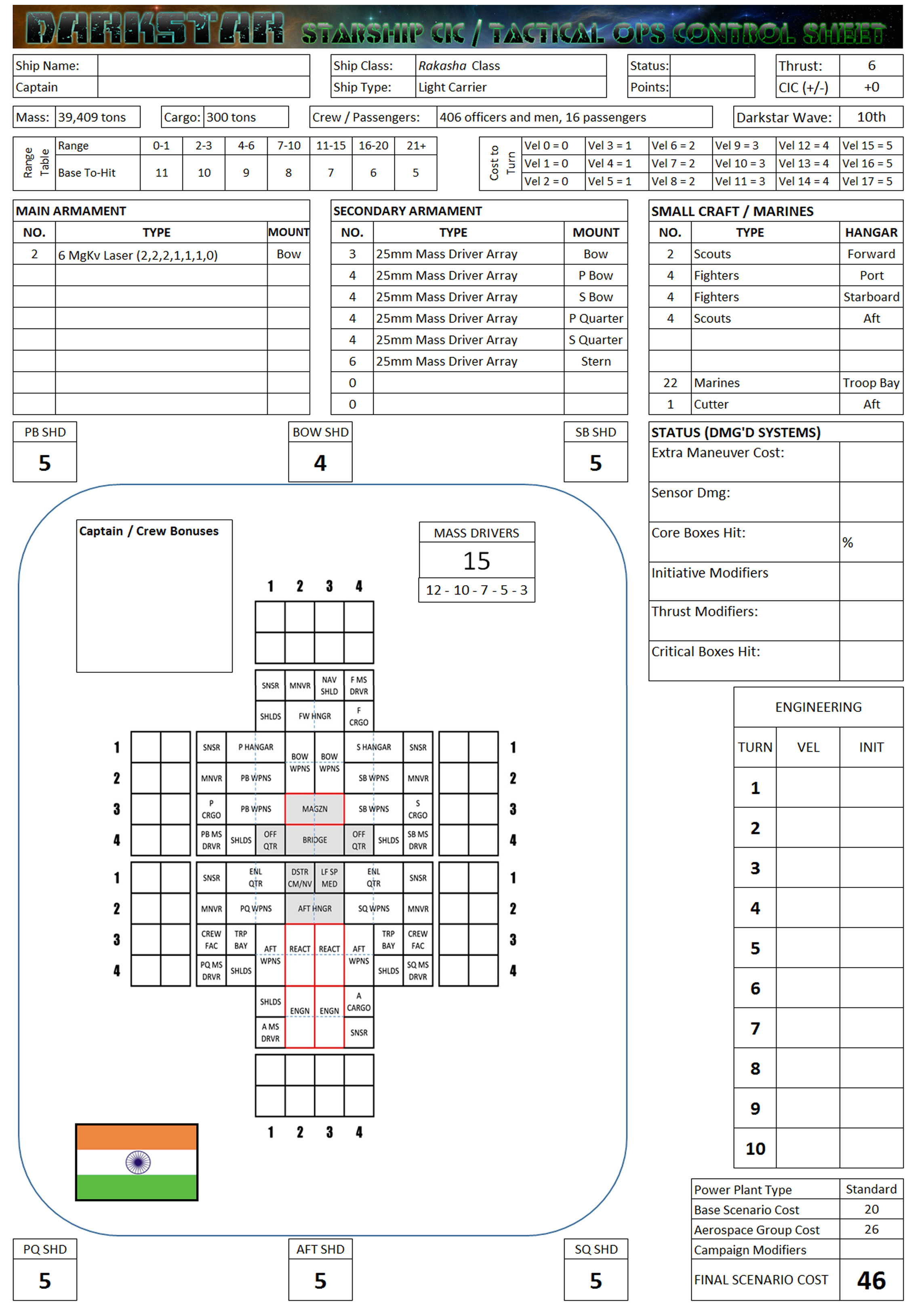 The Rakasha light carrier, named for legendary demons and demonesses in Hindu mythology, has been a fairly successful starship class built to project Indian aerospace power deeper into known space. Conceived originally as something of a stopgap while larger classes of fleet carriers were built, the Rakasha carriers in fact proved to be tough, reliable, and flexible aerospace strike platforms. They are admittedly an older design, dating back from the closing days of the long and brutal Aquarius War against the Arab League. They underwent something of an overhaul and modernization whgen the new Chakra class aerospace fighter was introduced, requiring significant redesign of the Rakashas' launch bays and hangar facilities. While a long and expensive process, the the effort proved worthwhile given the quantum improvement of the Chakra over the older Dhanush (Longbow) class fighter. Analysts agree that this enhanced aerospace superiority and strike capacity has added at least twenty years to the service life of the Rakasha class light carrier. The Rakasha is somewhat unusual for a ship of this type, dispensing with the usual torpedo arrays and instead mounting the staple of the Indian Navy, the long-ranged laser. With just two emitters mounted in a forward turret, these weapons are strictly secondary, and of course cannot directly support the Rakasha's aerospace strike with further ship-launched warheads. However, experience has shown that while the Rakasha is launching, assembling, and deploying its aerospace strike (usually at least three minutes after the onset of an engagement), even a few drilling laser hits by these weapons can sometimes be enough to make a critical difference in the final effectiveness of such an aerospace strike, especially in aerospace torpedoes or missiles hit in areas previously damaged. In all, the Rakasha is a solid if unremarkable design, reliable if not fantastic, well-trusted by crews and commanders, and sure to see service in the Indian Navy for at least the foreseeable future.
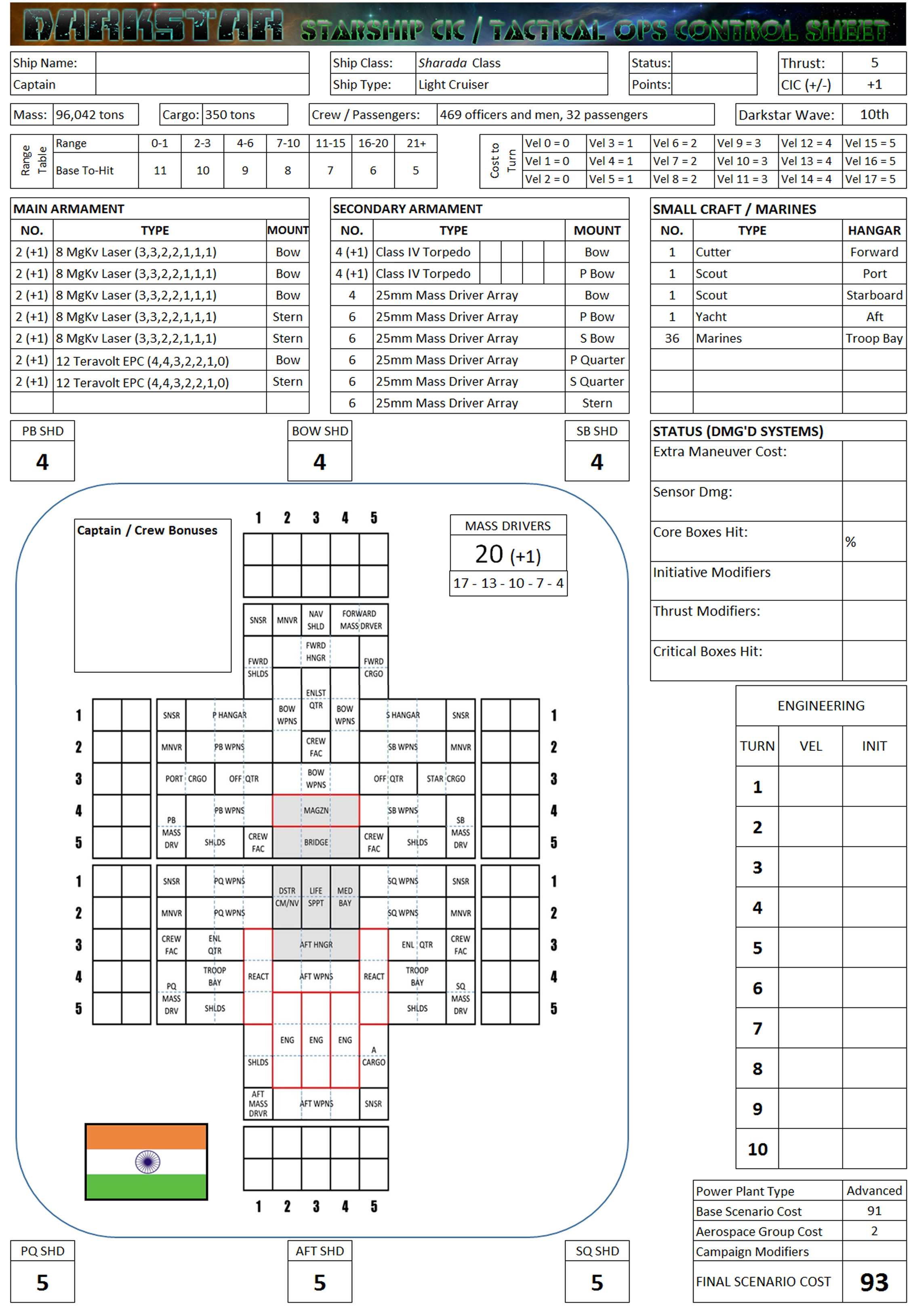 The Sharada class light cruiser is one of the newer warships coming off the slips of the Indian Republic, named for famous admirals in the early days of their interplanetary (and later interstellar) navy. Like most Indian warships, the Sharadas are sleek, beautiful, and very advanced, although not exactly heavy hitters in a capital ship action. With an advanced DT-fusion reactor assembly turning the gears down in engineering, the Sharada is anything put underpowered. The Sharadas are mounted with an advanced "Aakash 870" model targeting, command, control, and comms array, along with respectable Darkstar and ion drives for sublight propulsion. Yet for all these attributes, the Sharadas were not perfect. Originally, the ship was faster, but mounted only their four turrets of double-mounted 8 MgKv laser emitters. But early experience in combat against the Arab Leage, Chinese, and rogue British "privateers" showed that while these weapons can certainly shoot holes in hulls, the odds of significant internal damage (decompression, internal explosions, engine shut-downs) was pretty slim. For this reason, the Sharada class was pulled in and retrofitted with the new 12-teravolt EPCs. This slowed the ship down, and cut into the family quarters (always extensive on Indian warships, see the expanded passenger accomodations). But even the most diehard Indian naval design officer had to admit that no cruiser can outrun rail guns, and bringing your family along in space doesn't do much good if you can't protect them. After the refit, two Sharada class cruisers (Anasuya and Zinta) were escorting an Indian settlement convoy when they were attacked by a Russian "wolfpack" of Russian destroyers and K-56 class corvettes. Complemented by their new EPCs and torpedo arrays, the two cruisers quickly exploded three of the corvettes and crippled a destroyer, putting the rest of the Russian raiders to hasty flight. Another ship of the class, the Kharnanda, sailed under the flag of the the Maharani Jaya Amritachandra (Victory of the Eternal Moon) during the recent IK Pegasi conflict. As the flagship of the Indian battlegroup, she nearly turned the tide of victory against the Arab League and Americans at the climactic battle of Jebel al Itaqu.
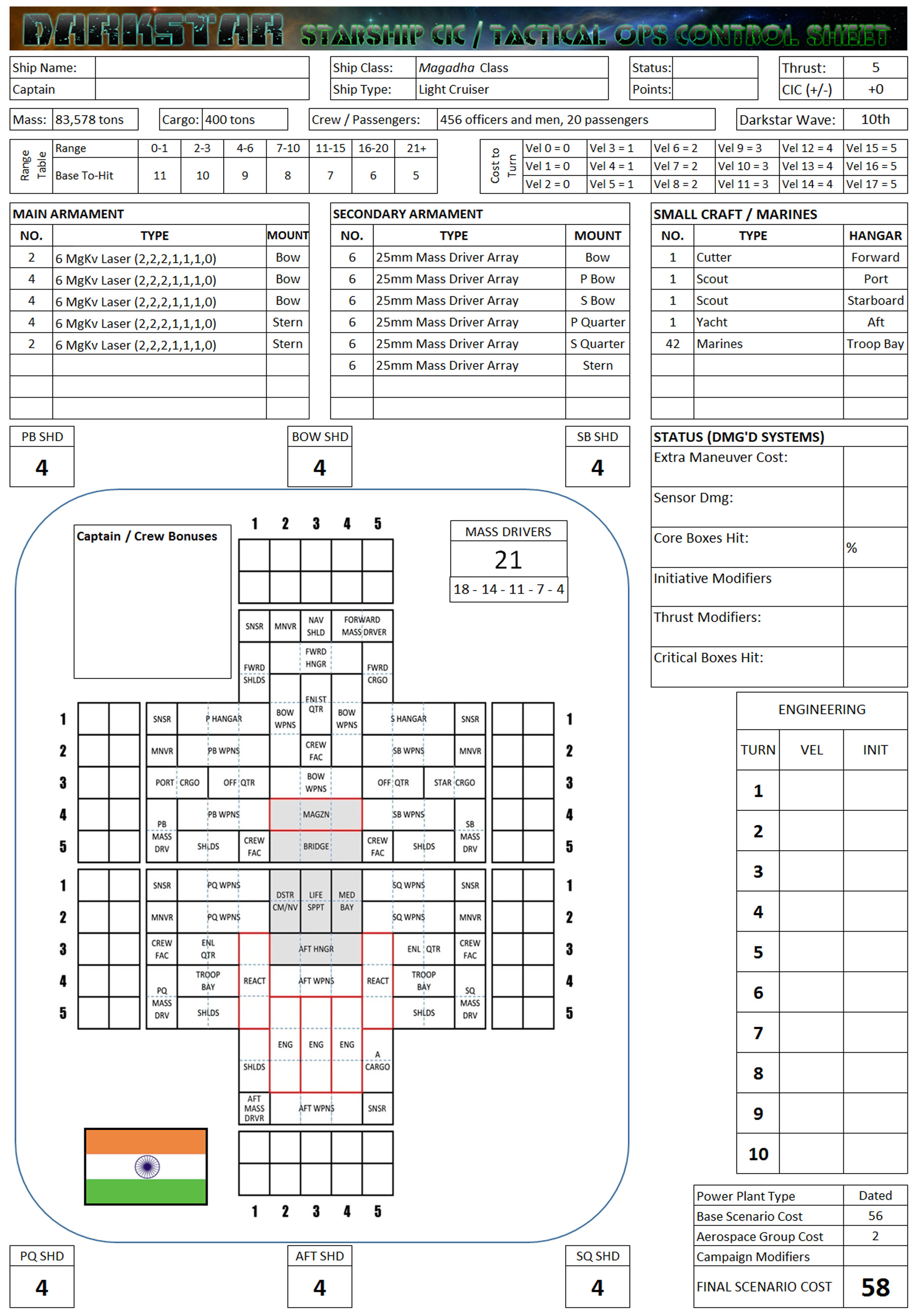 Until relatively recently, the Magadha class light cruiser was seen as a glaring weakness in the Indian Navy, and perhaps any long-range prospects of the Indian Republic as amn interstellar colonial power at all. Named for the ancient monarchs of the Magadha dynasties, the Magadha cruisers actually began their careers with promise, their dizzying array of 6-megakelvin lasers burning holes through virtually every opponent they came across. The advent of the Aquarius War, however, put the Magadhas up against new threats the design was not prepared for, heavy concentrations of Arab League aerospace groups and Russian torpedo spreads. Heavy damage to several vessels, including a few explosions, scuttlings, or total write-offs, prompted immediate upgrades to the ship's mass driver defenses, but this only slowed the ships down, making them easy meat for Arab Shabbak-class gunboats and Russian torpedo corvettes. A second round of refits with lighter, more power-efficient 25mm mass drivers largely corrected the issue, but by then the embattled Magadhas were twenty-five years old. Formerly a "dreadnought" in duels against enemy light cruiser, destroyers, and frigates, these ships found themselves up against more heavy cruisers or advanced light cruisers. Those 6-megakelvin lasers, plentiful as they were, just weren't heavy enough to cripple enemies of this caliber, especially since the Magadha had to get so close for them to appreciable damage. Finally, the Sharada class light cruiser was introduced. While a "replacement" ship class usually sounds the death knell of the older type, for the Magadha the new stablemate provided a second lease on life. Relieved of task force and battlegroup flag ship duties, the Magadha found a new role as capital ship escorts for the larger Gujarat class heavy cruisers, Naga class strike carriers, Maya class fleet carriers, and Kali class battleships. The Magadhas' relatively modest speed is no issue here, their huge volume of smaller-caliber weapons makes them ideal for fending off smaller ships that love to prey on larger ship's sterns and engineering sections, and their upgraded point-defense systems allow for solid support against enemy aerospace attacks. Losses, damage, and drydock time have fallen off sharply, and the venerable old Magadha class have settled in their new role, often seen as "prestige" ships in a task force given their long and storied careers.