








Persei-Aries War – Oriskany v. Rasmus




Recommendations: 1421
About the Project
After racking up 127 entries, 3500+ recommendations, and 600+ comments, the original Darkstar project thread was getting a little unwieldy. So I'm starting a new one, featuring a new campaign for interested players in the OTT community and beyond. So far we have five players, but there's always room for more!
Ever wonder if you had what it took to command fleet of starships in tactical combat? Darkstar offers that challenge to the hard-core wargamer, with a "Newtonian Physics" movement system, rules for astrophysical objects and phenomena, gravity, and of course dizzying amounts of 26th-century firepower. There are no aliens, no "hyperspace," no planets that look suspiciously like movie studio back lots. Just the old empires of Earth doing what they do best, colonization and kicking the hell out of anyone who gets in their way (i.e., each other).
In addition to starship tactical combat, Darkstar includes rules for carriers and aerospace craft, atmospheric operations, orbital and surface installations, boarding actions, assault landings, and a complete campaign system.
The system is free to download for members of the OTT community, and of course we play almost every weekend with a on-line version with starship commanders around the world! So if you ever want in, you know where to find us!
Related Genre: Science Fiction
This Project is Active
Task Force Oriskany DEFEATED!
FROM: UNITED NATIONS REGIONAL COLONIAL CENTER
02:30 SOL GMT, 15 NOVEMBER 2520
BREAKAUTH: 181072.18J
CLEARANCE: SECRET (NATIONAL)
**UNITED NATIONS COMMUNIQUE**
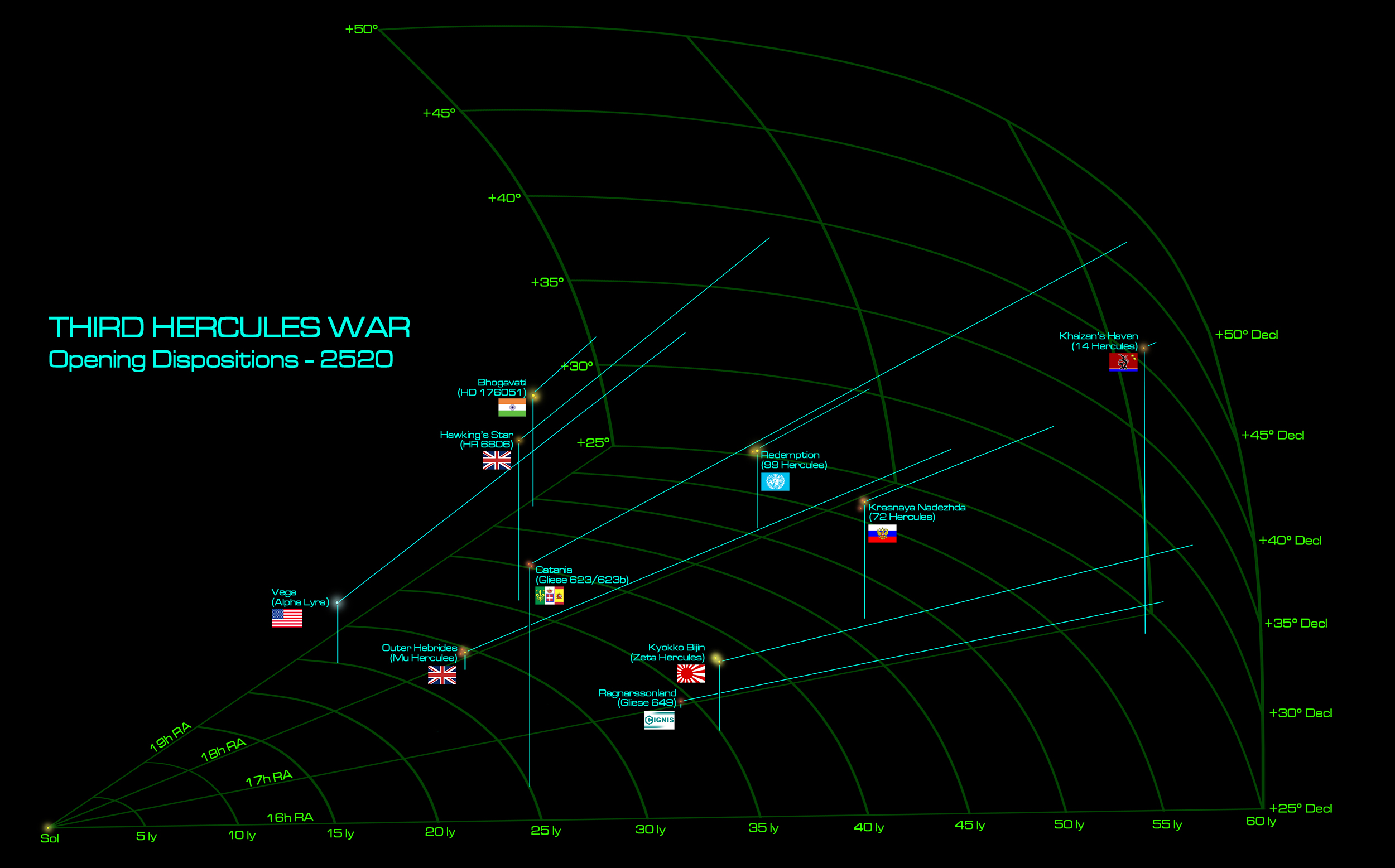
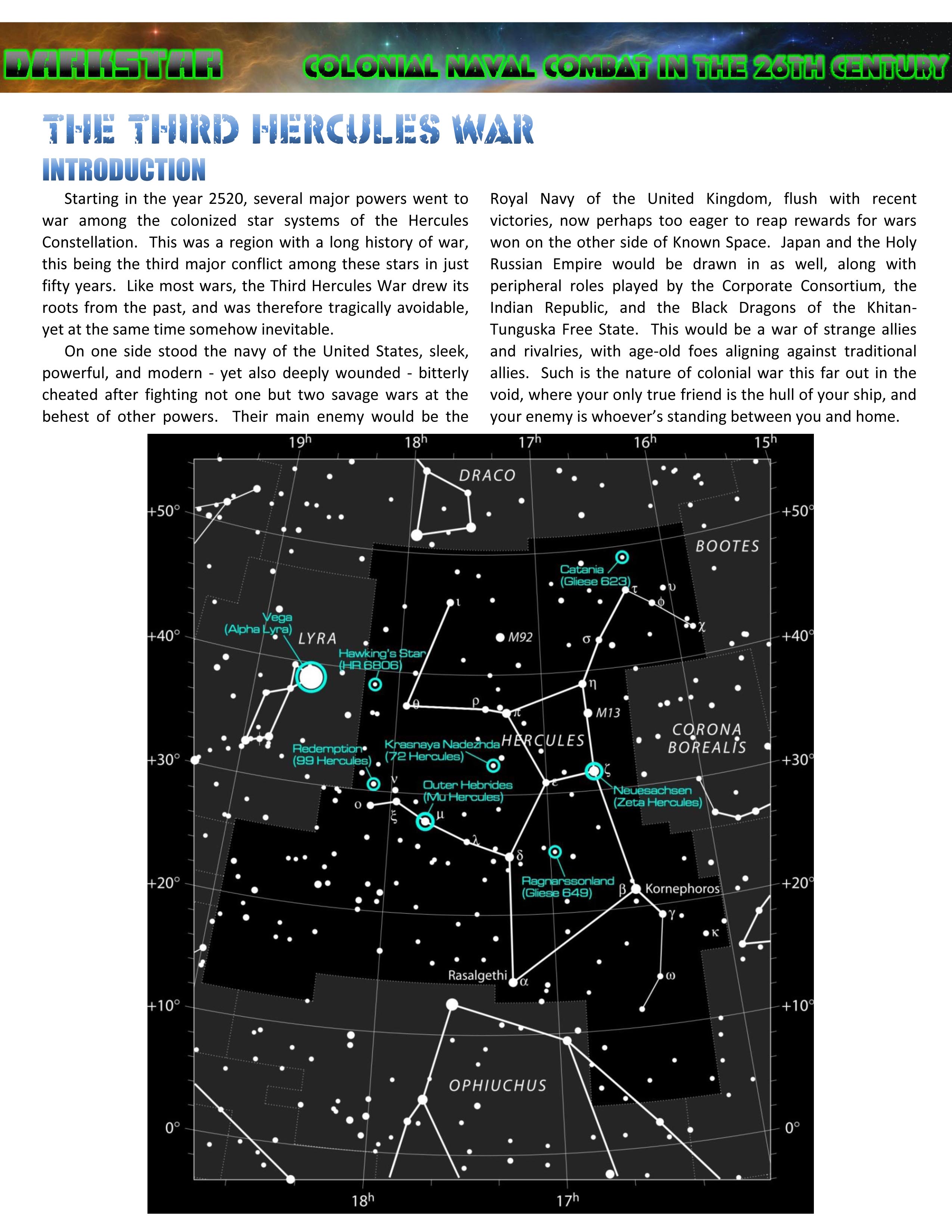
A second battle has been reported in the rapidly-developing Hercules Crisis. It seems the United States has now entered the war, honoring new treaties with the Holy Russian Empire, which opened hostilities with the United Kingdom and Japan last month in the Zeta Hercules system (Kyokko Bijin – “Beauty of Dawn”) We can now confirm that TASK FORCE ORISKANY has engaged in open combat in the 72 Hercules system (Krasnaya Nadezhda – “Red Hope”), apparently to intercept a British and Japanese raiding force against the Russians in retaliation for their incursion in Kyokko Bijin.
The American intervention was a startling one, given the distance of their closest base at Vega (Alpha Lyra) some thirty light-years away. But during the recent Xi Scorpio and Scorpion’s Tail Wars, Task Force Oriskany has built a record of incredibly fast superluminal jumps, their ships apparently fitted with heavily-upgraded Darkstar drives. Thus, when the British heavy cruiser HMS Agamemnon (escorted by the destroyer HMS Sheffield), alongside the Japanese light cruiser Sendai Byo (escorted by the frigates Urakaze and Sakito) emerged from their Darkstar waves in the outer protoplanetary debris field of the Russian-held 72 Hercules system, they found the much smaller American force just arriving as well, along with a Russian K-56 class torpedo corvette. The two forces will meet at Molodoy Burunduk (Baby Chipmunk), a Mars-sized planet far out on the outer fringe of the 72 Hercules system.
Given that the British and Japanese (known as the “Renkei Alliance”) launched this operation as a raid, and that the Japanese cannot fully commit to a “hit and stay” assault with Russian cruiser somewhere in their own Kyokko Bijin system, and that the Americans are clearly defending someone else’s star system, this wasn’t a terribly hard-fought action by either side. While we are informed that losses on both sides were relatively light, and that fighting was generally cautious, reserved, and measured, it was a major action nonetheless, especially since it heralds the entry of the United States into the war.
The Hercules Crisis is over. The Third Hercules War has begun.
Americans and Russians: @oriskany
British: @damon
Japanese: @rasmus
Played: Saturday, October 26, 2019
Engagement 02: Interdiction of Cruiser Raid, Molodoy Burunduk (Baby Chipmunk), Kranaya Nadhezda system (72 Hercules), 15 November 2520
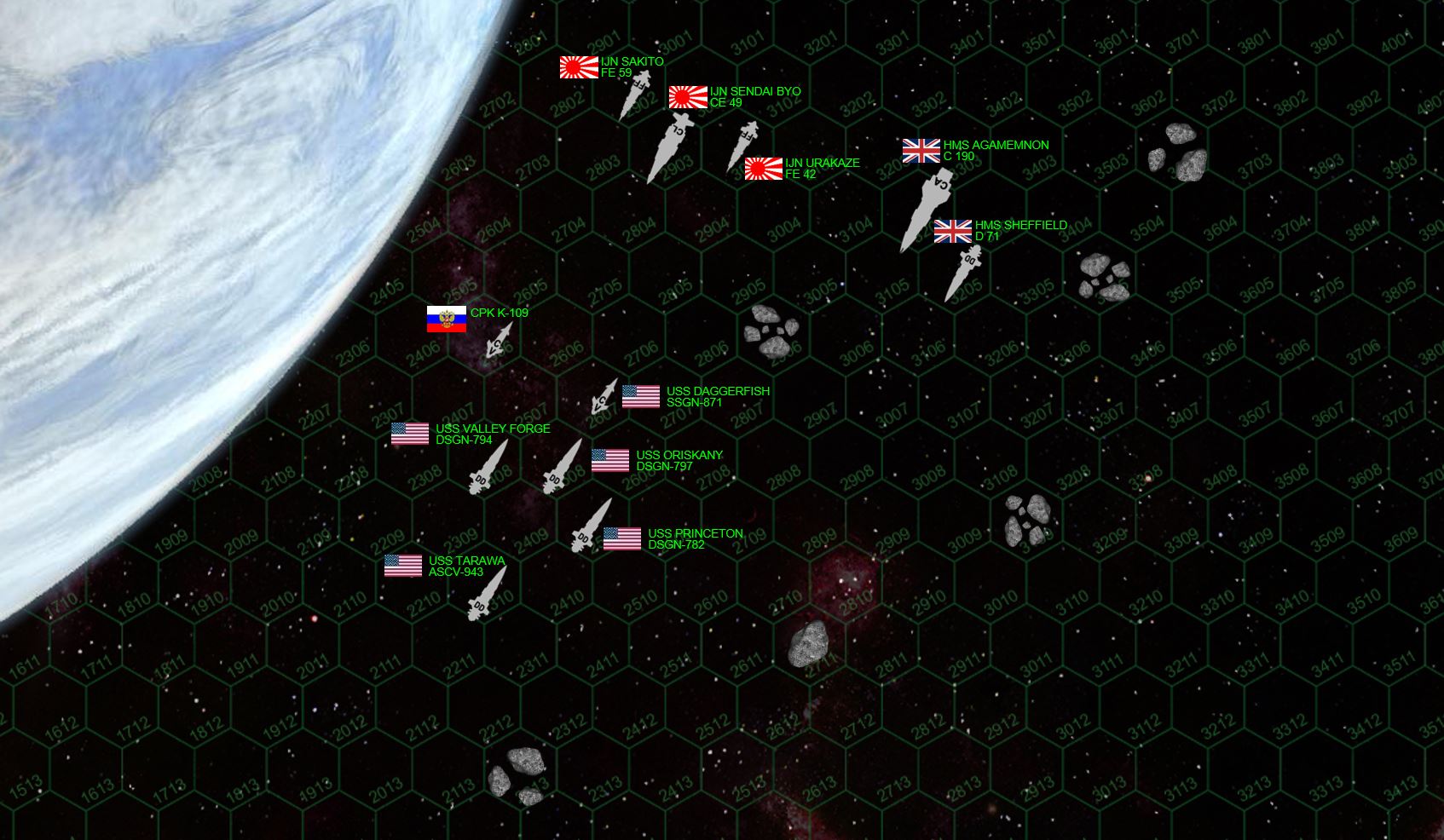 The Americans are outweighed here by as much as three-to-one. Task Force Oriskany has no ship heavier than 48,000 tons (the three Valcour-class destroyers USS Oriskany, Princeton, and Valley Forge), along with the Buford-class light carrier USS Tarawa (technically a USMC planetary assault ship) and the torpedo corvette USS Daggerfish. The “Renkei Alliance” force is headed up by the Trafalgar class heavy cruiser HMS Agamemnon, backed up by the light cruiser IJN Senai Byo, destroyer HMS Sheffield, and frigates IJN Urakaze and IJN Sakito. But what the Americans have is experience and a huge number of upgrades. These are veteran ships and crews, the Marine fighter group aboard the Tarawa is among the best in Known Space (VMSA-309, the Tigersharks). But can that experience and those upgrades really overcome such a vastly more powerful force? The planet is measured out to be Mars-sized (radius 19 hexes = diameter of 6800 kilometers). Usual gravity rules apply.
 Both sides make their approach. The Americans come on incredibly fast, determined to make the most of their smaller ships’ advantages in speed and maneuverability. The Marine fighters launch from the Tarawa, while all American and Russian ships release a full frontal spread of Mk 48 and P-500 torpedoes. The small guns of the Japanese frigates cannot reach the Americans, while the Agamemnon, Sendai Byo, and Sheffield try to ping at the Tarawa with long-ranged weapons. Almost everything misses, however, thanks to powerfully-upgraded ECM and gravitic shielding.
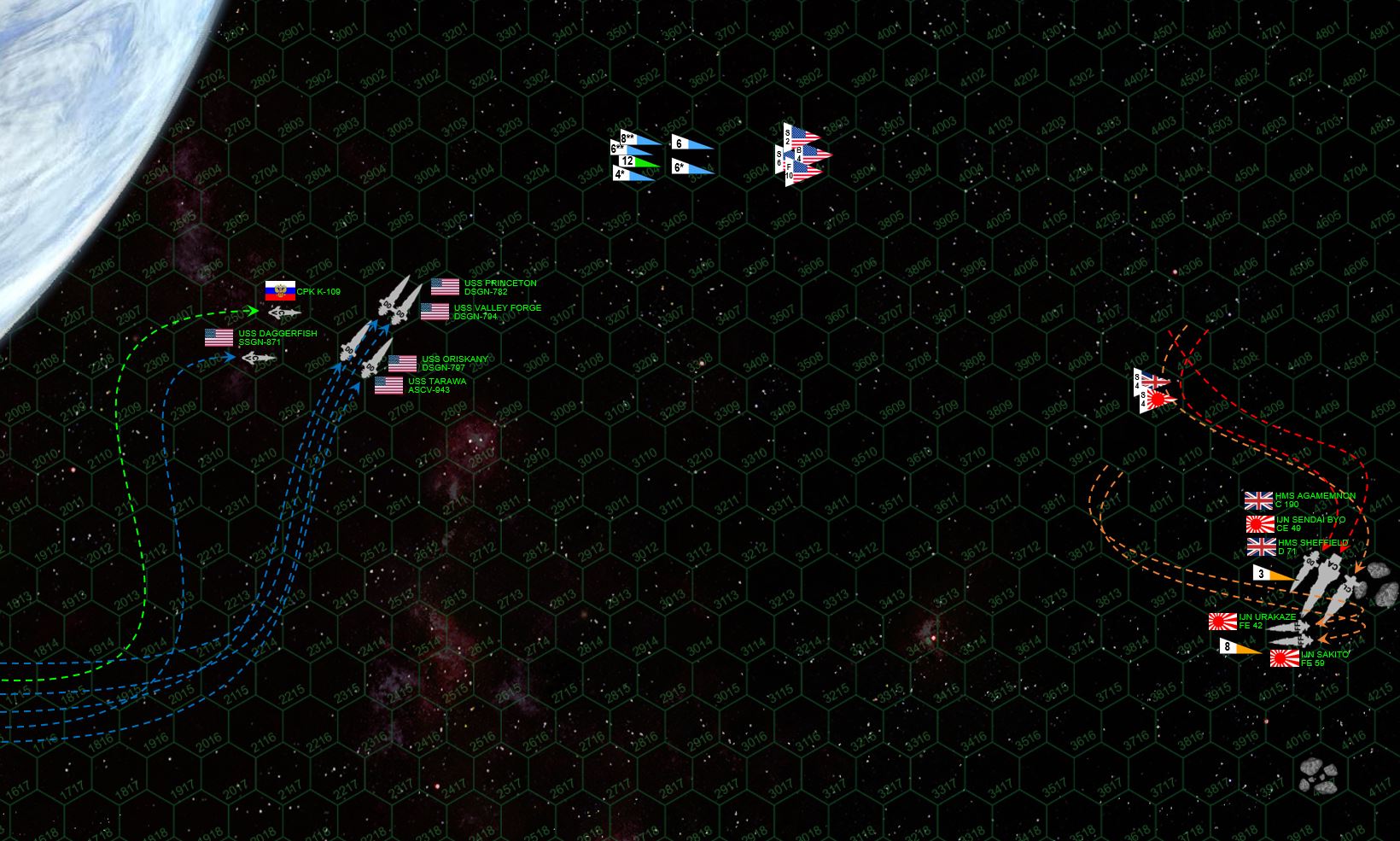 The British and Japanese S-Turn away from the Americans trying to keep their distance where their accurate (and heavier guns) will prove more of an advantage. They’re also hoping to knock out at least one American or Russian ship to thin out that incoming wave of torpedoes. The Tarawa has now finished launching her Marine strike group, “Avenger” bombers and “Corsair” fighters howling in behind the Mk 48s and P-500s. The Americans continue to snake further around the British and Japanese flank, clearly hoping for attacks on vulnerable engines and reactors, and to perhaps force the British and Japanese to turn TOWARDS the planet to engage them. This is always a dangerous move, as a loss of power means the ship is a death-dive toward the planet’s surface. That said, the Americans must also be careful now that the Japanese and British are beginning to maneuver among the debris field of this dwarf planet’s failed moon.
 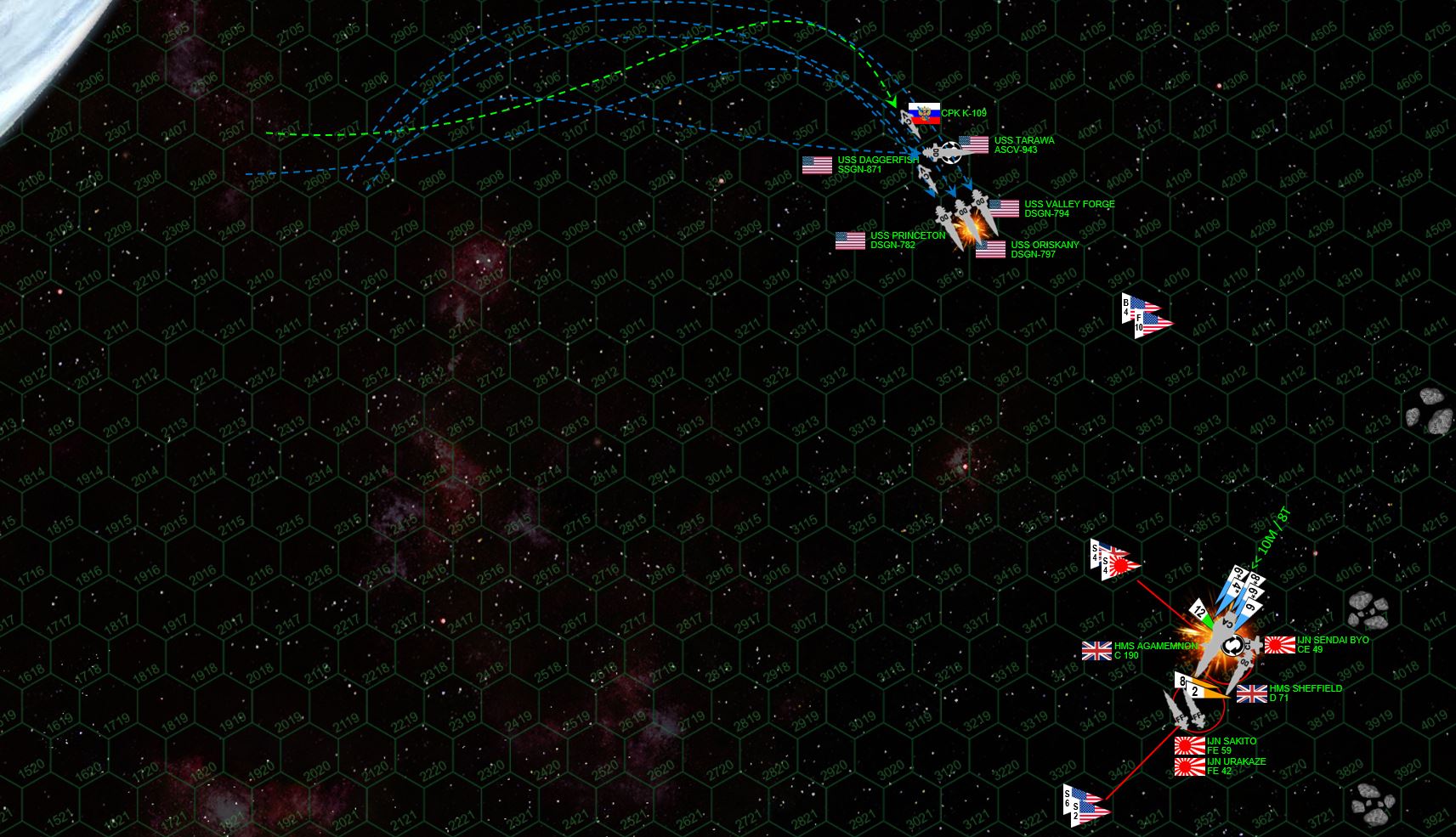 Turn Three, where the Americans finally pounce. With a sharp turn to starboard, they make high speed straight toward the Japanese and British. Their torpedoes make their terminal attack runs at the heavy cruiser Agamemnon, but there’s a crucial flaw in the attack. The slower Russian torpedoes are JUST out of the required range to attack the STERN of the Agamemnon, and instead hit the cruiser’s starboard quarter. This lack of coordination means that the combined torpedo strike isn’t quite enough to destroy the Agamemnon’s engineering sections and cripple the ship, even with the Marine bomber and fighter missile strike. That said, the Agamemnon is GRAVELY damaged, losing two sensor suites and almost blinded. The Japanese and British, meanwhile, pour a complete broadside into the USS Oriskany at just 1800 kilometers, every single gun on all five ships opening fire on one target. Although the bridge and forward magazine is hit, “The Lady O” does not lose power. Casualties are heavy, however, and Captain Matthew Spencer is compelled to order his legendary ship to break off the action.
  Spencer realizes now that he’s missed his first and best chance to win this battle. With just three destroyers, there’s no way he can win in a gunnery duel with a heavy cruiser, a light cruiser, a destroyer, and two frigates. As Oriskany heaves out of harm’s way, the Valley Forge and Princeton move to cover her. Daggerfish and K-109 sling out more torpedoes, hoping that just maybe a second torpedo strike just might cripple the Amagemnon. The Tarawa, however, has taken damage to her maneuvering thrusters in the opening Renkei fusillade … and cannot match the rest of the task force’s turn … not at this speed. She’s thus forced to break off the action in a different direction, but isn’t quite fast enough. Japanese Ki-45 Toryu (Dragon Slayer) torpedoes hit her astern and devastate her engines and power reactors, crippling her instantly. Her “Tigershark” Marine fighters exact a small measure of payback, their chain guns and autolasers actually crippling the frigate Sakito. The second wave of American and Russian torpedoes again slam into the Agamemnon, but again she survives.
 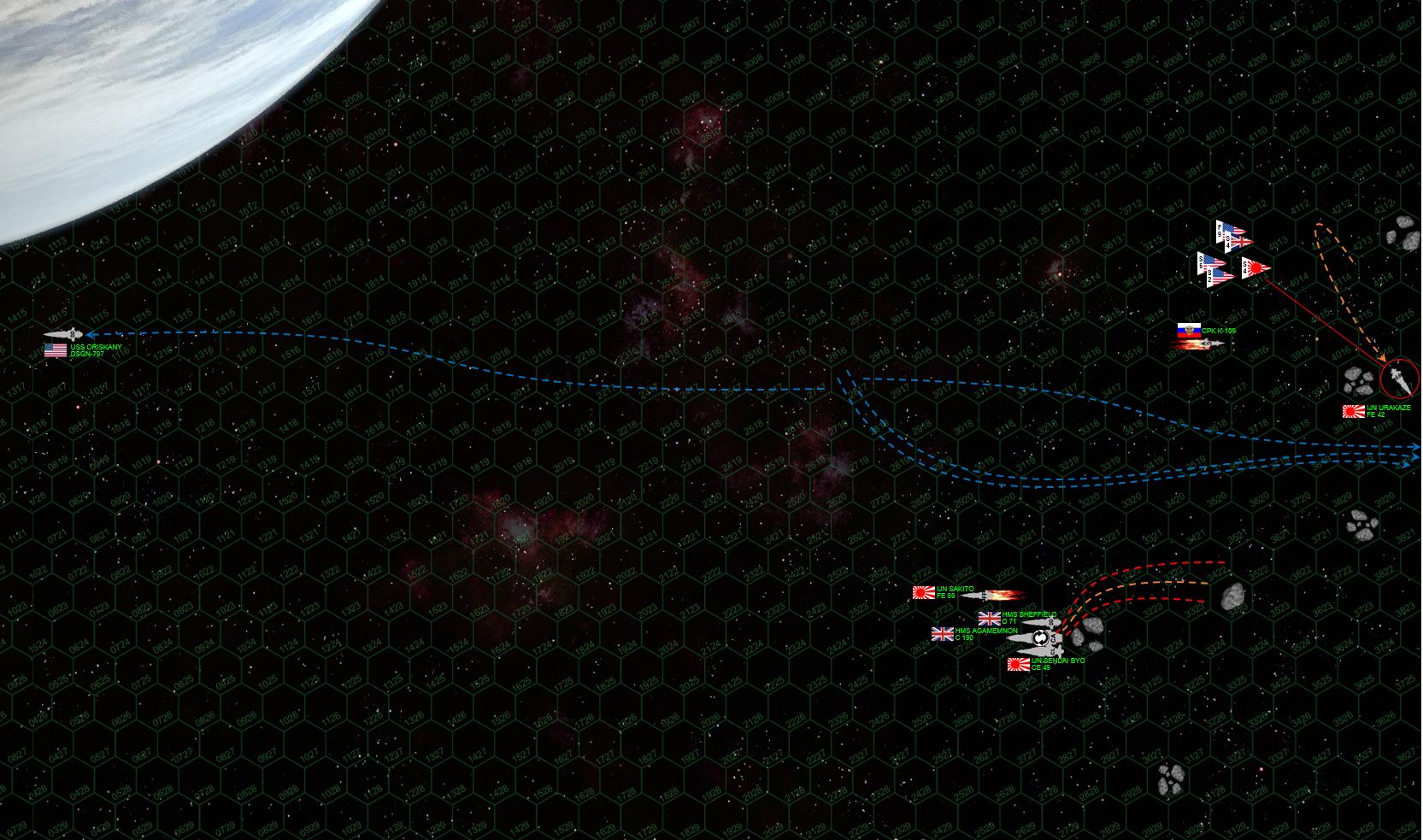 The Oriskany makes flank speed and races out of the battle area, using the planet’s gravity to assist her speed. She’s lost forward shields, even a single hit from a Ki-45 torpedo could end the ship forever. The rest of the fleet breaks off as well, after Spencer makes the grueling and difficult decision against an all-or-nothing gunnery and torpedo strike against the Agamemnon’s injured starboard quarter (they can’t hit her stern directly because her captain Lord Edward Cavendish) has screened his engines with proto-lunar debris directly astern). There’s a despairing attempt by the Marine fighters to “shoot down” IJN Urakaze, but their commander doesn’t realize that Urakaze has no forward shields and so attacks the stern. No appreciable damage is done. The Americans have LOST this battle, with two seemingly small but critical errors that largely threw away their edge in expertise and upgraded ships … instead making this a slugging match of weight against weight, a contest they could never win. For their part, the British and Japanese fought a cautious, reserved, and measured battle, using angles, distance, patience, and asteroid debris to negate American advantages in maneuverability.
 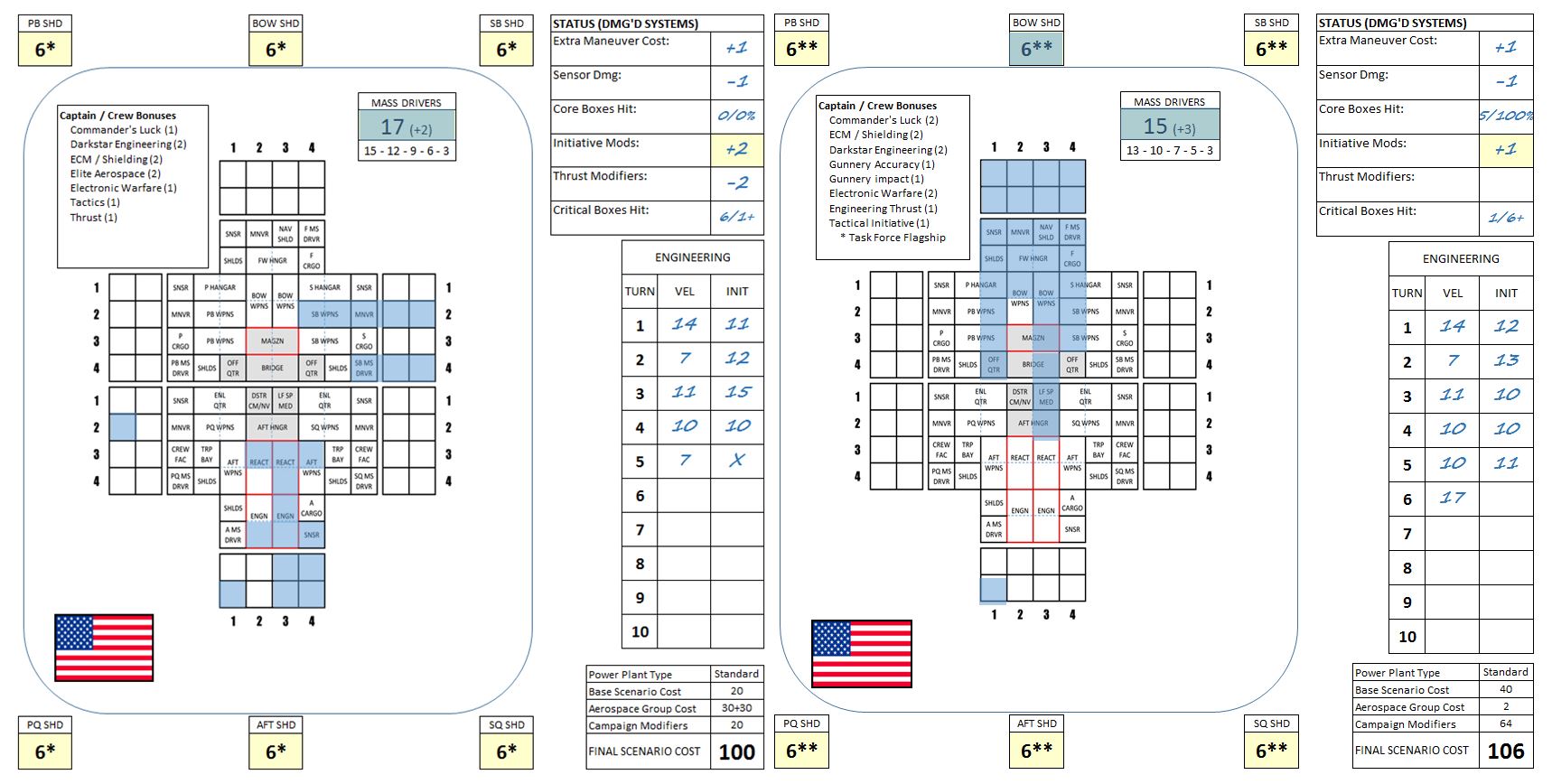 Here are the Warships Record Sheets (WRS) of the Marine carrier USS Tarawa (left) and the USS Oriskany (right). You can see where the Tarawa took the brunt of the Japanese and British cruiser fire on her starboard bow, then a fusillade of Ki-45 torpedoes astern. Then we have the Oriskany, who took every gun in the Renkei force … and at pretty close range as well. It’s amazing these ships didn’t explode, but again these ships have heavily upgraded ECM, gravitic shielding, and enhanced electronic warfare suites. At the end of the day they’re “just” destroyers, they’re just insanely fast, wicked accurate, and almost stealthy enough to serve as Romulan warbirds. :D I’m hoping this comparison also shows how ships can survive a LOT of damage (Oriskany remained operational), or be crippled by just a little. It’s all about WHERE the damage hits, and what systems go down. This means that tabletop tactics in range, angles, movement, and planning are crucial, as well as longer-term forethought when designing the warships themselves.
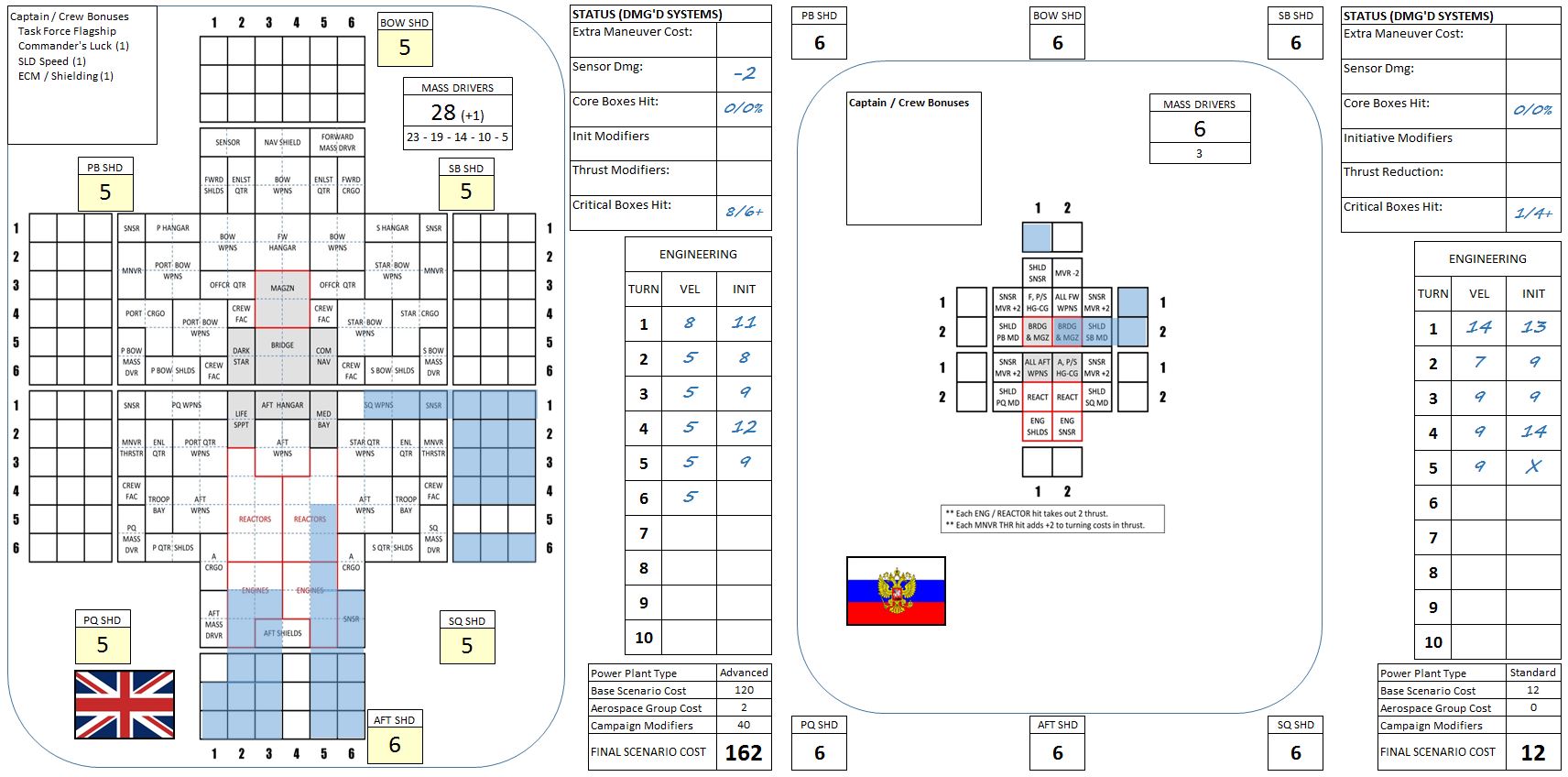 The mighty Agamemnon, where it took the full torpedo might of the Russo-American force … three times. Critically, however, note where the damage is on two sides. The first big slam on the starboard quarter is because the Russian torpedoes were just too far away to hit full astern along with the Americans. Put that starboard quarter damage on the aft facing instead, and this game is a shattering American victory. The second big pasting on the starboard quarter came when Damon maneuvered his cruiser to where I couldn’t get at his stern thanks to asteroids, timely turns, and distance. Then we have the K-56 torpedo corvette K-109, crippled by the pin-point guns on Rasmus’ light cruiser Sendai Byo. Of course, corvettes are murderously hard to hit, but once you do, it doesn’t take much because they’re so small.
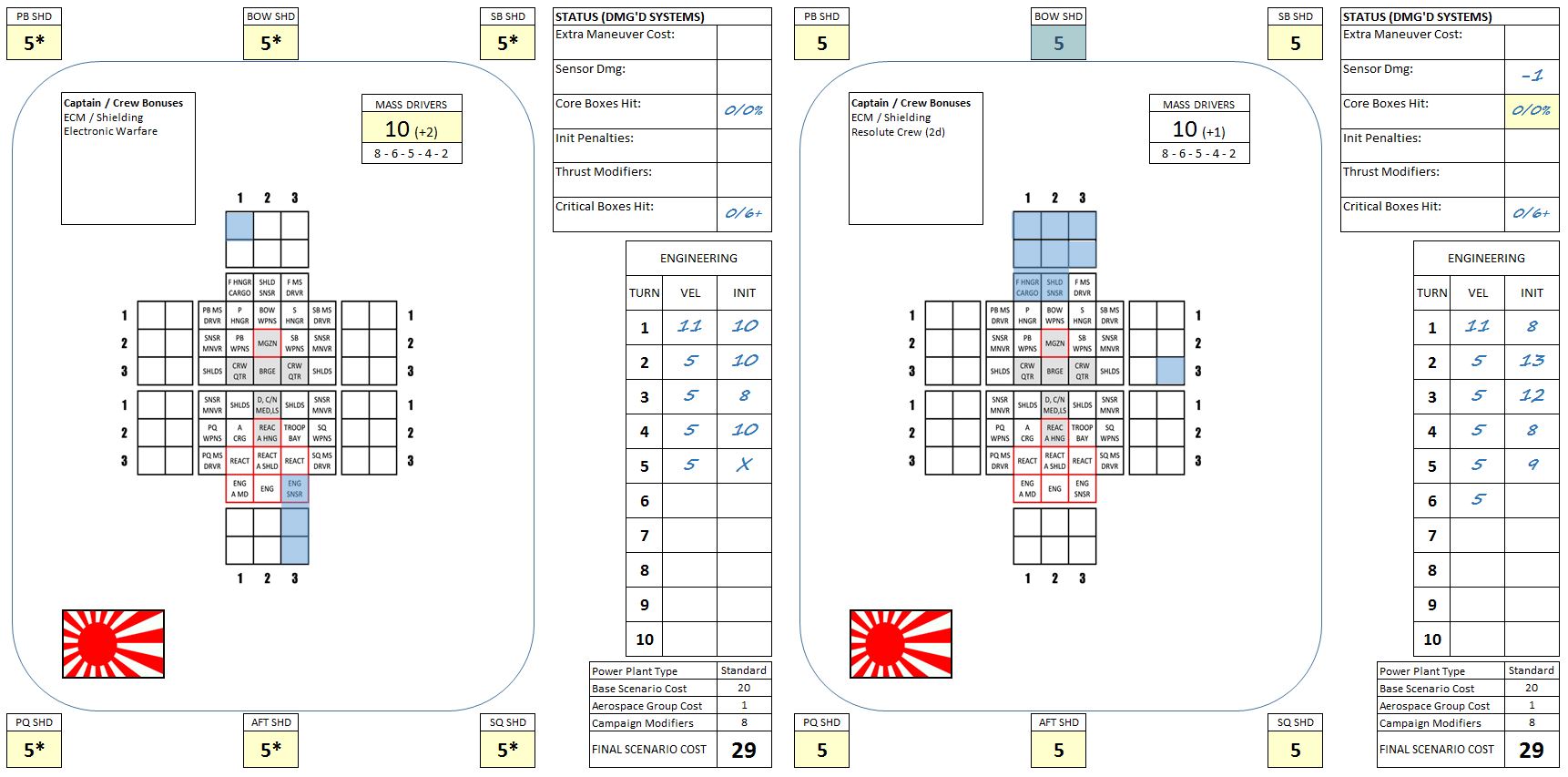 The two Japanese frigates. As if the Russo-American torpedo strike wasn’t a bad enough mistake on my part (if I’d waited until Turn 4 with that ordinance strike, I would’ve won hands down) … I then screwed up again on Turn 5 by forgetting that the Urakaze had NO FORWARD SHIELDS for that fighter strafing mission! Just three boxes of damage would have hit the bridge and crippled the ship in a miniature recreation of INS Executor’s end in Episode VI ROTJ. But even if I’d done this, the Americans still lose overall 113 to 61, a 13% victory. So this wouldn’t have changed the overall result, but it still bugs me when I make blatant rules mistakes like this.
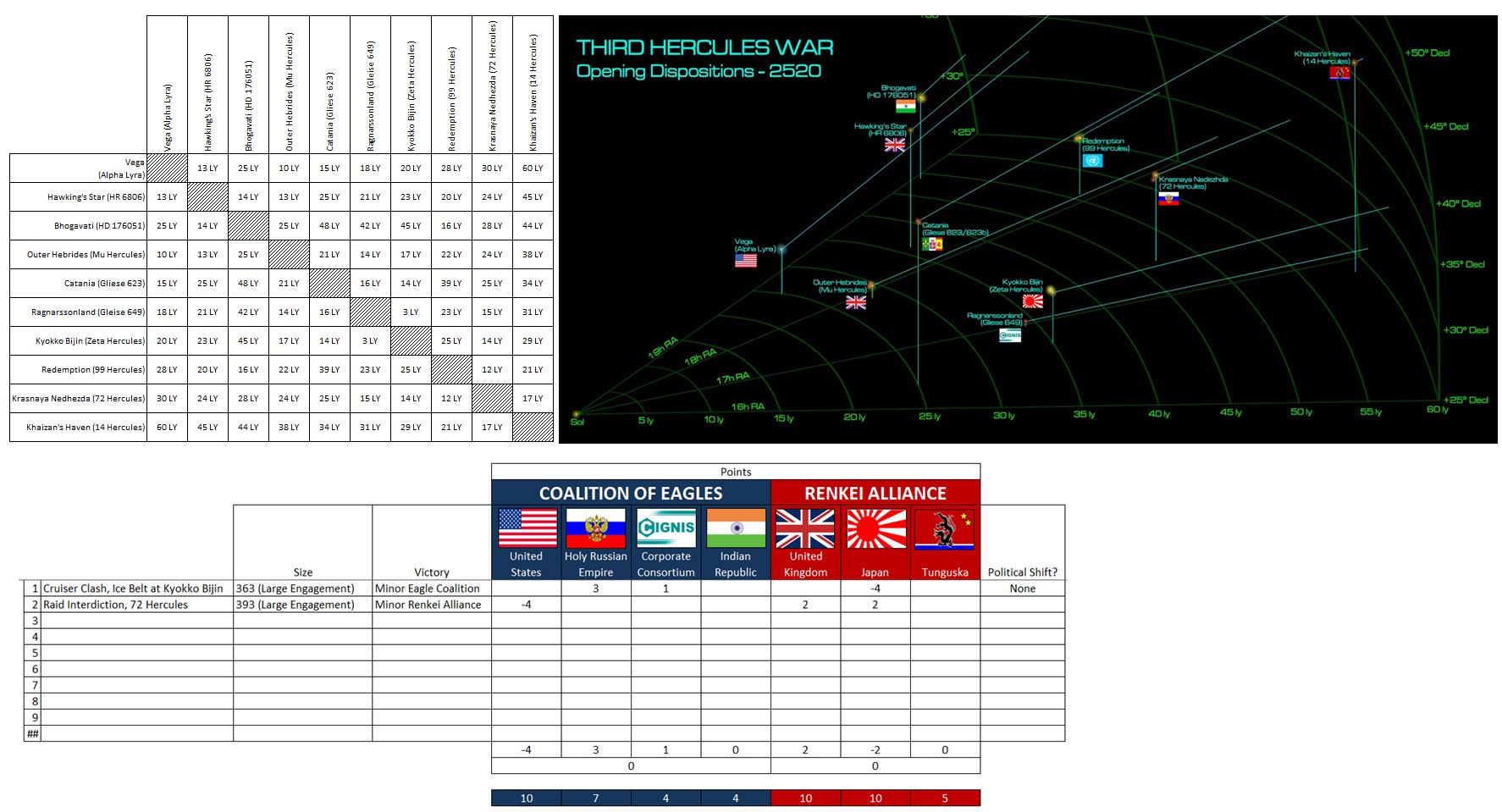 So UNLIKE PREVIOUS Darkstar games, this is part of a FULL CAMPAIGN we are tracking with actual astrophysical data, locations of all ships, damage / status of ships, superluminal transit times, and communication times. There is no FTL comm in the Darkstar ‘verse, remember – courier ships only, which admittedly travel at x1000 c, but that’s still days or weeks between some of these star systems. So Damon and Rasmus have won in 72 Hercules. They can either choose to remain in that system with the ships they have (ships that are NOT crippled can make repairs where they are, crippled ships must return to port and make repairs there). The risks are: My Russian fleet (admittedly reduced) is still lurking in the outer ice belt of Rasmus’ Zeta Hercules system where we won previously. And we calculated the transit times and the repair times for Task Force Oriskany, and even with the Tarawa crippled, we can be fully assembled back at Alpha Lyra (Vega) in 26 days. (just 8 days to cross 30 light years … yes, these Americans are THAT fast), +12 internal damage boxes on USS Tarawa (x1.5 because she is CRIPPLED) = 8 + 18 = 26 days. And both Hawking’s Star and the Outer Hebrides are RIGHT THERE within easy striking distance of Vega. So Rasmus and Damon agree to take their win and pull out, back to Zeta Hercules and Outer Hebrides, respectively. As for the Russians, I left their decision to the dice (as I’m also campaign referee, I want to avoid meta-gaming). They rolled to pull the Admiral Lazarev cruiser group out of Zeta Hercules, given the new threat directly in Krasnaya Nadhezda. Remember how slow information transits between these star systems. All my Russians in Zeta Hercules know is that there’s been a raid in their home system and the Americans failed to stop it. By the time they hear that the British and Japanese have pulled OUT of 72 Hercules, the Russians are probably on their way back to redress the situation.
 Task Force Kama
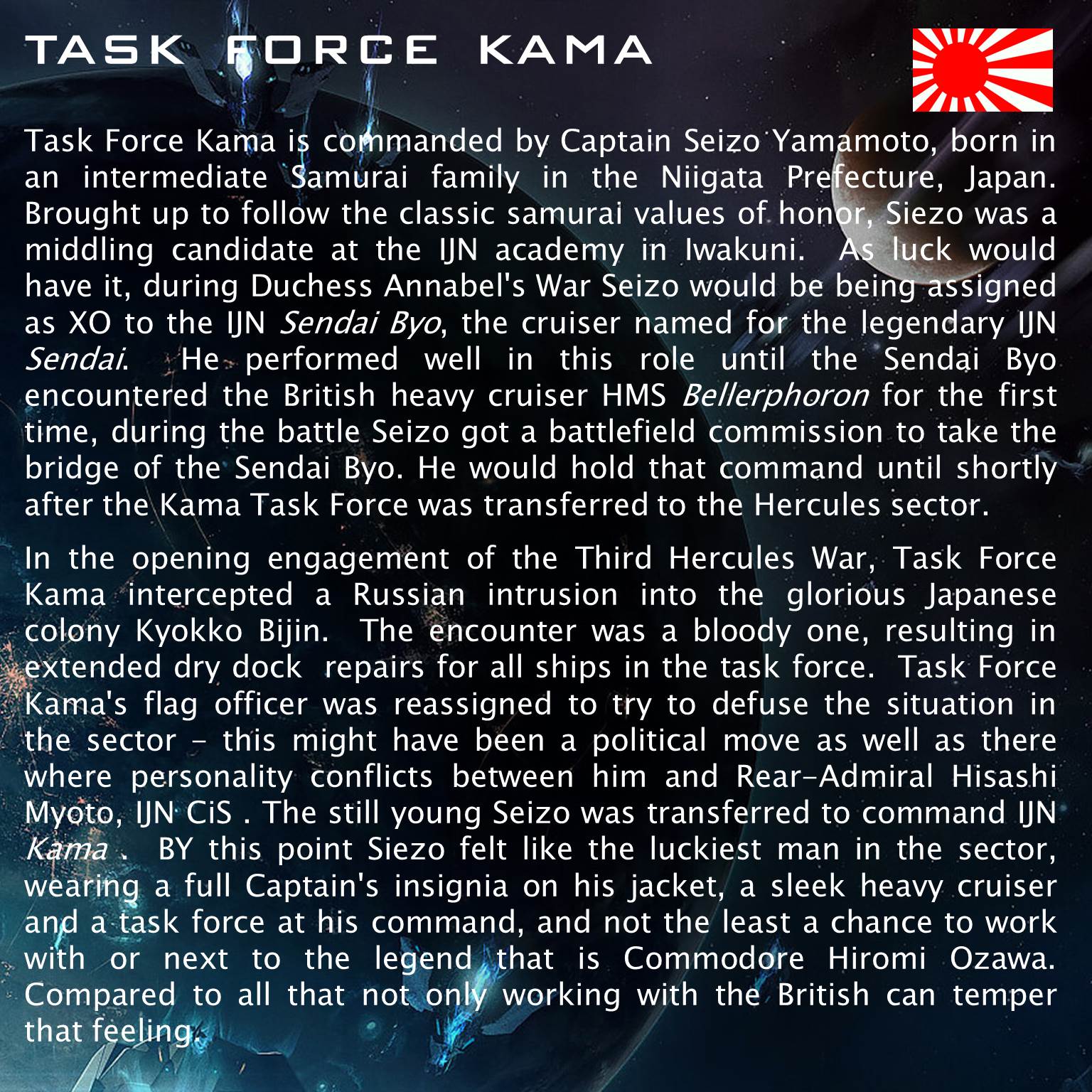
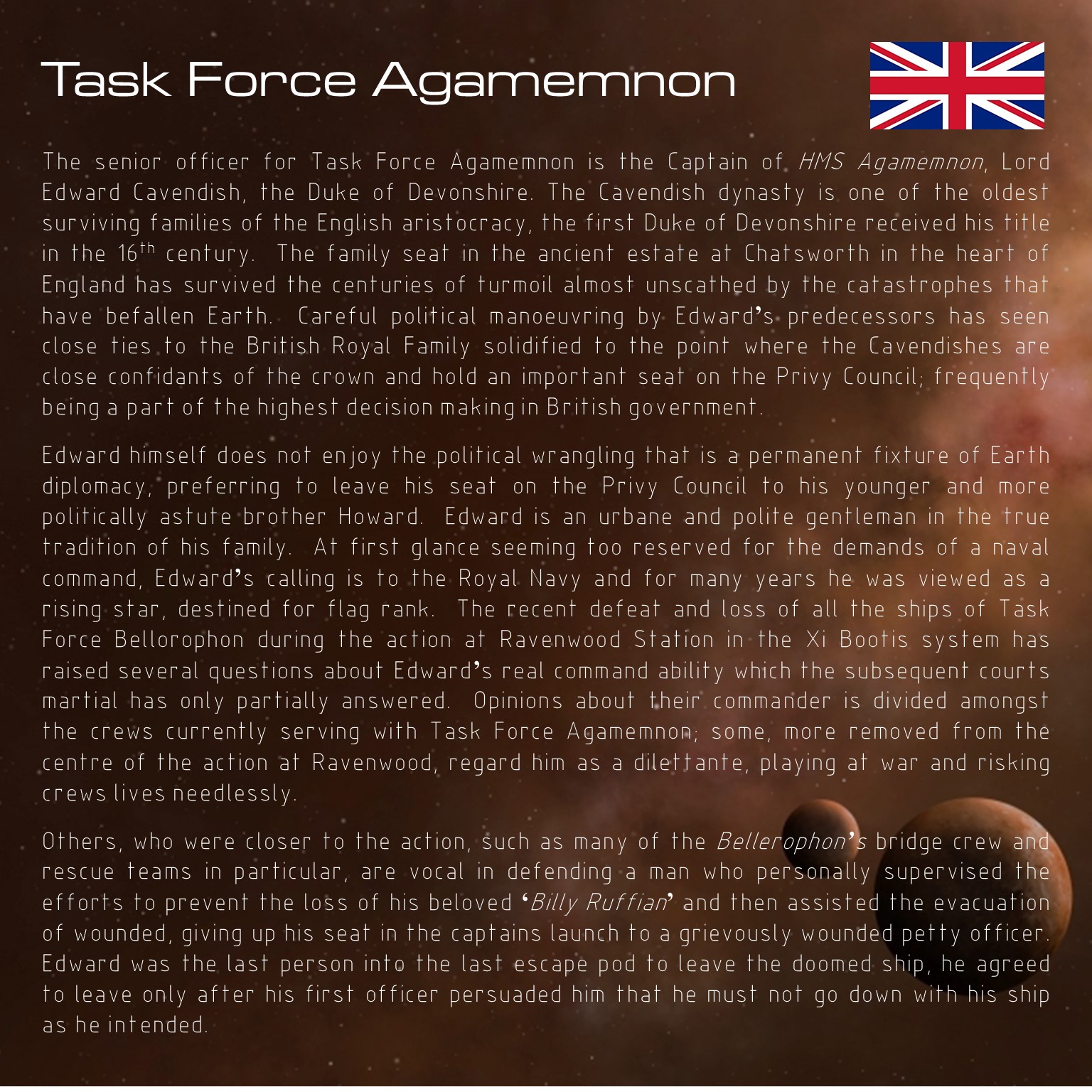
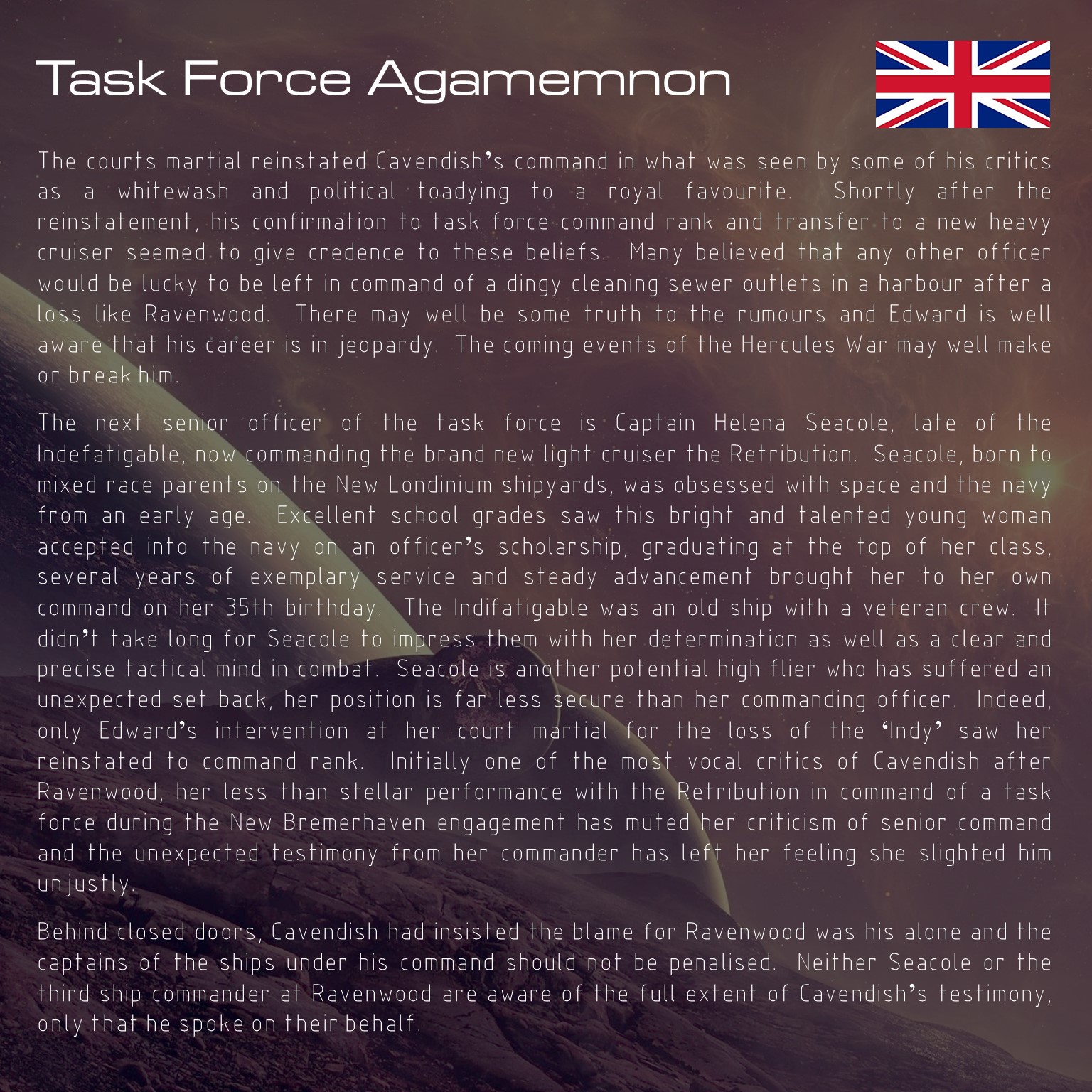
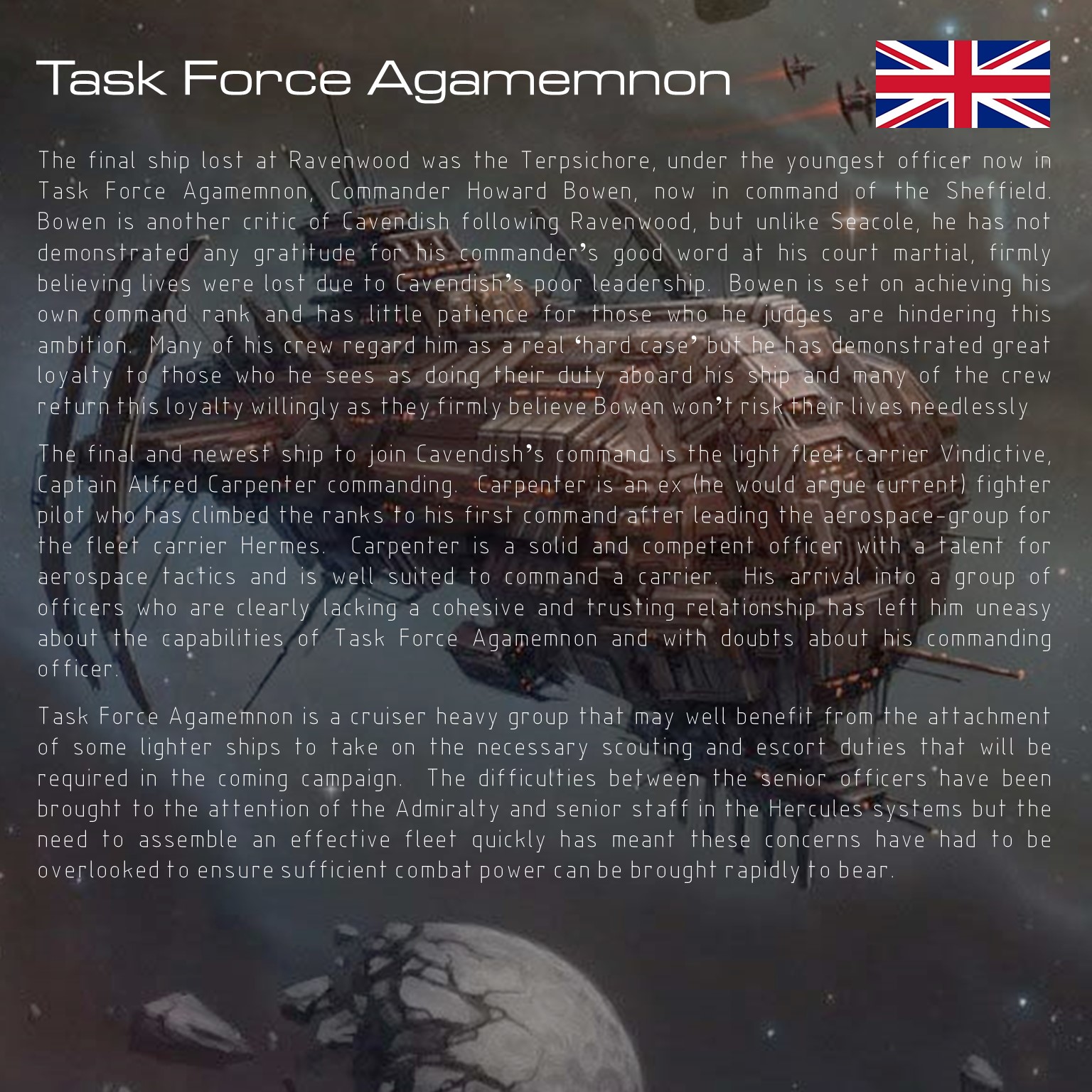
There are written up by community member @rasmus. I added some quick graphics in the back, but these are his writings for the officers and warships in the task force he’s been playing in the Duchess Annabel’s War and the Third Hercules War.
Clicking on each slide might help with the text, depending on your screen size.

Community Participation - Damon's Writeups For His Task Force
There are written up by community member @damon. I added some quick graphics in the back, but these are his writings for the officers and warships in the task force he’s been playing in the Duchess Annabel’s War and the Third Hercules War.
Clicking on each slide might help with the text, depending on your screen size.
Third Hercules War Officially Underway!
FROM: UNITED NATIONS REGIONAL COLONIAL CENTER
02:30 SOL GMT, 22 OCTOBER 2520
BREAKAUTH: 181072.18J
CLEARANCE: SECRET (NATIONAL)
**UNITED NATIONS COMMUNIQUE**
This advisory communique is hereby issued from the United Nations Communications and Liaisons Administration (UNCLA), Hercules Strategic Command Sector (SCS), to the offices of all colonial and regional governors, senior ambassadors, and national-level adjutants (level NG-21 and above) as previously specified as CLEARANCE level contacts by the secretaries and ministers listed as AUTHORIZED for such communication materials, as recorded on file by this office.
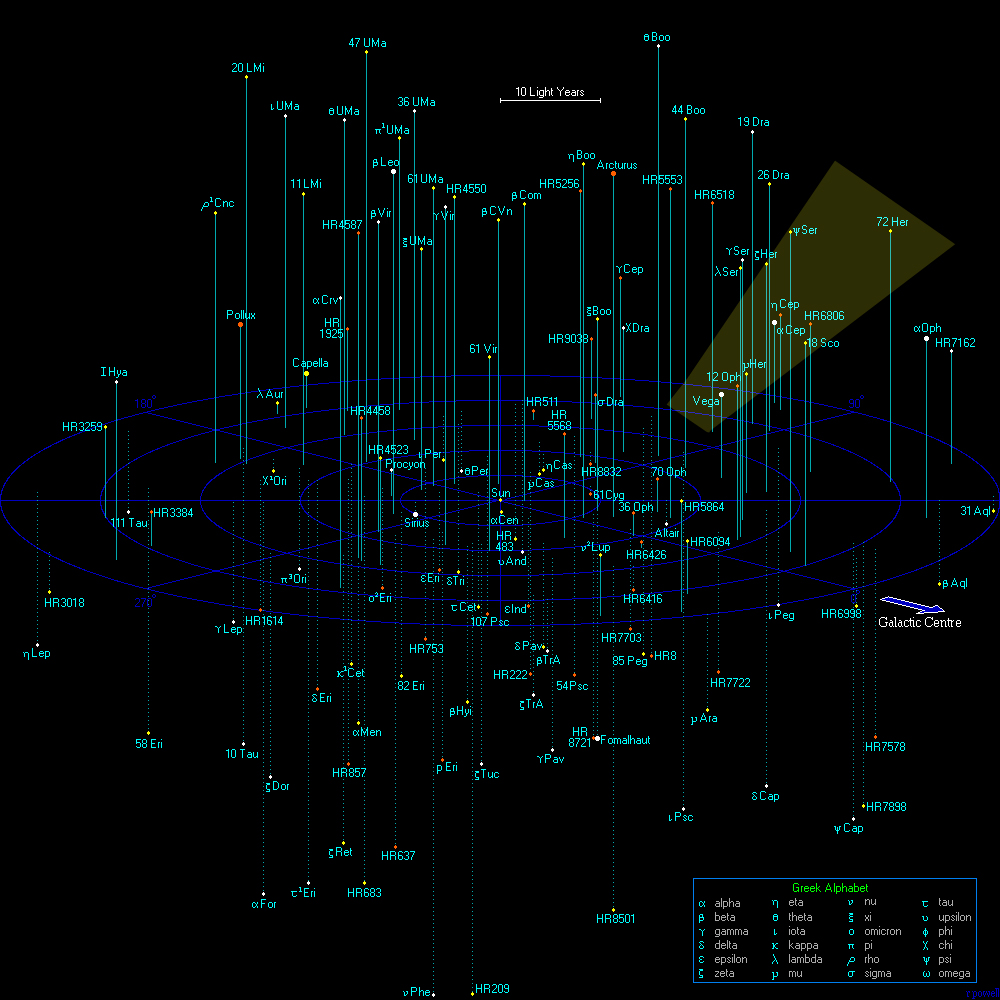
A shipping and superluminal courier advisory is now in effect for star systems within the Hercules SCS, ranging in radial Sol distance of 7-20 parsecs (22.82 to 65.2 light years). BE ADVISED A STATE OF CRISIS now exists for planetary systems, colonies, automated shipping lanes, and interstellar medium for the space prescribed and enclosed by parameters outlined above.
Eight days ago, an incident occurred in the outer protoplanetary debris disc of the Zeta Hercules star system involving naval and aerospace units of the Navies of the HOLY RUSSIAN EMPIRE, the EMPIRE OF JAPAN, and the CONSORTIUM OF INTERNATIONAL COMMERCE AND DEVELOPMENT (Corporate Consortium). Reports of this incident, which took place some 7.4 parsecs from this office, is only now being reported, and details are far from complete. At this hour, all this office can confirm with certainty is that heavy weapons fire was exchanged between these forces, resulting in significant loss of life and damage to property.
Negotiations between the parties involved are presently underway here at the Almacor Colonial Offices for the United Nations, Hercules SCS Regional Branch, at Redemption Colony (99 Hercules). Updates will be passed to authorized national-level offices as events develop.
In the meantime, the United Nations urges and advises with all gravity that military commanders under each nation’s respective naval commands be contacted with all possible speed. The value of caution and forbearance at this critical juncture cannot be overstated if a general STATE OF WAR is to be avoided.
>>>>
Such was the communique sent by automated FTL drone to all the governments and military command centers in the Hercules Strategic Command Sector, dated 22 October 2520. Of course, even with 12-magnitude Darkstar waves, some colonies wouldn’t get this message for 10-12 days. Such is the travel times across these distances even at x1000c. In any event, by then it was too late. News of the initial battle had already spread, and decisions had already been made. The THIRD HERCULES WAR was on.
The .pdf attached to this project thread in a previous post already outlines the background and recent history of this region, describing the steadily building tension between the United States, the Holy Russian Empire, and the Indian Republic on one side, and the United Kingdom, Japan, the Corporate Consortium on the other. The powder keg was set. Saturday’s battle between myself, @gladesrunner, and @rasmus is the spark that blew it up.
In short, this is the beginning of a new Darkstar campaign, which we hope you will enjoy looking through, perhaps following, or even joining in!
Engagement 01: Meeting Skirmish in Outer Ice Belt, Kyokko Bijin (Zeta Hercules), 14 October 2520
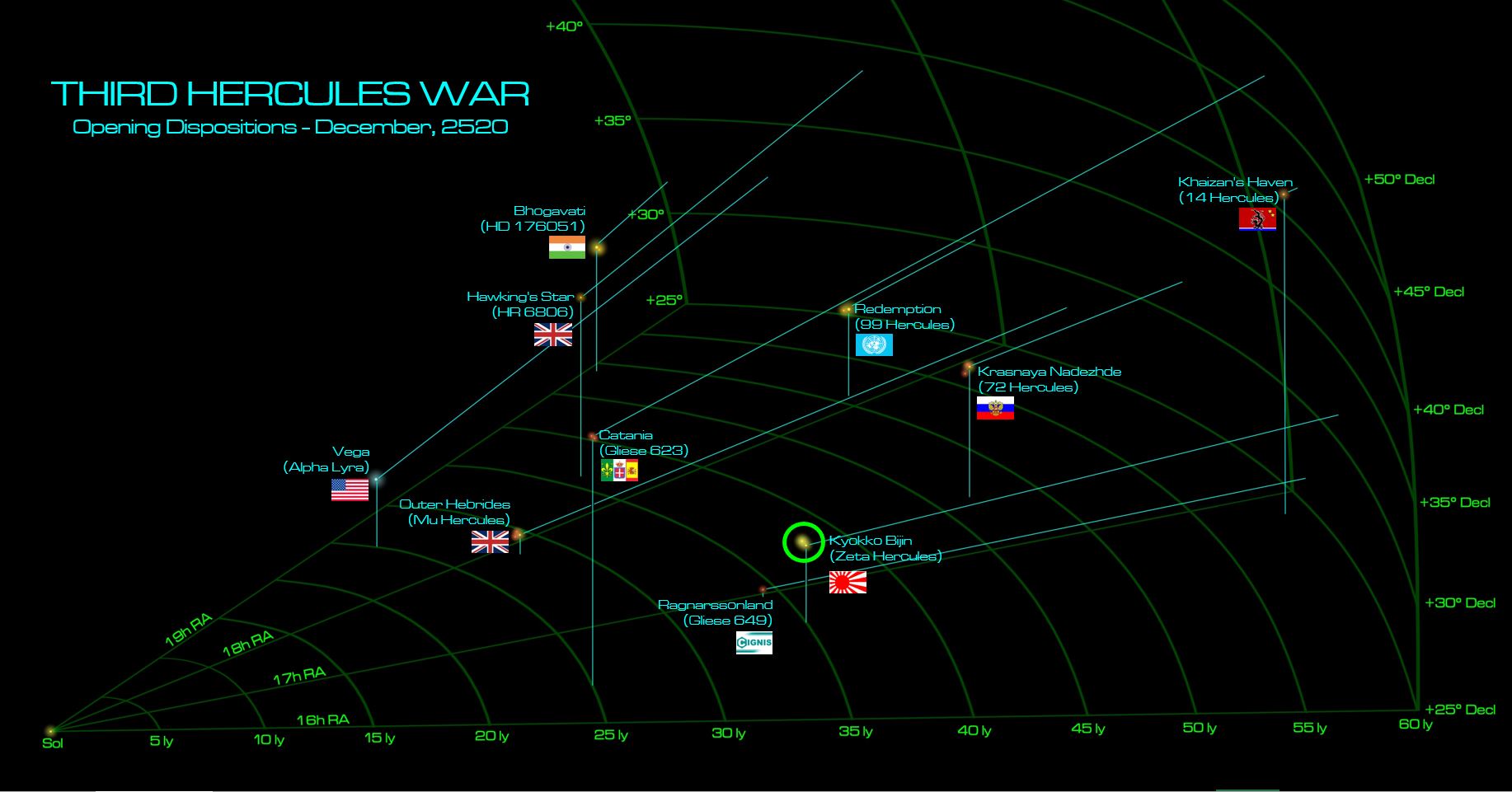 The green circle marks the location of our first battle. A United Nations envoy ship was on its way from Redemption back to Sol. Along the way, it stopped just outside the Zeta Hercules system in order to download new navigation data from the network of satellites, drones, and beacons that every colonized star system has deployed for this purpose. All these star systems are moving in relation to each other, after all, and for safe and efficient Darkstar waves, incredibly-detailed navigation data must be constantly updated into each ship’s computers. Thus, most of the safer, more mundane civilian and commercial shipping lanes pass through as many star systems as possible.
 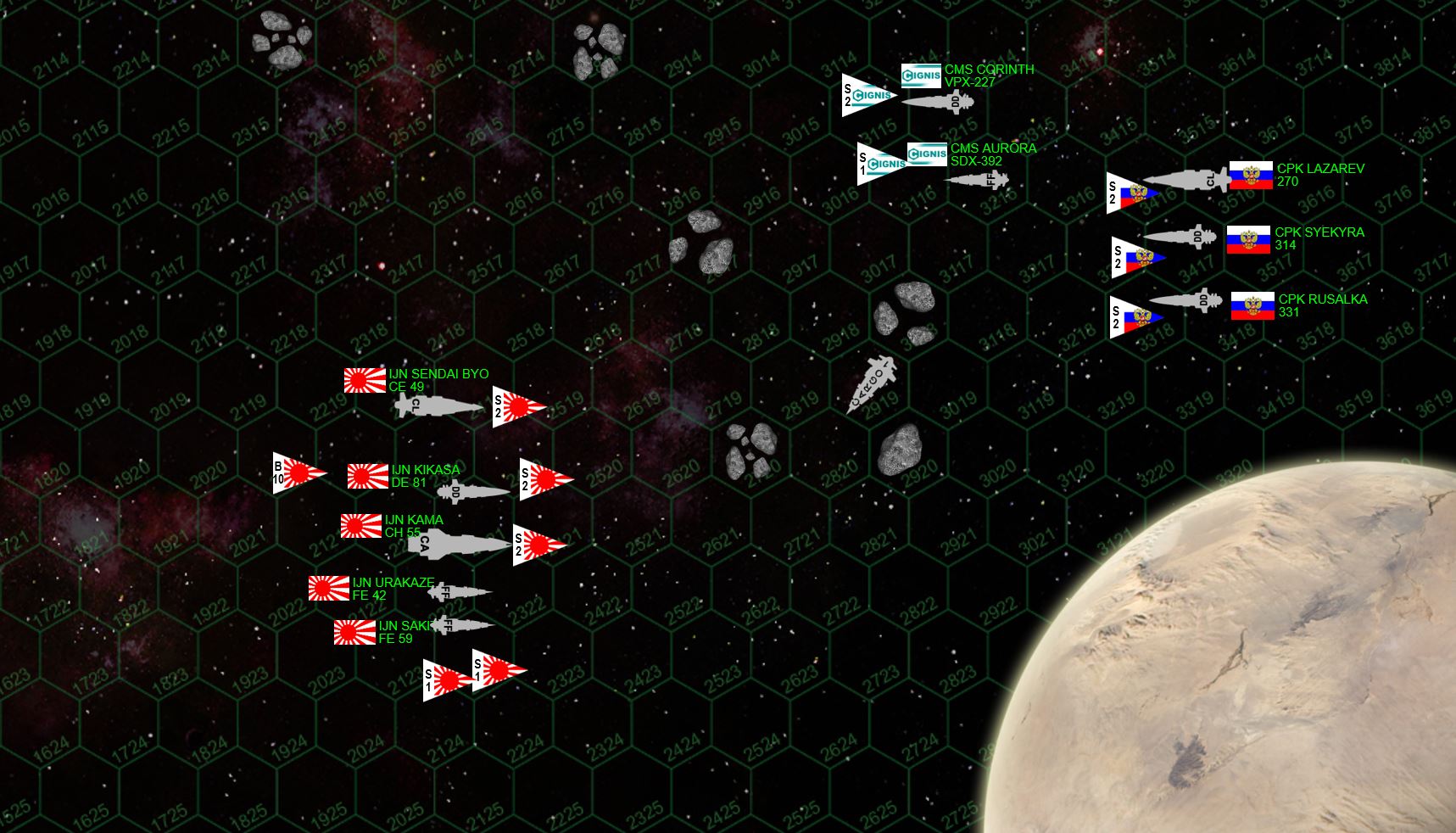 Ironically, it was this need for navigational safety that got the SS Serendipity into navigational trouble, striking an asteroid in the outer ice belt of the Zeta Hercules star system, taking enough damage that she had to eject her starboard reactors to avoid a catastrophic overload. Now adrift in the weak gravity of this ice belt dwarf planet (1800 kilometers across, about three-quarters the diameter of Pluto), she dropped universal rescue beacons (URBs), asking for help. Well, help arrived all right. Mostly from the Japanese (Zeta Hercules is their system, after all), but also from a roving cruiser squadron of the Holy Russian Empire and a destroyer-blockade runner element of the militarized “maritime security consultant branch” of the Cignis Corporation. As the three task forces close, the Japanese continue to warn off the Russians and Corporates, warning them that Kyokko Bijin is Japanese sovereign territory. A flight of Japanese B7N “Tenrai” (Heavenly Thunder) bombers joins the cruiser force from a nearby system patrol station. Meanwhile, the Russians and Corporates counter that the URBs deployed by SS Serendipty, a UN-flagged vessel, makes this an international call for help. What both sides really want, of course, is to take credit for rescuing the UN ship, thus lending legitimacy for their ongoing claims in the escalating Hercules crisis. Strike that, what they REALLY want is a fight. Both sides feel they can sweep in quickly, smash up a few enemy ships, and streak back out again, claiming an early lead in the new Third Hercules War.
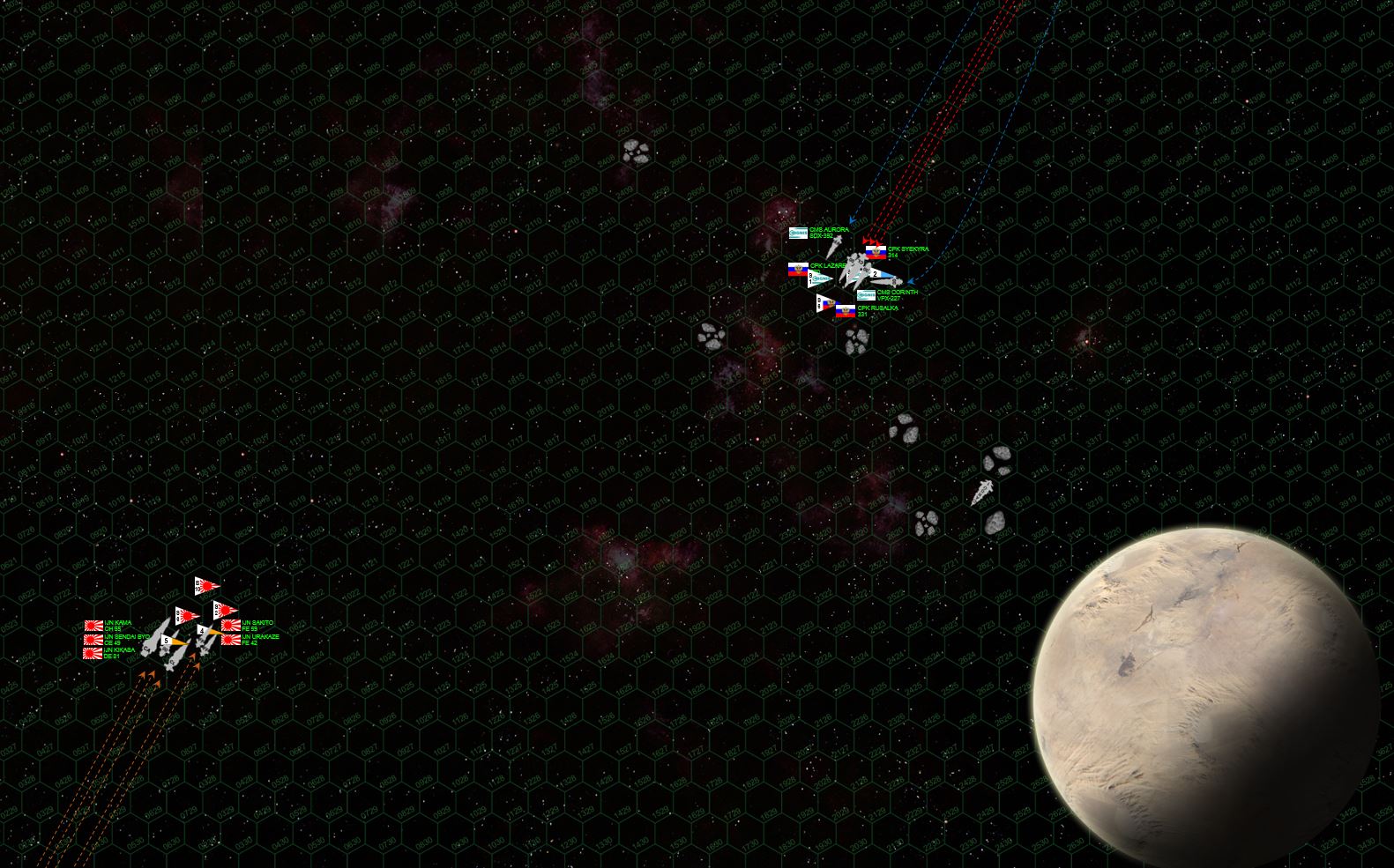 Both sides make their approach. The Russians set the pace for their side, barreling into the combat area at the very high speed of 36 kilometers per second. The Japanese set the more reserved speed of 24 kps, anxious as always to keep the range long for their cruisers mounting hyper-accurate and long-ranged guns. Russians, conversely, like to get close, firing blistering jets of plasma at near point-blank range. Note how the Russian commander, Captain Piotr Fedorovich Myshaga, carefully keeps an asteroid field between his approach vector and the Japanese. Thus the Japanese can only fire on the Cignis destroyer CMS Corinth, and her advanced ECM suites and gravitic shielding protect from most of that. True, the Russians can’t fire back right now, but more importantly ... they’re over 2,000 kilometers closer to the Japanese now, and all without taking a whiff of fire.
  Weaving through the asteroid fields trailing behind the dwarf planet’s orbital path, the Russians make a sharp hook to starboard and again cut straight toward the Japanese. Again, note Myshaga’s positioning. By placing himself between the Japanese and the dwarf planet, he forces the Japanese to turn dangerously toward the planet to engage him. Any Russian fire now coming at the Japanese is that much more dangerous, as crippled or disabled ships run the risk of collision with the planetoid. Also, Myshaga has consulted with his corporate ally, Vice-President Ike Karus, and they decided to make their initial attack with torpedoes rather than broadside gunnery. Thus, the Russians point their port and starboard bow arcs toward the Japanese, rather than their beams. Yet even at this distance, the guns of the Japanese cruisers are dangerous, and heavy lasers, EPCs, and syglex emitters (x-ray “lasers” focused through intense gravitic lensing) open jagged slashes in Russian and Corporate ships. This is especially true since ALL guns of the Japanese strike frigates Urakaze and Sakita are mounted forward, as well as most of the guns of the heavy cruiser Kama (her guns arranged in a “Pacific” configuration, in three triple turrets with two turrets forward and only one aft). The light cruiser Admiral Lazarev takes the worst of it, how bow torn clean open and her forward shields gone. Yet the Russians and especially the Cignis ships score heavy blows on the little Japanese strike frigate Urakaze, the precise lasers of the Corinth drilling deep into the bow and setting off the magazine and hitting the bridge. Already one ship is down, the IJN Urakaze the first official “casualty” of the Third Hercules War.
 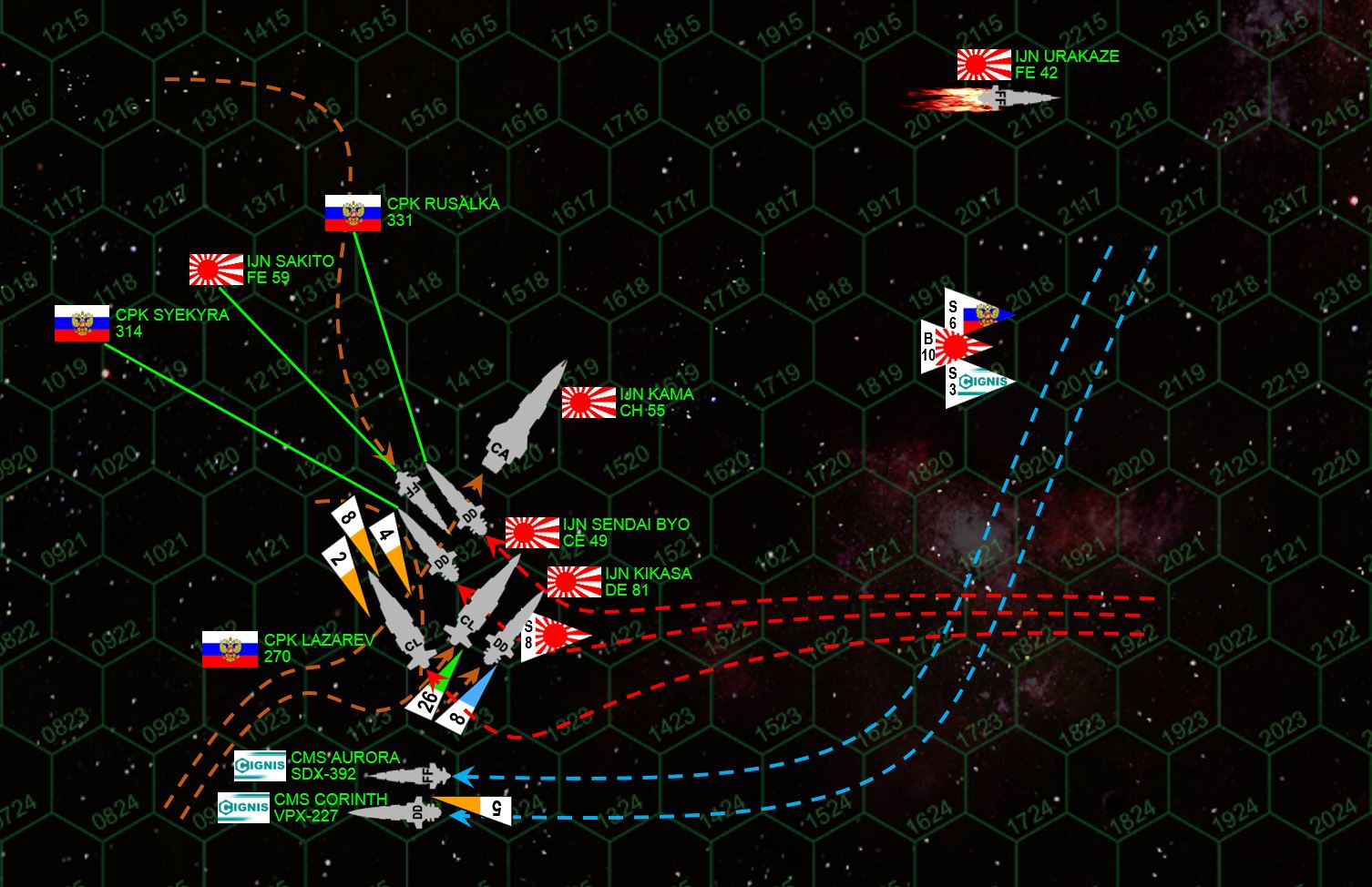 The Kama lunges for the Russians, hoping to cross their T with a devastating broadside. Myshaga sees the move and veers to port, then cutting hard to starboard. His destroyers CPK (Svyatoy Russki Korabl, Holy Russian Ship) Syekyra and Rusalka execute the maneuver perfectly, cutting their starboard broadsides behind the huge heavy cruiser Kama. Myshaga’s flagship CPK Admiral Lazarev moves to follow suit (with no forward shields, he knows his ship is about to be crippled, but resolves to take the larger IJN Kama with him), but has to veer further behind the Kama to avoid a collision with the oncoming strike frigate IJN Sakita. The light cruiser IJN Sendai Byo cuts in behind the Russian destroyers, escorted by the veteran destroyer IJN Kikasa, only to have the destroyer Corinth and blockade runner Aurora cut in behind THEM ... only to have the Japanese bombers launch a torpedo spread behind THEM. One way or another, this “skirmish” is about to become a knife fight of gruesome proportions.
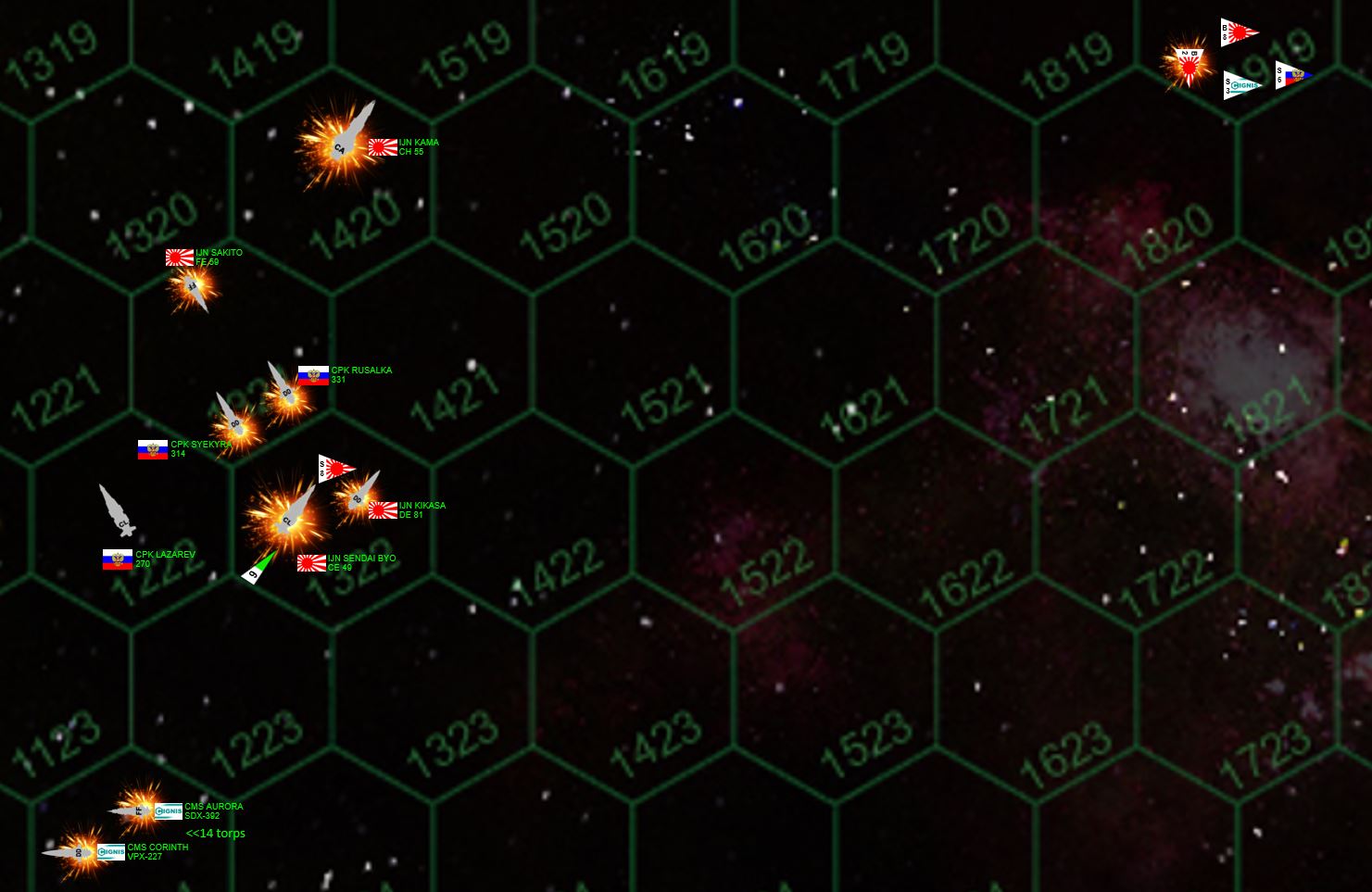 Okay, to get a better view on what’s actually happening here, I have blown up the hexes through which all these ships are all moving, and in what directions, at the crucial moment. Please remember these hexes are 180 kilometers across, a turn is one minute of time, and one hex of movement is thus 3 kilometers per second. The ships themselves are still massively oversized, usually 1 or 1.5 kilometers long at most. SO ... what happens here? First, the Japanese spread of Ki-45 “Toryu” (Dragon Slayer) torpedoes almost all are shot down. But three hit the unshielded bow of the Lazarev. And these are “Class V” Ki-45s, some of the deadliest torpedoes in Known Space. All three hit internal compartments (all the forward armor is already gone) ... but amazingly, the Lazarev’s bridge remains unstruck ... and the ship retains power. Casualties are heavy, however, and Myshaga is compelled to break off the action ... once he’s released his own withering broadside into the stern of the Kama. At this range ... Russian plasma projectors are just damned terrifying. The stern of the 150,000 ton Kama is simply melted off. Even as the Lazarev reels away, half her crew now killed, wounded, fighting fires, or trying to shore up bulkheads against chain-reaction decompressions, the forward guns of the Syekyra fire into the onrushing strike frigate Sakita (her aft guns firing into the Sendai Byo). The Satika is crippled by the Syekyra’s 40-kg plasma projectors, herself crippled an instant later when the Kama fires back with her huge aft batteries of 18-teravolt EPCs (electron particle cannons). As the Syekyra is left spiraling out of control through space, the Rusalka’s forward guns fire into the Kama, finally inflicting enough damage to cripple the massive Japanese ship. Rusalka’s aft guns fire into the Sendai, even as the Sendai and the escorting Kikasa fires its forward guns into the Rusalka and cripples her as well. Russian P-500 “Plamya” (Flame) Class III torpedoes strike into the hull of the Sendai Byo ... 17 were shot down but 9 hit the shields, three into the hull. Sendai’s portside engine is blown completely apart, opening her up to a hail of laser and syglex fire from the Corinth. Just that fast, the Sendai goes dark as well. The rest of the Corinth’s guns, together with the Aurora, fire into the Kikasa. The Kikasa hits the Aurora through the bridge, even as the Corinth (badly damaged) finally crippled Kikasa as well. Finally, the torpedoes fired from the Japanese bombers slam into the stern of the Corinth, which is likewise crippled. Sixty seconds, eight ships. Welcome to the Third Hercules War.
 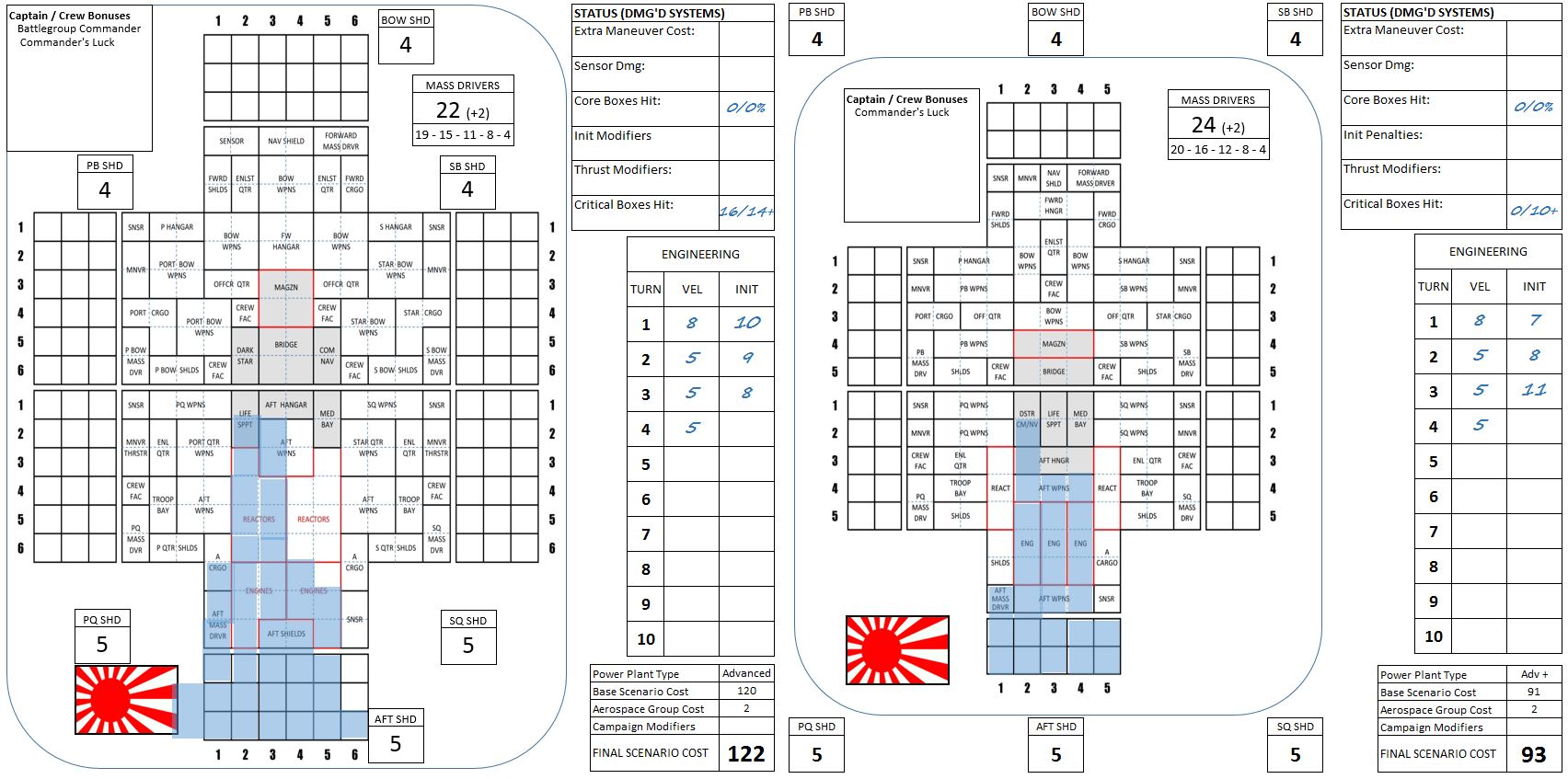 Here are the warship record sheets for the Japanese cruisers, the Kama and the Sendai Byo. In all, only 8 Japanese bombers remain (two were shot down by Russian and Cignis scouts), and the Russian flagship Admiral Lazarev, although she’s been forced to break off the action. But since she still has power, she counts as “operational” and so the Japanese only get half points for her in this raid. The score is 339 to 291, a 16% victory to the Russians and Corporates. Needless to say, no one’s going to be continuing hostilities now, everyone is full-bore into rescue and recovery efforts. But when news of this incident spreads, the war will officially be on.
  The warship record sheets of the Russian destroyers Syekyra (left) and Rusalka (right). The Americans will be “outraged” at this Japanese aggression, the British will maintain that the Americans are using this pretext to lean into the Hercules Rim from their Vega colony in the neighboring Lyra constellation. As the British and Japanese close ranks, the Americans will cry foul at the continuing Anglo-Japanese shipping and trade monopolies in the Hercules Rim, thus cementing their alliance with the nervous Russians and Consortium. The Americans will also enlist the aid of the Indian Republic, having promised them VERY generous shipping rights through Vega back to earth from the Indian colony at Bhogavati (HD 176051) in return for support against the British at Hawking’s Star and the Outer Herbrides.
 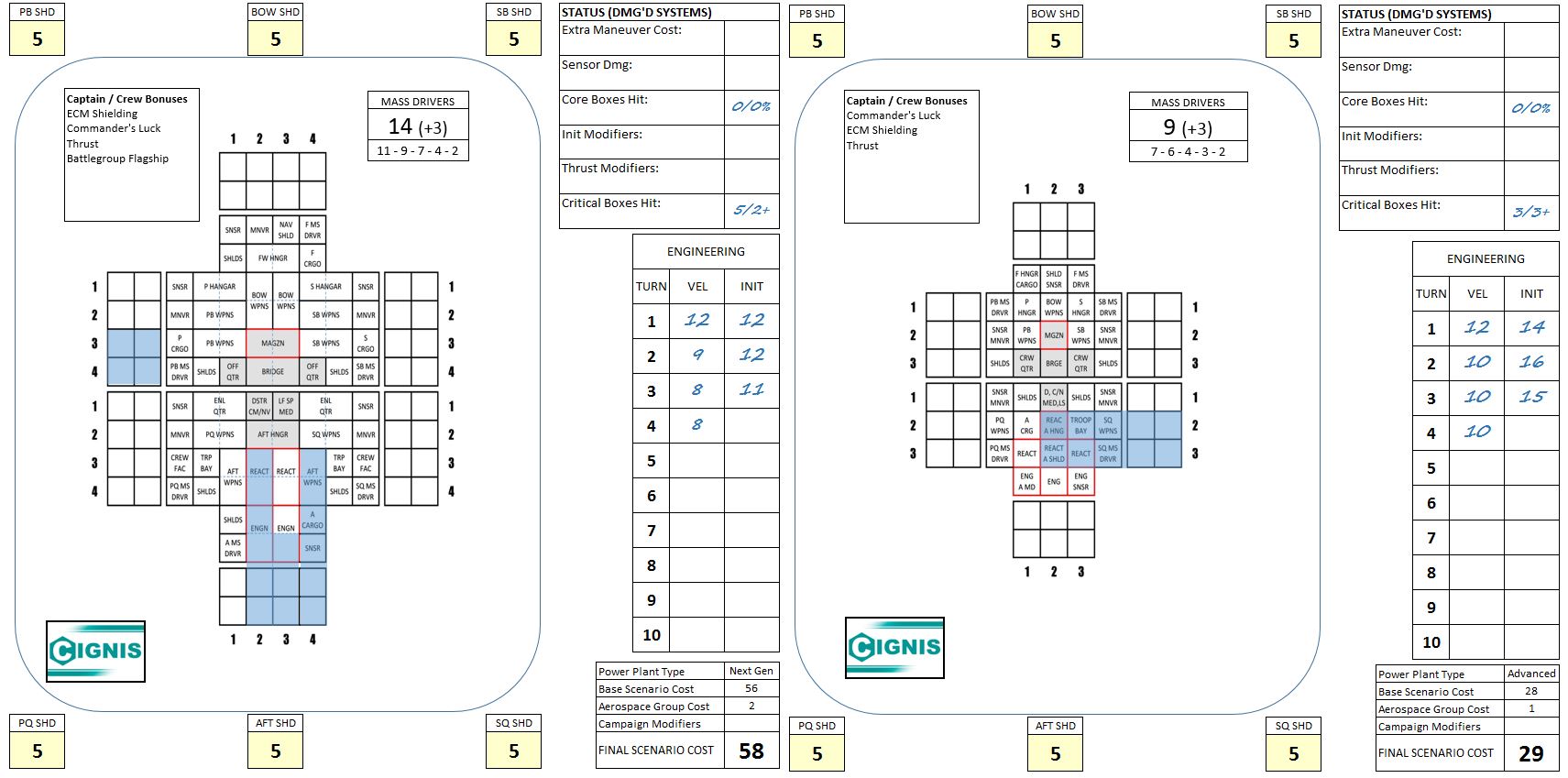 The Cignis destroyer Corinth and blockade runner (fast frigate) Aurora. In general, the Consortium likes to stay out of wars, but when they’re involved in one, they tend to pick the weaker side, if not from a military standpoint, at least a commercial one. The last thing they want is sectors of space dominated by monolithic national monopolies, like the one the British and Japanese are setting up along the Hercules Rim. The more “open” they can keep the shipping lanes and colonial development zones, the more free they are to do business and the happier their shareholders are.
 New Community Campaign - Third Hercules War
Well, it’s official. Today is the “soft launch” of the new Darkstar Campaign. So far we have four players, but more are always welcome!
We’re also starting a new thread, after the old one hit 127 entries, 3500+ recommendations, and 600+ comments, and was honestly getting a little unwieldy.
So here are the first campaign maps and background write up for the new Third Hercules War campaign. I hope you’ll enjoy following our progress, and as always, ping the thread if you feel like joining in sometime!