








PanzerKaput Goes To Barons’ War


Recommendations: 11332
About the Project
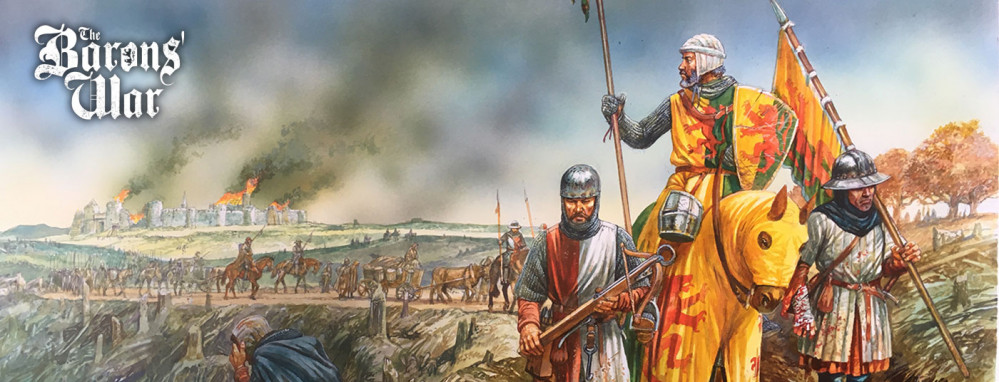
Set against a backdrop of a Civil War that lasted for two years, 1215-17, as a result of the issuing of Magna Carta. A civil war was the perfect opportunity for the leading nobles of the time to grab land and power while settling some old scores along the way. This vying for land and power hadn't stopped since the invasion of 1066 with only the strongest of kings being able to keep their nobles in check. Our narrative focuses on small groups of warriors brought together under a lord or baron to raid and steal or defend land and property. With the strong, wise, cunning and lucky aiming to rise out of this civil strife in a better position than when it started. The Barons' War skirmish game has been written to enable players to fight out tabletop battles against the backdrop of the First Barons’ War between rival Barons or rival factions who find themselves on either side of the conflict. The game is historically themed, the gameplay is fast-paced and tactical with plenty of narrative and where force building presents you with lots of options enabling two players to muster very different retinues. However, as intended, this is an alpha set of rules which does not include rules for siege warfare, although rules for fighting in buildings are included. Campaign rules are something that will be addressed at a later date and released online. Having grown out of the Barons’ War Kickstarter project, the intention is for this ruleset to develop into a system that could be used throughout the Medieval period. Starting with England from when the Western Roman Empire withdrew around 410 AD to 1485 AD when Richard III died at the Battle of Bosworth Field. This presents us with a huge span of history for gaming which can be broadly divided into Romano-British, Anglo-Saxon and Viking, Anglo-Norman, Angevin and Plantagenet. And that’s just when looking at it from Great Britain. With warriors of this period being pretty similar, it would be easy to use the profiles in this rulebook to play out tabletop battles in any setting. Over time we see these rules evolving with additional warriors, characters, abilities and scenarios being added starting with the Dark Ages, the Anarchy and the Crusades and shared to www.warhost.online, which has been set up to be the community website for the game.
Related Game: The Barons' War
Related Company: Footsore Miniatures and Games
Related Genre: Historical
This Project is Active
William Hardel
 William Hardel
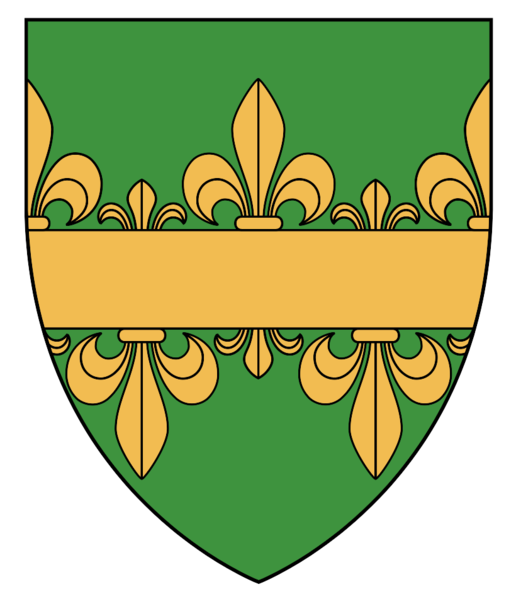
Just one member of the Twenty Five was represented in the list in an official capacity, and that was the Mayor of London, William Hardel. His inclusion affords proof of the key role which London had played in the rising that brought King John to the negotiating table in 1215.
London was by far the largest and most important city in England by the early thirteenth century, a major centre of national and international trade, and the country’s social, political and economic capital in all but name. The moment when the Londoners opened their gates to the rebels, lending them their support and, perhaps more crucially, their money, constituted a turning point in the struggle between King John and his opponents, indicating to the king that he was in danger of losing his kingdom and that it was time to compromise. The Londoners’ reward for their backing of the rebellion came in clause 13 of the Charter, which said, albeit without much precision, that the city was to have all its ancient liberties and free customs both by land and by water. On 19 June, four days after the making of the Runnymede pact, the barons, realising that their control of London was their trump card, made a treaty with the king which used its return as a tool to secure his compliance with the new agreement. The treaty laid down that the barons were to continue to hold London, and the Archbishop of Canterbury the Tower, until 15 August, by which time the oaths to the Twenty Five were to be exacted throughout the realm and the king was to meet all claims against him to the restoration of rights and property. If all this was carried out by 15 August, then the capital and the Tower were to be restored to him. In the event, the conditions were not met, and city and fortress remained in the barons’ temporary guardianship.
The mayor of London, with whom the barons began their negotiations in the spring of 1215, was one Serlo the Mercer. Later in the year Serlo was replaced by the new Mayor, William Hardel, who had served as sheriff in 1207-8, and who headed a vintner dynasty with holdings in Vintry and Bishopsgate Wards. On the baronial side the lead in the negotiations was probably taken by Robert FitzWalter, the self-styled ‘Marshal of the Army of God’, who was lord of Baynard’s Castle in the City, and therefore in some sense a Londoner himself. Serlo and William and their fellow merchants remained steadfast in their support for the rebel cause in the war to come. When Prince Louis landed in England in May 1216, he made the decision to head straight for London. Serlo and four other citizens, all office-holders, when approached, personally raised the sum of 1,000 marks (about £666), which they supplied for his use. On 2 or 3 June in St Paul’s churchyard the citizens, led by FitzWalter and Hardel, rendered homage to the French prince. In the wake of the settlement negotiated at Kingston in September the Londoners returned to the royalist allegiance.
William de Forz
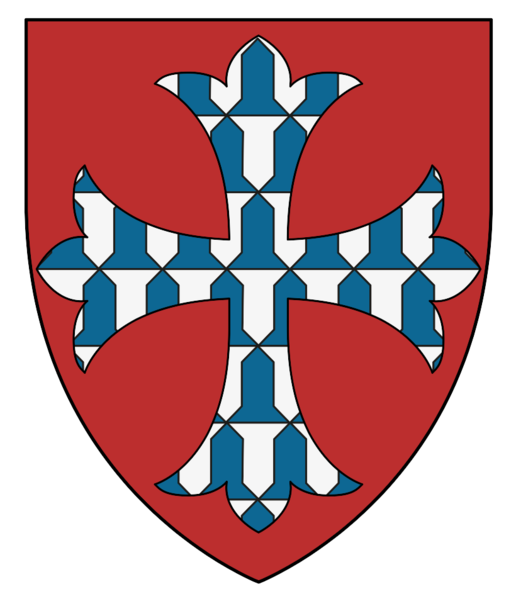 William de Forz (Fortibus)
William de Forz (Fortibus) (1191×6–1241), holder of the Norman title of count of Aumale, was a mercurial personality whose apparent self-interestedness and frequent changes of allegiance raise questions, difficult to answer, about the balance of personal ambition and concern for the common good in the motivation of the medieval aristocracy.
Forz was the son of the wealthy Aumale heiress, Countess Hawise, a much married lady, by her third husband, the Poitevin naval commander, William de Forz, who died in 1195. He came to England, probably from Poitou, in 1214, and in September or October of that year secured possession of the English lands of his mother’s inheritance on the condition that he married Aveline, daughter of Richard de Montfichet. In this way he was brought into contact with another lord to be chosen one of the Twenty-Five. William’s English lands consisted principally of the honours of Holderness and Skipton in Yorkshire, Cockermouth in Cumberland, and lands in Lincolnshire around Barrow-on-Humber in the north and Castle Bytham in the south.
In the spring of 1215, perhaps as a result of his links with Mountfitchet, he joined the baronial opposition to King John and after the meeting at Runnymede was nominated to the Twenty Five. By August, however, he had changed sides, returning to the king’s allegiance, and he accompanied John on his punitive expedition to the north of England in December. He deserted John a second time in June 1216 but had returned to royal service by the autumn, after Henry III’s accession, and attested the reissue of Magna Carta in November.
In the course of the civil war from 1215 William acquired many lands, some of which belonged to the Crown, which the Minority Government was keen to recover from him. He surrendered most of these properties in or before May 1220, but clung onto Castle Bytham in Lincolnshire, to which his family had an ancestral claim. At the end of 1220, apparently annoyed at being passed over for the appointment of seneschal of Poitou and Gascony, he rebelled against the Minority Government, suddenly left court to garrison Bytham, and then, faced with the ravaging of his lands, fled to the north of England, where he took refuge at Fountains. The Government treated him remarkably leniently, and he and his men were pardoned.
In his later years Forz was employed on a range of diplomatic and military business for the king, treating with the Holy Roman Emperor at Antwerp in 1227 and accompanying Henry III on his expedition to Poitou in 1230. In the spring of 1241 he set out for Jerusalem, but died on the way. His wife, Aveline, was buried at Thornton Abbey, but his own burial place is unknown.
Baron Belvoir and Spearmen
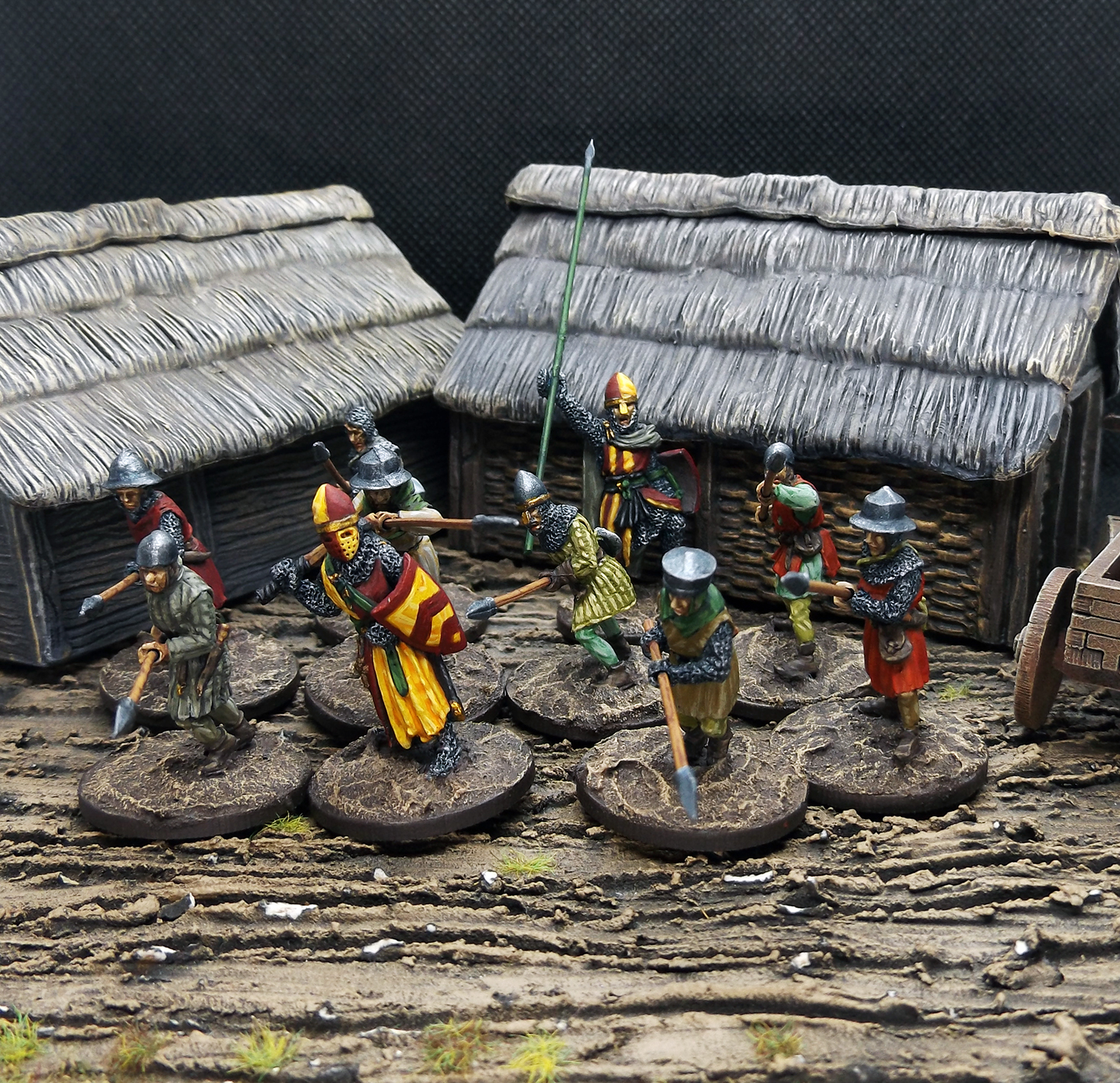 William d’Aubigny, Baron of Belvoir
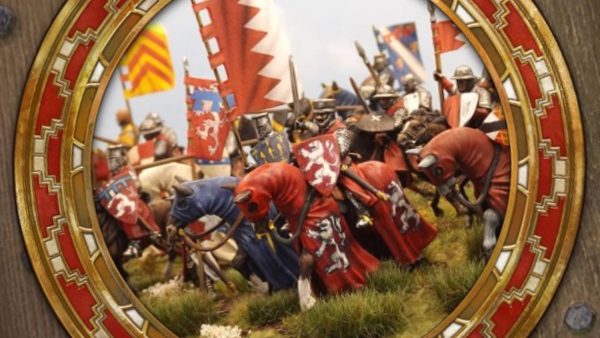
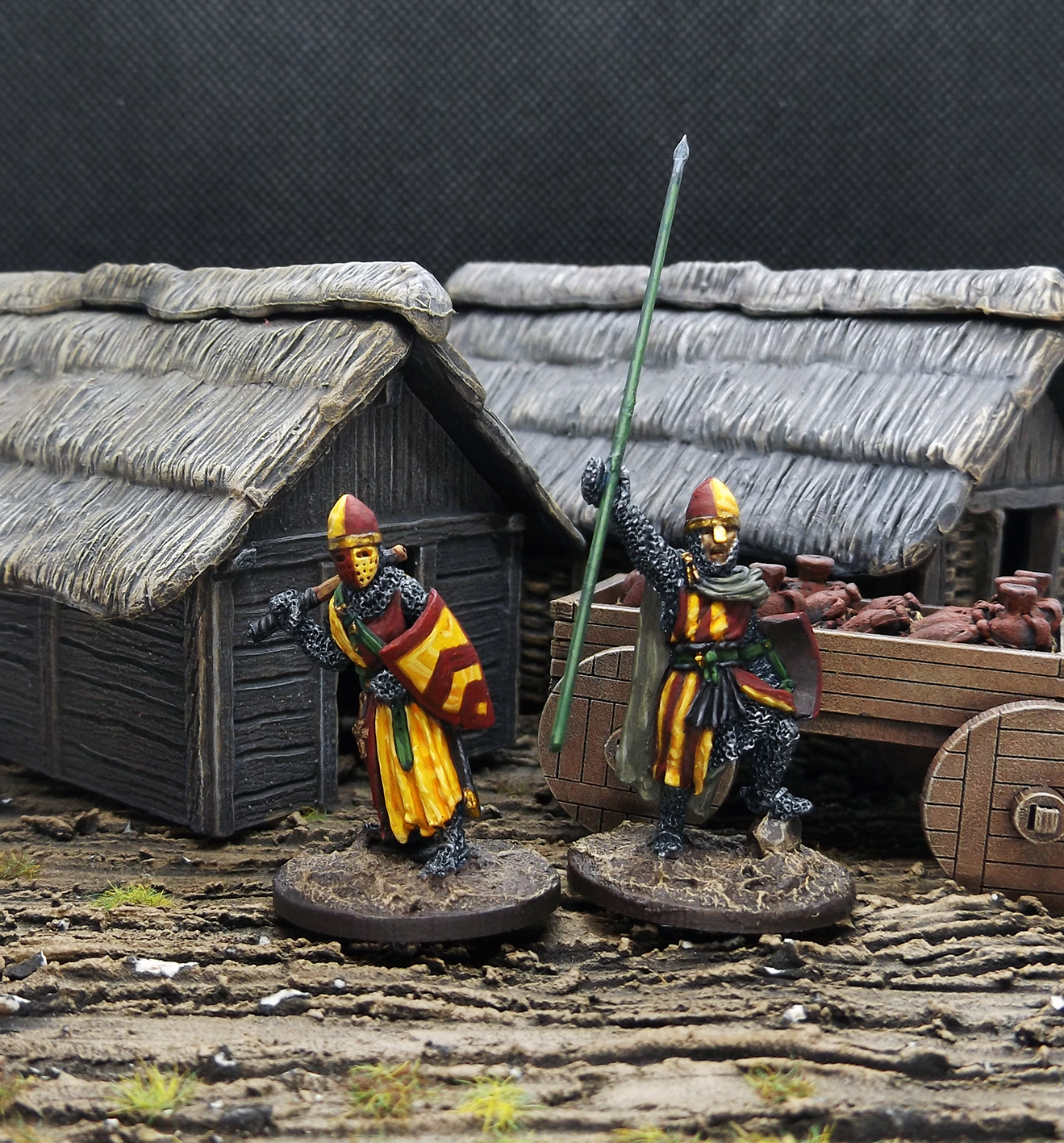
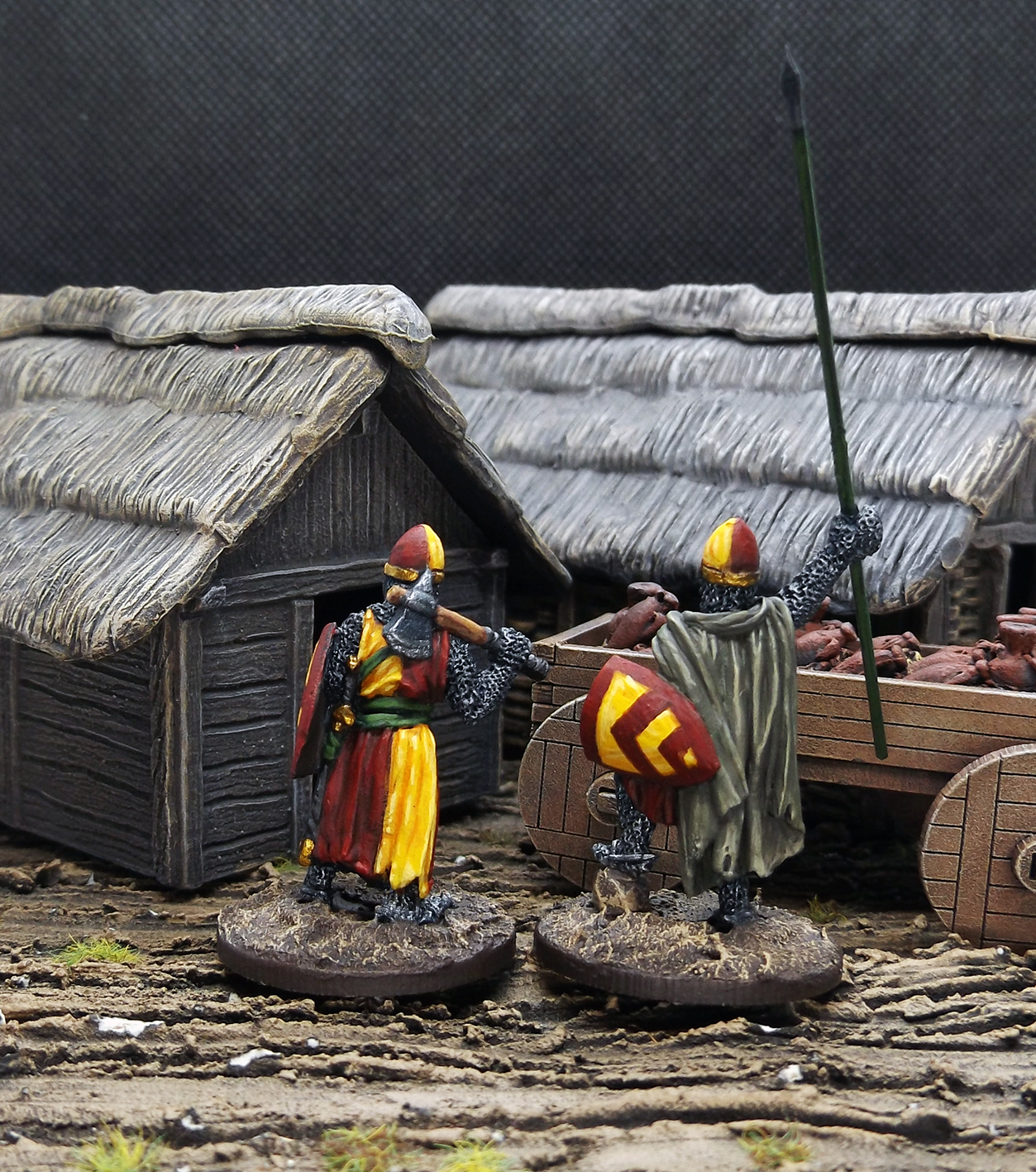
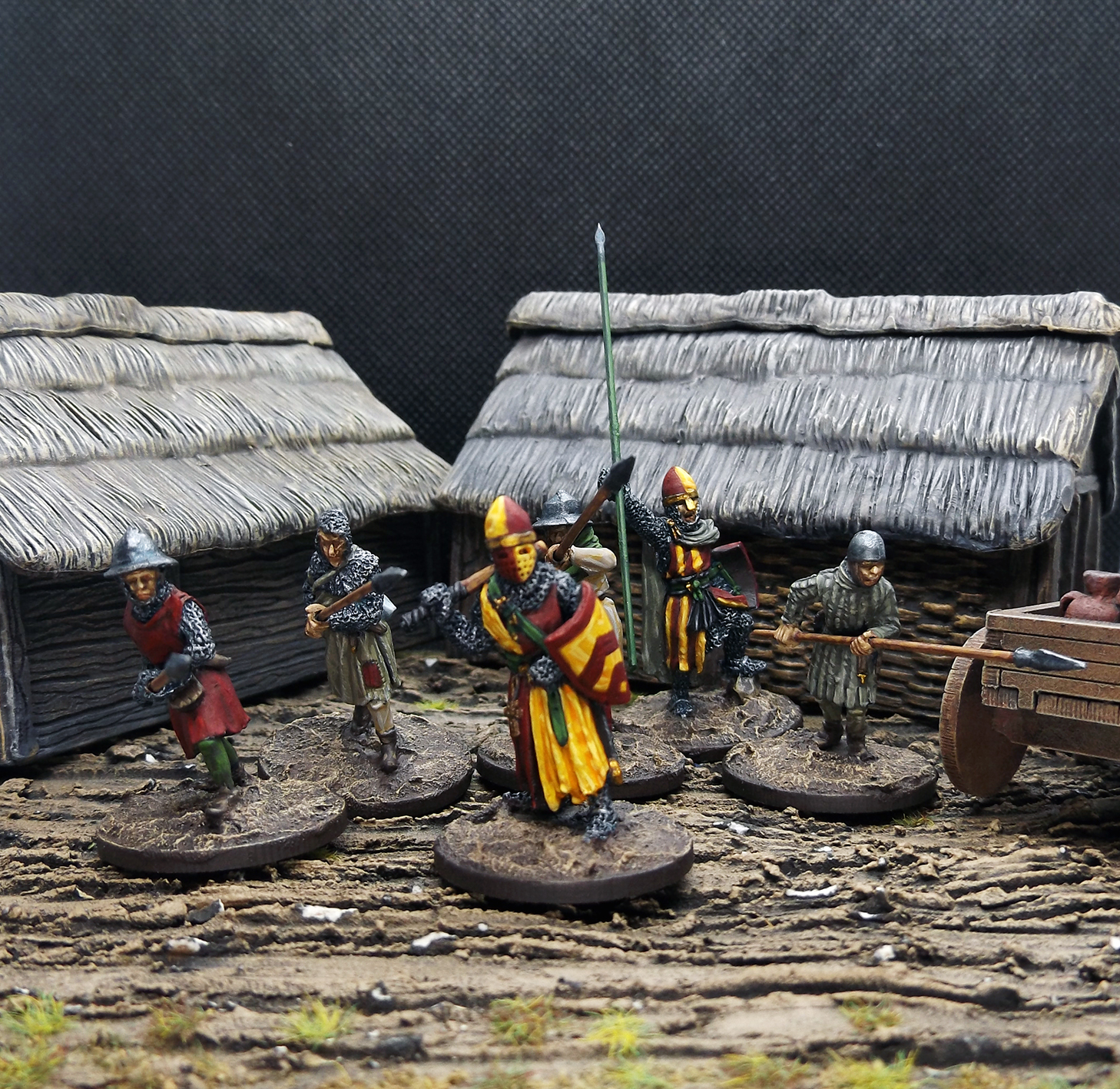
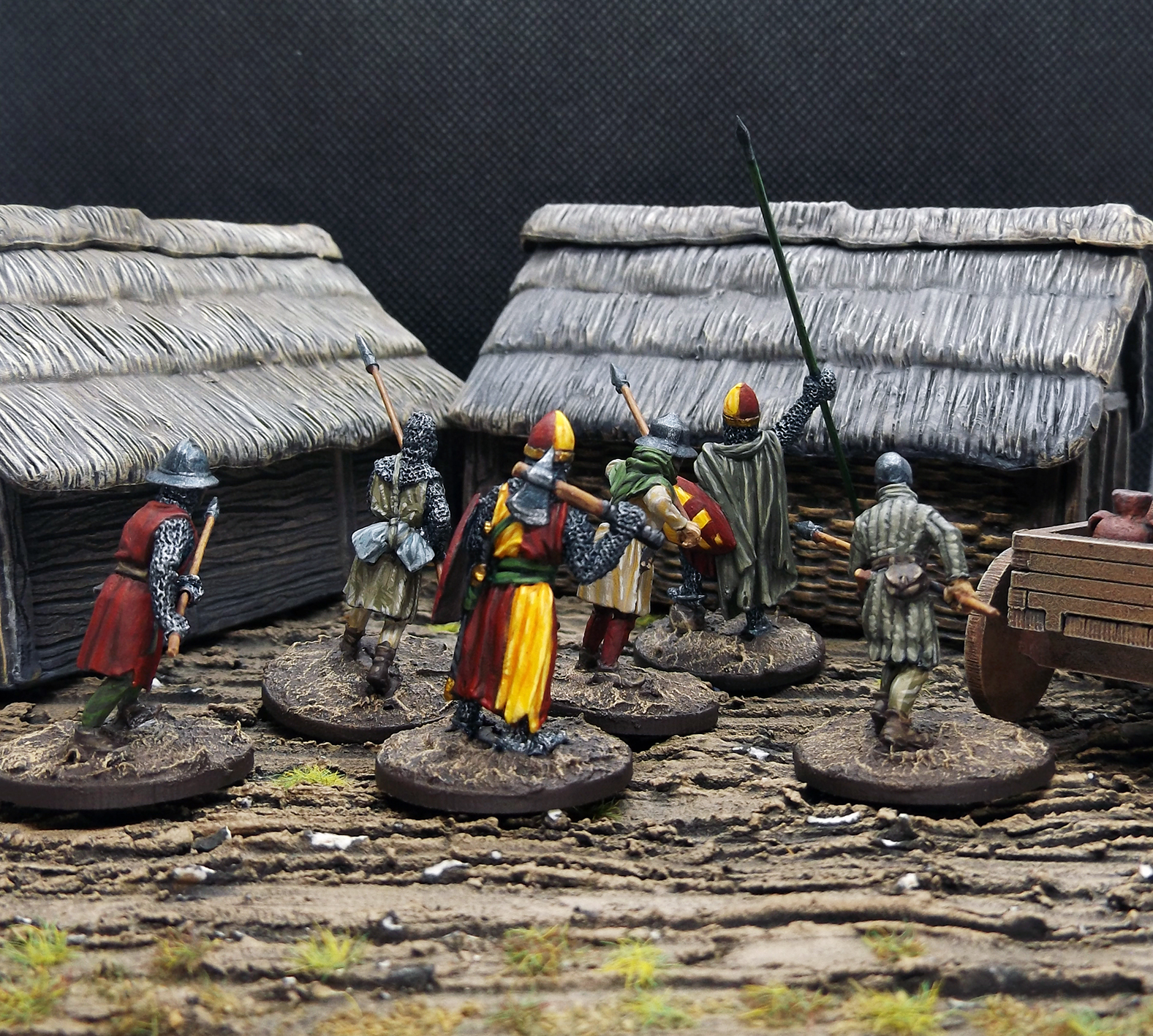
I have finished William d’Aubigny, Baron of Belvoir and another unit of Spearmen for The Barons’ War from Warhost and Footsore Miniatures & Games and I am loving this. Again I have freehand painted the shields and have painted the knights more colourfully that the average guy. Paul Hicks has done an amazing job of these and they are a complete joy to paint. I soon should have about 1000 points painted for the game.
John FitzRobert
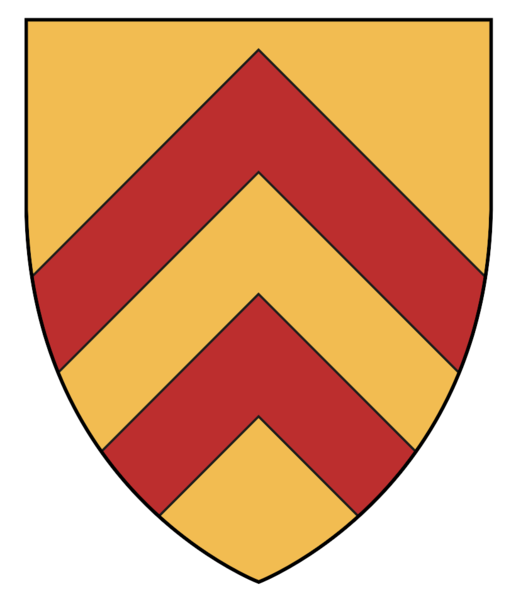 John FitzRobert
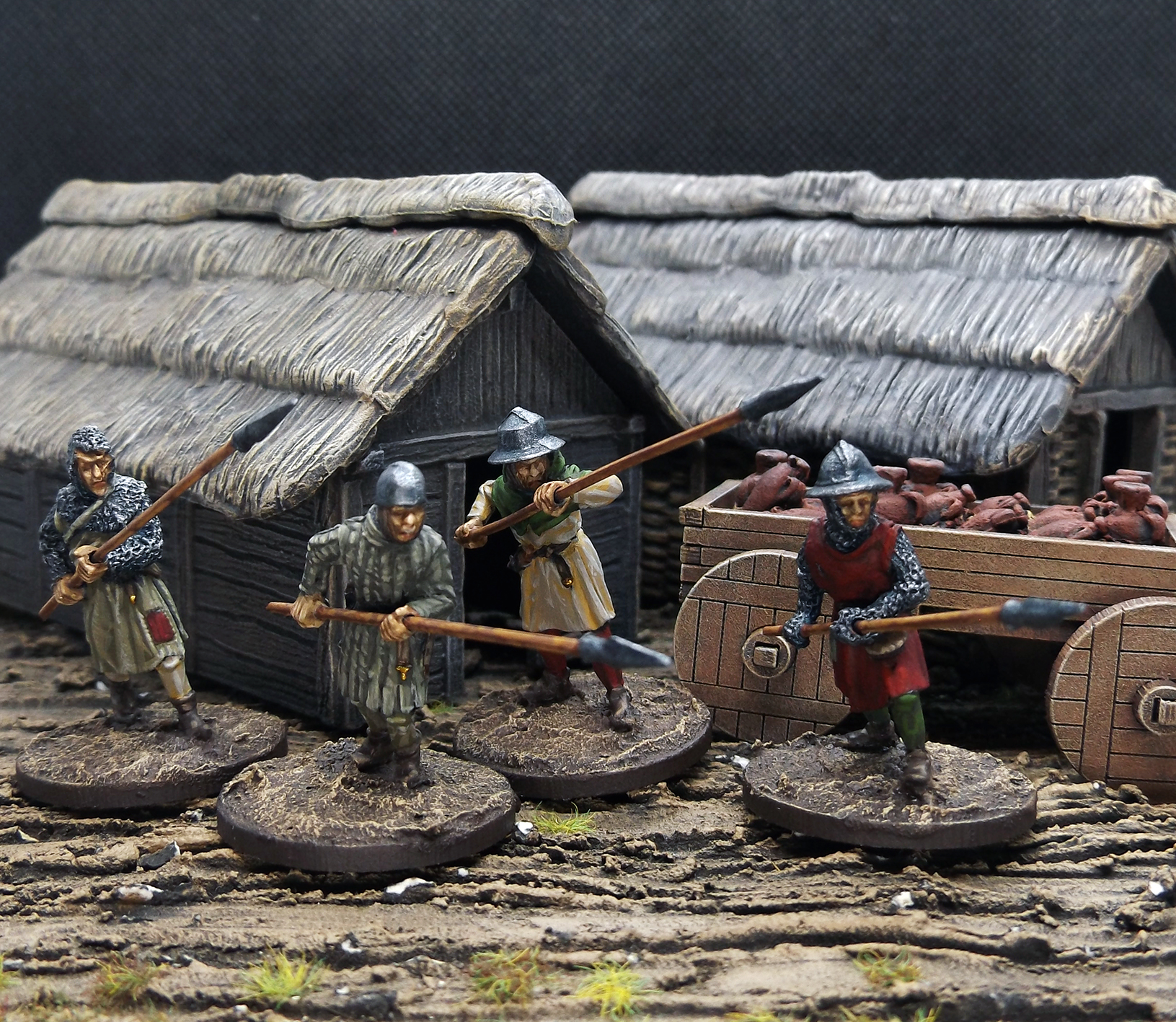
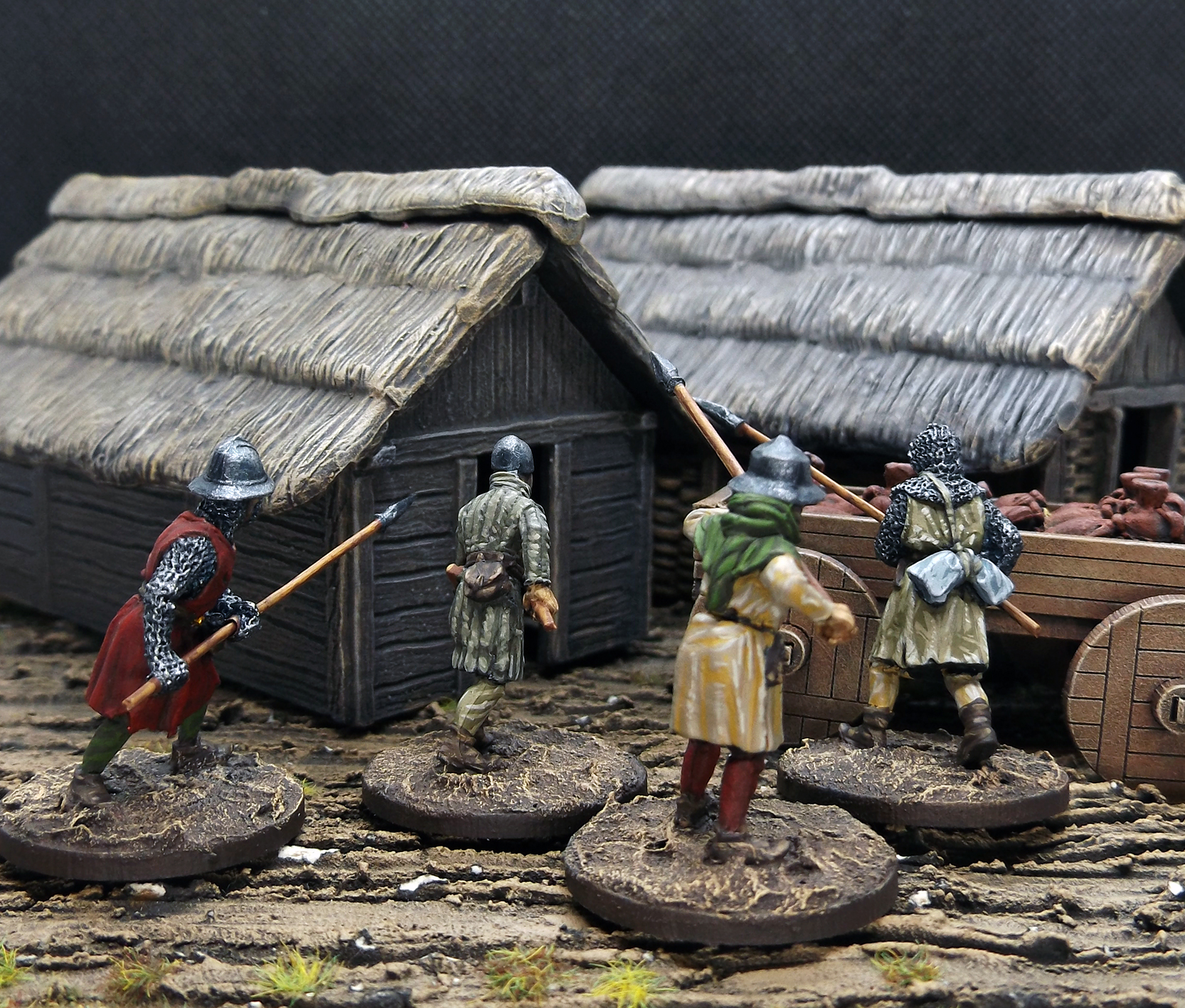
John FitzRobert (c. 1190-1240) held estates distributed across two regions of England, the far north along the Scottish border, and East Anglia and Essex. He accordingly had ties with the two main, but largely separate, groups of barons who rose in opposition to King John in 1216.
John’s ancestors had a long tradition of service to the Angevin monarchy. His grandfather Roger FitzRichard through his military prowess had earned the favour of Henry II, who in 1158 granted him the castle of Warkworth in Northumberland and a few years later the castle and feudal honor of Clavering in Essex. John’s father, Robert, who came of age in 1191, served as sheriff of Northumberland in 1203 and received various grants of manors from John in 1204 and 1205. Robert was a man of wealth and made numerous additions to the great castle at Warkworth which are still visible in the castle’s fabric today, notably the Carrickfergus tower and the western part of the south wall.
John, who succeeded his father in 1212, took over from the latter his established position in northern society, numbering among his associates Eustace de Vesci, William de Mowbray and Peter de Brus. However, he also spent time in East Anglia, where his great-grandfather had acquired estates through his marriage to a daughter of Roger Bigod, earl of Norfolk, and his father had strengthened the family’s position further by an almost equally valuable marriage to the daughter of the Norfolk landowner, William de Chesney. In 1213 and 1215 John served as sheriff of Norfolk and Suffolk.
Understandably, in the light of his and his family’s long tradition of royal service, John was a relative latecomer to the baronial cause. It was nonetheless a tribute both to his high standing and the strength of his ties in northern society that he was chosen one of the Twenty Five. After the renewal of hostilities in the autumn of 1215 he joined his associates in waging war against King John, but after the baronial defeat at Lincoln in May the following year he was among the earliest to offer submission to Henry III’s Minority government. He served as sheriff of Northumberland from 1224 to 1227.
John married twice, his first wife, whom he wedded in about 1218, being Ada de Balliol, through whom he acquired the lordship of Barnard Castle in County Durham, and his second wife Cecily de Fontaines. When he died in 1240, Matthew Paris, the chronicler of St Albans Abbey, wrote: ‘In this year died John FitzRobert, a man of noble birth and one of the chief barons of the northern provinces of England’.
Its a Hard Days Knight
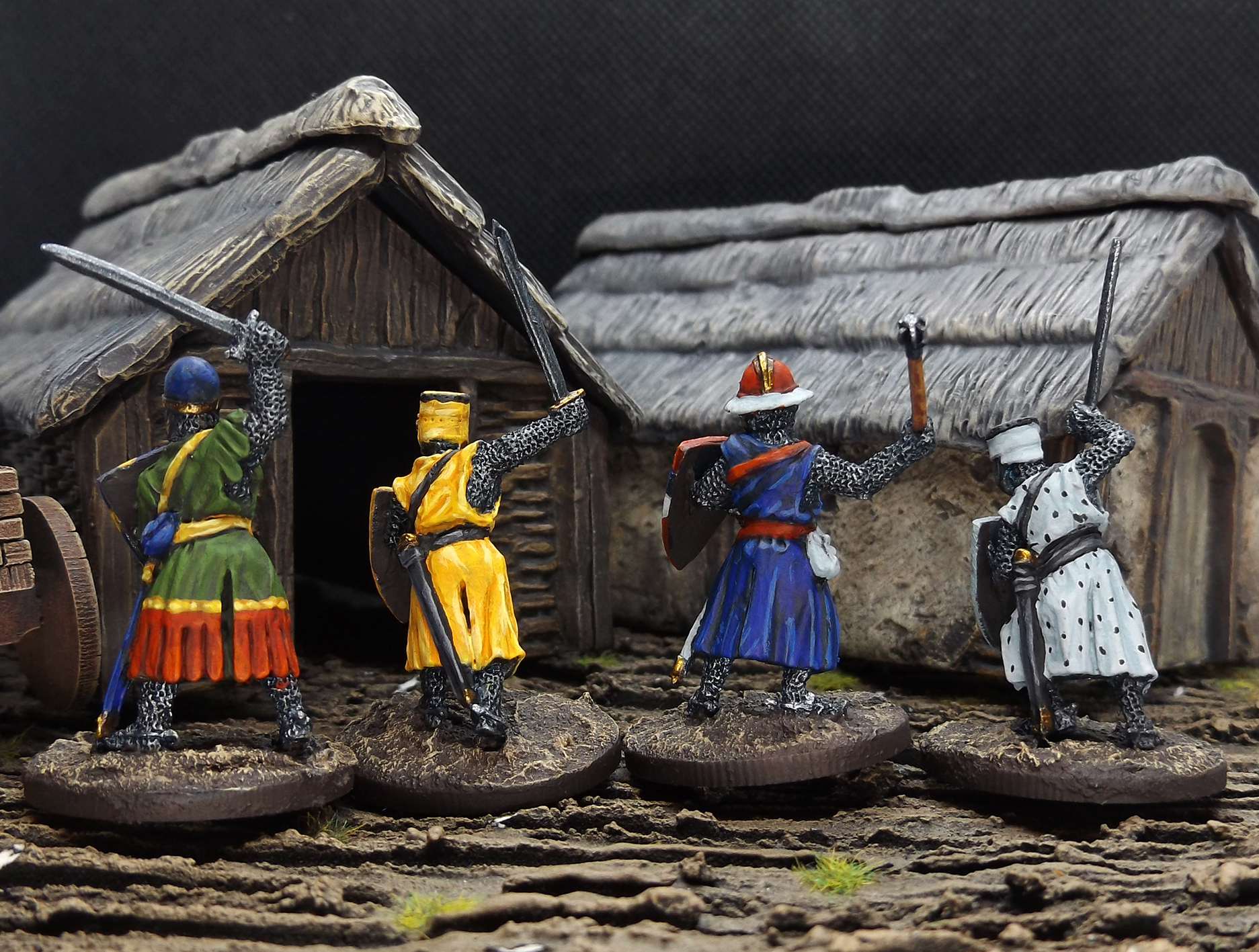
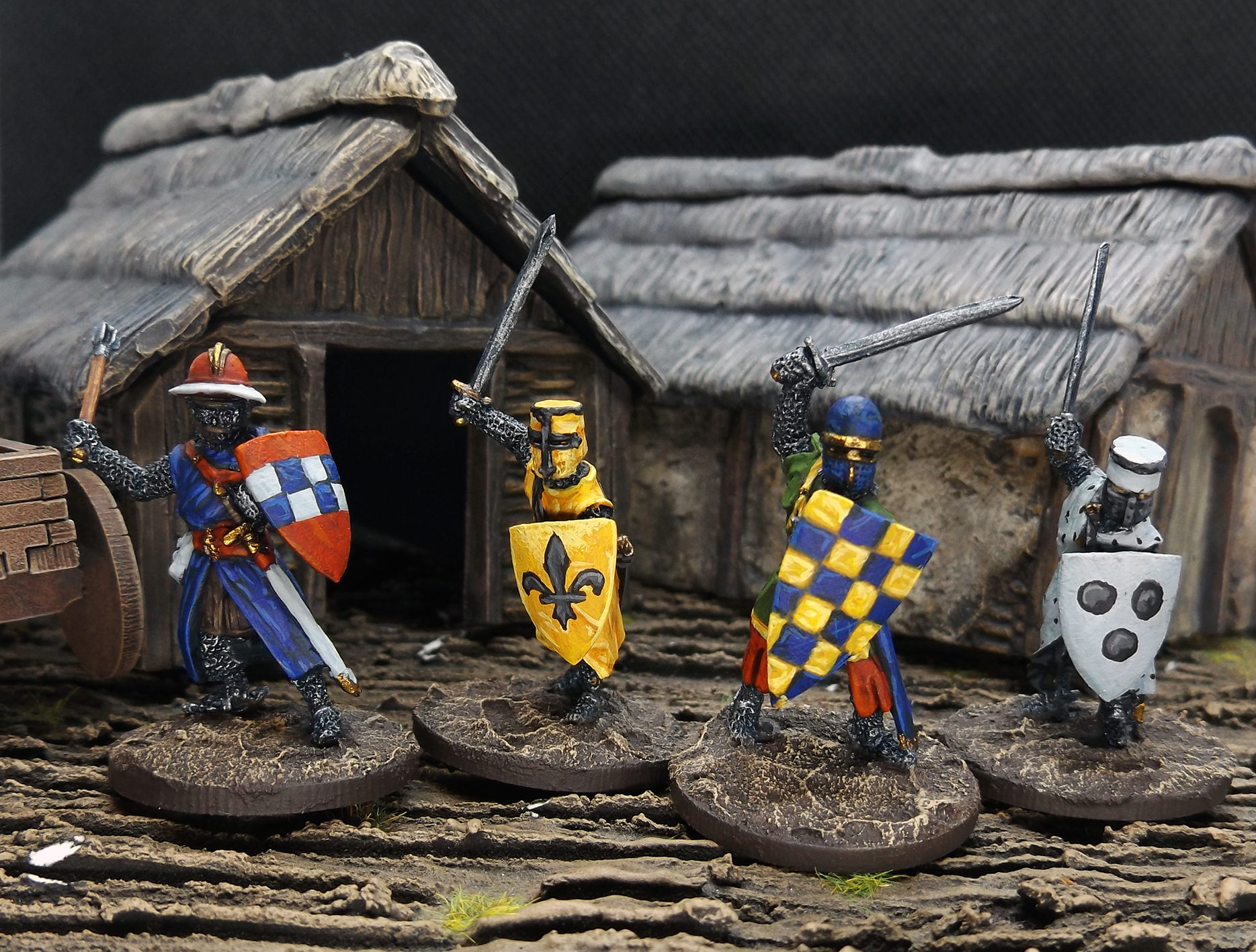
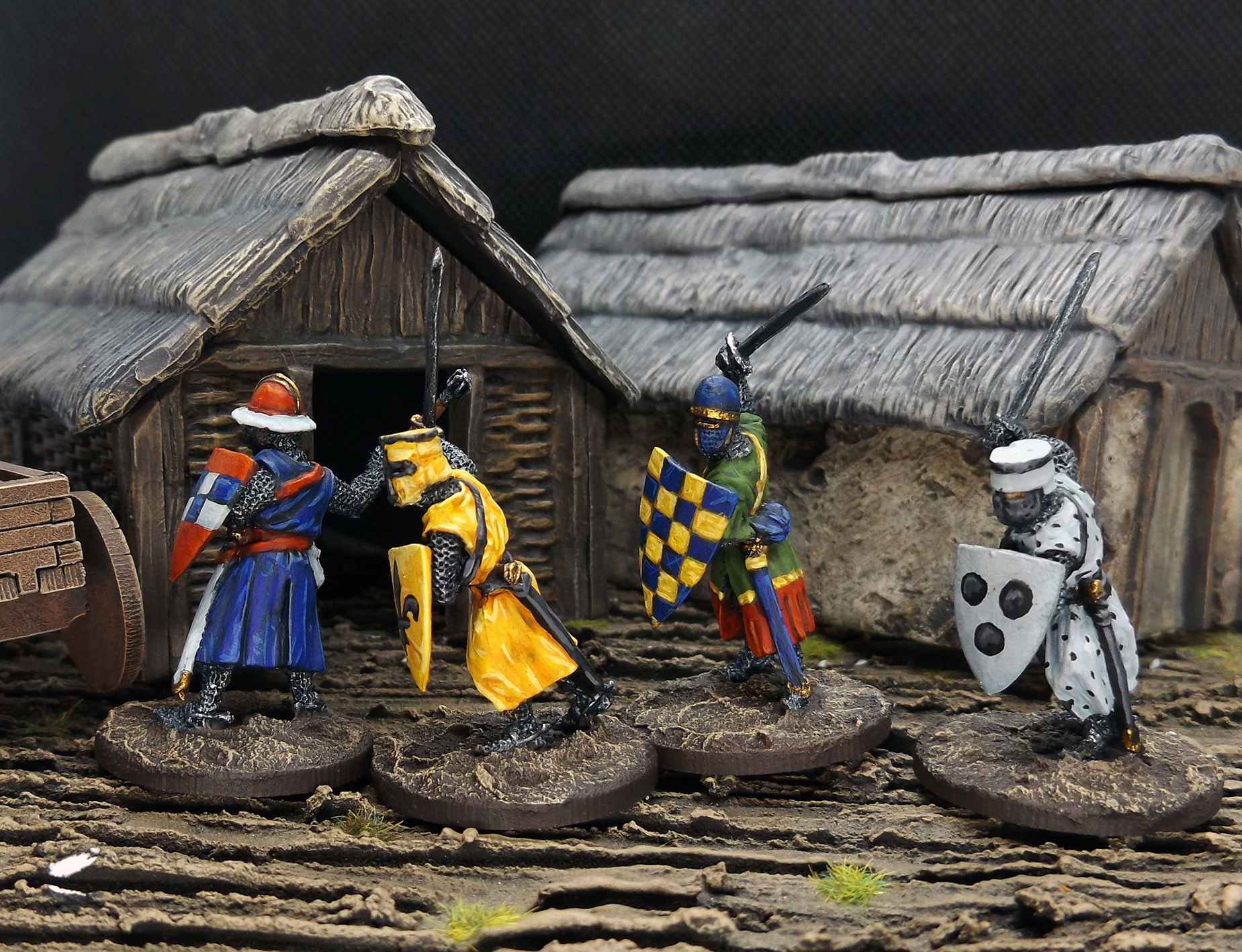
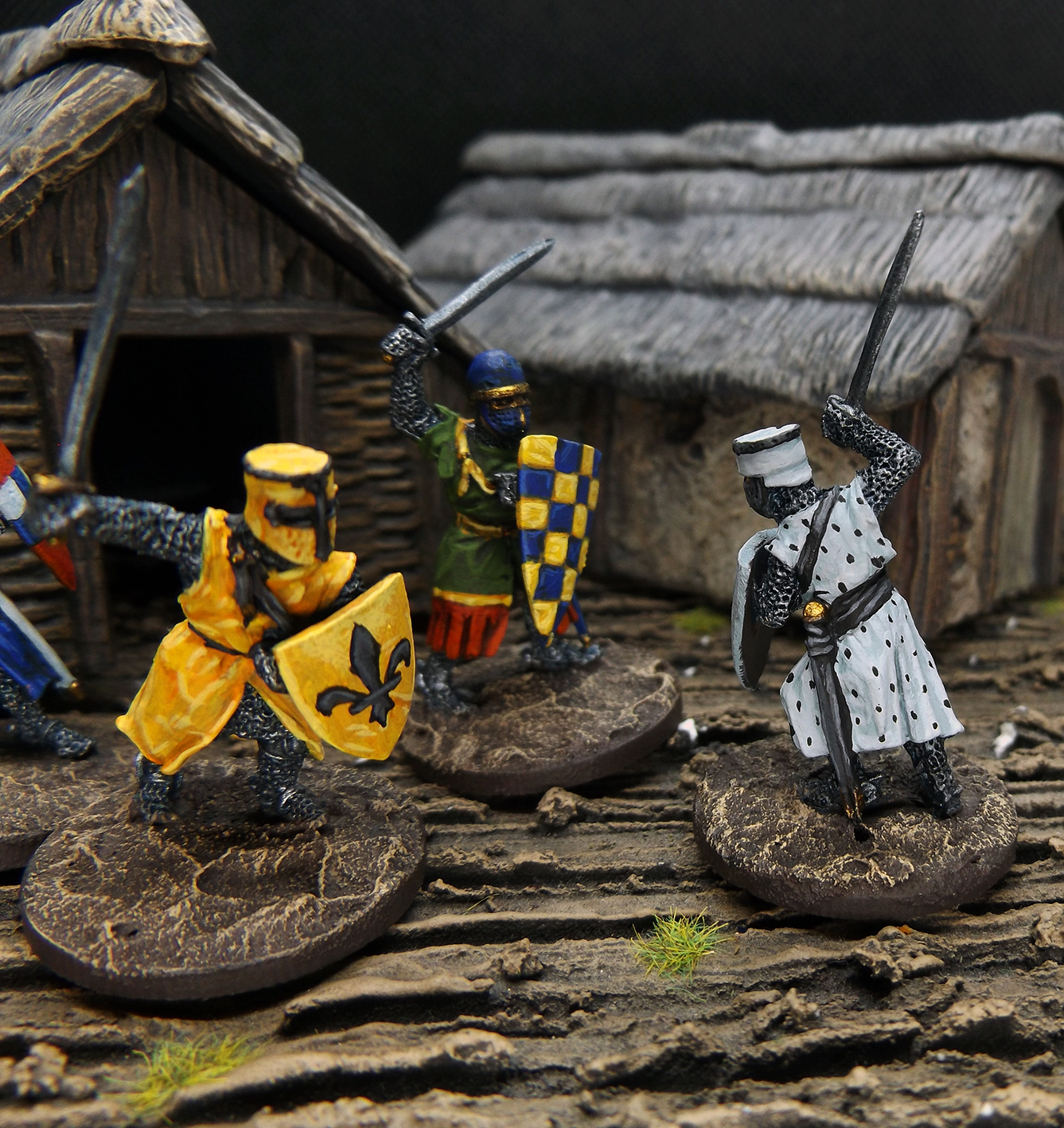 Knights battling in the village
I have finished my second unit of foot knights for my second Baronial force and again I have gone for that individual look to the knights as they would have they own livery and shield design and not one of their Lords. It is fun painting these and researching into them, but there is not a lot of information on who they worn, what the Rolls of Arms were and if they even had liveries and tabards. That to me is the fun part and in my head making up the names of the knights so I have characters on the battlefield.
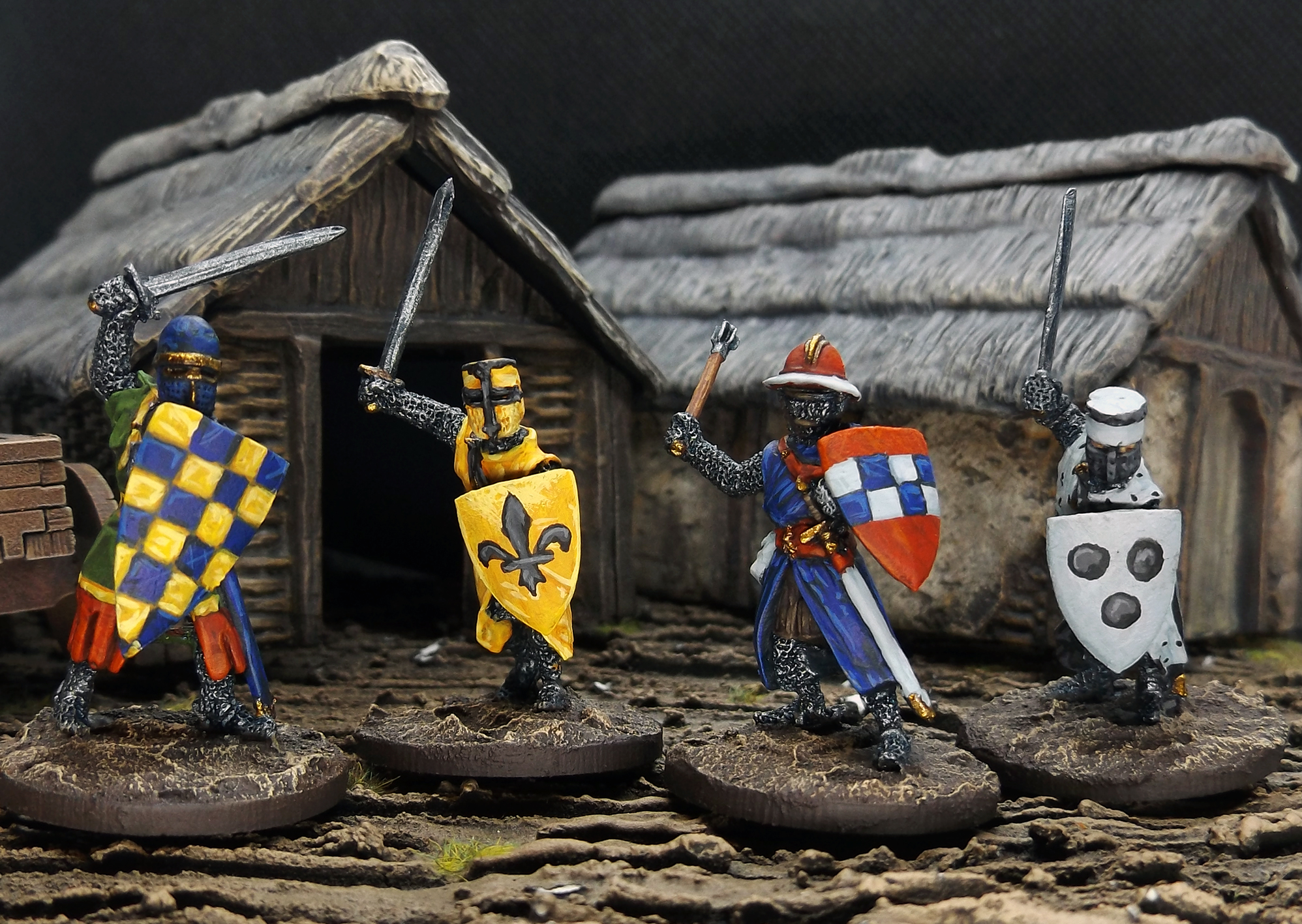
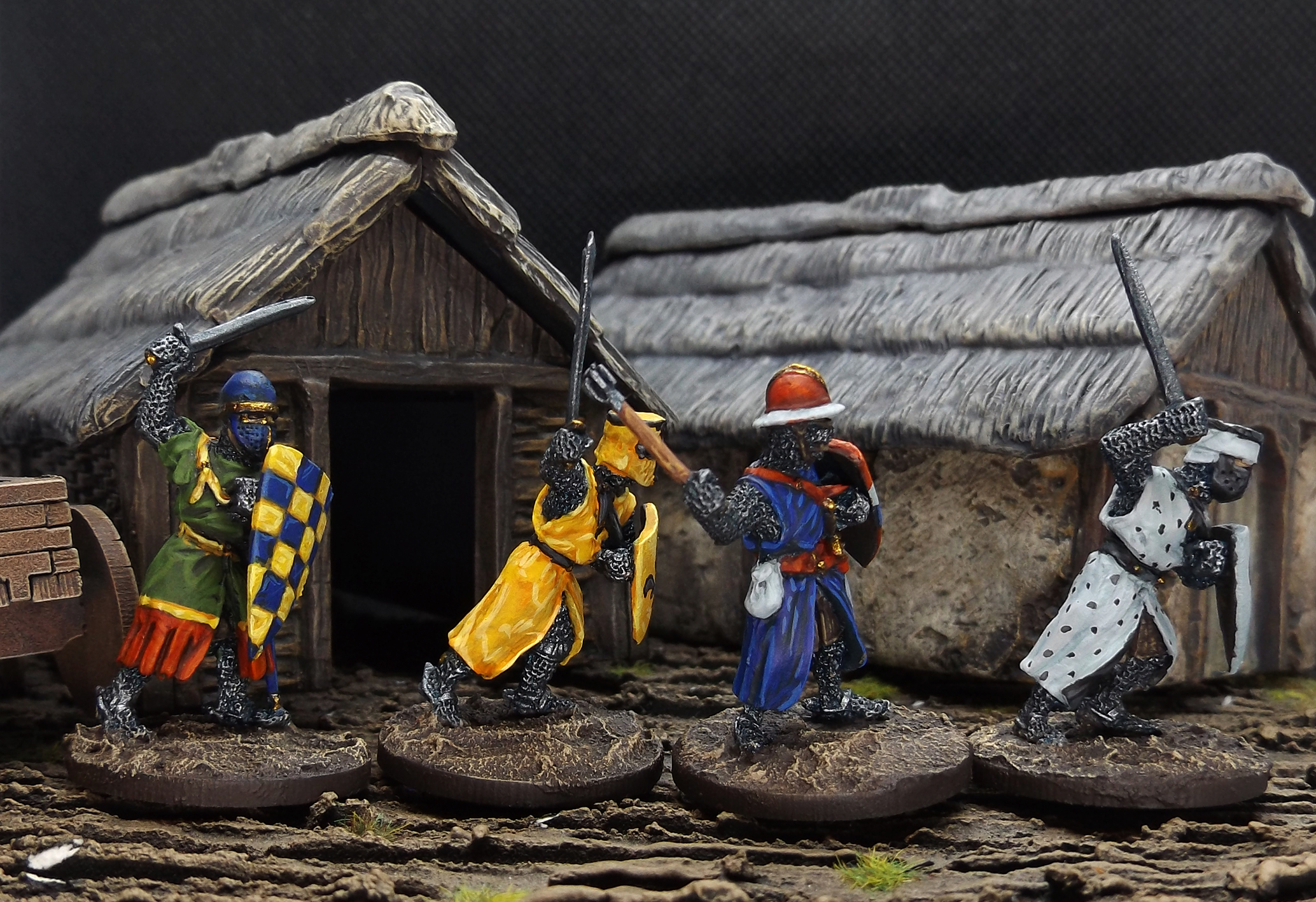

Barons' War Three Kickstarter Coming Soon
 BW3
BW3Richard and Gilbert de Clare
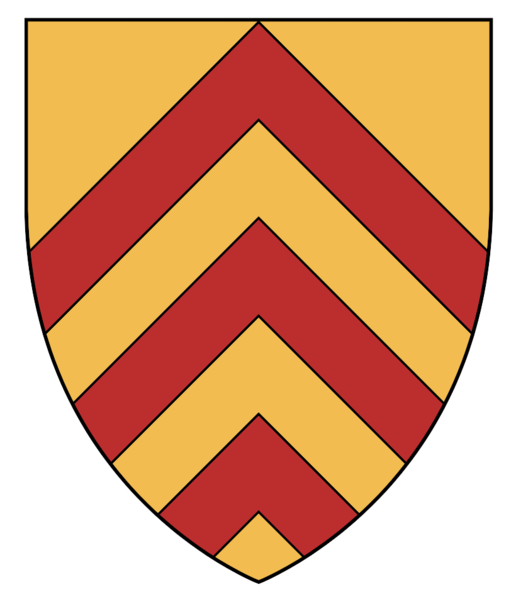 Richard de Clare
The de Clares were one of the great baronial families of twelfth- and thirteenth-century England, holding wide estates in eastern and western England and beyond. For a while the senior branch, based at Tonbridge (Kent), was eclipsed in fame and fortune by a brilliant junior branch which established itself in South Wales and the Marches. Richard FitzGilbert de Clare of this branch, known to history as ‘Strongbow’, was the leader of the semi-official Anglo-Norman invasion of Ireland in Henry II’s reign and obtained a grant of the lordship of Leinster from the king in 1171. This cadet branch became extinct in the male line on the death of Strongbow’s son Gilbert in 1185 and the family’s estates were later taken over by the Marshal earls of Pembroke.
Richard de Clare, appointed to the Twenty Five, of the senior branch of the family, was the son of Roger de Clare (d. 1173), lord of Tonbridge, who was in turn the younger brother and successor of Gilbert II (d. 1152), to whom King Stephen had granted the title earl of Hertford in or around 1138. In the twelfth and early thirteenth centuries the earls used the title ‘of Hertford’ interchangeably with that of earl of Clare.
For over four decades until his death in 1217 Earl Richard was the effective head of the house of Clare. He does not appear to have been especially active, however, playing little part in national affairs either in the last years of Henry II’s reign or in that of Richard the Lionheart. He only emerged as a figure of political importance towards the end of his life in the crisis of John’s reign, when he was appointed to the Twenty Five, most probably in recognition less of his personal qualities than his family’s exalted standing in the realm.
Earl Richard’s greatest and most lasting achievement was to add to the already considerable wealth and landed endowment of his line. In 1189 at the beginning of Richard’s reign, in a major acquisition, he received a grant of half of the honor (or feudal lordship) of the Giffard earls of Buckingham, which had escheated to the crown over twenty years before following the death of the last earl, Walter. The Lionheart effected an equal division between Earl Richard and his cousin Isabel, daughter of Strongbow and wife of William Marshal, earl of Pembroke, both of whom claimed descent from Roesia, Walter’s aunt and wife of Richard FitzGilbert de Clare, first founder of the family.
In 1195 Earl Richard made another substantial, though less perhaps important, addition to his family’s inheritance when he obtained the feudal honor of St Hilary on the death of his mother Maud, Earl Roger’s widow. The honor, for which Richard offered £360 to the Crown, included lands in Norfolk and Northamptonshire.
The most substantial of all the additions Earl Richard made to the family estate, however, came as a result of his marriage to Amicia, second daughter and eventual sole heiress of William, earl of Gloucester. The Gloucester inheritance was a vast one, comprising over 260 knights’ fees in England and extensive lands in Wales and the Marches. The story of its partition among the three daughters and co-heiresses is long and complex. Mabel, the eldest of the three, was married to Amaury de Montfort, count of Evreux in Normandy, while Isabel, the third and youngest, was married to the future King John. Mabel’s marriage was childless and on her husband’s death her lands passed to Isabel. John, however, on becoming king, divorced Isabel so that he could marry the Poitevin heiress Isabella of Angouleme, giving his now ex-wife in marriage to Geoffrey de Mandeville, another of the Twenty Five, and charging him 20,000 marks for the privilege. After Geoffrey died in 1216 her hand was taken by a third husband, Hubert de Burgh, but she herself died in 1217, and her estates passed to Amicia and her husband, Earl Richard. Earl Richard survived Isabel by only six weeks and did not live to secure formal seisin of her estates and title. It was left to his son and heir Gilbert, another of the Twenty Five, to succeed to the vast Gloucester inheritance. Shortly after his father’s death Gilbert assumed the combined titles of earl of Gloucester and Hertford. Countess Amicia lived out her last years in retirement, probably at Clare, having been separated from her husband, for reasons unknown, since 1200.
 Gilbert de Clare
Earl Gilbert was an active participant on the baronial side in the civil war that followed in the wake of King John’s rejection of Magna Carta. He fought with Louis and the French at the battle of Lincoln in May 1217 and was taken captive by none other than William Marshal, the Regent, whose daughter, Isabel, he was later to marry. In 1225 he was a witness to Henry III’s definitive reissue of Magna Carta. In 1230 he accompanied Henry on his expedition to Brittany, but died on the way back at Penros, in the duchy. The earl’s body was brought by way of Plymouth to Tewkesbury, where he was buried before the high altar of the great abbey. A monument, now lost, was erected to his memory by his widow.
By a strange irony, the de Clare family, like their predecessors in the Gloucester title, was to come to an end in 1314, after the death of the last earl, in the succession of three daughters and coheiresses and the partition of the family estates between them.







![New Carolingians & A Pillage Starter Set From Victrix? [Updated]](https://images.beastsofwar.com/2026/07/pillage-introductory-cover-600-338.jpg)