









PanzerKaput Goes To Barons’ War


Recommendations: 11332
About the Project
Set against a backdrop of a Civil War that lasted for two years, 1215-17, as a result of the issuing of Magna Carta. A civil war was the perfect opportunity for the leading nobles of the time to grab land and power while settling some old scores along the way. This vying for land and power hadn't stopped since the invasion of 1066 with only the strongest of kings being able to keep their nobles in check. Our narrative focuses on small groups of warriors brought together under a lord or baron to raid and steal or defend land and property. With the strong, wise, cunning and lucky aiming to rise out of this civil strife in a better position than when it started. The Barons' War skirmish game has been written to enable players to fight out tabletop battles against the backdrop of the First Barons’ War between rival Barons or rival factions who find themselves on either side of the conflict. The game is historically themed, the gameplay is fast-paced and tactical with plenty of narrative and where force building presents you with lots of options enabling two players to muster very different retinues. However, as intended, this is an alpha set of rules which does not include rules for siege warfare, although rules for fighting in buildings are included. Campaign rules are something that will be addressed at a later date and released online. Having grown out of the Barons’ War Kickstarter project, the intention is for this ruleset to develop into a system that could be used throughout the Medieval period. Starting with England from when the Western Roman Empire withdrew around 410 AD to 1485 AD when Richard III died at the Battle of Bosworth Field. This presents us with a huge span of history for gaming which can be broadly divided into Romano-British, Anglo-Saxon and Viking, Anglo-Norman, Angevin and Plantagenet. And that’s just when looking at it from Great Britain. With warriors of this period being pretty similar, it would be easy to use the profiles in this rulebook to play out tabletop battles in any setting. Over time we see these rules evolving with additional warriors, characters, abilities and scenarios being added starting with the Dark Ages, the Anarchy and the Crusades and shared to www.warhost.online, which has been set up to be the community website for the game.
Related Game: The Barons' War
Related Company: Footsore Miniatures and Games
Related Genre: Historical
This Project is Active
Heraldry and Shields Designs
Tincture is the limited palette of colours and patterns used in heraldry. The need to define, depict, and correctly blazon the various tinctures is one of the most important aspects of heraldic art and design.
Development and history
The use of tinctures dates back to the formative period of European heraldry in the twelfth and thirteenth centuries. The range of tinctures and the manner of depicting and describing them has evolved over time, as new variations and practices have developed.
The basic scheme and rules of applying the heraldic tinctures dates back to the 12th century. The earliest surviving coloured heraldic illustrations, from the mid-thirteenth century, show the standardized usage of two metals, five colours, and two furs. Since that time, the great majority of heraldic art has employed these nine tinctures.
Over time, variations on these basic tinctures were developed, particularly with respect to the furs. Authorities differ as to whether these variations should be considered separate tinctures, or merely varieties of existing ones. Two additional colours appeared, and were generally accepted by heraldic writers, although they remained scarce, and were eventually termed stains, from the belief that they were used to signify some dishonour on the part of the bearer. The practice of depicting certain charges as they appear in nature, termed proper, was established in the seventeenth century. Other colours have appeared occasionally since the eighteenth century, especially in continental heraldry, but their use is infrequent, and they have never been regarded as particularly heraldic, or numbered among the tinctures that form the basis of heraldic design.
Frequency and national variants
The frequency with which different tinctures have been used over time has been much observed, but little studied. There are some general trends of note, both with respect to the passage of time, and noted preferences from one region to another.
In medieval heraldry, gules was by far the most common tincture, followed by the metals argent and or, at least one of which necessarily appeared on the majority of arms. Among the colours, sable was the second most common, followed by azure. Vert, although present from the formative period of heraldic design, was relatively scarce. Over time, the popularity of azure increased above that of sable, while gules, still the most common, became less dominant. A survey of French arms granted during the seventeenth century reveals a distinct split between the trends for the arms granted to nobles and commoners. Among nobles, gules remained the most common tincture, closely followed by or, then by argent and azure at nearly equal levels; sable was a very distant fifth choice, while vert remained scarce. Among commoners, azure was easily the most common tincture, followed by or, and only then by gules, argent, and sable, which was used more by commoners than among the nobility; vert, however, was even scarcer in common arms. Purpure is so scarce in French heraldry that some authorities do not regard it as a “real heraldic tincture”.
On the whole, French heraldry is known for its use of azure and or, while English heraldry is characterized by heavy use of gules and argent, and unlike French heraldry, it has always made regular use of vert, and occasional, if not extensive, use of purpure. German heraldry is known for its extensive use of or and sable. German and Nordic heraldry rarely make use of purpure or ermine, except in mantling, pavilions, and the lining of crowns and caps. In fact, furs occur infrequently in German and Nordic heraldry.

Metals
The metals are or and argent, representing gold and silver respectively, although in practice they are often depicted as yellow and white.
Or (Ger. Gelb, Gold, or golden) derives its name from the Latin aurum, “gold”. It may be depicted using either yellow or metallic gold, at the artist’s discretion; “yellow” has no separate existence in heraldry, and is never used to represent any tincture other than or.
Argent (Ger. Weiß, Weiss, Silber, or silbern) is similarly derived from the Latin argentum, “silver”. Although sometimes depicted as metallic silver or faint grey, it is more often represented by white, in part because of the tendency for silver paint to oxidize and darken over time, and in part because of the pleasing effect of white against a contrasting colour. Notwithstanding the widespread use of white for argent, some heraldic authorities have suggested the existence of white as a distinct heraldic colour.
Colours
Five colours have been recognized since the earliest days of heraldry. These are: gules, or red; sable, or black; azure, or blue; vert, or green; and purpure, or purple.
Gules (Fr. gueules, Ger. Rot) is of uncertain derivation; outside of the heraldic context, the modern French word refers to the mouth of an animal.
Sable (Ger. Schwarz) is named for a type of marten, known for its dark, luxuriant fur.
Azure (Fr. azur or bleu, Ger. Blau) comes through the Arabic lāzaward, from the Persian lāžavard both referring to the blue mineral lapis lazuli, used to produce blue pigments.
Vert (Fr. vert or sinople, Ger. Grün) is from Latin viridis, “green”. The alternative name in French, sinople, is derived from the ancient city of Sinope in Asia Minor, which was famous for its pigments.
Purpure (Fr. purpure or pourpre, Ger. Purpur) is from Latin purpura, in turn from Greek porphyra, the dye known as Tyrian purple. This expensive dye, known from antiquity, produced a much redder purple than the modern heraldic colour; and in fact earlier depictions of purpure are far redder than recent ones. As a heraldic colour, purpure may have originated as a variation of gules.
Stains
Two more tinctures were eventually acknowledged by most heraldic authorities: sanguine or murrey, a dark red or mulberry colour; and tenné, an orange or dark yellow to brownish colour. These were termed “stains” by some of the more influential heraldic writers, and supposed to represent some sort of dishonour on the part of the bearer; but in fact there is no evidence that they were ever so employed, and they probably originated as mere variations of existing colours. Nevertheless, the belief that they represented stains upon the honour of an armiger served to prevent them receiving widespread use, and it is only in recent times that they have begun to appear on a regular basis.
Sanguine or Murrey, from Latin sanguineus, “blood red”, and Greek morum, “mulberry”, one of the two so-called “stains” in British armory, is a dark red or mulberry colour, between gules and purpure in hue. It probably originated as a mere variation of one of those two colours, and may in fact represent the original hue of purpure, which is now treated as a much bluer colour than when it first appeared in heraldry. Although long shunned in the belief that it represented some dishonour on the part of the bearer, it has found some use in the twentieth and twenty-first centuries.
Tenné or tenny, from Latin tannare, “to tan”, is the second of the so-called “stains”. It is most often depicted as orange, but sometimes as tawny yellow or brown. In earlier times it was occasionally used in continental heraldry, but in England largely confined to livery.
Furs
The use of heraldic furs alongside the metals and colours dates to the beginning of the art. In this earliest period, there were only two furs, ermine and vair. Ermine represents the fur of the stoat, a type of weasel, in its white winter coat, when it is called an ermine. Vair represents the winter coat of the red squirrel, which is blue-grey above and white below. These furs were commonly used to line the cloaks and robes of the nobility. Both ermine and vair give the appearance of being a combination of metal and colour, but in heraldic convention they are considered a separate class of tincture that is neither metal nor colour. Over time, several variations of ermine and vair have appeared, together with three additional furs typically encountered in continental heraldry, known as plumeté, papelonné, and kürsch, the origins of which are more mysterious, but which probably began as variations of vair.
Ermine

Ermine (Fr. hermine, Ger. hermelin) is normally depicted as a white field powdered with black spots, known as “ermine spots”, representing the ermine’s black tail. The use of white instead of silver is normal, even when silver is available, since this is how the fur naturally appears; but occasionally silver is used to depict ermine. There is considerable variation in the shape of ermine spots; in the oldest depictions, they were drawn realistically, as long, tapering points; in modern times they are typically drawn as arrowheads, usually topped by three small dots.
Vair

Vair (Ger. Feh) derives its name from Latin varius, “variegated”. It is usually depicted as a series of alternating shapes, conventionally known as panes or “vair bells”, of argent and azure, arranged in horizontal rows, so that the panes of one tincture form the upper part of the row, while those of the opposite tincture are on the bottom. Succeeding rows are staggered, so that the bases of the panes making up each row are opposite those of the other tincture in the rows above and below. As with ermine, the argent panes may be depicted as either white or silver; silver is used more often with vair than with ermine, but the natural fur is white.
When the pattern of vair is used with other colours, the field is termed vairé or vairy of the tinctures used. Normally vairé consists of one metal and one colour, although ermine or one of its variants is sometimes used, with an ermine spot appearing in each pane of that tincture. Vairé of four colours (Ger. Buntfeh, “gay-coloured” or “checked vair”) is also known, usually consisting of two metals and two colours.
Several variant shapes exist, of which the most common is known as potent (Ger. Sturzkrückenfeh, “upside-down crutch vair”). In this form, the familiar “vair bell” is replaced by a T-shaped figure, known as a “potent” due to its resemblance to a crutch. Other furs sometimes encountered in continental heraldry, which are thought to be derived from vair, include plumeté or plumetty and papelonné or papellony. In plumeté, the panes are depicted as feathers; in papelonné they are depicted as scales, resembling those of a butterfly’s wings (whence the name is derived). These can be modified with the color, arrangement, and size variants of vair, though those variants are much less common. In German heraldry there is also a fur known as Kürsch, or “vair bellies”, consisting of panes depicted hairy and brown. Here the phrase “vair bellies” may be a misnomer, as the belly of the red squirrel is always white, although its summer coat is indeed reddish brown.
-

Potent
-

Plumeté or and sable
-

Gules, papelonné or
-

Kürsch
Other tinctures
Several other tinctures are occasionally encountered, usually in continental heraldry:
- Cendrée, or “ash-colour”;
- Brunâtre (Ger. Braun), or brown, occasionally used in German heraldry, in place of purpure;
- Bleu-céleste or bleu de ciel, a sky blue colour intended to be lighter than azure;
- Amaranth or columbine, a strong violet-red, found in at least one grant of arms to a Bohemian knight in 1701;
- Eisen-farbe, or iron-colour, found in German heraldry; and
- Carnation, often used in French heraldry as the colour of flesh.
The heraldic scholar A. C. Fox-Davies proposed that, in some circumstances, white should be considered a heraldic colour, distinct from argent. In a number of instances, a label or collar blazoned as “white” rather than “argent” appears on a supporter blazoned argent or or. The use of “white” in place of “argent” would be consistent with the practice of heraldic blazon that discourages repeating the name of a tincture in describing a coat of arms, but if it were merely intended as a synonym of “argent”, this placement would clearly violate the rule against placing metal on metal or colour on colour (see below). This difficulty is avoided if “white” is considered a colour in this particular instance, rather than a synonym of “argent”. This interpretation has neither been accepted nor refuted by any heraldic authority, but a counter-argument is that the labels are not intended to represent a heraldic tincture, but are in fact white labels proper.
Proper
A charge that is coloured as it naturally appears is blazoned proper (Fr. propre), or “the colour of nature”. Strictly speaking, proper is not a tincture in itself, and if, as is sometimes the case, a charge is meant to be depicted in particular colours that are not apparent from the word “proper” alone, they may be specified in whatever detail is necessary. Certain charges are considered “proper” when portrayed with particular colours, even though a range of different colours is found in nature; for instance, a popinjay proper is green, even though wild parrots occur in a variety of colours. In some cases, a charge depicted in a particular set of colours may be referred to as “proper”, even though it consists entirely of heraldic tinctures; a rose proper, whether red or white, is barbed vert and seeded or.

_Nord-France.svg)
.svg)

Blazon
In heraldry and heraldic vexillology, a blazon is a formal description of a coat of arms, flag or similar emblem, from which the reader can reconstruct the appropriate image. The verb to blazon means to create such a description. The visual depiction of a coat of arms or flag has traditionally had considerable latitude in design, but a verbal blazon specifies the essentially distinctive elements. A coat of arms or flag is therefore primarily defined not by a picture but rather by the wording of its blazon (though in modern usage flags are often additionally and more precisely defined using geometrical specifications). Blazon is also the specialized language in which a blazon is written, and, as a verb, the act of writing such a description. Blazonry is the art, craft or practice of creating a blazon. The language employed in blazonry has its own vocabulary, grammar and syntax, which becomes essential for comprehension when blazoning a complex coat of arms.
Other armorial objects and devices – such as badges, banners, and seals – may also be described in blazon.
The noun and verb blazon (referring to a verbal description) are not to be confused with the noun emblazonment, or the verb to emblazon, both of which relate to the graphic representation of a coat of arms or heraldic device.
Blazon is generally designed to eliminate ambiguity of interpretation, to be as concise as possible, and to avoid repetition and extraneous punctuation. English antiquarian Charles Boutell stated in 1864:
Heraldic language is most concise, and it is always minutely exact, definite, and explicit; all unnecessary words are omitted, and all repetitions are carefully avoided; and, at the same time, every detail is specified with absolute precision. The nomenclature is equally significant, and its aim is to combine definitive exactness with a brevity that is indeed laconic.
However, John Brooke-Little, Norroy and Ulster King of Arms, wrote in 1985: “Although there are certain conventions as to how arms shall be blazoned … many of the supposedly hard and fast rules laid down in heraldic manuals [including those by heralds] are often ignored.”
A given coat of arms may be drawn in many different ways, all considered equivalent and faithful to the blazon, just as the letter “A” may be printed in many different fonts while still being the same letter. For example, the shape of the escutcheon is almost always immaterial, with very limited exceptions.
The main conventions of blazon are as follows:
- Every blazon of a coat of arms begins by describing the field (background), with the first letter capitalised, followed by a comma “,”. In a majority of cases this is a single tincture; e.g. Azure (blue).
- If the field is complex, the variation is described, followed by the tinctures used; e.g. Chequy gules and argent (checkered red and white).
- If the shield is divided, the division is described, followed by the tinctures of the subfields, beginning with the dexter side (shield bearer’s right, but viewer’s left) of the chief (upper) edge; e.g. Party per pale argent and vert (dexter half silver, sinister half green), or Quarterly argent and gules (clockwise from viewer’s top left, i.e. dexter chief: white, red, white, red). In the case of a divided shield, it is common for the word “party” or “parted” to be omitted (e.g., Per pale argent and vert, a tree eradicated counterchanged).
- Some authorities prefer to capitalise the names of tinctures and charges, but this convention is far from universal. Where tinctures are not capitalised, an exception may be made for the metal Or, in order to avoid confusion with the English word “or”. Where space is at a premium, tincture names may be abbreviated: e.g., ar. for argent, gu. for gules, az. for azure, sa. for sable, and purp. for purpure.
- Following the description of the field, the principal ordinary or ordinaries and charge(s) are named, with their tincture(s); e.g., a bend or.
- The principal ordinary or charge is followed by any other charges placed on or around it. If a charge is a bird or a beast, its attitude is defined, followed by the creature’s tincture, followed by anything that may be differently coloured; e.g. An eagle displayed gules armed and wings charged with trefoils or (see the coat of arms of Brandenburg below).
- Counterchanged means that a charge which straddles a line of division is given the same tinctures as the divided field, but reversed (see the arms of Behnsdorf below).
- A quartered (composite) shield is blazoned one quarter (panel) at a time, proceeding by rows from chief (top) to base, and within each row from dexter (the right side of the bearer holding the shield) to sinister; in other words, from the viewer’s left to right.
- Following the description of the shield, any additional components of the achievement – such as crown/coronet, helmet, torse, mantling, crest, motto, supporters and compartment – are described in turn, using the same terminology and syntax.
- A convention often followed historically was to name a tincture explicitly only once within a given blazon. If the same tincture was found in different places within the arms, this was addressed either by ordering all elements of like tincture together prior to the tincture name (e.g., Argent, two chevrons and a canton gules); or by naming the tincture only at its first occurrence, and referring to it at subsequent occurrences obliquely, for example by use of the phrase “of the field” (e.g., Argent, two chevrons and on a canton gules a lion passant of the field); or by reference to its numerical place in the sequence of named tinctures (e.g., Argent, two chevrons and on a canton gules a lion passant of the first: in both these examples, the lion is argent). However, these conventions are now avoided by the College of Arms in London, and by most other formal granting bodies, as they may introduce ambiguity to complex blazons.
- It is common to print all heraldic blazons in italic. Heraldry has its own vocabulary, word-order and punctuation, and presenting it in italics indicates to the reader the use of a quasi-foreign language.
-

Azure, a bend or. A coat made famous by the medieval court case Scrope v. Grosvenor.
-

Party per pale argent and vert, a tree eradicated counterchanged. Arms of Behnsdorf.
-

Argent, an eagle displayed gules armed and wings charged with trefoils Or. Arms of Brandenburg.
-

Quarterly 1st and 4th Sable a lion rampant on a canton Argent a cross Gules; 2nd and 3rd quarterly Argent and Gules in the 2nd and 3rd quarters a fret Or overall on a bend Sable three escallops of the first and as an augmentation in chief an inescutcheon, Argent a cross Gules and thereon an inescutcheon Azure, three fleurs-de-lis Or. Arms of Churchill.


The Completed St Marys' de Pratis Force
 Abbot William Pepyn's Force
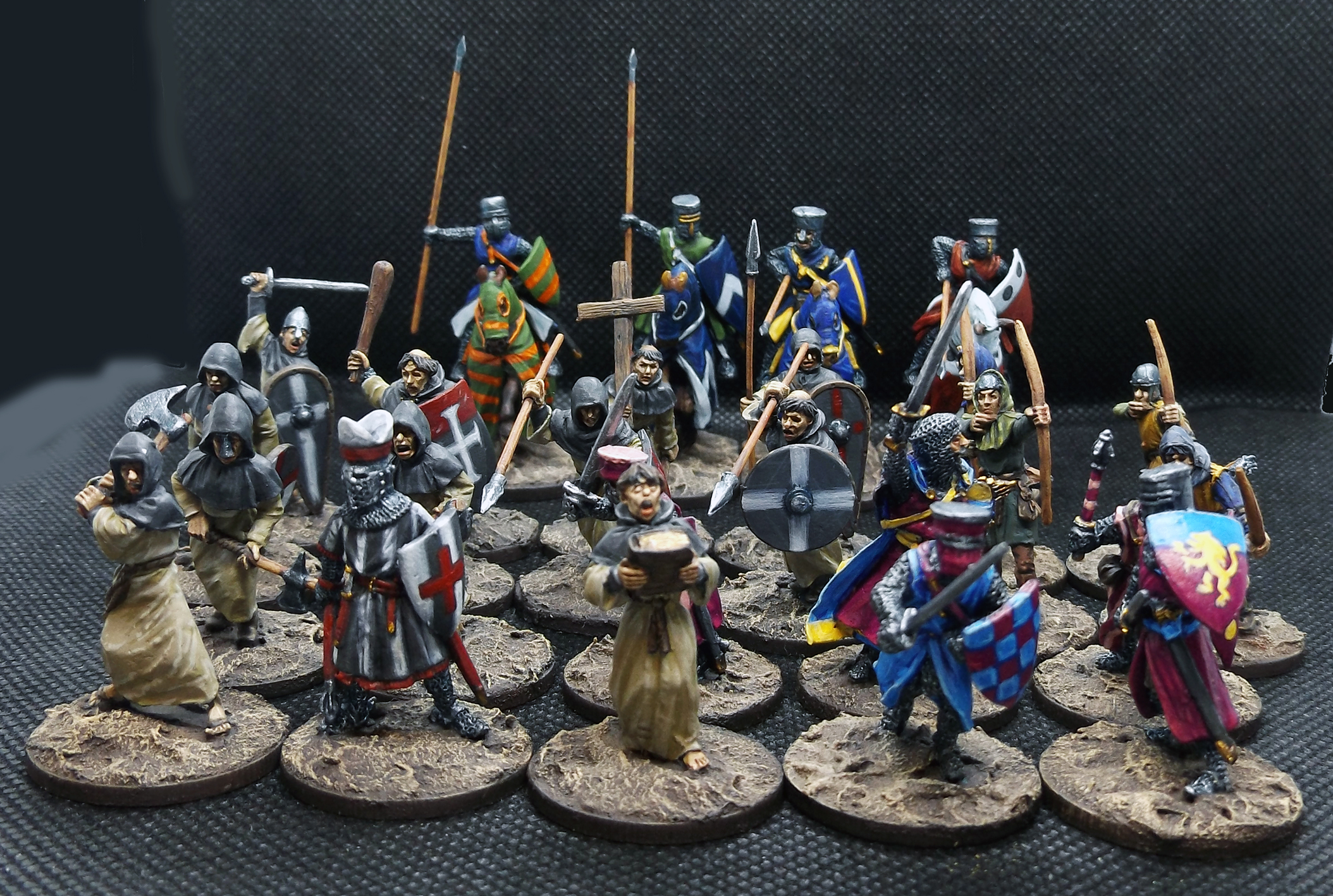
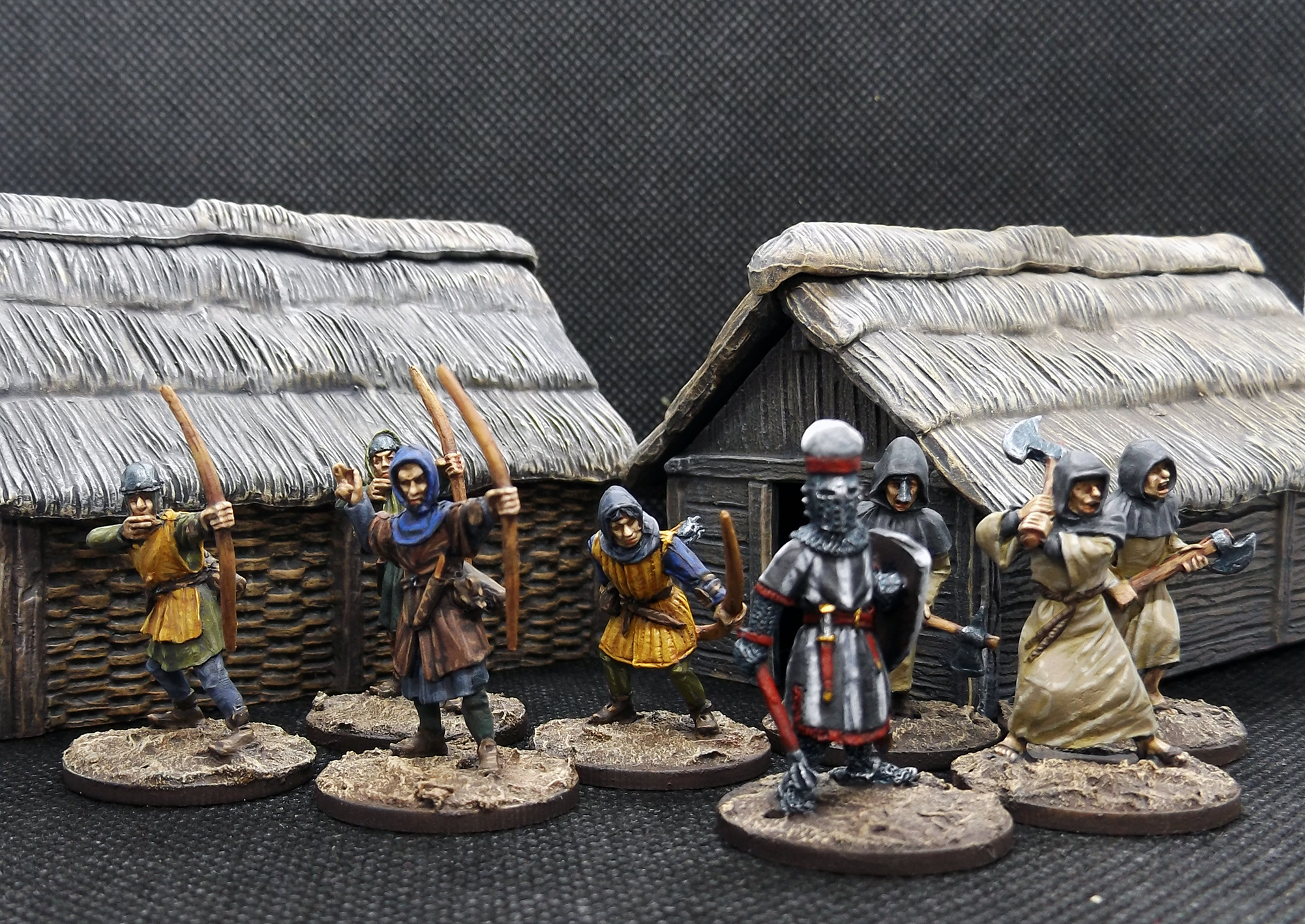
I have finish my St Mary de Pratis, Leicester Abbey, force and I am blooming chuffed with it. I wanted a Militant Monk force because the Paul Hicks’ sculpts of the monks are so characterful and because because I thought it would be fun. Abbot William Pepyn is the commander and with the local lord’s knights to help protect the realm. What do you think of them?

The Mounted Arm of the Force
 Mounted Knights
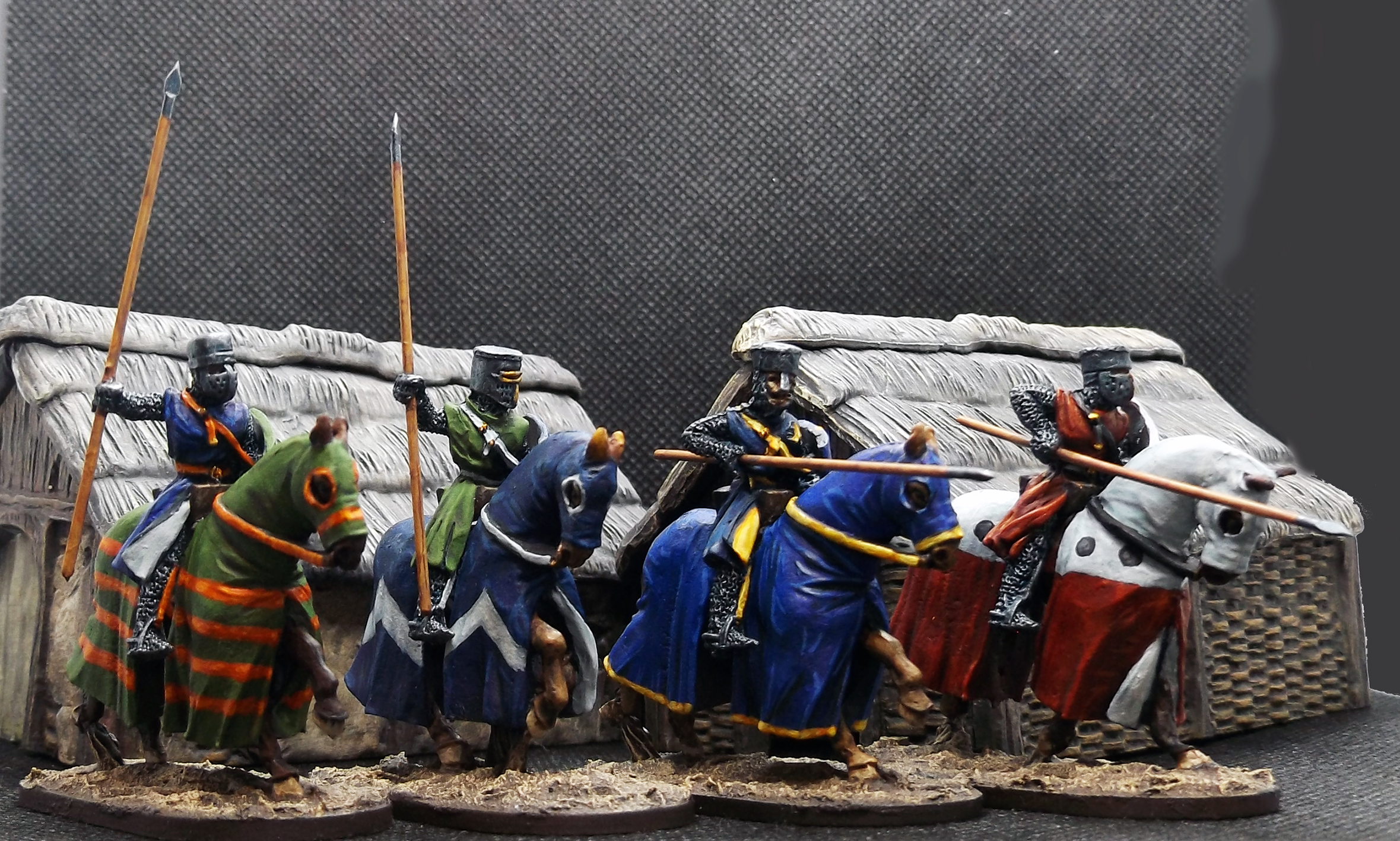
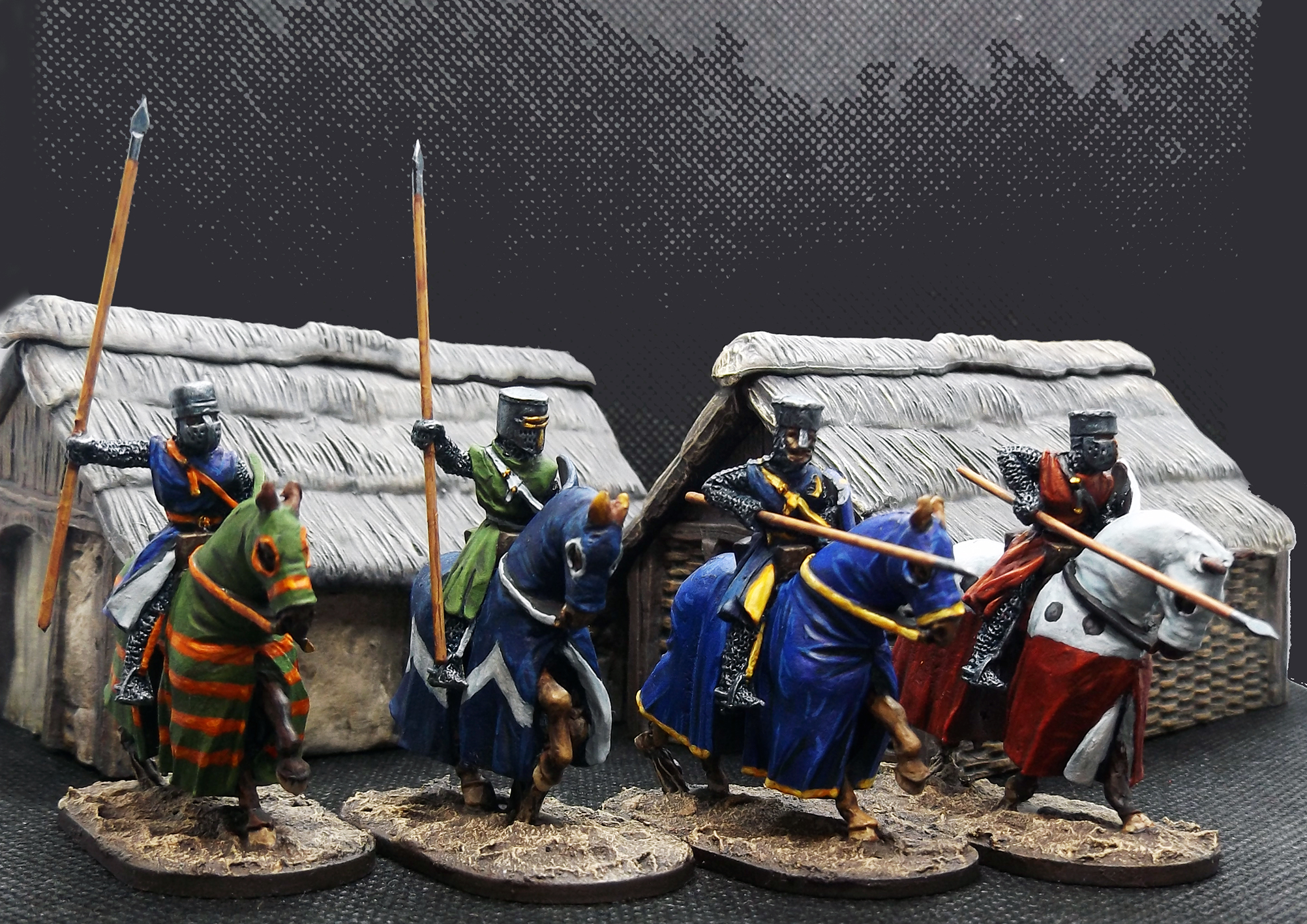
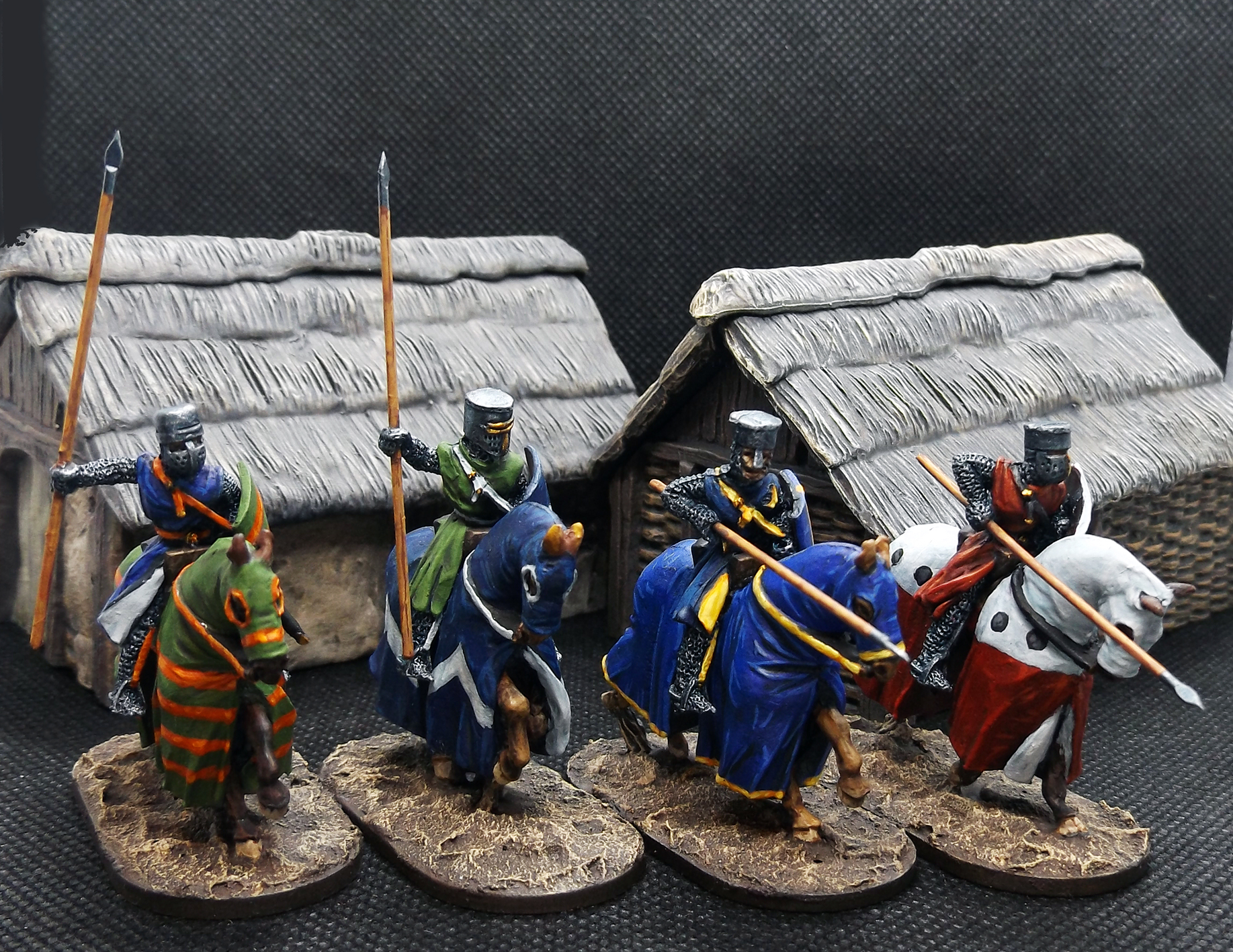
This is the last unit for my St Mary de Pratis force which in turn we led part of a larger force and these are the mounted knights. I have foot knight which are the backbone of the force, taking the centre with everything supporting them but the mounted knights are the hammer, the fast attack force, designed to sweep anyway all before these with there lance and armour. Well that is the theory.
I have painted these to be more lesser knights, lower order, loaned to the Abbey by their Baron/Lord protector. I love the way and feel of them and work well against the drab coloured monks.

Archers, Hunters or maybe Poachers
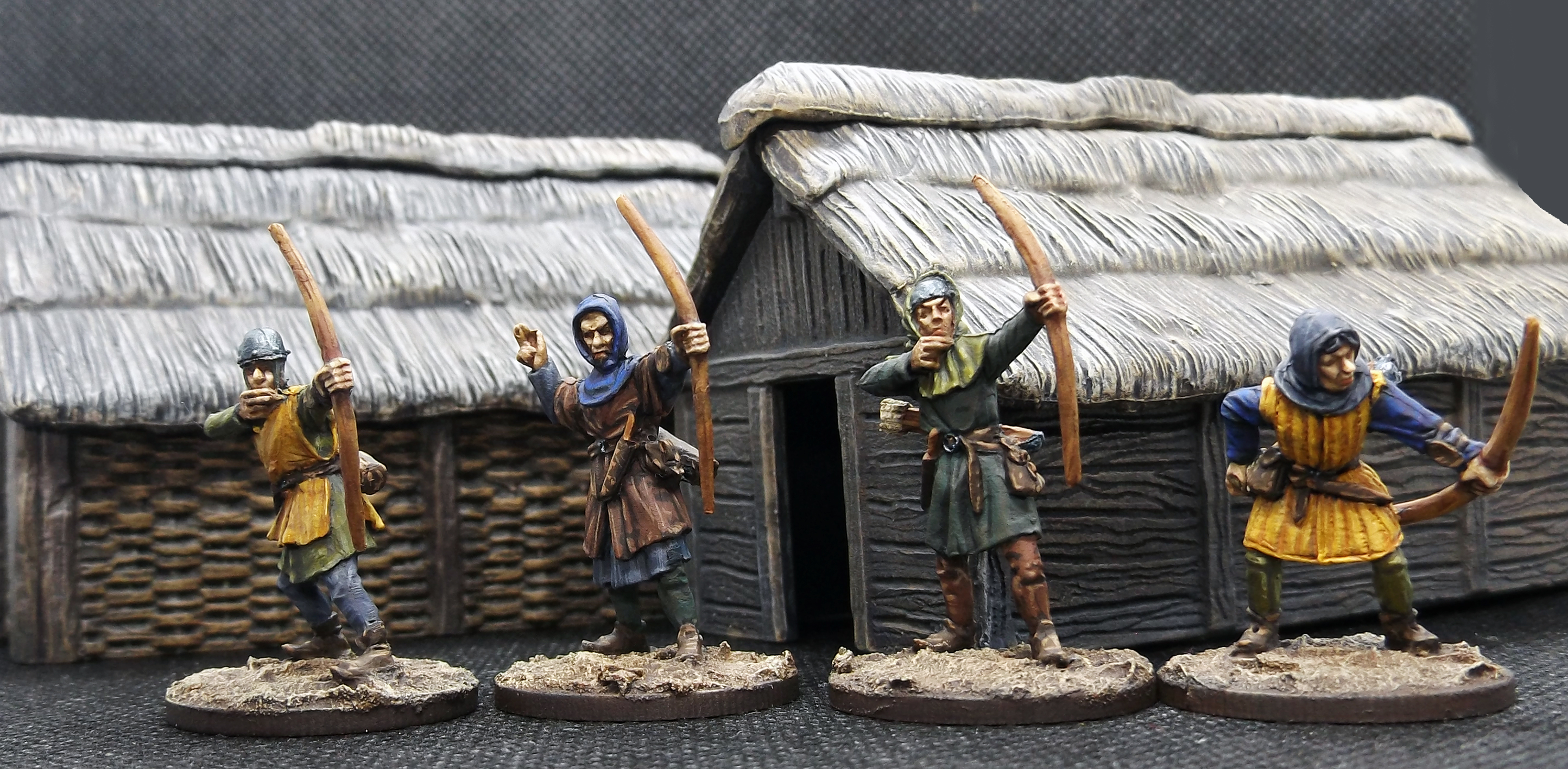 The Archers for my St Mary de Pratis force
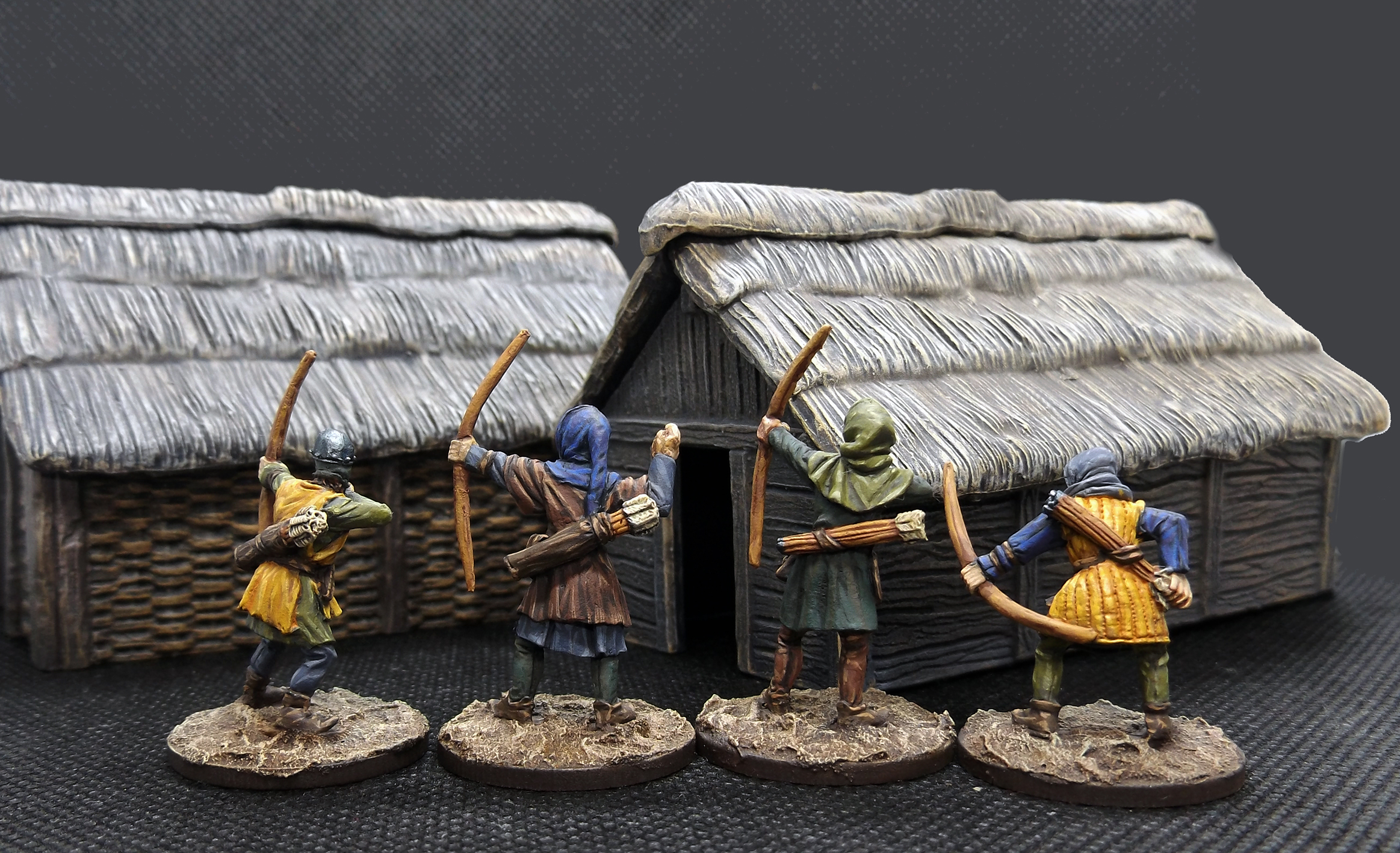
I’ve finished my archers for my St Mary de Pratis force and I wanted a civilian look, no “uniform” look for these as I seen them the foragers for the abbey. I think I have got the “look and feel” right and I cannot wait to paint so more missile troops for this game.
What do you think?

The Barons’ Responsibilities
Clause 61 of Magna Carta
 The Magna Carta
Since, moreover, for God and the amendment of our kingdom and for the better allaying of the quarrel that has arisen between us and our barons, we have granted all these concessions, desirous that they should enjoy them in complete and firm endurance forever, we give and grant to them the underwritten security, namely, that the barons choose five-and-twenty barons of the kingdom, whomsoever they will, who shall be bound with all their might, to observe and hold, and cause to be observed, the peace and liberties we have granted and confirmed to them by this our present Charter, so that if we, or our justiciar, or our bailiffs or any one of our officers, shall in anything be at fault toward anyone, or shall have broken any one of the articles of the peace or of this security, and the offence be notified to four barons of the foresaid five-and-twenty, the said four barons shall repair to us (or our justiciar, if we are out of the realm) and, laying the transgression before us, petition to have that transgression redressed without delay. And if we shall not have corrected the transgression (or, in the event of our being out of the realm, if our justiciar shall not have corrected it) within forty days, reckoning from the time it has been intimated to us (or to our justiciar, if we should be out of the realm), the four barons aforesaid shall refer that matter to the rest of the five-and-twenty barons, and those five-and-twenty barons shall, together with the community of the whole land, distrain and distress us in all possible ways, namely, by seizing our castles, lands, possessions, and in any other way they can, until redress has been obtained as they deem fit, saving harmless our own person, and the persons of our queen and children; and when redress has been obtained, they shall resume their old relations towards us.
And let whoever in the country desires it, swear to obey the orders of the said five-and-twenty barons for the execution of all the aforesaid matters, and along with them, to molest us to the utmost of his power; and we publicly and freely grant leave to everyone who wishes to swear, and we shall never forbid anyone to swear. All those, moreover, in the land who of themselves and of their own judgment, and he shall be sworn in the same way as the others. Further, in all matters, the execution of which is entrusted to these twenty-five barons, if perchance these twenty-five are present and disagree about anything, or if some of them, after being summoned, are unwilling or unable to be present, that which the majority of those present ordain or command shall be held as fixed and established, exactly as if the whole twenty-five had concurred in this; and the said twenty-five shall swear that they will faithfully observe all that is aforesaid, and cause it to be observed with all their might. And we shall procure nothing from anyone, directly or indirectly, whereby any part of these concessions and liberties might be revoked or diminished; and if any such thing has been procured, let it be void and null, and we shall never use it personally or by another.
The Articles of the Barons
The Articles of the Barons - The Magna Carta
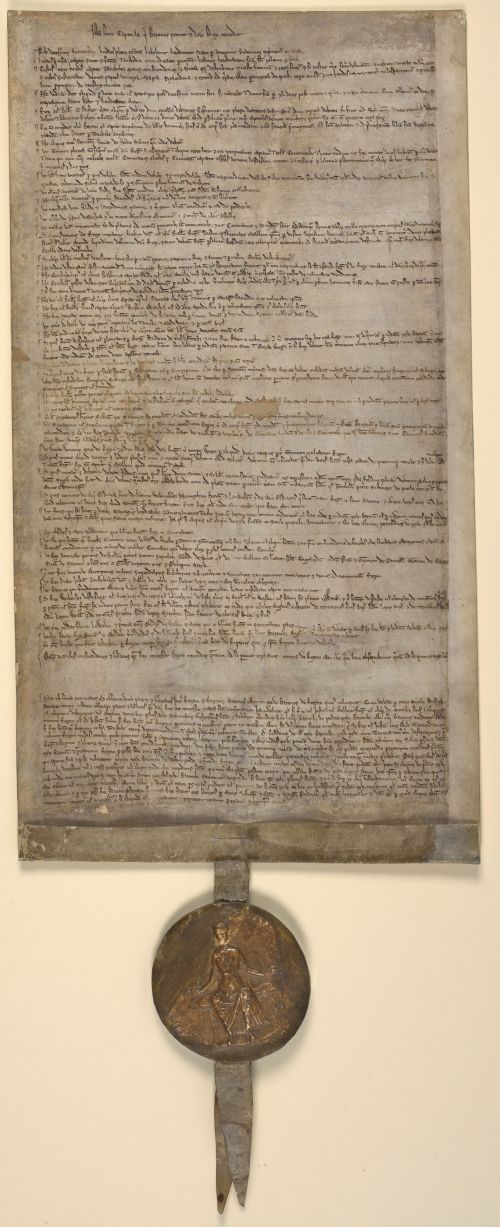 The Articles of the Barons
1 After the death of their predecessors, heirs of full age are to have their inheritance by the ancient relief to be set out in the charter.
2 Heirs who are under age and in wardship are when they come of age to have their inheritance without relief or fine.
3 The guardian of an heir’s land is to take reasonable issues, customs and services, without destruction and waste of his men and goods, and if the guardian of the land inflicts destruction and waste, he is to lose the wardship. And the guardian is to maintain buildings, parks, fishponds, pools, mills and other things pertaining to that land, out of the issues of the same. And heirs are to be so married that they are not disparaged, and this by the counsel of their near kinsmen.
4 No widow is to give anything for her dower or marriage portion after the death of her husband, but she may remain in his house for forty days after his death, and her dower is to be assigned to her within that period; and she is to have her marriage portion and her inheritance immediately.
5 Neither the king nor his bailiff are to seize any land for debt while the debtor’s chattels suffice; nor are the debtor’s pledges to be distrained, while the principal debtor has enough to make payment; if indeed the principal debtor defaults on his payment, the pledges are, if they wish, to have the debtor’s lands until the debt is fully paid, unless the principal debtor can show that he is quit with regard to the pledges.
6 The king is not to grant to any baron the right to take an aid from his free men, except to ransom his person, to knight his first-born son, and to marry, once, his first-born daughter, and he is to do this by way of a reasonable aid.
7 No-one is to do more service for a knight’s fee than is owed for it.
8 Common pleas are not to follow the king’s court, but are to be appointed to some fixed place. And recognitions are to be held in the same counties, in this manner: the king is to send two justices four times in the year, who with four knights of the same county, chosen by the county court, are to take assizes of novel Disseisin, Mort d’Ancestor and Darrein presentment, nor is anyone to be summoned on account of this except the jurors and the two parties.
9 A free man is to be amerced for a small offence in proportion to the nature of the offence, and for a great offence in accordance with its magnitude, saving to him his livelihood; the villain is also to be amerced in the same way, saving to him his crops under cultivation; and the merchant in the same way, saving to him his stock in trade, by oath of trustworthy men of the vicinity.
10 A cleric is to be amerced in respect of his lay fee in the same manner as the aforesaid, and without regard to his ecclesiastical benefice.
11 No township is to be amerced for making bridges over rivers, unless they used rightfully to be there of old.
12 The measure of corn and wine, and the widths of cloths and other things, are to be reformed; and weights likewise.
13 Assizes of novel Disseisin and Mort d’Ancestor are to be expedited, and other assizes likewise.
14 No sheriff is to involve himself in pleas pertaining to the crown without the coroners; and counties and hundreds are to be at their old farms without any increment, except for the king’s demesne manors.
15 If anyone holding from the king dies, it is to be lawful for the sheriff or other royal bailiff to seize and record his chattels by the view of law-abiding men, as long as none of them are removed, until it is more fully known whether he owes any clear debt to the king; and then when the debt to the king is paid. the residue is to be relinquished to the executors to perform the testament of the deceased; and if nothing is owing to the king then all the chattels are to go to the deceased.
16 If any free man dies intestate, his goods are to be distributed by the hand of his nearest kinsmen on both sides of his family, under the supervision of the church.
17 Widows are not to be distrained to marry, when they wish to live without a husband, as long as they give security that they will not marry without the consent of the king, if they hold of him, or the consent of their lords of whom they hold.
18 No constable or other bailiff is to take corn or other chattels, unless he pays cash for them immediately, (or) unless he has respite with the consent of the seller.
19 No constable is to distrain any knight to give money instead of castle-guard, if he is willing to perform that guard in person or, if he is unable to do it for a satisfactory reason, through another reliable man; and if the king takes him in the army, he is to be quit of castle-guard in proportion to the amount of time [away].
20 No sheriff or royal bailiff, or anyone else, is to take any free man’s horses or carts for transporting things, except with his consent.
21 Neither the king nor his bailiff is to take another man’s wood to his castles or on other of his business, except with the consent of the person whose wood it is.
22 The king is not to hold the land of those who have been convicted of felony except for a year and a day, and then it is to be surrendered to the lord of the fee.
23 All fish-weirs are in future to be entirely removed from the Thames and Medway, and throughout the whole of England.
24 The writ called praecipe is not in future to be issued to anyone for any tenement in respect of which a free man could lose his court.
25 If anyone has been disseised or dispossessed without judgment by the king of lands, liberties and his right, it is to be restored to him immediately; and if a dispute arises about this, it is to be settled by judgment of the twenty-five barons; and those who were disseised by the king’s father or brother are to have their right without delay by judgment of their peers in the king’s court; and the archbishop and bishops are to deliver judgment at a specific day, without the possibility of an appeal, as to whether the king ought to have the term [of exemption] of other crusaders.
26 Nothing is to be given for a writ for an inquest concerning life or members, but it is to be granted without payment and not denied.
27 If anyone holds of the king by fee-farm, socage or burgage, and of someone else by knight service, the king is not to have the wardship of the knights of another man’s fee by reason of the burgage or socage, nor is he to have the wardship of the burgage, socage or fee-farm. And no free man is to lose his knights by reason of petty serjeanties, like those who hold a tenement by rendering knives or arrows or suchlike.
28 No bailiff is to put anyone to law by his accusation alone, without trustworthy witnesses.
29 The body of a free man is not to be arrested, or imprisoned, or disseised, or outlawed, or exiled, or in any way ruined, nor is the king to go against him or send forcibly against him, except by judgment of his peers or by the law of the land.
30 Right is not to be sold or delayed or withheld.
31 Merchants are to have safe conduct to go and come to buy and sell, without any evil exactions but paying only the old and rightful customs.
32 No scutage or aid is to be imposed in the kingdom except by the common counsel of the kingdom, unless for ransoming the person of the king, and knighting his first-born son, and marrying, once, his first-born daughter, and for this a reasonable aid is to be taken. Tollages and aids on the city of London, and on other cities which have such liberties, are to be taken in like manner. And the city of London is to have in full its ancient liberties and free customs, both by water and by land.
32 No scutage or aid is to be imposed in the kingdom except by the common counsel of the kingdom, unless for ransoming the person of the king, and knighting his first-born son, and marrying, once, his first-born daughter, and for this a reasonable aid is to be taken. Tollages and aids on the city of London, and on other cities which have such liberties, are to be taken in like manner. And the city of London is to have in full its ancient liberties and free customs, both by water and by land.
33 It is to be lawful for each man to leave the kingdom and return to it, saving his allegiance to the king, except in time of war for some short time, for the sake of the common utility of the kingdom.
34 If anyone has taken a loan from Jews, great or small, and dies before the debt is paid, the debt is not to incur interest as long as the heir is under age, whoever he may hold from. And if the debt falls into the hand of the king, he is to take only the principal recorded in the charter.
35 If anyone dies and is indebted to Jews, let his wife have her dower. And if there are surviving children, let their needs be met from the property, and let the debt be paid from the residue, saving the service of the lords. And let other debts be dealt with in like manner. And let the keeper of the land surrender to the heir, when he comes of age, his land stocked with what the issues of the land can reasonably provide by way of ploughs and other necessary implements.
36 If anyone holds of an escheat, as of the honour(s) of Wallingford, Nottingham, Boulogne and Lancaster, or of other escheats which are in the king’s hand and are baronies, and dies, his heir will not give a relief or perform any service to the king other than he would to the baron; and the king is to hold it in the same manner in which the baron held it.
37 Fines made for dowers, marriages, inheritances and amercements, unjustly and against the law of the land, are to be entirely remitted; or they are to be dealt with by judgment of the twenty-five barons, or by judgment of the greater part of them, together with the archbishop and others whom he wishes to convoke to act with him. On condition that if any or some of the twenty-five are in such an action, they are to be removed and others substituted in their place by the rest of the twenty-five.
38 Hostages and bonds which were surrendered to the king as security are to be restored.
39 Those who have been outside the forest are not to come before the forest justices on the grounds of common summonses, unless they are involved in pleadings or [are] pledges. And the evil customs of forests and foresters, of warrens, and sheriffs, and rivers, are to be put right by twelve knights of each county, who should be chosen by the good men of that county.
40 Let the king remove entirely from office the kinsmen and whole brood of Gerard d’Athée, so that they may not hold office in future: namely, Engelard, Andrew, Peter and Guy de Chanceaux, Guy de Cigogné, Matthew de Martigny and his brothers; and his nephew Geoffrey, and Philip Mark.
41 And let the king remove the foreign knights, mercenaries, crossbowmen, routiers and serjeants who come with horses and arms to the detriment of the realm.
42 And let the king make justices, constables, sheriffs and bailiffs from those who know the law of the land and are willing to keep it well.
43 Let barons who have founded abbeys, for which they have royal charters or ancient tenure, have the custody of them when they are vacant.
44 If the king has disseised or dispossessed Welshmen of their lands, liberties or anything else in England or in Wales, they are to be given back to them immediately, without any legal proceedings. And if they were disseised or dispossessed of their English tenements by the king’s father or brother without judgment of their peers, the king will without delay do them justice, in the same way that he is to do justice to Englishmen, for tenements in England according to the law of England, for tenements in Wales according to the law of Wales, and for tenements in the march according to the law of the march. Let the Welsh do the same for the king and his men.
45 Let the king give back the son of Llywelyn, and also other hostages from Wales, and the bonds which were handed over to him as security for peace, unless things should be otherwise under the charters which the king has, by judgment of the archbishop and such others as he wishes to convoke to act with him.
46 Let the king deal with the king of Scots for the returning of hostages, and over his liberties and right, in accordance with the terms he comes to with the barons of England, unless it should be otherwise under the charters which the king has, by judgment of the archbishop and such others as he wishes to convoke to act with him.
47 And all the forests which have been afforested by the king during his reign are to be disafforested, and let the same be done with regard to the rivers which are game reserves by this king’s doing.
48 What is more, all these customs and liberties which the king has granted to the realm, to be observed on his own account with regard to his own men, all the men of the realm, both clergy and laity, will observe on their own account with regard to their own men.
Battles of Magna Carta, Part Four
1216-17: THE SIEGE OF DOVER CASTLE
Another epic and desperate siege of the castle by Prince Louis of France, and said to be the most momentous in all English history. The French king supported the unruly barons by sending his son and large forces. All aspects of siege warfare were employed and ultimately failed. Siege engines, mining and even bribery did not succeed, though the French did capture the barbican and undermined the gatehouse. The defenders rebuilt barricades and beat back the French.
1216-17: SANDWICH (LANDING AND NAVAL BATTLE)
King John called upon the naval resources of the Cinque Ports (Hastings, Rye, Hythe, Romney and Sandwich) which provided 50 ships, and had another 50 built. (In 1213, Philip II had gathered a fleet to invade England with papal blessing against the excommunicated John. The allies surprised the French fleet at anchor, capturing 300 vessels, and burning 100 more!) The royalist naval victory of 1217 meant that the war was finally over. A month later, the Treaty of Lambeth ensured that Prince Louis and his men left England, never to return.
1217: LINCOLN (SIEGE AND BATTLE)
Lincoln town was pro-rebel, but the castle held by Lady Nichola de la Haye was a pro-John castellaine. In May 1217, French forces besieging the castle were routed by a relieving force under William Marshal (Earl of Pembroke). The town was thoroughly sacked and its goods carried off by the victors earning the nickname ‘Lincoln Fair’.
1224: THE SIEGE OF BEDFORD
Henry III besieged the Bedford Castle in 1224 after a falling out with Falkes de Breauté. It involved an army of 2,700 soldiers. The siege of the mighty castle lasted from 20 June until 15 August and was one of the longest sieges of the century, rivalled only by those of Dover (July 1216 – May 1217) and Kenilworth (May to December 1266). It began with a move led by Hubert de Burgh to bring back under royal control all royal castles entrusted to the adherents of King John. It was the last outburst of violence which had begun at the end of King John’s reign but the firm action taken by the sixteen year old Henry III to capture the castle ensured that with the exception of the revolt of Richard Marshal in 1233, England was not riven by civil war for another forty years. It was another milestone in the flowering of a growing sense of Englishness.
Battles of Magna Carta, Part Three
1216: THE SIEGE OF WINDSOR
After granting Magna Carta at Runnymede, the king retired to Windsor from the capital, which was soon afterwards occupied by the barons. Hostilities, however, soon broke out again; the barons abjured their allegiance and sought help from France. The invasion of England by Louis of France, which began in May 1216, was followed by the siege of Windsor Castle. The castle was held for the king by Fawkes de Breauté, one of John’s unsavoury advisors, who had filled the castle with foreign mercenaries. The siege lasted from June to September, when it was raised, and on the death of the king in October it was still in the hands of his adherents.
1216: THE SIEGE OF BERWICK CASTLE
In the northern reaches, King John arrived in 1216 to storm the fortified town of Berwick. On the river Tweed, it stood close to the borders of England and Scotland. The castle was founded in the 12th century by the Scottish King David I.
1216: THE SIEGE OF BARNARD CASTLE
The 1216 siege of Barnard Castle in Durham was successfully resisted for King John by Hugh de Baliol against invading Scots. Leading rebel and Magna Carta surety Eustace de Vesci was shot dead by a crossbowman during the siege. The influence of the family enabled John Baliol, with the help of Edward I, to be crowned King of Scotland.
1216: THE SIEGE OF BERKHAMSTED CASTLE
In December 1216, Berkhamsted Castle was besieged by Prince Louis of France. It is likely that the constable at the castle was aware of the approach of a hostile force of French mercenaries. He will have hastily arranged for plentiful food supplies to be brought in: bread, cheese, eggs and meat. Hopefully, he would have sent women and children out of harm’s way, if only to preserve the food and drink supplies for fighting men. Wells in the bailey and on the motte provided plentiful water and they would have hunkered down, ready for the attack.
After twenty days of siege, the garrison within surrendered. Next year, the year following the death of King John, the castle was reclaimed by Royalists.













![New Carolingians & A Pillage Starter Set From Victrix? [Updated]](https://images.beastsofwar.com/2026/07/pillage-introductory-cover-600-338.jpg)