








Redvers and Son have a Baronial Kerfuffle




Looking at Leaders
Historical games always provide the opportunity to do a bit of research and try to find some connection with your army. For more recent historical games, a lot of people use family as their connection but, despite what my children think, I’m not old enough to have relatives that remember the medieval period, or were in any way involved, I’ll need some other connection.
To find a connection, the obvious choice was to use my location. Without wanting to dox myself too much, I live around the Lindfield area in Sussex. Lindfield is an old village that was first listed in 765AD in a Saxon charter, then known as Lindefeldia or ‘open land with lime trees’, when King Ealdwulf granted the building of a Minster church. At the time, Sussex was its own Kingdom (Kingdom of the South Saxons – shortened to Sussex) although it was later annexed by Wessex, thought to be shortly after 827AD following the battle of Elundun that saw the rise of Wessex.
At the time, the Saxons divided Sussex into North-South strips called Rapes, thought to have been used for administrative control of the kingdom, such as collection of taxes, land ownership and raising troops. The south of Sussex was at the time more developed and this is where the Lord of each Rape established their castles, with the northern parts of the county largely covered in forest, marsh and heathland.
Each Rape was further divided into a Hundred and we can map Lindfield into the Hundred of Burleigh Arches within the Rape of Pevensey. The map of the Rapes and Hundreds below is the best I could find and dates from 1832. The fact that Lindfield is in the Rape of Pevensey is also a little surprising given that Pevensey is some distance to the South East of Lindfield. Lewes is much closer and would have made more sense for Lindfield to be included in the Rape of Lewes but then perhaps that is a modern era view of the geography.
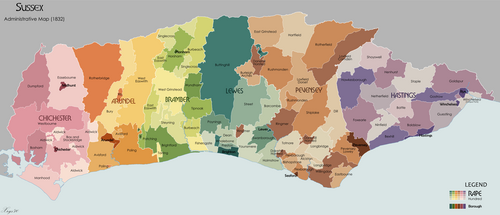 The Rapes and Hundreds of Sussex
So why is Saxon era Sussex relevant to Medieval Sussex? The Rapes and Hundreds continued to be a form of administration within the county throughout the medieval period and formed the basis of land ownership through the feudal system. So knowing who the Lord of each Rape was should provide some view on who can lead my army.
Lindfield is listed in the Doomsday book under the Parish of Lindfield. At the time, this was land owned by the Bishop of Canterbury who, during the first Barons War 1215-1217, was Stephen Langton. At the time of the war, Archbishop Langton had been banished from the kingdom by King John as it was Langton who had led opposition to John, forcing him to sign the Magna Carta and effectively start the war.
With Langton overseas at the time of the war and with Lindfield being part of the Hundred of Burleigh Arches and under the control of the Lord of Pevensey, I decided to investigate who this was at the time. Pevensey was owned by the L’Aigle family who also had lands in France. In the years before the first Barons’ War, Gilbert L’Aigle was lord of Pevensey and was by all accounts favoured by King John at the time of John’s coronation. Gilbert left his lands in England to defend his holdings in Normandy and this angered King John who confiscated Pevensey from Gilbert. Gilbert’s brother-in-law, William de Warenne, Earl of Surrey, stepped in and put up 3000 marks to hold Gilbert’s lands for him and effectively become the, albeit temporary, Lord of Pevensey.
History gets somewhat unclear here as Gilbert, stripped of his lands by King John, joined up with Louis VIII, who was also Gilbert’s king for his Normandy lands. It also appears that King John permanently stripped Gilbert of his lands and granted Pevensey Castle to the Lord of Arundel (Arundel being another Rape of Sussex) who, at the time, was William d’Aubigny, 3rd Earl of Arundel. So who the ruling Lord of the Hundred of Burleigh Arches at the time of the first Barons’ War is unclear (at least to me and my limited investigation).
Despite being unclear, I do have some options here to build my warband around. I have William de Warene, Stephen Langton and William d’Aubigny. It would appear that William de Warenne was mostly loyal to King John whereas Stephen Langton and William d’Aubigny sided with the rebels. William d’Aubigny also led the defence of Rochester Castle during a lengthy siege. So given that we have agitants from both sides, I’ll probably end up painting them all up.
Looking around the internet, I can easily find relevant transfers etc for William de Warenne, so I think this is where I will start. I’ll come back to Stephen Langton and William d’Aubigny later, possibly once I have found suitable models, shield transfers and banners.