








Spring Clean Challenge: Every Game is Miniatures Agnostic




Recommendations: 61
About the Project
I have quite a few miniatures in search of a better rules set, whether it's because I bought into a mediocre game or just picked up some models without really thinking about what I would use them for. So I'm always on the lookout for interesting rulebooks, and as a result my pile of opportunity consists of more than just unpainted models. So for this year's challenge, I want to focus on getting some unplayed games to the table.
Related Game: Violent Dark
Related Genre: Science Fiction
Related Contest: Spring Clean Hobby Challenge 2026
This Project is Completed
What's got Billy so spooked?
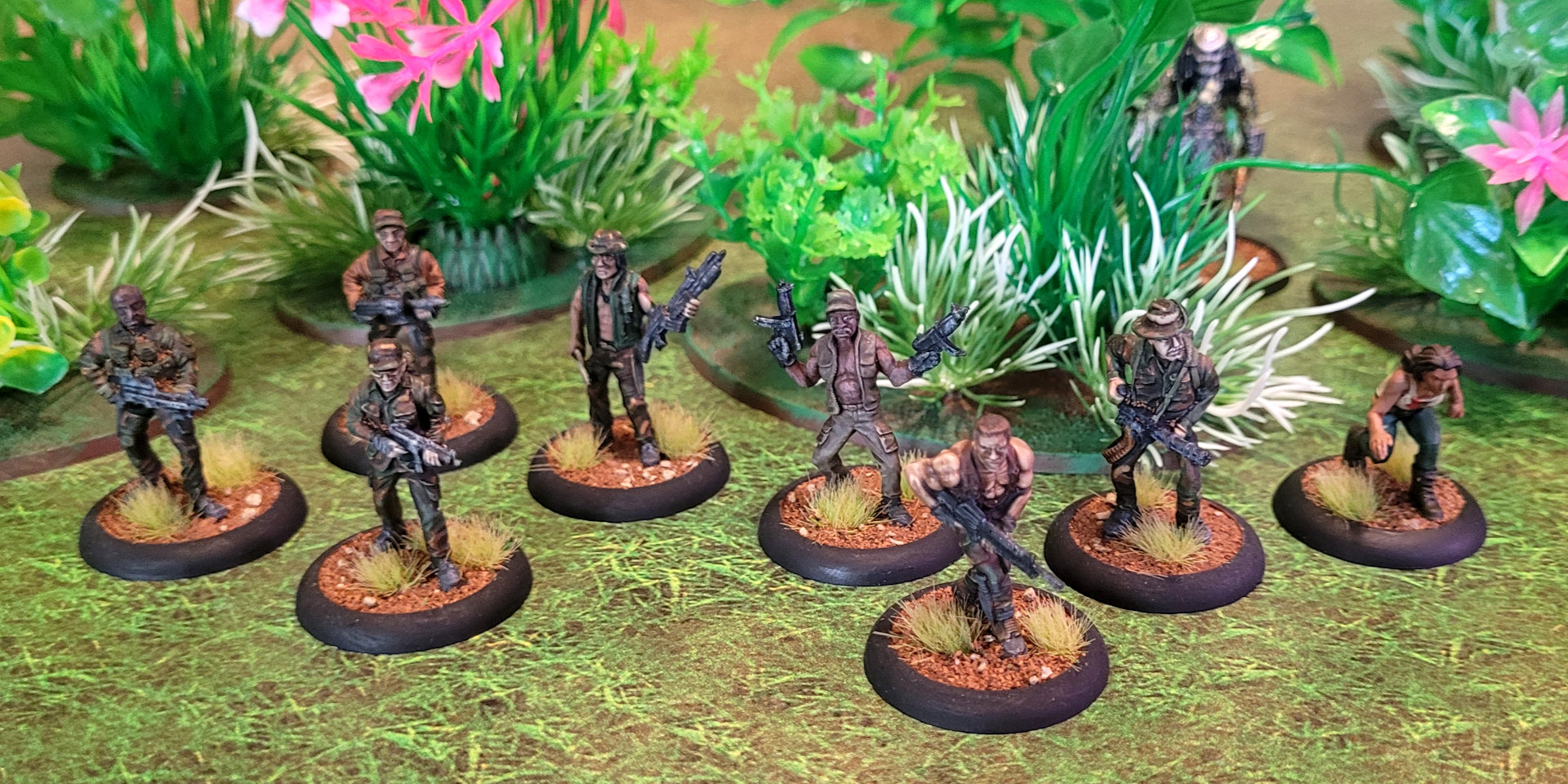
I’ve had this set of figures from the cast of Predator for so long I can’t remember where I got them, and I’ve been looking for a way to get the action of the original film to the tabletop for at least as long. I even got as far as using HeroForge to make Anna, as I could never find a suitable model anywhere else — it’s perhaps not so surprising that weaponless characters in vaguely paramilitary clothes are scarce, and Anna not having a weapon is a major part of the film.
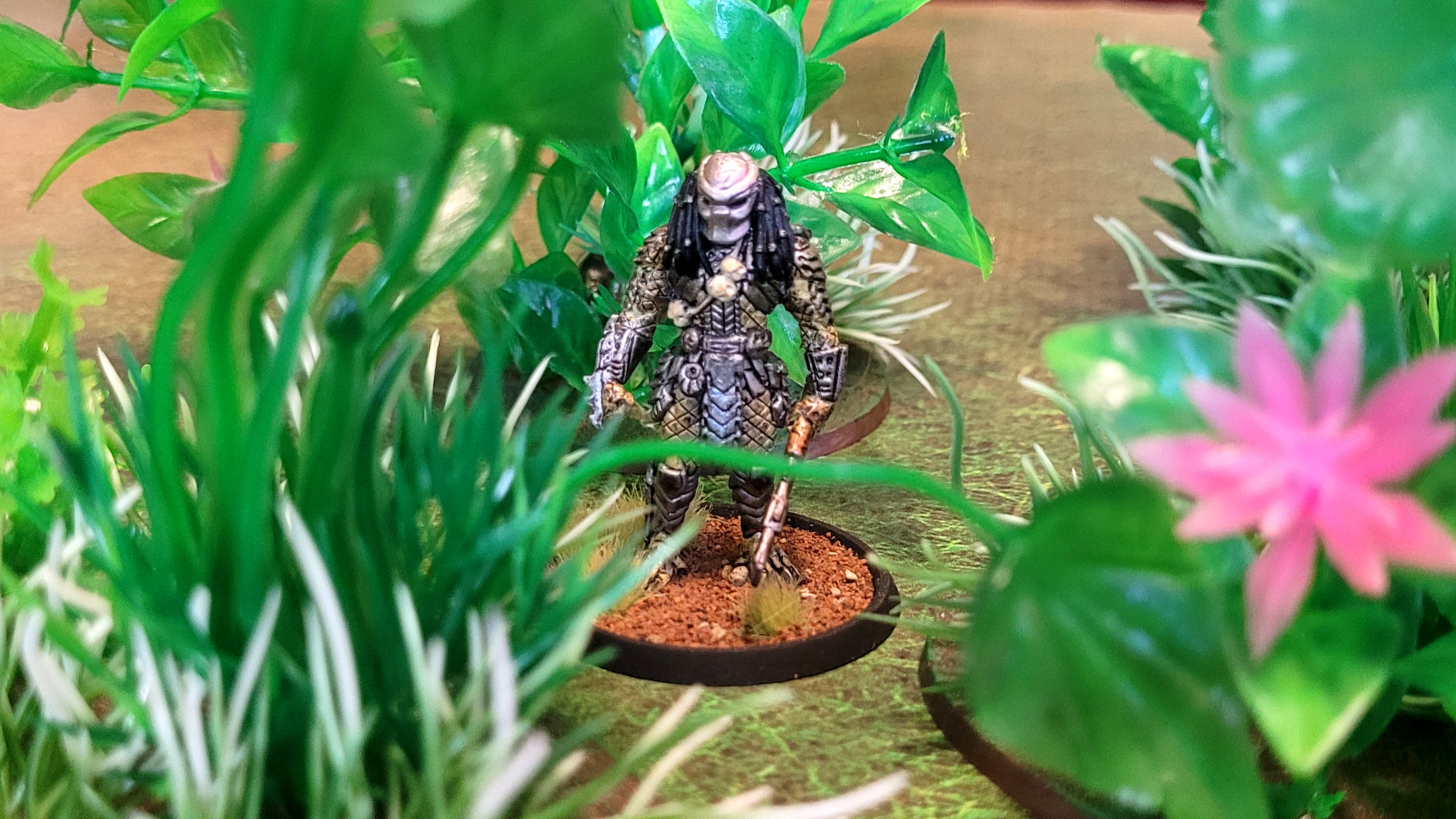
Predators themselves aren’t hard to come by. The one you see here is a rebased Horrorclix figure, and I’ve also got several from the Prodos AvP game.
When I heard about The Doomed, I thought it might fit the bill for a game involving a group of characters fighting a single enemy. The game supports solo play, which might be the best way to play out the events of the film, but I’m more intrigued by the semi-coop 2-player mode. Players each have their own warbands who are at odds with each other, but they also have a massive NPC monster that they’ll likely have to work together to take down.
At first I was thinking that I’d just split the Predator crew in half, with Dutch in charge of one group and Dillon leading the other. I still might try that, but on reading the rules in more detail, I’m thinking that AvP might be a better choice, with one player running the humans and the other player running a small group of Predators, with the Aliens as the bad guys.
I’ve got all the miniatures I need, so now I just need to work up some stats and get a table set up.
The jungle...it just came alive and took him.
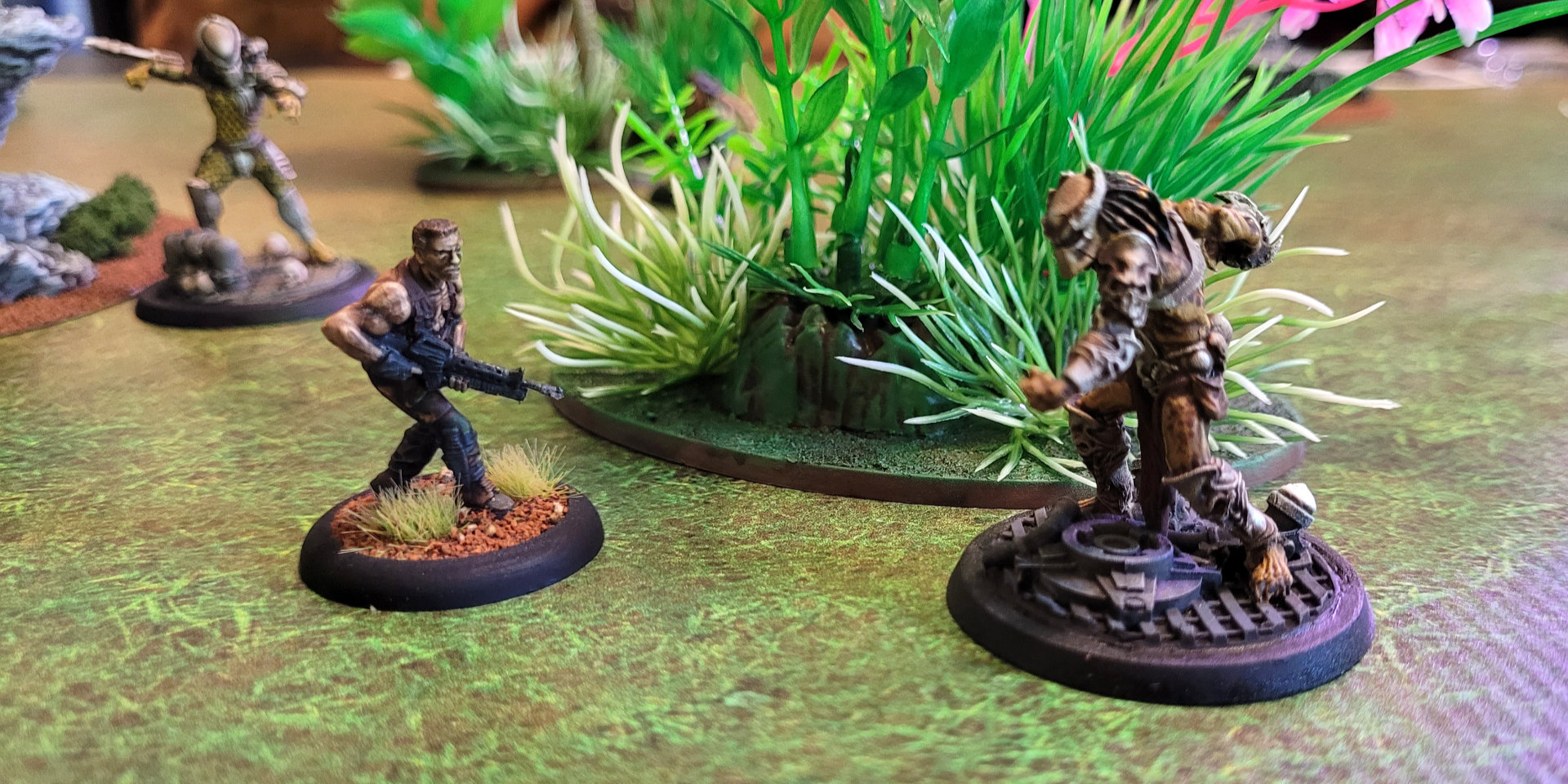
The Doomed has an interesting structure to it. Player-controlled warbands compete over what the game calls Conflicts, generally goal-based objectives like occupying the opponent’s staring area, securing sections of the board, or singling out and destroying specific enemy targets. This is made more complicated by the presence of a non-player Horror, a powerful character who attacks both players with equal abandon.
The rules specify that you can skip using a Conflict if you want a more cooperative game, and this is what we decided on for our first game.
I worked up stats using the Martyr Retinues faction as a loose stand-in for Predator’s human cast. Since there would be two of us playing, I split the characters into two squads: one with Dutch leading Hawkins, Poncho, and Billy, and the other featuring Blain, Mac and Anna, led by Dillon. I stuck to the game’s as-written rules for creating warbands, with one exception: I wanted Anna to function like she did in the film, with no weapons but a deeper insight into the Predator, so I came up with some special rules for her that I hoped wouldn’t break the game.
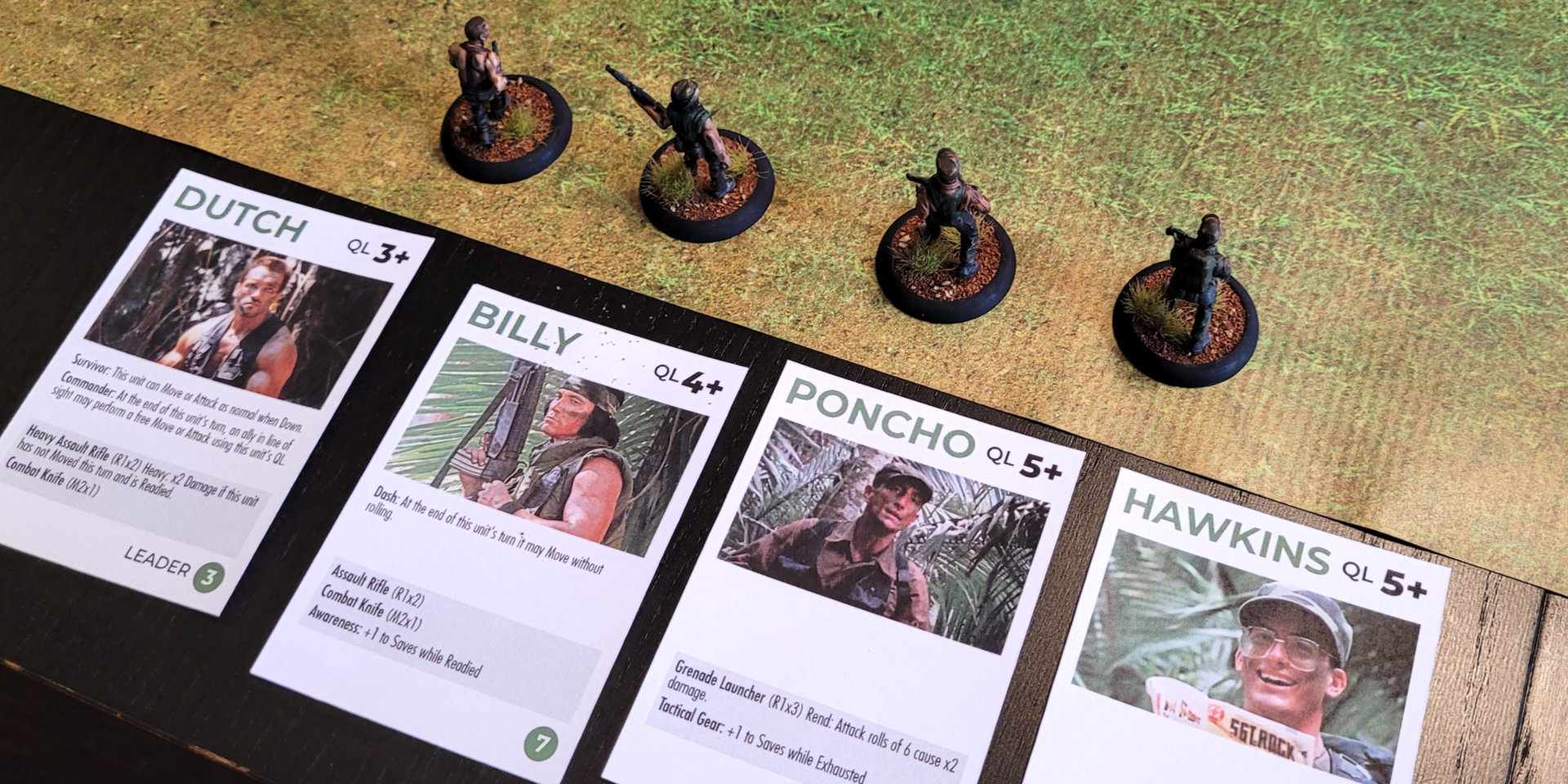
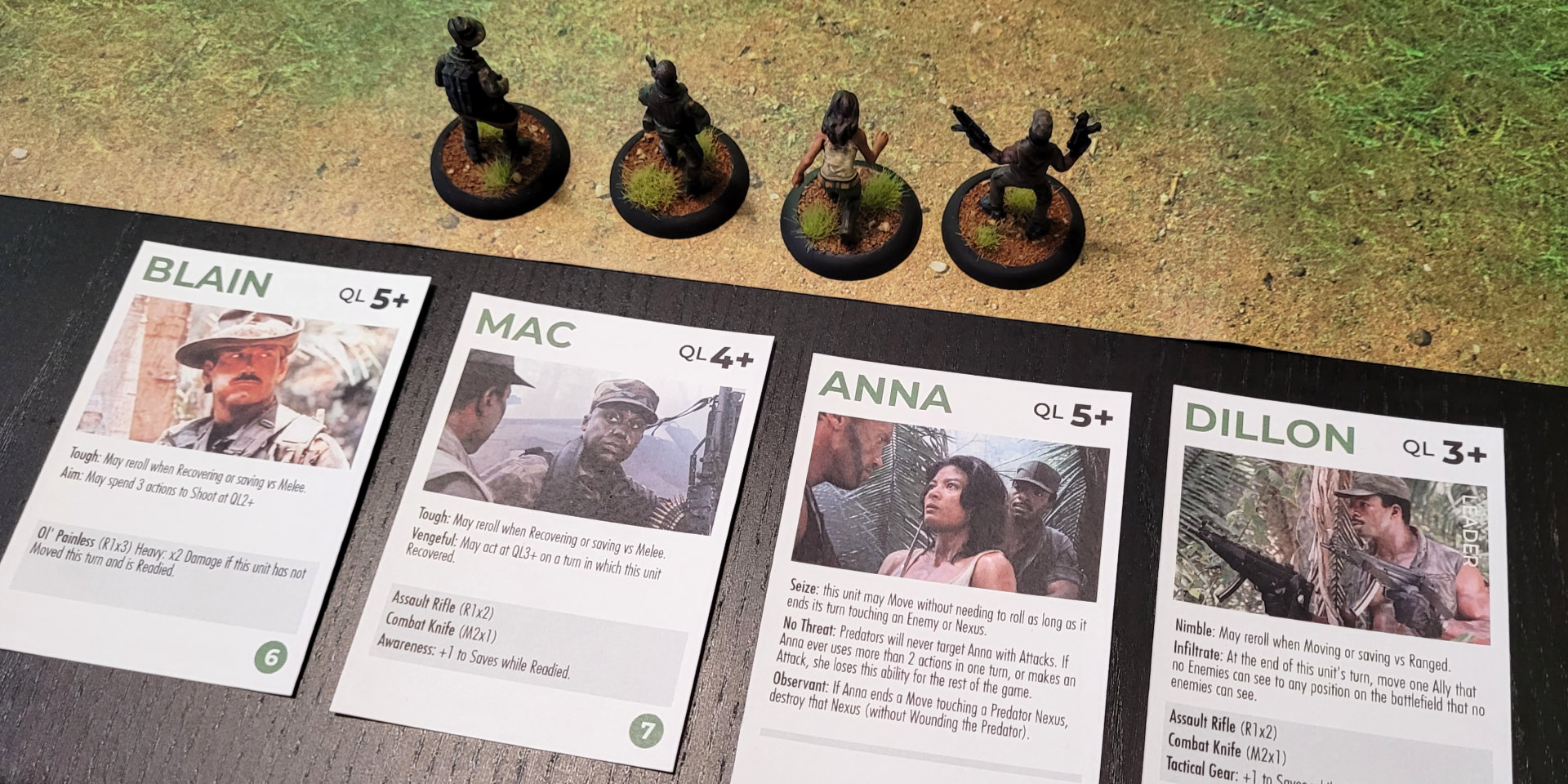
The Doomed has rules for creating your own Horrors, but as it turns out I didn’t need to: the game’s Warped Hunters are clearly meant to be stand-ins for the Predator. Well, three of them, actually…
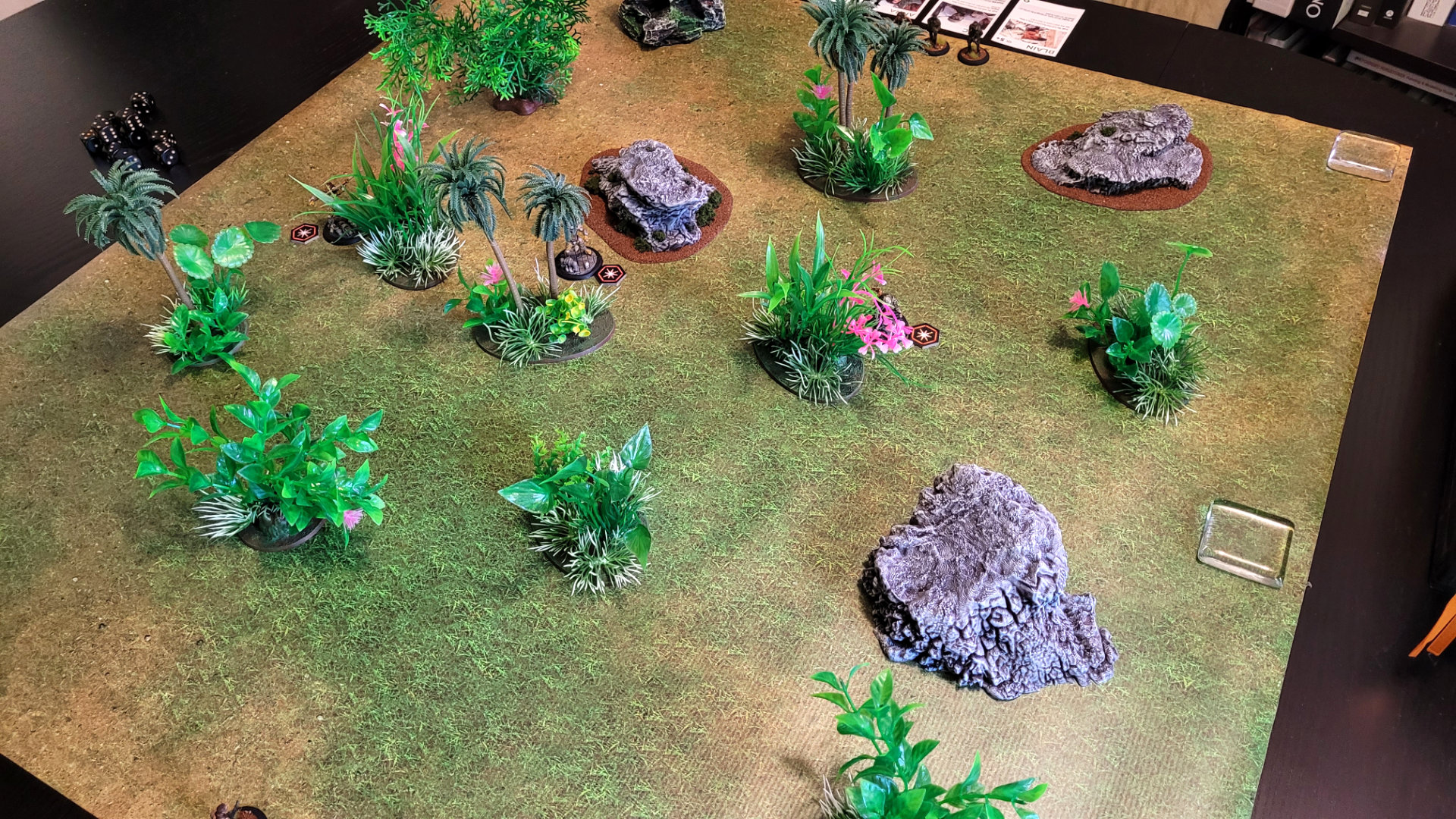
We set up a 3×3 jungle board covered in trusty plastic aquarium plants, and placed the Predators in cover along the center of the board. The rules for Horrors in The Doomed include placing Nexuses, 3 tokens that player units can interact with. In the case of the Warped Hunters, these nexus tokens remain attached to the three Horrors, with each one being destroyed the first time a Hunter is wounded by a player action. Destroying each one triggers an in-game effect (one helpful to the players, the other two not so much), and the Hunters can’t be killed until all three nexuses are destroyed.
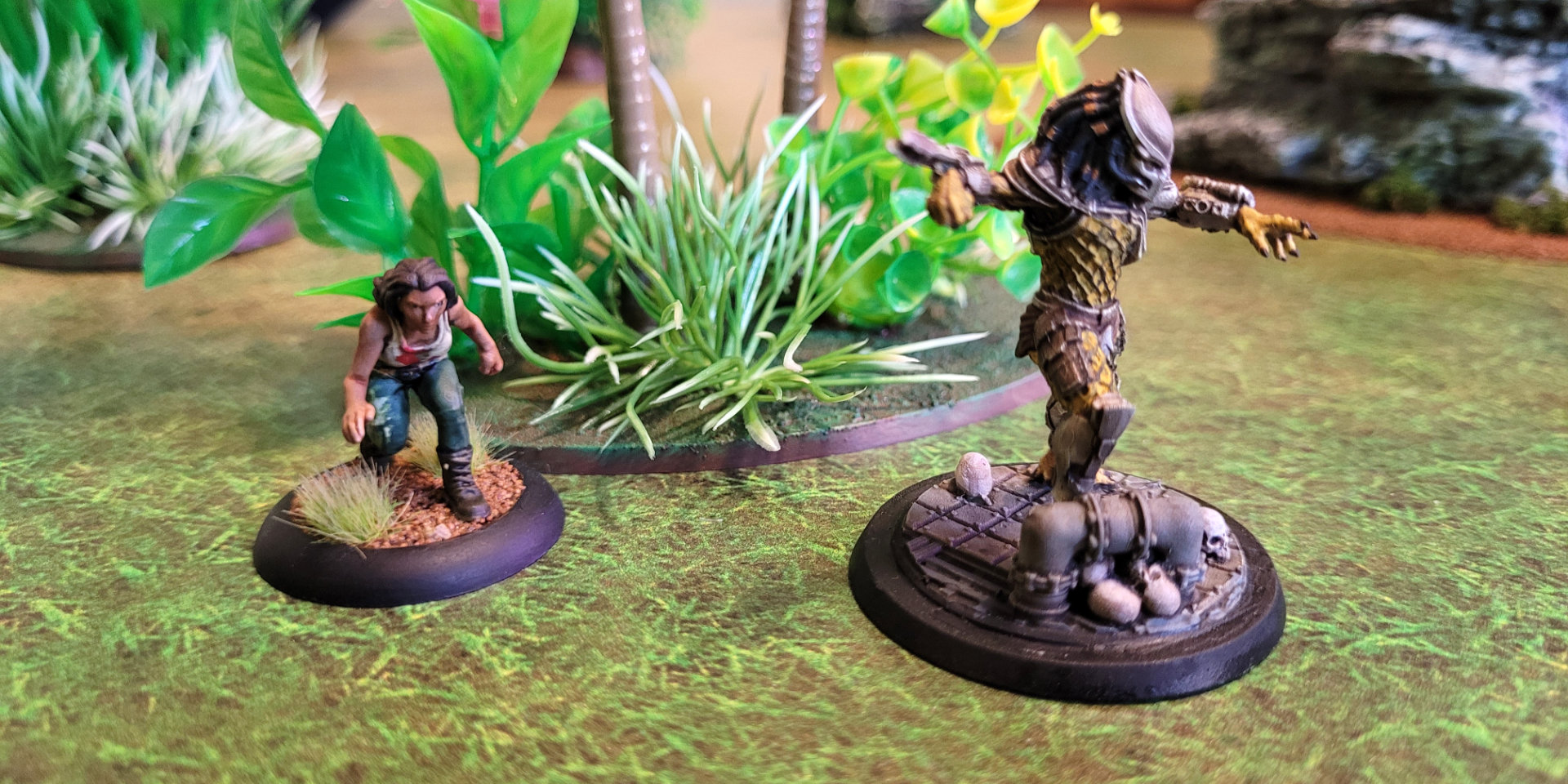 Anna can't fight, but she can collect blood samples, which is arguably more useful.
For Anna’s special rules, I decided that she never got targeted by the Predators and couldn’t make attacks, but if she moved into contact with a Nexus she could remove it without needing to wound the Predator — simulating her finding the Predator’s blood on the leaves in the film, and providing the insight that “if it bleeds, we can kill it.”
The actual rules are pretty simple. Each character’s only stat is their Quality Level, which gives them a target number to roll when attacking, resisting damage, or attempting additional movement. Interestingly, there’s no range or measuring; movement is as far as you want in a straight line (so terrain has to be placed carefully to avoid long, clear avenues) and ranged attacks are at line of sight. Characters will have one or two special abilities that give them conditional bonuses, and different weapons determine how many dice are rolled in an attack, and how much damage each success deals.
Overall we enjoyed the game’s simplicity, but there were two game elements we didn’t care for. The first was damage: when a unit takes damage (by failing to save against one or more attack-inflicted hits), you roll on a table to see what happens. This part we liked, as it adds a little flavor to the effects of being hit, with results that could give the victim a free move or attack, or have them go into a panic and attack a nearby friendly. However, any roll of doubles results in the target being killed as soon as the effect resolves, which we found to be a little too egregiously random — we lost two characters on turn 1 due to unlucky dice rolls, which is kind of a problem when the average warband is only going to contain 4-6 characters in total.
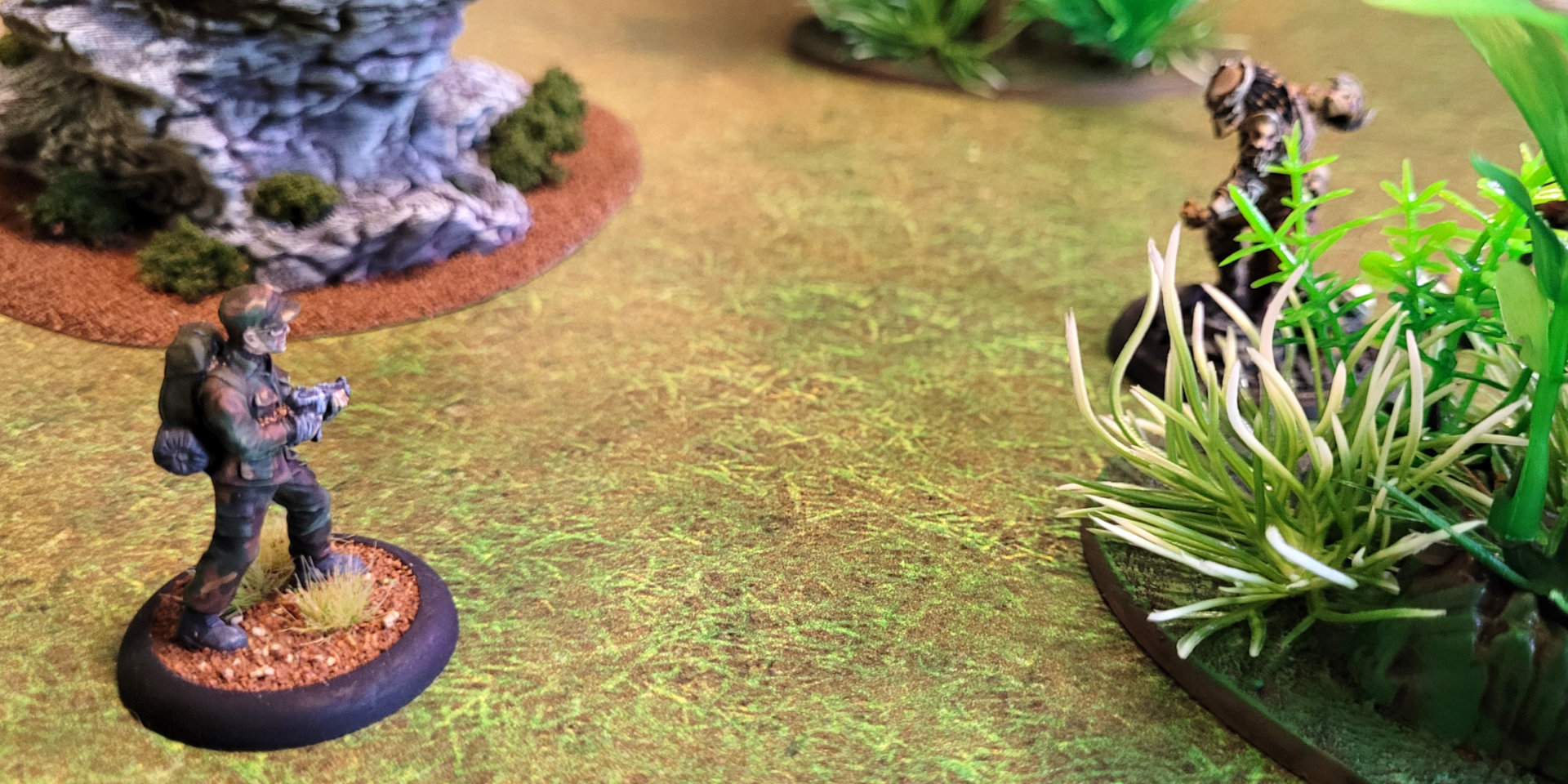 Not looking good for Hawkins...
The second element we didn’t care for is that some attack rolls are only 1 die, and there is something deeply unsatisfying about rolling a single d6.
Despite losing two of our characters on the first turn, and another on turn 2, we won the game on turn 3 by killing all 3 Predators. It’s possible that our special rules for Anna and/or our decision to play fully coop gave us an unfair advantage, and I do think that simply trying to simulate the action from the first Predator film didn’t really give the game an opportunity to shine.
I think The Doomed might work better as a full-on Aliens vs. Predator game, and with that in mind I’m going to work up stats for Aliens and Predators as playable warbands. I’m sure there is at least one Horror in the game that will make a good stand-in for the Aliens, which will give us options to play Aliens, Predators or humans as player warbands, with either Predators or Aliens as the NPC horrors. That will also give us an opportunity to try out the PvP conflicts in a way that makes more sense.
Whoever wins, we lose...
We got in two more games of The Doomed. I statted up a group of Predators and some generic Marines, basing them on the miniatures from the Prodos AvP 2nd Edition boxed game. With two opposing player-controlled forces, I think we got a much better taste of how The Doomed is supposed to play, as opposed to our first game which was purely cooperative.
A full game of The Doomed uses a scenario-based Conflict, which is what the two players are competing over, and a Horror, which is the non-player monster that attacks and interferes with both players. You would think a common enemy would make the game semi-cooperative, but honestly it’s more like “let’s you and him fight,” hoping that the NPC will keep your opponent busy while you go after objectives or otherwise take advantage of the situation.
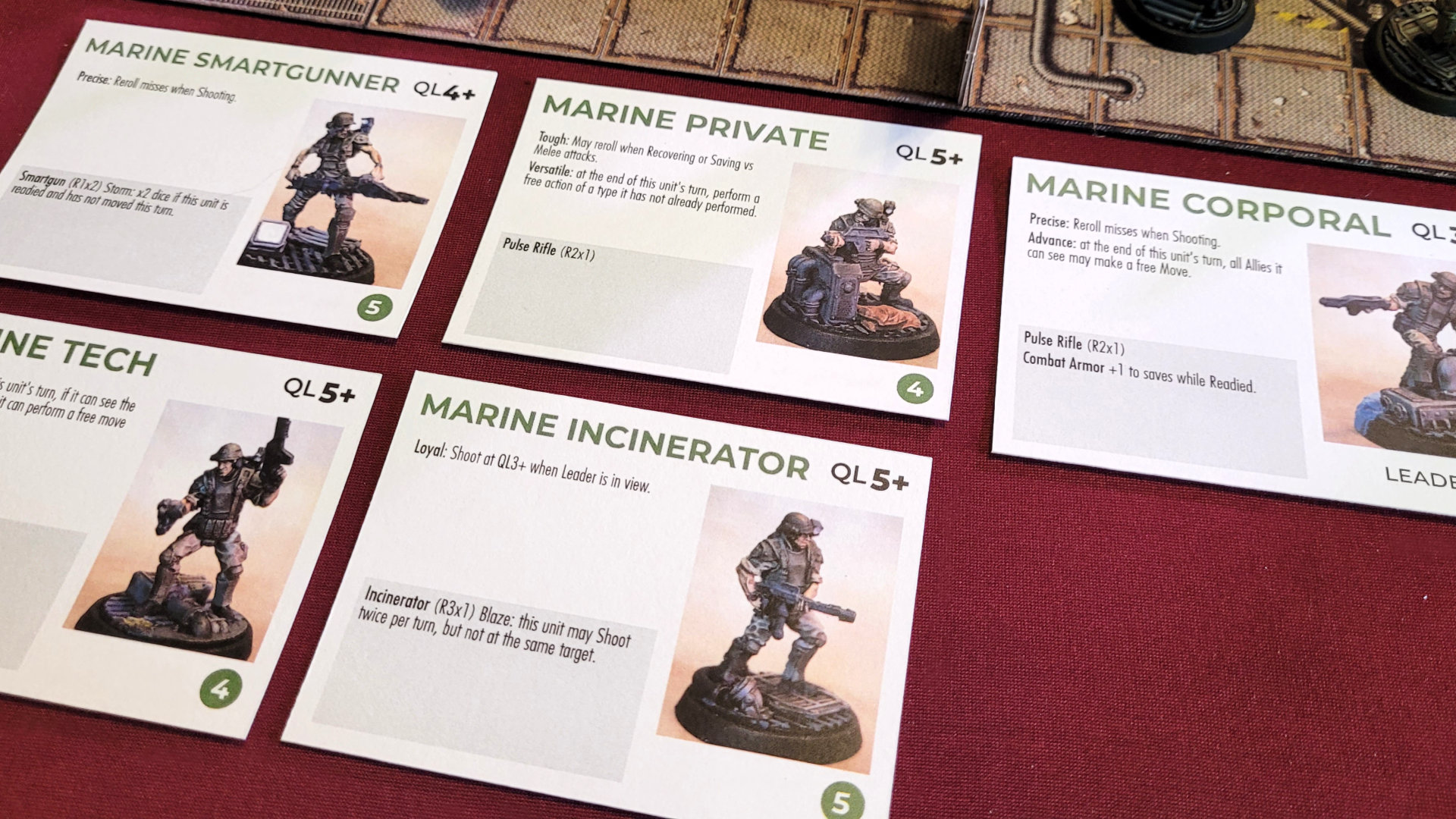
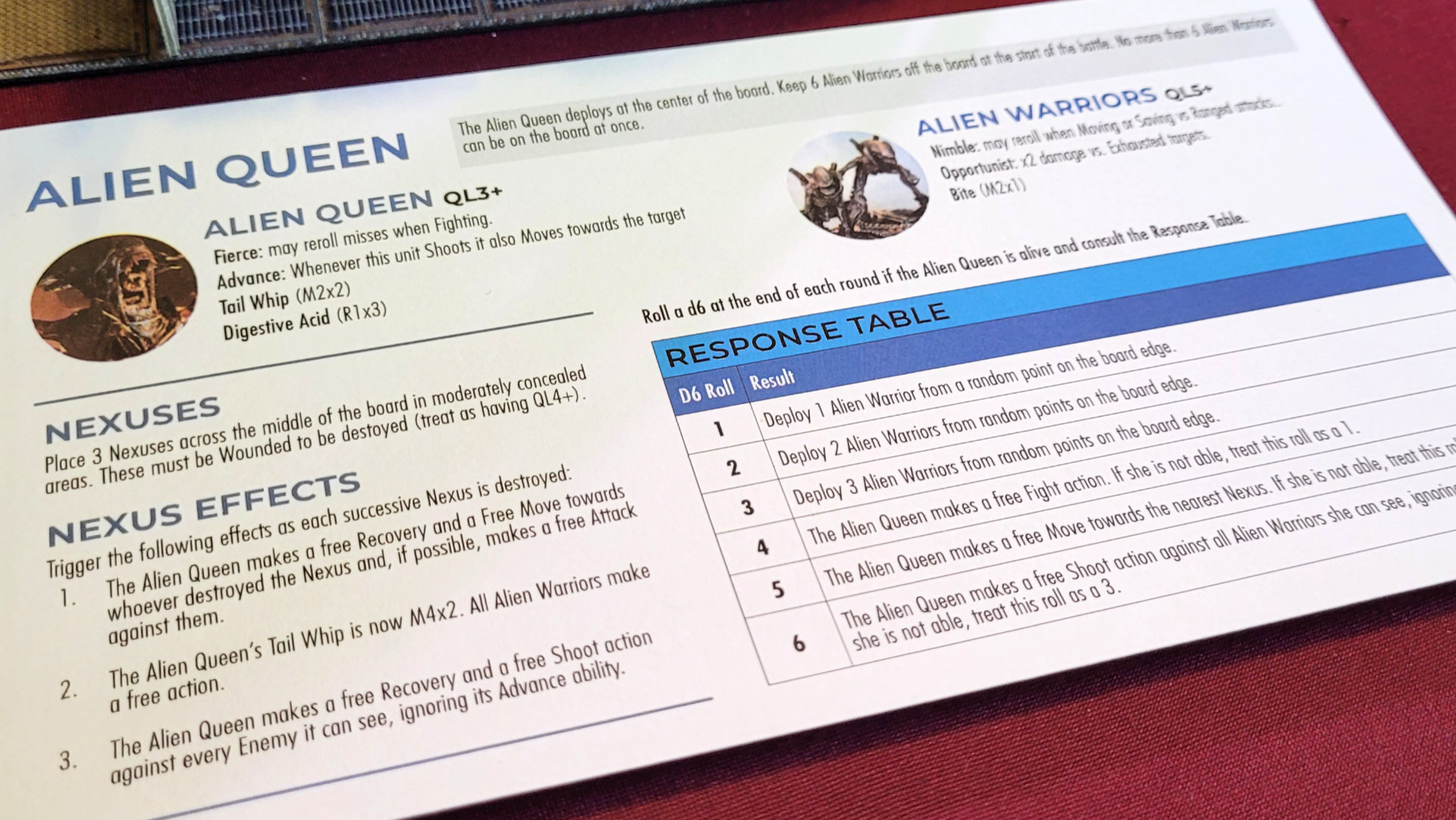
For our first game, we used the Devourer as our Horror, reskinned as the Alien Queen. This beast comes with six lower-powered minions that pop in and out over the course of the game — this idea appealed to me, due to the little-known fact that during the filming of Aliens, there were only six Alien costumes, meaning that you never saw more than six of them at a time.
For our Conflict we chose Ambush, which made sense from a narrative point of view, with the Predators setting a trap for the human Marines, only to find that they might have bigger problems. The victory conditions were simple: you win if more than half of your opponent’s force is dead, but the Alien Queen also has to die in order for the game to end.
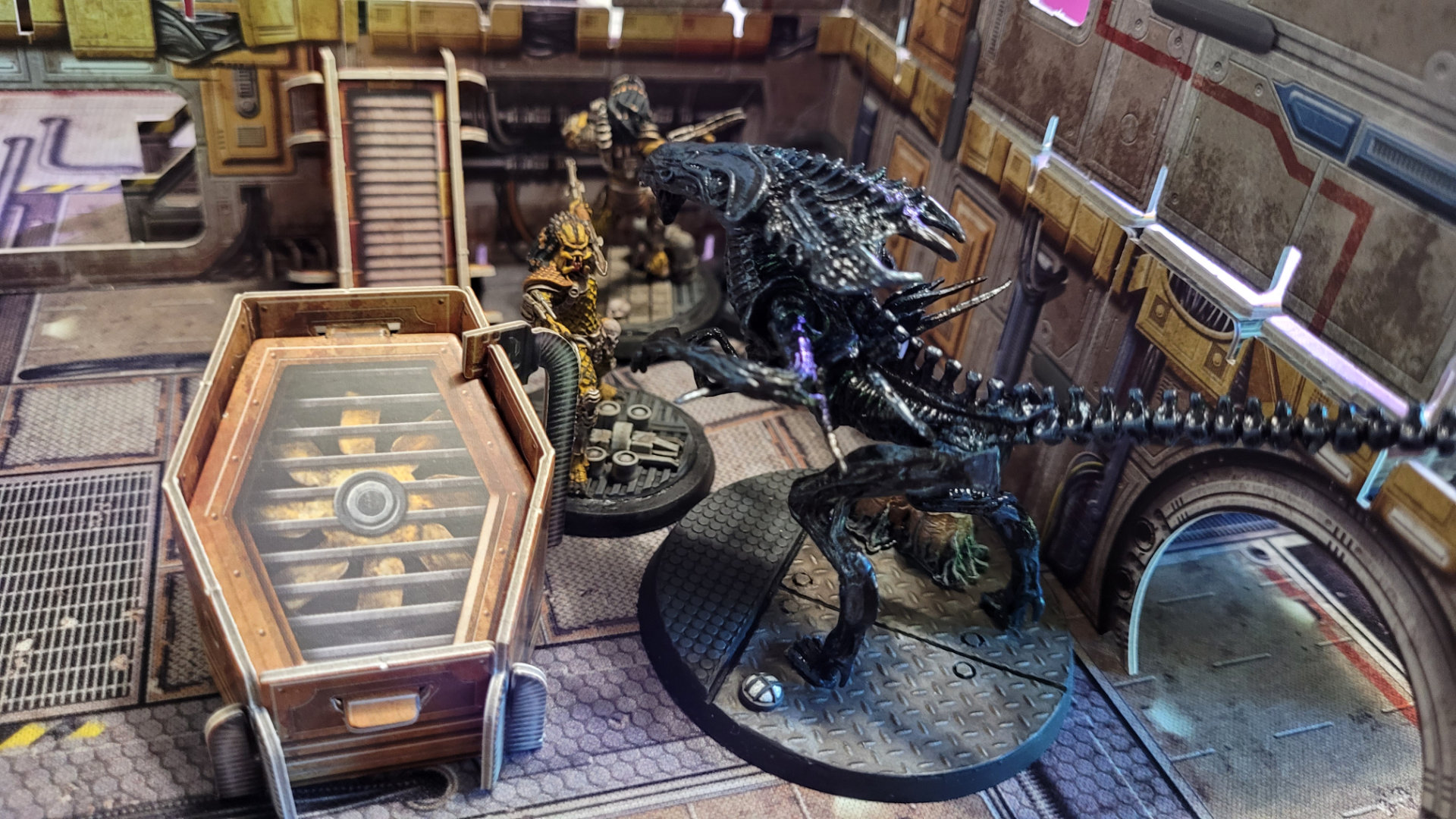
The game against the Queen ended rather abruptly in the middle of round 2 (something I’ll discuss in more detail shortly), so we played a second game, this time against an unending horde of fairly low-powered Aliens. Our objective was to occupy two vantage points on the board, and overall the game was more satisfying than the first: with more non-player models on the board there was more going on, with the Predators getting dog-piled by Aliens at one end of the board, and the Marines trapped in a stairwell on the other while trying to get to one of the vantage points.
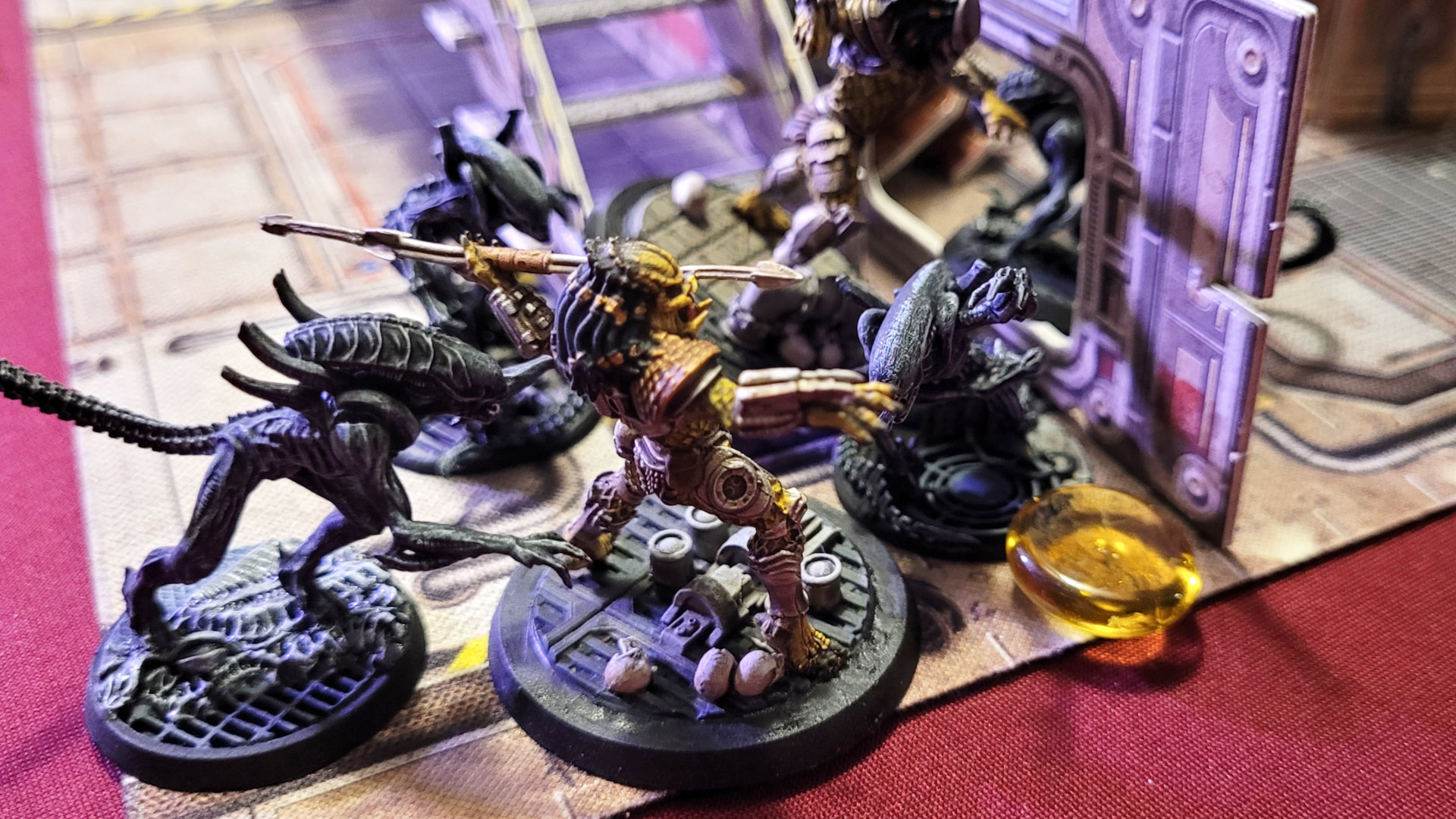
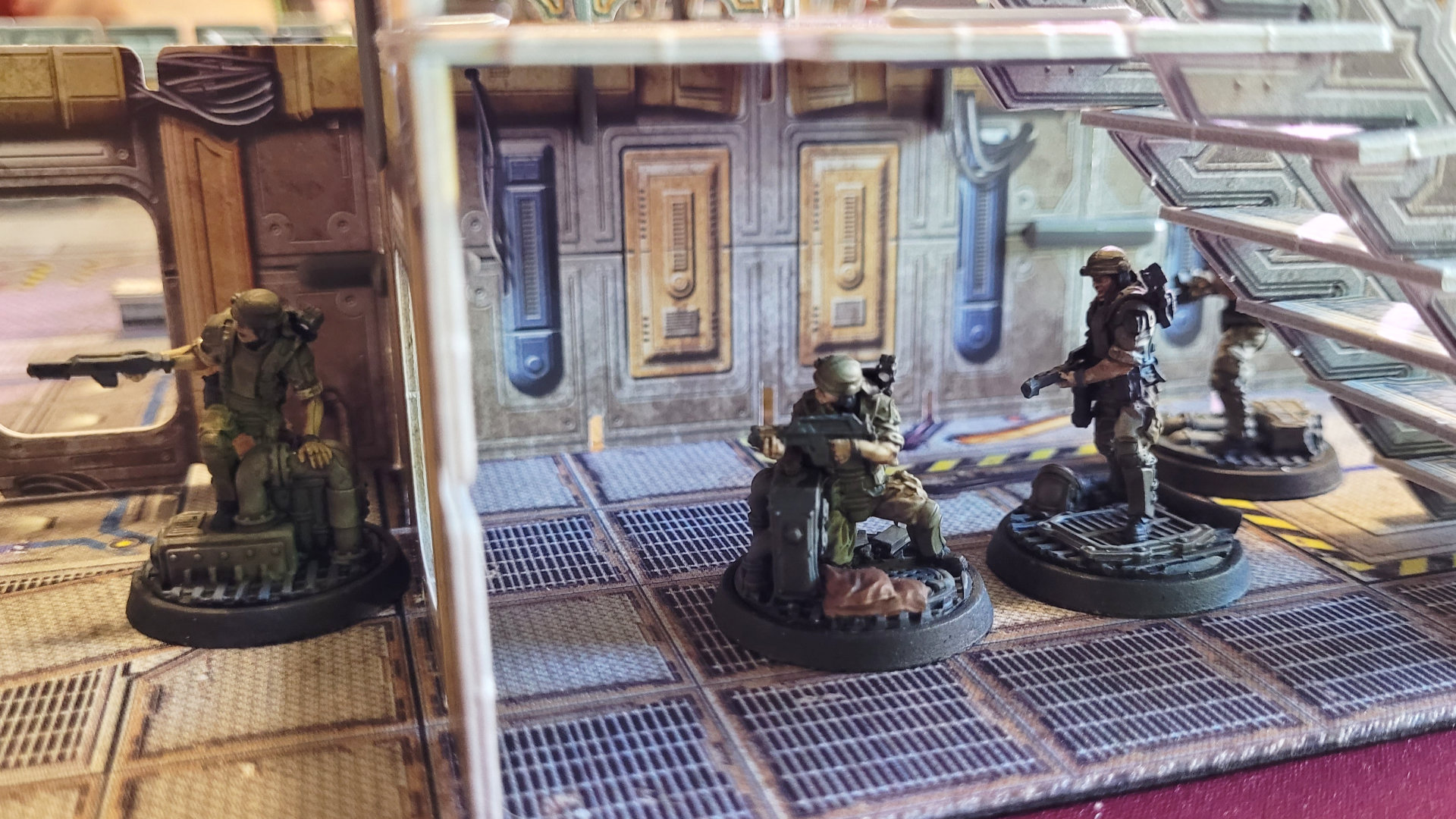
The tone of The Doomed is very on-brand for the AvP franchise, but in practice we found the game’s combat mechanics to be a little lacking. Each weapon has a rating describing how many dice are rolled, and how much damage each successful die inflicts, which is fine, but you occasionally find yourself only rolling one die when attacking, which often leads to egregious, arbitrary results. The defender then gets to roll a save against each point of damage — if any damage gets through, they have to roll on the dreaded Shock Table, which was paradoxically the most fun and the most aggravating part of the game.
The fun part is that the table makes taking damage more interesting, adding free moves and/or attacks for either the attacker or the defender. The aggravating part is that any roll of doubles means instant death for the defender, which we found to be really arbitrary, especially in a low model count game where you only have 3-5 characters in your squad. Out of three games, we only had one even make it to the third round, and all of them ended pretty abruptly, even after we modified the rule to only counting results of 2 or 12 as doubles.
I do like the structure of the game a lot — I like games with NPCs that liven things up and make the game more than “everyone run to the middle and fight.” Using Horrors and Conflicts to generate scenarios is a great idea, and we very much enjoyed that part of the game. I even like the idea of the Shock Table, making taking damage more interesting than just counting off hit points, but at the same time I think combat resolution needs something to make it a little less arbitrary.
The dark is so violent
I seem to have an overwhelming need to model the Alien universe on the table top in as many different ways as I can. The Prodos AvP game was way too fiddly and over-engineered for my taste, and GF9’s Another Glorious Day in the Corps is…okay, I suppose. But I think we can do better, and that’s why I picked up Violent Dark, a small model count, atmospheric solo/coop sci-fi horror miniatures game that looks like it might do a good job with modeling horror action similar to the first Alien film.
Oddly enough, once I started digging into the rule book, I decided not to go the Alien route with it. The game’s suggested starting enemy is a band of rogue synthetics, which immediately called to mind MEP Miniatures’ East Wolds Robotics range, which I had a great time painting up last year. Even better, I hadn’t yet found a game to play with them.
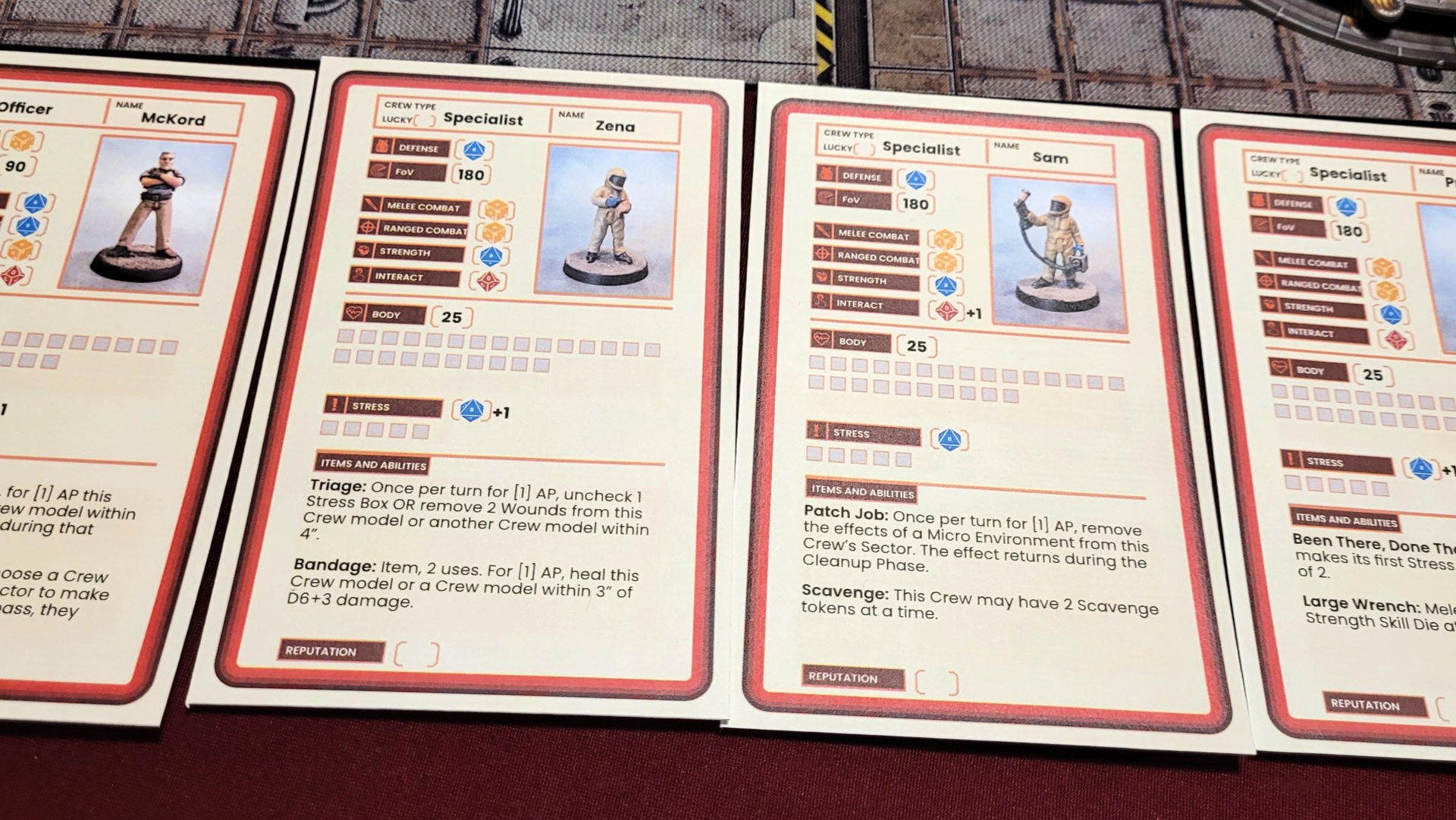 I do love a stat card.
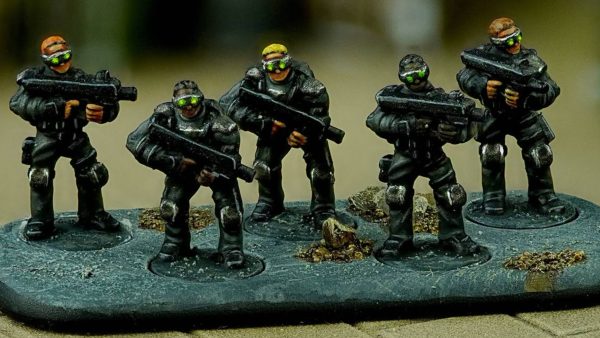
In the course of statting up characters for the game, I found that I would need a few military and corporate types in addition to MEP’s scientists and janitors, which led to a delightful look through my collection, in some cases pulling out models I hadn’t used in years. I had a great time coming up with identities for them, and it kind of proved the whole point of this project — not only is every game miniatures-agnostic, every miniature is game-agnostic as well.
Back to the game. Violent Dark is pretty fun, and does a good job with Alien-style claustrophobic space horror. However, it’s also very fiddly, with a lot of little modifiers and other details to remember that had me flipping through the rule book throughout the game — I don’t think I’ve ever played a game more in need of a player reference sheet. But in the end I enjoyed the two scenarios I played.
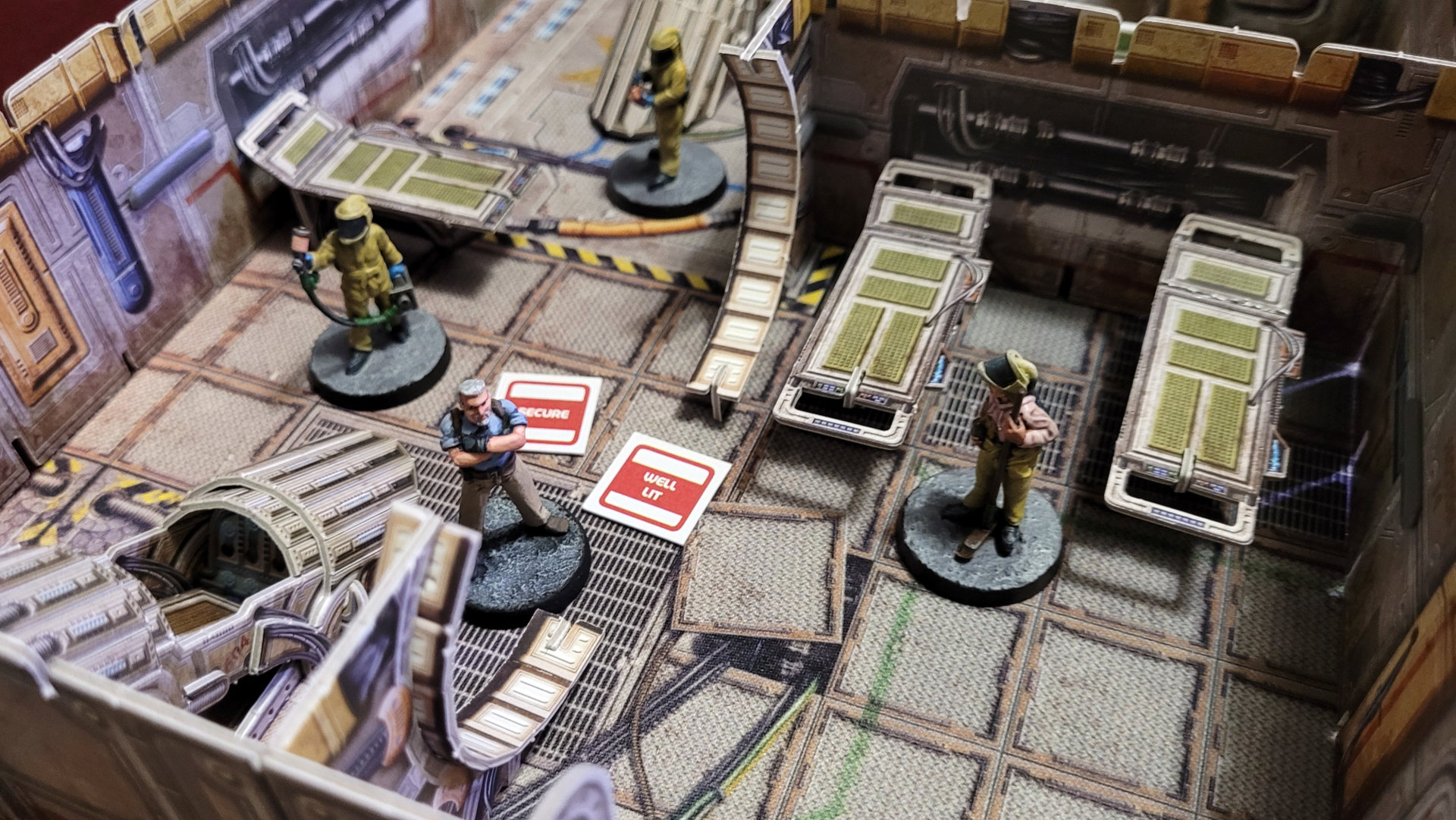 Three hapless technicians and their tough-as-nails boss wake up from cryo-sleep to find...
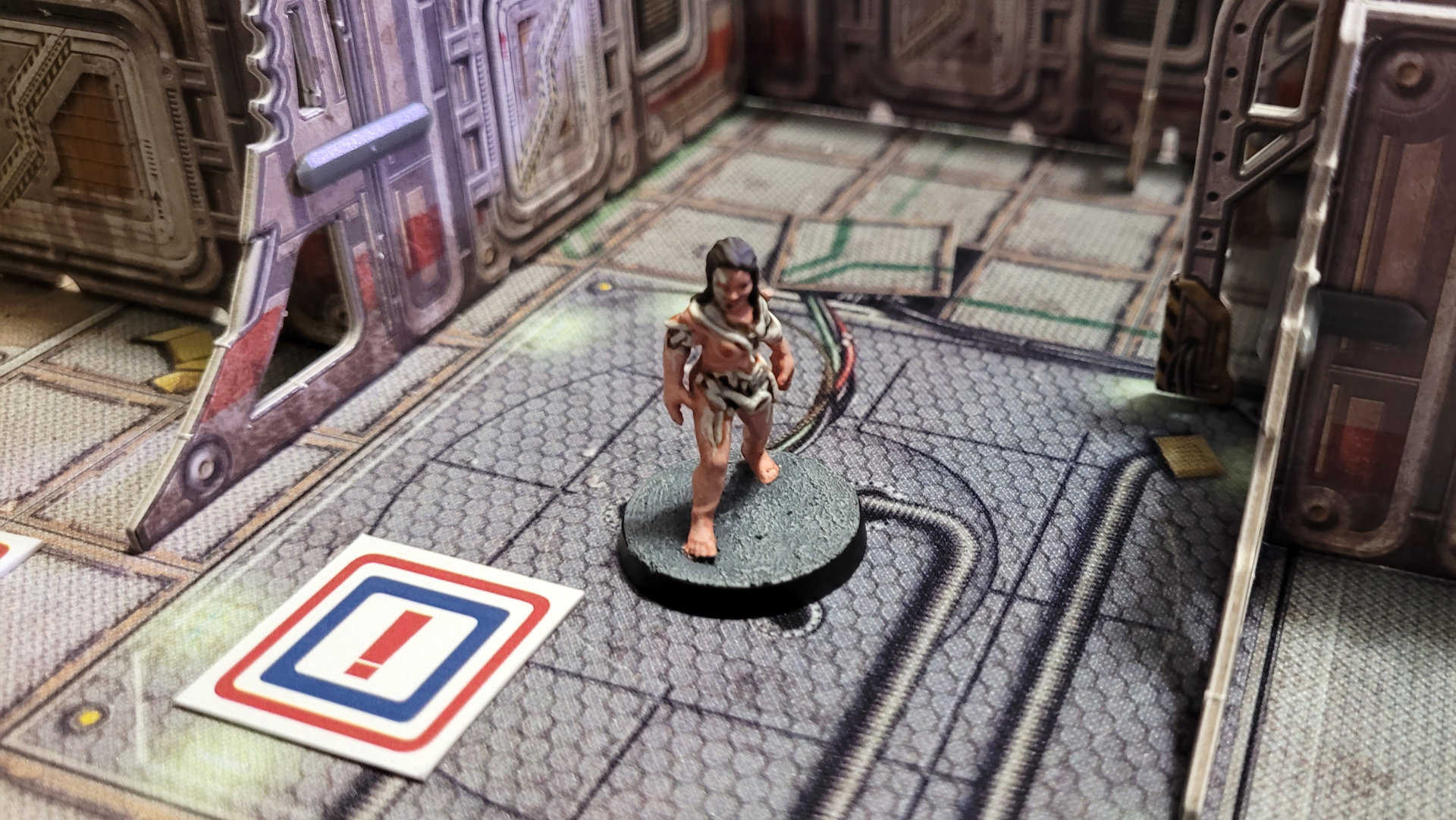 ...a very angry android!
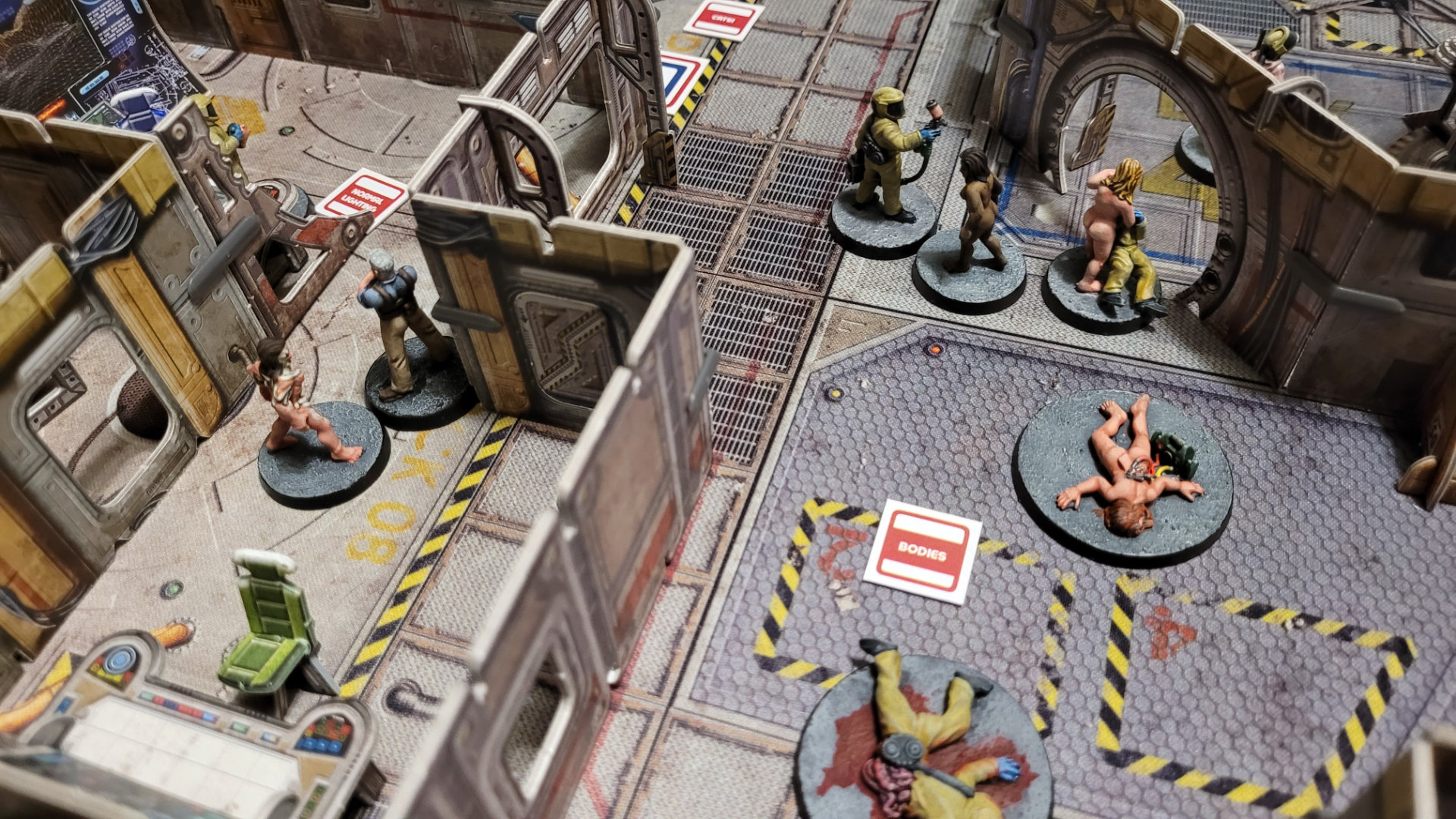 More underdressed androids join the fray, and I had just the thing for the "Bodies" environment condition.
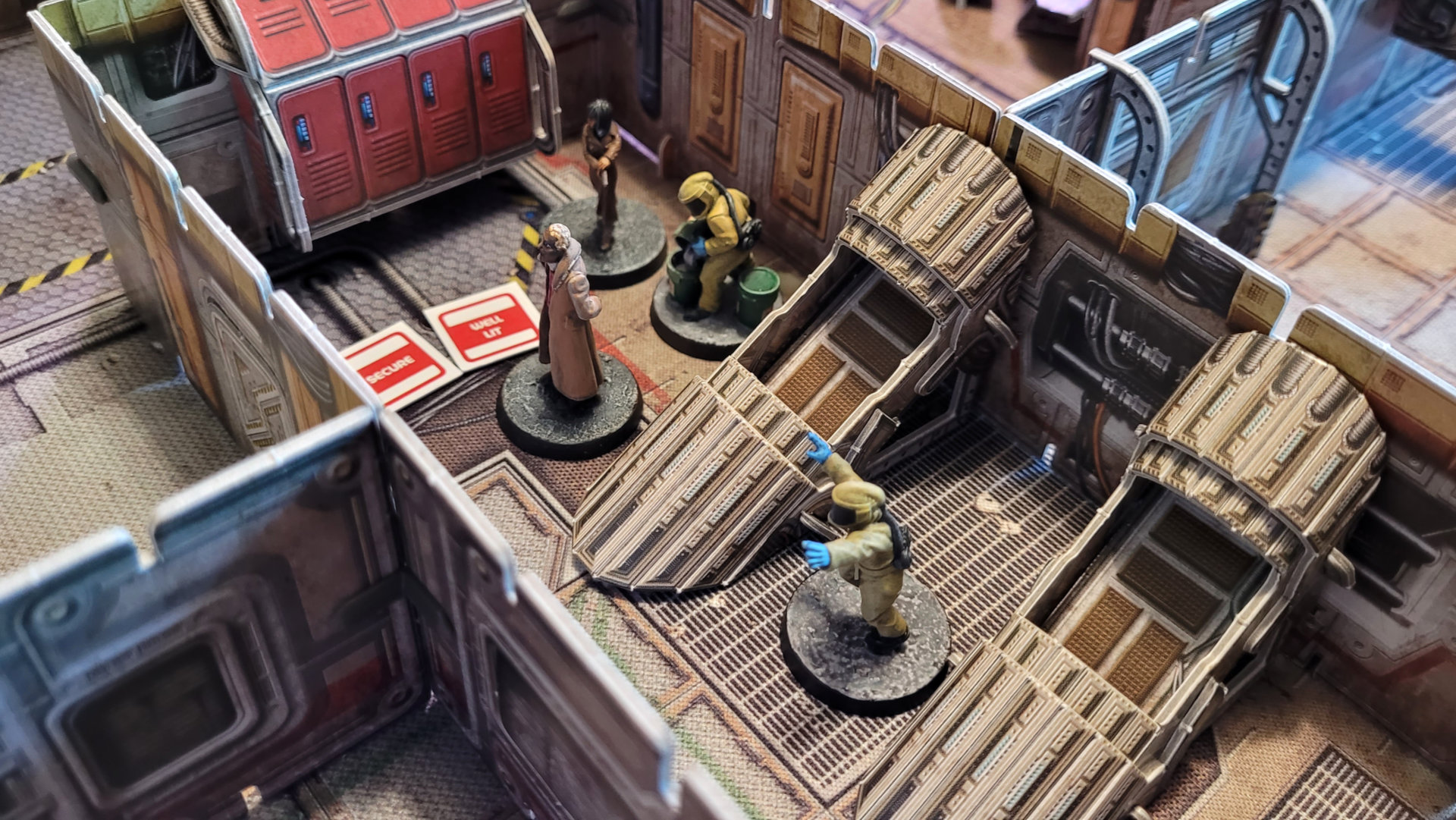 I mixed it up a bit more for my second game, with a corporate "adjuster" and her bodyguard, along with two techs.
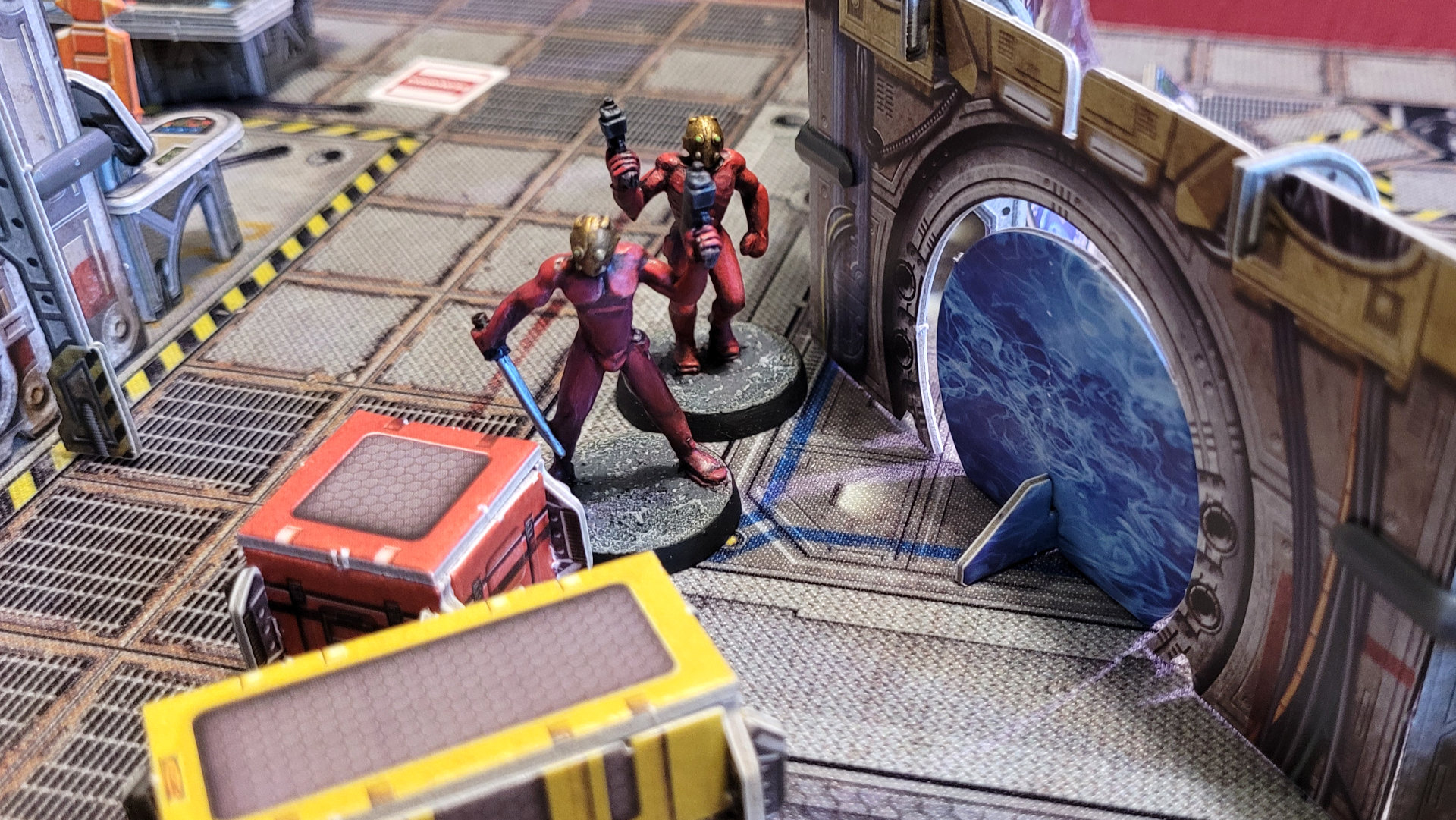 I must admit I never thought I'd find a use for these models, but they're perfect for Violent Dark's mercenary salvagers.
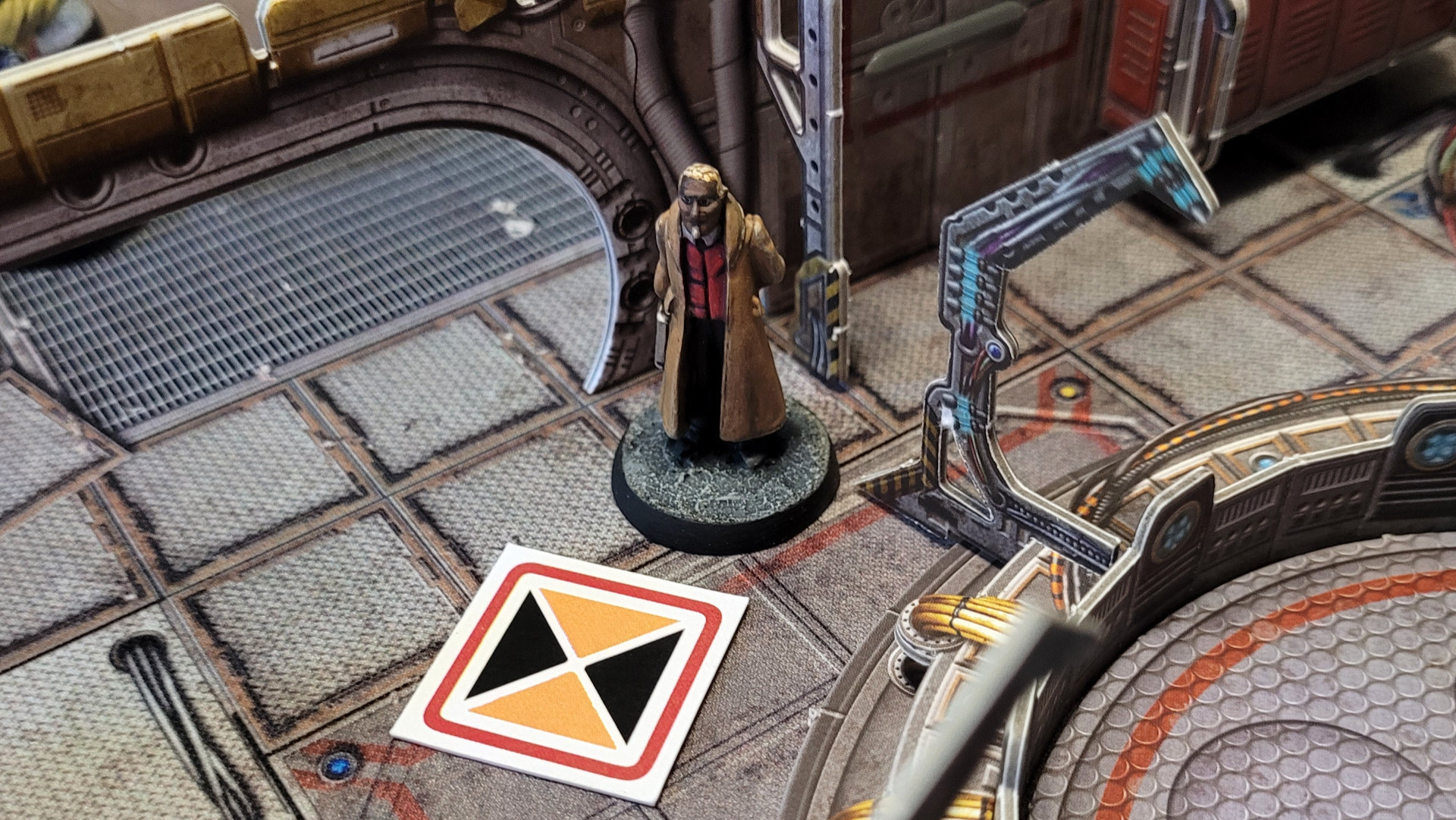 The corporate bodyguard wins me the game...barely.
Will I play it again? Possibly. The game gets the grim corporate future tone just right, and I haven’t even played the Xenos scenario yet. But I’ll definitely do up some kind of rules reference sheet if I do.
Tribal!
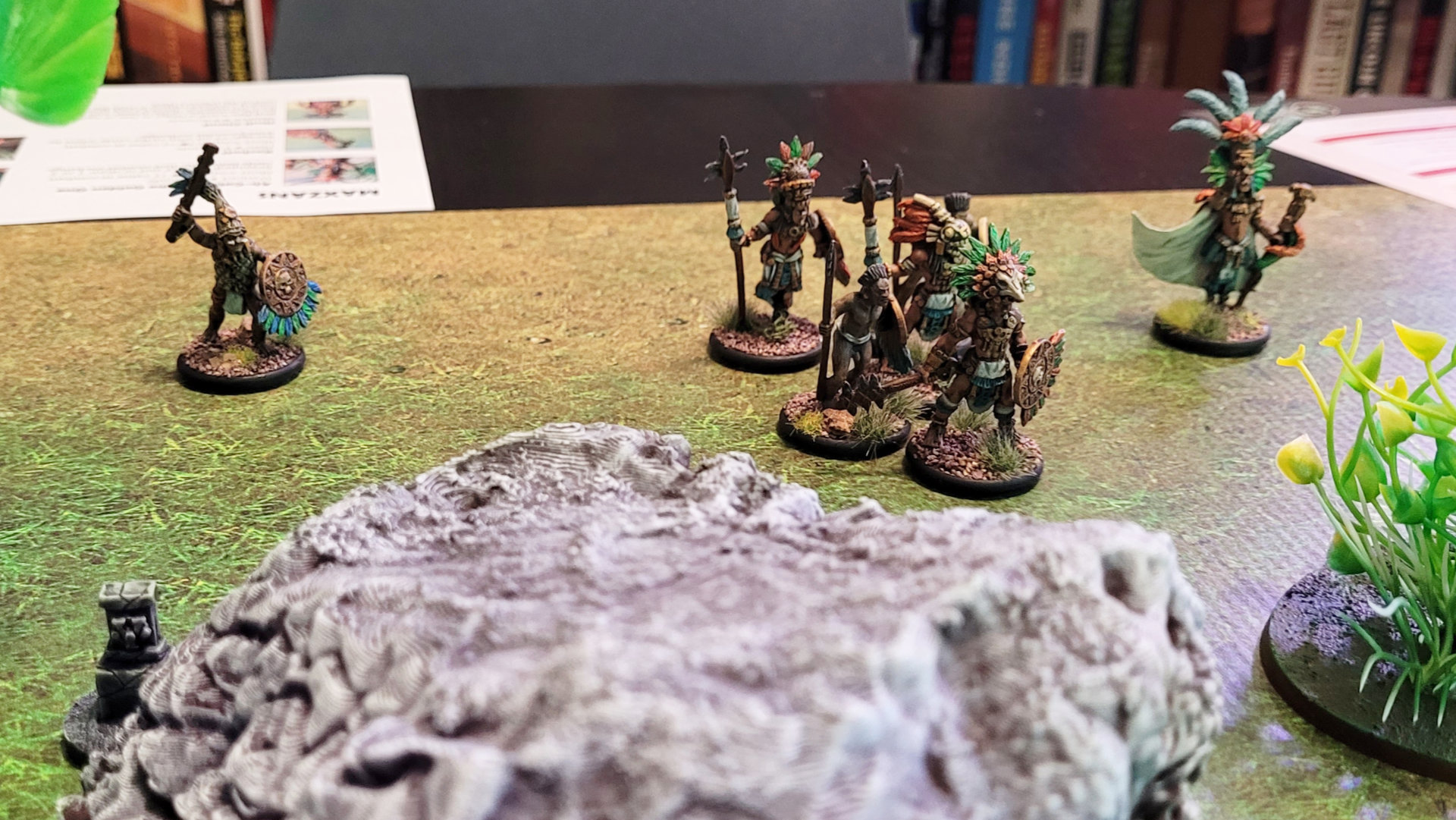 A tribe of Aztecs (Savage Core Maxzans), ready to defend their territory.
Tribal caught my eye for two reasons. The first was the ancient cultures theme — I was looking for an alternate game to play with my Savage Core models, having had a…mixed experience playing that game in the past. Don’t get me wrong, there is a lot that I love about Savage Core (the incredibly characterful models, for a start), but there are a few things about the rules that I don’t particularly care for, and in any case I’m always on the lookout to get more mileage out of my collection of miniatures.
The other reason Tribal looked interesting was that it is entirely playing card driven. No dice whatsoever, it even uses card edges to measure distances for movement. Using playing cards instead of dice appeals to me on a lot of levels — you still get a semblance of randomness, but using cards introduces a level of tactical decision making that you just don’t get from dice. At the most basic level, choosing from a hand of cards, even if they were drawn randomly from a deck, gives players a lot more agency than rolling a handful of dice. Additionally, you know how many of each number are in the deck, so as the game progresses, the cards that are going to come up become more predictable.
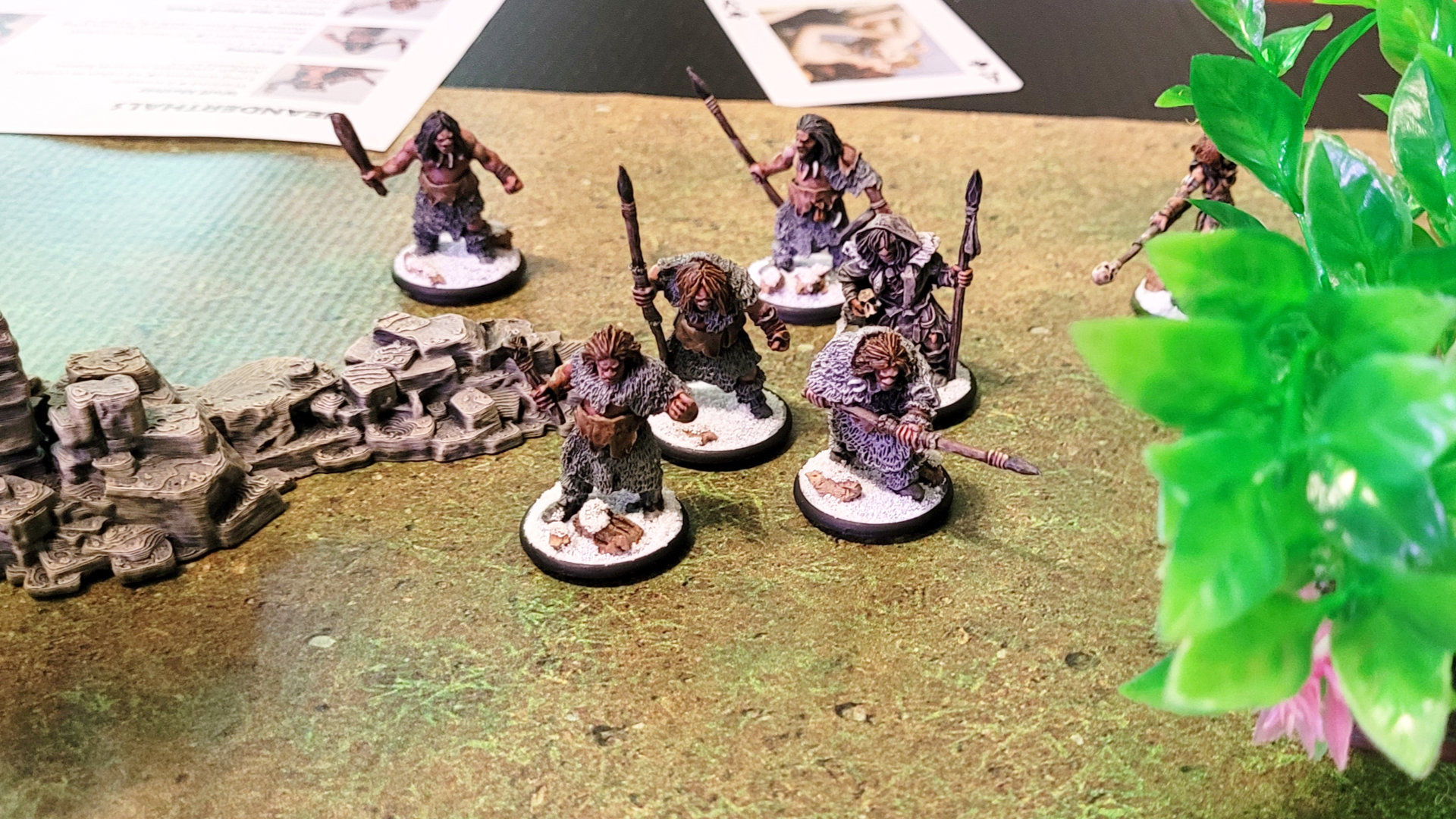 A unlikely group of neanderthals arrive to threaten the Aztecs -- maybe they were frozen in a cave and recently thawed...
In that respect, Tribal did not disappoint. The game uses the cards with great efficiency — the card you draw for initiative each round will then be assigned to one of your units, who will either be able to use it in melee combat, or as a defense against a ranged attack. Melee is resolved by each player drawing a hand of cards equal to the unit’s remaining hit points (starting with the card assigned to that unit at the start of the round, if they still have it), so a healthier model has an advantage over one that has taken damage. It’s a very elegant system.
The rules even make use of the different card suits, with black cards representing attacks and red cards, defenses, and spades or clubs giving a bonus to different types of melee weapons. Ranged combat in the game is more about harrying your opponent — you might inflict a little damage, but the main goal is to force the unit to use their activation for the turn to dodge your arrows.
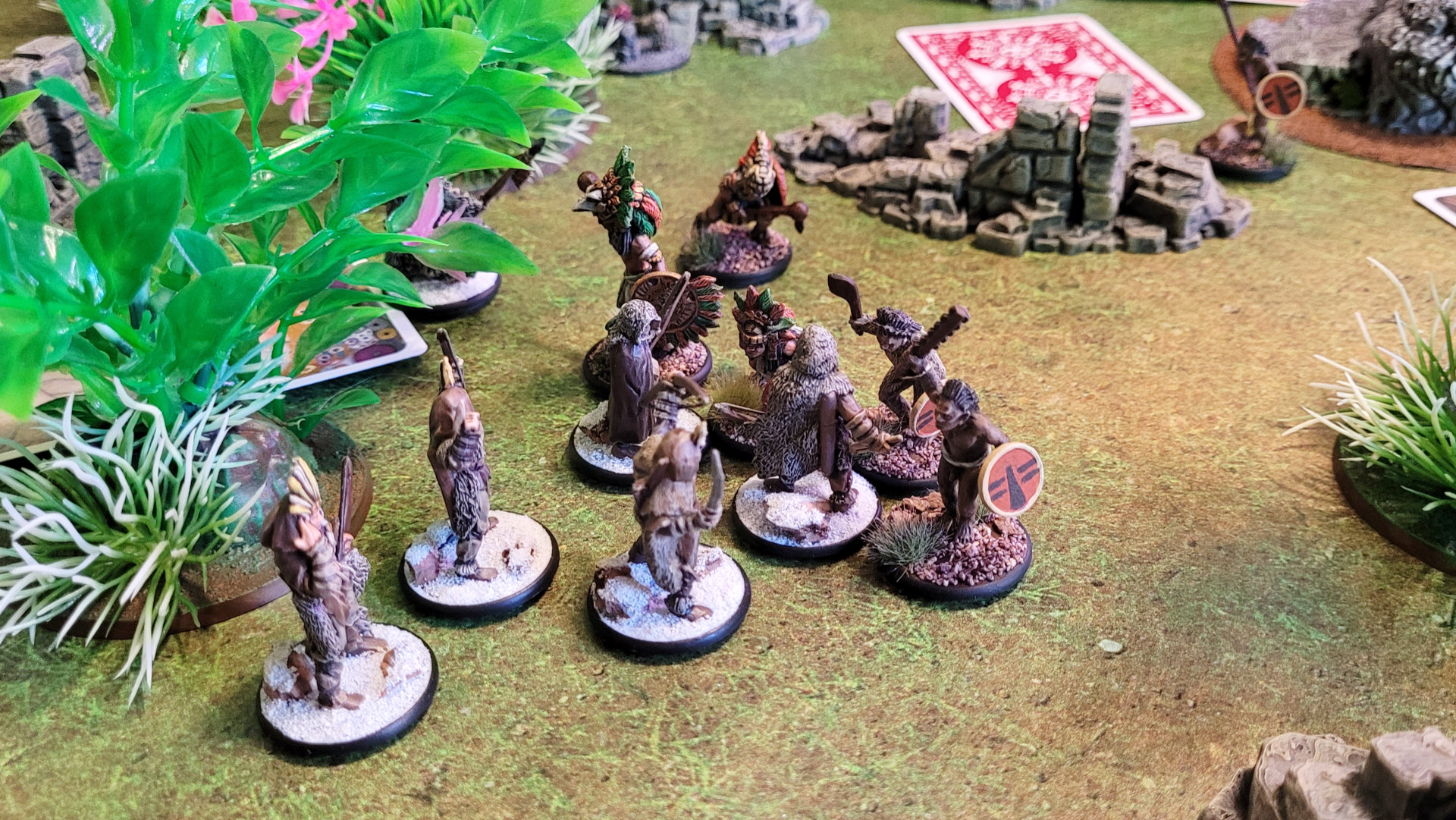 Our first major clash, as a group of Aztec warriors take down a whole unit of neanderthal archers before they manage a single shot.
One thing I didn’t care for in Tribal was the idea of having multi-figure groups that act as one unit. The game organizes low-level combatants into groups of 5, classified as either marksmen or warriors. They move and attack as a group, so what they really are is a unit with a larger footprint on the board that still only makes one move and one attack — essentially you’re using multiple miniatures to keep track of hit points, which seems like kind of a waste. But I’ve played other games that do this (Mythic Battles and Star Schlock immediately come to mind), so I might just be saying that because I was scrambling to get enough Savage Core models together to make up the needed groups of Tribal warriors.
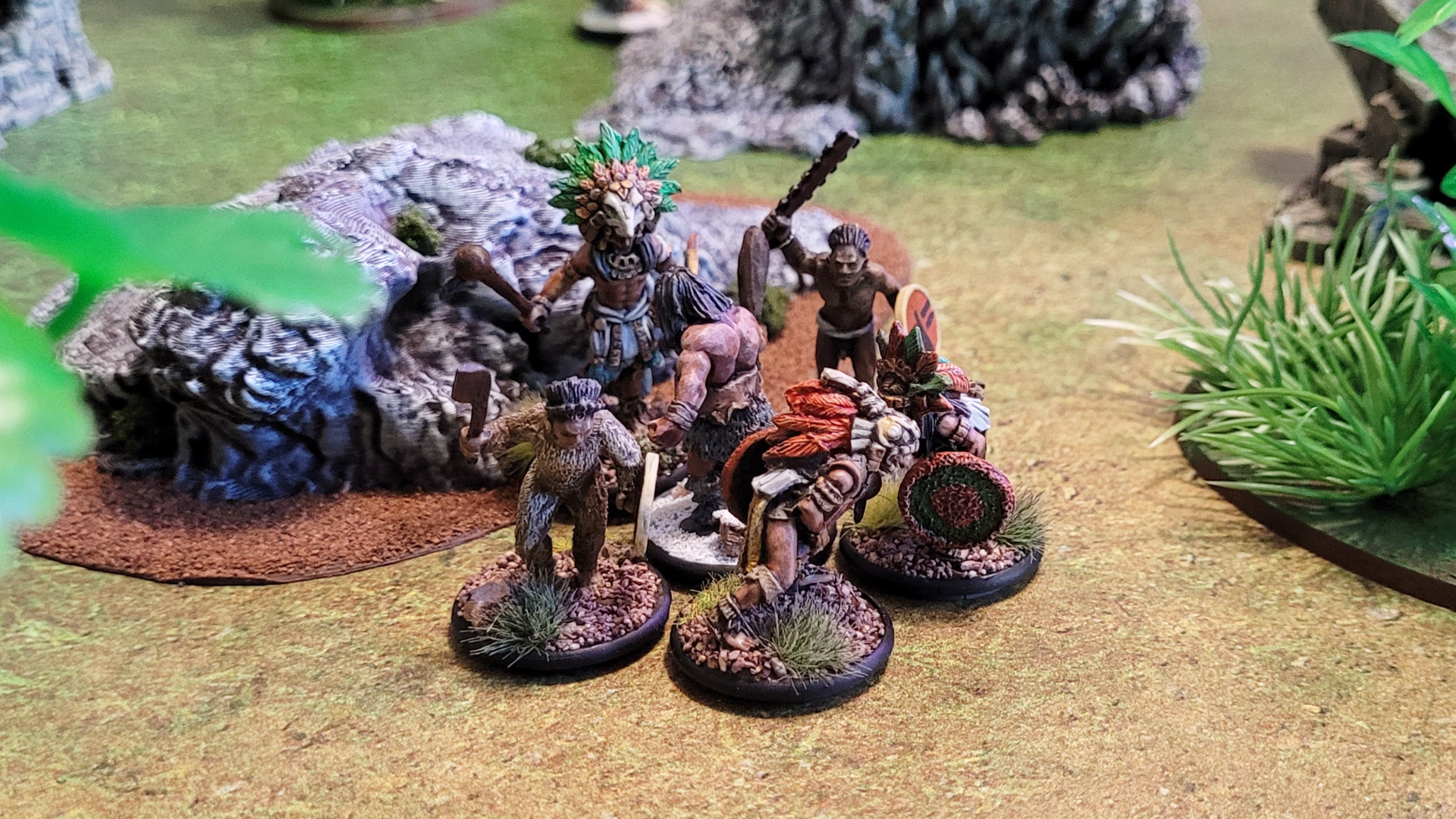 A neanderthal hero finds himself surrounded by enemy warriors.
The only other issue I had with the game was that it felt a little thematically bland. Each character only has one stat (hit points) and maybe one or two special abilities which tend to be pretty simple, so there wasn’t much going on in the game to give it theme or personality. That may not be entirely fair since I’m comparing it with Savage Core, a game with a massive excess of quirky theme that comes out in the game. Tribal might also be a victim of unfair comparison to Violent Dark, the last game I played for this project, which is tailor-made from the ground up to fit a very specific theme, which it does extremely well.
Apart from that, we enjoyed our first game of Tribal, and will definitely be playing it again. I’m also thinking about ways I might be able to bring some more of what I like about Savage Core into the Tribal rules set, or perhaps figure out away to replace Savage Core‘s egregious dice rolling with some of Tribal‘s card mechanisms.
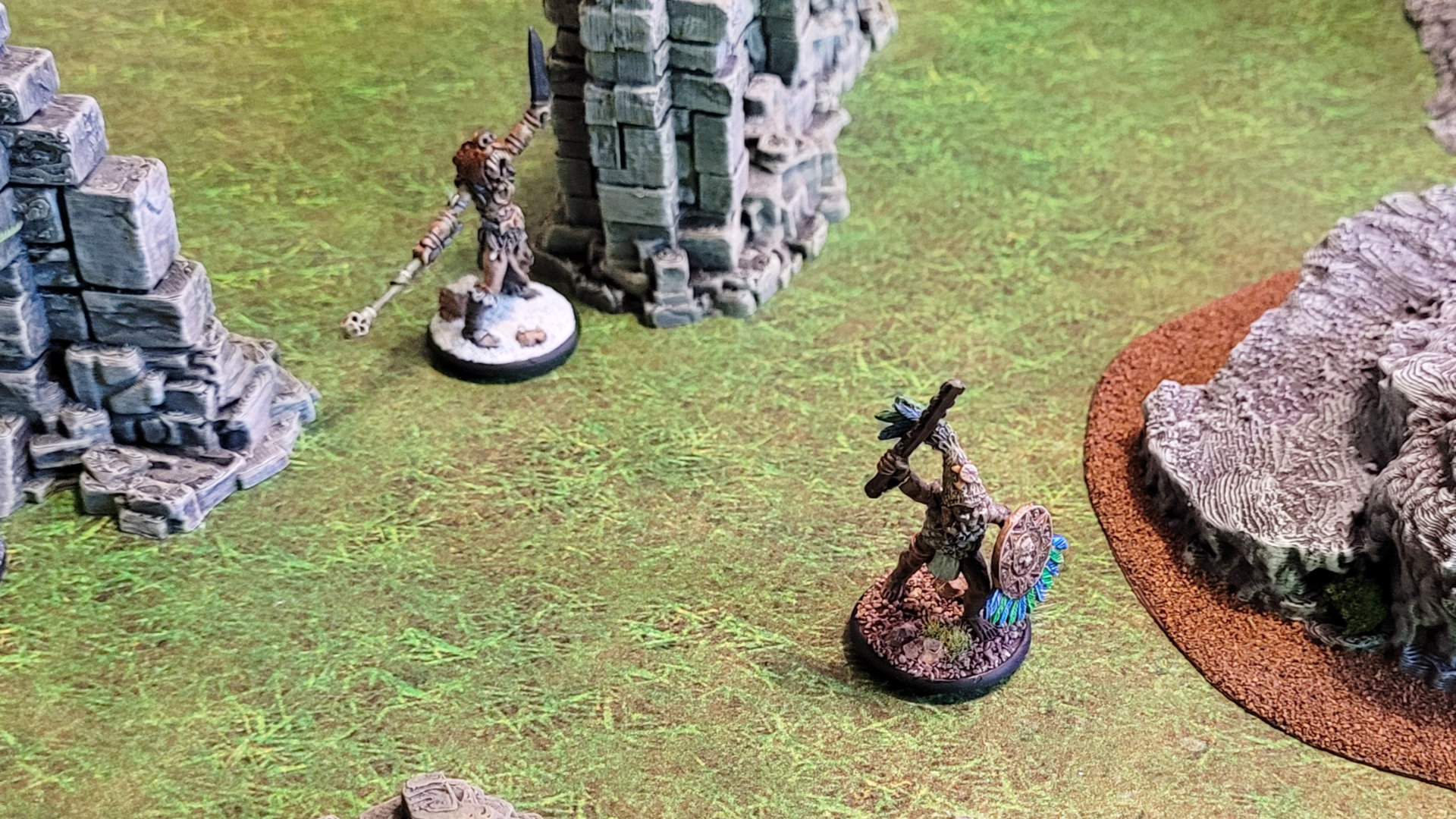 A neanderthal shaman uses a curse to send an Aztec hero scurrying in the other direction.
Well, it took more than an hour
Now we come to the last of the rules sets I wanted to try out for this project: One-Hour Skirmish Wargames, an interesting rules-and-scenarios book by John Lambshead. I didn’t buy this one with anything in particular in mind — I was mainly interested in the playing card based game mechanics.
The book provides a simple set of rules for activation, moving, and attacking. So simple, in fact, that I could tell this would need to be a strongly scenario-led game. No problem there, the book also includes 6 scenarios, ranging from Napoleonic through both world wars to the cold war, and it even includes a pulp scenario involving dinosaurs and invading aliens.
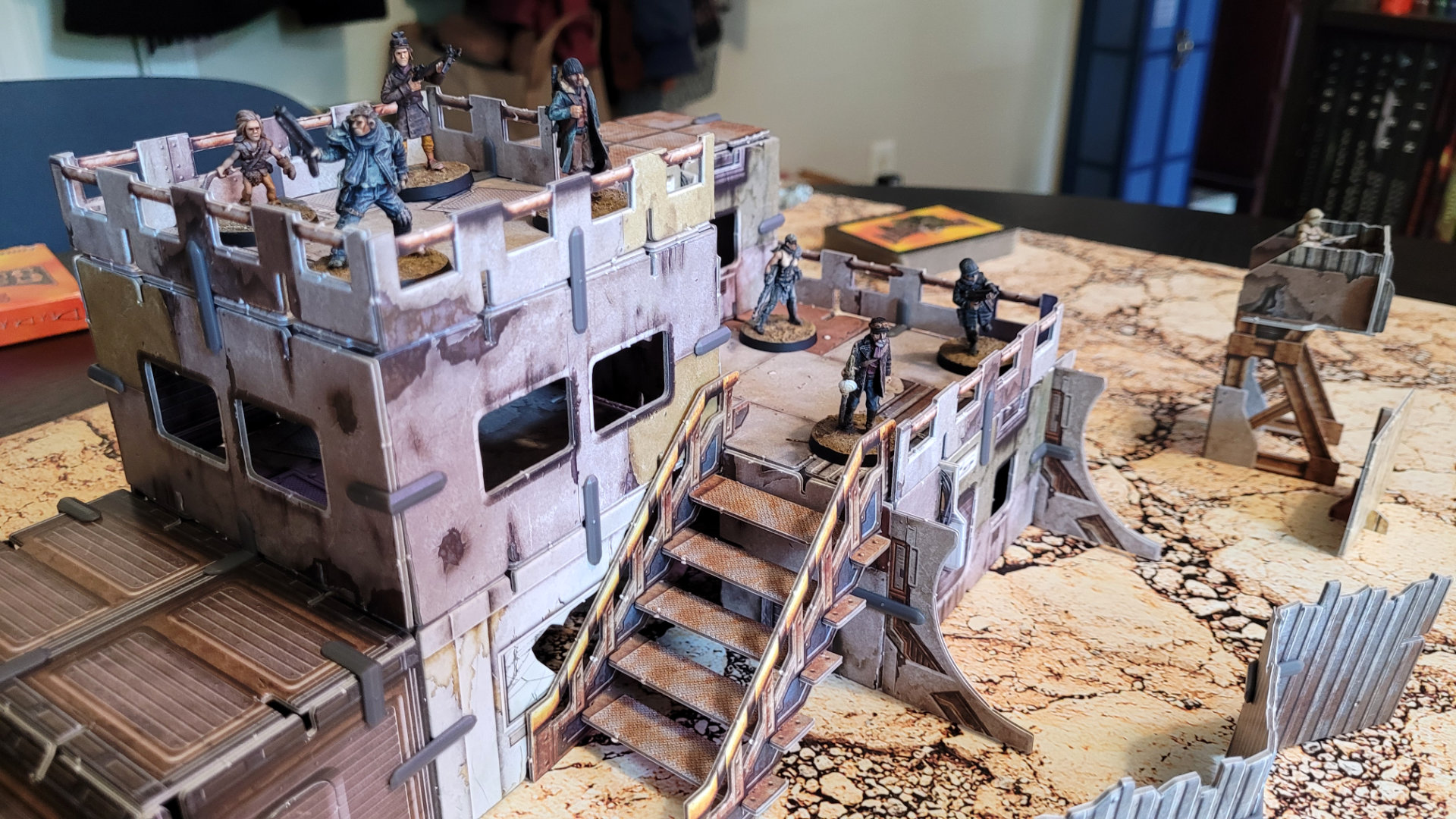 Zulu wars or after the apocalypse, it's all pretty much the same.
Surprisingly I decided to hold off on the pulp scenario, instead deciding on one that takes place during the Zulu wars. I don’t really have any historical miniatures for this period, but I was thinking I could re-skin it for the xenomorphs and colonial marines from Aliens. The other scenario that caught my eye was a WWII-era convoy raid, which I was thinking I could do with the ridiculous number of post-apocalypse models I have in my collection.
Then it hit me — if you put “defend the fortress from attacking hordes” together with the convoy raid, you essentially have the plot of the second Mad Max film. This seemed ideal as the Zulu scenario had a few units with rifles — now I wouldn’t have to explain what the Aliens were shooting…
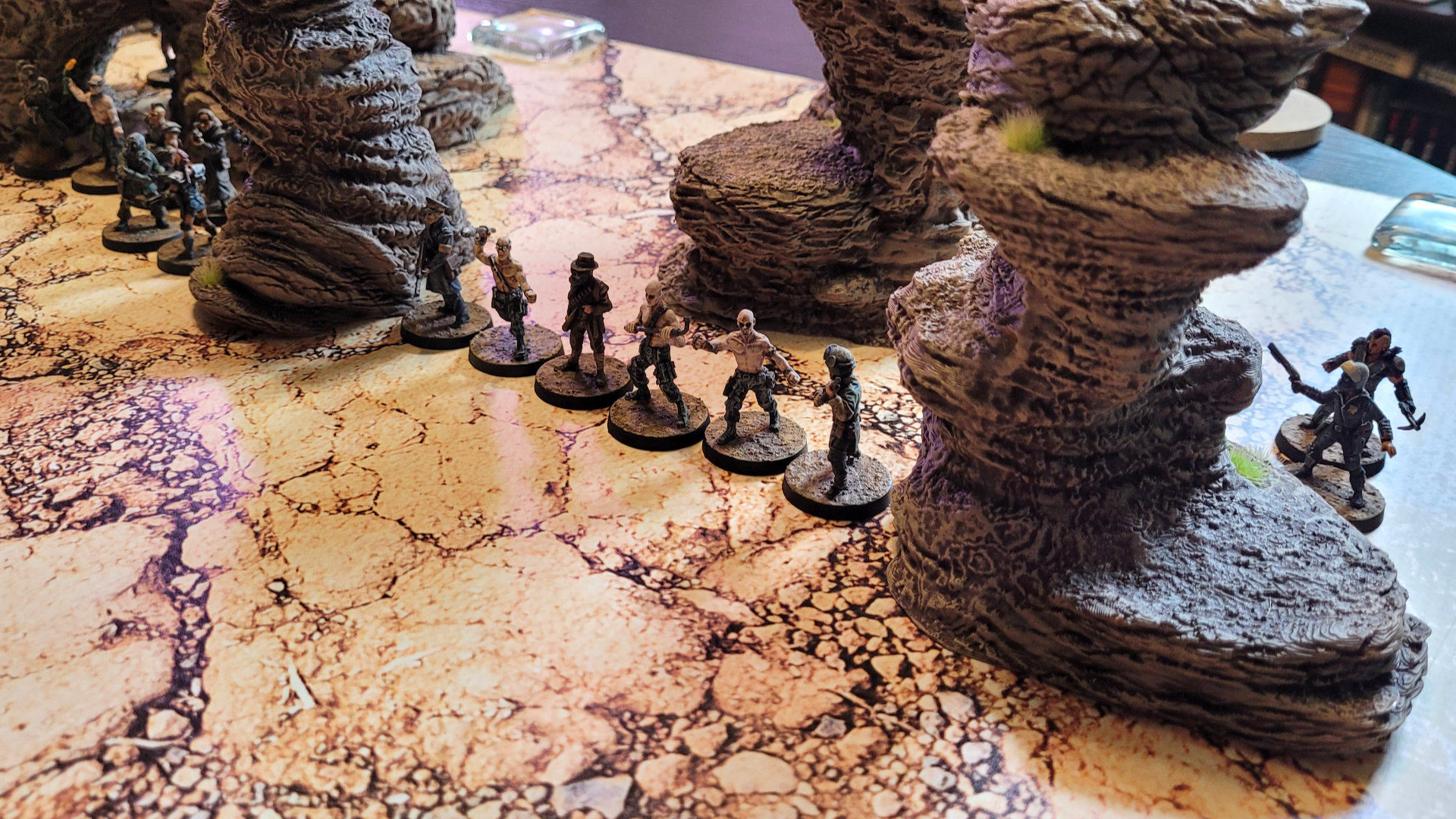 An intimidating lineup of wasteland warriors, courtesy of Crooked Dice.
Alas, while digging into the convoy scenario I decided it would need more work than I was willing to do in order to re-skin it. The scenario involves a lot of different characters with different types of weapons, on both sides. Not a problem if you have miniatures for German soldiers, SAS and French partisans modeled with the correct weapons and equipment, but it would be too difficult to keep track of which post-apocalypse models were standing in for the WWII characters without doing up some stat cards with images, which was more work than I was willing to put in.
So we decided on just doing the Zulu scenario, reskinned for Lord Humongous and his mob of wasteland warriors laying siege to Max and a small group of survivors. The Zulu army consisted mainly of warriors with spears, with only three of them armed with rifles — most of the models we would be using had rifles or pistols, so we reasoned that only a few of them actually had bullets, and selected three that would be easy to identify.
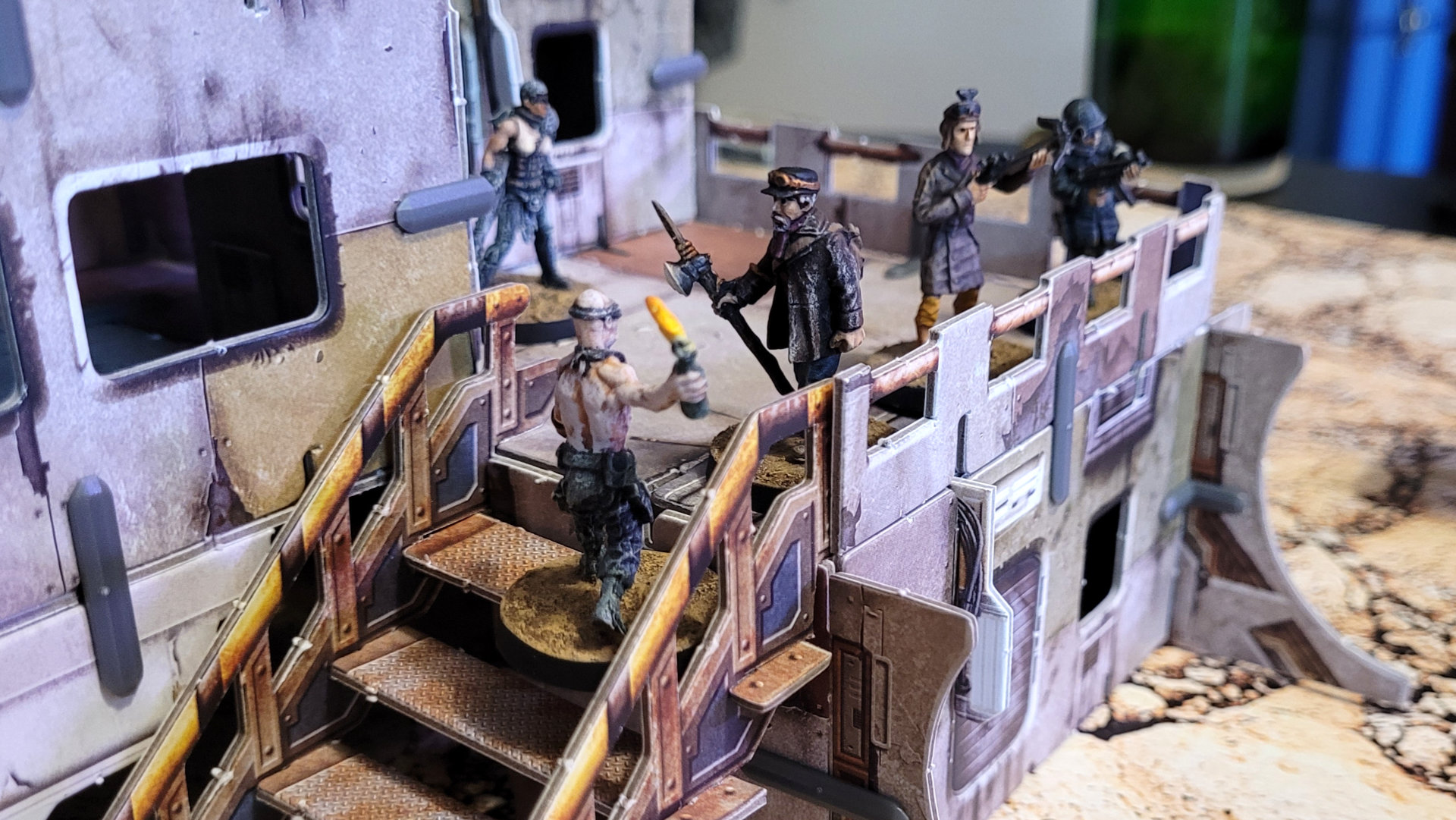 The first breach.
The scenario was interesting to play out. The wasteland warriors had to cross an open field to the defenders’ redoubt, and would win the game if they had models inside the redoubt when the game’s time limit hit. The defenders (standing in for the British) had better weapons and were able to pick off attackers at range, but the problem was that there were only 8 defenders against a starting force of 16 attackers. To make matters worse, attacker casualties re-spawn after a turn, meaning they have and endless flood of warm bodies. The defenders’ only hope of winning was to keep the attackers out of the redoubt until the time limit ran out.
The card based game system was nice and fast-paced, although most of the game did involve the defenders shooting down attackers at range. Things got a little more interesting once attacking models started making it to the wall — melee combat is quite a bit more decisive.
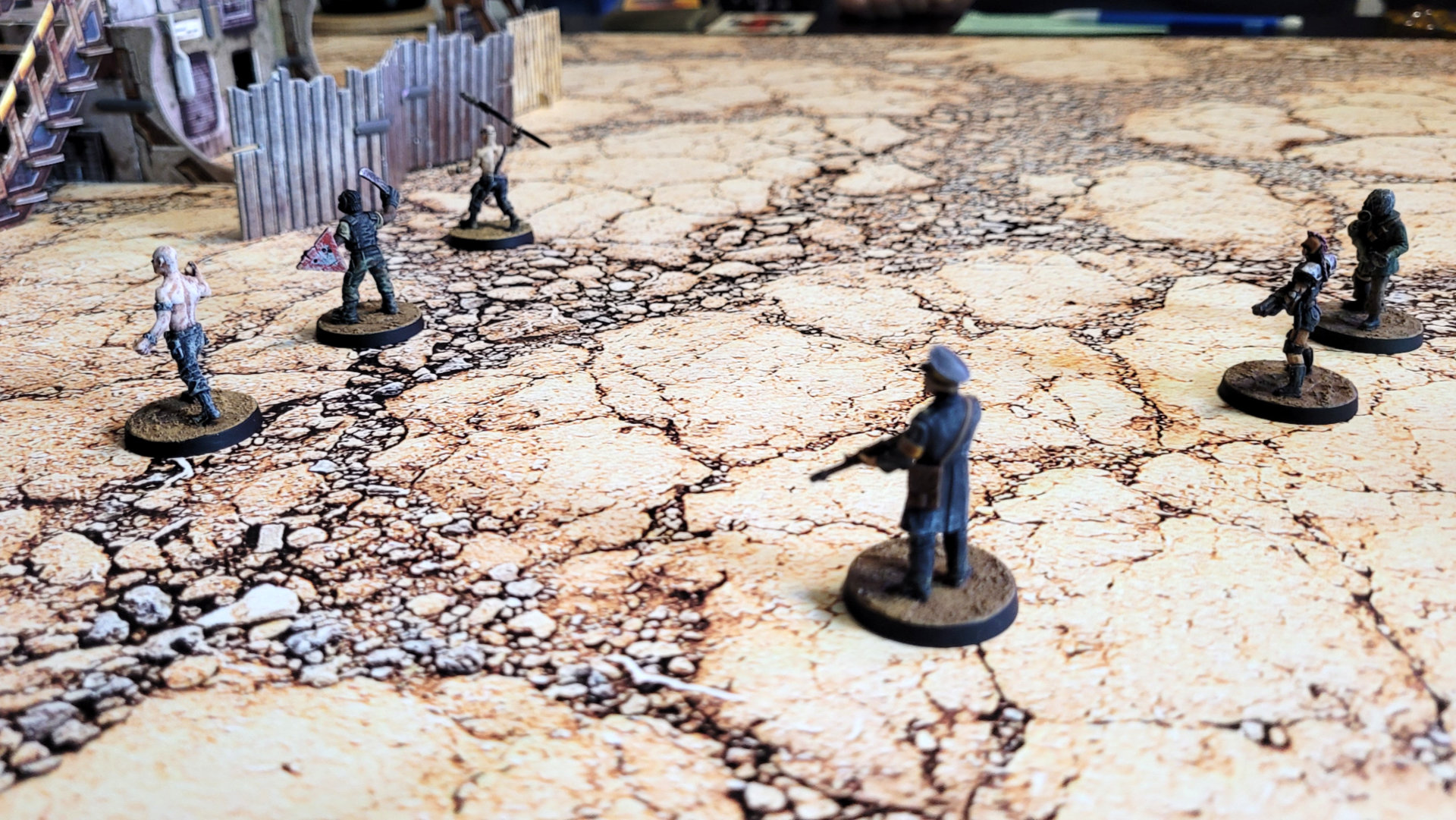 The hordes just keep on coming...
The only issue we had with the game was that the turns, and therefore the time limit, were very random and arbitrary, and the game ended in a somewhat abrupt and unsatisfying manner. After drawing a card each for initiative, the acting player draws another card, which tells them how many action points they have to use, with moving and shooting costing one point each, and additional moves costing 3 or 5 more points. Once all the points are spent the other player draws a card for their action points, and they go back and forth until someone draws a joker, which immediately ends the round.
At the end of each round, the defending player draws a card and sets it aside — when these set aside cards add up to 30, the game is over. This means that the game could end in at few as three rounds. Our game came to an abrupt halt after five, just as things were getting interesting. We decided to play on for a few more rounds, but the scenario doesn’t work without a set time limit. We could try increasing that total to 40 or even 50, but that could extend the game to 10 rounds or more, which would probably be too much. I get that you don’t want to know exactly when the game is going to end, but the timer needs to be a little less random to ensure that the game goes long enough to be interesting but not so long that it becomes a slog.
All in all, One-Hour Skirmish Wargames was an interesting, if light, rules set that I might consider using again if I have a specific scenario in mind. It’s generic enough to accommodate any genre or time period, which is both a strength and a weakness — without a specific setting to back it up, it really relies on games being designed around interesting scenarios. That said, I do want to try the pulp scenario, maybe with some of my recently painted Doctor Who models…
Conclusions
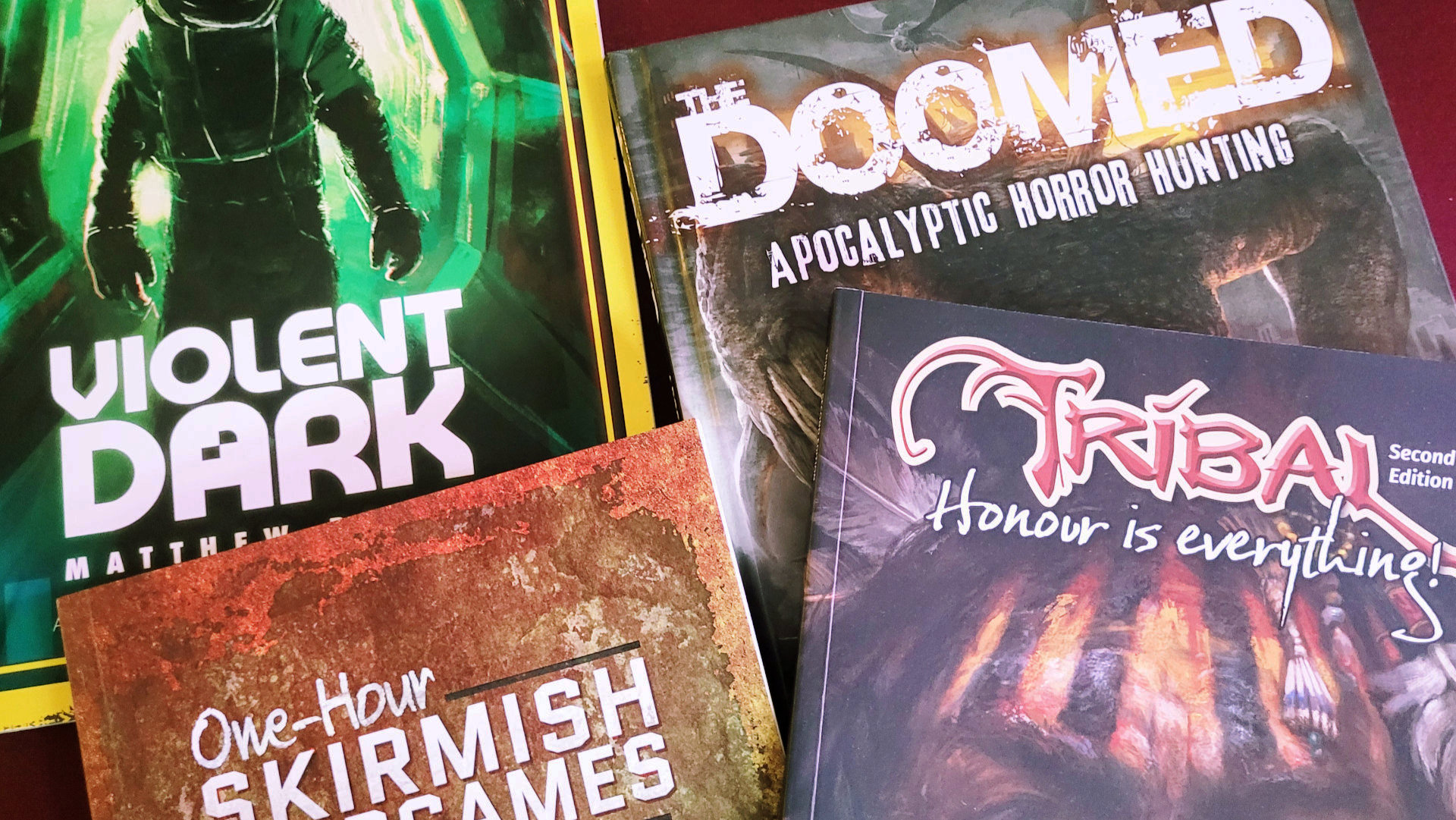
Thanks to the Spring Clean Challenge nudging me along, I was able to play all four of the games that had until now been sitting on my shelf unplayed, so we’ll call that a victory for sure. I enjoyed some games more than others, but none of them were bad and each had a unique feature or mechanism to offer.
Although it was the most fiddly, I think Violent Dark was my favorite of the four. It was very focused on a specific theme and mood, and I think that was to its benefit. In the past I’ve always had an eye out for a good generic system that I could use with multiple genres and sets of models, mainly so I wouldn’t have to keep learning new rules sets, but I now stand convinced that the best rules are going to be tailored to the specific setting and genre you want to play out on the table top.
Tribal was the winner in terms of raw mechanics. Its card-based system for moving, fighting and even generating in-game objectives was very engaging. What it lacked was personality — there aren’t really specific factions with different play styles, just a list of skills and abilities that every model has access to, and the period of history the game wants to evoke is very broad, asking the players to supply immersive details for themselves. My objective with Tribal was as a potential alternate rules set for Savage Core, so if I want to continue with that I’ll need to work out ways to import Savage Core‘s abundance of personality.
One-Hour Skirmish Wargames has potential if I want to play out a specific scenario, which I believe is the game’s intent from the start. It might be another possibility as an alternate set of movement and combat rules to try to drop into other games, especially if the goal is to reduce the frustration caused by egregious dice rolling…
I didn’t really care for the game mechanisms in The Doomed, but its system for generating game objectives and NPCs is great. I loved the use of competitive objectives combined with, but separate from, a non-player threat that may force the players to temporarily join forces while they deal with the bigger problem. The ability to tailor the style of game by choosing to play with a conflict OR a threat OR both should make for a lot of variety, and I don’t see why this couldn’t be adapted to serve another game system (perhaps even one of those mentioned above).
I’ll definitely be playing Violent Dark and Tribal again if I can squeeze them into my crowded gaming schedule, and I may well look at swiping some of the conflict and NPC threat ideas from The Doomed. I’m not sure about One-Hour Skirmish Wargames — I do think it has potential, but scenarios for it will need to be crafted with some care and I’m not sure if I have the bandwidth for that.