










DARKSTAR CAMPAIGN UPDATE: DUCHESS ANNABEL’S WAR IS OVER




Recommendations: 3619
About the Project
The year is 2512.
The powers that remain on an ecologically-devastated and plague-ravaged Earth have been forced to look to the stars for the resources, capital, and room not only to expand, but to survive. While the setbacks encountered by mankind over the past 500 years have forced him to unite in a shaky global coalition and make fantastic strides in technology, they have also caused seismic and reactionary shifts in religion, culture, and politics. A second age of imperialism has dawned, and because man would never survive another war on the fragile remains of planet Earth, he is forced to ply his oldest trade ... war ... exclusively among the stars.
Darkstar is a tactical war game postulating naval combat in a “science faction” universe set five centuries into a troubled and uncertain future. Players take command of warships serving in the new “black water” navies of reborn empires of old, struggling for control of shipping lanes, resources, and colonies. Ships maneuver and fire in fast-paced combat, with survival not only of the players’ fleets at stake, but perhaps their nation and all of humanity as well.
Related Genre: Science Fiction
This Project is Active
Darkstar - Table Pics 02
Playtesting new Heavy Cruiser Class and veteran USS Oriskany (DSGN-791) against Heavy Cruiser Task Force
Three turns in, and so far my little Japanese-American alliance battlegroup is doing great.
With Enhanced Sublight, my ships have +1 thrust each turn and with Starship Tactics, they have a +2 to initiative. Long story short, we were able to get close-range broadsides with both my heavy cruiser IJN Naginata and destroyer USS Oriskany across the British heavy cruiser’s stern, a prime location.
Note the damage tracks digging deep through HMS Kraken’s engines, reactors, and even core. She’s crippled, out of the game and set adrift on her last heading and velocity (pro tip, never end your turn pointing toward a planet if you can possibly help it – it’s a fast way to lose a ship if you’re crippled).
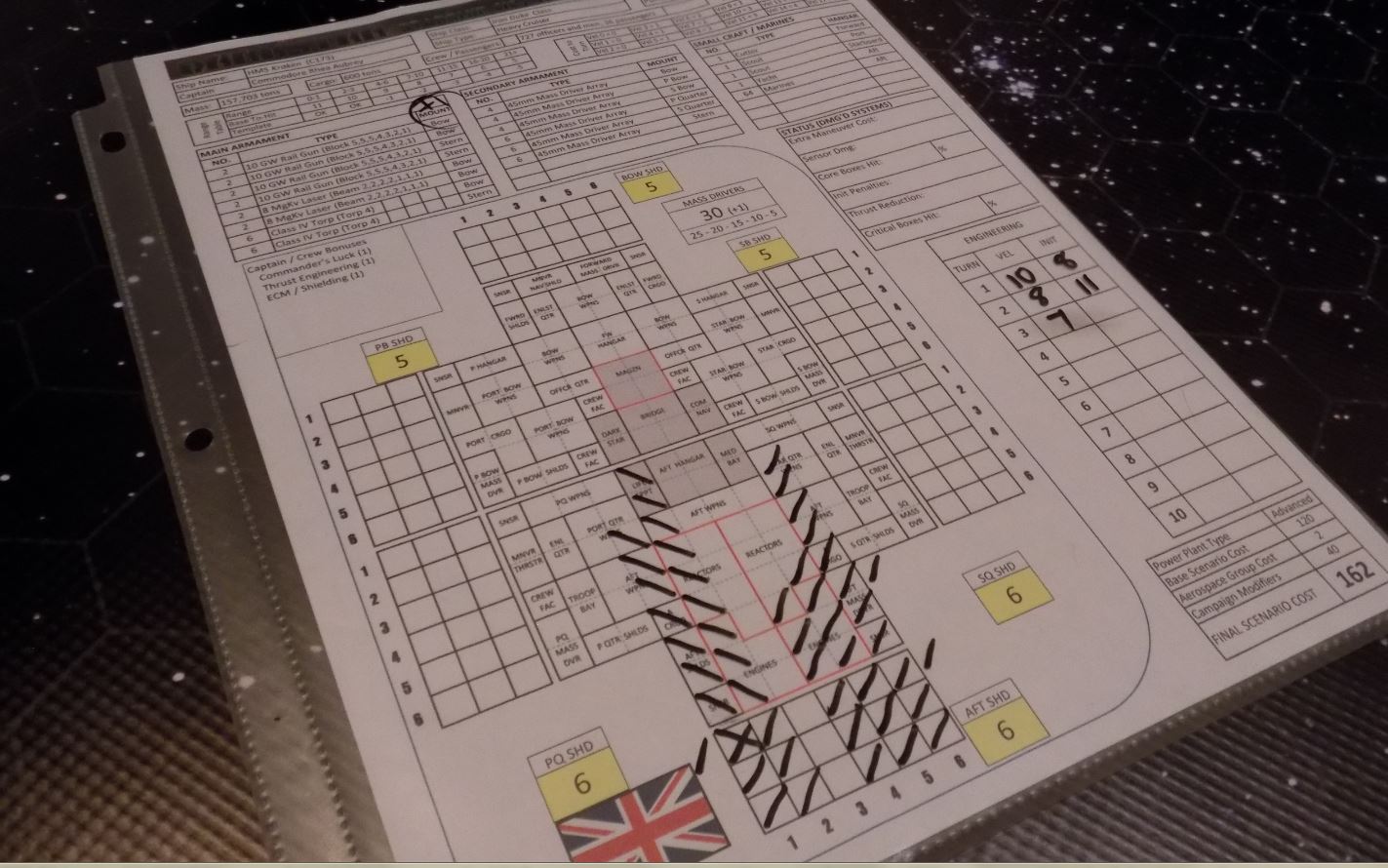
Here’s the shot where Nagainata was able to cripple the Kraken. Note where the Japanese cruiser is presenting a broadside right across the British cruiser’s stern. This is an extremely deadly maneuver, and not easy to pull off. Basically, you have to get very lucky with your initiative or catch your opponent napping. In this case I kind of kind both.
I do have to correct myself in the previous panel – by the looks of this photo USS Oriskany was not in this killing salvo on HMS Kraken, although I do remember contributing some torpedoes to this fire phase. So Oriskany did help with this, but not with gunnery.

Although @gladesrunner has clearly lost this game (HMS Kraken) is down and that frigate went up like a string of Chinese firecrackers in the very first fire phase, goddamn is this new heavy cruiser powerful), she keeps her chin up and keeps it from turning into a rout.
This is especially important as it’s a playtest of the game’s point balance. If the game really is a rout, then I have to go back to the drawing board and tweak some of these campaign upgrades …
But she’s fighting back. USS Oriskany has since been crippled by return fire from the Kraken. Fire is simultaneous in this game, so in the same turn Naginata was tearing apart Kraken’s stern, Kraken was also doing the same to the Oriskany.
Although crippled, the Oriskany will live to fight again. things saved her life. One. she has double-upgraded ECM and Gravitic Shielding. Two, the range is longer. And three, only forward guns of the Kraken fired on her, the Kraken’s aft turrets were firing point blank against the Naginata.
Anyway, the game is now down to just the Naginata and @gladesrunner’s remaining light cruiser, the Relentless class light cruiser HMS Requiem. The Requiem has put a broadside across Naginata’s stern, not to mention some previous torpedoes from the Kraken. So when Naginata loses initiative on Turn 6, she parks her stern “against the moon” in an attempt to protect her damaged fantail from more of Requiem’s rail guns and deep-cutting lasers.
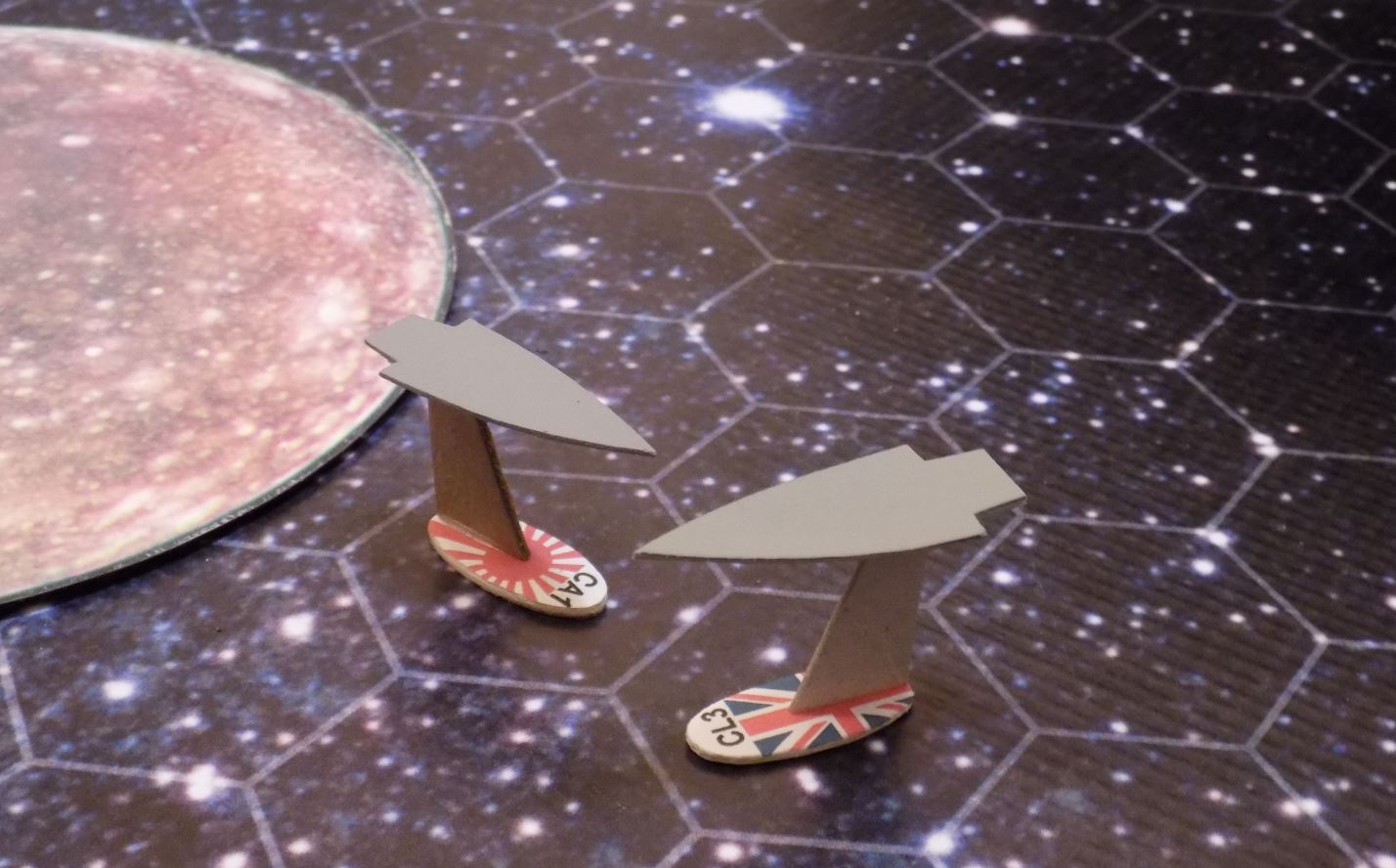
The Requiem finally goes down, not through lack of speed, bravery, or maneuverability … just the Naginata (a 200-point heavy cruiser) is just too damned powerful for a 102-point light cruiser (smaller ship, much few campaign upgrades). Honestly once the Kraken went down, this game was up.
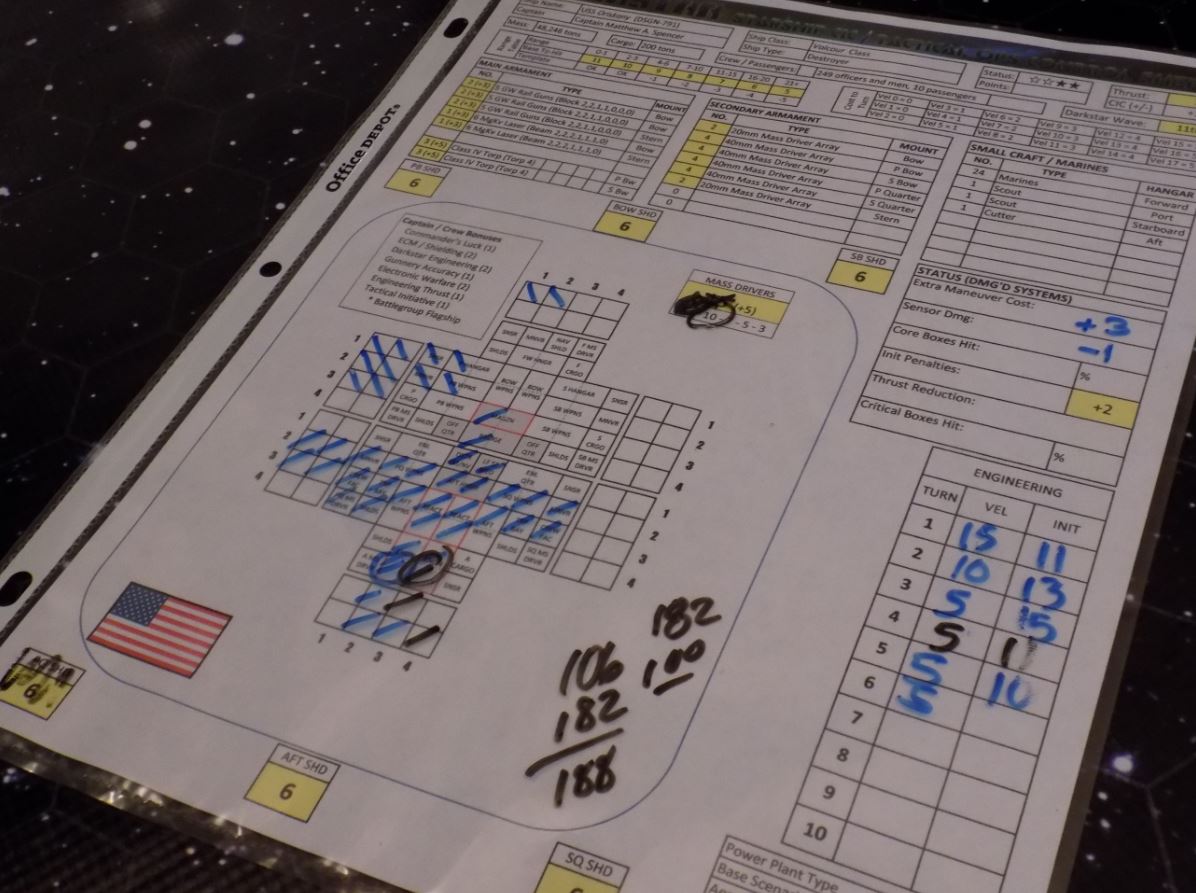
But the game felt very well balanced. We played it again after this and the British did much better. This time the Oriskany really got the $h*t shot out of her, as in she legitimately almost died. Here’s her damage sheet from the second game:
Both port and starboard engines, gone. Port and starboard reactors, gone. Her point defense mass drivers have been hit twice. She’s lost three maneuvering thrusters, resulting in a +2 thrust cost to make any turns at all or even roll over on her back (a useful maneuver to screen damaged armor or present fresh batteries / torpedo spreads) Port quarter shields are gone. Magazine’s been hit. Bridge has been hit, the captain has been wounded and will have to roll to survive. Sensors have been damaged, she’s lost her aft 5gw rail gun turret …
The whole ship could have actually exploded on the spot, there was a 40% chance based on the damage sustained to critical systems (engines, reactors, magazines).
THAT was a nail-biter of a roll, I can assure you of that. I’ve played this ship on and off for six years, if I lost her now I think I would physically cry.
Also, if we were playing a campaign game, she’d need 45 days in dry dock (30 internal boxes hit = 30- days, +50% for being crippled / towing time) – plus whatever time it took to transit to nearest friendly port (again, FTL travel time in this setting is strictly limited).
Darkstar - Table Pics
Playtesting new Heavy Cruiser Class and veteran USS Oriskany (DSGN-791) against Heavy Cruiser Task Force
Good morning all ~
Okay, so to supplement the “virtual game table” pics and battle reports in in previous posts, here are some pics of live “Darkstar” tabletop play we’ve had with community members @gladesrunner and @aras.
I apologize for the quality of some of these pics – the game mat I bought wasn’t quite the quality I expected, it’s pretty glossy and thus very hard to photograph well with a digital camera.
So the first game is to playtest a newly-designed Japanese heavy cruiser, the Katana class (all ships in this class named for ancient Japanese hand weapons, obviously). A smidge of backstory:
One of my most veteran starships, the sleek and sexy Japanese light cruiser Sendai (Taiho class) has recently been destroyed outright in a battle.
I wept, I raged, I drank my way through the five stages of grief.
Anyway, the captain of that ship made her survival roll and so now needs a new ship. Ironically, she’s accrued enough campaign points to earn a promotion (even though she just lost a ship), so I’m comforting myself through the grieving process by designing and playtesting this captain’s new and even better warship, the heavy cruiser Naginata.
The thing is, captains taking command of new ships (either surviving ship destruction or just transferring from one ship to another) get to keep the campaign upgrades they’ve purchased so far. Not all upgrades effect tactical tabletop game play, but those that do increase the scenario point cost of the ship. These new Katana class cruisers are friggin’ expensive as it is, and when this ridiculously high-powered captain takes command (and her command bonuses are all applied to the new ship design’s base cost) … well, this heavy cruiser winds up costing more than some pocket battleships or battlecruisers.
It’s time to see if these new points stack up. So she and another ridiculously-upgraded ship (i.e., I should really retire this ship and her captain) – which just happens to be named USS Oriskany (DSGN-791, Valcour class destroyer, see posts below) head out in a scrimmage game to see if they can take on a much larger, but more normally-experienced force of British warships.
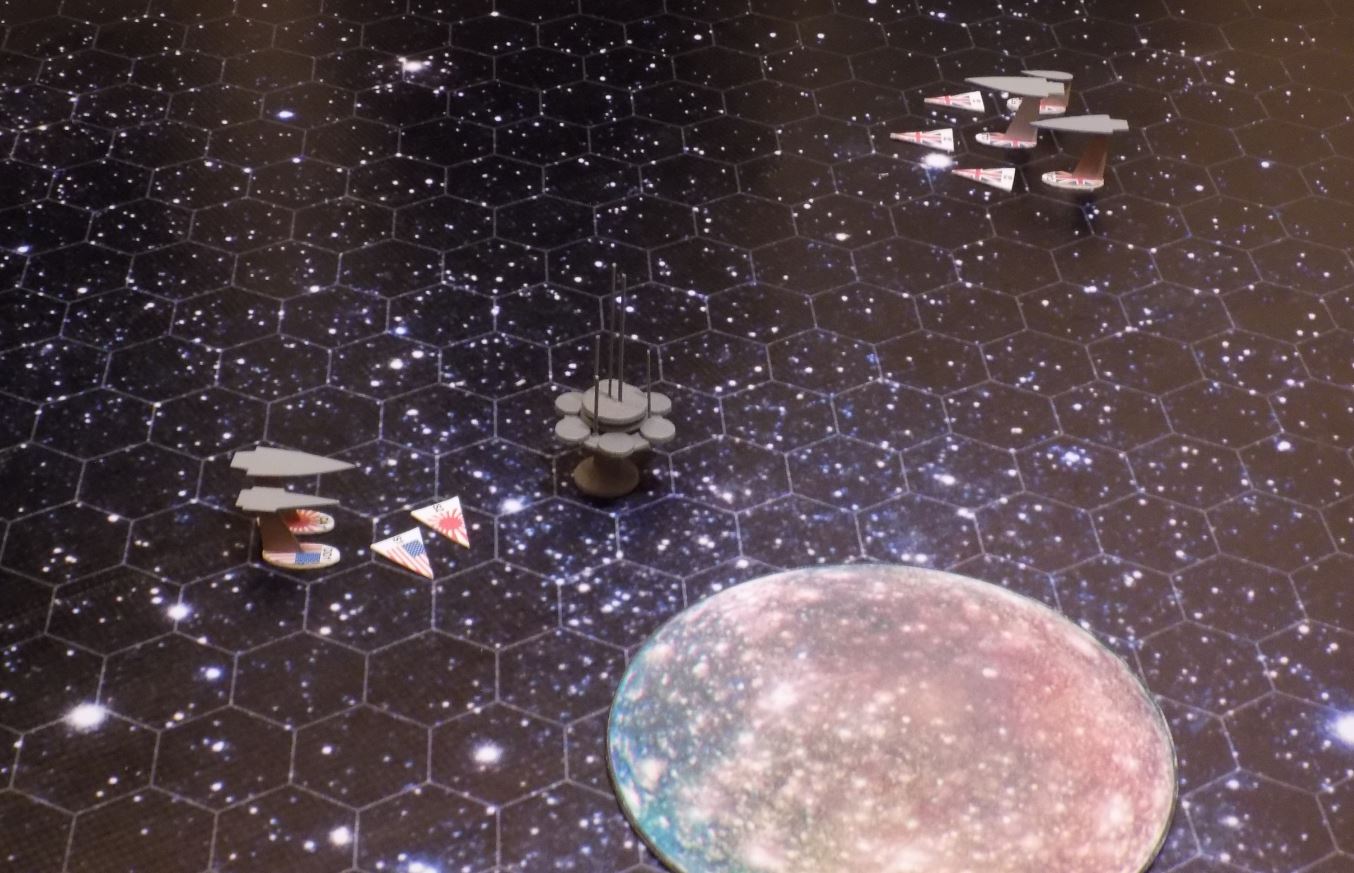
The idea is to ensure the campaign upgrades are not over- or under-powered for their increasingly exorbitant point costs … and test whether the “asymmetrical” aspect of this game design is actually balanced.Picture One – the battle space
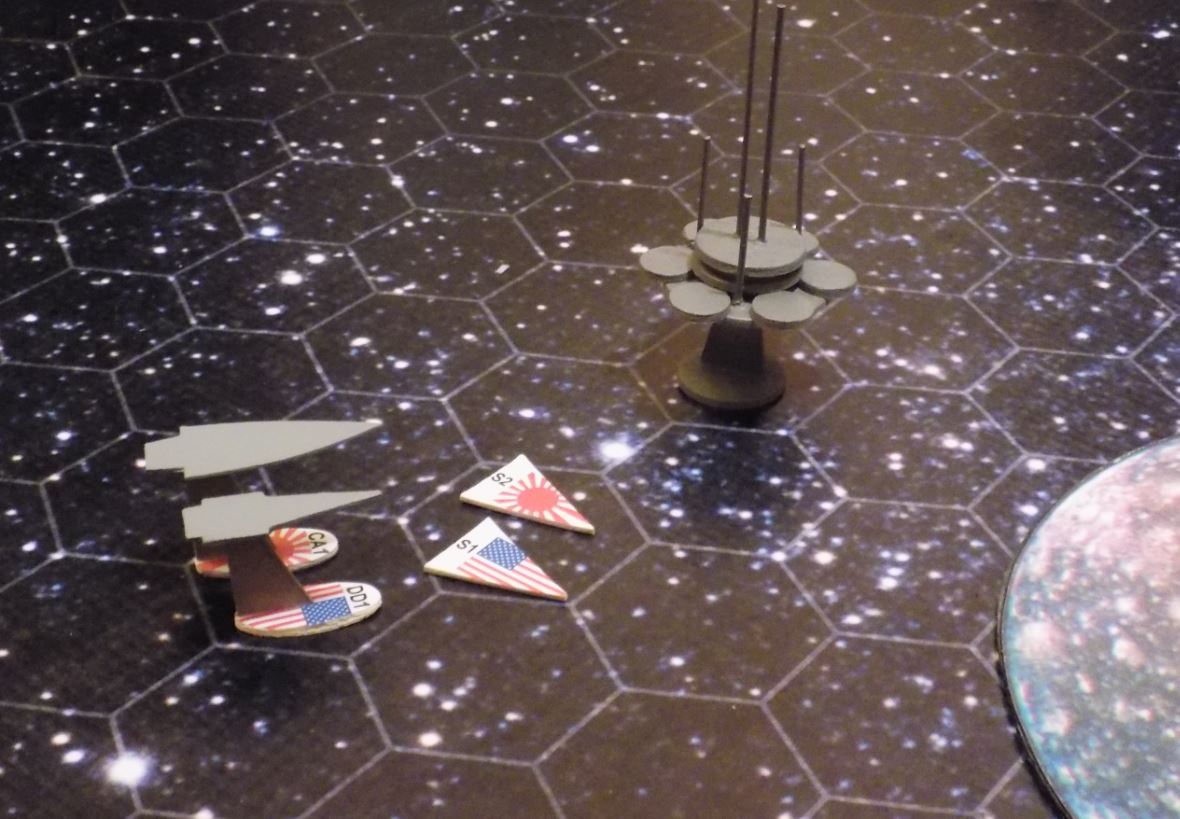
Picture One – the battle space
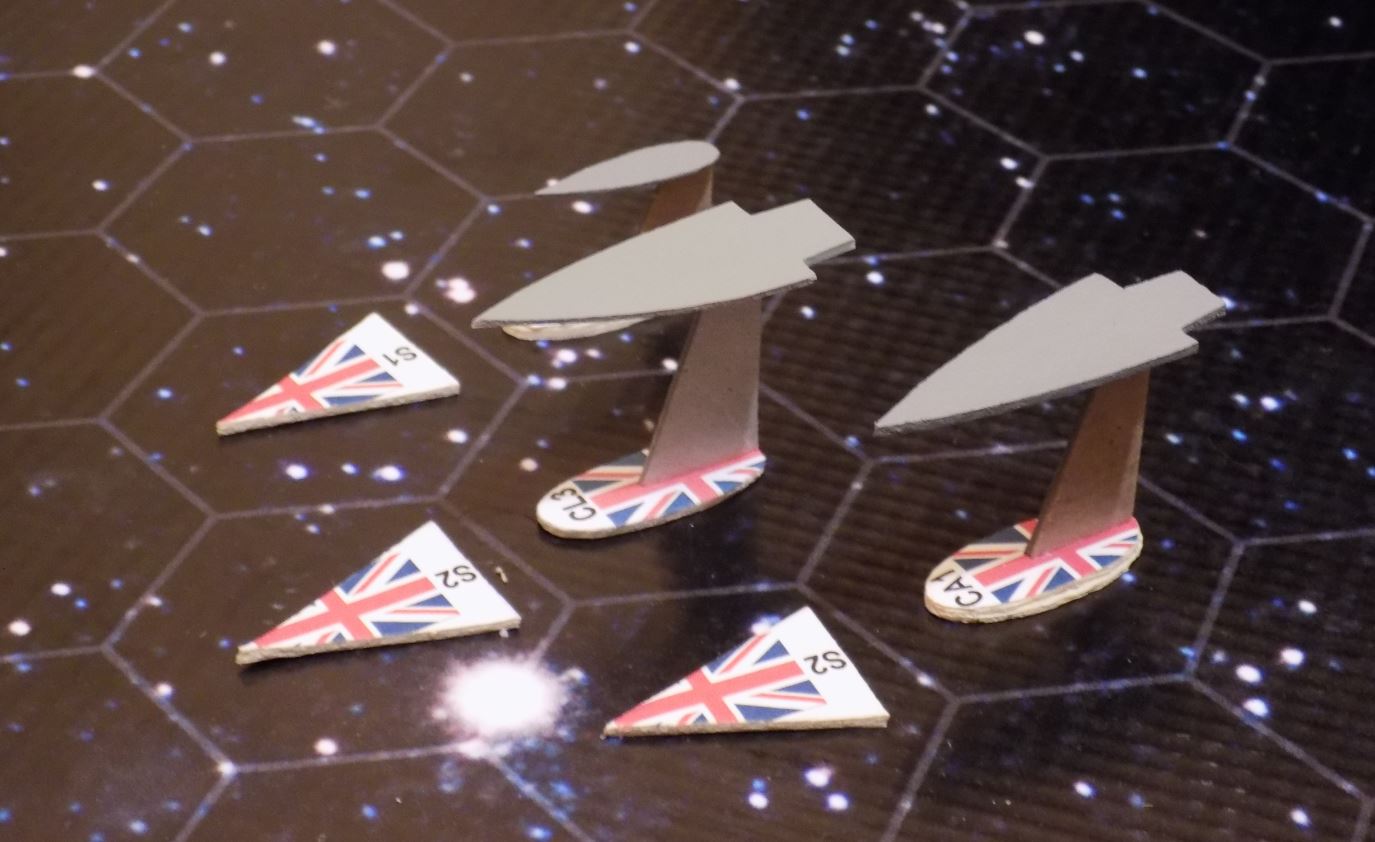
Picture Two – the Japanese-American allies
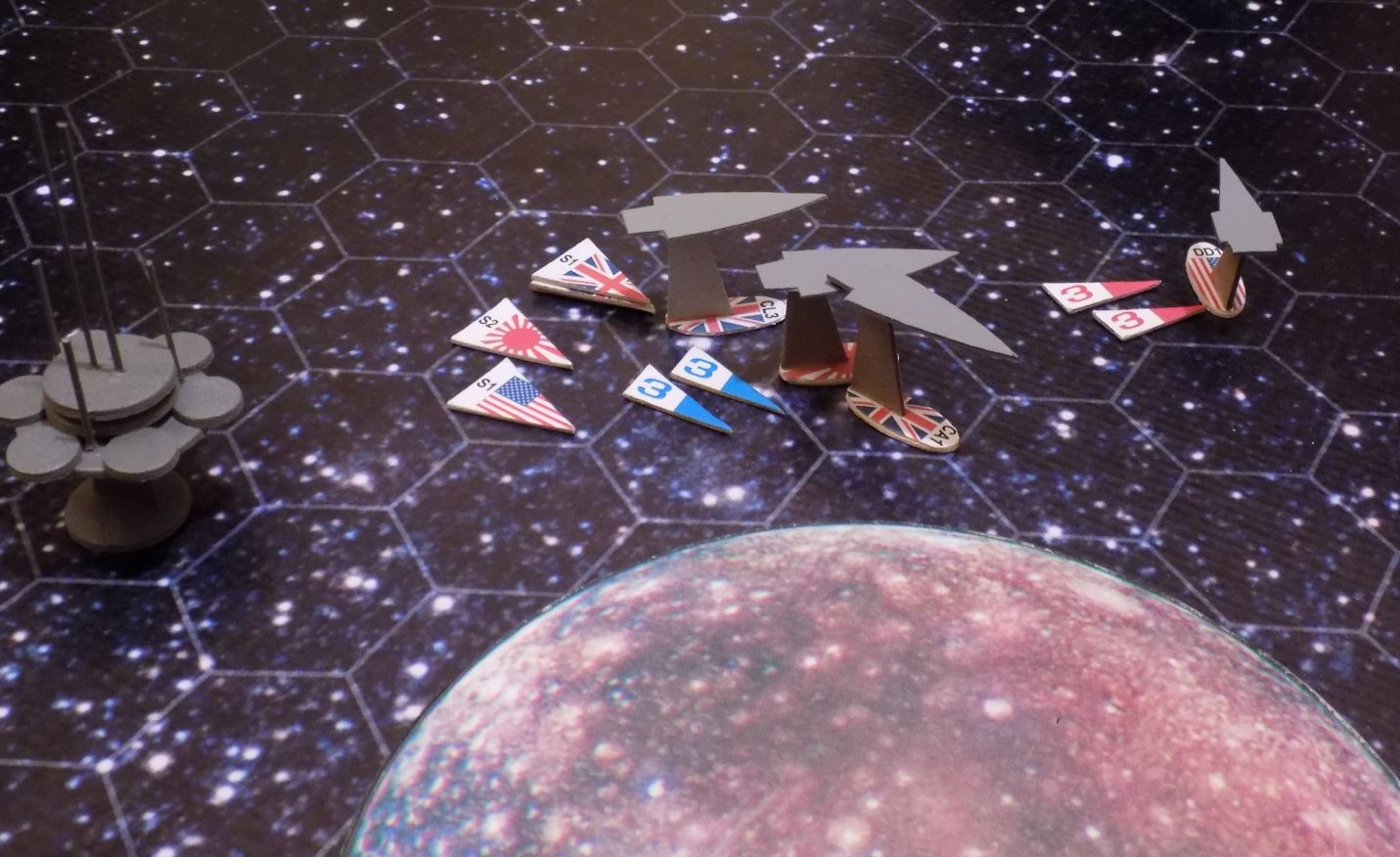
Picture Three – a British heavy cruiser (CA), light cruiser, and a frigate (behind)
Picture Four – the battle begins.
Darkstar Warship Design: Kutusov Class Light Cruiser
 Named for famous field marshals and admirals of Russian and Soviet history, the Kutuzov class of light cruiser represents a new step forward in the Holy Russian Navy, an attempt to break with old gun-heavy designs like the Slava, Sovnya, and Peter the Great. Instead the Kutuzov mounts entirely particle-based weaponry. Among these armaments is a formidable array of new RSA Molniya 550 (Lightning) model electron particle cannons, easily capable of stripping a destroyer bare of armor with a single volley at up to a thousand kilometers if fired from a full broadside. But even these mounts are only meant to support the Kutuzov’s true weaponry, four immense Tunguska Arms 790A 40-kilogram thorium plasma projectors, mounted in two double turrets. Combined with the EPCs, these give the Kutuzov a truly hellish punch at close range. Any captains who come up against one of these warships is best advised to try and keep the engagement ranges as long as possible. For all its strength, however, the Kutuzov of course has weaknesses as well. Shielding and speed are only adequate, and the Bozhorshkin Electronics sensor and targeting suite is hardly top of the line. The torpedo array is also a little dated, although with eight tubes in a forward spread, the Kutuzov is almost guaranteed to hit with at least one of them. In all, the Kutuzov is a robust, pragmatic, and well-balanced design. In its weaker aspects it is unspectacular without being poor, but its firepower makes it a frightening contender for its class, particularly at close range. Eighteen units of the class have been built so far, with a slightly modernized variant on the drawing boards. They have seen combat in at least three Strategic Command Sectors, where they have earned the respect of friend and foe alike.
Mass: 109,220 tons
Complement: 458 officers and men
Marines: 32
Passengers: 16
Sublight thrust: 5
Darkstar Wave: 10th (x300 c)
Aerospace: (2) scouts, (1) 1,200-ton cutter, (1) 4,000 ton yacht
ECM & Gravitic Shielding:
Bow: 4
P Bow: 4
S Bow: 4
P Quarter: 4
S Quarter: 4
Stern: 5
Armament:
Turret – x2 40-kilogram plasma projectors (bow)
Turret – x2 40-kilogram plasma projectors (stern)
Turret – x2 12-teravolt electron particle cannons (bow)
Turret – x2 12-teravolt electron particle cannons (bow)
Turret – x2 12-teravolt electron particle cannons (stern)
Turret – x2 12-teravolt electron particle cannons (stern)
Rack – x4 Class III gravitic torpedoes (p bow)
Rack – x4 Class III gravitic torpedoes (s bow)
Turret – x3 35mm mass driver point defense array (bow)
Turret – x4 35mm mass driver point defense array (p bow)
Turret – x4 35mm mass driver point defense array (s bow)
Turret – x4 35mm mass driver point defense array (p quarter)
Turret – x4 35mm mass driver point defense array (s quarter)
Turret – x6 35mm mass driver point defense array (stern)
Ships in Class:
261 CRK Kutuzov
262 CRK Suvorov
263 CRK Golovin
264 CRK Sheremetev
265 CRK Menshikov
266 CRK Potempkin
267 CRK Chernyshyov
268 CRK Chichagov
269 CRK Istomin
270 CRK Lazarev
271 CRK Makharov
272 CRK Nakhimov
273 CRK Ushakov
274 CRK Senyavin
275 CRK Zmajevic
276 CRK Spiridov
277 CRK Chernavin
278 CRK Gorshkov
Darkstar - Sample Battle Report
Outer System Skirmish
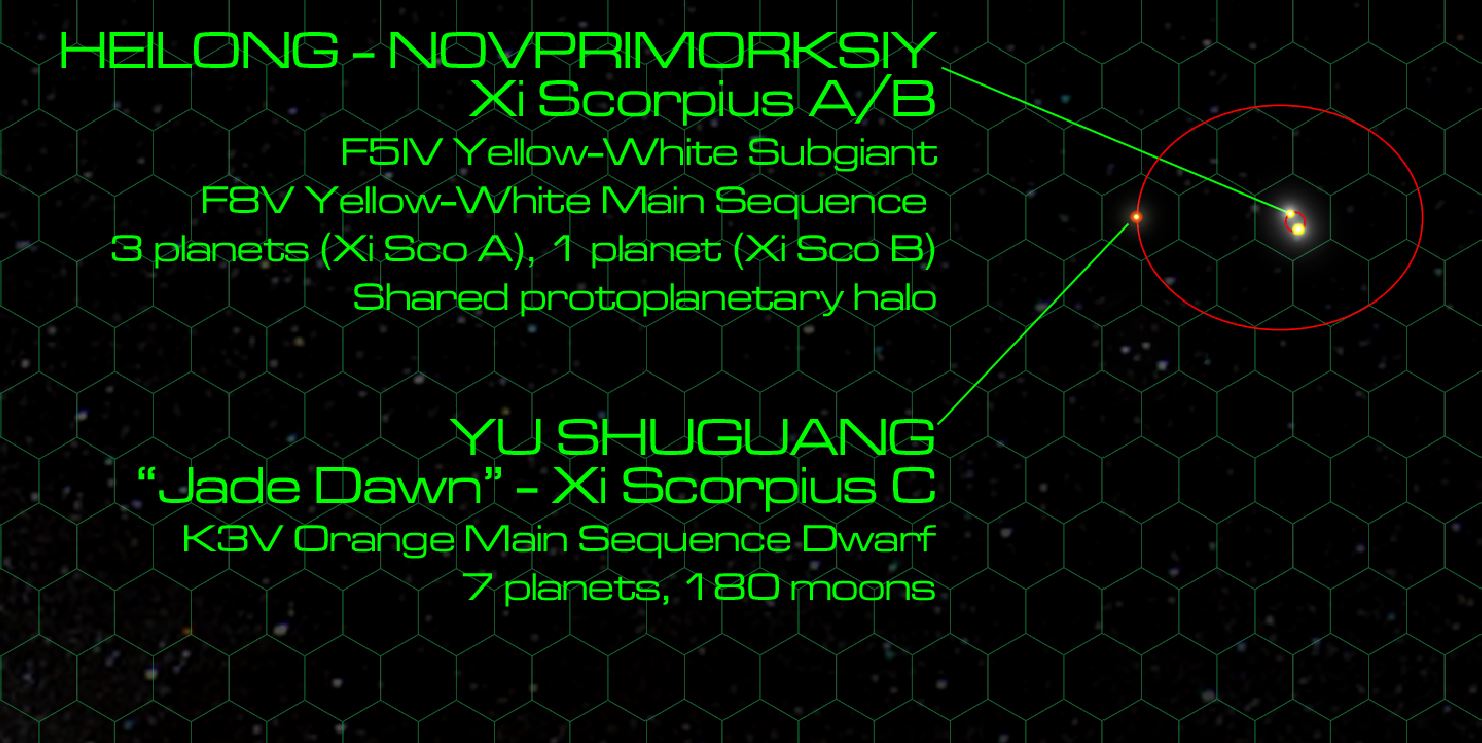
Suji’s Refuge – Jade Dawn Star System (Xi Scorpio C)
Xi Scorpio War, 24 January 2518
The Xi Scorpio War has raged on now for a little over a year.
After an initial bloodbath breaking into the Xi Scorpio stellar group at the Battle of Kitami Shima, the “Pacific Alliance” (Japanese-American naval task force) has steadily beaten back the “Black Dragons” of the Khitan-Tunguska Free State, planet by planet, system by system. Although they have liberated the “Flower of Hokkaido” colony in Xi Scorpio D (the rare and precious Earth analog planet that everyone’s fighting over), the Pacific Alliance now pushes into the Black Dragon colonies (in fact, originally Chinese and Russian colonies) of Jade Dawn (Xi Scorpio C) and Heilong-Novopromorskiy (Xi Scorpio A/B) to ensure the Black Dragon threat never reemerges .
One of the war’s recent turning points was at the horrific Battle of Tamakura, near a Galilean moon of the Tamakura gas giant of the Xi Scoprio D system. Although the Pacific Alliance won that battle, both fleets took tremendous damage, with heavier units expected to be in dry dock for weeks if not months. As a result, the Pacific Alliance can only maintain the pressure on the beaten Black Dragons with a small destroyer task force built around the destroyer USS Oriskany. This sets up a series of small skirmishes in the Jade Dawn star system among destroyers, frigates, and the occasional light cruiser, one of which is presented here.
BACKGROUND:
While the Oriskany and Princeton are engaged at Kosyang 71 (moons of another nearby gas giant in Xi Scorpio C), Commander Raymond Cruz (aboard the newly-arrived U.S. Marine Corps Buford-class light carrier/aerospace assault ship USS Tarawa) is slinking around the rim of the Jade Dawn star system. His mission is to secure a lodgment somewhere on the far side. Escorting him is the “hardest working tin can in the U.S. Navy”, the Valcour-class destroyer USS Valley Forge under Commander Garrison Heathe.
“Ghosting” around the edge of the star system in a series of first-magnitude Darkstar waves (excruciatingly slow but quiet and almost impossible to detect), the Tarawa and Valley Forge use the star’s gravity to curve their trajectory. They creep around the system’s spinward edge, staying just inside the Kuiper Belt until they approach a series of rocky planetoids known as Suji’s Refuge. These are the remains of a large terrestrial moon once in orbit of an outer gas giant, turn to shreds by gravitational tides and left to drift along the system’s cold outreaches.
Also in Suji’s Refuge, however, is a small supply and surveillance installation of the Khitan-Tunguska Free State. Not picking up on the automated beacon’s passive sensors, the Tarawa and Valley Forge are soon detected and by the end of their third day on station, the Americans are being approached by a small but powerful Black Dragon battlegroup.
This force is made up of three of their oldest “friends” in the Xi Scorpio War, the Russian-built Novgorod frigate Malayslovets, the old Chinese Nanchong class missile destroyer Huangdi, and their flagship, the Xhia-class light missile cruiser Meikang, a veteran of the Xi Scorpio War from as far back as the very first battle at Kitami Shima.
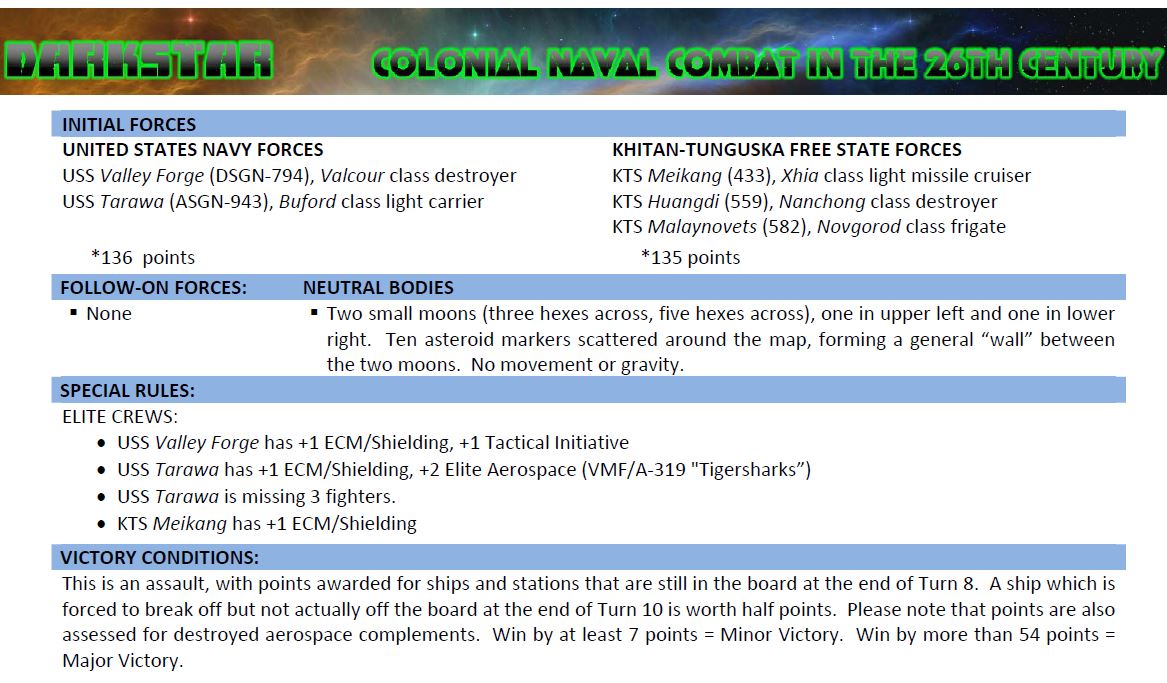
The Americans accelerate to approach the Black Dragons but keep their approach slow, in no hurry to engage the Meikang battlegroup and the vastly superior gunnery. As the Tarawa begins launching her aerospace group (the elite U.S. Marine Corps squadron, VMF/A-391, the Tigersharks), the Black Dragons are screaming in at an insane speed of almost 50 kps. The Americans spot the Huangdi first, so Cruz is able to duck his two ships behind drifting KBOs to screen themselves from immediate torpedo lock. This also means that while both American warships can see acquire Black Dragon targets and fire full torpedo spreads, only some of the Black Dragons can do the same back at them. Hopefully this will equalize the some of the Americans’ disadvantage in numbers and firepower.
But the veteran Meikang, a nemesis from all the way back to Kitami Shima, sees this move and deftly skirts around the debris, the Malaynovets tucked tight into her wake. The Black Dragons loose a massive torpedo wave. The Americans fire off a spread as well, then turn on their wakes and hairpin turn away.
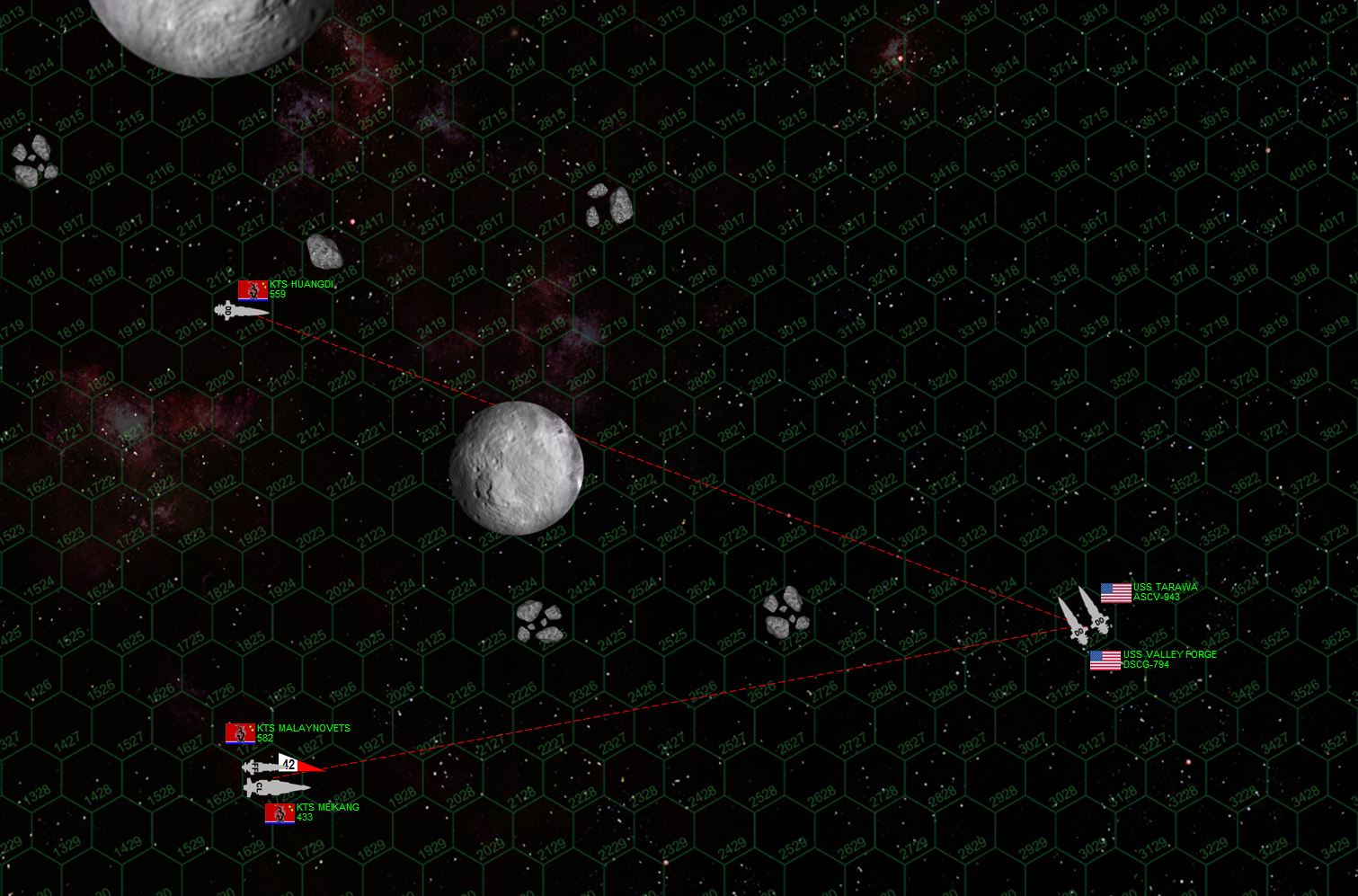
Things start off well for Cruz’s battlegroup . . . two of these American Mark 48 gravitic torpedoes hit the frigate Malaynovets, one from the Tarawa and one from the Valley Forge. Lucky strikes on the port bow touch off the forward magazine and the little Malaynovets is soon crippled and adrift in space. Meanwhile the slower Black Dragon torpedoes still haven’t hit and the Tarawa has all her Marine F/S-44 “Corsair” fighters and F/A-81 “Avenger” torpedo-bombers launched.
Despite the Americans striving to keep their distance, Black Dragon gunnery soon has the range on the Valley Forge, and a few heavy 7-gigawatt rail gun hits are scored on her fo’c’sle. The Meikang and Huangdi press through the drifting “asteroid wall,” and finally there is no more cover for the Americans. Cruz keeps pivoting back, to keep the range open as long as possible, but the Valley Forge is sluggish due to its jarring hits. The Meikang and Huangdi line up for a perfect 1400 km broadside – and torpedoes – 52 of them – slam into the Valley Forge even as she fires on the Huangdi. Marine “Hawkeye” scouts shoot down one torpedo, and mass drivers shoot down ten more . . . but the rest hit the shields and one actually gets through. The barrage of 7-gigawatt rail guns that immediately follow from the Meikang is worse, along with the 30kg plasma jets from the Huangdi. The whole front end of the Valley Forge is basically sheared off, including a jarring explosion of the forward magazine, torpedo bays, and scout ship bays. Personnel losses are heavy, and the Valley Forge is crippled and adrift, burning in space.
Meanwhile, the Marine pilots of VMF/A-391 loose their ordinance at the Black Dragons. They have lined up a perfect strike straight at the stern of the Meikang, coordinating with a second spread or torpedoes from the Tarawa. The Black Dragons have shot down all the Mark 48s, which means the Meikang’s enhanced ECM and shielding suite can only take so much, and five ASM-56 Harpoon torpedoes, along with four ASM-92 Hellfire missiles, hit the hull. The Meikang is blown out of the battle, her two centerline engines are completely blasted out of the hull, the starboard reactor shuts down, the bridge implodes in a decompression, one of the ship’s magazines go up . . .
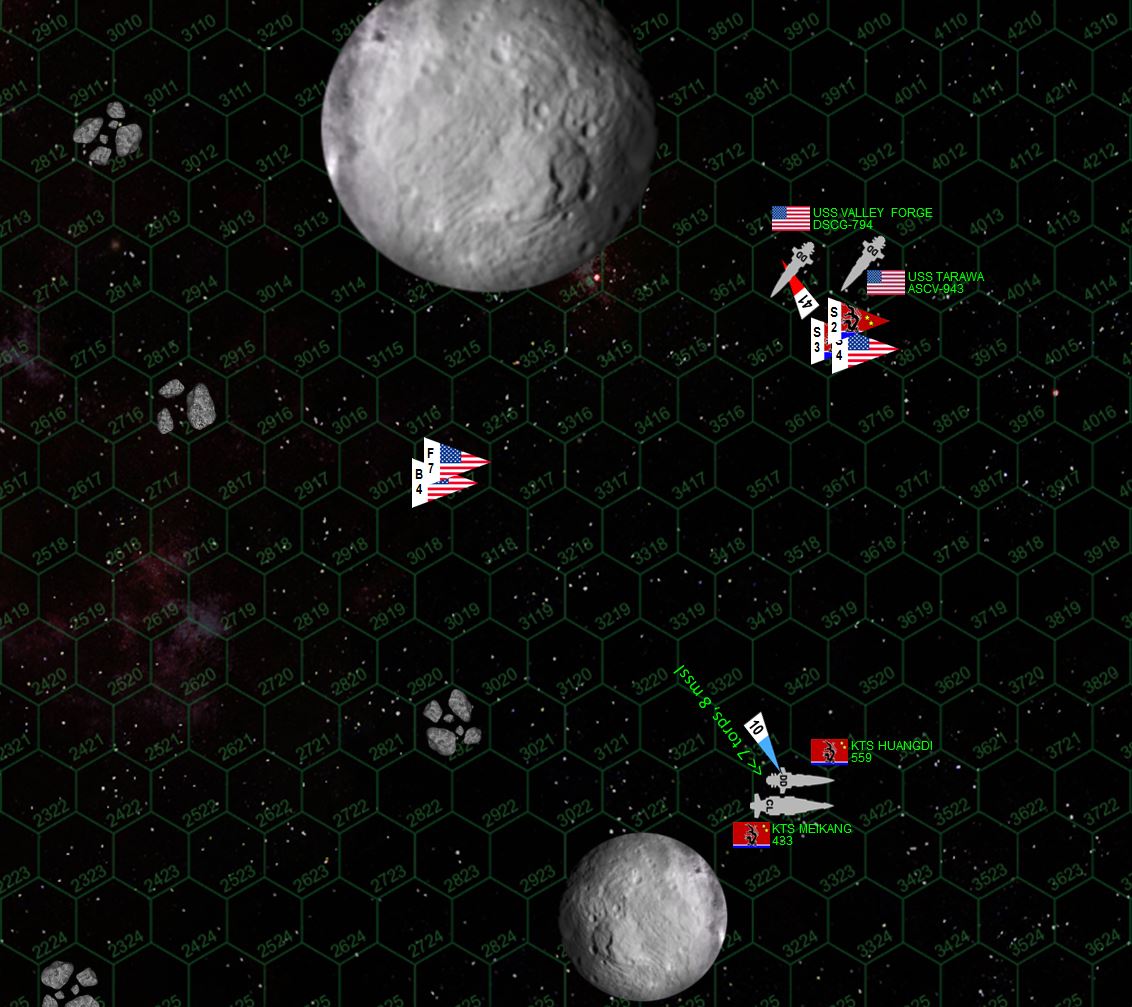
The Tarawa turns on her wake and heads away, not eager for a gunnery duel with a vengeful Black Dragon destroyer. The Huangdi pursues, slinging out more torpedoes. The Tigersharks fall in behind her for a gunnery run, intercepted by Black Dragon scout planes. One Avenger is shot down, and three Marine Corsairs are shot down by Huangdi’s mass drivers. The Tigersharks’ gunnery run doesn’t knock out the Huangdi, but causes critical damage to her aft sections, especially her stern shielding, sensors, and aft weapons.
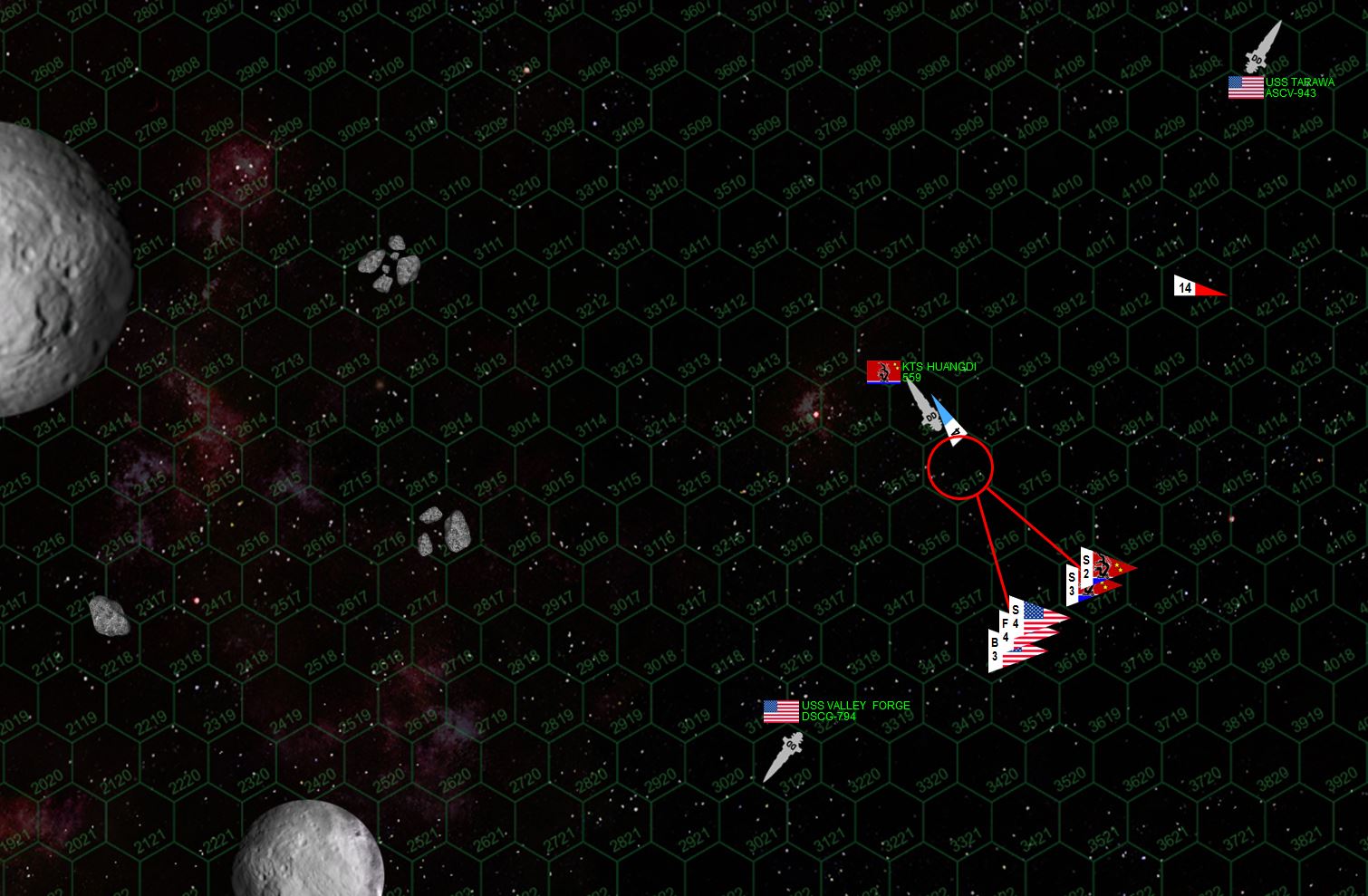
Cruz realizes the Huangdi has no aft weapons or shields, so will probably try to keep her bow pointed at the Tarawa. Judging by Huangdi’s vector and velocity, he’s able to turn the Tarawa again on her heel and have her forward torpedo tubes ready to engage where the Huangdi will be. Sure enough, the Huangdi veers right where expected, and Tarawa looses four more torpedoes. Two of Huangdi’s torpedoes hit Tarawa in turn, damaging sensors and maneuvering thrusters, but the Tarawa’s return strike, especially a second gunnery run by the bloodied Marine Tigersharks, take out Huangdi’s port engines and damage port reactor. She loses power and is set adrift.
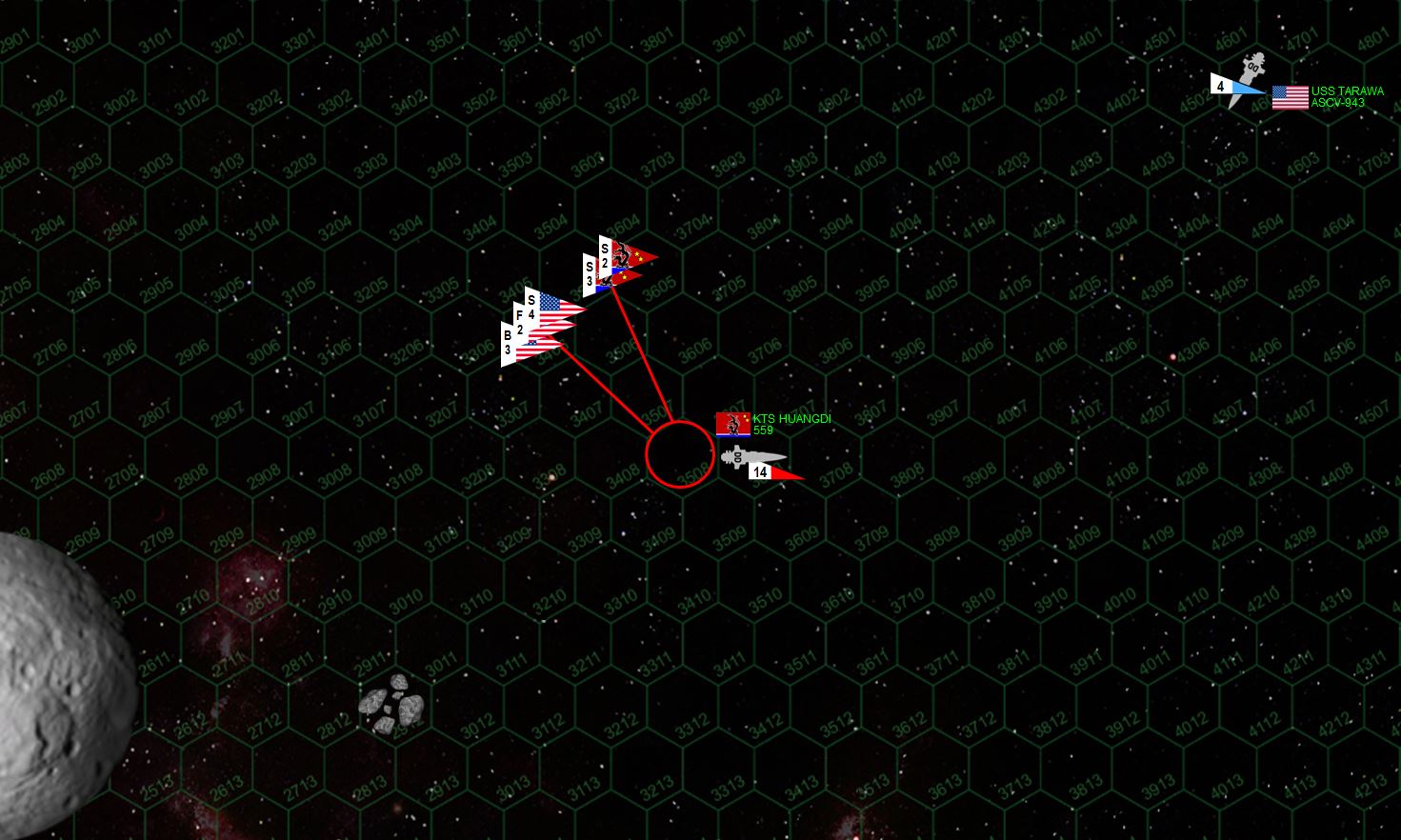
The skirmish at Suji’s Refuge is an American win, albeit a bloody one. The Meikang was about to be scuttled, but again this lucky ship somehow survives, ejecting that starboard reactor just in time and somehow surviving the thermonuclear explosion just a few kilometers away. The Valley Forge is almost in worse shape, requiring 63 days of repair to bring her back on line. So for the next few weeks, the Tarawa will have to secure that foothold at Suji’s Refuge alone. The battlegroup flagship, USS Oriskany, will help her out, leaving the Princeton at Kosyang 71, assisted by the newly-arriving Shepard-class frigate sent from the Kurokawa system by task force commander Captain Daniel Chealtham, USS Ronald Evans.
The Americans have basically won the Jade Dawn system (Xi Scorpio C) at this point. But until American cruisers and bases . . . and especially the Japanese squadron under Hiromi Ozawa . . . can get up here, it won’t be secure. For now it’s up to “Battlegroup Oriskany” to hold it, or at least maintain a presence, against inevitable Black Dragon counterstrike out of Heilong-Novprimorskiy (Xi Scorpio A-B binary)
Black Dragons have crippled Valley Forge (58 points), shot down five fighters, one bomber all double elite (24 points), plus 1 bank point = 83. Americans have crippled Meikang (70 points), Huangdi (40 points), Malaynovets (20 points ) = 130. Americans win by 47. Minor Pacific Alliance Victory.
Darkstar - Xi Scorpio War (2516-18)
Sample setting and "test bed" environment for four-faction war
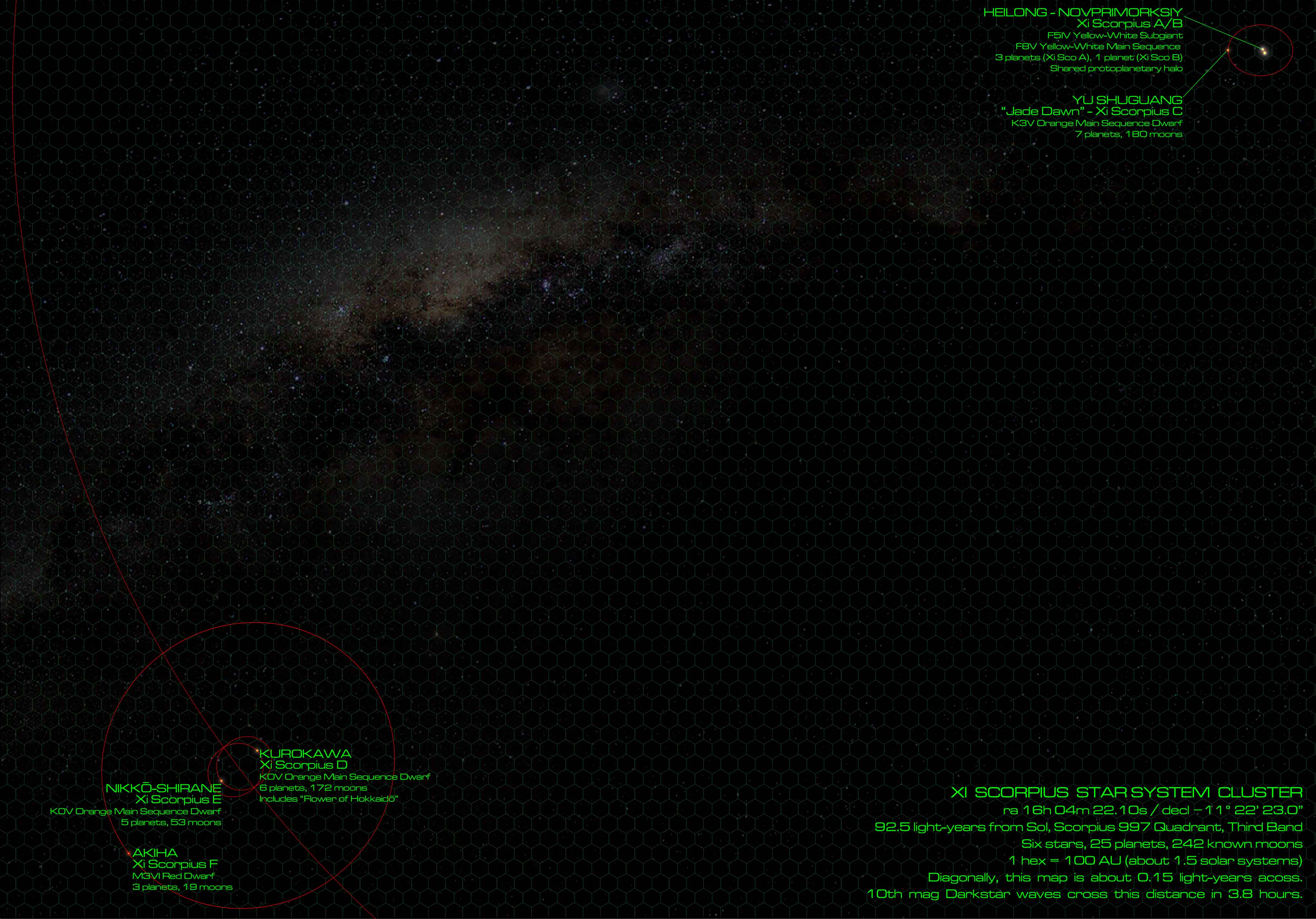
This is an overview of a “sandbox” environment I’ve been using for repeated test games of the newer editions of the Darkstar tactical starship combat system.
The Xi Scorpio stellar group is an actual six-system formation a little over 92 light-years from Earth, where a major war has been started by the so-called Khitan-Tunguska Free State (a breakaway faction that has rebelled from colonies of the Holy Russian Empire and the Panasian League).
In broad summary, these “Black Dragons” of the Khitan-Tunguska Free State attacked Japanese colonies in Xi Scorpio because there is a near-Earth analog planet in the Turakawa star system (Xi Scorpio D). Because of their bloody uprising against the Panasian League and Russian Empire, the Black Dragons know they and their descendants can never return to Earth, so hope to found their new nation at the Flower of Hokkaido colony. This is what they are calling their “Earth and Sky” mandate – an inalienable right for all men to have a place to raise their children and bury their dead. A nation cannot exist entirely in space.
The Black Dragon invasion struck from the former Panasian and Russian colonies of Jade Dawn (Xi Scorpio C) and the binary system of Heilong-Novopromorskiy (Xi Scorpio A/B). These former Russian and Chinese rebels bloodily wiped out the Japanese civilians on Hokkaido’s Flower “Mongol style” – which naturally prompted immediate response from the Japanese.
The problem for the Japanese is that in the world of Darkstar, 92 light-years is about a three-six month voyage. The Japanese Navy has just one rapid-response, long-range task force where all the ships are upgraded to where they can generate 11th-magnitude Darkstar waves (cutting this time roughly in half).
In order to procure reinforcements, the Japanese Foreign Office contacts the US State Department and invokes a “military mutual assistance clause” signed in the treaty that ended the recent Japanese-American “Andromeda Arc War.” Now, compelled by treaty, former enemies of the American and Japanese navies (some of them very personal) must sail the incredible distance of 92 light-years and fight as allies to retake these Japanese colonies.
So in game terms, we have small but elite battlegroups and task forces of Japanese and American warships (heavily upgraded, up to light cruiser in size) in a far-flung colonial conflict against local rebels with much less experience, but far greater numbers and far heavier Chinese and Russian-built warships – since these embattled star systems are right next to major Black Dragon shipyards.
Darkstar - Sample Starship Player Sheet - USS Oriskany (Valcour class destroyer DSGN-791)
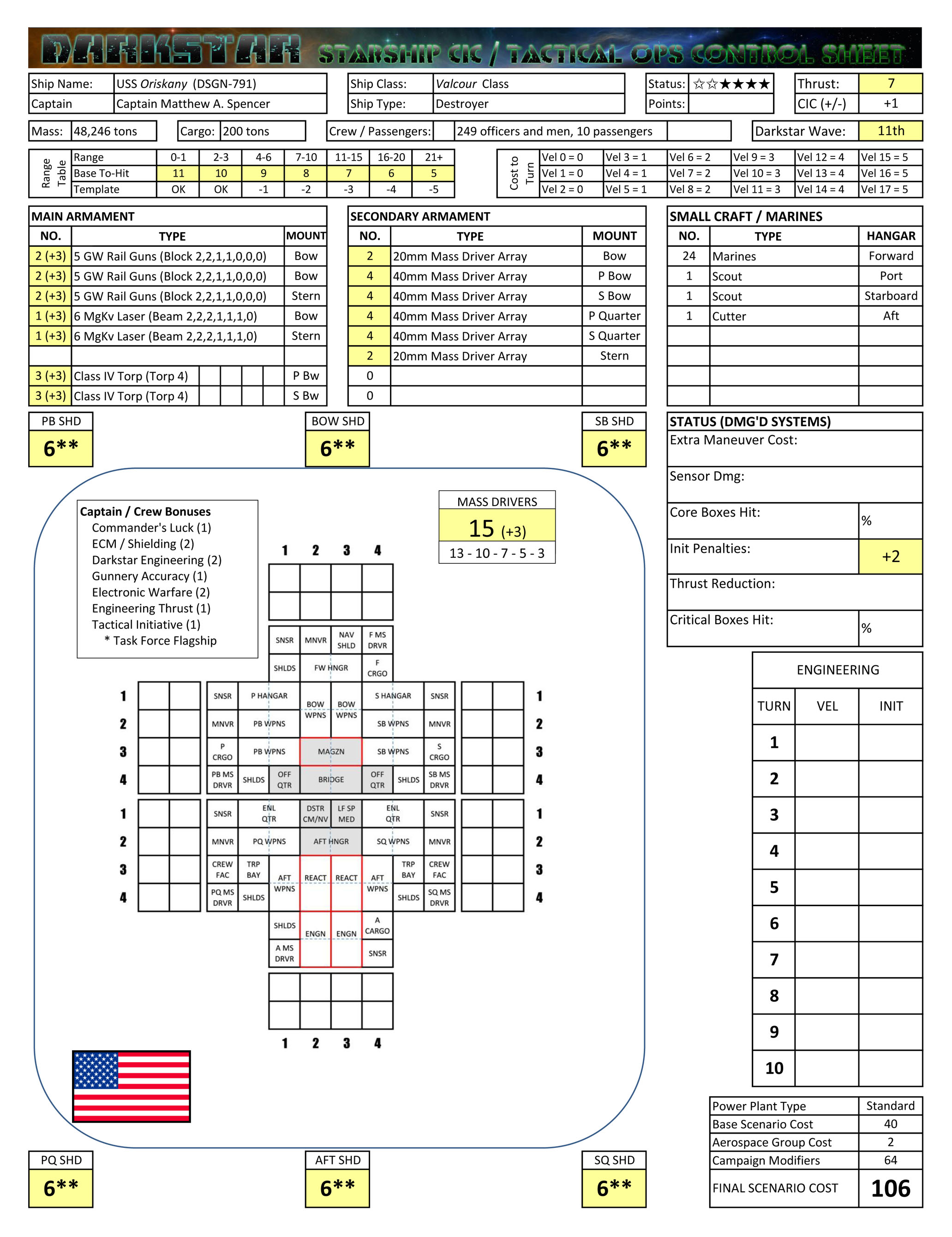 Okay, so once you get a ship class designed (or selected from the existing choices), one of these player sheets are quickly filled out for each ship. Now this one is for the most decorated ship in the game, quite predictably named USS Oriskany.
 If you take your ship into a battle, you get 1 campaign point. If you're on the winning side, you get 2 campaign points. Very large battles, especially heroic actions, etc., sometimes gets you 1 extra point per game. Anyway, these accrue and for every six points, you can buy something off our list of campaign advantages.
You can also buy promotions for your commander or upgrade your ship class (from a frigate to a destroyer or a destroyer to a light cruiser, etc.).
Needless to say, over six years of game play and some 54 separate games. USS Oriskany here has built up quite a few campaign points which has allowed her fourteen upgrades. Some of these have been in her captain (promoted from commander to captain, which I needed before I could buy battlegroup commander, which I needed before I could buy task force commander, etc.). Others have been in the ship herself and her crew.
Of course this has also jacked up her point cost considerably (note the "106" in the bottom corner), making her almost triple the price of a standard destroyer (40). But the "Lady O" is now at the point where she can take on "raw" heavy cruisers, which for a destroyer is pretty crazy. It's also necessary, since she has the same POINT COST as a heavy cruiser.
Darkstar - Sample Starship Design Sheet: Valcour Class Fleet Destroyer
 First off, I'm very glad to see that people are interested in this Darkstar content. I know it's not usually the kind of miniature-based wargame we see on Beasts of War - but projects can come in all shapes and forms ... including the design and construction of new game systems.
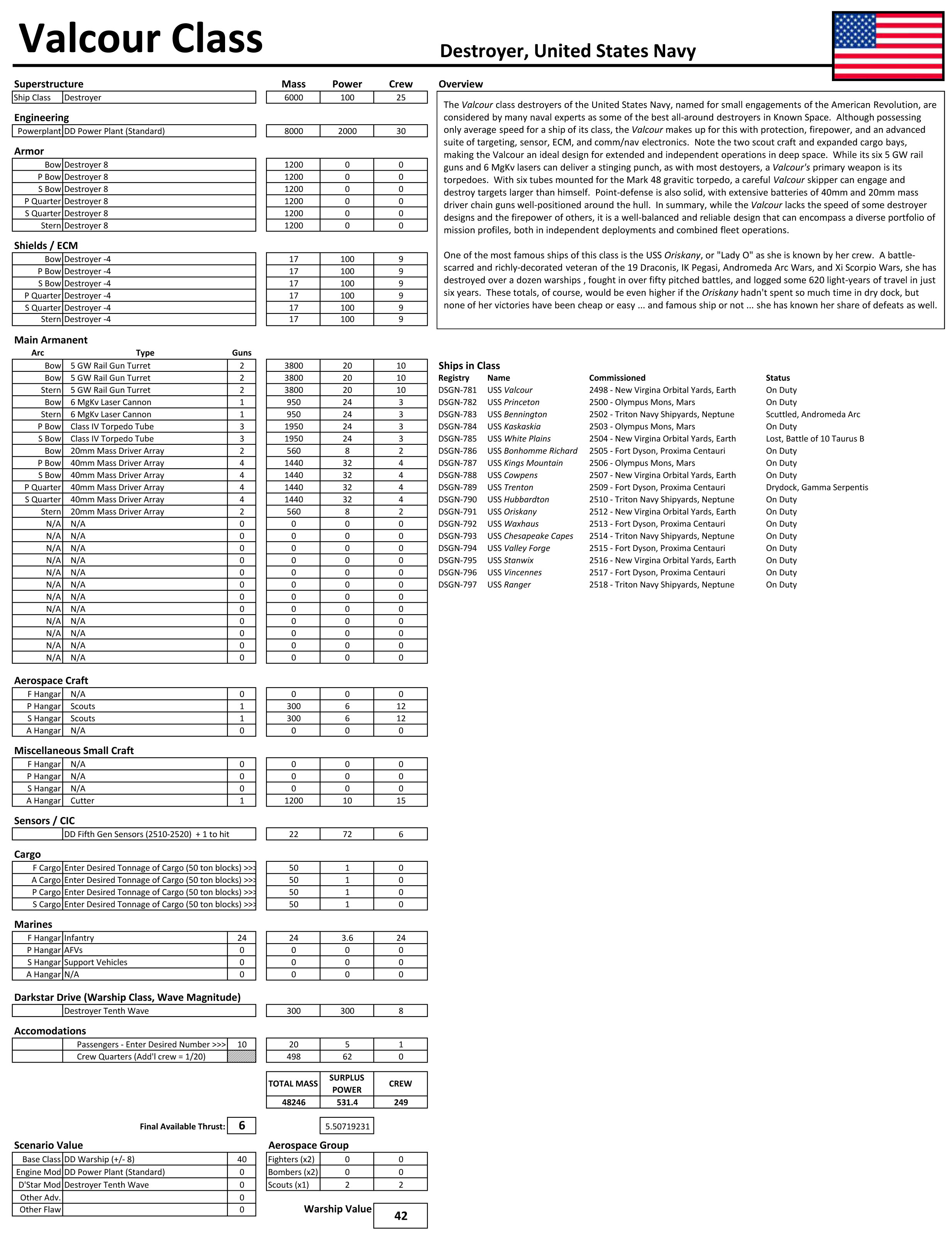
 In any event, here is the design sheet from MS Excel for one of the 90 or so warship classes in the game at the moment - the Valcour class destroyer. Once players select the class and engineering plant, they start selecting things like armor, shields, weapons, aerospace craft, marines, extras, from drop down menus that appear in the component column. For guns, marines, small craft, etc, they also select number. This adds up the power and weight of each system, and the totals are tabulated at the bottom. Remaining power is divided by accrued mass, and that is the ship's thrust. Standard for destroyers is a 6 (some classes are faster, some are slower), but the Valcour is designed as a standard "workhorse" class warship, so I was aiming at a 6.
Darkstar - Campaign Map 03 - Hercules Gate
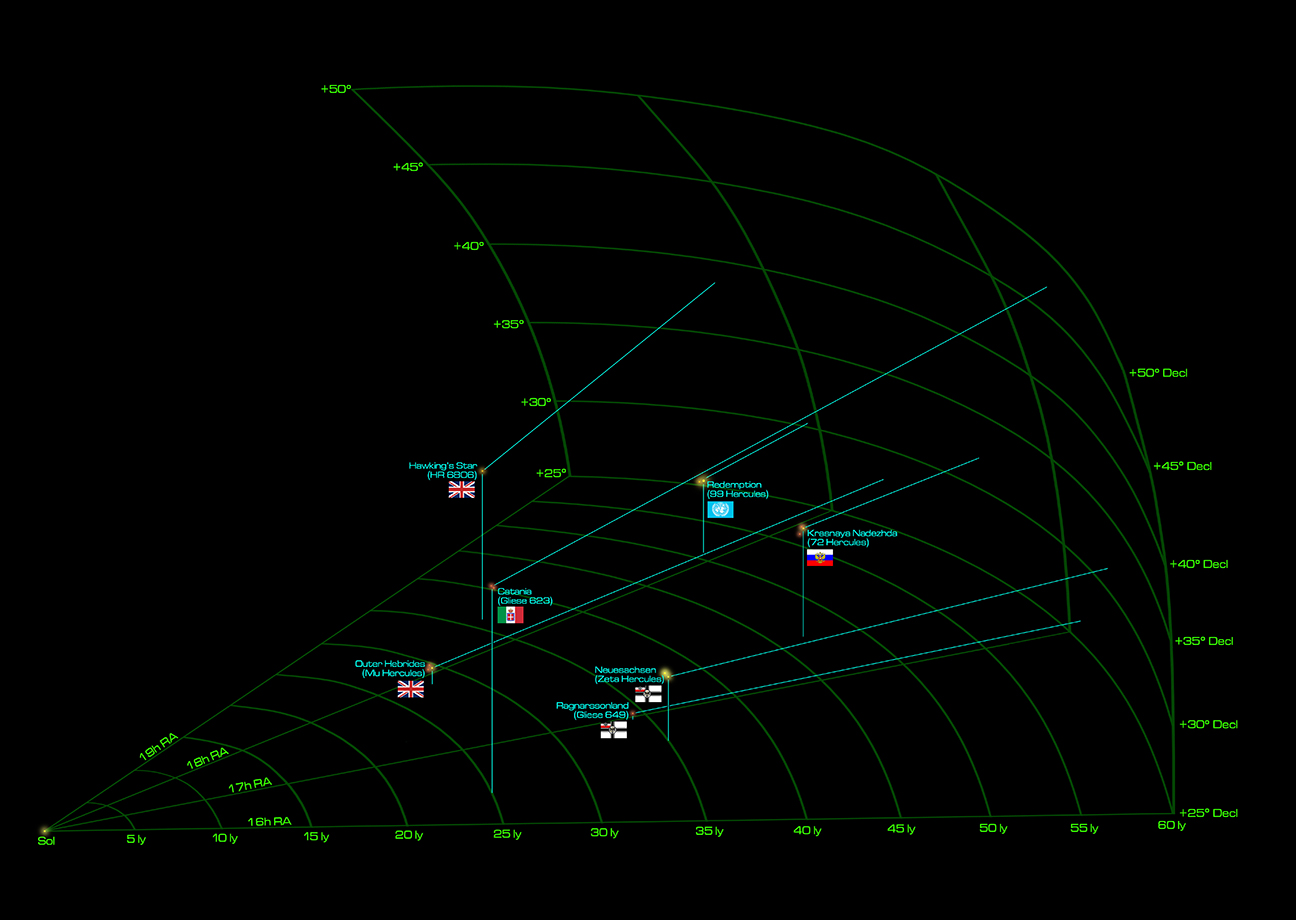 Another of our Darkstar campaign settings, where Imperial Prussians and New Roman Alliance (Italians, French, and Spanish, mostly) face off against an alliance of convenience between the United Kingdom and the Holy Russian Empire. The UN has an enclave out here as well. Distance in light-years is plotted along the bottom, and we also had the approximate distance in light-years between all these systems plotted. This became very important in the campaign, and players had to plot their movements weeks or months in advance, in addition to towing and repair times for warships damaged in previous battles, to plan for their next moves. So from the British star system at the Outer Hebrides (Mu Hercules) to the Imperial Russian colony at Krasnaya Nadezhda (72 Hercules) was about 23 light-years, which would take most military grade ships just short of 28 days.