





The Zoidyssey - Adventures with Warriors of Athena

Shrine, statuary and plinths
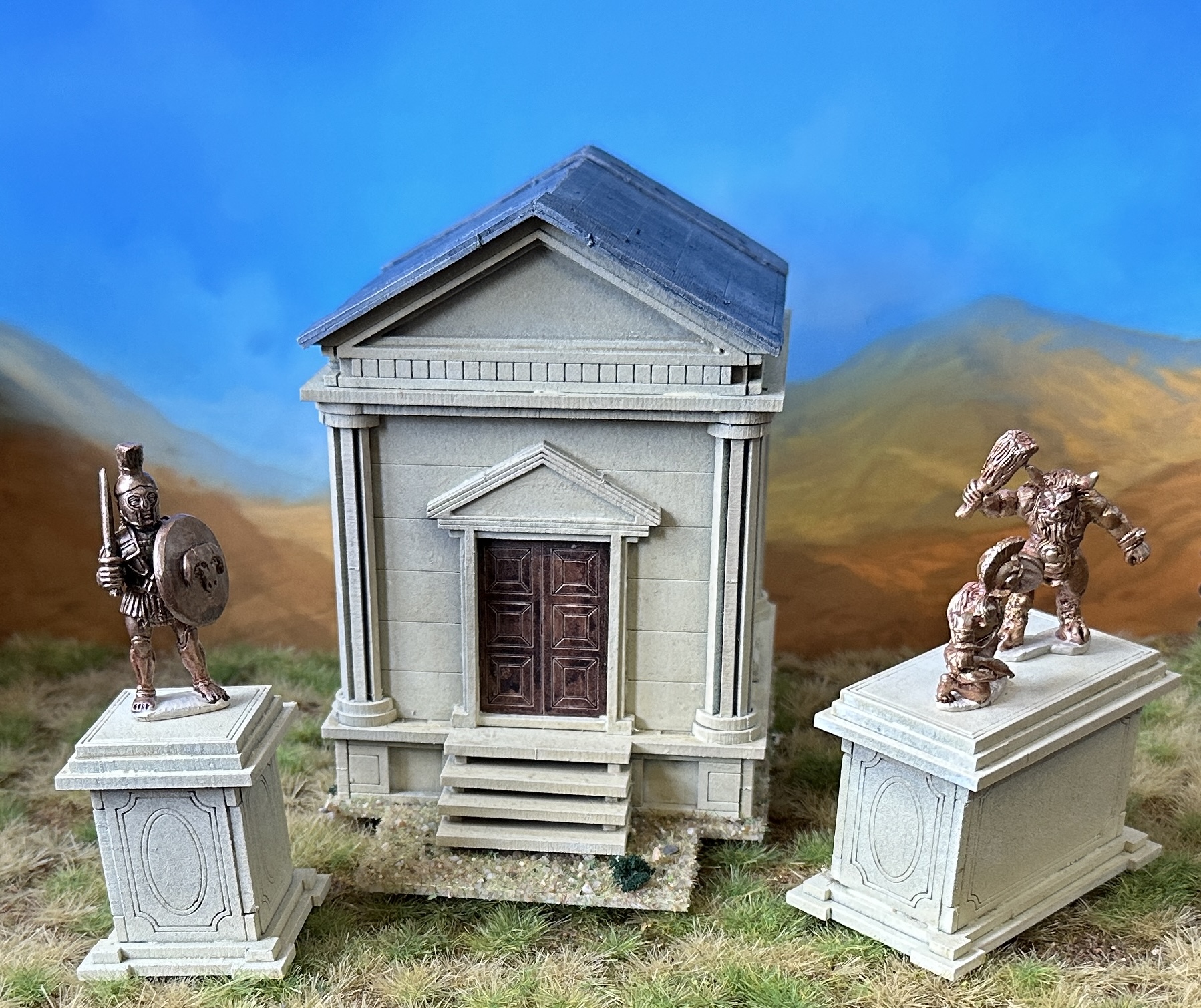
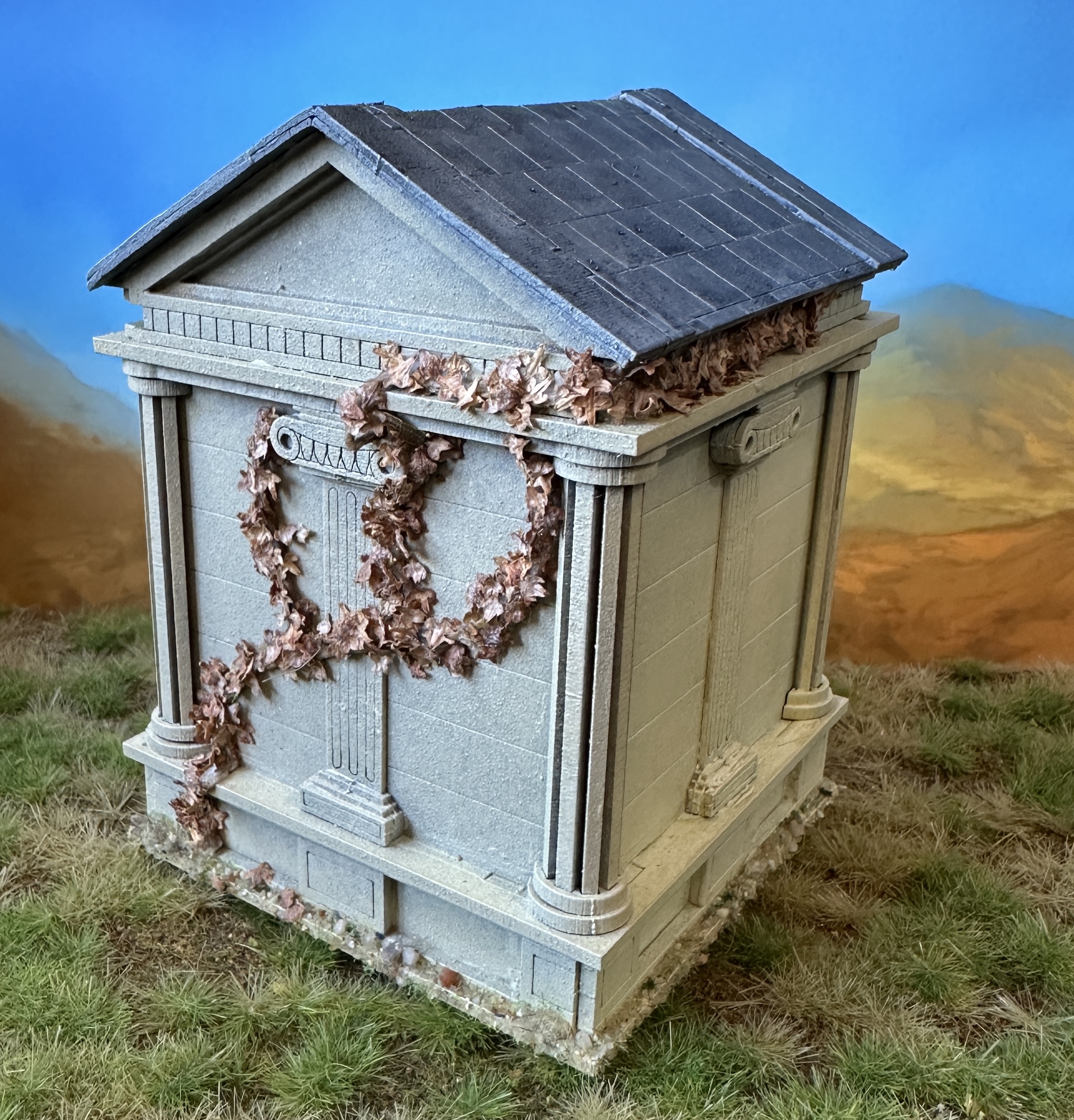
In order to dress the table, particularly for any scenarios that involve a temple or devotional focus, I needed a suitable building. Many actual temples that we have in the archaeological records are huge, much larger than would be useful in this small scale game. On re-reading The Argonautica (Jason and the Argonauts) they make frequent stops to sacrifice and honour gods and heroes at small shrines or mausolea. Fortunately for us Sarissa Precision have a kit for just such a building. They also have statue plinths, a rectangular one and a square one in a single kit. I got both kits and put them together. Construction of these kits is relatively straightforward although I always seem to make a minor error of part or order of build at some point so not the most zen experience.
Then for some statues. I had the Foundry Theseus and the Minotaur set and they are truescale 25mm so not a good fit for the 28mm minis I’m using. I thought they would make a nice statuary pairing, a good thing to go on the rectangular plinth.
I didn’t have anything suitable for other gods or heroes. Then I got lucky. At Legionary on Saturday I spotted a takeaway tray with some metal miniatures in it with £5 as the price. I picked them up for a closer look and found 13 Chiltern Miniatures Greek gods, godesses and heroes. These were from a range of 40mm miniatures depicting most of the Greek panoply. They have a distinctive sculpting style, being quite chunky and simplistic in style. I was very happy to hand over my fiver and away home they came.
On further inspection I can identify Zeus, Hades, Poseidon, Hermes, Athena, Aphrodite, Hephaestus, Nike and the semi-divine heroes Theseus, Perseus and Achilles. There are two female gods that are harder to identify. The kneeling one I think might be Persephone and the other with the wide spread arms and flowing hair might be Nemesis. I’m pleased with the distinct suulpting style they have, it differentiates statues from people very effectively.
Painting commenced.
Painting the buildings
The buildings were undercoated in Halfords grey then oversprayed with a cream colour. Once dry they got a liberal coat of Howling Sand Speedpaint and then a drybrush of Vallejo Bonewhite acrylic. The tile roof was done in slate grey using several coats of Runic Grey Speedpaint. The Speedpaint doesn’t settle or absorb into the surface evenly giving a very naturalistic colour variation. I added some Krautcover Sands of Sparta to the base of the shrine and then some Jarvis Scenics creeper in the summer colour. I may recolour this in green at some stage but I’m happy with the autumn/winter look for now.
Painting the statues
I started with a zenithed undercoat, white over black. Then I went in with Talos Bronze Speedpaint over the entire model. This is quite a strong copper colour so will be good in the recesses and darker areas. Over this a drybrush of AP Warpaint Fanatic Emperor Gold. Then a mixture of a few drops of this with the same quantity of Vallejo Metal Gold and Vallejo Metal Copper. This gives a bright ‘new bronze’ colour. The ancient Greeks painted their statues or applied gold leaf, even to the bronze ones, so the dark green patina that we are used to looking at examples in museums isn’t what the ancients were used to. Instead the exhibit Bunte Götter (The colour of the Gods) gives a well researched example of how they might have looked. The issue for us miniature gamers is that painting style lacks detail and if we painted our miniatures like that they would resemble old fashioned toy soldiers. So as a compromise I’ve gone with a new bronze finish. It is at least quick.
Here’s what everything looks like. As you can see I’ve used the statues to show a shrine to the hero Theseus. I can depict a shrine to any of the gods or heroes that I’ve got models of, just by swapping out what I put on the plinths.
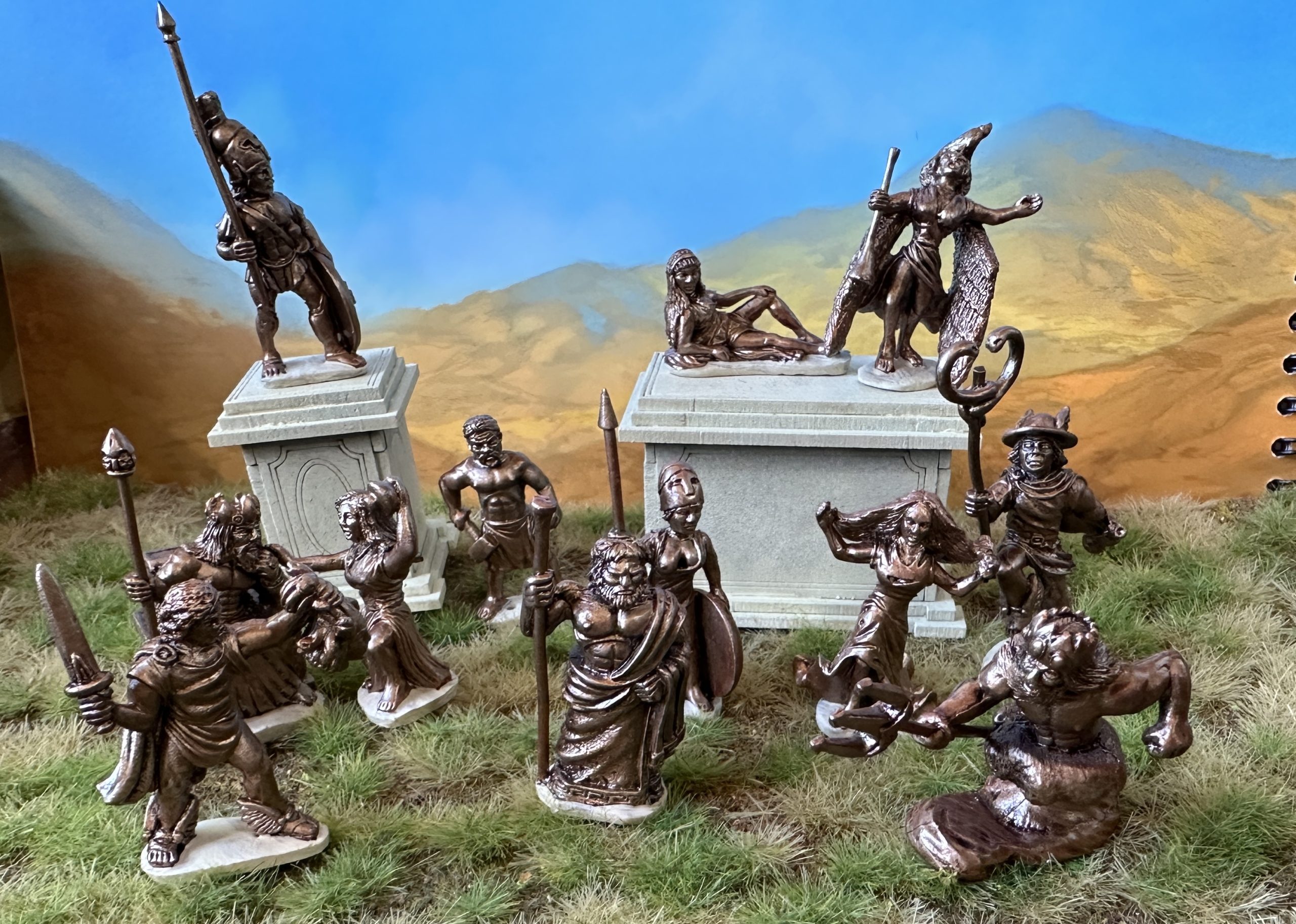 Greek statues (from left to right) Perseus, Hades and Persephone, Achilles (on plinth), Hephaestus, Zeus, Athena, Aphrodite and Nike (on plinth), Nemesis, Poseidon, Hermes.