







DARKSTAR CAMPAIGN UPDATE: DUCHESS ANNABEL’S WAR IS OVER




Recommendations: 3619
About the Project
The year is 2512.
The powers that remain on an ecologically-devastated and plague-ravaged Earth have been forced to look to the stars for the resources, capital, and room not only to expand, but to survive. While the setbacks encountered by mankind over the past 500 years have forced him to unite in a shaky global coalition and make fantastic strides in technology, they have also caused seismic and reactionary shifts in religion, culture, and politics. A second age of imperialism has dawned, and because man would never survive another war on the fragile remains of planet Earth, he is forced to ply his oldest trade ... war ... exclusively among the stars.
Darkstar is a tactical war game postulating naval combat in a “science faction” universe set five centuries into a troubled and uncertain future. Players take command of warships serving in the new “black water” navies of reborn empires of old, struggling for control of shipping lanes, resources, and colonies. Ships maneuver and fire in fast-paced combat, with survival not only of the players’ fleets at stake, but perhaps their nation and all of humanity as well.
Related Genre: Science Fiction
This Project is Active
Darkstar - Weekend Update
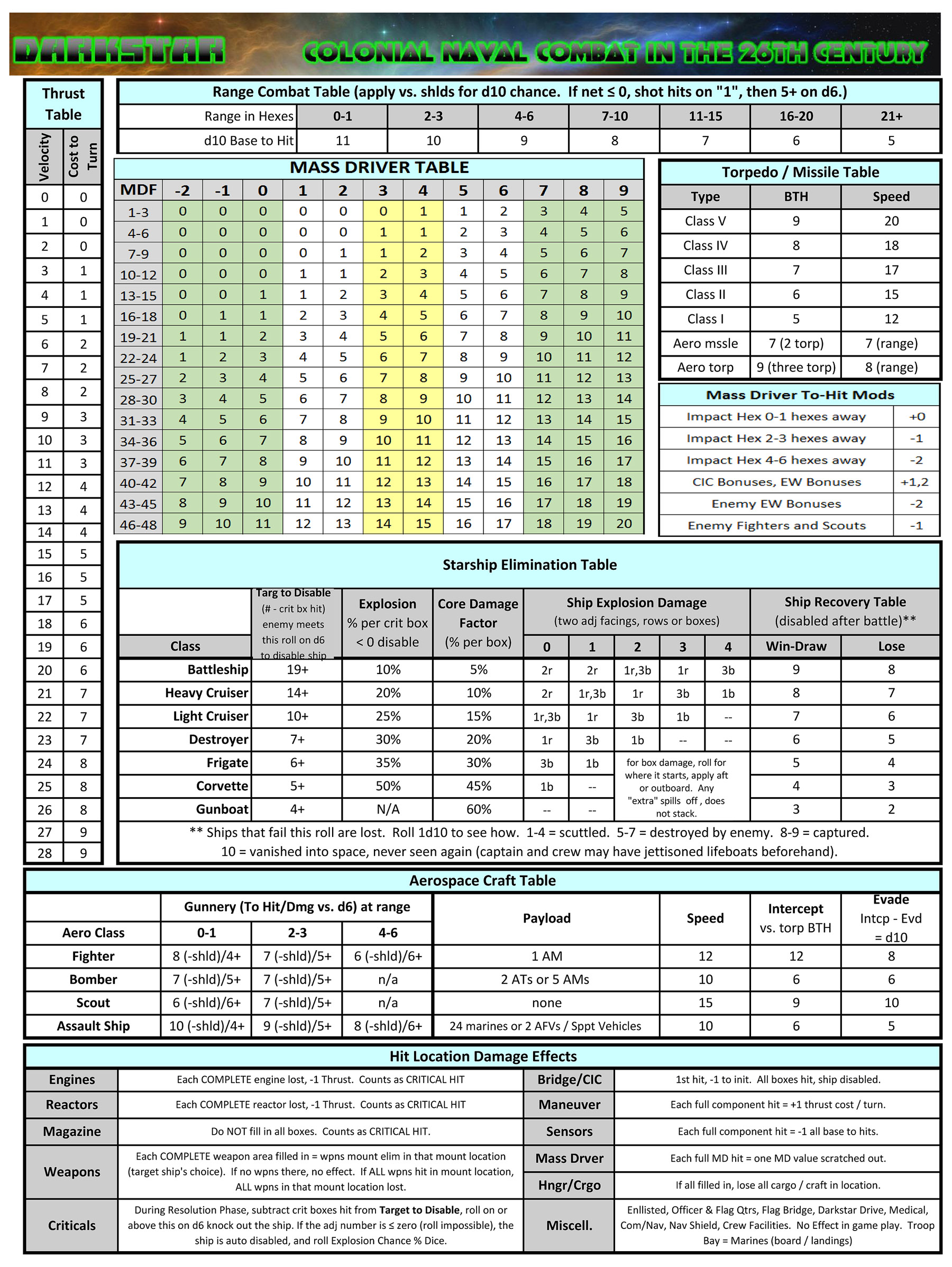
Good afternoon, all ~ Okay, people have been asking for more of a detailed look into the rules on Darkstar – here is the primary QRS that drives 95% of actual tabletop play.
A little rough around the edges from a graphic design perspective, but this thing is constantly being updated as we drill down through the smaller and smaller flaws and tweaks of the 2.0 Edition gameplay.
So along the top is base to hit targets (d10) to hit at certain range brackets. These are modified by enemy ECM / gravitic shielding (usually -4 through -6).
Along the left is the cost to make a 1-hexside facing change depending on the velocity of your ship. Obviously the faster you are moving, the harder it is to make hairpin maneuvers.
Tables are also provided for torpedo movement and hit resolution, and of course for mass driver (point defense). This has been one of the biggest changes in 2.0 Edition. Whereas before each mass driver would fire separately (bucketfuls of d10s) here there is a simple chart where a ships TOTAL mass driver value is pre-calculated and rolled on this chart to see how many torpedoes or aerospace craft are hit. We’re looking a d6 table, with heavy modifiers possible.
Starship elimination table, of “Death Table” follows. The “Target to Disable” is a d6 roll and enemy commander needs to kill a certain class of ship. Obviously, for a battleship you can’t roll 19+ on a d6. But you subtract from that target how critical damage boxes (engines, reactors, magazines) have been hit, and that’s you’re roll. So knock out 13 critical hit boxes on a battleship (good luck with that) and that 19+ becomes a 6+, remotely possible on a d6.
By way of contrast, a much smaller destroyer like USS Oriskany starts with a 7+. Hit just ONE engine, reactor, or magazine box and the ship now has to roll a 6+ to be crippled.
If you really beat the hell out of a ship to where that d6+ roll us adjusted to “0+” or below, and there’s a chance the ship simply explodes.
Core damage is another type of damage box, deep within the ship. While not “Critical” and may not cause the ship to explode, it can definitely cause the ship to be FORCED to break off (first officer takes over, the ship’s AI automatically pilots the ship away from danger, the fleet commander ORDERS you to break off, etc). These core boxes are usually things like med bays, life support, the bridge, etc.
There are also charts for the collateral damage the ship does to other nearby ships if its explodes. Controlled fusion is the main power source in this verse, and if that becomes uncontrolled, there’s a thermonuclear explosion that can really damage other ships (especially small ones) if they are too close.
Finally there is a Starship Recovery Table, where players see whether or not their crippled (not exploded) ships are recovered after the battle, or scuttled, or picked off by enemy ships, or captured, or simply “lost in space.”
Tables for Aerospace Craft (fighters, bombers, scouts, assault boats) and the game effects of certain hits within a starship are also listed.
There are many many MANY more charts in this game, but they deal mostly with campaign play, character progression, starship engineering and design, etc.
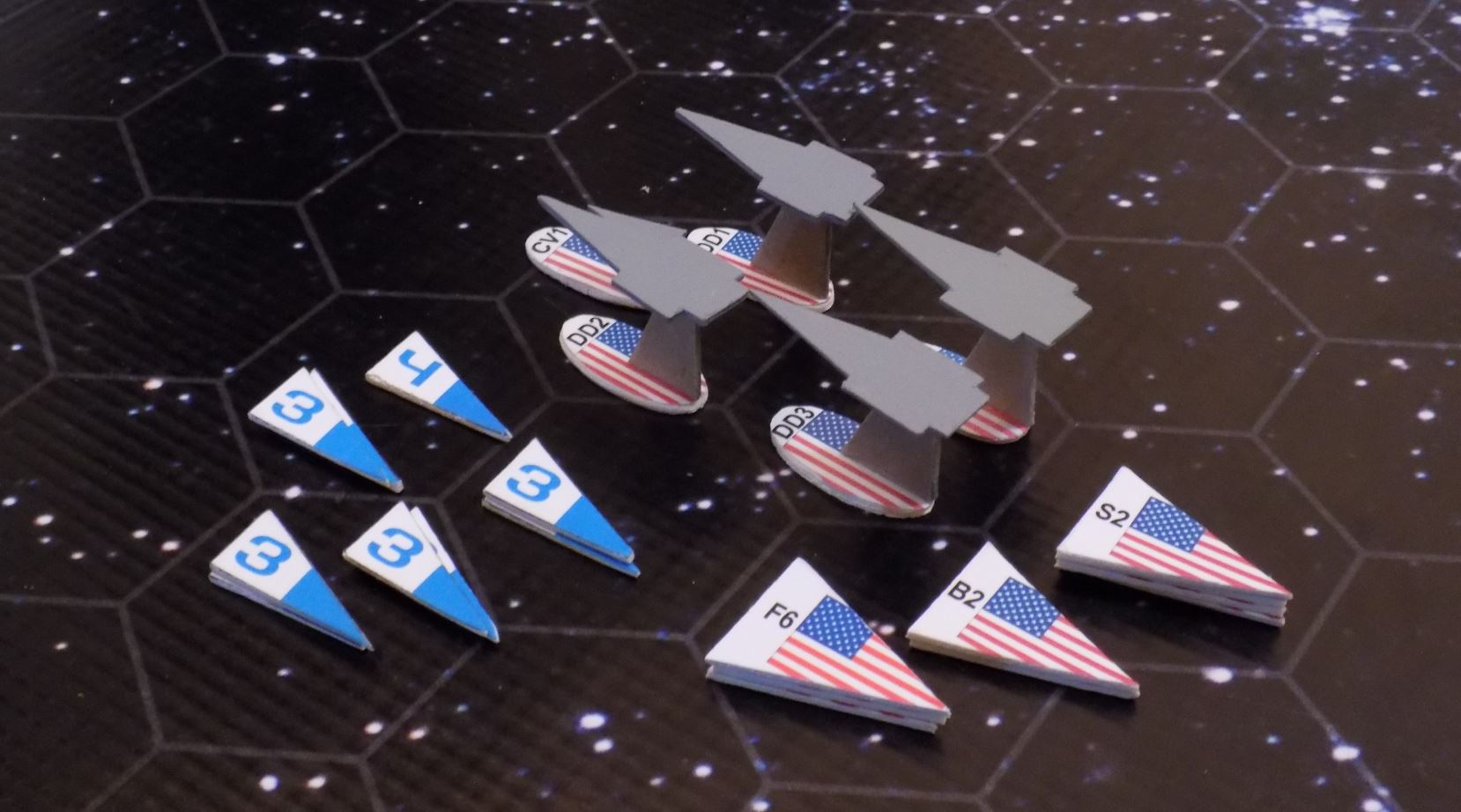
Meanwhile, we have a pretty big game set up for today! The full “Oriskany Task Force” is ready for action, a game I don’t get to play very often because these ships are so friggin’ elite and upgraded they’re very expensive to bring on the table (and no one wants to fight against them). We’re looking at Valcour-class destroyers USS Oriskany (DSGN-791), USS Princeton (DSGN-782), and USS Valley Forge (DSGN-794). There’s also the Marine assault ship USS Tarawa (ASCV-943), deployed here in a light carrier role, and the torpedo corvette (think WW2 submarine) USS Daggerfish (SSGN-871). Also shown are the scouts launched from these destroyers (E/S-71 “Hawkeye”), as well as the fighters (F/S-44 “Corsair”) and bombers (F/SA-81 “Avenger”) of Marine aerospace strike squadrom VMF/A-391 “Tigersharks.”
We are heavily outgunned by the enemy force facing up today (commanded by the evil and treacherous “Commodore @Gladesrunner “) – but again, just about everything there is very elite and heavily upgraded, allowing us to really punch above our weight. We’re also much faster, and all have upgraded thrusts and tactical initiative bonuses, so this will definitely be a game of lightfooted maneuver vs. gigantic advantages in weight, armor, and weapons.
The enemy fleet. As discussed in previous posts, the “Black Dragons” of the Khitan-Tunguska Free State are made up of colonies that rebelled against the Holy Russian Empire and the Panasian League, so most of their ships are Russian or Chinese in design. We have the dreaded Zhang Jia and Xin Tian, both Xhia-class light missile cruisers, along with the Nanchong-class destroyer Xianhoa. The Russian part of the fleet is the Kutuzov-class light cruiser Petranyevska, the Sovnya-class destroyer Gorokhov, the Novgorod class frigate Irynova, and the K-56 class torpedo corvette K-206.
In all, 366 points per side. I hope to score a win here, not only to give my Americans more campaign points, but a solid win here also ends the “Scorpion’s Tail” war I still have in progress. From a “meta perspective” I’d like to wrap up this war once and for all so I can focus more on the Duchess Annabel’s War we’ve been posting about lately (and we have another few games scheduled for tomorrow). 😀
WISH ME LUCK!

Darkstar Campaign Log - Duchess Annabel's War
Full Scale War in Progress in Libra, Saggitarius, Ara, Scorpio Constellations! Five Factions Engaged! Five Battles Reported So Far!
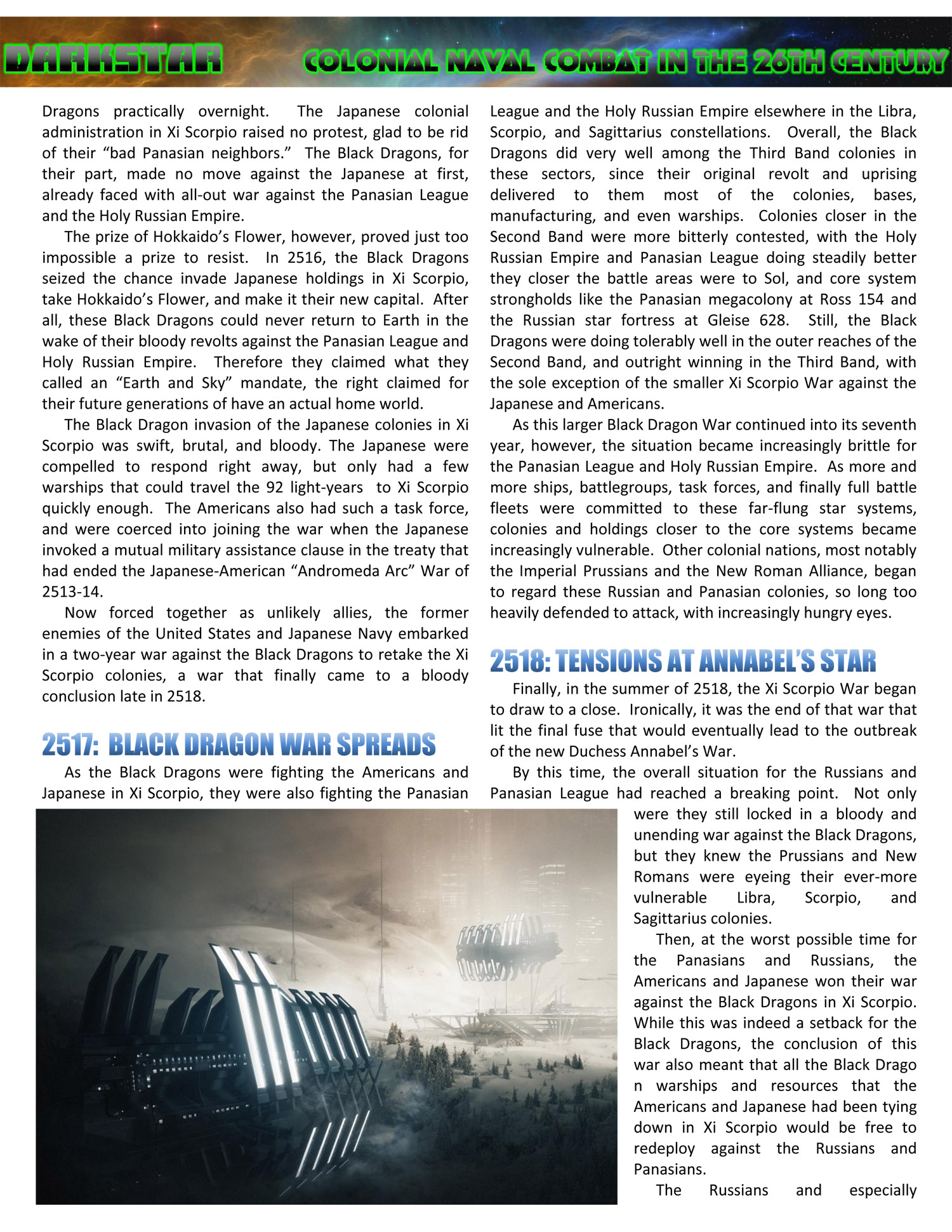
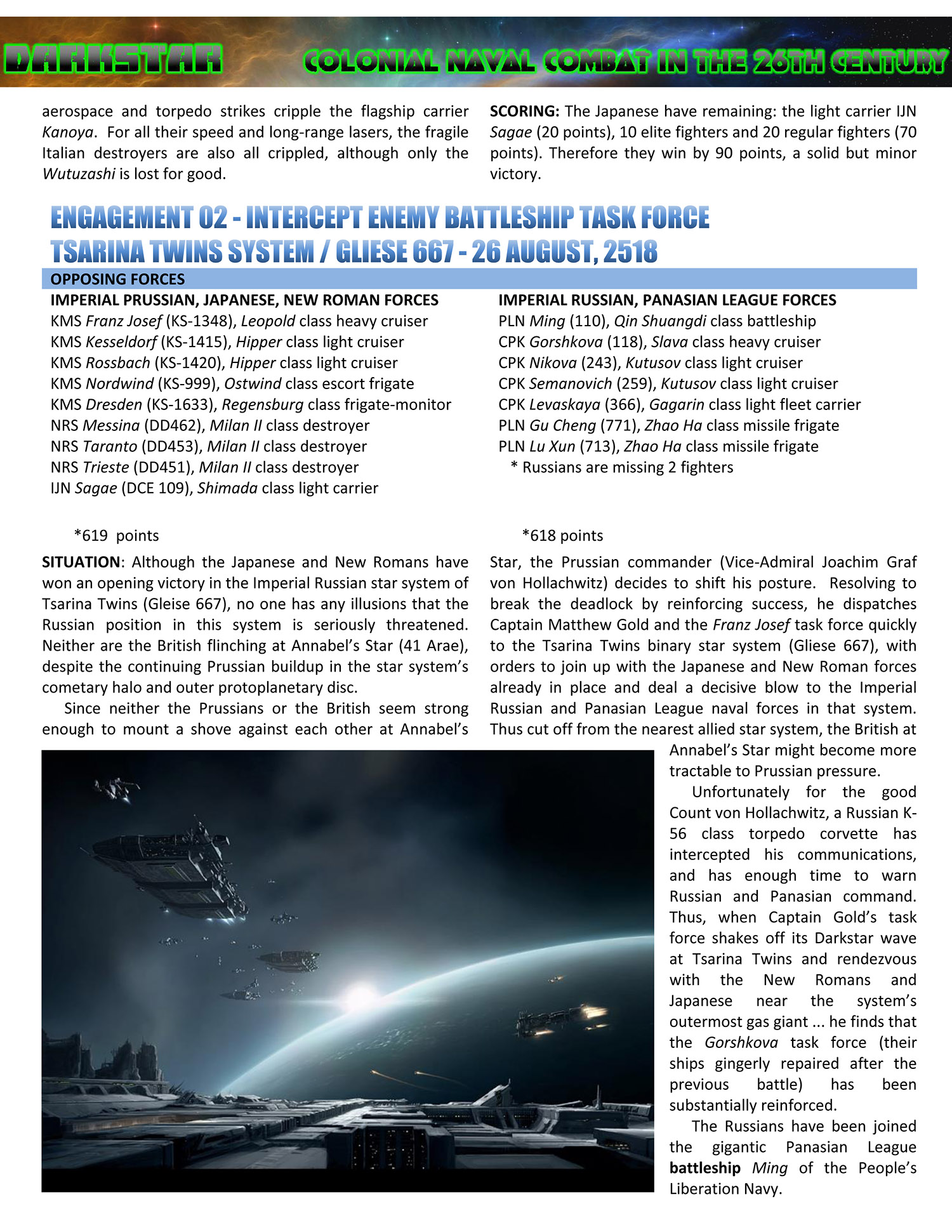
Good afternoon ~ Okay, for those who are curious 0 here is how a Darkstar Campaign is generally set up, played out, and recorded. The attached .pdf includes the first 10 pages of a campaign currently in progress between myself, BoW: Gladesrunner, BoW: Aras, and one other player.
Sample pages of the .pdf are laid out as images below.
Again, this campaign is not complete, and won’t be complete for weeks, if not months. If anything, it’s just getting started. I have the general idea of posting updates to this project so we can all publish our progress and community members can follow along and see how this war across the stars unfolds!
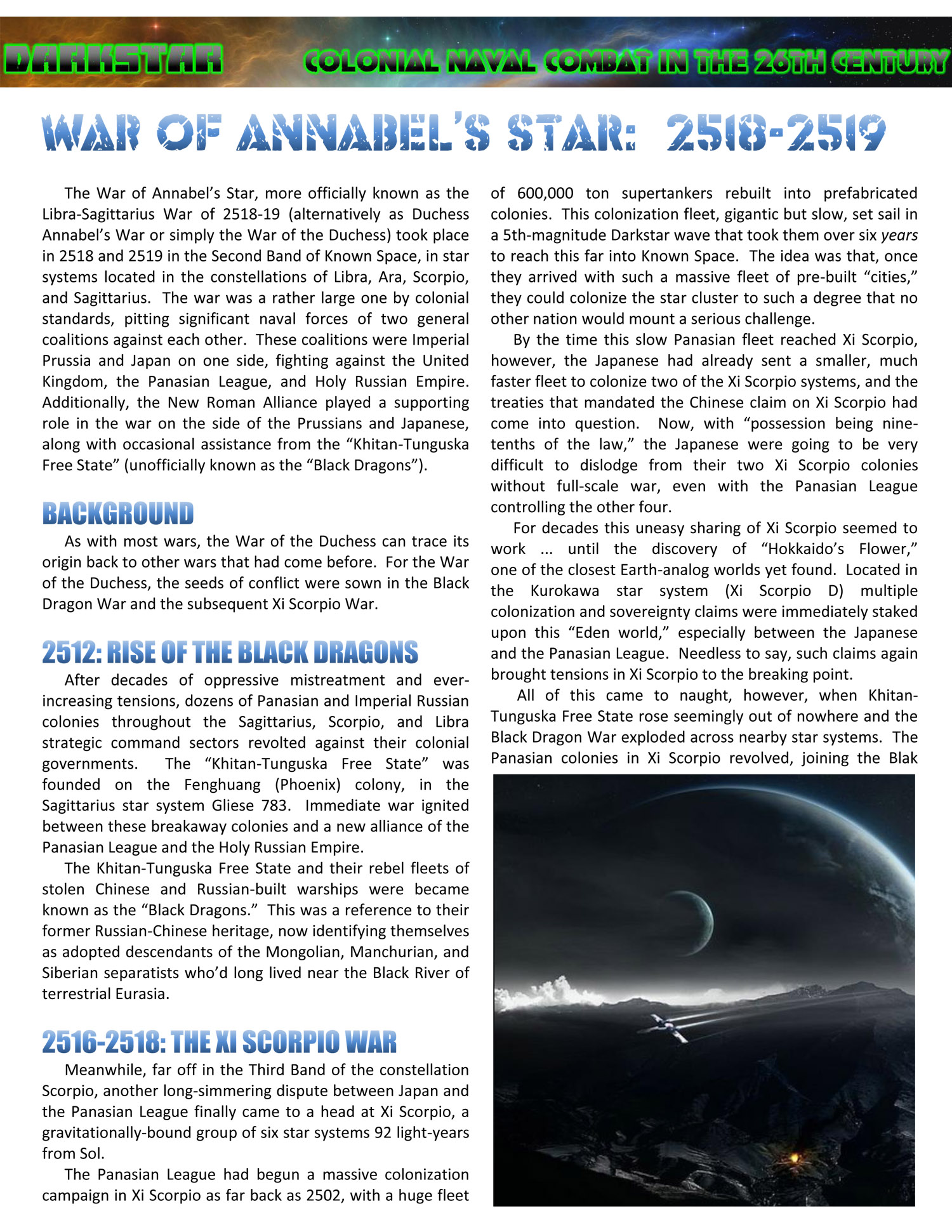


War of Annabel's Star (2518-2519)
Campaign Setting Map for Darkstar

Here is the campaign map for the Darkstar campaign currently underway between myself, @gladesrunner and @aras. The lower left corner marks Earth’s location, the rest are real stars and their approximate locations in the Libra, Ara, Scorpio, and Sagittarius. I don’t pretend to be good at trigonometry or plotting the declination, distance, and right ascension coordinates of these stars, but this is the general idea of what’s out there in these directions and in these distance ranges.
There’s a lot more being put together for this particular setting, explaining the background for the war, the factions involved, how it started, and what the different factions each hope to get out of the war (and how it ties the opposing coalitions together). Not quite ready for publication yet, as they campaign is still in progress and in fact only in the very early stages.
Darkstar Warship Design: Foch-Hispaniola Class Light Cruiser
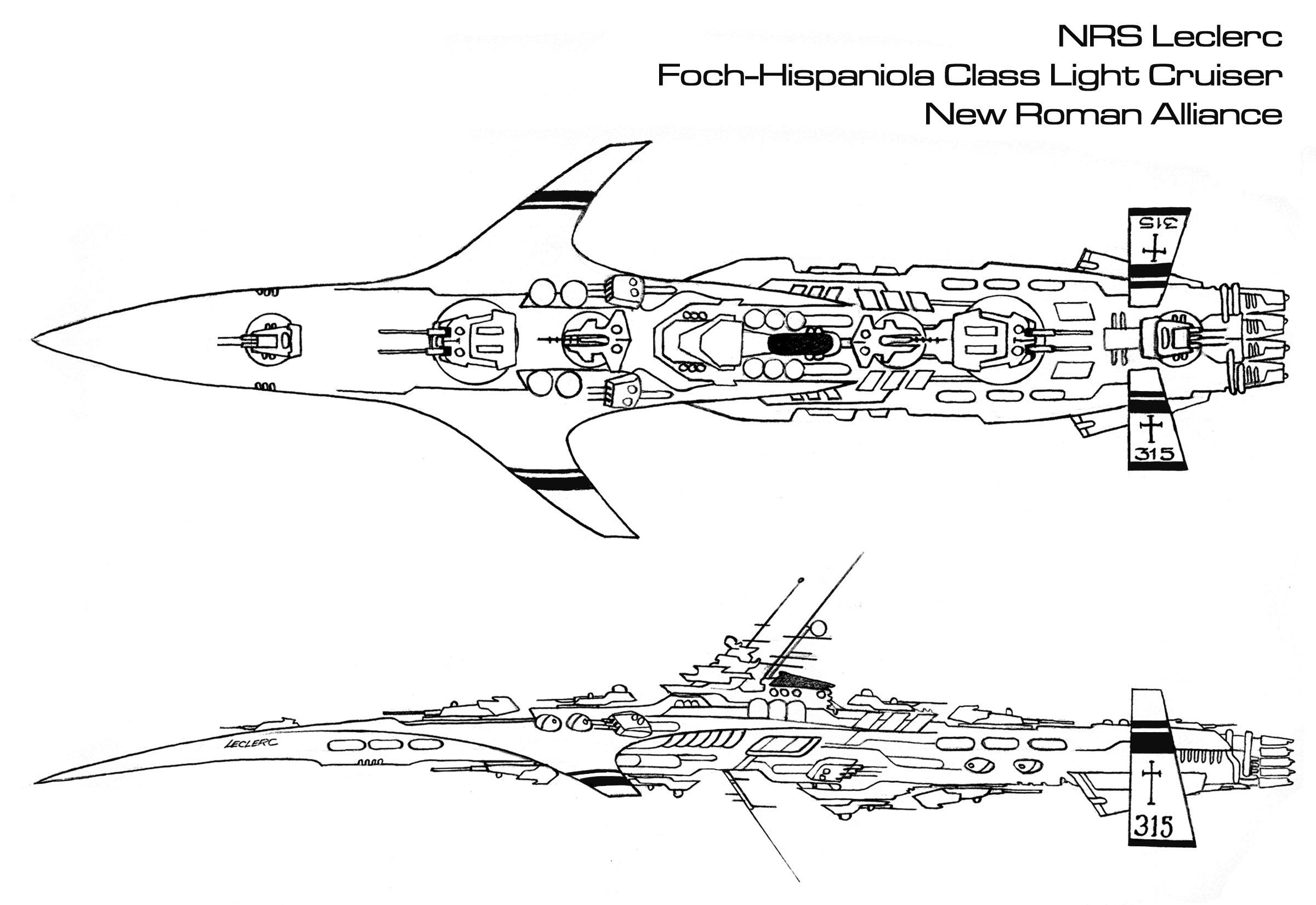
The Foch class light cruisers of the New Roman Alliance are some of the most modern warships currently in operation. With a next-generation power plant, they also mount advanced sensors, targeting electronics, and CIC comnav, all while being among the fastest cruisers in Known Space, able to keep pace with most classes of destroyers.
For armament, the Foch class carries eight 7-gigawatt rail guns (probably the “oldest style” tech aboard). These are arrayed in a typical pattern of double turrets, backed up by a formidable pair of 12 MgKv laser emitters that look like they belong on a battleship. Manufactured my Matra Aerospace Dynamics, they can burn through almost any known armor at optimum range, and cleave through a destroyer at ranges exceeding 4500 kilometers. The Dassault-Thales manufactured CIC suite also ensures that the Foch can hit targets at this range, while the immense quad-array of engines gives the ship the thrust to escape whatever it can’t kill.
Although part of the New Roman Alliance, all Foch class light cruisers are named for French commanders and battles of the First and Second World Wars, and are almost exclusively crewed by men and women of French or French Canadian descent, who take such a pride in their heritage that they have almost formed a “navy within a navy.” Since the class carries no torpedoes and has extensive cargo carrying capacity, it is expected that these ships will also serve as flagships for small battle groups in the Third Band of Space or even beyond, expanding the dominion of the New Roman Alliance ever deeper into the stars.
The ships also have greatly expanded passenger bays, and their plush accommodations go a long way in furthering the New Roman Alliance’s reputation for elite decadence. Indeed, one Russian prisoner wisecracked that when he was brought aboard the NRS Leclerc during the Olympian Path War, he thought he’d been brought aboard a luxury liner. While these accommodations certainly don’t do much for the Foch’s combat effectiveness, it can’t be denied that whenever Roman nobles, dignitaries, or ambassadors have to make an protected voyage, they request a Foch class light cruiser.
Indeed, the class became so popular that the Spanish began building their own line, known as the Hispaniola class, and an Italian line is rumored to be in the making.
Metrics:
Mass: 93,799 tons
Complement: 490 officers and men
Marines: 40
Passengers: 60
Sublight thrust:64
Darkstar Wave: 10th (x300 c)
Aerospace: (2) scouts, (1) 1,200-ton cutter, (1) 4,000 ton yacht
Bridge / CIC: +2 Next Gen
Powerplant: Enhanced Next Gen (3640 power)
ECM & Gravitic Shielding:
• Bow: 4
• P Bow: 4
• S Bow: 4
• P Quarter: 4
• S Quarter: 4
• Stern: 4
Armament:
• Turret – x2 7-gigawatt rail guns (bow)
• Turret – x2 7-gigawatt rail guns (bow)
• Turret – x2 7-gigawatt rail guns (stern)
• Turret – x2 7-gigawatt rail guns (stern)
• Turret – x2 12-megakelvin lasers (bow)
• Turret – x2 12-megakelvin lasers (stern)
• Turret – x4 35mm mass driver point defense array (bow)
• Turret – x4 35mm mass driver point defense array (p bow)
• Turret – x4 35mm mass driver point defense array (s bow)
• Turret – x6 35mm mass driver point defense array (p quarter)
• Turret – x6 35mm mass driver point defense array (s quarter)
• Turret – x4 35mm mass driver point defense array (stern)
Ships in Class:
• CL307 – NRS Foch – 2507, Nuovo Sardinia Shipyards, Earth
• CL308 – NRS Joffre – 2508, Littorio Colony, Capella Lambda
• CL309 – NRS Petain – 2509, Gallileo Station, Ganymede
• CL310 – NRS Marne – 2510, Nuovo Sardinia Shipyards, Earth
• CL311 – NRS Verdun – 2510, Littorio Colony, Capella Lambda
• CL312 – NRS Reims – 2511, Gallileo Station, Ganymede
• CL313 – NRS Versailles – 2512, Nuovo Sardinia Shipyards, Earth
• CL314 – NRS Somme – 2512, Nuovo Sardinia Shipyards, Earth
• CL315 – NRS Leclerc – 2513, Littorio Colony, Capella Lambda
• CL316 – NRS Bir Hacheim – 2514, Gallileo Station, Ganymede
Parallel Production (Spanish Hispaniola Class)
• CL341 – NRS Hispaniola – 2506, Gallileo Station, Ganymede
• CL342 – NRS Cadiz – 2507, Nuovo Sardinia Shipyards, Earth
• CL343 – NRS Córdoba – 2508, Littorio Colony, Capella Lambda
• CL344 – NRS Granada – 2509, Gallileo Station, Ganymede
• CL345 – NRS Alicante – 2510, Nuovo Sardinia Shipyards, Earth
• CL346 – NRS Cartegena – 2510, Littorio Colony, Capella Lambda
• CL347 – NRS Barcelona – 2511, Gallileo Station, Ganymede
• CL348 – NRS Zaragoza – 2512, Nuovo Sardinia Shipyards, Earth
Darkstar - Battle Report
David & Goliath: USS Oriskany vs. KTS Koloslavo in Gas Giant Atmosphere
MISSION: INTERDICT ENEMY REINFORCEMENTS TO THREATENED STAR SYSTEM
Nazarovo Gas Giant // Heilong-Novopromorskiy
(Xi Scorpio A/B Binary Star System) // 02 April, 2518
Even two weeks after their devastating defeat in the gigantic Battle of Tamakura, the Khitan-Tunguska Free State is still dragging its feet regarding the initiation of peace talks with the Japanese-American “Pacific Alliance” in Xi Scorpio. Clearly their intention is to forestall further Pacific Alliance advances into Heilong-Novopromorskiy binary star system (Xi Scorpio A/B, their last holdings in Xi Scorpio), while scrambling to repair ships crippled at the Battle of Tamakura or even bring in additional warships from other fronts.
The newly-reinstated Japanese colonial administration of Hokkaido’s Flower (finally back on its feet) is not having it. Captains Ozawa and Chealtham are ordered to exert additional pressure in “Hei-Novo” star system (Xi Scorpio A/B) to bring the Black Dragons to the negotiating table. With destroyers like the USS Princeton, Valley Forge, the light carrier Tarawa, and light fleet carrier Nagashima now repaired and moving back into the nearby Jade Dawn star system (Xi Scorpio C), Japanese and American naval commanders feel more confident to get aggressive in Hei-Novo.
Yet just at this moment, USS Oriskany is the only warship the Pacific Alliance has in Hei Novo, and even she has just been delicately repaired her bruising punching match with the Zhui Kang Station. The Japanese destroyer IJN Kikasa (damaged much worse in this late engagement) is being escorted back for repairs by the frigates John Young and Ronald Evans, and the rest of the aforementioned Pacific Alliance ships are still being brought up to Jade Dawn after repairs at Hokkaido’s Flower.
Nevertheless, Captain Matthew Spencer of the Oriskany soon has a target in his sights. The massive 168,000-ton Slava class heavy cruiser Koloslavo, hulking veteran of battles like Shomiyama and Tamakura, has been detected in the eclipse shadow of the Nazarovo gas giant. Clearly the Black Dragons are desperate, Koloslavo has been brought back “into service” without an escort, or even fully repaired.
On the other hand, attacking a heavy cruiser with only a destroyer is borderline madness. But this is the USS Oriskany, probably the most decorated, upgraded, experienced, and famous destroyer in the United States Navy.
The Koloslavo spots the Oriskany vectoring toward her, and dips down into the turbulent, lightning-shredded clouds of the Nazarovo gas giant. Their hope is that the lighting and clouds will blur out Oriskany’s clear edge in electronics, leaving the battle as a simple slugging match of gunnery which the Koloslavo will win every time. If nothing else, the lightning will damage a smaller ship like Oriskany much more than the massive Koloslavo.
Spencer puts his ship at general quarters and orders all ahead flank, aiming her prow straight down into the Nazarovo storm clouds. Can the Oriskany take down this damaged giant in an epic “David & Goliath” showdown?
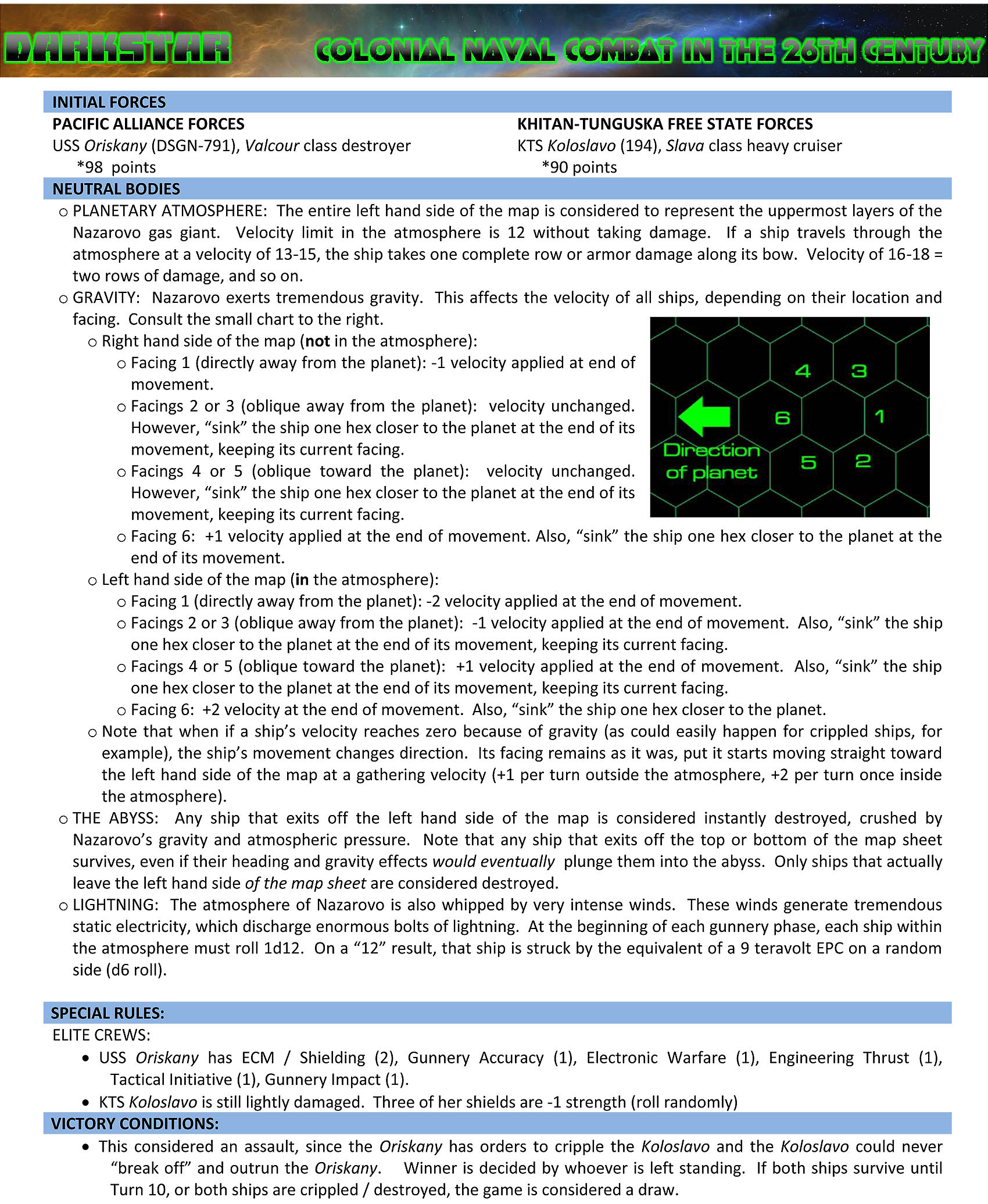
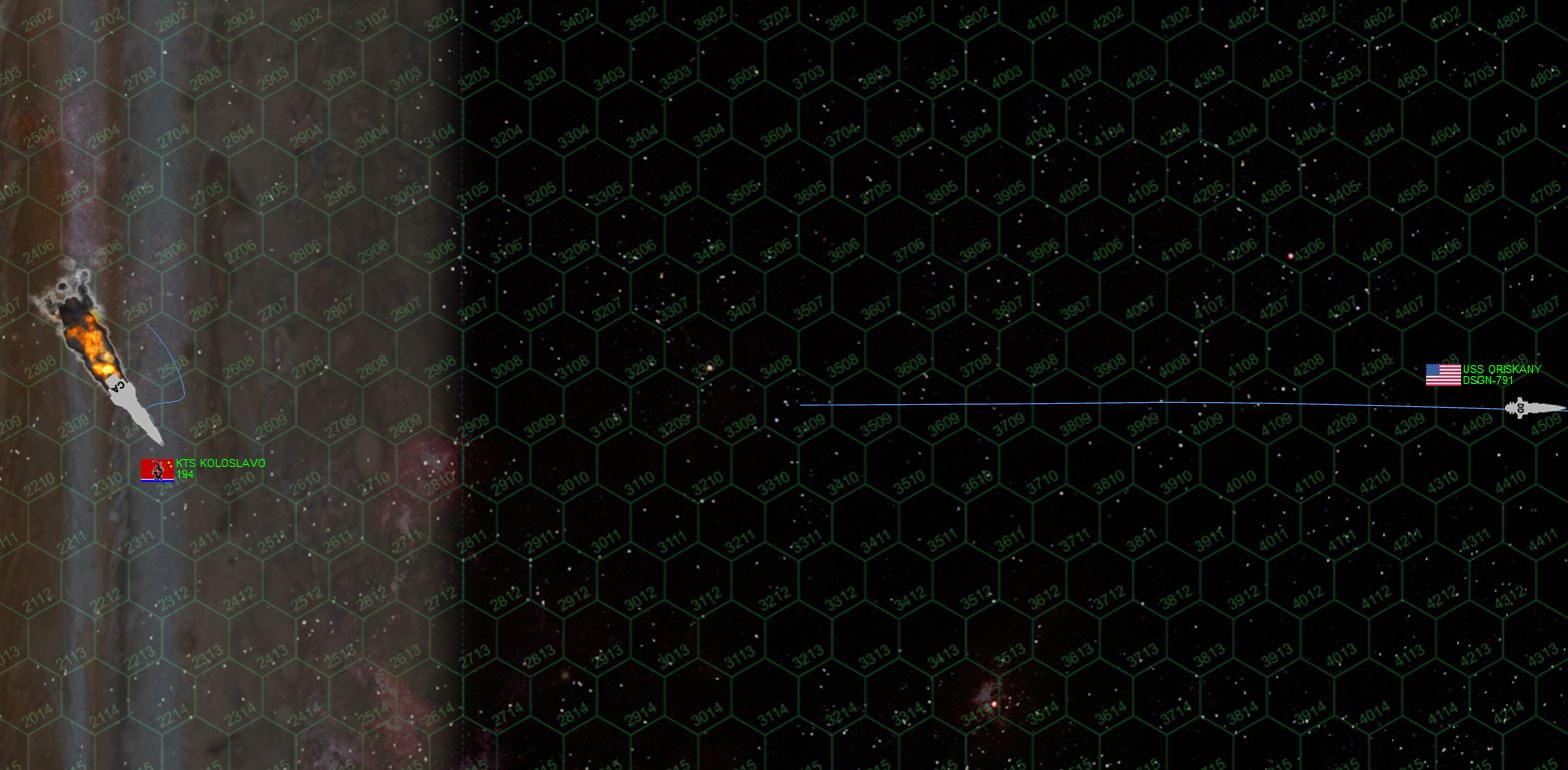
As the USS Oriskany approaches the Nazarovo gas giant, her sensors detect (as expected) the massive heavy cruiser KTS Koloslavo lurking in the storm-shredded, lightning-scorched atmosphere. The cruiser is vectored with her prow upward, engines down into the gas giant’s denser cloud layers. Clearly her captain hopes to protect some of her damaged shields (starboard bow, port quarter, stern) and discourage the Oriskany from cutting across her stern, or at least forcing her deep into the dangerous Nazarovo atmosphere to do so. Also, the huge cruiser can withstand the planet’s lightning much better than the smaller Oriskany, so the Koloslavo is content to force Spencer to take Oriskany “down into the soup” to engage.
Spencer has no problem with the idea. Screaming down at near-suicidal 60 kilometers per second, Oriskany streaks toward Nazarovo in a powered dive. Initially positioned to greet the Oriskany with a long range broadside, already Koloslavo’s aft-mounted guns, plasma projectors, and torpedo tubes are no longer able to come to bear. But she has plenty of forward guns, blasting up out of the Nazarovo atmosphere at 4,000 kilometers. One 10gw rail gun bolt not only hits the Oriskany at this incredible speed and distance, but also right on the armor protecting her bridge. Clearly the Koloslavo’s gunners have had their coffee this morning.

With all engines now full-astern in a maximum deceleration curve, Oriskany rolls over to port and dive-bombs straight down into the Nazarovo atmosphere. A second salvo from Koloslavo’s forward guns miss, as does a ripple-chain of incredibly powerful lightning. Oriskany slings out a full spread of Mk 48 gravitic torpedoes while her forward guns ping away at Koloslavo’s thickly-armored port bow.
Spencer knows he is playing a very dangerous game. If damage from Koloslavo’s withering batteries shut down Oriskany’s power, there is no chance to save the ship. Screaming at nearly 30 kps straight down into the gravity well of a gas giant, the 48,000 ton destroyer will be crushed like an egg shell in a matter of minutes in the titanic heat, pressure, and winds of Nazarovo’s lower atmospheric layers. Already Oriskany’s leading edges are glowing a dull red, the ship’s velocity just short of actually burning off layers of the ship’s hull.
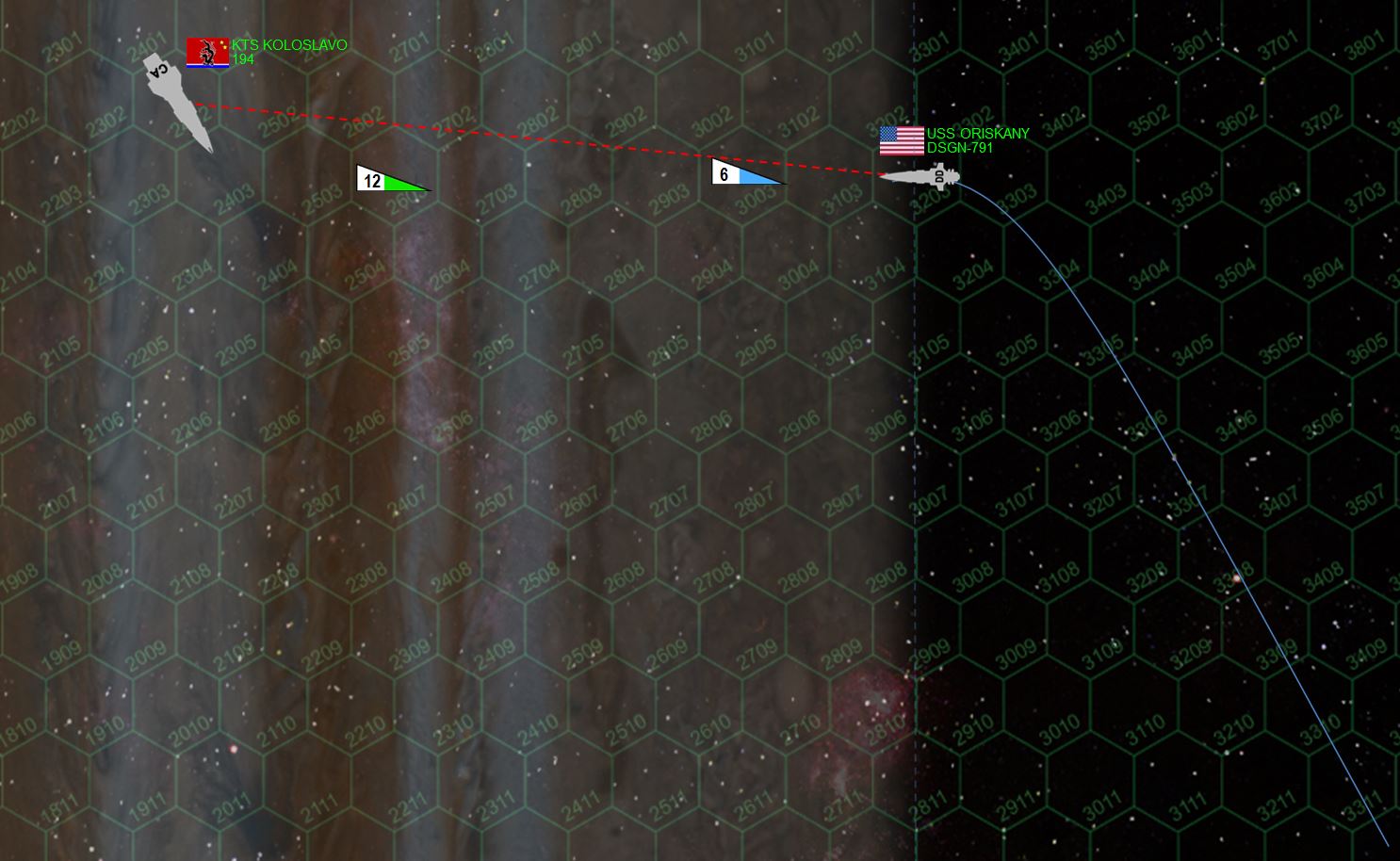
Oriskany is heading straight for the Koloslavo. At the last moment, she makes a port turn, the planet’s gravity still pulling her straight down. Thus, the Oriskany is actually flying partly sideways as she screams past the Koloslavo, giving her a split-second opportunity to put a broadside straight into the massive cruiser’s stern.
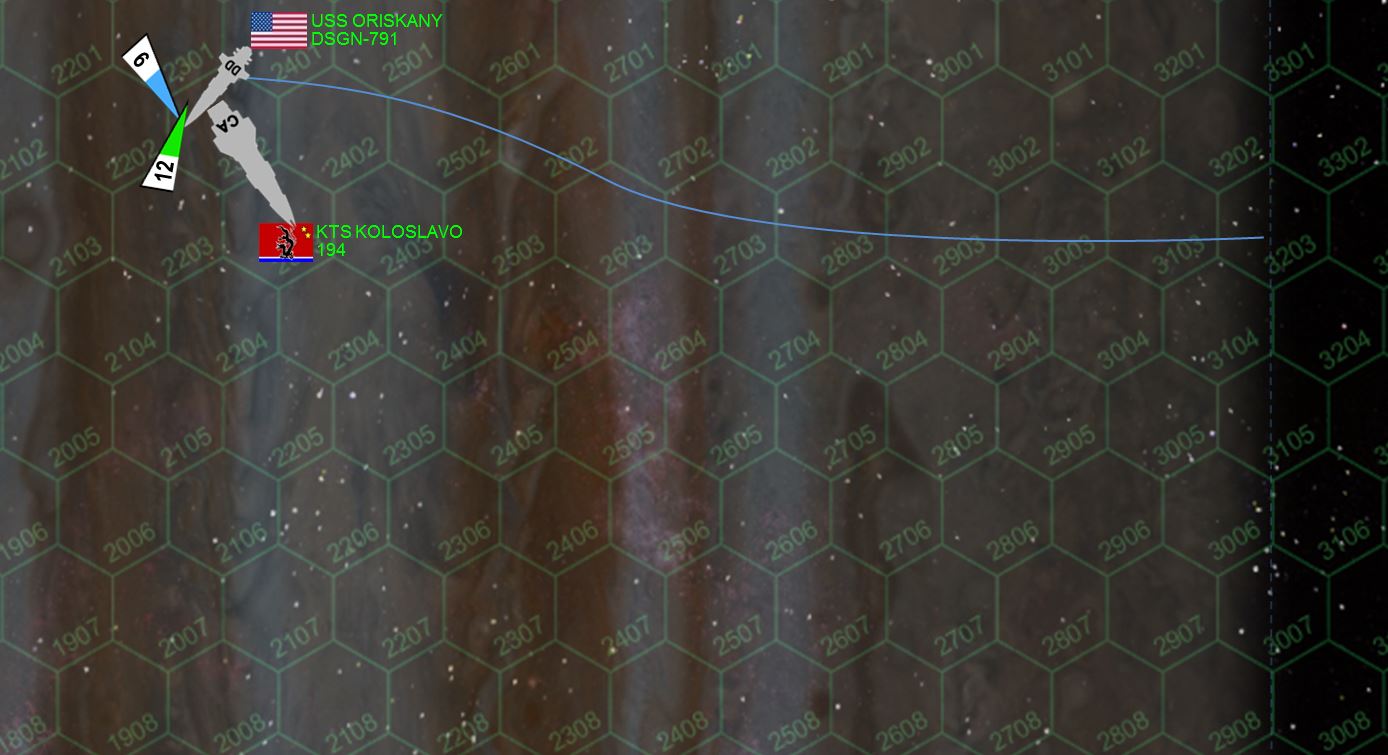
Oriskany’s torpedoes hit first. Only one is shot down by the Koloslavo’s mass drivers, her point-defense system apparently nowhere near as proficient as her main turret gunners. Meanwhile, twelve P-500 warheads of the Koloslavo are headed for Oriskany. Seven are shot down, and the remaining five are turned aside by the “Lady O’s” upgraded ECM suite.
Only two of Oriskany’s torpedoes actually hit the Koloslavo, however, badly damaging the armor but not getting to any of her reactors or engines. The guns do better, tearing through the weakened armor into the massive cruiser’s vitals and knocking down her aft shields. But legendary as she may be, Oriskany is only a destroyer with 5gw rail guns and 6mk lasers. Without landing a solid spread of torpedoes, she just doesn’t have the “punch weight” to take down a heavy cruiser in one salvo.
The Koloslavo, on the other hand, even with only her aft gun mounts, positively maul the Oriskany. Within ten fiery seconds her forward shields are down, her port-side torpedo bays are hit, she loses mass drivers, maneuvering thrusters … internal explosions almost reach the forward magazines. At less than 100km, a salvo of 10gw rail guns simply does terrible damage and again, the Koloslavo’s gunners are excellent.

Darkstar - Battle Report (Part 02)
David vs. Goliath - USS Oriskany vs. KTS Koloslavo in Gias Giant Atmosphere
The Oriskany, her port bow engulfed in a sheet of flame, continues to plummet past the Koloslavo. Both ships are really in trouble here. Oriskany’s enhanced engines fire full power and start to turn her again to port, but her speed is nearly out of control and she’s just lost some of her maneuvering thrusters. This is a very bad time to lose the ability to turn. The Koloslavo, meanwhile, with damaged engines, struggles to push her 168,000-ton bulk up out of the gas giant’s gravity.
The Koloslavo pours more power through her smoldering ion engines, executing a groaning s-turn to try an turn her exposed, unshielded fantail away from Oriskany. The maneuver actually works, Oriskany is moving so fast, in such a dangerous direction, and with such damaged maneuvering thrusters, that she can only decelerate and make a slight turn to port, which still puts her on a course deeper into Nazarovo’s crushing gravity and with her stern facing directly toward Koloslavo’s full broadside (although at a range of 2,200 km, thankfully). More rail guns and plasma slams into Oriskany, actually damaging her portside engines. Yet again, Koloslavo’s gunners are on the money (scoring solid hits even with damaged sensors).
For a heartbeat, there’s a very real possibility that Oriskany could meet her end here at Nazarovo. With her engines hit, there’s the danger of her losing power, a death sentence given her speed and vector … 2,500 km deep in the gas giant’s atmosphere. Russian-made torpedoes also come in, and Oriskany loses more mass drivers, another shield …
Yet the “Lady O’s” legendary luck holds out. Her engineers maintain power. An instant later, the last three torpedoes that were launched from her port side tubes (an instant before they were blown out of the ship’s hull) strike the Koloslavo’s unshielded stern. Yet just as Koloslavo’s main armament gunners are dead-eyes, her mass driver gunners seem to be cross-eyed. No torpedoes are shot down, and all three American warheads hit.
The battle is decided right there. The torpedoes detonate in Koloslavo’s sensors, aft cargo bays, portside engines, and starboard reactors. For a razor-edge moment, whether or not the ship loses power could really go either way, but again luck holds with the Oriskany and the Koloslavo goes dark.
In that moment, the massive ship is doomed. Only moving at 12 kps, and still 900 kilometers in the atmosphere at too shallow of an ascent angle, she does not have the escape velocity or vector to break free.
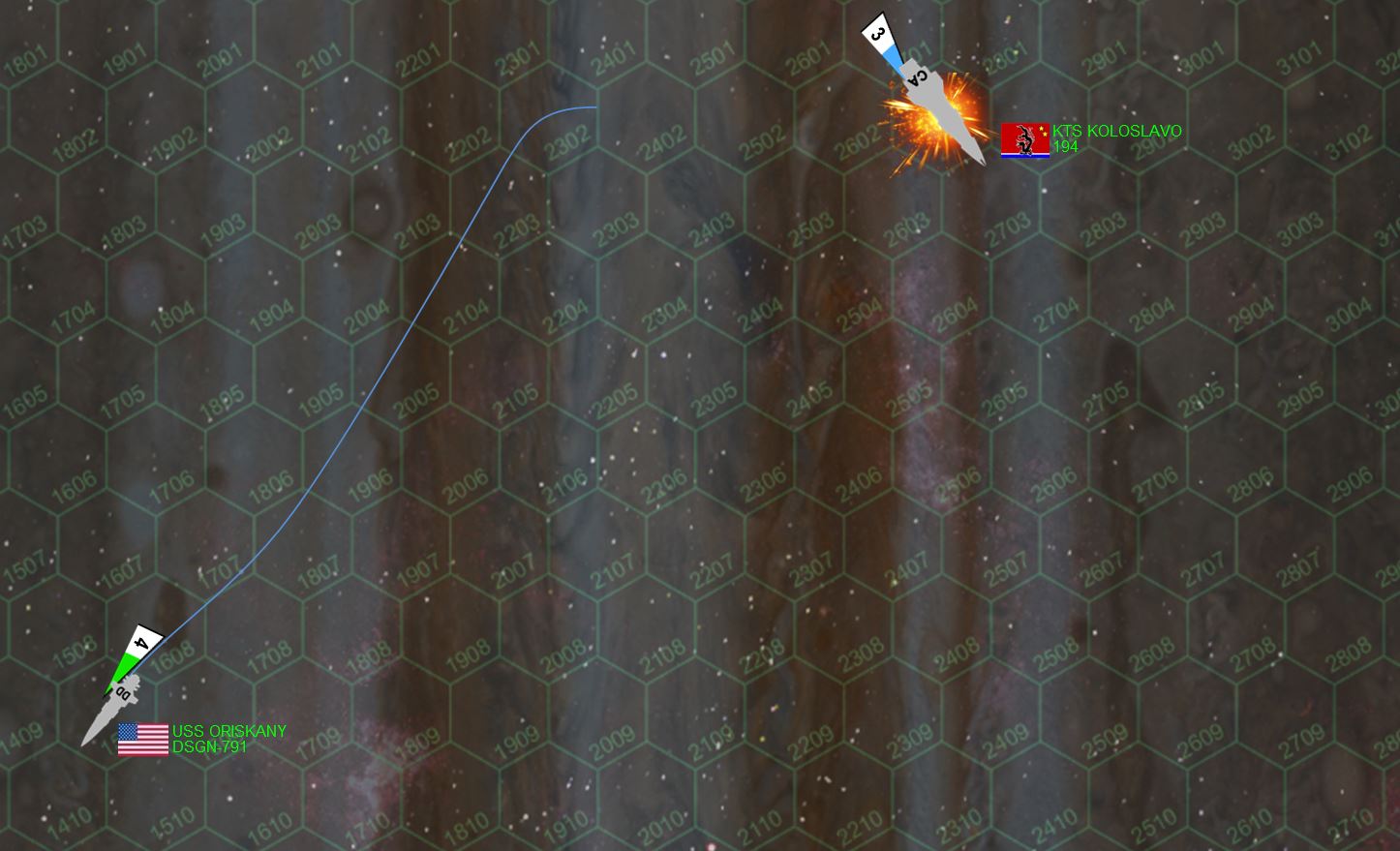
The Oriskany, meanwhile, with two sensors arrays down, half her torpedoes gone, two 40mm mass driver turrets gone, two shields down, and streaming a sheet of fire fed by escaping atmosphere, heaves against her damaged engines and maneuvering thrusters to pull up and away from the Nazarovo abyss. She isn’t free yet, she has to power up through 2,500 km of storm clouds and lightning, with the planet’s unforgiving gravity pulling down on her all the way.
Meanwhile, Koloslavo has already lost that battle. Cutters, launches, and escape pods are soon streaming out of her stricken hull, her trajectory quickly slowing and arcing downward.
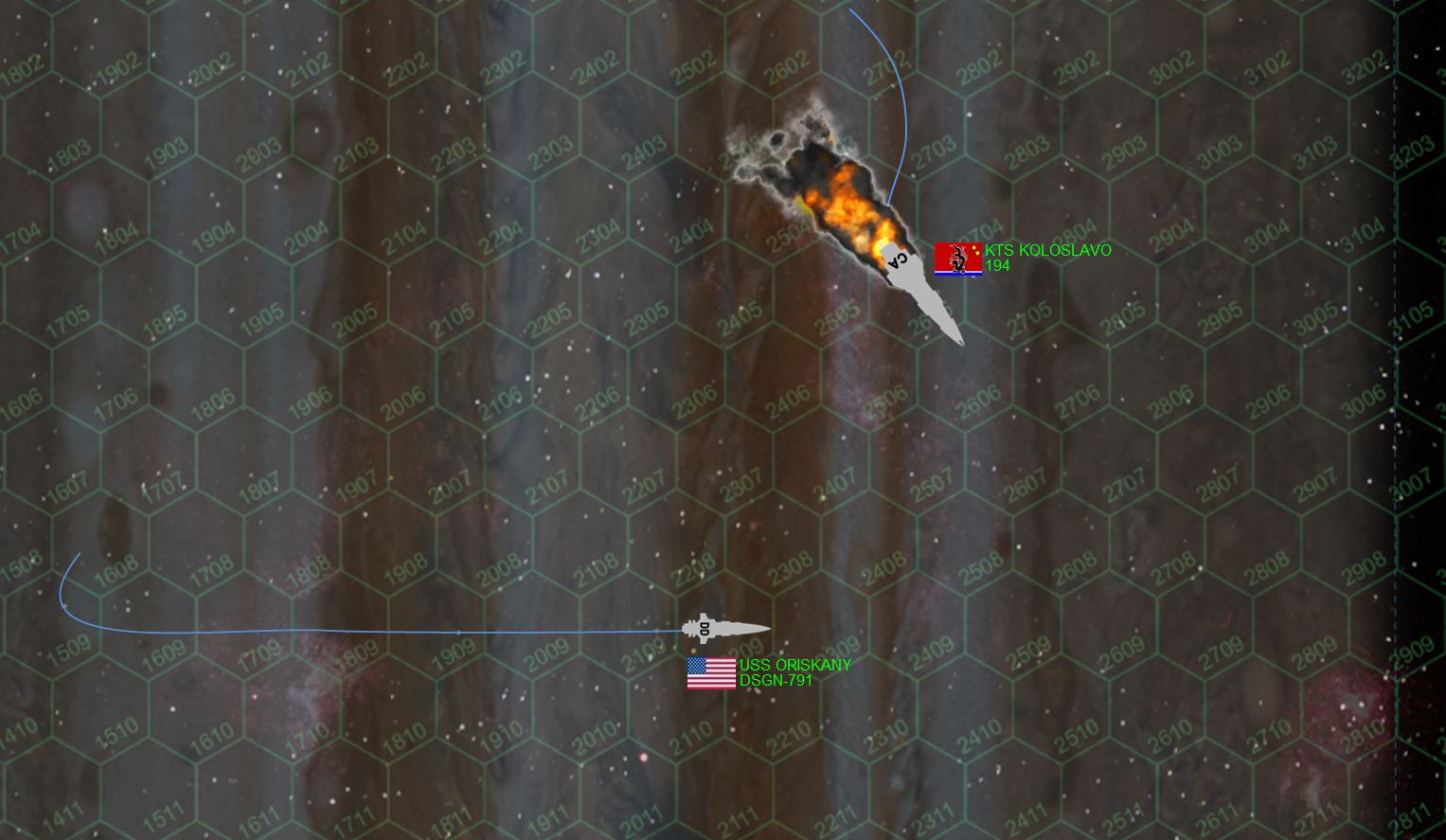
Two more minutes and Oriskany is almost clear. One last bolt of storm cloud lightning hits her starboard bow, coring through the armor and venting her starboard cargo bay. Finally she erupts free from Nazarovo, battered and scorched from stem to stern, trailing wreckage and flame, missing jagged slabs of armor plating, weapons, sensors, mass drivers, and maneuvering thrusters. But she’s made it.

The Koloslavo, meanwhile, has finally been halted, now sucked inexorably downward to her grave. Her crew has a full five minutes to abandon ship, so crew losses are actually surprisingly light (she carries 749 crew and 72 marines, most of which survive the day). But for the proud ship herself there is just no escape. She’s falling at over 18 kps when what’s left of her hull finally caves in, the wreckage vaporized in the unbelievable heat and pressure deep in the bowels of the Nazarovo gas giant some time later.
As for the Oriskany, she’ll need two days to limp back to Hokkaido’s Flower, and 28 days in dry dock to weld her charred, pitted, and perforated hull back together. Fortunately, ships like the Princeton, Valley Forge, Takakawa, and Spokane are soon ready to take the place of the Oriskany–Kikasa battlegroup in the “Hei-Novo” system (Xi Scorpio A/B), so the Pacific Alliance can continue to apply pressure toward peace talks with the Khitan-Tunguska Free State.
RESULT: Minor Pacific Alliance Victory
Darkstar - Taiho Class Light Cruiser
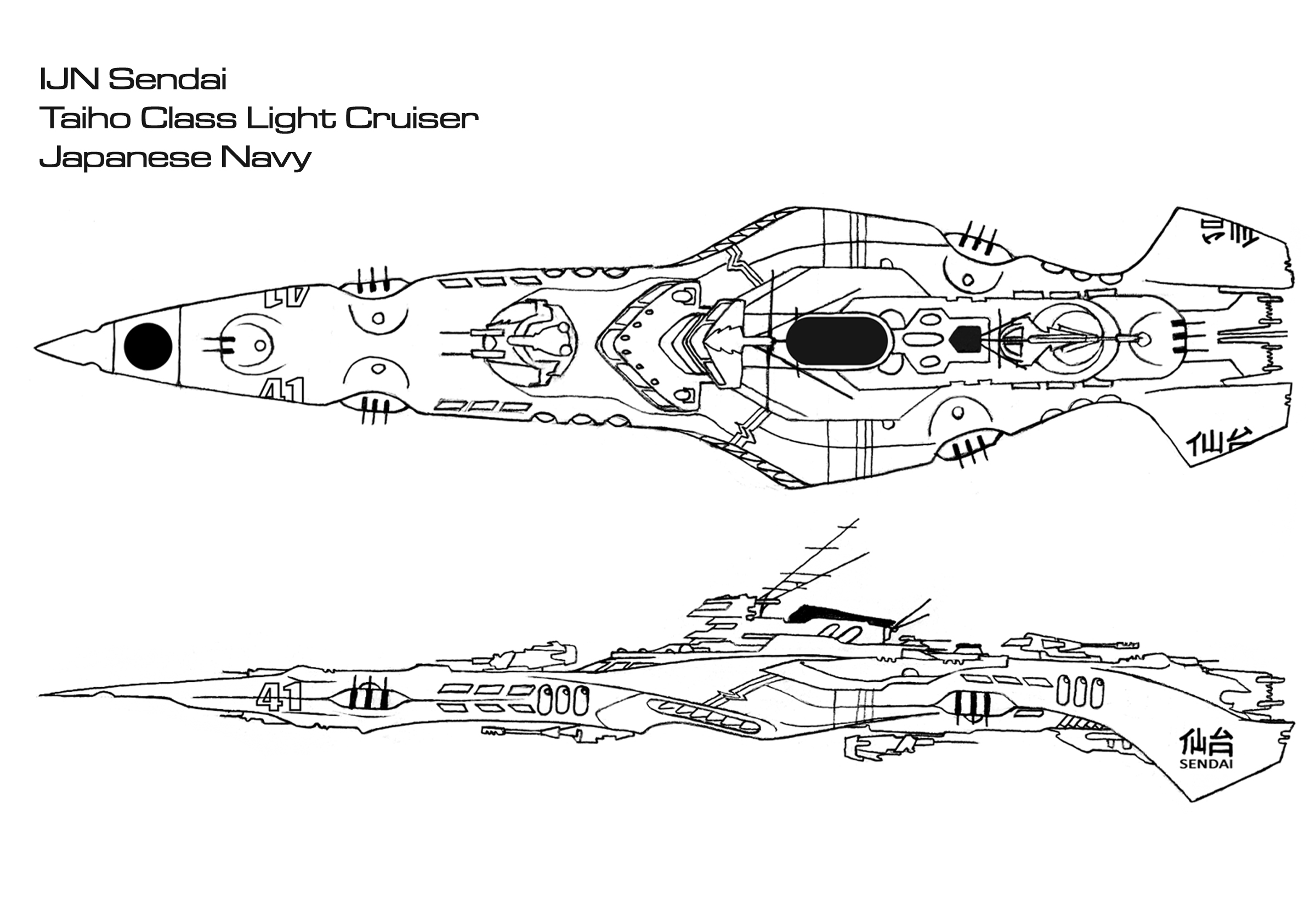
The Taihō (“Great Phoenix”) class of light cruiser is one of the most modern warships of its size presently being produced by any navy. The are sleek, fast for a cruiser, and beautiful. Furthermore, they bristle with state of the art ECM emitters, shielding, and some of the most advanced target acquisition sensors in Known Space. Although originally fitted with rail guns, the Taihō has since dispensed with such tradition in favor of a lighter, longer-ranged array of 8 MgKv laser emitters, backed up by powerful 60 eHz syglex emitters for carving off a target’s armor or damaging the larger components of bigger ships. Even a medium-ranged broadside from a Taihō can easily burn through the hide of a comparable-sized ship, shaving down protection with her x-ray guns before punching into reactors, engines, and magazines with heavy lasers and of course the dreaded Ki-45 “Toryu” (Dragon Slayer) torpedoes.
These updates to the Taihō also saw new thinking in regards to the shielding and mass driver defenses. Original ships of this class suffered heavily from Chinese, Prussian, and American torpedo strikes to their engines and gravity rudders, and so defenses in the aft quarters has been greatly increased. However, a ship natually can’t be invulnerable everywhere, so forward protection is actually somewhat weak. Lastly, the Taihō cruisers were upgraded to the newest “Seiku” (Clear Sky) targeting and fire control system, enough to partially suppress the ECM of even the most heavily-shielded of targets. Yet for all this technology, the Taihō remains a relative lightweight in sheer hitting power and resilience when stacked up against the cruisers of other navies. Such advanced equipment also raises questions of supply and maintenance, especially given the rather cramped cargo capacity. Only time will tell if the new tech crammed into the sleek hulls of the Taihō class will stand the rigors of colonial naval combat.
Metrics:
Mass: 78,867 tons
Crew: 417 Officers and Men
Marines: 42
Passengers: 15
Cargo: 300 tons
Aerospace:
2 scouts at 300 tons
1 launch at 2,000 tons
1 yacht at 4,000 tons
ECM / Gravitic Shielding
Bow: 4
P Bow: 5
S Bow: 5
P Quarter: 5
S Quarter: 5
Stern: 5
Armament:
Turret – x2 8-mgkv lasers (bow)
Turret – x2 8-mgkv lasers (stern)
Turret – x1 75-eHz syglex emitter (bow)
Turret – x3 class V Ki-45 torpedo tubes (port bow)
Turret – x3 class V Ki-45 torpedo tubes (starboard bow)
Turret – x6 35mm mass driver point defense array (bow)
Turret – x4 35mm mass driver point defense array (p bow)
Turret – x4 35mm mass driver point defense array (s bow)
Turret – x6 35mm mass driver point defense array (p quarter)
Turret – x6 35mm mass driver point defense array (s quarter)
Turret – x6 35mm mass driver point defense array (stern)
Ships in Class
CE 37 IJN Taiho — 2506, New Kyoto Shipyards, Earth
CE 38 IJN Nagara — 2508, Akagi Prime, Gamma Leporis
CE 39 IJN Chitose — 2509, New Kyoto Shipyards, Earth
CE 40 IJN Oyodo — 2510, Shogun Station, Callisto
CE 41 IJN Sendai — 2511, Shogun Station, Callisto
CE 42 IJN Tone — 2512, Akagi Prime, Gamma Leporis
CE 43 IJN Kitakami — 2513, New Kyoto Shipyards, Earth
CE 44 IJN Takase — 2514, Akagi Prime, Gamma Leporis
CE 45 IJN Shogawa — 2515, Shogun Station, Callisto
CE 46 IJN Kozuryu — 2516, Shogun Station, Callisto