










Conquering the verse, one parsec at a time.




Law and Order
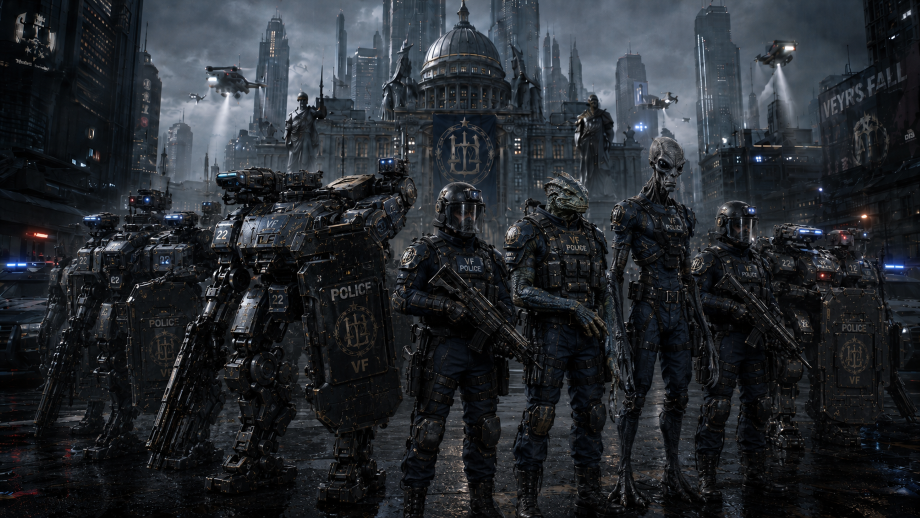
The Police of Veyr’s Fall
The official police of Veyr’s Fall are known as the Veyr’s Fall Civic Security Directorate, though most citizens call them CivicSec, the Directorate, or, less politely, company shields.
On paper, they are the lawful police force of the planetary government. They patrol the streets, investigate crimes, manage public order, protect government buildings, respond to riots, and enforce planetary law. Their badges bear the official emblem of Veyr’s Fall, their uniforms are dark blue and black with silver-gold trim, and their officers swear an oath to protect the citizenry.
In practice, they are exhausted, underfunded, compromised, and surrounded on all sides by forces far richer than themselves.
The Directorate is not a single, clean organisation. It is a layered, fractured institution made up of honest cops, desperate cops, bought cops, frightened cops, corporate plants, off-world recruits, alien auxiliaries, android officers, and combat robots. Some officers still believe in the badge. Some use it to survive. Some use it to hurt people. Many have forgotten why they joined.
A Force Owned by Debt
CivicSec officers are not paid enough to live well, but they are paid just enough to remain trapped.
The job is dangerous, and injuries are common. Armour fails. Street gangs use military surplus. Corporate security teams leave wreckage behind and expect the police to clean it up. Riots turn ugly fast. Androids malfunction. Alien labour enclaves sometimes erupt into violence when promises of work, housing, or transport off-world prove false.
Medical treatment for wounded officers is rarely free.
Helix Dominion clinics patch them up, rebuild limbs, treat radiation damage, install organ stabilisers, and provide trauma medication — but every treatment comes with a payment plan. A cop who loses a leg in a refinery riot may return to duty with a Helix prosthetic and a debt larger than their yearly salary. An officer exposed to toxic fumes may need monthly injections to stay alive. Another might rely on neural stabilisers after a concussive blast.
Leaving the job means losing discounted treatment, housing access, pension protection, and debt restructuring.
So many good cops stay because quitting would bankrupt their families.
They walk patrols with repaired bones, borrowed organs, and company-owned implants, knowing the same corporations that caused their injuries now own the cure.
Crime Rate
Crime on Veyr’s Fall is not just high. It is normalised.
Official figures claim the planet suffers from a moderate but manageable security crisis, with violent crime concentrated in “economically distressed zones.” Verity Public Communications repeats this wording constantly.
The real situation is far worse.
Across the major cities, especially the lower industrial districts, crime is estimated to be three to five times higher than the official reports admit. In some abandoned hab-zones and factory warrens, there are no reliable statistics at all because the government has effectively stopped counting the dead.
Common crimes include:
- Theft, black-market trading, and cargo hijacking.
- Corporate sabotage disguised as street crime.
- Gang protection rackets.
- Illegal cybernetic surgery and android modification.
- Identity fraud through stolen Civitas records.
- Fuel theft from Tarsk Meridian depots.
- Food riots and ration fraud.
- Kidnapping for debt repayment, ransom, or forced labour.
- Murder-for-hire and deniable corporate assassinations.
- Police corruption, evidence tampering, and paid non-response.
The highest crime districts are not always the poorest. Some of the most dangerous places on Veyr’s Fall are corporate border zones, where rival company interests overlap, and everyone pretends the violence is random.
A dead union organiser is recorded as gang violence.
A bombed transport hub is blamed on extremists.
A missing journalist is listed as a voluntary disappearance.
A murdered witness becomes an unfortunate robbery.
Crime is everywhere. Truth is a rare commodity.
Police Response Time
CivicSec response times depend almost entirely on where the call comes from and who owns the street.
In the wealthy corporate enclaves, government districts, orbital transit zones, and executive residential towers, response is fast and heavily armed. In these areas, police drones, android units, and rapid-response vehicles can arrive in two to five minutes. Sometimes, corporate security arrives first and merely allows CivicSec to file the report afterwards.
In ordinary working districts, response times average twenty to forty minutes, assuming a patrol is available, fuel has been allocated, and the local precinct has not been bribed to ignore the incident.
In the lower habs, refugee blocks, old industrial zones, and unofficial settlements, response may take several hours.
In some areas, no one comes at all.
Citizens in the worst districts have a bitter saying:
“If CivicSec arrives in five minutes, you are rich. If they arrive in an hour, you are useful. If they arrive tomorrow, you are evidence.”
Even then, “response” does not always mean help. Sometimes it means a report. Sometimes it means a bribe demand. Sometimes it means an armoured robot ordering everyone to lie face down while it calculates acceptable collateral damage.
Life Expectancy
The official planetary life expectancy on Veyr’s Fall is listed as 98 years.
No one believes that number.
The government uses averages padded by corporate executives, protected specialists, wealthy off-worlders, and citizens with access to Helix treatments. In the upper districts, a person with money, gene therapy, clean food, private security, and medical insurance might live to 125 or more.
For the average citizen, life expectancy is closer to 64 to 68 years.
In the lower industrial zones, contaminated districts, gang territories, and refugee settlements, it can fall to 42 to 48 years.
For undocumented workers, illegal migrants, debt labourers, and citizens without medical registration, no reliable records exist. Many simply disappear from the system long before they die.
The main causes of early death are industrial disease, untreated injuries, polluted water, workplace accidents, gang violence, addiction to corporate-issued stimulants, food contamination, and delayed medical treatment. Helix can cure many of these conditions, but only for those who can pay or those who remain useful.
Human Officers
The human police of Veyr’s Fall are a study in slow collapse.
Some are still brave. Some still run toward gunfire, protect children during raids, falsify reports to save desperate families, warn dissidents before arrests, or quietly sabotage corporate orders they know are wrong. They are tired, angry, and often afraid, but they still remember that the badge was meant to mean something.
Others have given up.
They take bribes because their children need food. They ignore crimes because the wrong suspect is protected. They shake down street vendors, steal from evidence lockers, sell patrol routes to gangs, or act as private enforcers for corporate interests. Some become cruel because cruelty is the only power left to them.
Between these extremes is the majority: officers trying to get through one more shift without dying, being sued, being framed, being bought, or being noticed by someone powerful.
Androids and Robots in the Force
Androids and robots are a major part of CivicSec.
They are cheaper to deploy, easier to repair, and far more politically convenient than human officers. A robot does not demand hazard pay. An android can patrol toxic zones without complaint. A combat frame can hold a barricade long after human morale would fail.
But not all machine officers are alike.
Some are simple law-enforcement robots: armoured machines loaded with crowd-control routines, threat-recognition software, and obedience protocols. They follow orders with ruthless efficiency and no moral hesitation. If their programming says a crowd must disperse, they disperse it. If their hidden directives identify a target as a threat, they act before any human officer can question why.
Others are advanced androids with artificial intelligence, personalities, memory development, and self-awareness. Some believe deeply in justice. Some are more compassionate than their human colleagues. Some quietly struggle with the fact that Novatek Ascendant Systems can alter, audit, or erase parts of their minds if they are deemed defective.
A self-aware android officer may face the same horrors as any human cop, but with one additional fear:
Their conscience may not legally belong to them.
There are rumours of entire police units running hidden Novatek command layers. These directives do not appear in official CivicSec systems. They activate under certain conditions: protect corporate property, suppress android liberation groups, ignore specific executive warrants, or prioritise corporate infrastructure over civilian life.
Many officers do not know whether the machine beside them is a partner, a person, or a weapon waiting for the right signal.
Alien and Off-World Officers
Veyr’s Fall promised opportunity to everyone.
That was the lie that brought many aliens and off-worlders to the planet.
Some came as workers. Some are refugees. Some are security contractors. Some were veterans from distant wars who believed a government police job would offer stability, citizenship, and a way out of poverty. Instead, they found debt, suspicion, poor housing, corporate contracts, and a planet where outsiders are useful but rarely welcome.
Many alien officers join CivicSec because the job provides legal status, ration priority, housing access, and protection from deportation. Civitas Continuance Authority often uses police service as a pathway to residency, though the requirements are harsh and the promises frequently change.
Some alien officers are bitter. They see humans as the architects of Veyr’s Fall’s misery, the species that lured them with false promises and then trapped them in debt. For these officers, the uniform becomes permission to punish the population that disappointed them.
Others side fiercely with ordinary humans. They recognise the same exploitation in different shapes. They protect migrant districts, help workers cross checkpoint lines, and understand that the real enemy is not species, but ownership.
This creates tension inside the force. Human officers resent alien recruits given dangerous jobs but fewer rights. Alien officers resent human citizens who still have more legal standing than they do. Android officers watch both and quietly wonder whether either group sees machines as people.
Public Reputation
Most citizens do not trust CivicSec, but many still call them when things go bad.
The police are feared, mocked, needed, hated, and occasionally loved. A corrupt precinct can be worse than a gang. A good precinct may be the only thing stopping a district from collapsing completely.
Children in safer districts are taught that CivicSec protects them.
Children in the lower habs are taught to hide when the blue lights come.
The force’s motto remains:
“Order. Duty. Protection.”
Someone has scratched a different version onto the walls of several precinct holding cells:
“Order for sale. Duty in debt. Protection for those who pay.”










![Sneak About With Star Wars: Legion’s Guerilla Troopers & More [UPDATED]](https://images.beastsofwar.com/2026/09/g-troops-star-wars-cover-600-338.jpg)