







Redvers and Son Get Into Bushido




Recommendations: 1291
About the Project
My son and I were looking for a new game to get into. Something that was low on models, fun and reasonably quick to play. We decided on Bushido.
Related Game: Bushido
Related Genre: Fantasy
This Project is Active
Deployable terrain
As part of your warband, Bushido allows you to purchase upgrade cards, event cards and terrain to refine your approach. My son likes to use both the Road Side Idol and the Gorinto cards as part of his Temple of Ro Kan force so rather than deploying 30mm bases, I decided to 3d print some terrain for him.
On the left in the picture, we have the roadside idol that allows a monk in btb with it to use an activation to generate their full Ki for the turn. Very handy for the Ki hungry monks.
The idol was a 3d scanned image of a real Buddhist statue (I forget which one) that I’ve downloaded and reduce in size to fit the game scale. I’ve then virtually attached it to a 30mm base in a 3d building tool and printed it out. It’s been painted with a bronze, given a light dry brush of dark rubber grey, a heavy dose of nihilakh oxide which I’ve then wiped most of it off. Finally, a dry brush of shining gold to pick out the detail. All quick and easy.
The Gorinto (on the right in the picture) allows one model each turn within 6″ to gain 1 extra Ki (Ki being the in game currency for models to perform their special actions and boost their abilities). Out of game, a Gorinto is a Buddhist pagoda, often used in funeral services.
To create this, I’ve searched thingiverse and found a free gorinto which I’ve then attached to a 30mm base in a 3d builder program. Once printed, it got a grey primer, black wash and then a grey dry brush. It was painted in about 30 minutes including drying time.
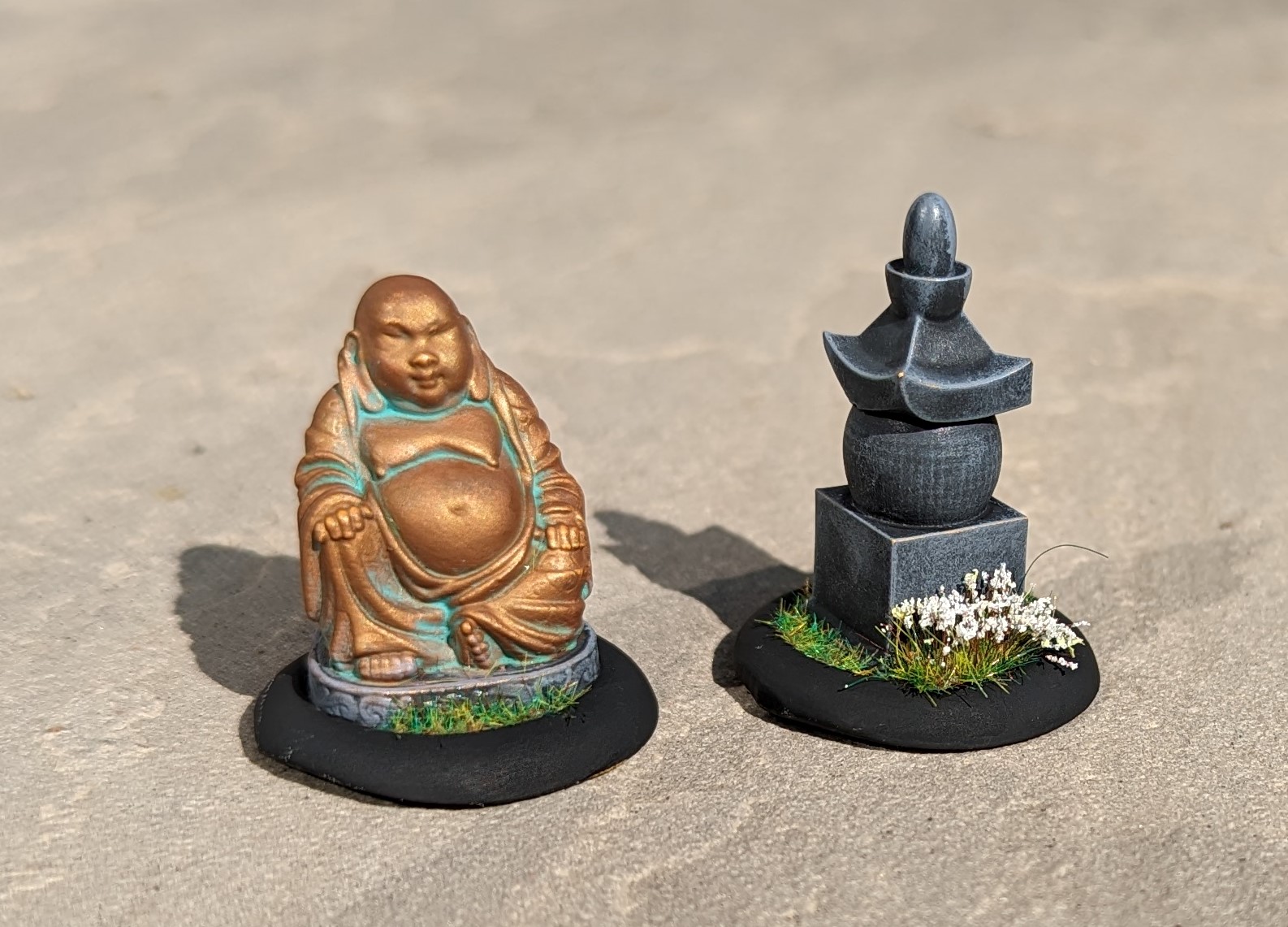 Idol and Gorinto, living in harmony
Making a Panda Restaurant
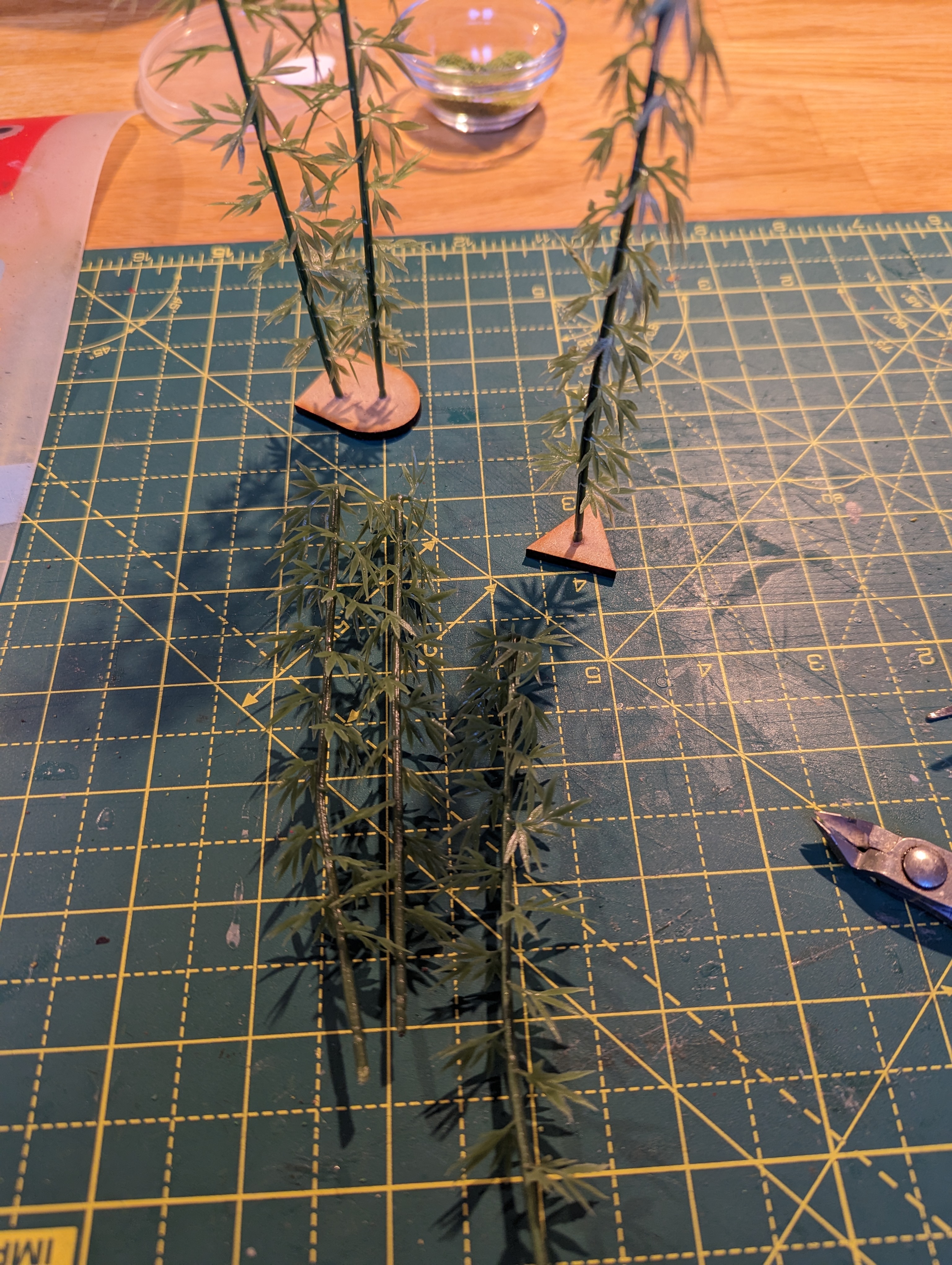
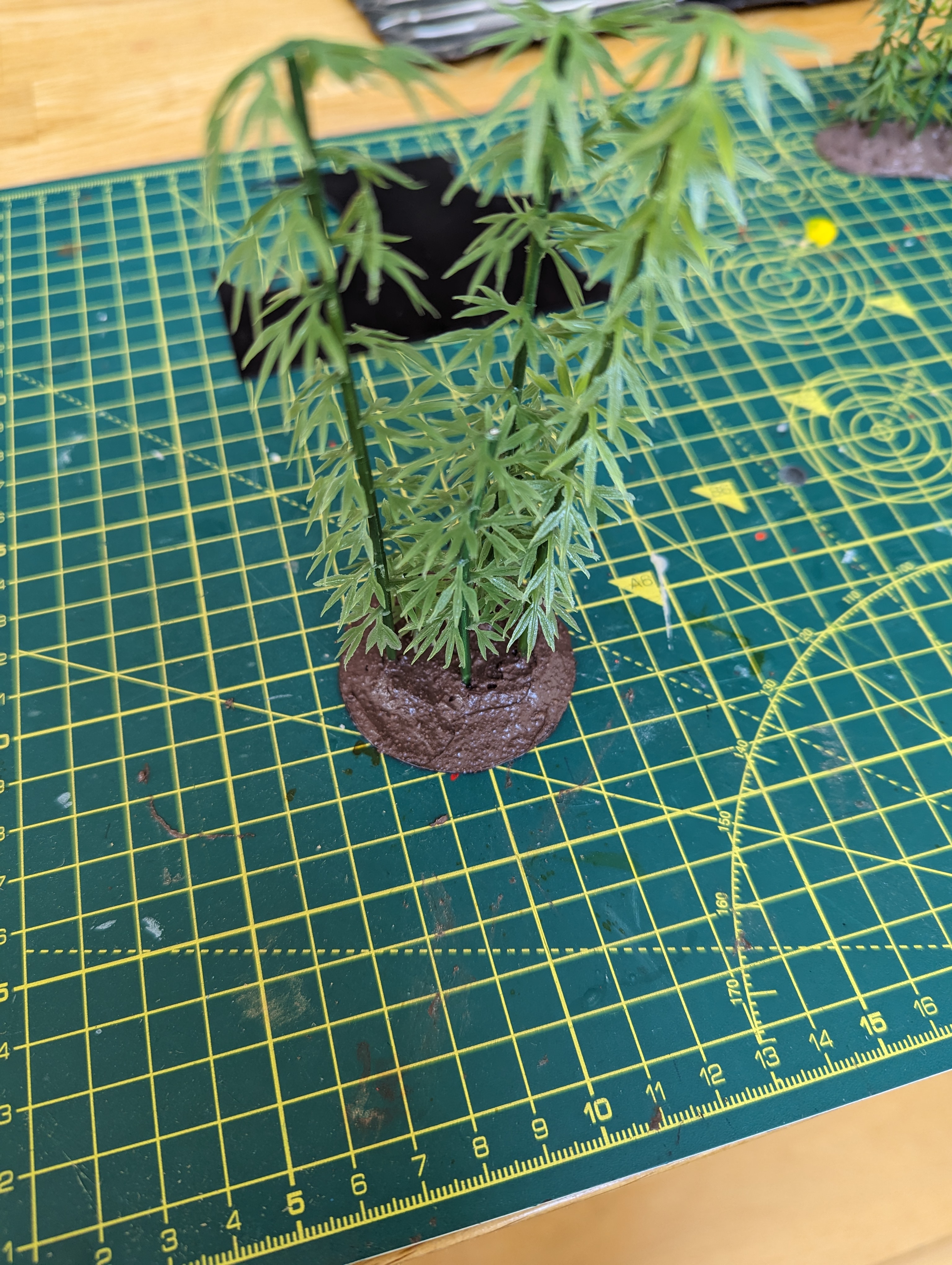
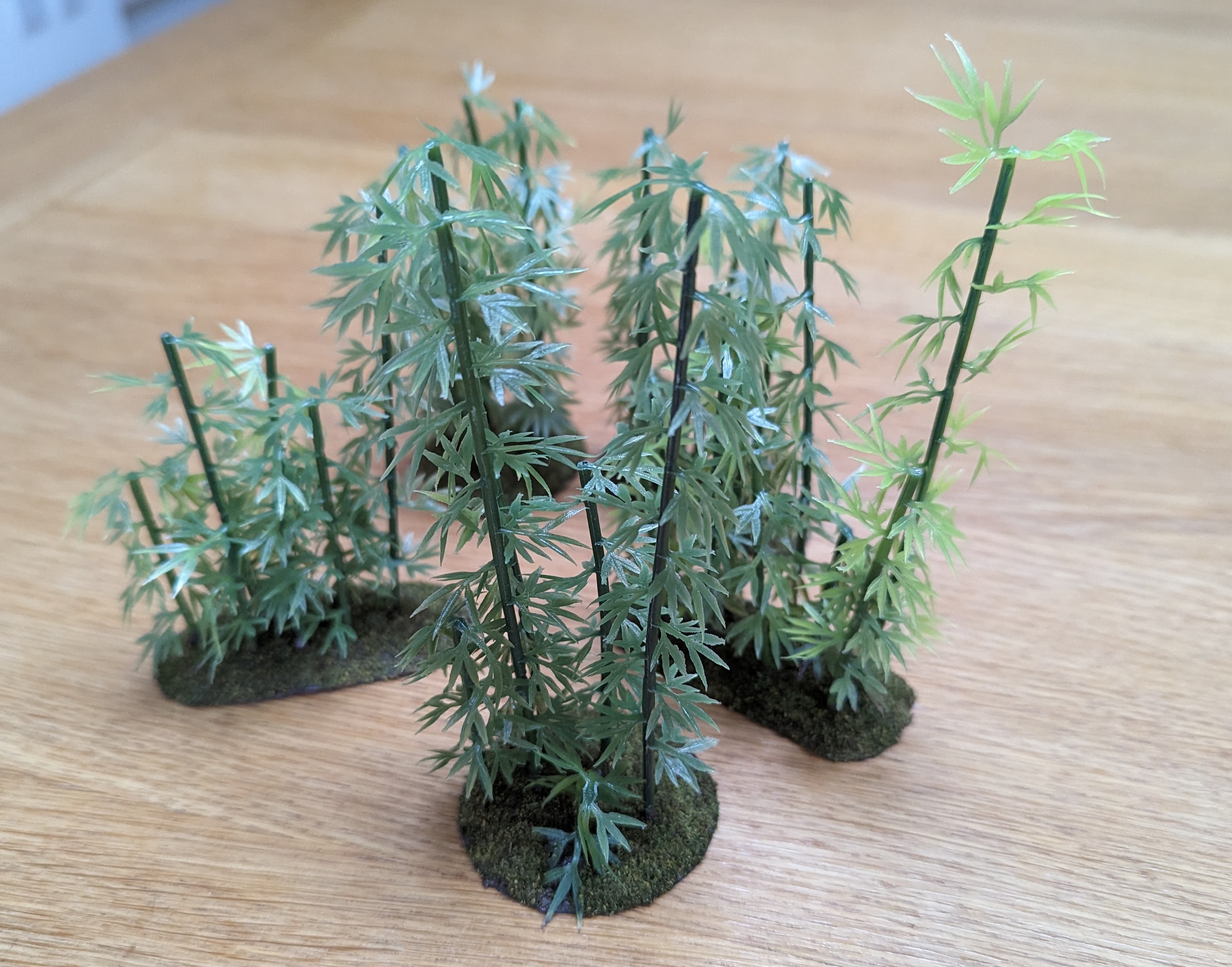
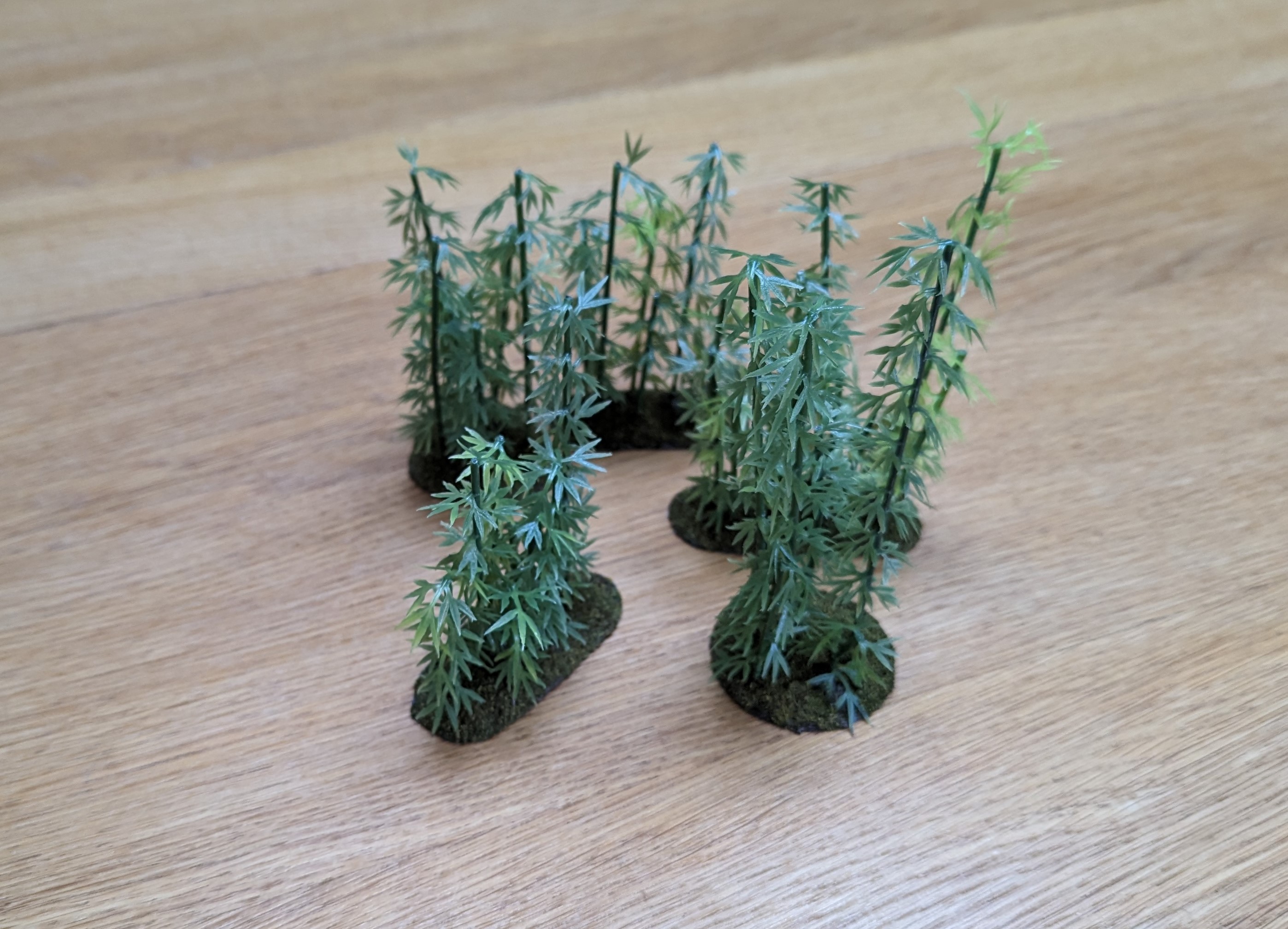
We’ve got no vegetation for our Bushido games, so time to correct that. I’ve ordered a bag of plastic bamboo. It’s not the most realistic of plastic flora but will certainly work for some throw down terrain for our games.
I’ve got lots of left over 3mm mdf off cuts which I’ve used as a start of the base. I’ve drilled a hole in the mdf and then just glued the bamboo into it, cutting the bamboo to different heights to create variation. I’ve then cut plasticard to the desired shape and size of the terrain and glued the mdf/bamboo to the plasticard.
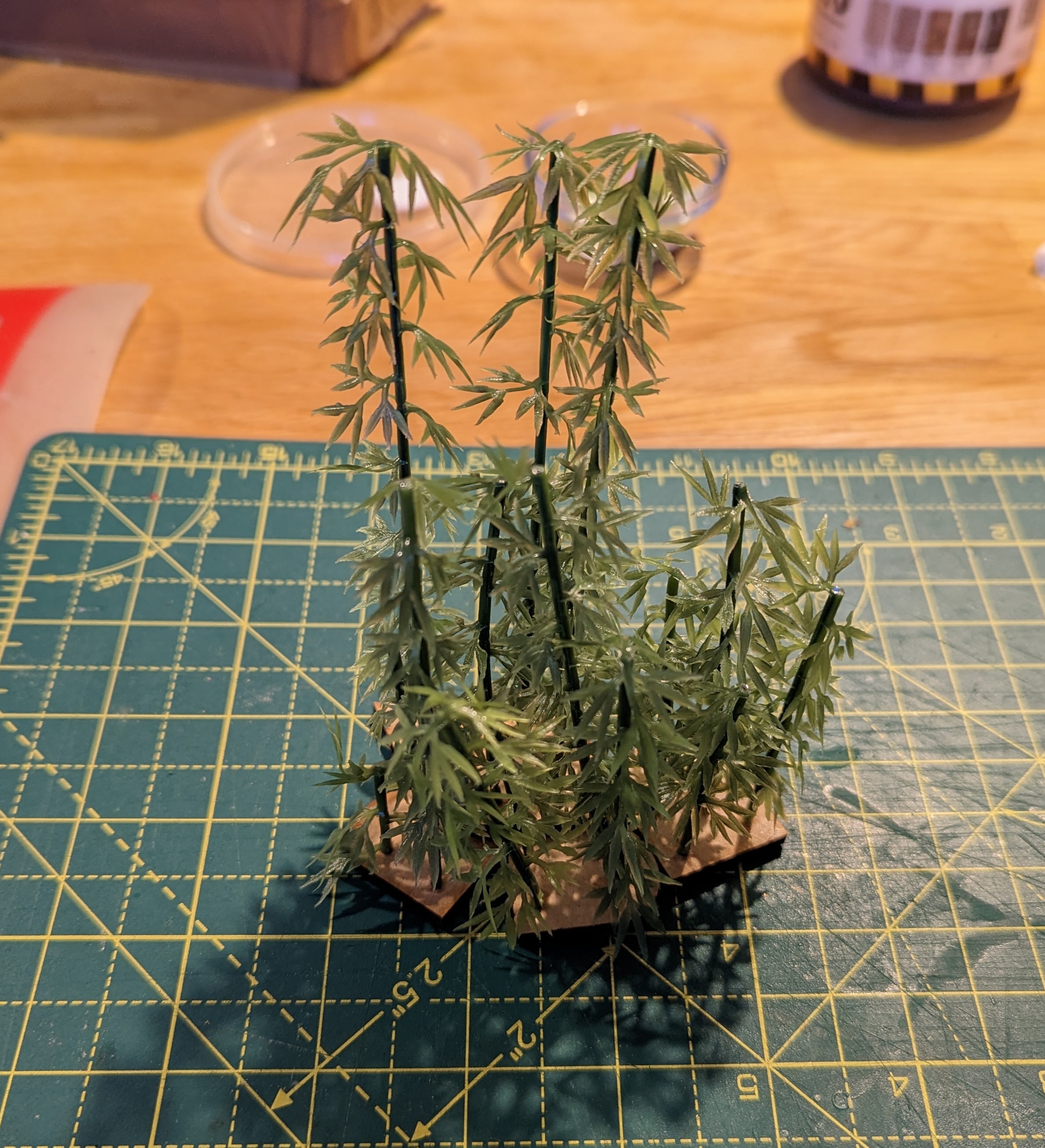
Once all the superglue is dry, I’ve smeared the plasticard and mdf with my acrylic mud paste. I’ve been very liberal here to hide the mdf. Once dry, an application of pva and some flock and job done! Quick, easy but quite effective.
 Lloyd shot
The Cult Starter Set: Mokoti
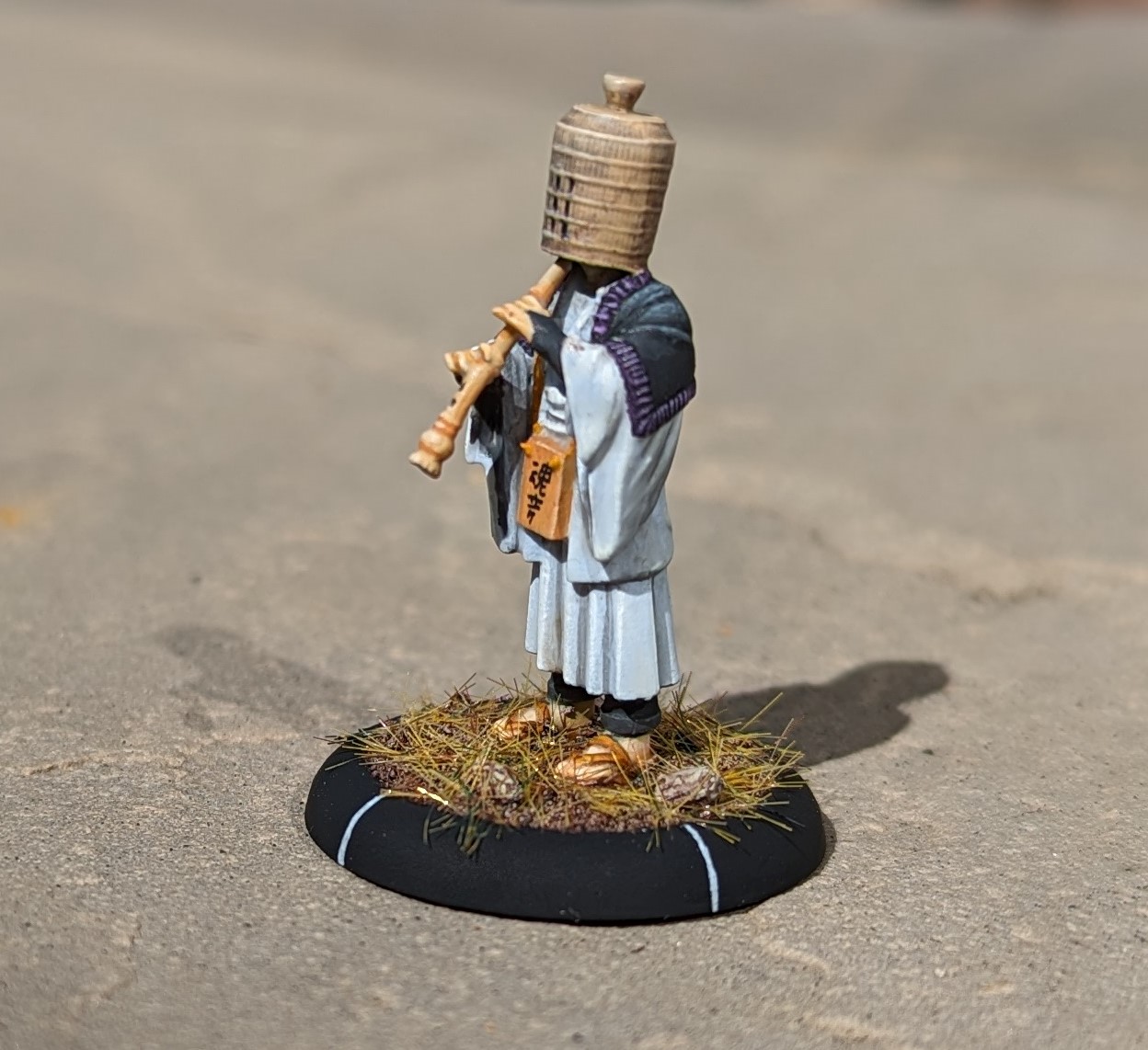
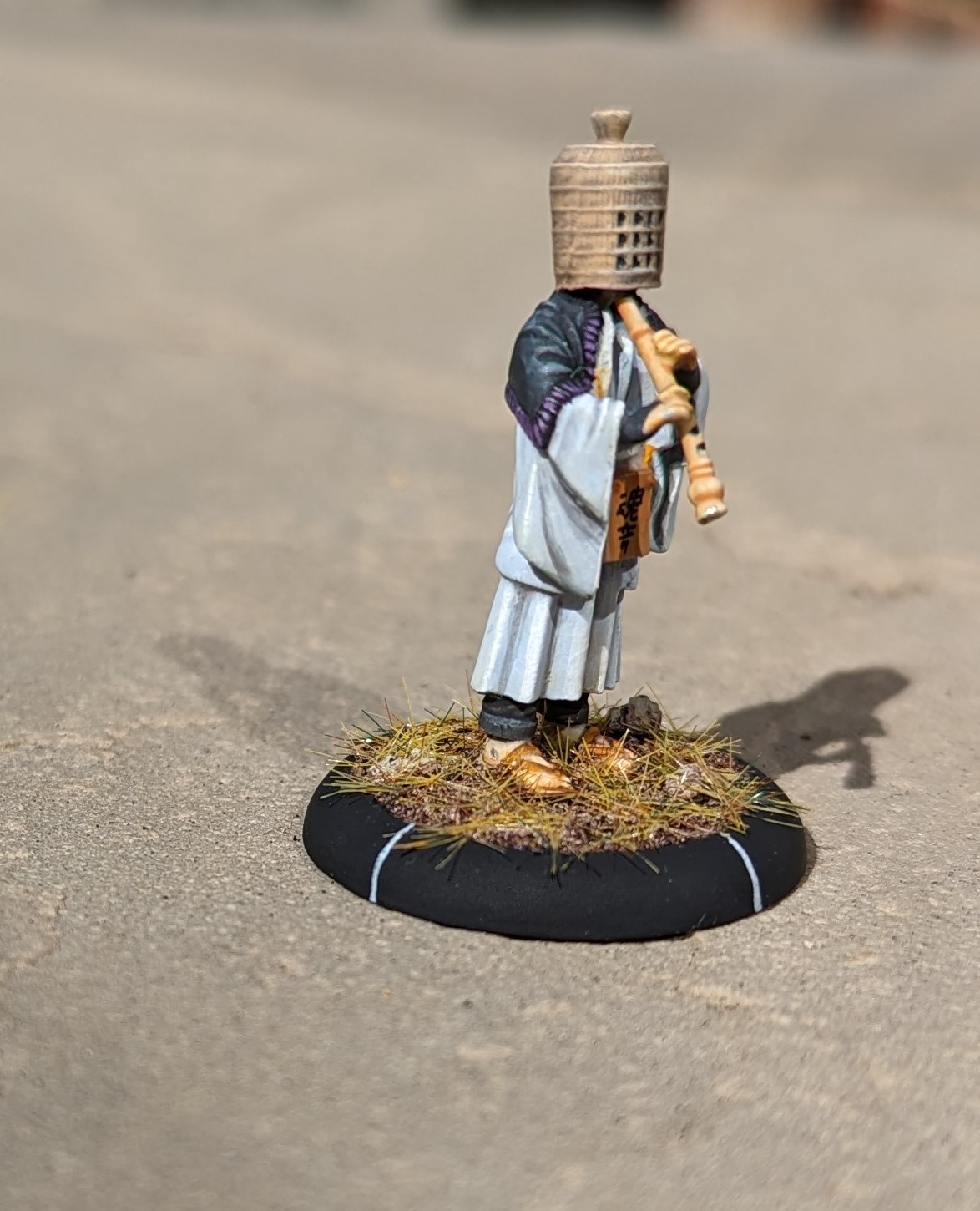
We’ve now got lots of lovely terrain to play around but time to actually paint some models beyond the Ronin starter set. I’ve delved into my Cult of Yurei starter set and started on Mokoti. In game, he’s cheap – just 10 rice, the Bushido equivalent of points – so in a normal 100 point game, he’s not hogging a lot of points but he does come with the Obey Ki feat which allows him to attempt to control other models. In the last battle report, this came in handy in controlling the mighty Kuma!
He’s based upon the Zen Buddhist Komuso monks that used to travel from village to village in Japan, playing their flute for food donations. They used to wear a wicker or reed basket on their head (called a tengai) to separate the monk from their ego.
In the case of Mokoti, he uses his flute to subvert those he meets and bends their will to that of the Cult.
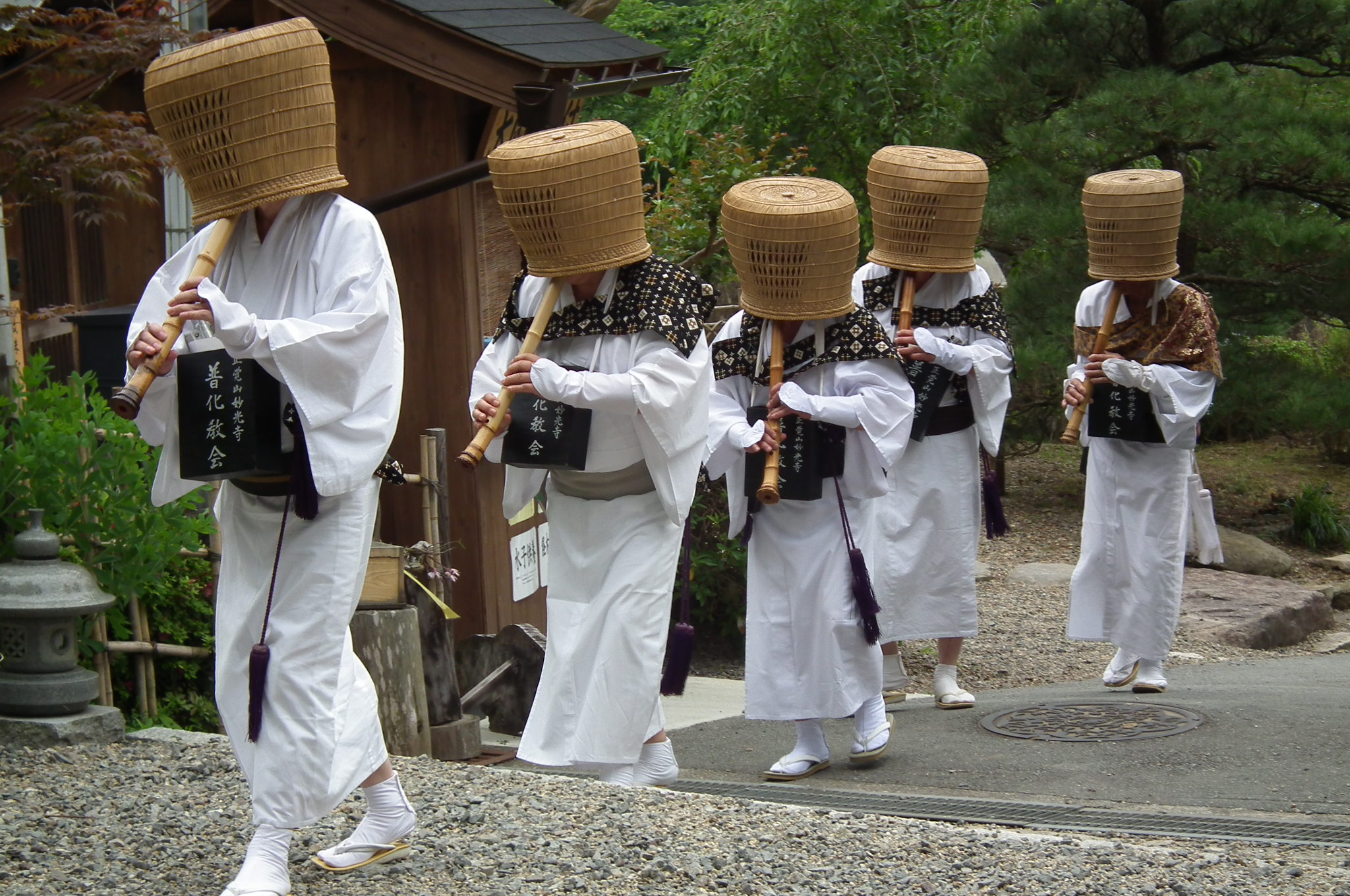 Some Komuso monks yesterday
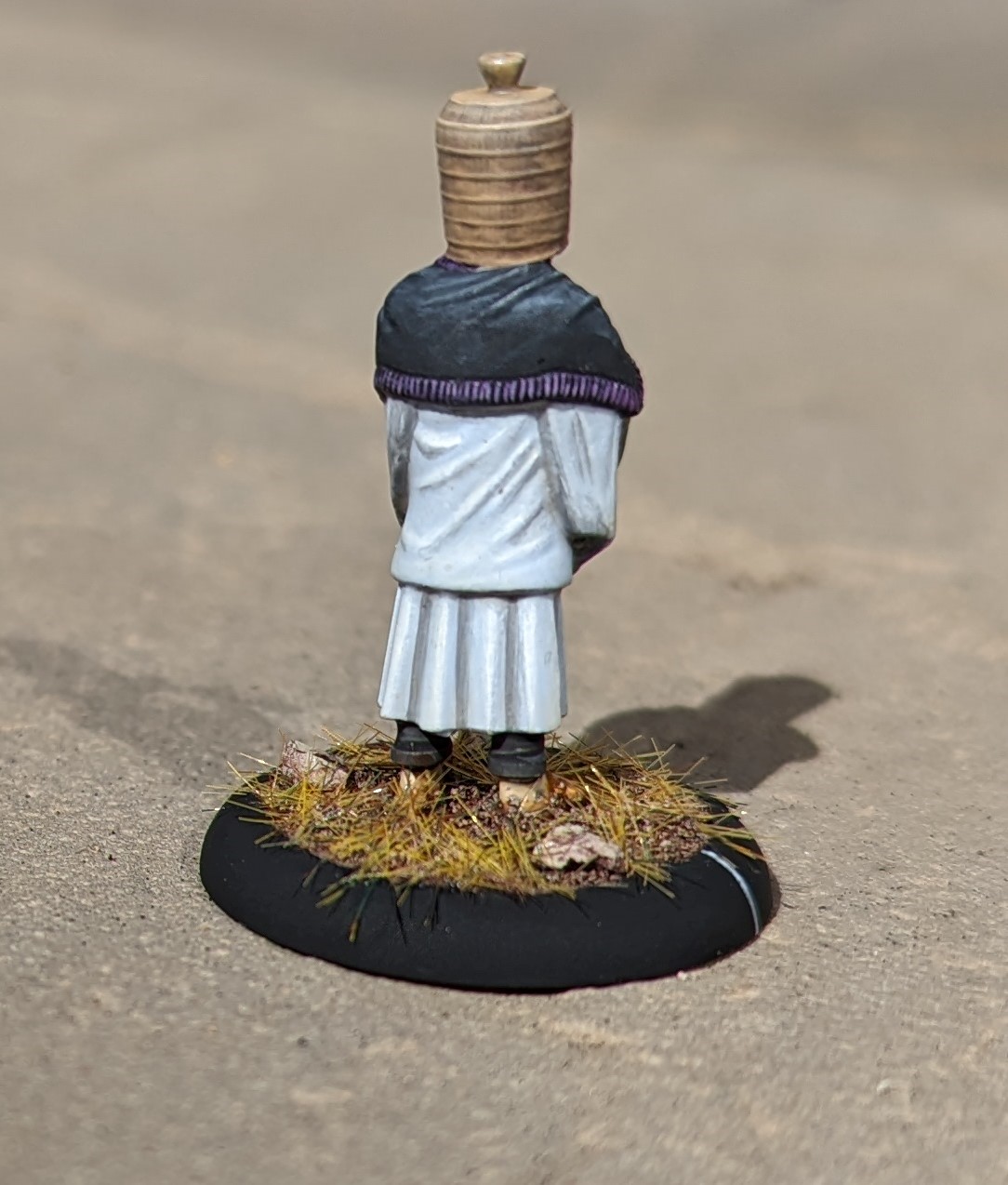
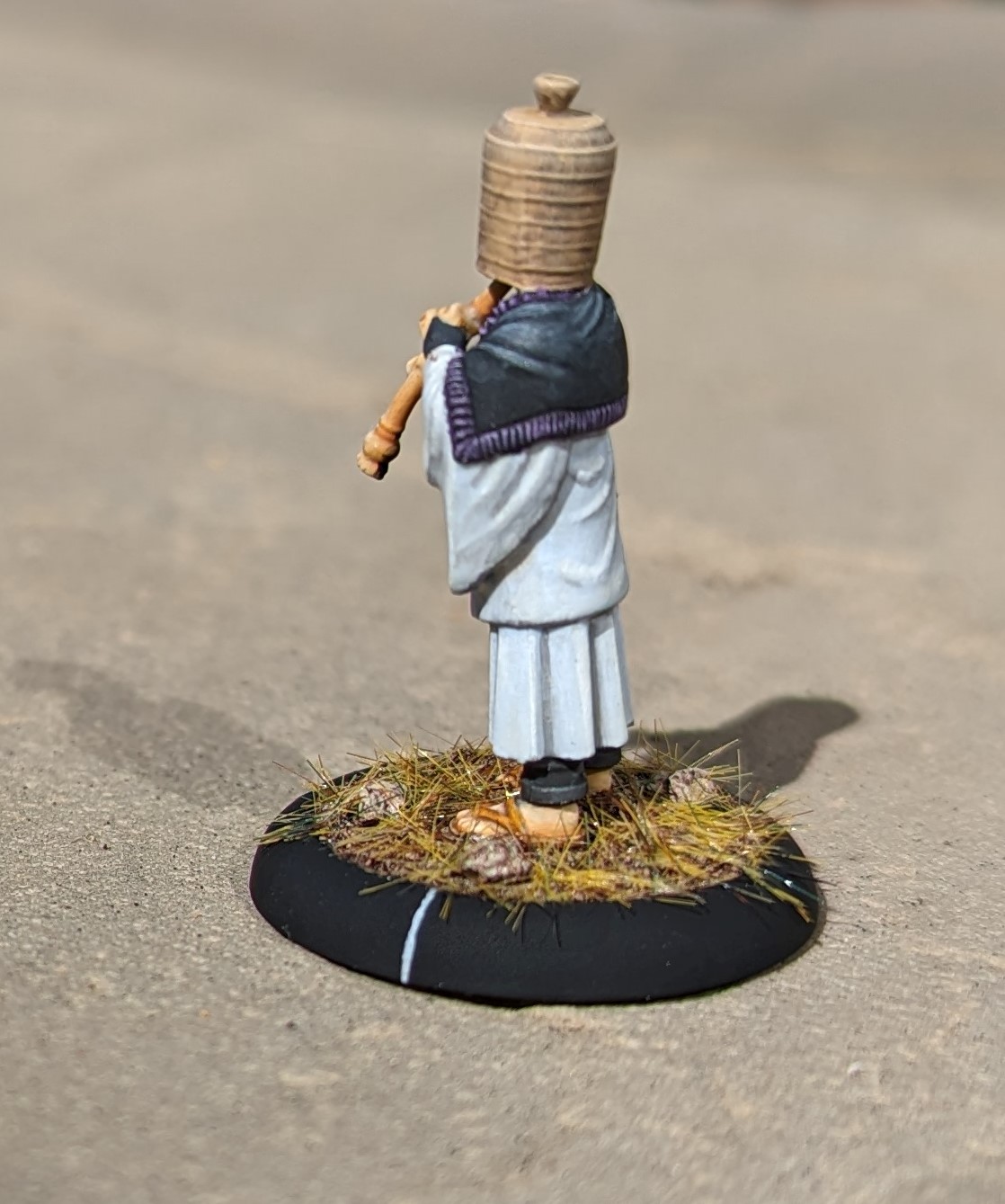
Painting wise, I’m going to use Purple as the accent colour to tie all of my Cult models together. In this case, I’ll paint the tassels of his shawl purple. The main clothing is off white and then mixed with Luftwaffe uniform to develop a gradually darker grey that was applied as a glaze into the folds.
The wicker basket was tricky as the definition is too fine for dry brushing but I started with Iraqi sand, then a light soft tone wash (twice) before carefully trying to pick out the higher areas with first Iraqi Sand and then IS mixed with off white.
The shawl was a Luftwaffe grey given several nuln oil washes. I’ve then picked out the raised areas with glazes of Luftwaffe grey and off white mixes.
The sandals was flat earth for the wooden bases while the strapping was scruffulous brown. Flesh was made up of a mix of various flesh tones from my Scale 75 flesh set.
The writing on the board I think says Pay Me, at least that was what Google Translate came back with. It could be highly offensive or mean nothing at all.
The base I’m aiming again for consistency across the Cult. In this case it is a dry earth acrylic mix which, when dry, gets a brown wash. I’ve then applied clumps of dead earth, to really highlight the Cult’s dead side.
Overall, fairly easy but the glazing always takes a bit of time to get right.
Battle Report No. 3
This game was played a little while ago, but I’ve only now gotten around to tackling the project system in submitting it.
Once again, it was my son’s Temple of Rokan (TRK) force against my mighty Cult of Yurei (CoY).
We selected a new mission for this game with deployment along each faction’s back edge. This called for 6 objective markers (the chess pawn looking pieces painted a metallic blue) to be placed on the board in a hexagonal shape. The two objective markers closest to each faction’s deployment are friendly to that faction (and consequently hostile to the other faction) and the two objectives deployed on the centre line are neutral. Each faction also received 3 prayer tokens.
Scenario points can be earned on each turn if a model in base contact with an objective marker uses an activation to pray. A prayer token is spent and the factions gain 1 scenario point for praying at a friendly objective, 2 at a neutral objective and 3 at hostile objective. At the end of Game Turn 4, each faction gains scenario points equal to the number of friendly objectives that are on the table.
1 Victory Point is then earned at the end of Turn 4 for the faction with the most scenario points. The scenario points are then reset to zero (any used prayer tokens are not reissued but unused tokens can be spent in future rounds).
At the end of Turn 5, any prayer scenario points earned that turn are added to the number of friendly objectives that a faction has and the most scenario points gets 1 Victory Point. The scenario points reset to zero again.
At the end of Turn 6, the same happens and the game then finishes, with the faction with the most VPs the winner!
In addition to praying at an objective, a model in base contact can also choose to spend their activation and interact with the objective. This turns a hostile objective to neutral and a neutral objective friendly.
Simple eh? It’s more simple than I’ve described it…..
Onto the forces.
My son ran a slightly different list in this game than the previous two and it is below,
- Master Ekusa (who’s a monk riding a tortoise and can heal, remove activation tokens and stops attacks due to his zen like demeanour)
- Taiyo (a ronin from the starter set who has a low points cost and is able to resupply friendly models. He’s also a Villager, allowing my son to take the two pit trap cards below)
- Yim (a monk who’s strong and linked to iron)
- Saruka (another flame monk and can also cast a fireball like ranged attack)
- Kuma (an angry, bo staff wielding panda who can root opponents to the spot while slapping them around a lot)
In addition, my son had selected a couple of terrain pieces that allow extra Ki generation for his models (Ki allows the activation of special abilities and boosts regular stats and the TRK are big Ki users). He also selected some trap cards as well. He had a one off event card that allows him to give 4 Ki to any one of his models. Kuma also had an enhancement card of prayer beads allowing him to generate an additional Ki each turn.
I changed my list up and also opted for some additional cards,
- Mo Ises (an assassin that likes stabbing people in the back)
- Mokoti (dreadful in combat but can control enemy models)
- Umeka (another assassin armed with a pair of scissors – I guess she also likes hobby crafting)
- Risu (A pitch fork wielding nutter who can poison people from afar)
- Ibara (Can handle himself in combat and can throw some fire around at range)
- Tenbatsu (another ronin who’s a combat monster)
- 2 plague rats (very quick, dispensable and can also hand out poison)
In addition, I equipped Mo Ises with the Violence Fetish enhancement card which gives her a boost in melee combat. I’ve also taken the Crush the Oppressed event card, which when played, doubles the number of state tokens applied to all enemy models. I think this could be a game winner for me as state tokens include poison, fire and control. Played at the right time, my son is not going to be happy!
Terrain and Deployment.
You take turns placing terrain until one side stops at which point the other faction can place one more piece. I stopped after about 3 objects but my son just carried on sticking stuff down across the board. He kindly placed quite a lot of cover on my side of the board.
You deploy each model in turn with the edge of the base in contact with the back edge of your side. I deployed into three groups, on the left flank I have the two fast plague rats and Risu, in the middle Umeka, Mo Ises and the mighty Tenbatsu and on my right Mokoti and Ibara.
My son placed Ekusa, Kuma and Yim in the middle (making a solid central force!) and Taiyo and Saruka on his left. He had no right flank.
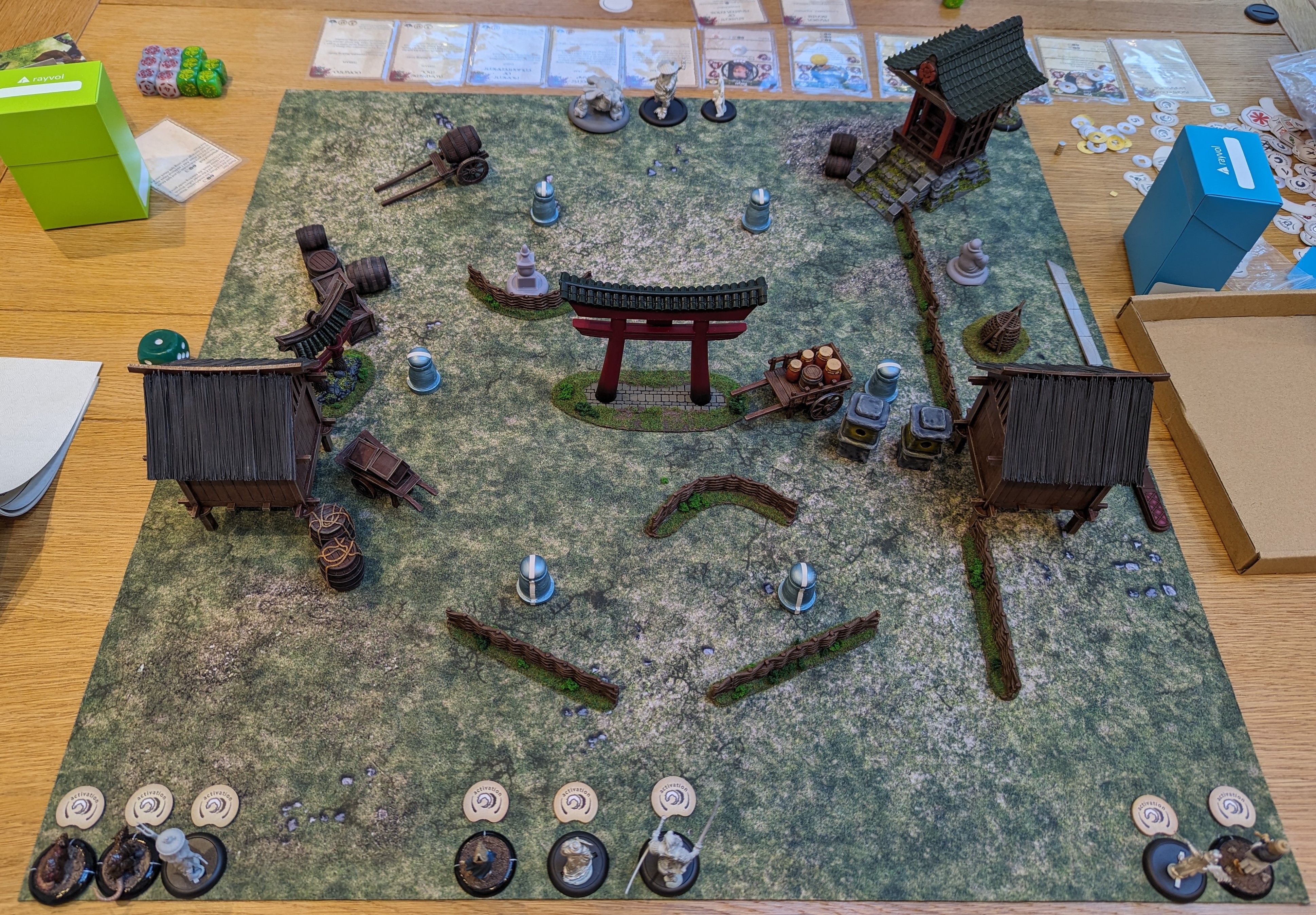 Deployment (with Taiyo and Saruka hiding behind the hut top right)
Turn 1.
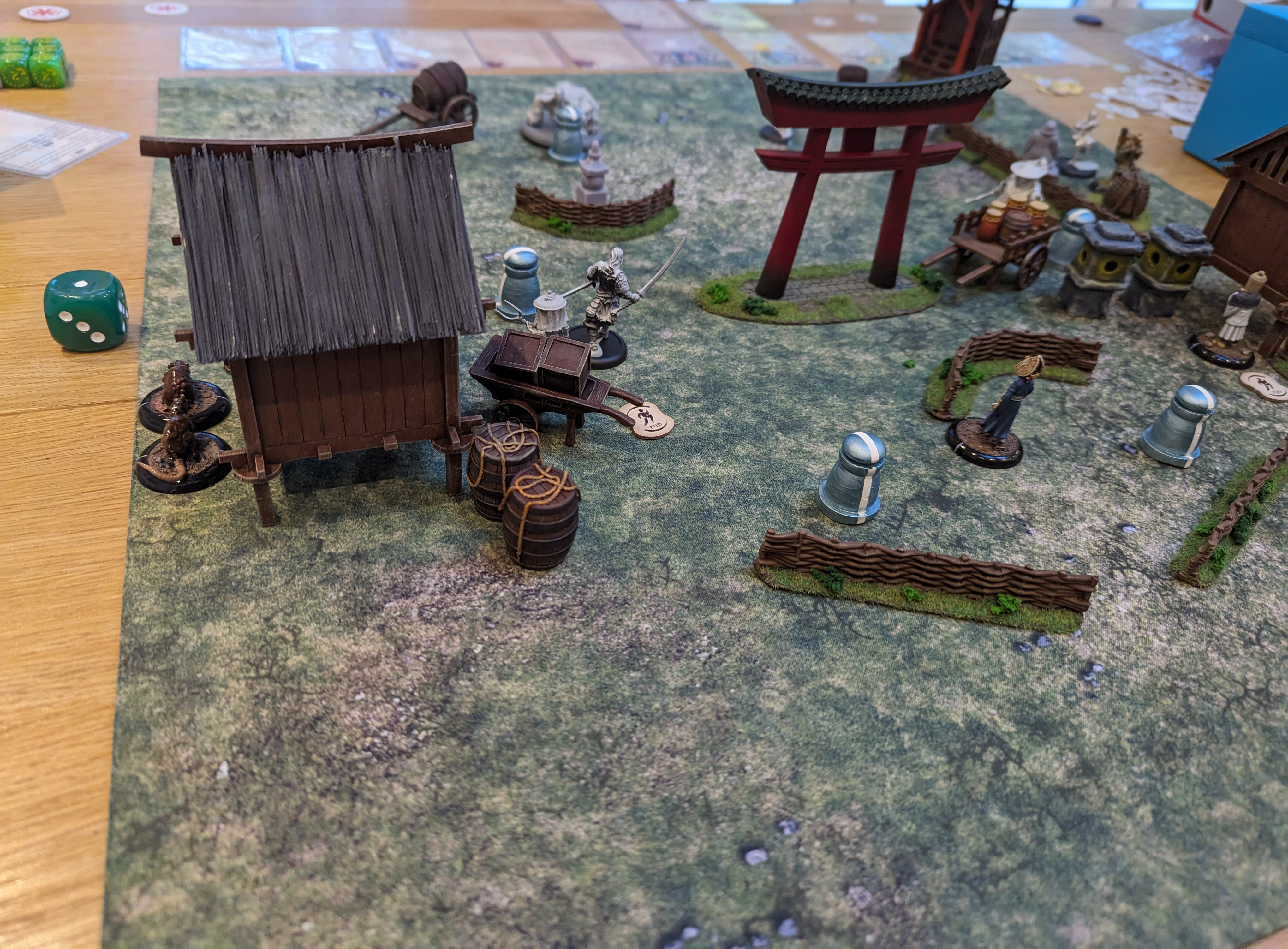
All of the models move forward in a largely uneventful turn. Yim prays at a friendly objective earning TRK 1 Scenario point. Saruka also gets into range of one of the TRK terrain pieces to gain extra Ki. I’m able to advance my plague rats quite far up my left flank – I’m hoping to bring a threat from the rear onto some of his models. My son tried both of his trap cards on my rats but failed to have any effect as I rolled the required numbers to avoid them!
Turn 2.
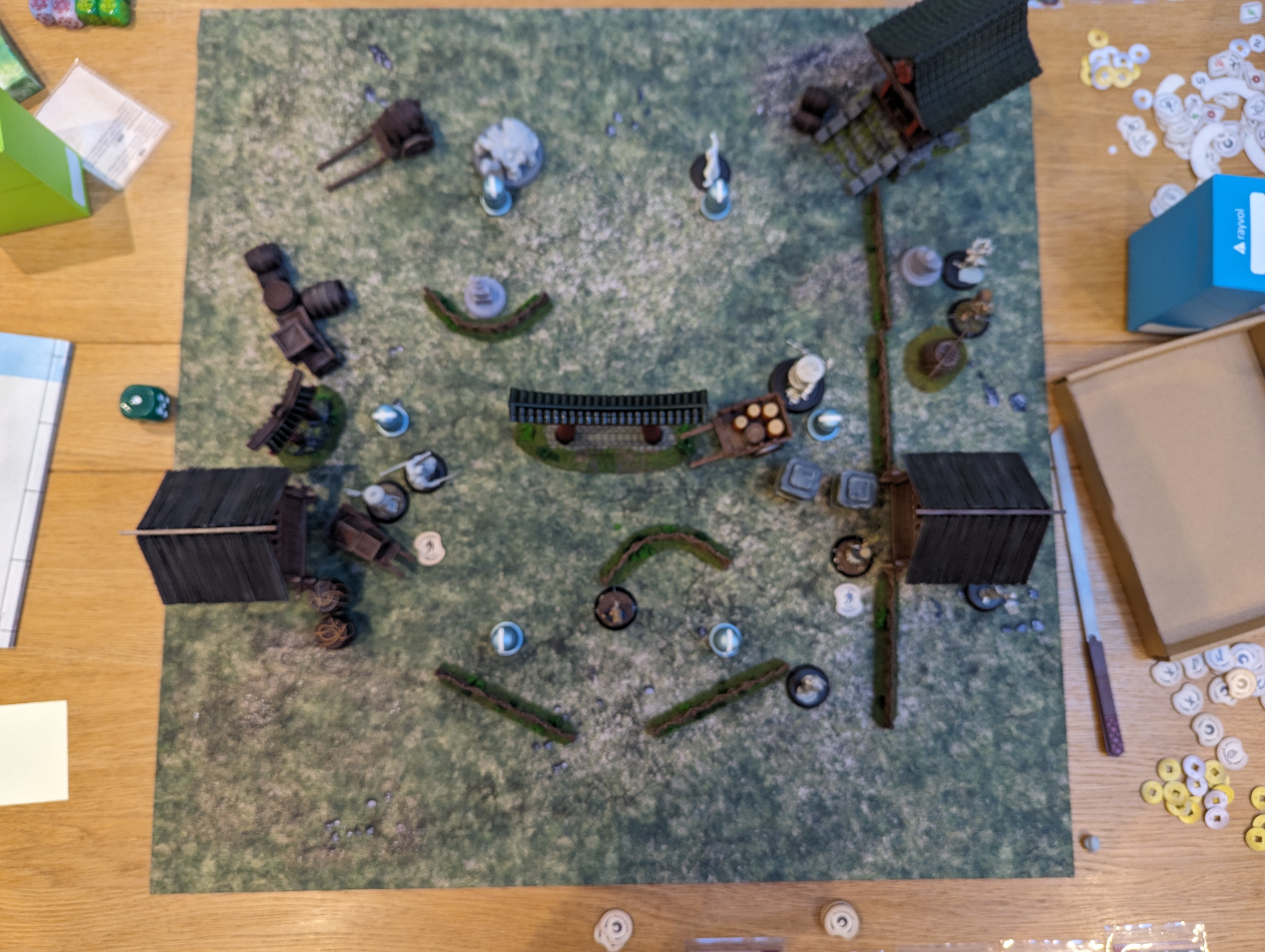
My rats continue their gallop around the back and are into the TRK back field – handy! Kuma gets into base contact with a neutral objective and spends TRK’s second prayer token to gain another 2 scenario points, bringing TRK’s total to 3.
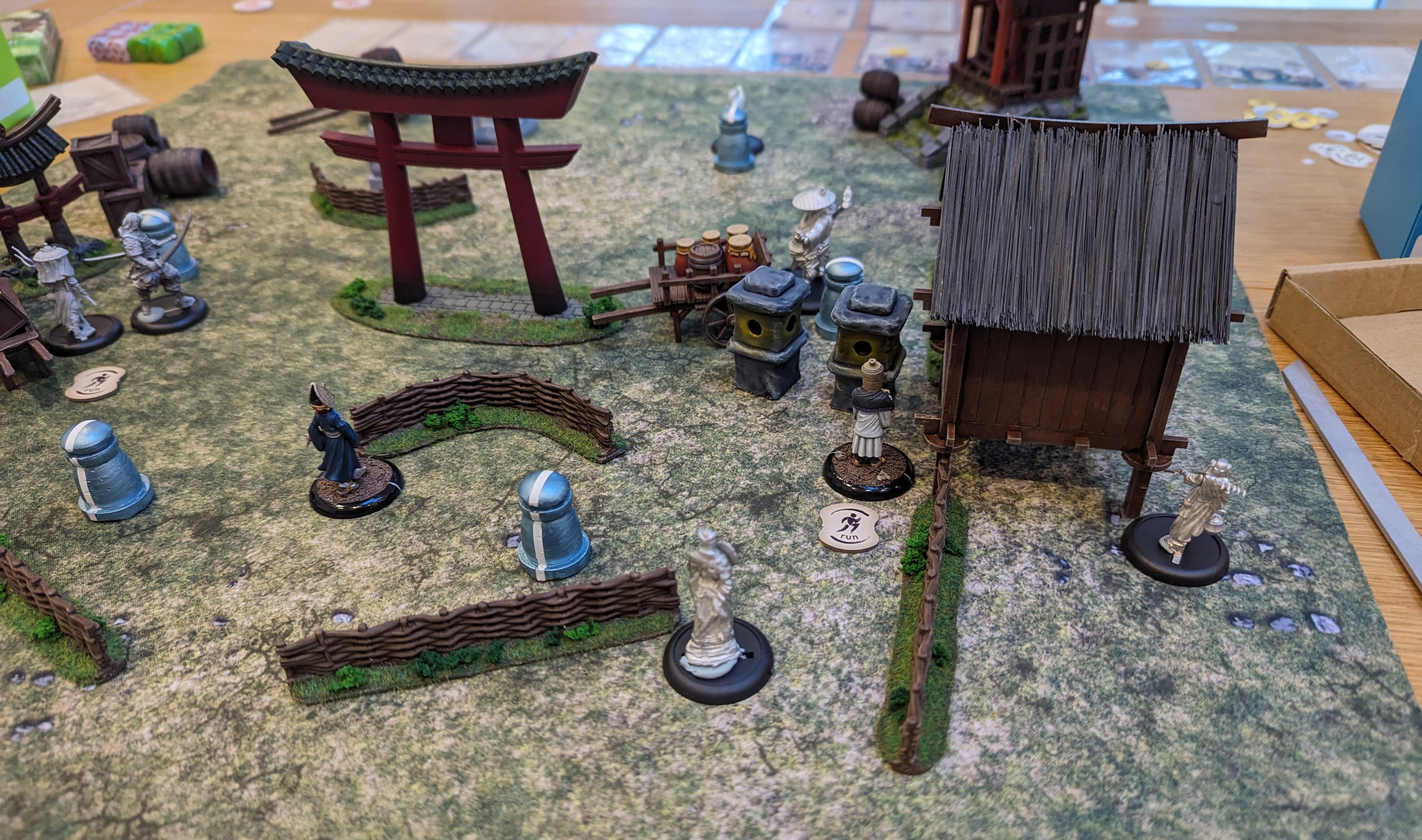
Taiyo (who’s not known for his martial skills) charges Ibara. Ibara can strike first but fails to do any damage however Taiyo suddenly finds his inner samurai and batters Ibara for 4 wounds.
Saruka activates next and in support of Taiyo moves forwards and uses her Ki to cast Dance of Dragons and kills Ibara. Some nice combo work there from my son!
However, I strike back as Mo Ises uses her Obey Ki feat and is able to take control of Taiyo, which makes him part of my force for one activation.
Yim prays again to gain another scenario point however Risu interacts with a neutral objective to turn it friendly to CoY.
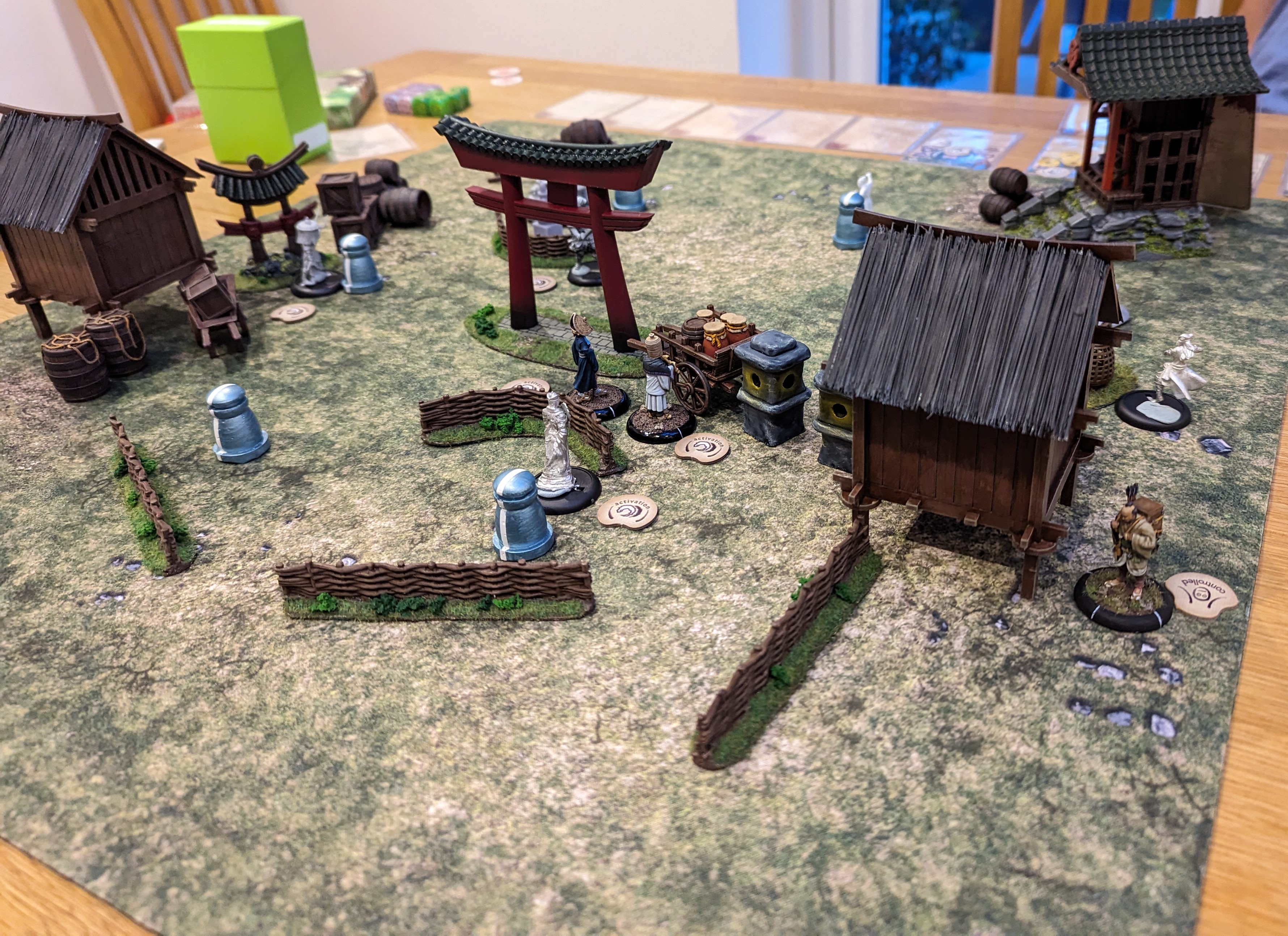 Action from turn 2
Turn 3
I bring Tenbatsu into the fray and activate his Oni Rage. This makes him very aggressive at the expense of a degree of control. I charge him into Yim and cause 5 wounds to Yim with Yim unable to hit back.
The mighty Kuma, seeing his friend Yim in trouble, charges Tenbatsu and casts War Cry. Tenbatsu is outnumbered by Yim and Kuma and loses dice to roll in defence. This proves to be fatal as Kuma roundly slaps Tenbatsu into next week and kills him in one shot. This is not a good turn of events for CoY!
Mokoti, seeing how useful Kuma could be if he were on the side of CoY uses his Obey Ki feat and is able to convert Kuma to CoY, albeit for just one activation. Not wanting to miss out on the controlling Ki feats, Mo Ises uses Obey and is able to control Saruka.
It’s at this point I play my Crush the oppressed event card and get to add one additional control marker to Kuma, Taiyo and Saruka meaning that I now get to activate them twice each in the service of CoY!. My son was really not very happy at this point.
I use the controlled Taiyo, who is out on his own a little, to move into base contact with Saruka. Taiyo is somehow able to kill Saruka, so CoY gets its first kill.
My rats, still lurking in the background, leap forward to attack the already wounded Yim. I don’t care if they die, so I allocate all my dice into the attack pool hoping to overwhelm Yim’s defence pool – I do and I manage to remove Yim’s final wound and kill him.
Suddenly things are looking up for the CoY.
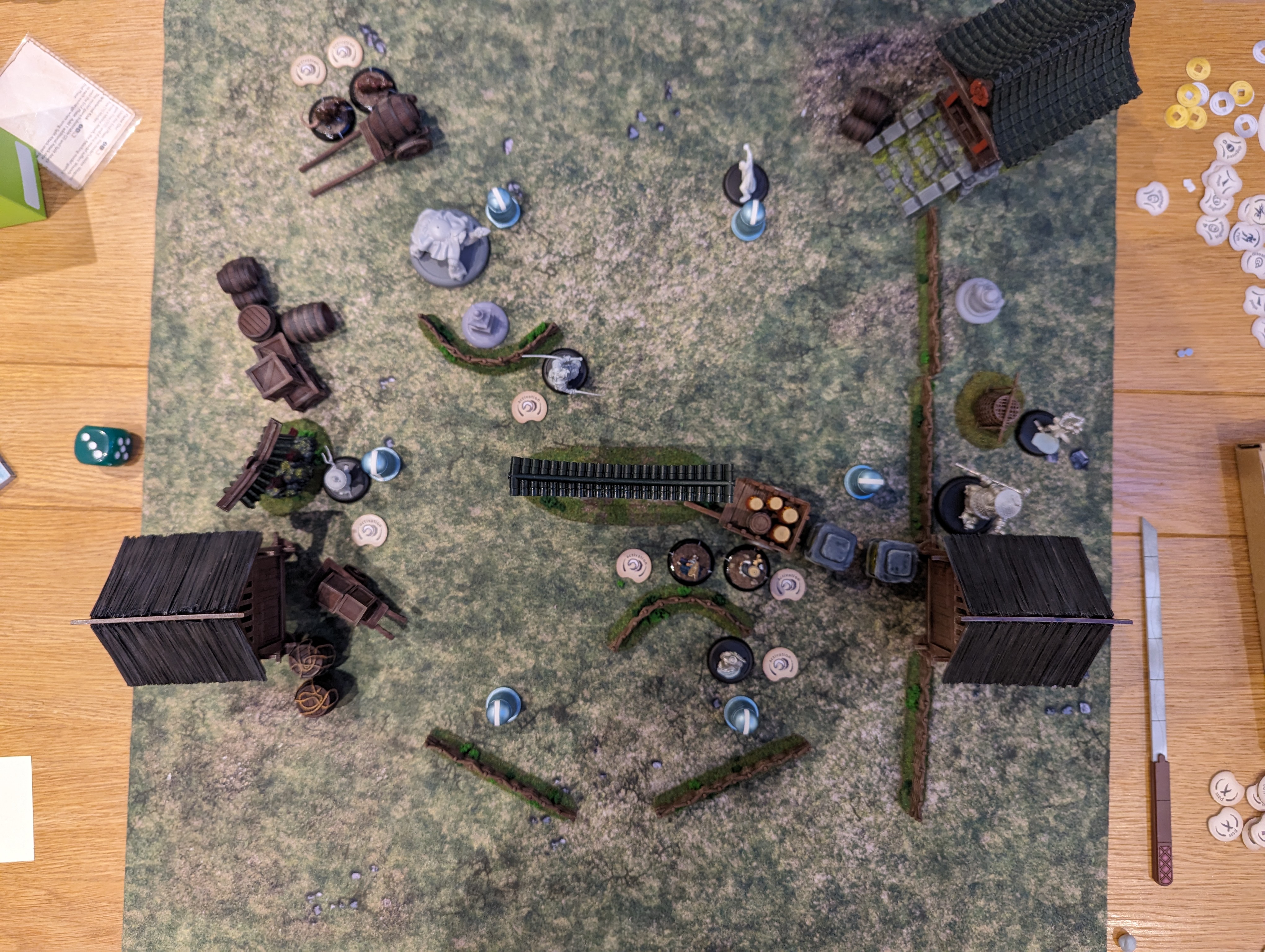 End of turn 3
Turn 4
Kuma, still controlled by the CoY, attacks Master Ekusa. Ekusa is great in defence and Kuma struggles to get through but is able to cause a single wound. I run Taiyo back up the flank to move him away from my forces to use up his last control marker.
End of turn 4 is where we look at the scenario points. My son has accumulated 4 scenario points from praying and has two friendly objective markers. I have three friendly objective markers so, with a score of 6 to 3, the TRK takes a Victory Point. The scenario points are reset to zero.
Turn 5
I kick off with Mo Ises who immediately targets Kuma and gets control of him. The TRK use up their wait token to see what I will do so I take the opportunity to attack Taiyo with one of my plague rats who hits, doing no damage but Taiyo picks up a poison marker. Taiyo kills the rat in return though.
I make Kuma attack Ekusa but this results in no damage as Ekusa’s defence cancels out Kuma’s attack. I use Mokoti to convert another objective to friendly and Risu moves up to block Kuma and Ekusa should they decide to make a dart for the objectives in the next round.
Once all of the models have been activated, the End Phase starts. It’s here that fire, poison and other tokens are managed. Taiyo takes a wound from the poison token he picked up from the plague rat and dies. The plague rat has his revenge from beyond the grave!
At the end of the round, my son is regretting burning all of his prayer tokens early on as with 4 friendly objectives to 2, the CoY have more scenario points and wins a victory point.
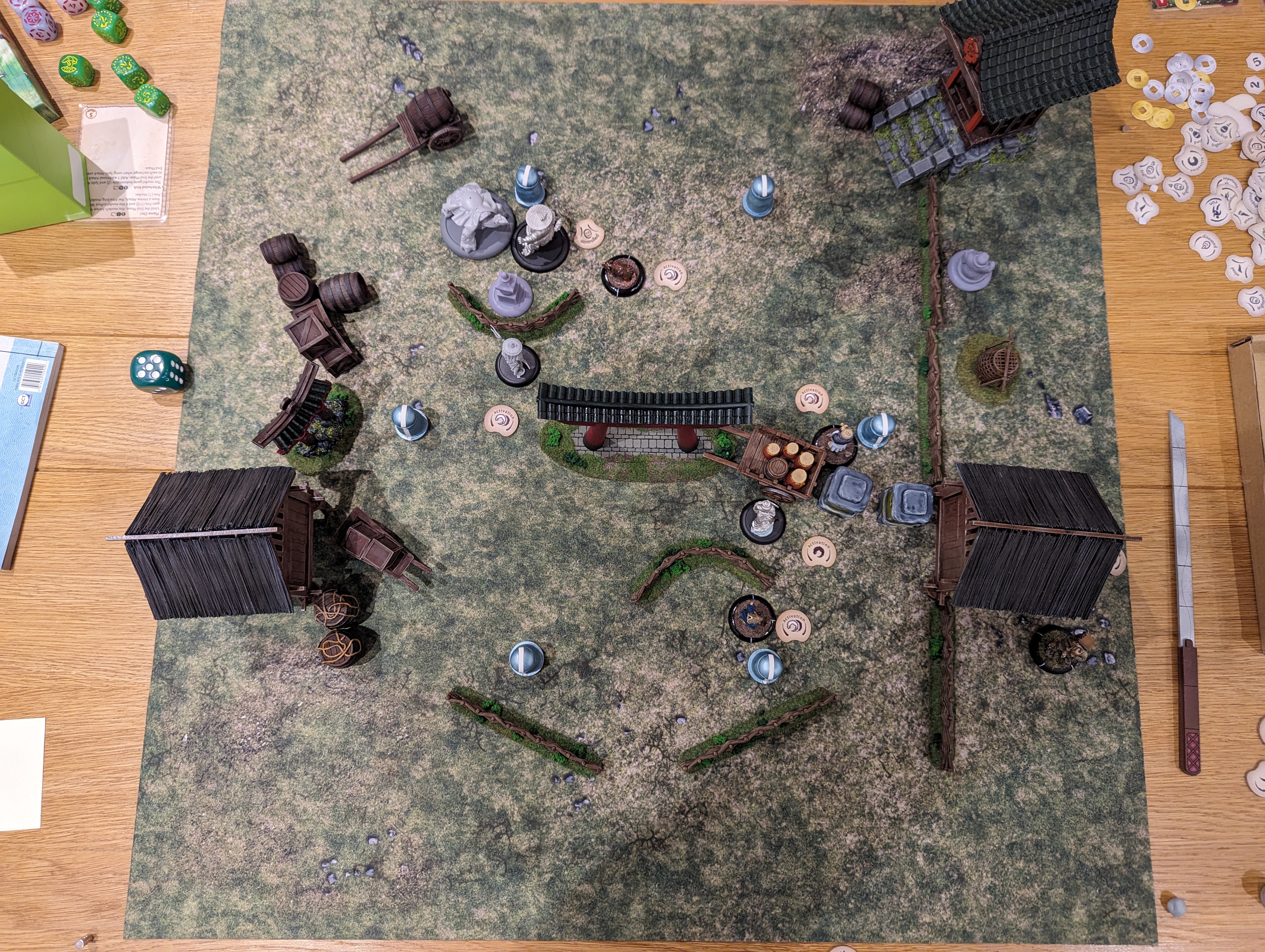 End Turn 5
Turn 6
All to play for as the scenario points are reset to zero.
Mokoti gets straight to work in controlling Kuma, who has spent more time fighting for CoY than he has for TRK this game. However, Ekusa uses his special Ki ability to remove all of Kuma’s tokens, lifting the control. Ekusa then attacks Risu but fails to cause any wounds.
I launch a plague rat at the rear of Ekusa, more out of hope than anything else but given that Ekusa has already taken some damage, the biting rat is too much for him and Ekusa goes down.
At this point, with just Kuma left, my son realises that he cannot get enough scenario points to pick up the last victory point this round and concedes the game 2-1, a win for the Cult!
More Terrain
Time to add some more small terrain elements. All of the following pieces have been 3d printed with the stl files coming from Thingiverse.
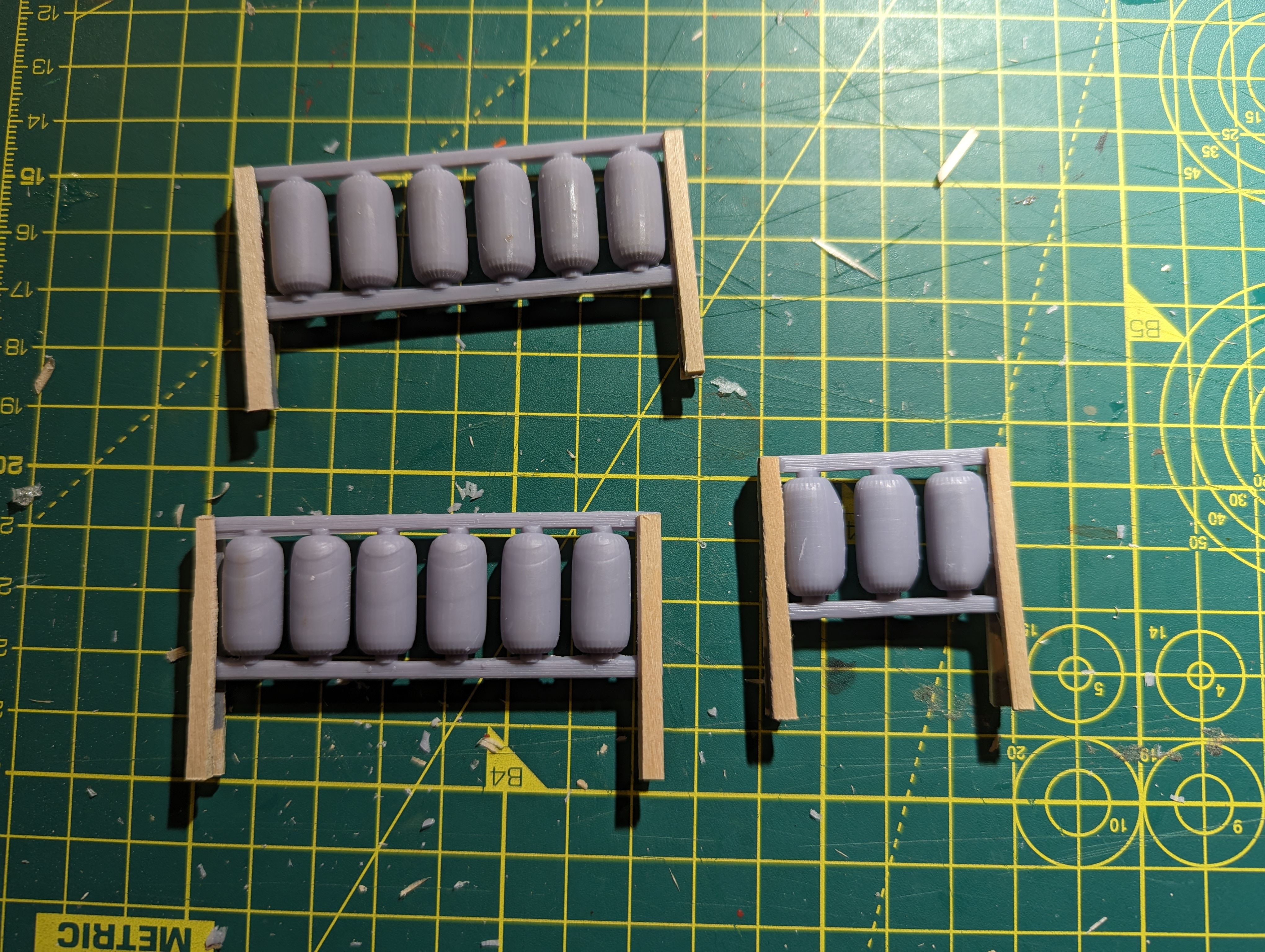
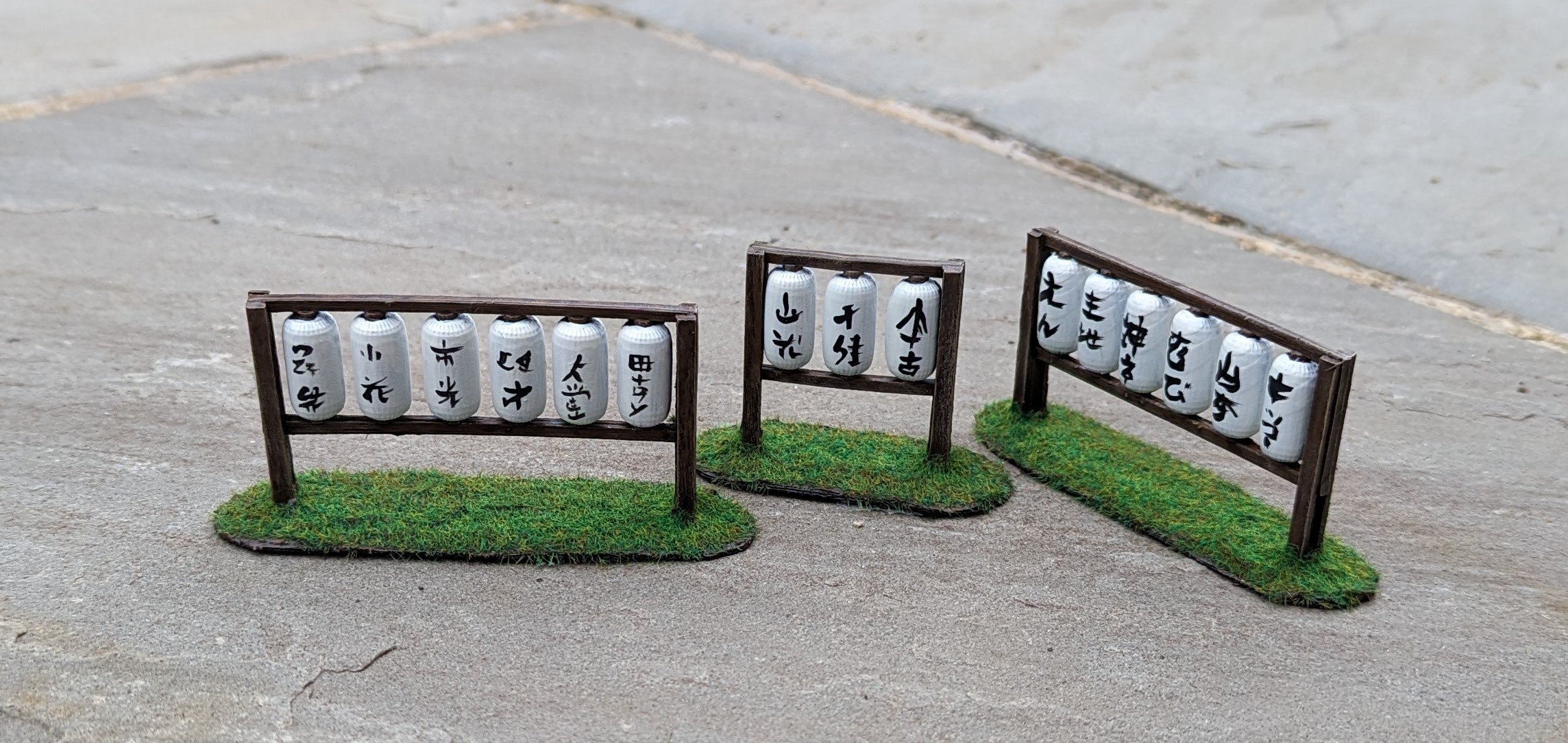
Japanese paper lanterns are a tradition and used to celebrate at festivals. They are often grouped together into racks to create a colourful display. I managed to find an stl file of the lanterns and printed this out. This then needed to be mounted as the racks did not come with legs. For this, I’ve just cut some wooden tongue depressors into the right lengths and stuck these to the rack. Once dry, it was primed and then stuck to a plasticard base and secured in place with and acrylic paste.
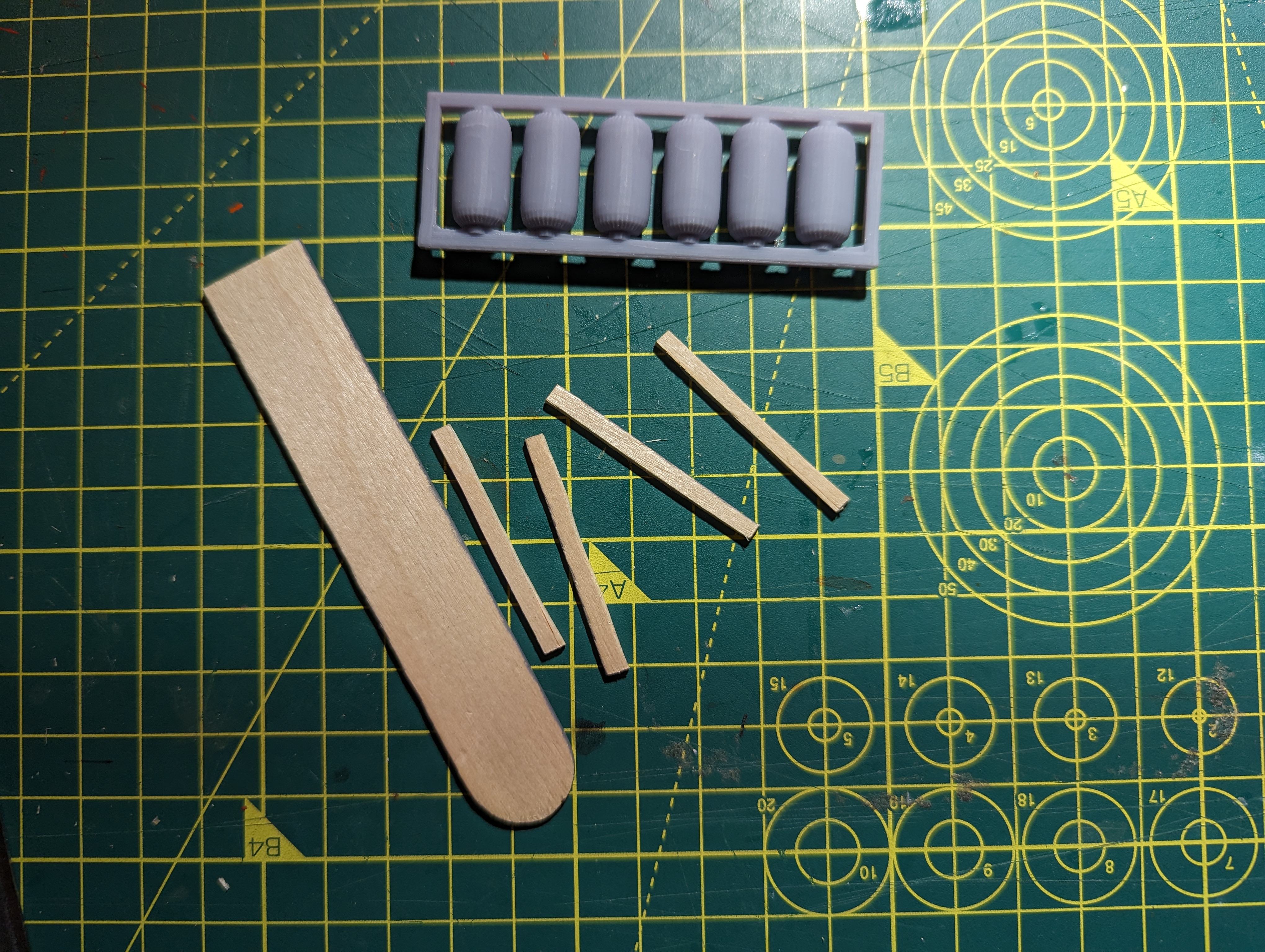
I’ve taken a quick approach to the painting. The wood was painted flat earth, then given a brown wash before an Iraqi sand dry brush. The lanterns were an off white with black for the writing. I’ve tried to copy some characters from internet pictures but the writing could be nothing, people’s names or something rude. Who knows but let’s hope I’m not about to start an international incident.
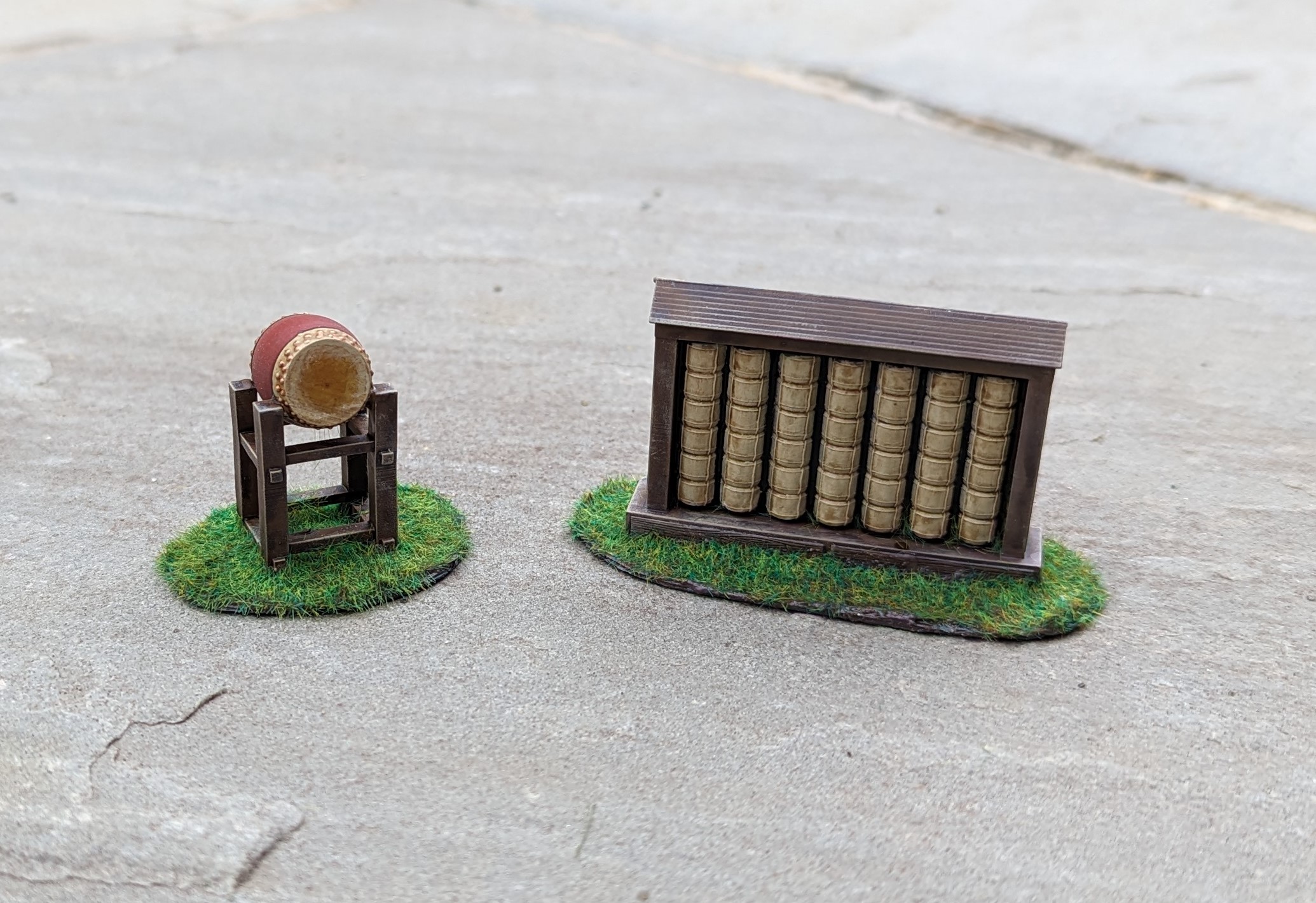
Sake racks are common to both display the barrels and allow for maturation of the drink. Drums are also used for both musical entertainment, war and communication, so both objects would lend themselves to the trappings of a small village.
The wood for both items was painted in the same way as the lanterns above. The drum skin and the sake barrels were then painted a bone colour and given a soft tone wash. The drum barrel is cavalry brown. You often see the drum skin gets discoloured where it is struck, so to replicate this I’ve used a watered down brown and gently glazed the area to reach the desired effect.
And job done (apart from the flocking – summer grass). Simple and easy.
Dirty Plague Rats
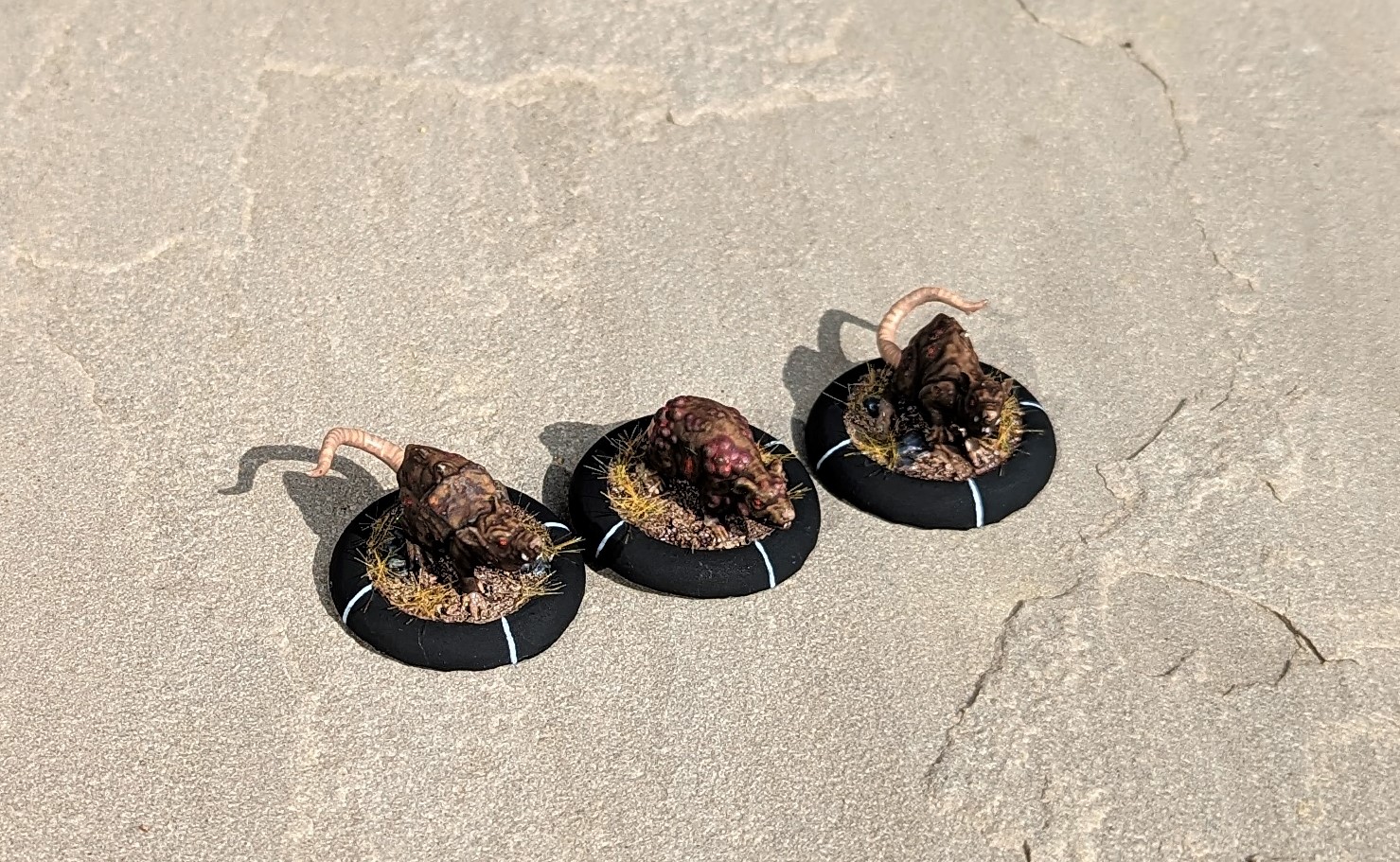
The Cult of Yurei, being all about the death and decay, can take various rats as part of their force. As you might expect, these aren’t the most powerful or formidable of characters but they do provide some chaff to block parts of the board and have your opponent activate their models before your key characters activate. One of the rat units available are plague rats of which you can field three. While not particularly powerful, if they do successfully hit in attack, they get to dish out poison markers which inflict additional damage at the end of the turn.
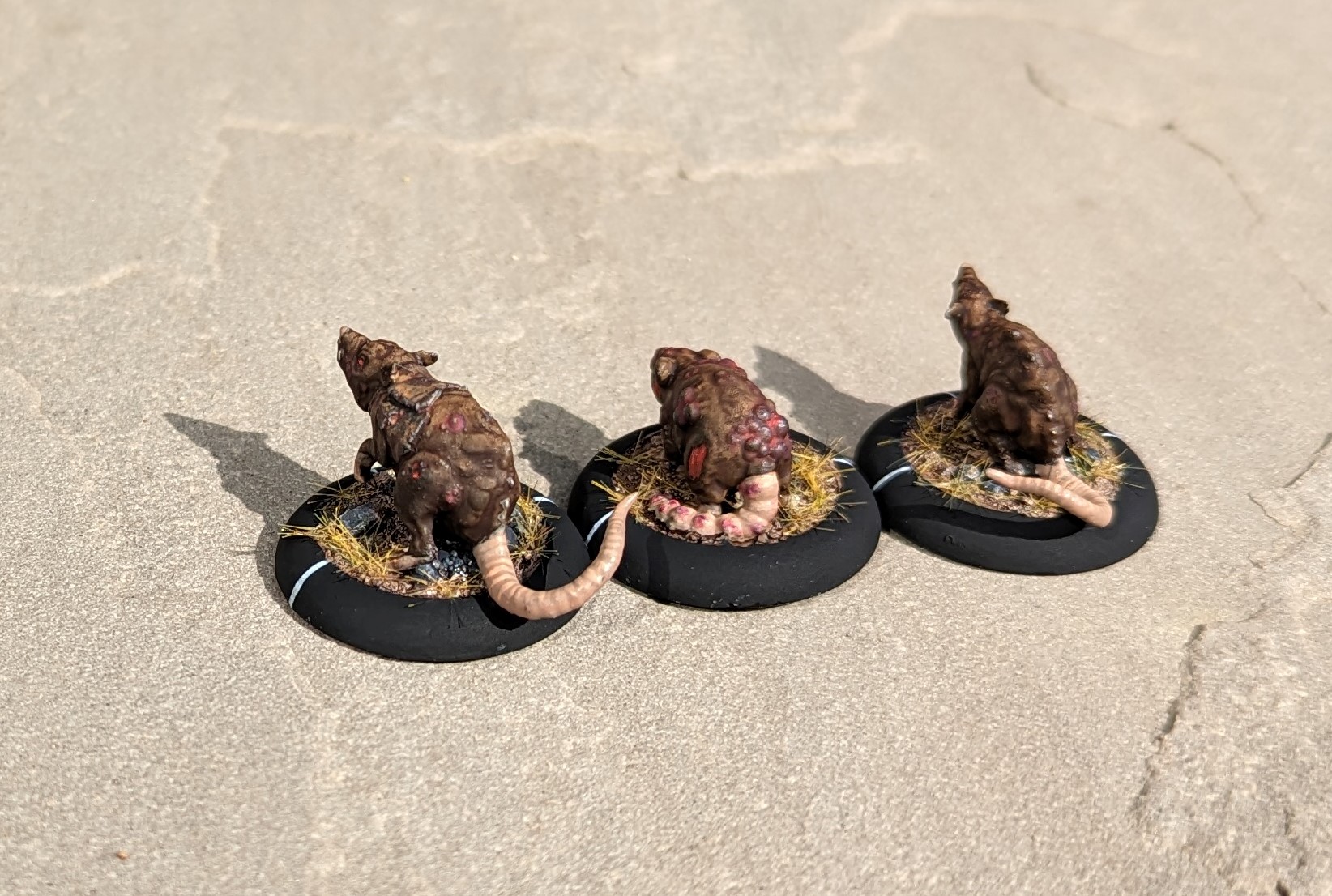
In this case, I searched Thingiverse (not to be mistaken for Redvers) for suitable models of which there were a few. Using Microsofts 3D builder, I was able to manipulate the files to get the right size and then attached them to 3D bases for the game. These then went off to the 3D printer.
Painting wise, I took a quick approach to these. A base of dark brown was then given a dark tone wash. I’ve then dry brushed up the highlights through successively lighter browns. Teeth/claws were off white with a yellow wash. The tail was a skin tone given a brown wash. For the boils and lesions, I’ve used a purple glaze applied several times followed by a red glaze over the highest points.
The basing is just Mig Ammo dry earth acrylic mud with a wash applied and then a light flocking of dead grass. This will be my Cult of Yurei basing across all of my models to try to tie them together.
Ryokeen
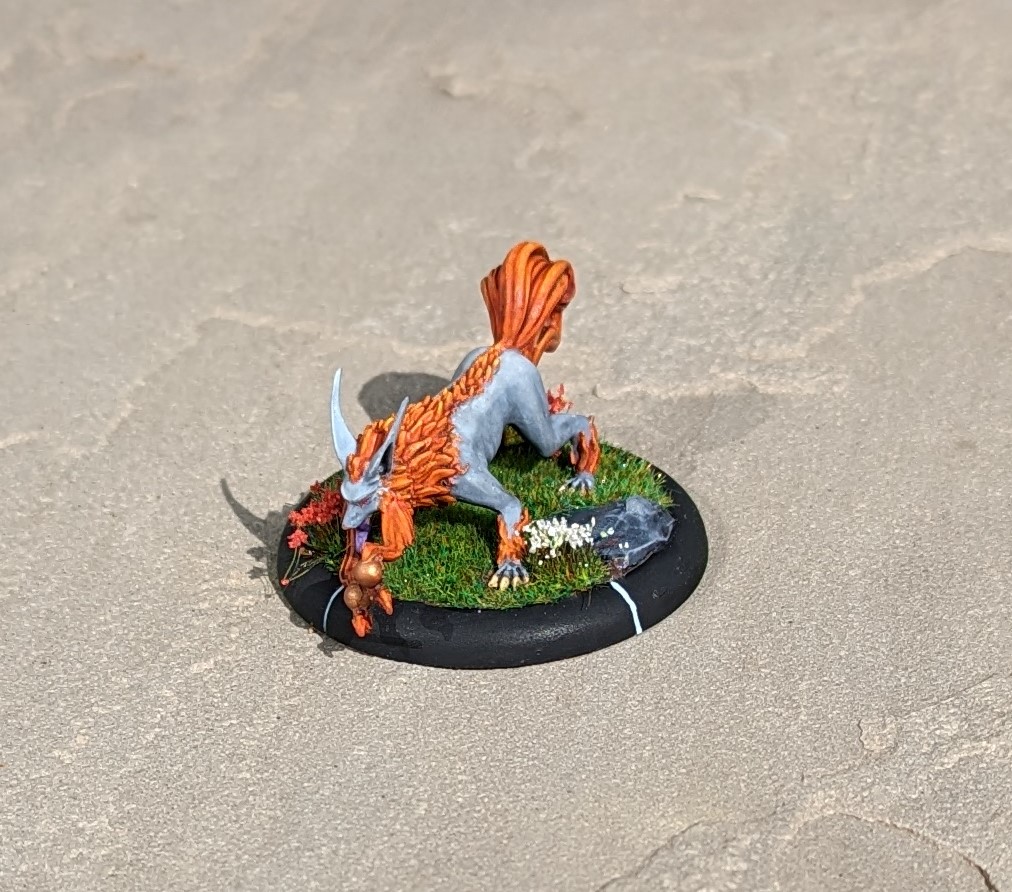
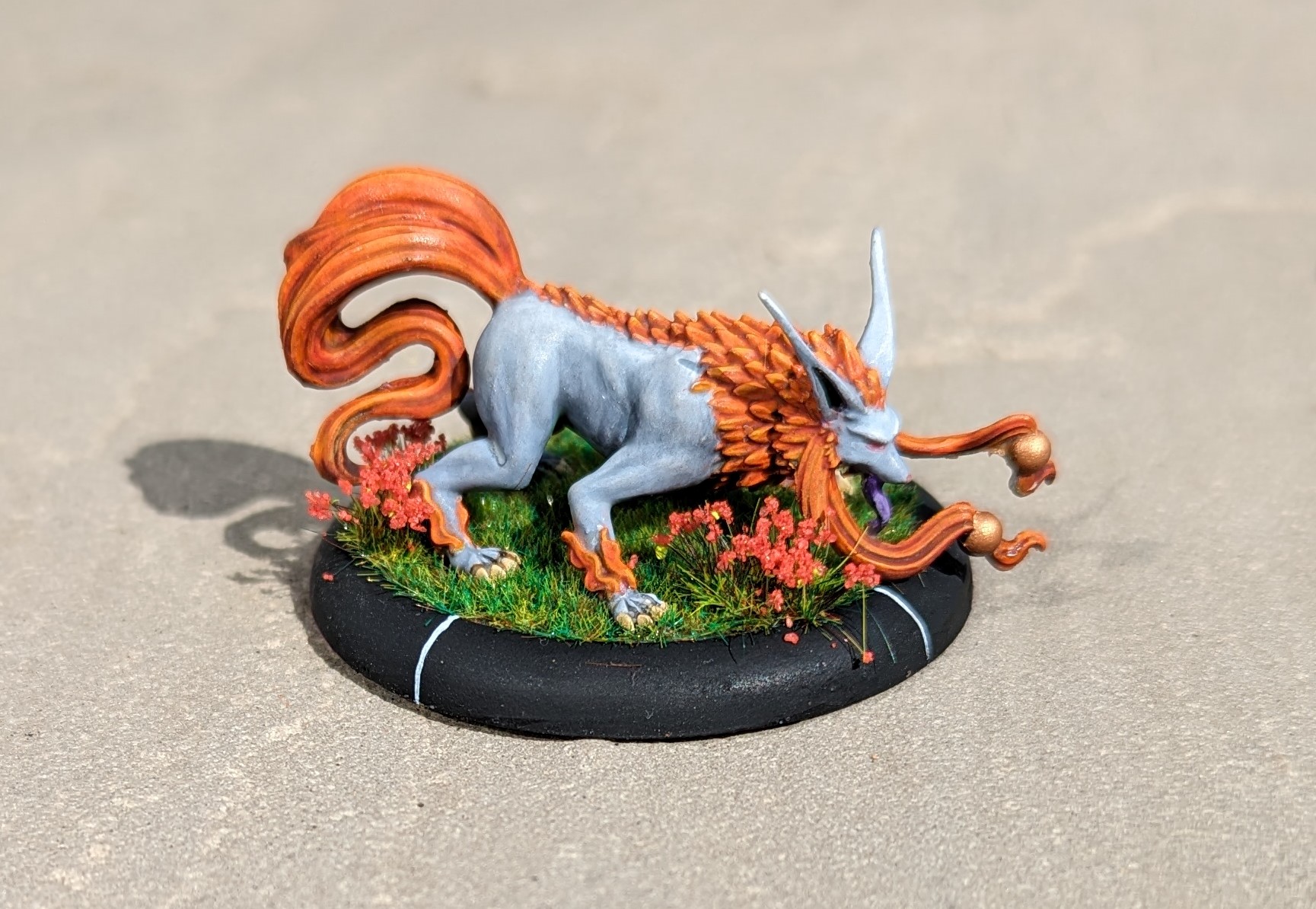
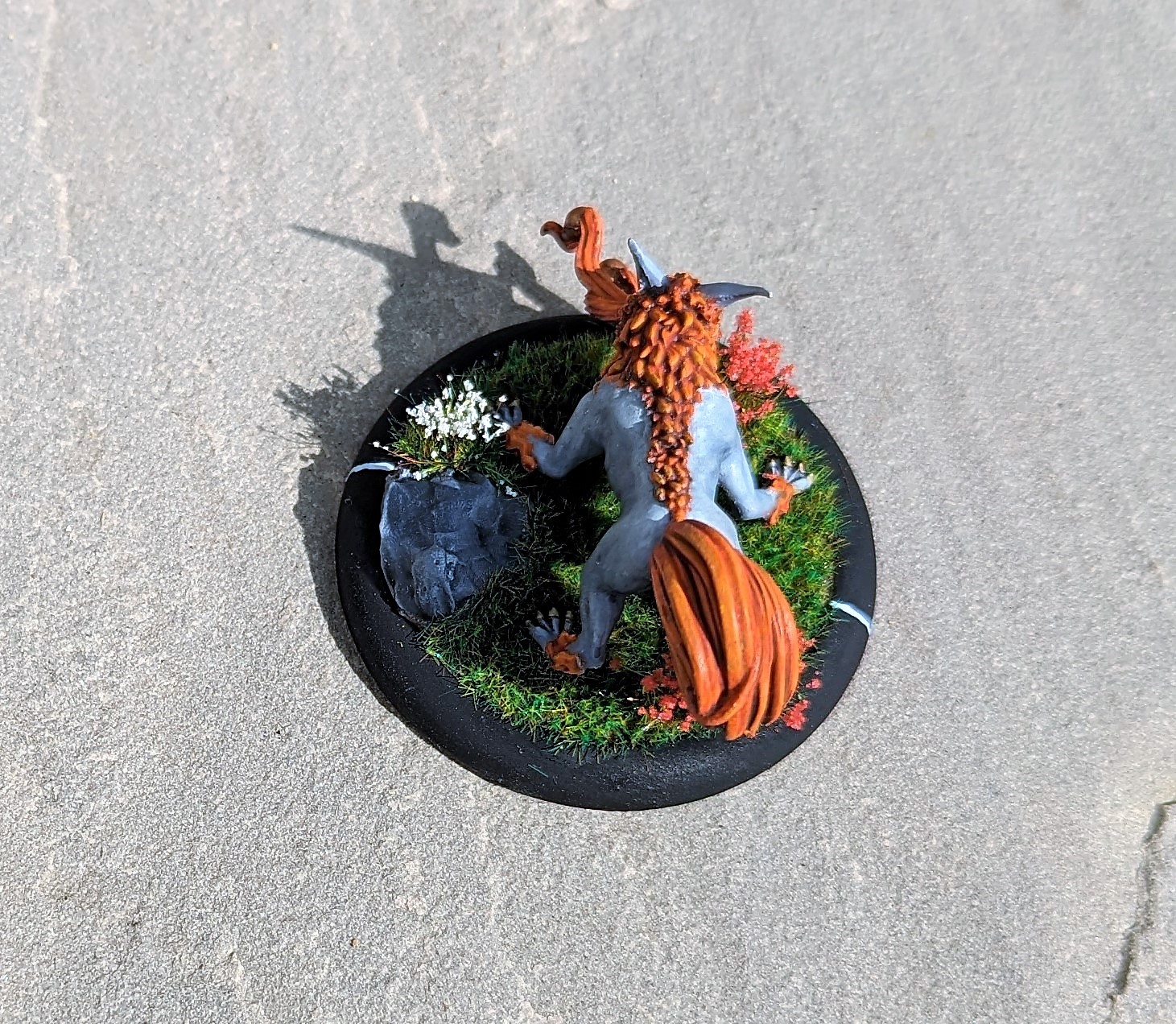
Continuing with the Bushido starter set, we’ve painted up Ryokeen. This is not to be mistaken for the ex Manchester United and Republic of Ireland midfield hard man but rather some sort of large fox type animal. In game, Ryokeen has fantastic movement and, like a certain ex Manchester United and Republic of Ireland midfield hard man, can leave opposing models prone and stunned after entering base to base contact. As a Ronin, Ryokeen can play for a number of factions including both the Temple of Ro-Kan and the Cult of Yurei, so a handy model to have painted up.
My son started to paint this model but got a bit fed up and passed it to me to finish. He started with a grey base coat and a fire orange for the fur. From there, I started to highlight the skin up using lighter levels of grey. The fur I gave a red ink wash and then highlighted with orange and yellow. That was about the sum total of the paint job – quick and easy.
The base is an acrylic mud from Mig Ammo and I’ve 3d printed a rock which I stuck into the mud before it dried. I’ve then just flocked it up with a summer grass and added some flower clumps to give it a pleasant, summery feel. Our thinking is that this is a basing theme that we will continue for the Temple of Ro-Kan.
Shameless Self Promotion
A bit late on this one, but this project is now the proud owner of a Golden Button


![Gripping Beast Announce They Are Closing Their Doors [Updated]](https://images.beastsofwar.com/2026/09/gripping-beast-announcement-cover-600-338.jpg)