








DARKSTAR CAMPAIGN UPDATE: DUCHESS ANNABEL’S WAR IS OVER




Recommendations: 3619
About the Project
The year is 2512.
The powers that remain on an ecologically-devastated and plague-ravaged Earth have been forced to look to the stars for the resources, capital, and room not only to expand, but to survive. While the setbacks encountered by mankind over the past 500 years have forced him to unite in a shaky global coalition and make fantastic strides in technology, they have also caused seismic and reactionary shifts in religion, culture, and politics. A second age of imperialism has dawned, and because man would never survive another war on the fragile remains of planet Earth, he is forced to ply his oldest trade ... war ... exclusively among the stars.
Darkstar is a tactical war game postulating naval combat in a “science faction” universe set five centuries into a troubled and uncertain future. Players take command of warships serving in the new “black water” navies of reborn empires of old, struggling for control of shipping lanes, resources, and colonies. Ships maneuver and fire in fast-paced combat, with survival not only of the players’ fleets at stake, but perhaps their nation and all of humanity as well.
Related Genre: Science Fiction
This Project is Active
Darkstar Live Blog !! P3
Update – 23:45
GMT Okay, the battle is finally over!
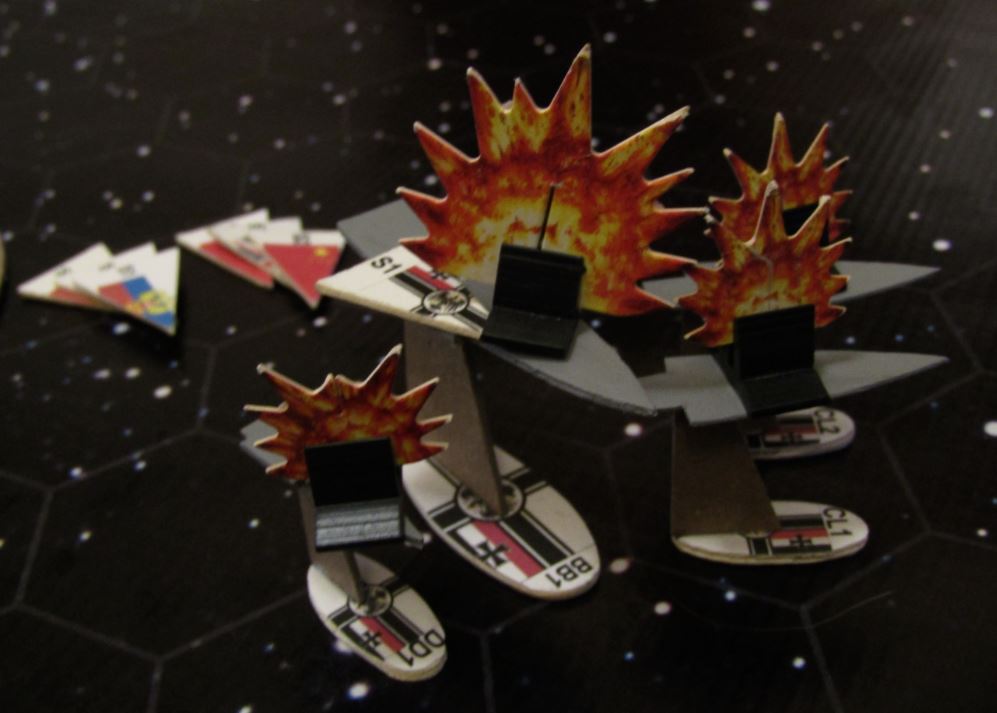
First up, my last Russian heavy cruiser is indeed crippled by that torpedo spreads!

The Kraken and Xu Shan manage to take out the destroyer Oder and finally the pocket battleship Von der Tann. Return fire forces the Xu Shan to break off … leaving the only Duchess’ Alliance warship still operational on the field is the HMS Kraken … so 182 points for the Duchess’ Alliance … a minor victory from this 635 point battle.
Darkstar Live Blog !! P2
Entry – 21:10 GMT
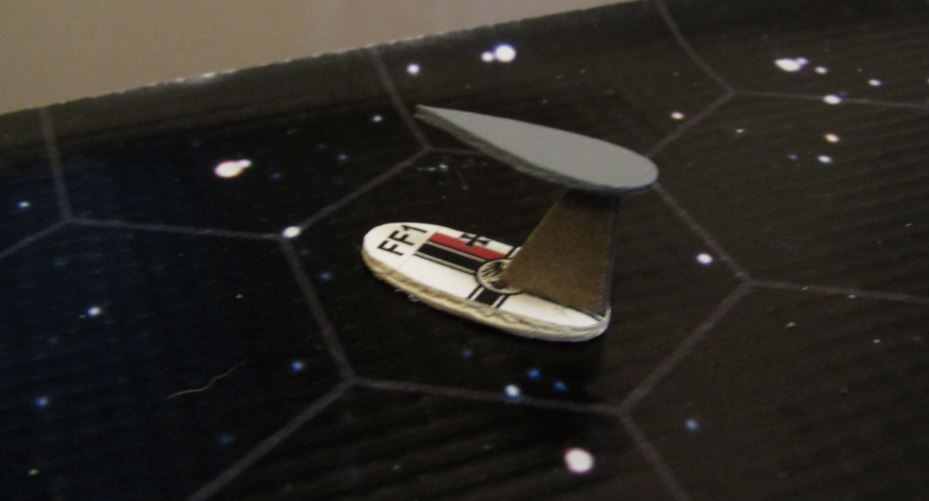
The battle heats up! As the heavily damaged Prussian electronic warfare escort frigate KMS Nordwind flees … the way is open for Russian, Chinese, and British torpedoes! The two Prussian light cruisers move in, hoping to cut broadsides across the stern of the Russian Narva that lost initiative. But now the Petrograd cuts across the stern POINT BLANK of the two German cruisers, and the battleship Von der Tann cuts across her stern! Chinese cruisers and destroyers cut across the battleship’s stern! Dozens of torpedoes sail in!
Message from the Petrograd …
WITNESS ME !!!!
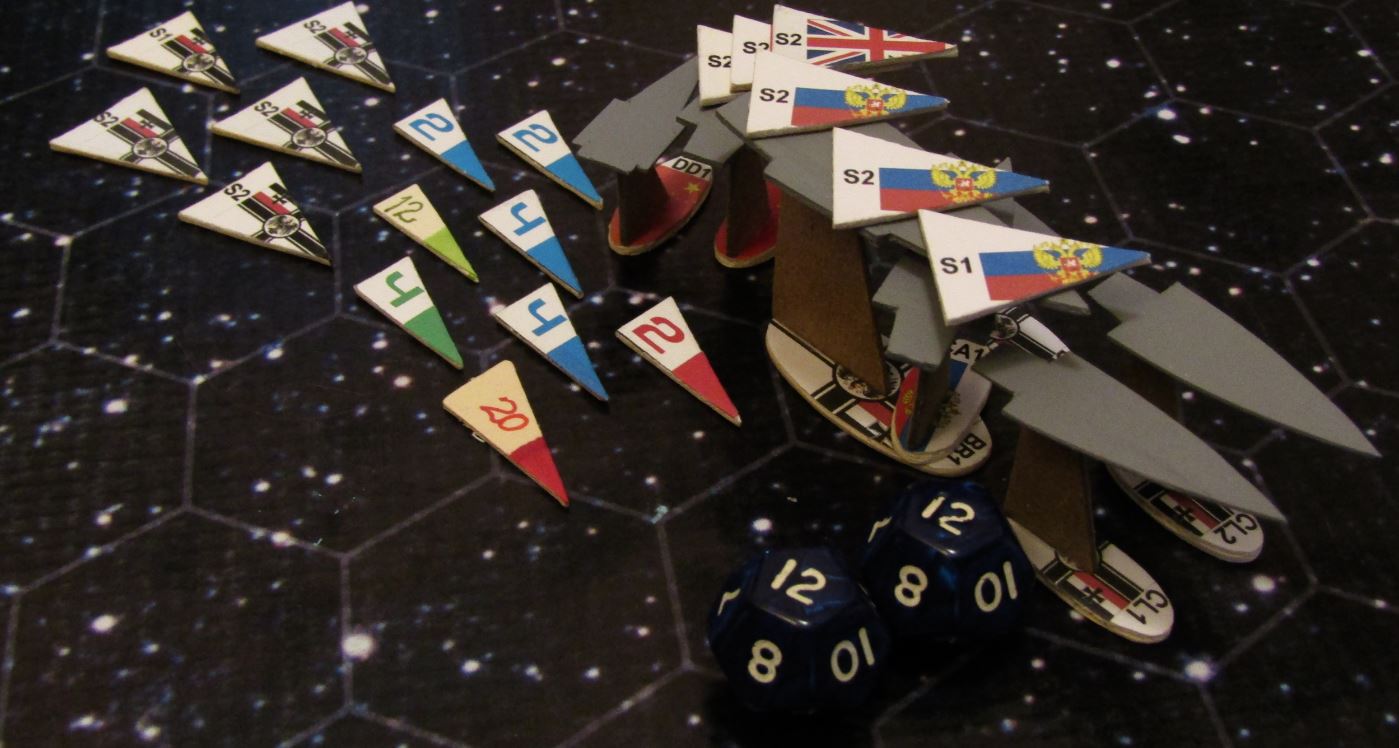
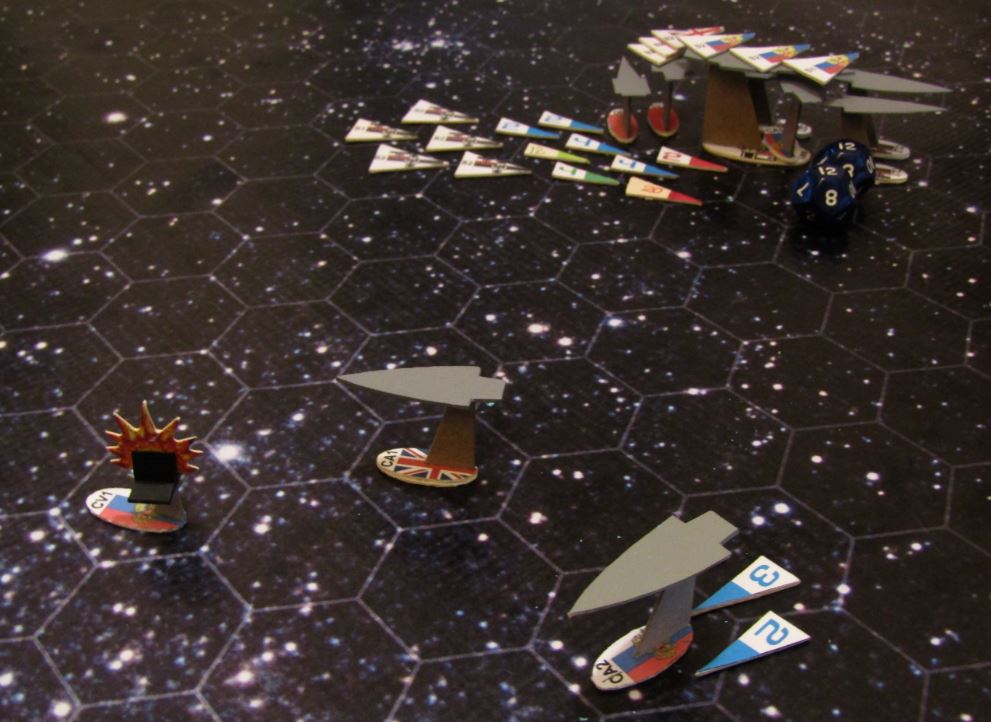
AUGHHH! 21:25 GMT … first torpedoes are impacting! We’ve shot down all Prussian torpedoes coming at us! It’s been a holocaust of Prussian scouts!
WHAT A DAY!
WHAT A LOVELY DAY!
Update: 23:03 GMT –
Long fire phase plus a slight break for dinner –
The fire phase from hell is over!
First, the Petrograd manaced to cripple both the Gustow and the Rossbach, but was of course blown inside out by the huge guns of the Von der Tann (primary guns only). Secondary guns crippled the Chinese destroyer Hohhot. The Hohhot and the Xu Shan crossed the Von der Tann’s sterns for point-blank broadsides that did an incredible amount of damage against the pocket battleship’s stern and DAMNED NEAR took her out … but she’s still clinging to life at the moment.
This thing could still go either way! I’m pretty sure that Prussian pocket battleship is going down this next turn, but she’s taking out multiple ships per turn, and big ships too … Most of the allied hopes are now in the HMS Kraken … as the Russian CPK Narva is badly damaged in the stern and has lost her aft shielding as well.
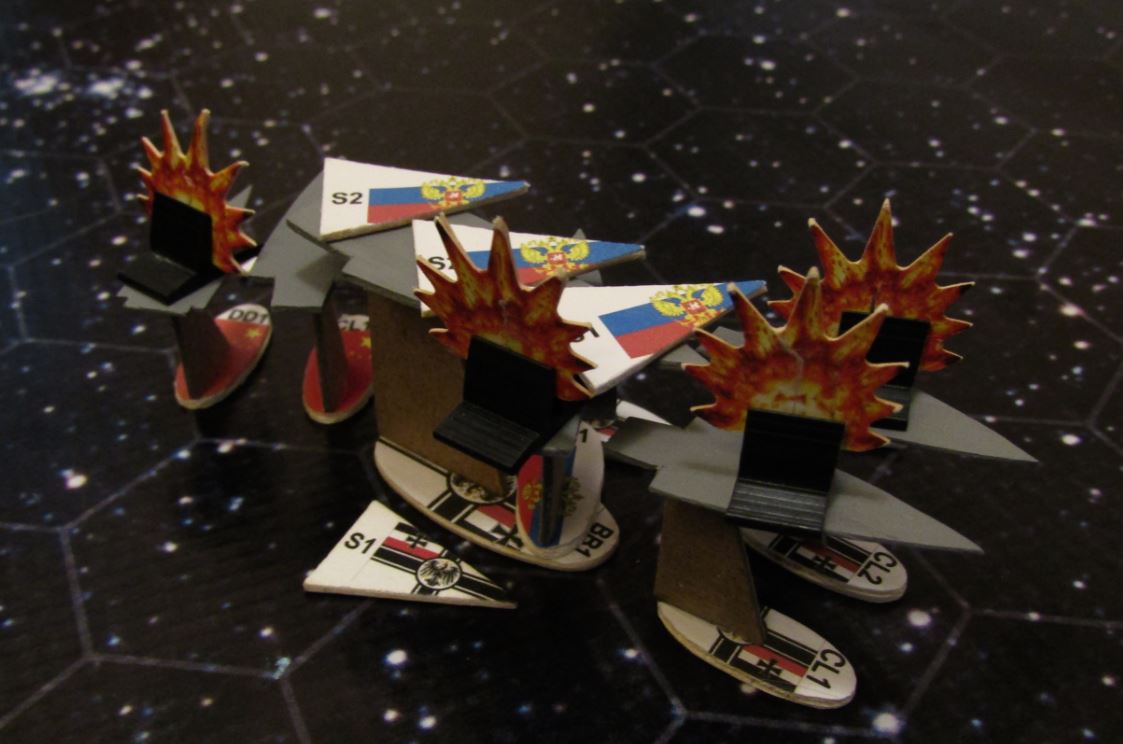
Update: 23:10 GMT –
Torpedoes coming in for the round of combat. My poor Russian heavy cruiser rolled very badly on her point-defense roll here, and is rolling on a penalty because of sensor damage sustained last turned. I only shot down one of these torpedoes, and the other three pretty much automatically hit because this cruiser also lost her aft shielding (last broadside volley from the Prussian cruisers Gustow and Rossbach). These detonated in the engines, and have probably knocked out this Russian heavy cruiser as well.
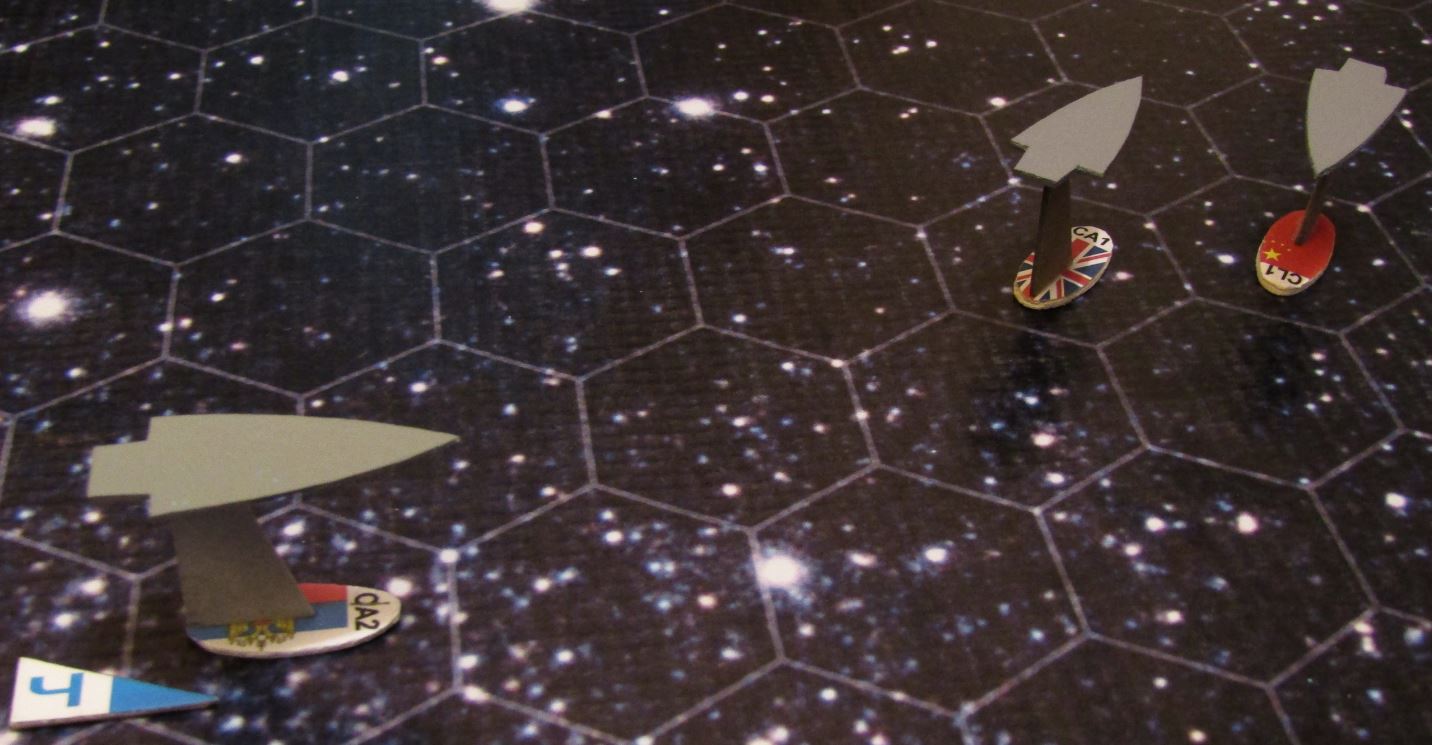
Update: 23:15
Torpedo and missile spreads from Chinese, Russian, and British cruisers that has probably crippled the Von der Tann finally.
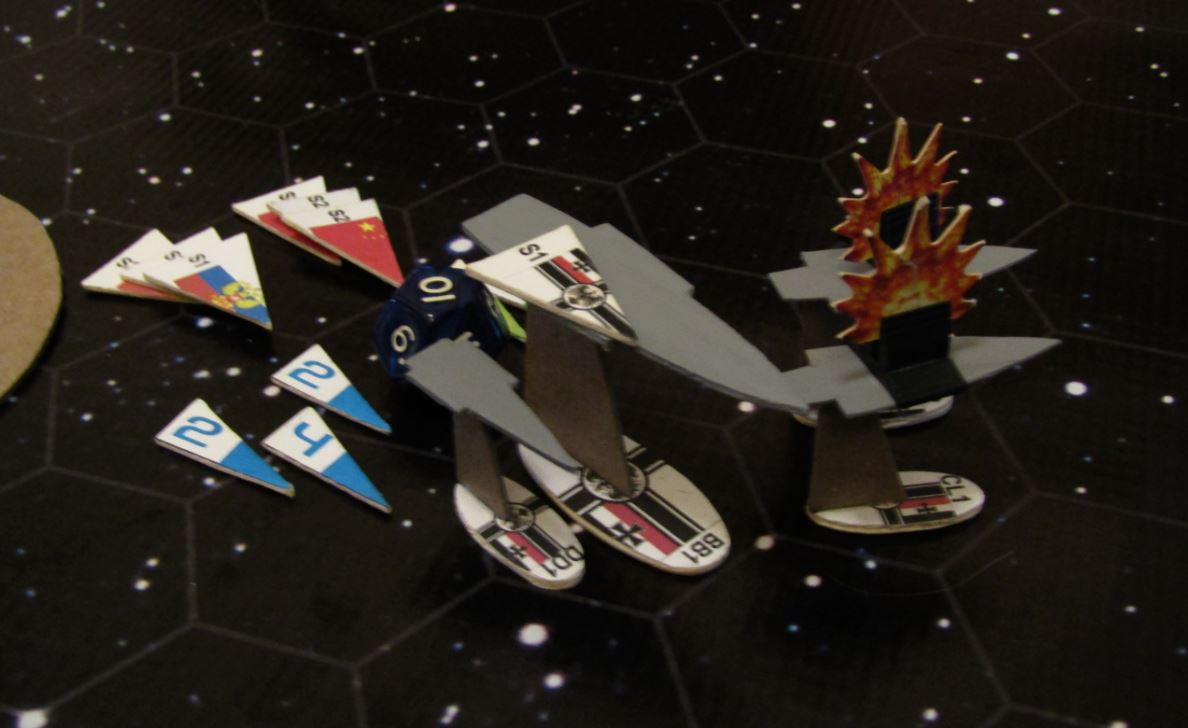
Darkstar Live Blog !!
Hey, we’re finally getting ready for 640-point megagame in Darkstar, where the new Prussian pocket-battleshaip Von der Tann is getting sent out on her maiden voyage! Between turns I may start posting pictures and mini-bat-reps … almost like a Darkstar Live Blog!
A Prussian battlefleet faces off against a “Duchess Annabel’s” coalition of Chinese, Russian, and British warships! No carriers in this one, just a slugging match of heavy cruisers light cruisers, destroyers, and one pocket battleship!
Who do you think will win?!?!
>>>>>>>>>>>>>>>>>>>>>>>>>>>>>>
Entry – 20:09 GMT
PRUSSIAN FORCE:
KMS Von der Tann (pocket battleship)
KMS Güstow (light cruiser)
KMS Rossbach (light cruiser)
KMS Oder (destroyer)
KMS Nordwind (EW escort frigate)
ALLIED FORCE:
HMS Kraken (heavy cruiser)
CPK Petrograd (heavy cruiser)
CPK Narva (heavy cruiser)
PLN Xu Shan (light cruiser)
PLN Hohhot (destroyer)
CPK K-98 (torpedo corvette
>>>>>>>>>>>>>>>>>>>>>>>>>>>
Entry – 20:18 GMT:
First weapons fired at 2880 kilometers!
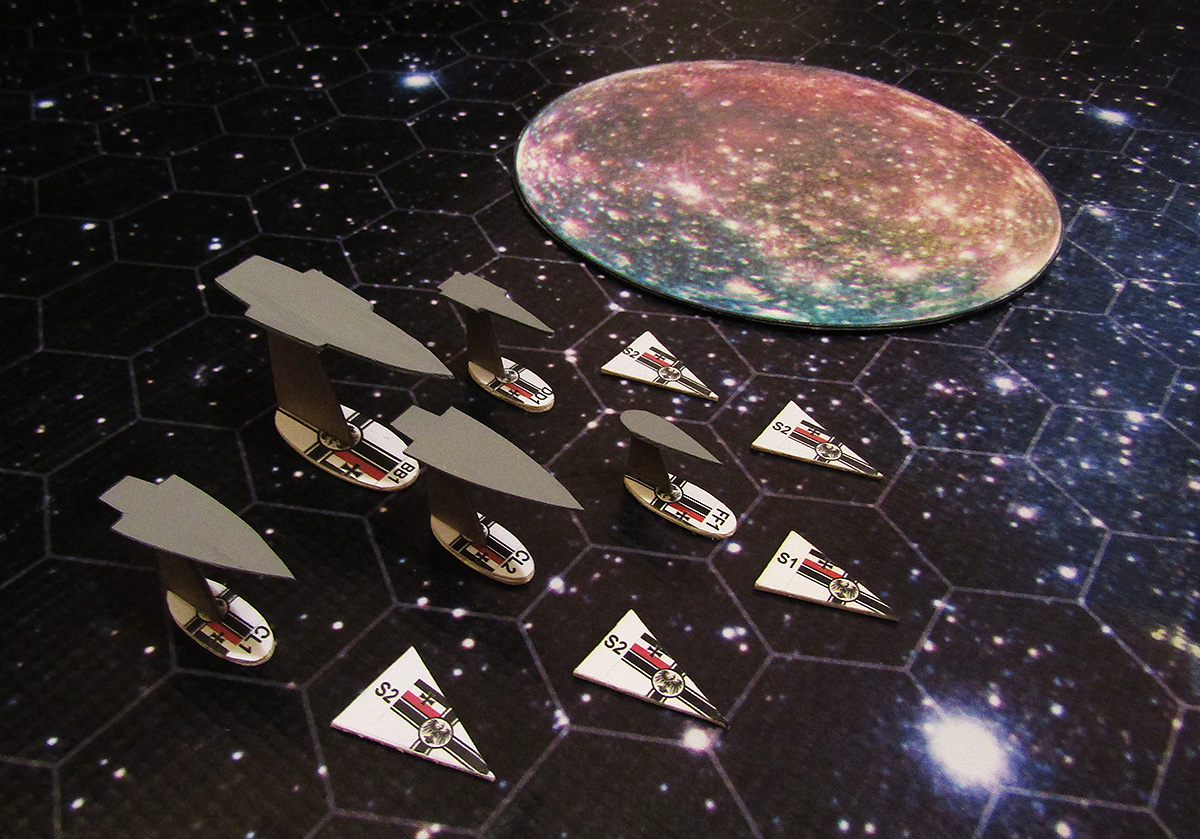
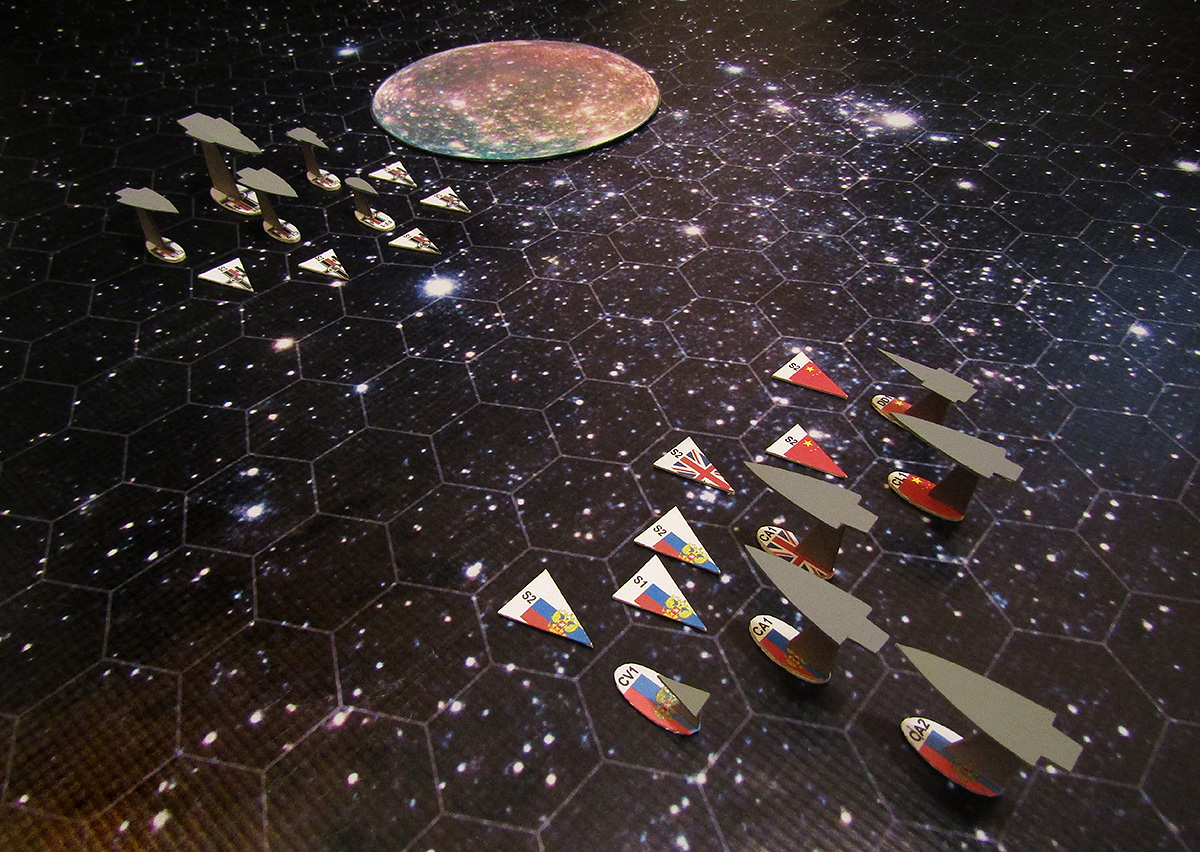
Entry – 20:30 GMT
First fire! K-98 corvette is horribly damaged, along with Prussian frigate Nordwind, heavy cruiser Petrograd (relatively light damage). UPDATE: K-98 corvette is crippled and knocked out of the battle in the opening volley! Nordwind rolled a 38% … and a 30 or below would have forced her to break off! so she BARELY stayed in!
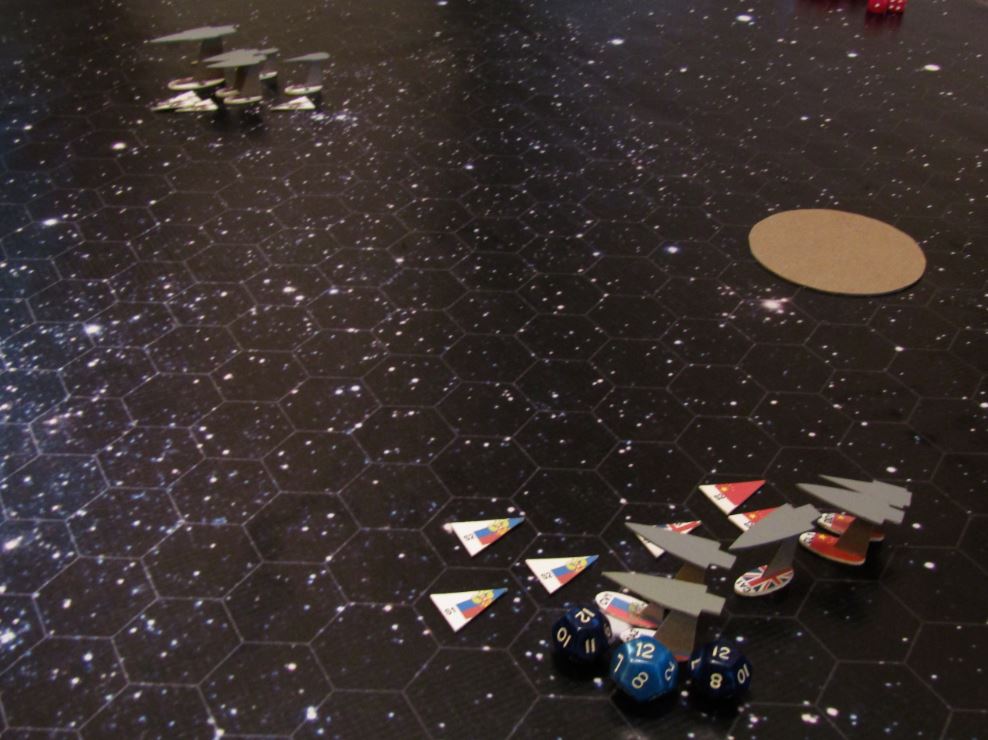
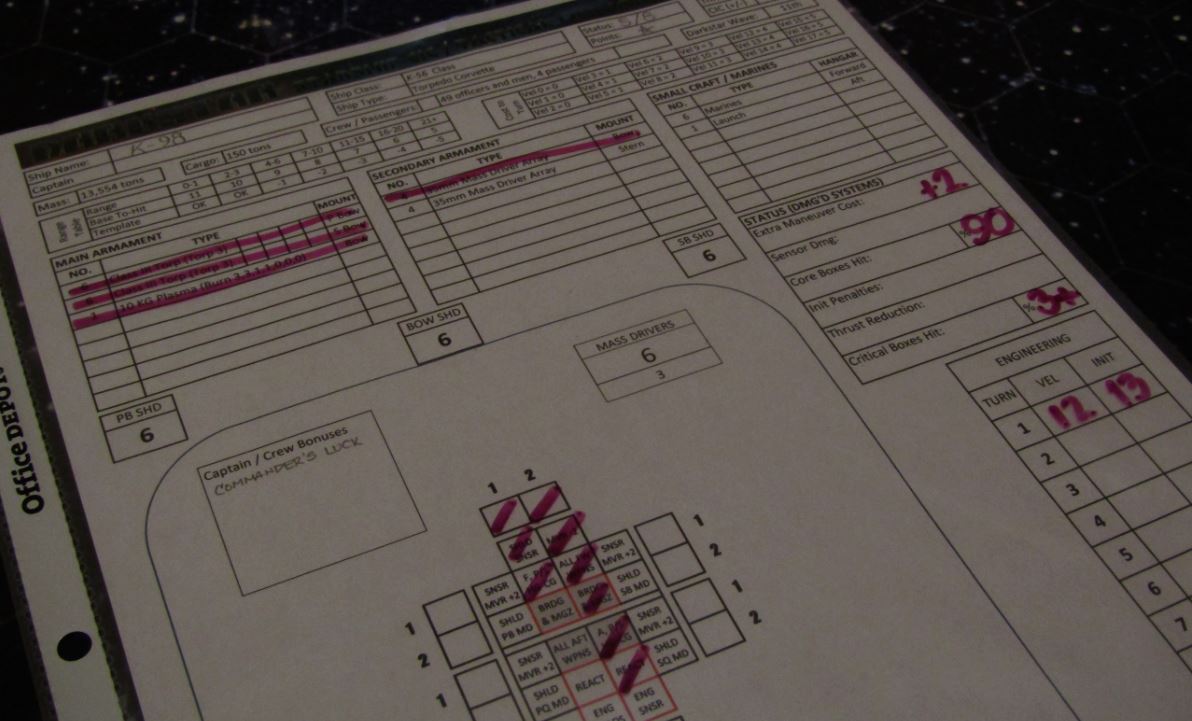
Entry 20:45
Yes, Alex and his might battleship and light cruiser task force decided to put a significant amount of firepower on a pitiful little corvette!
Come on, man! PICK ON SOMEONE YOUR OWN SIZE! 😀 😀
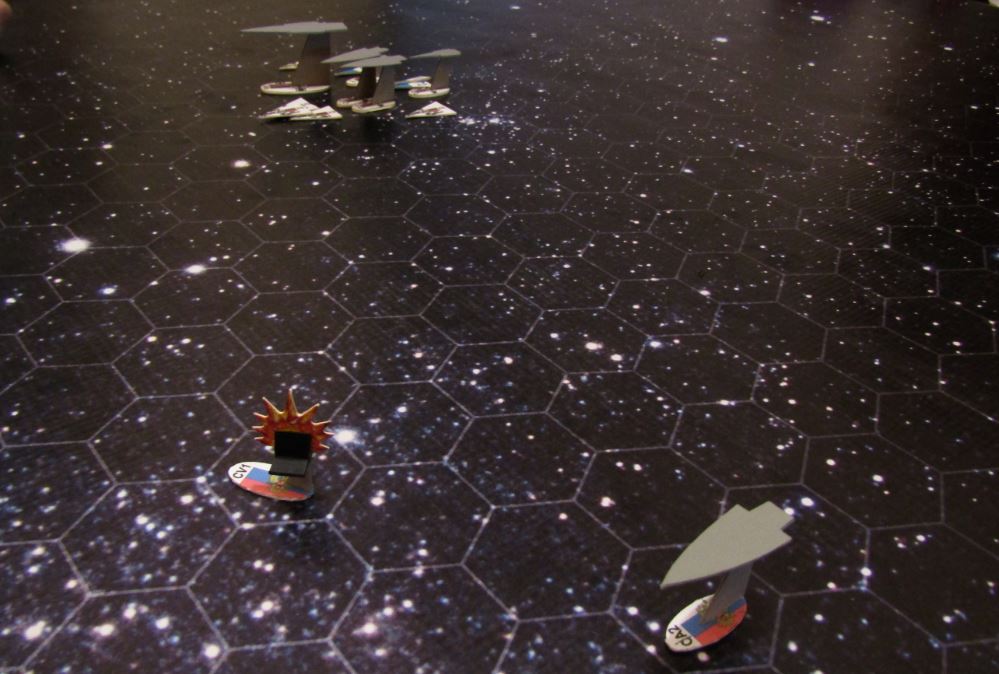
Deep Space Engagement P1
Screening Engagement in Helioshock Boundary
Onomoken Star System (HD 172051)
12 January 2519
SITUATION: Having been handed a series of rough defeats in the Cervantes star system (Mu Ara), the Iron Wolves are finally falling back to surrounding friendly systems to regroup and lay new plans. One such haven is the nearby Japanese star system of Onomoken (“Lord’s Sword” – HD 172051), a yellow main sequence star with no less than six terrestrial planets rich in ores and metals, and three gas giants with heavily-colonized and industrialized moons. At just 11.5 light-years away from the recently-embattled Cervantes system, it lies within just two weeks’ striking distance of most naval task forces in Cervantes, making it a prime target for resurgent Annabel’s Alliance striking out from these Imperial Russian holdings.
In fact, British, Panasian, and Russian naval commanders have already decided on a different course of action. With the Franz Josef “Kruezergeschwader” (cruiser squadron) so more or less gutted and Prussian naval forces so badly damaged throughout the Libra-Sagittarius SCS (strategic command sector), it is hoped that the direct path to the Eisenwolf Colonies at Gliese 570 lies more or less open – or at least lightly defended. Just maybe, Annabel’s Alliance can seize the moment to smash the weakened Prussians out of the Duchess’ War.
To prevent other nations of the Iron Wolf coalition from reinforcing these Prussian colonies, misdirection operations are launched to keep Japanese, New Roman, and Black Dragon battlegroups and task forces pinned down in other areas. The first of these is intended to reinforce the impression that the Annabel Alliance is indeed making a push in the opposite direction from Cervantes, toward the nearby Japanese colonies of Onomoken.

The mission is given to Captain Pyotr Myshaga and the Lazarev task force. Although not nearly at full strength after the savage battles in Cervantes, Myshaga’s force is nevertheless deemed fit to at least launch a diversionary raid into Onomoken’s outermost reaches. After all, the Lazarev and her escorts are hardly invading the system, simply penetrating its outlying regions and engaging the first small force it runs across.
Myshaga and his Russians, however, get a little more than they bargained for as they complete their first high-speed Darkstar wave toward the Onomoken system. Typically, invading naval formations first make such a fast “approach wave,” usually at ninth- or tenth-magnitude, to cover most of the interstellar distance to a target. Dropping out of their Darkstar wave just outside the system, they then take new sensor readings and astronavigational fixes (aligning themselves to the relative galactic motions of the target star system, which of course are usually radically different from the star system from which they sortied), and finally set a much slower, more accurate, and stealthy Darkstar course to actually penetrate the enemy star system.
While making preparations for this second jump, however, the Lazarev task force finds it is being approached by a New Roman cruiser-destroyer battlegroup, built around the Foch-Hispania class light cruiser Leclerc. Myshaga decides this will be the “small force” he will engage to fulfill his mission. There are no moons or planets nearby, this battle will take place in the whisper-thin electromagnetic bands of the Onomoken star systems helioshock boundary, where the star’s solar wind is piled up ever so faintly against similar solar wind and particles of the interstellar medium. Put more simply, it’s at the very edge of interstellar space, some 20,000 AU (almost one-third of a light-year) out from the Onomoken star.
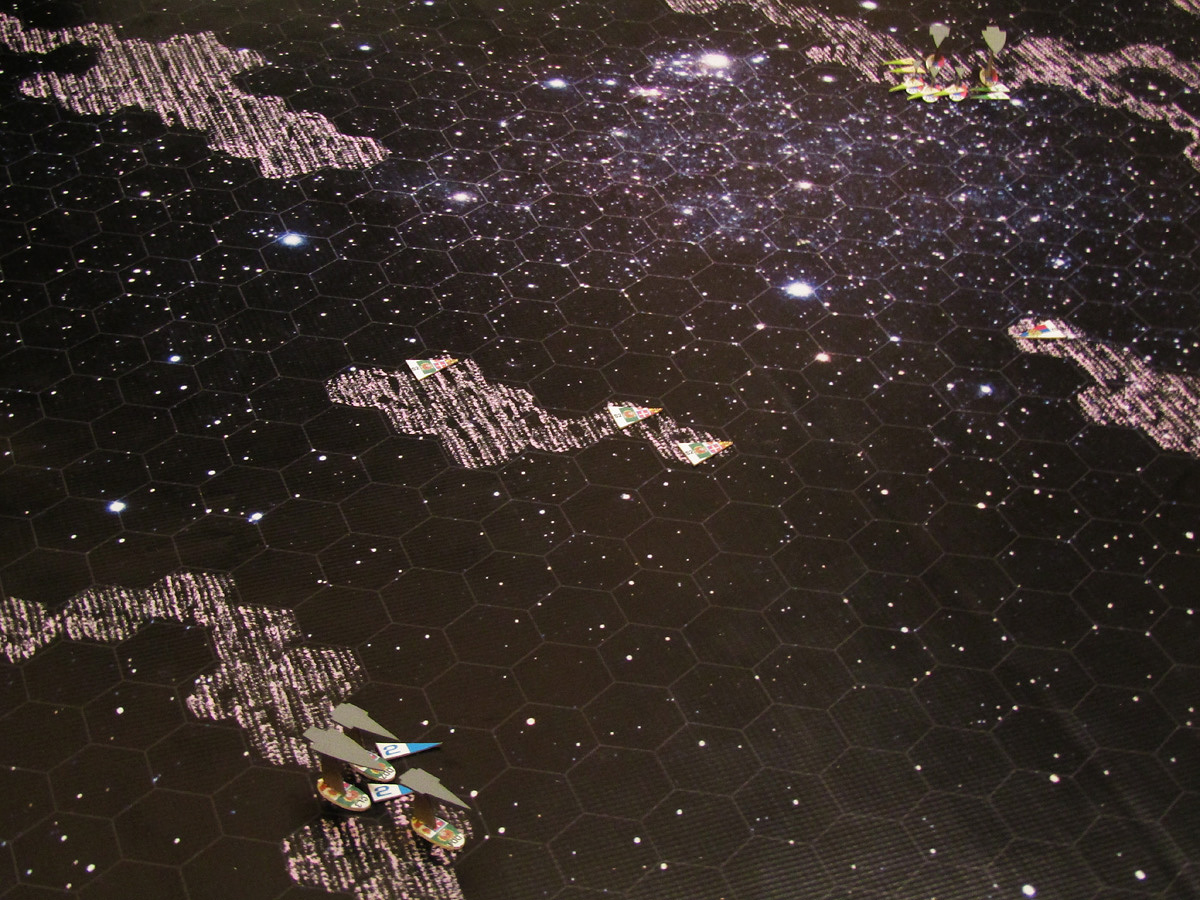 The French and Russian battlegroups make their initial approaches. Note the colored bands on the map. These are "density waves" in the vast ocean of ionized solar wind particles that permeate this whole area of space, the "helioshock boundary" where the solar wind of the nearby Onomoken star can no longer push against the interstellar medium and thus "piles up" in rippled waves just dense enough to partially interfere with a ship's targeting sensors. In game terms, each colored hex that a warship's intended line of sight / line of fire must enter adds +1 to the target difficulty. Each hex is 180 kilometers across.
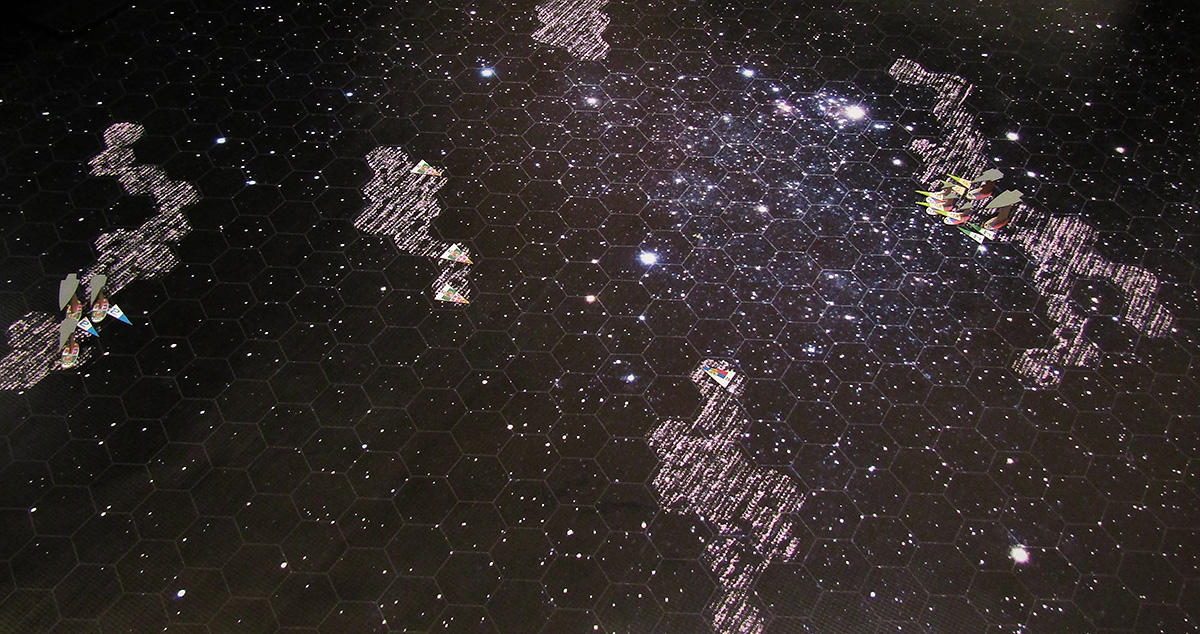 The ships continue to close. Here they are are about 3600 kilometers apart (2230+ miles), or roughly the distance between London and Jerusalem. All of Europe and part of the Middle East would easily fit between these two fleets.
REPORT: What was supposed to be a raid quickly turns into more of a pitched battle, as the Leclerc battlegroup and Lazarev task force make their initial approaches.
With much longer-ranged weapons, more gunnery, and more accurate sensors, the French of the Leclerc, Calais, and Corsica opt to keep the range open as long as they can, holding back and drilling the Russian corvettes with long-ranged laser fire to lighten the weight of the expected Russian torpedo spreads. The Russians, for their part, and to close the distance as quickly as possible, but are also using the vast, ionized bands of charged particles drifting throughout this helioshock boundary as “cover,” hoping they will take the edge off superior New Roman electronics.
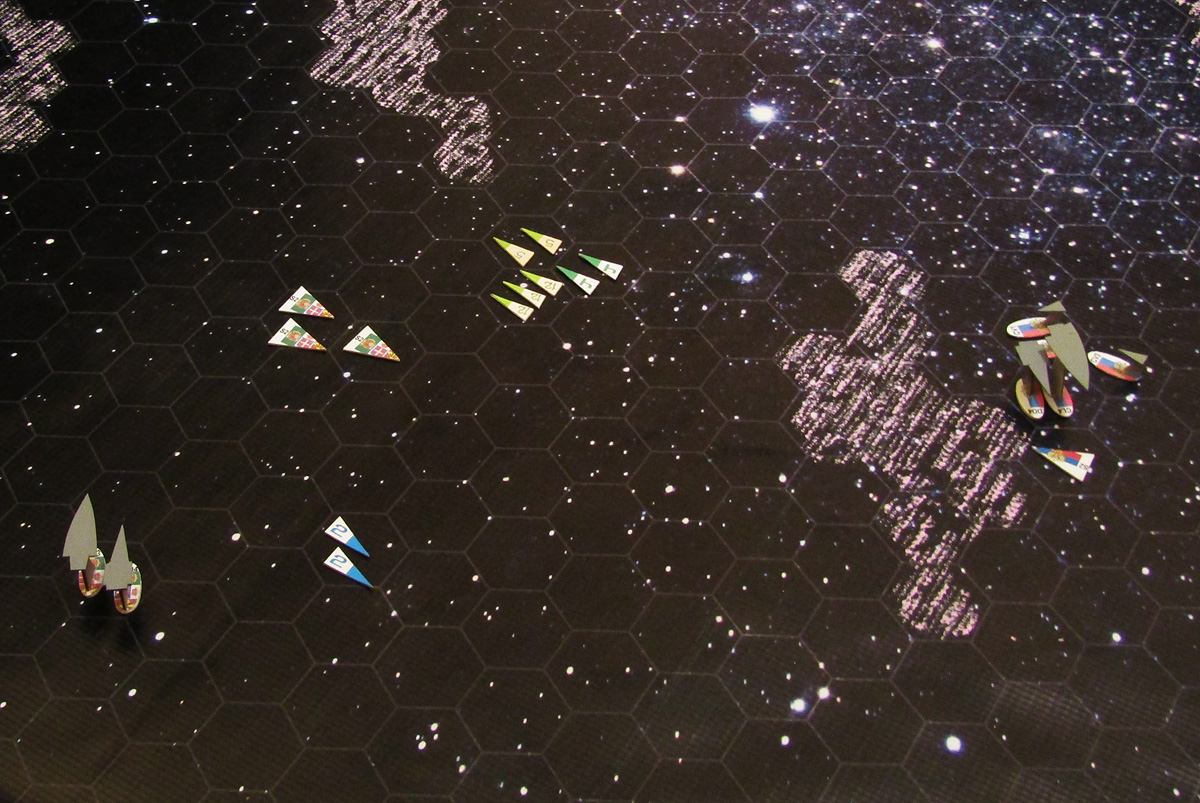 The fleets continue to close, the French (left) trying to keep the range long where their superior targeting electronics will give them an edge ... the Russians (right) trying to use ionized density waves as a kind of "cover."
At first, the tactics of both sides seem to be working reasonably well. As the Russians hoped, the opening French volley missed at a range of 3600 kilometers, partly due to the EM disruption of the helioshock ion bands. But as the Russians close, a second French volley engages the torpedo corvette K-121 at 2,200 kilometers, not quite crippling her but forcing her captain to break off the action.
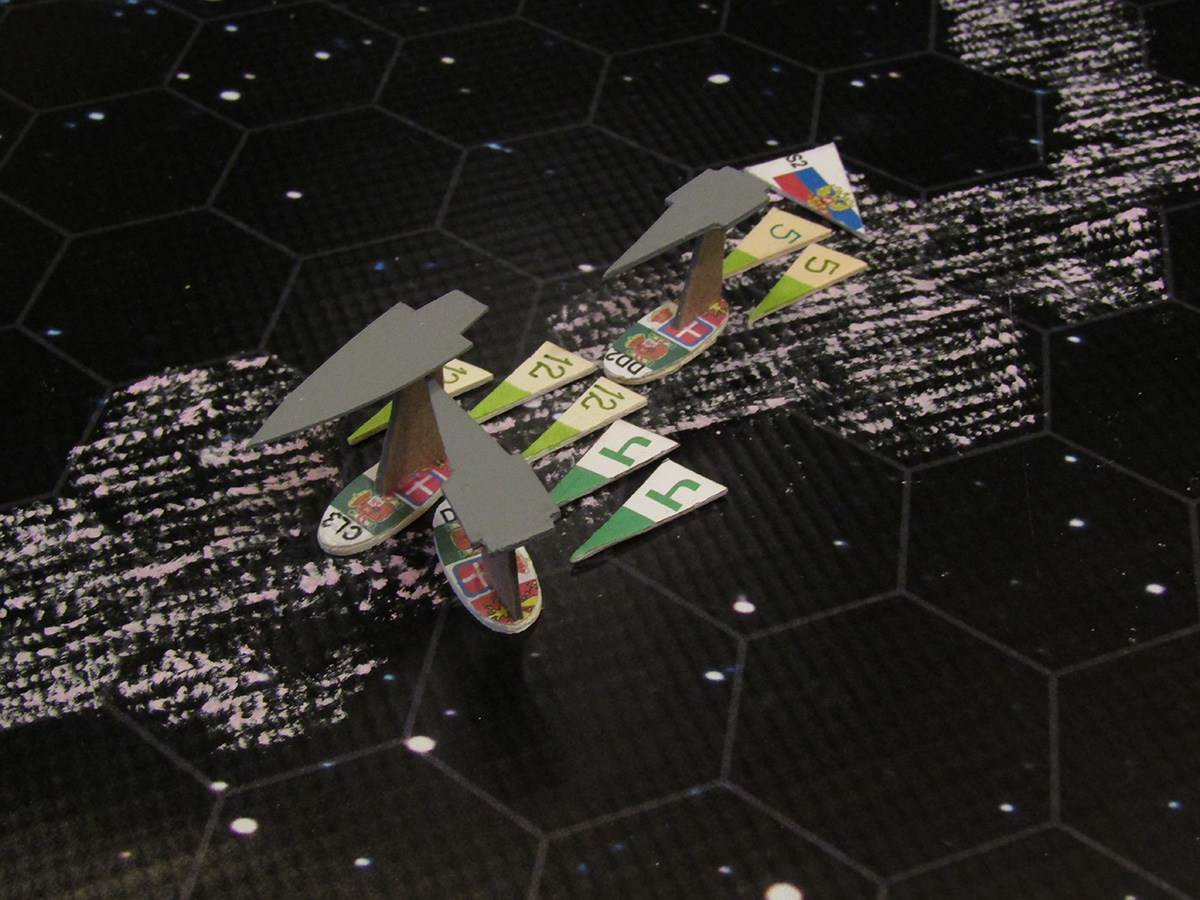 The Russians make the mistake of splitting their torpedo wave between the French flagship (NRS Leclerc - CL3) and one of her escorting destroyers (NRS Calais - DD2)
For the French, however, things become unstuck from there. The Russian return volley, even at this relatively extended range, is devastating. The Lazarev and Syekyra have upgraded their targeting systems, and even shooting through a dense “pressure wave” of ionized solar wind, enough hits are scored on the starboard bow of the fragile destroyer Corsica to force her to break off. The damage isn’t actually that bad, but the hits just happen to set up a cascade failure through Corsica’s navigation computers and life support systems. Then again, perhaps no one is particularly eager to get in a really bloody fight this far out from any bases, colonies, or potential rescue.
 The Russians are losing patience, finally setting a direct course for the French, still slinging out full torpedo spreads although from here they can only engage with gun frontal batteries, while the French are "crossing their T."
Deep Space Engagement P2
Screening Engagement in Helioshock Boundary
Onomoken Star System (HD 172051)
12 January 2519
The Russians press their advantage, and perhaps get a little too confident, splitting their torpedo spread between both the cruiser Leclerc and destroyer Calais, clearly hoping to wrap up this little raid straight away. The move doesn’t work, and although both remaining French ships are heavily damaged, they remain operational. Their return volley, meanwhile, positively mauls the corvettes K-98 and K-109, leaving both burning cripples, adrift in space and already screaming for rescue.
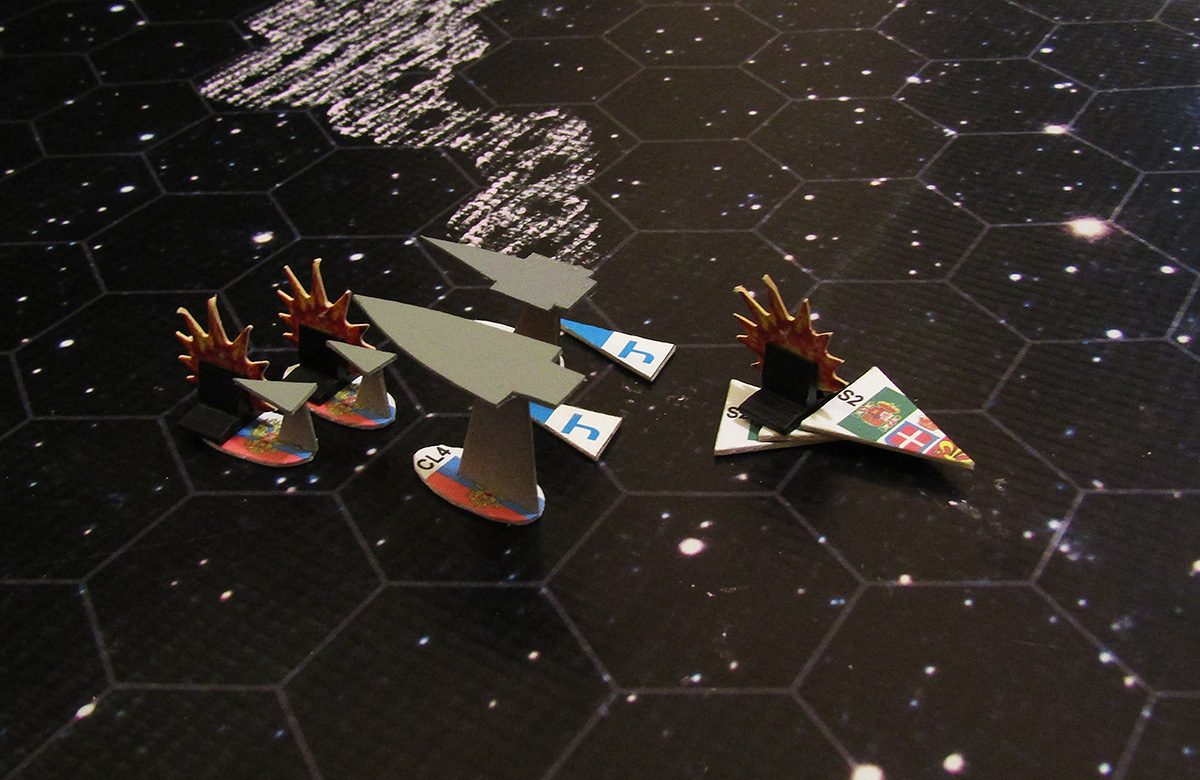 The Russians take their first real losses. One of their small torpedo corvettes has already been forced to break off, now two more are outright crippled by powerful French laser fire. However, French torpedo spreads are easily shot down by Russian mass driver point-defense guns, in fact the Russians have enough point defense guns to also shoot down ALL SIX of the French scouts.
With all three of their torpedo corvettes now removed from the fight, the Russians will have to rely much more on raw gunnery to defeat the weakened French. But their guns for the moment aren’t doing very well at all, despite the shorter range. The French commander (Captain Raphael deChalemonde) now has his ships in a solar wind pressure wave, using it as a disruptive screen against Russian targeting while the Russians are barreling at him more or less in the “open.”
Myshaga, however, now has the taste of blood in his teeth. Shaking off his losses, he continues to press the French, his next volley finally crippling the badly-damaged destroyer Corsica. But the Corsica has already released her own broadside of 8-megakelvin lasers at the Syekyra, followed up by a volley of pinpoint accurate rail guns from the Leclerc and especially her incredibly powerful (and long-ranged) 12-megakelvin lasers. These hits slash right across Syekyra’s engines, exposed as Myshaga turned his ships to broadside the French. The Syekyra lies crippled right along with the Corsica, both destroyers tumbling through deep space.
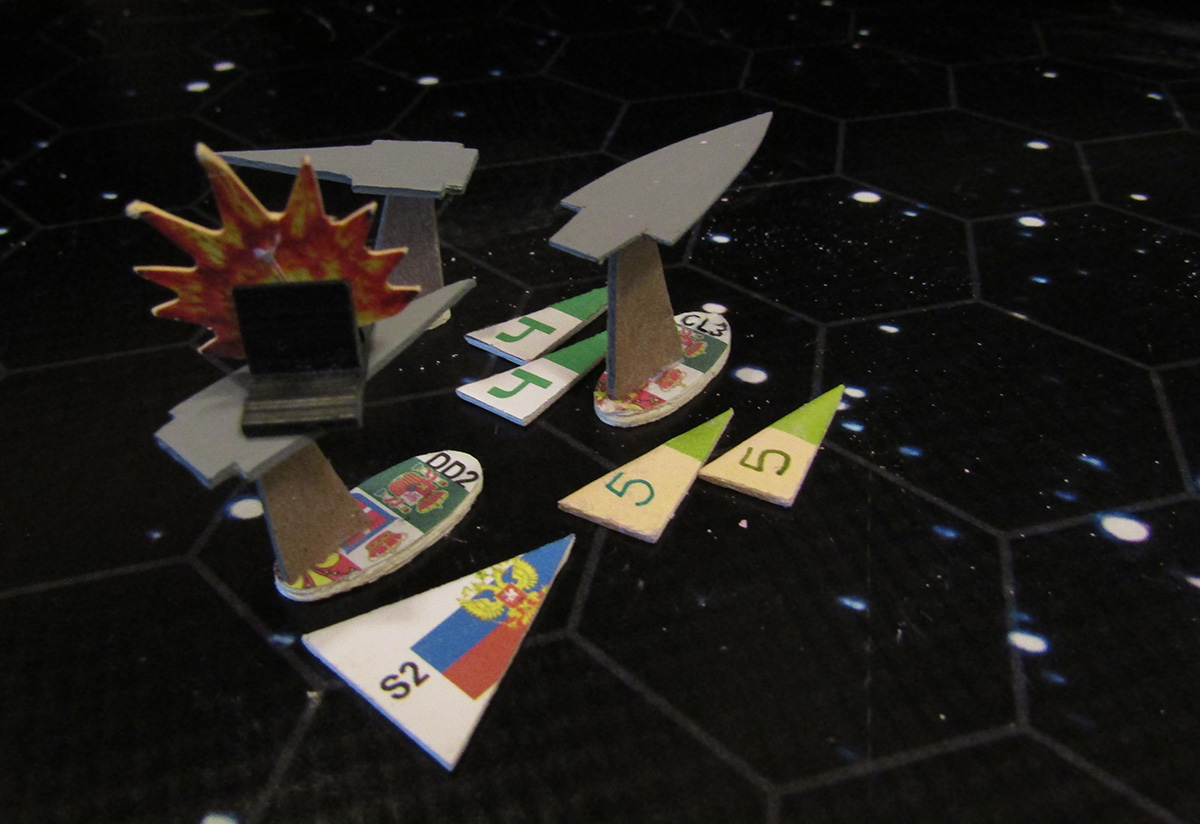 The French destroyer Corsica is crippled.
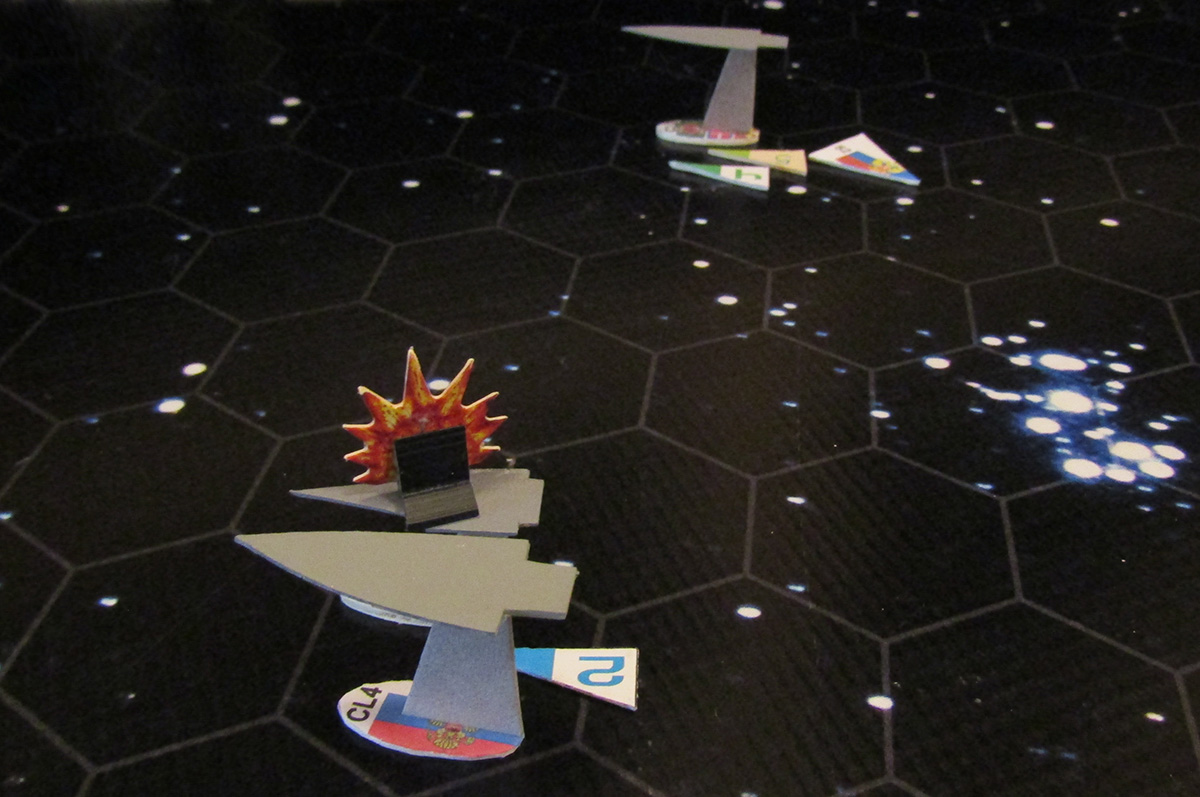 But the Corsica and the light cruiser Leclerc likewise take down the Russian destroyer Syekyra.
The battle has now come down to the two flagships, Lazarev and Leclerc. Myshaga and the Lazarev have a clear advantage, however, as the Leclerc has already been hit astern by five torpedoes and has thus lost two complete engines, along with maneuvering thrusters and perhaps most distressingly, sensors suites that feed telemetry data into her advanced targeting system. Largely hobbled and half-blind, the Leclerc really has no chance against the undamaged Lazarev, yet for an incredible ten minutes, Leclerc keep hope alive through some great maneuvering and lucky breaks. The Lazarev just can’t finish her off, all the while taking a steady stream of damage from Leclerc’s rail guns and especially her powerful 12-megakelvin lasers. The Leclerc can’t win, but if she can just survive, she can force a draw … or perhaps force the Lazarev to break off with a lucky hit.
Just such a miracle almost happens when the Lazarev’s bridge is hit by one of Leclerc’s penetrating high-powered lasers. Myshaga himself is wounded in the resultant explosions, but the Lazarev’s bridge remains operational and Myshaga retains command.
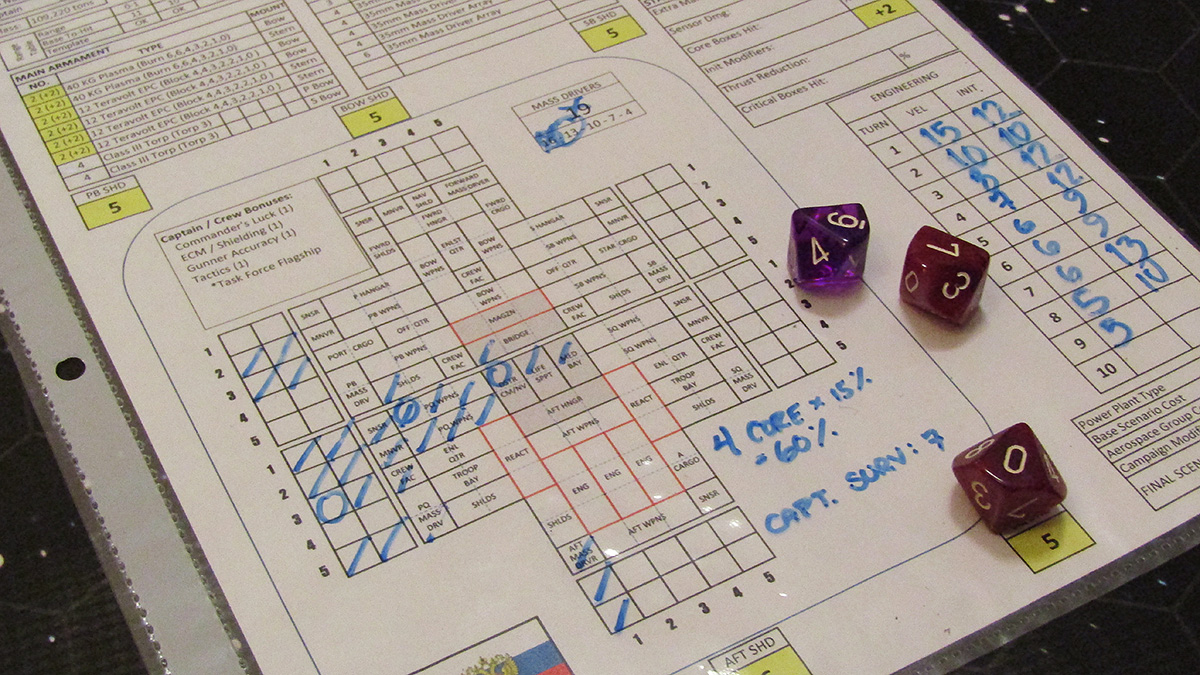 Each class of weapon not only does different amounts of damage at different ranges, but also different "profiles" or shapes. Explosive weapons like rail guns and torpedoes can "cavitate" inside the target, as we see here. Successive 7-gigawatt rail gun hits from the Leclerc against the Lazarev have struck her port quarter too far forward to hit any engines or reactors, but note how the shells explode outward a little as well as deeper into the ship. This "sideways" cavitation damage causes one of the Lazarev's bridge boxes to be hit. ALL bridge boxes hit means the ship is immediately crippled and out of the game. However, even partial bridge boxes hit have bad consequences. Also, the boxes shaded in gray are considered "core" compartments - with four of these hit the Lazarev have a 60% chance of being forced to break off the action (15% per core box for light cruisers) - but note the 67 rolled ... she BARELY remains in the fight. With partial bridge damage, though, the captain might also be killed or wounded ... it's a 1-7 for safety on a d10. Note the 10 rolled ... the captain is hit! He gets a re-roll if he wants, however (note the "Commander's Luck" merit purchased at upper left). If Myshaga uses this re-roll here, however, he can't use it later in the game ...
 The end comes with abrupt brutality. With half her engines and maneuvering thrusters gone, Leclerc can only outmaneuver the Lazarev for so long. Finally Lazarev cuts behind her for a point-blank broadside across her stern at less than 150 kilometers. Already savaged by an earlier Russian torpedo spread, the Leclerc’s engines and reactors are positively shredded by close-range Russian plasma and EPC fire. Beyond crippled, the Leclerc ejects both her reactors with just seconds to spare, it’s really a miracle she doesn’t explode.
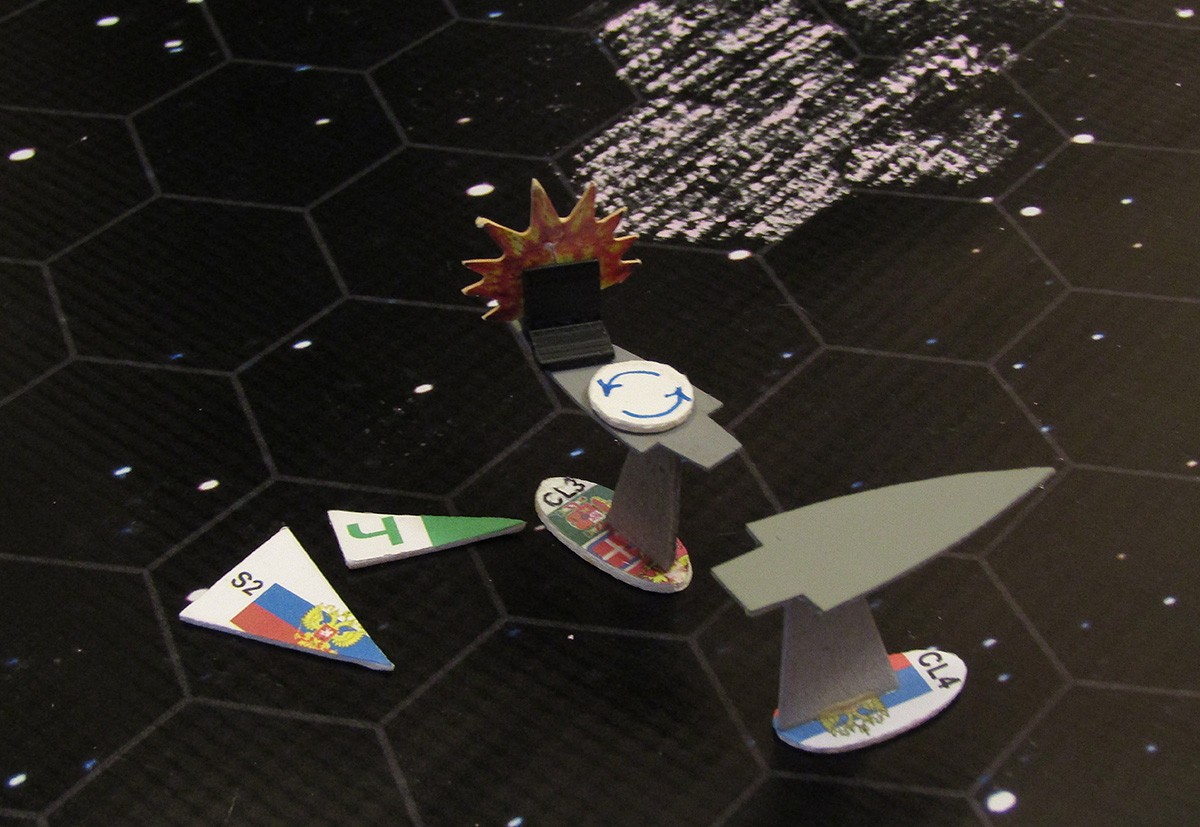 Time runs out at last for the Leclerc. Despite some big disadvantages and a very unlucky start of the game, she ALMOST pulled off a draw here. When the Lazarev finally gets a broadside behind her, however, as we see here ... Leclerc is doomed.
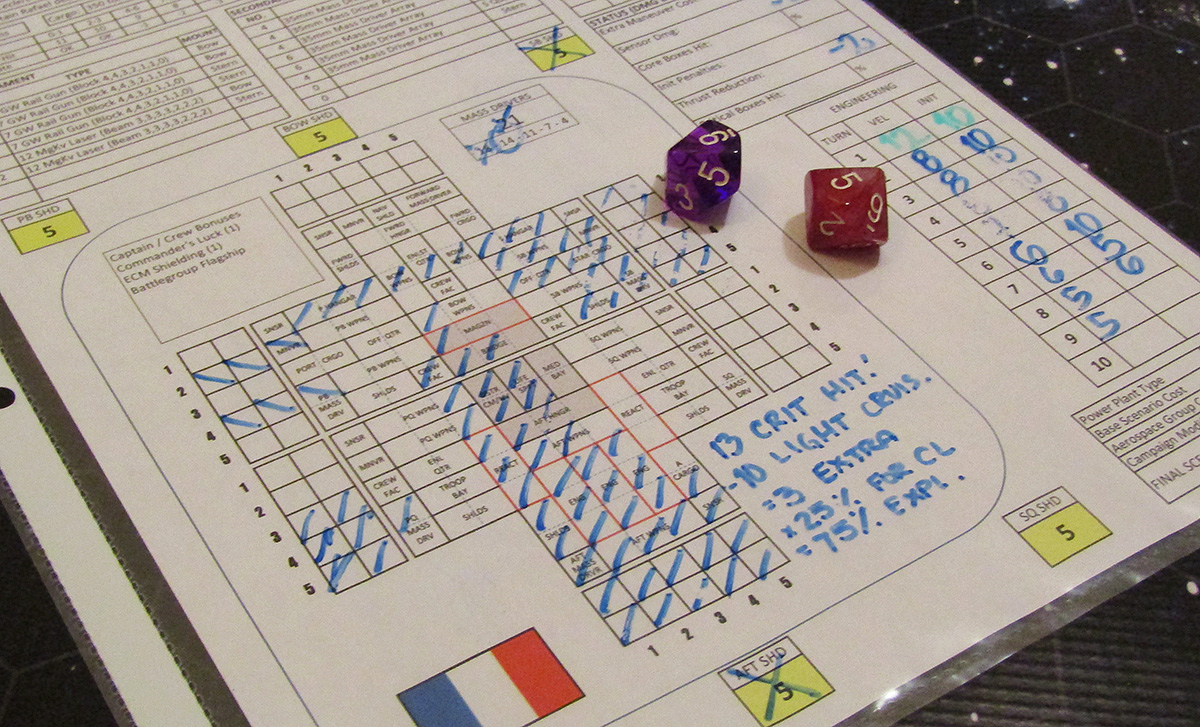 The savagery of close-range Russian firepower is made evident here. With her stern already badly damaged by previous torpedo hits, Leclerc's stern is positively blown inside out by Lazarev's powerful plasma projectors and EPC emitters. Damage has tunneled comepletely through the ship to set off secondary explosions as far forward as the bridge and forward magazines. The Leclerc is more than crippled, she really should explode here. Light cruisers start off with a "cripple number" of 10+ on a d6, this target is reduced by 1 for each critical box (red) hit. Leclerc has lost 13 critical boxes. So the Lazarev has to now roll a -3 (10-13) on a d6 ... so Leclerc is obviously automatically crippled. Worse, because that target number is now actually NEGATIVE, Leclerc is in very real danger of exploding. For light cruisers it's 25% for each point that she's in the negative, which is as we've seen is -3. So she has a 75% chance of exploding. Note the 95 rolled on percentile dice, however ... against the odds Leclerc has survived! She's crippled, of course, her captain may be killed or wounded, and she'll spend 90 days in dry dock (60 internal component boxes hit, +50% for being crippled) - and I don't even want to imagine the casualties among her crew of 490 officers and men ...
 The “skirmish” is over. Although heavily damaged, including a bridge hit that has wounded her captain, the Russian light cruiser Lazarev remains operational. Even considering the rescue and recovery operations that will keep her occupied for the time being, she now represents a major threat to the Japanese holdings in the Onomoken star system. In fact, major Japanese vessels (including in all probability the Konoya carrier strike group) will not be available to help defend the Eisenwolf Colonies against the larger invasion of Annabel Alliance warships already en route. Although only a diversion, only a “sideshow,” the fact remains that this skirmish in the Onomoken helioshock boundary represents another massive come-back for the Russian Navy in Duchess Annabel’s War, and more bad news for the faltering Iron Wolf Coalition.
SCORING: The Russians have the light cruiser Lazarev remaining and two scouts (116 points). With the overall battle only being 208 points in size, this constitutes a MAJOR VICTORY, although only in a small battle.
Designing "German" Pocket Battleship P3
KMS Von der Tann (KS-1208)
Scharnhorst-class pocket battleship
Imperial Prussian Navy - Psi Serpentis and Duchess Annabel’s War
Design and Roll-Out
The actual gameplay warships record sheet for the Scharnhorst-class pocket battleship in snow complete. Hard copies are printed up and this ship is ready for her “maiden voyage” playtest hopefully this weekend. 😀
Meanwhile, smaller battles between French task forces of the New Roman Alliance and the Black Dragons of the Khitan-Tunguska Free State are hopefully on the cards for tonight, tomorrow, or perhaps Saturday.
Again, for best results, select the image, then open the image in new tab for full resolution.
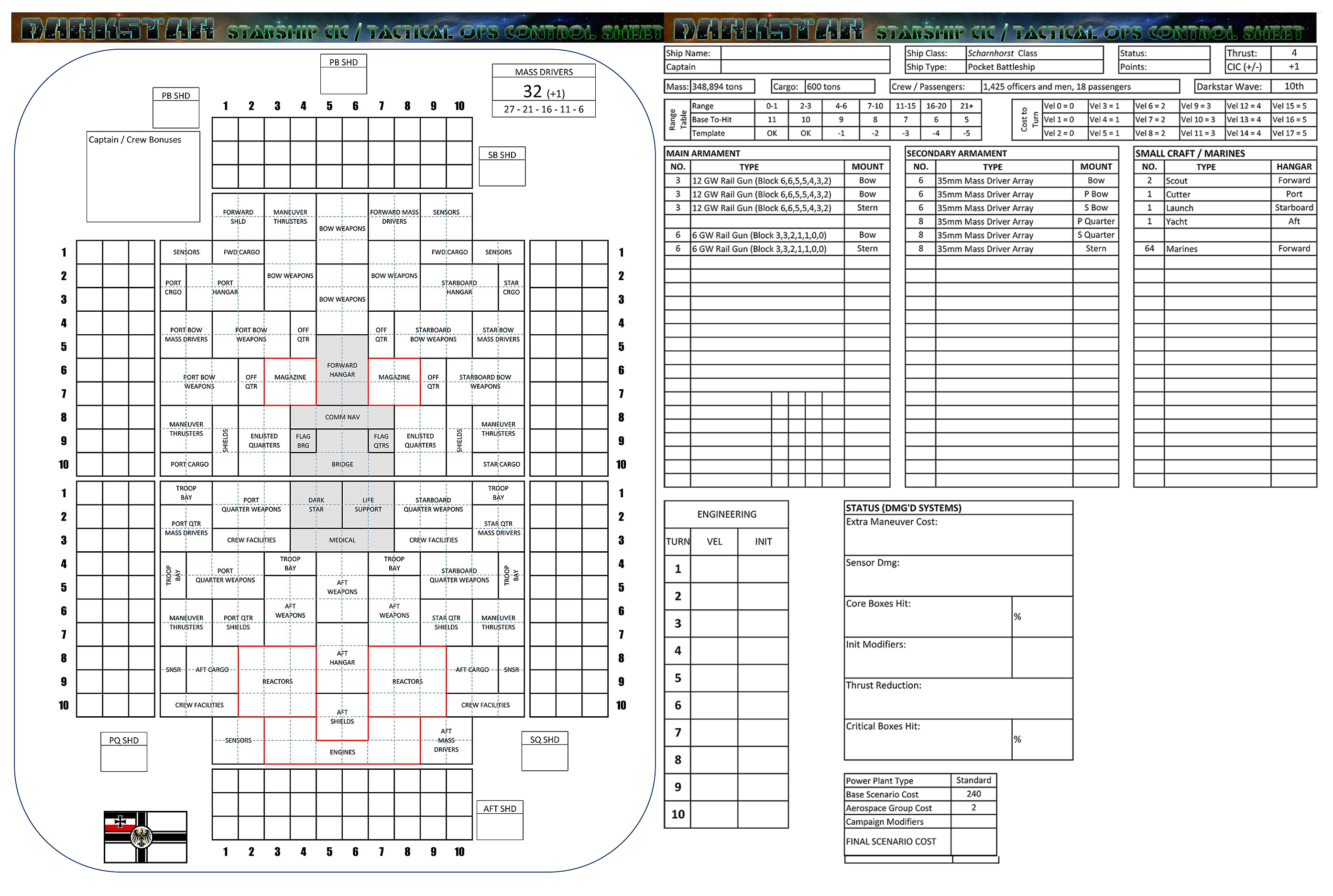 Warship record sheet for the Scharnhorst class pocket battleship. It lists the weapons mounts, maps out the components that can be damage, tracks velocity and initiative, helps players with the costs for facing turns at different velocities, shows shields and armor, and lays out the locations and firing arcs of all the ship's weapons. Modifiers that can accrue in combat are also tracked here. These are usually slipped into plastic document protectors and written on with dry erase markers for greatest ease of repeated play.
 Designing "German" Pocket Battleship P2
KMS Von der Tann (KS-1208)
Scharnhorst-class pocket battleship
Imperial Prussian Navy - Psi Serpentis and Duchess Annabel’s War
Design and Roll-Out
Okay, now it’s time to start drawing this baby out (PS14, after concept sketches the old fashioned way just to hammer out ideas).
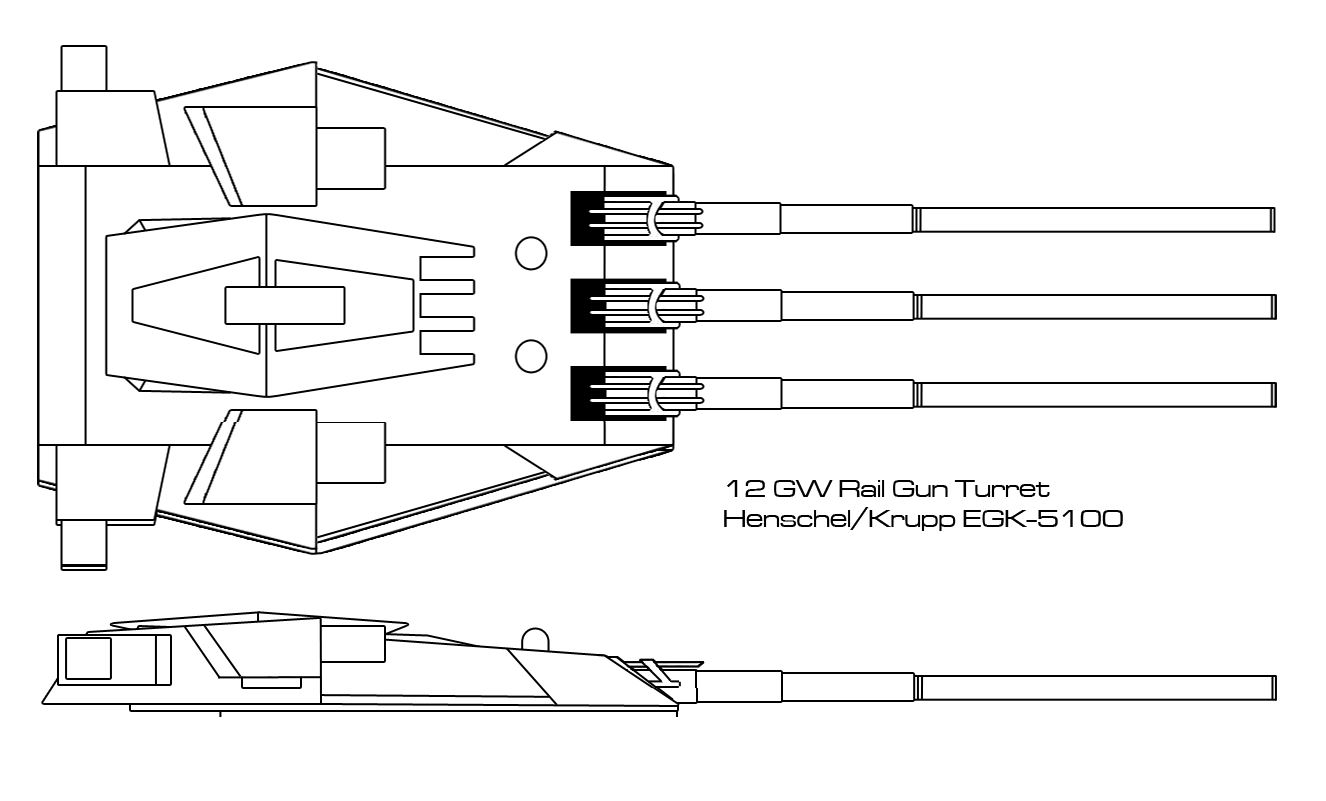
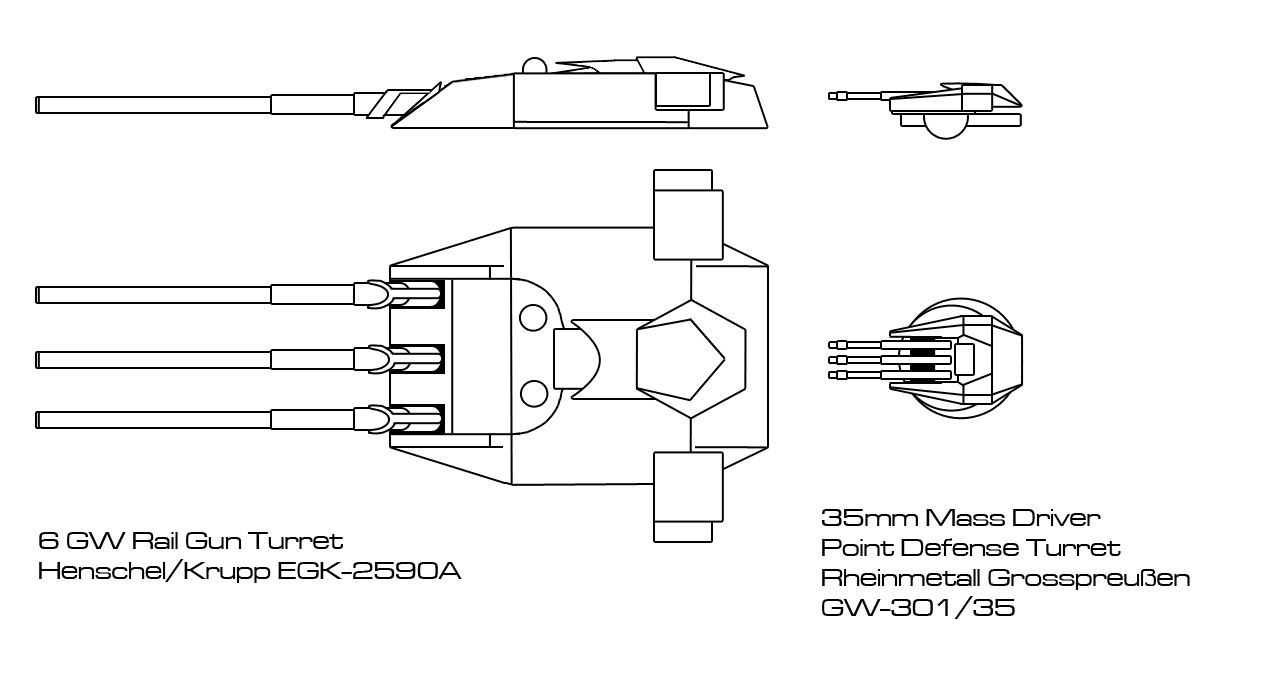
First, we have the 12-gigawatt rail gun turrets. As naval historians may have guessed, the Scharnhorst’s three triple turrets are inspired by the 11-inch triple turrets of the historical Scharnhorst in WW2.
Then, the smaller 6-gigawatt rail guns, and the 35mm paint defense arrays.
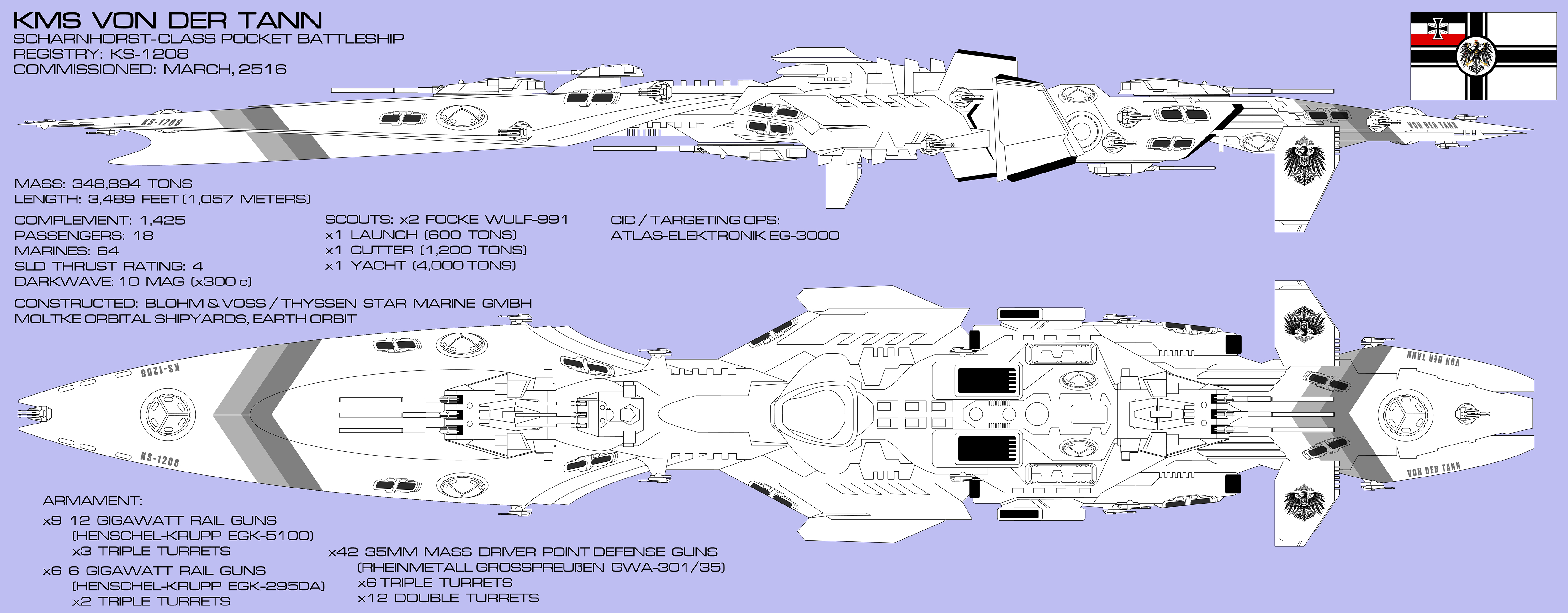
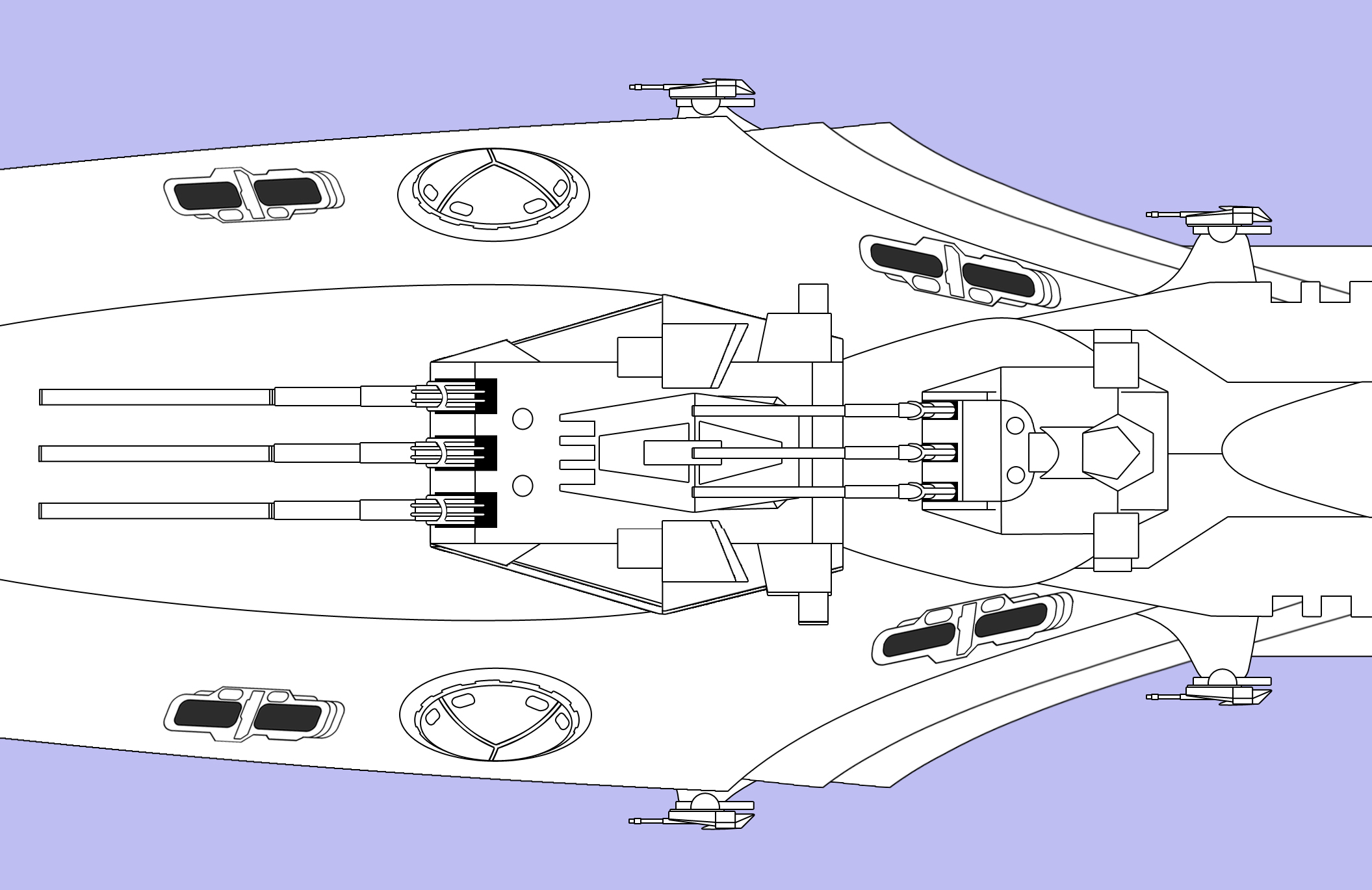
Okay, no more teasing. Here is the full ship layout. Again, she looks huge, not quote three-quarters length of an Imperial II class star destroyer in Star Wars. But in Darkstar, she is a lightweight for a battleship. They come much, much bigger than this. The Scharnhorst class is built for speed, the classic “battlecruiser” that can outrun whatever she can’t outshoot.
FOR BEST RESULTS – CLICK ON IMAGE AND WHEN IT OPENS, OPEN IMAGE IN NEW TAB for best resolution.
A few design features, some “military,” some “game required,” others purely for aesthetics.
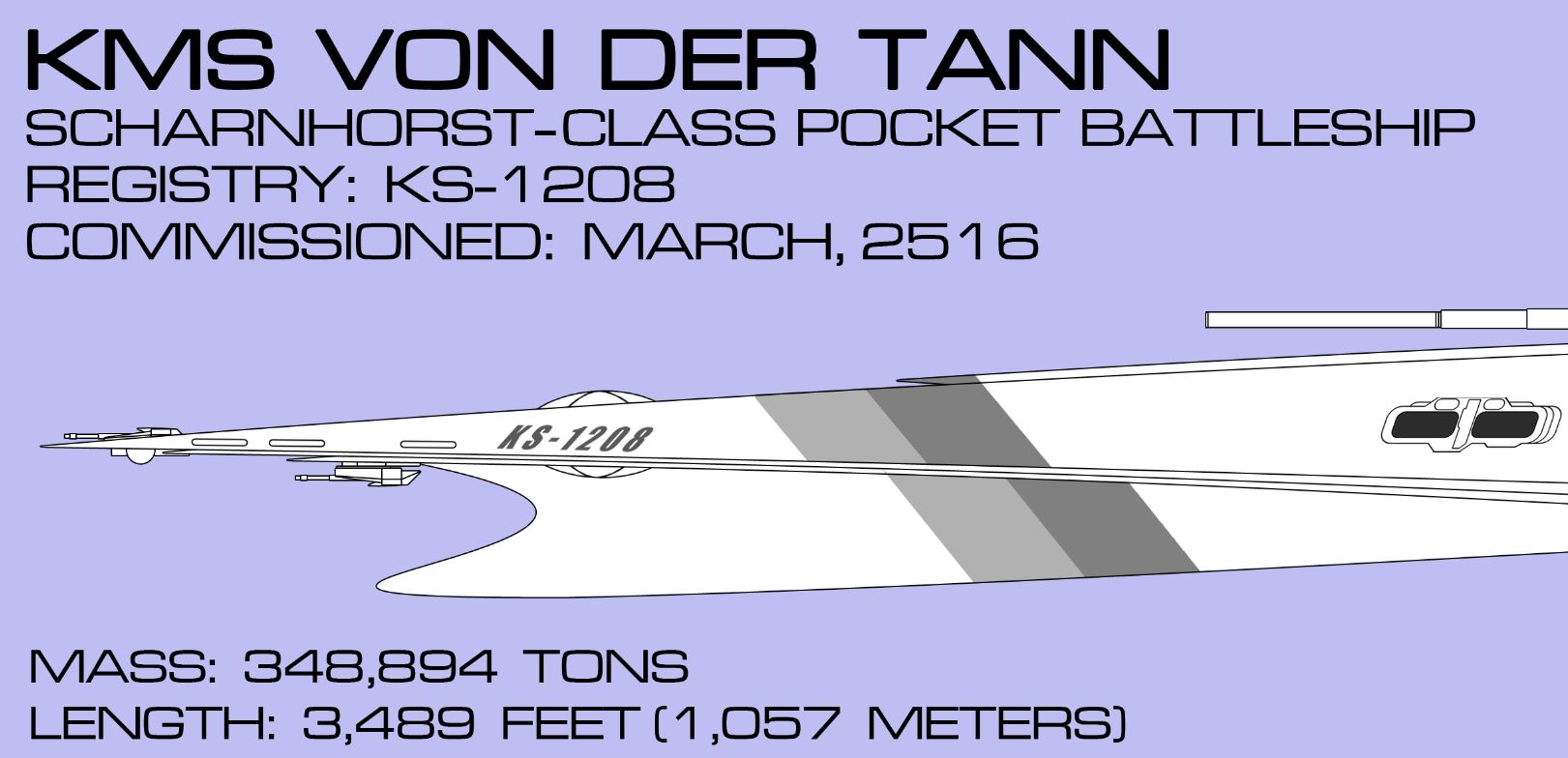
First we have the prow. As you may have seen from other older drawings in this thread, our Prussian ships have that classic WW1-inspired “Kaiser Prow” with the forward-swept bow. Here, the Scharnhorst has a much more sleek version, but the design concept and influence is still there. Also note where I’ve tried to give the mass driver batteries the widest possible arcs … fore and aft, port and starboard, ventral and dorsal. Space combat is in three dimensions, after all.
Next is the stern, where we see her two port engines, more mass driver protection (more on the aft quarters, most enemy commanders like to aim torpedoes at the stern of a ship to get at reactors and engines) , along with maneuvering thrusters to provide lateral movement and turning ability.
Note that in Darkstar, the ion thrust of these engines is managed not through “pipes and nozzles,” but through superconducting containment field magnets. This allows the thrust to be vented with equally forwards or backwards, so ships can decelerate as easily as they can accelerate (helps with game design/ mechanics when the players apply thrust points in the movement phase).
The round objects you see are the shield generators. There are six locations for these on most ships, bow, stern, port bow, starboard bow, port quarter, starboard quarter.
The large fin you see (and elsewhere on the ship) are gravity rudders. By applying a slight bend to the curved space-time that allows these ships to have artificial gravity, gravitic shielding, and even their limited FTL travel, they can also assist with maneuvering by bending the space they’re actually travelling through, especially important since these ships usually fight battles at 15-30 kps and cruise at 30-100 kps.
Also, this keeps the ships moving and turning in a predominantly “forward” direction, maintaining a bit of a “space opera” feel rather than a strict Newtonian movement system where ships could theoretically move sideways as easily as any other direction.
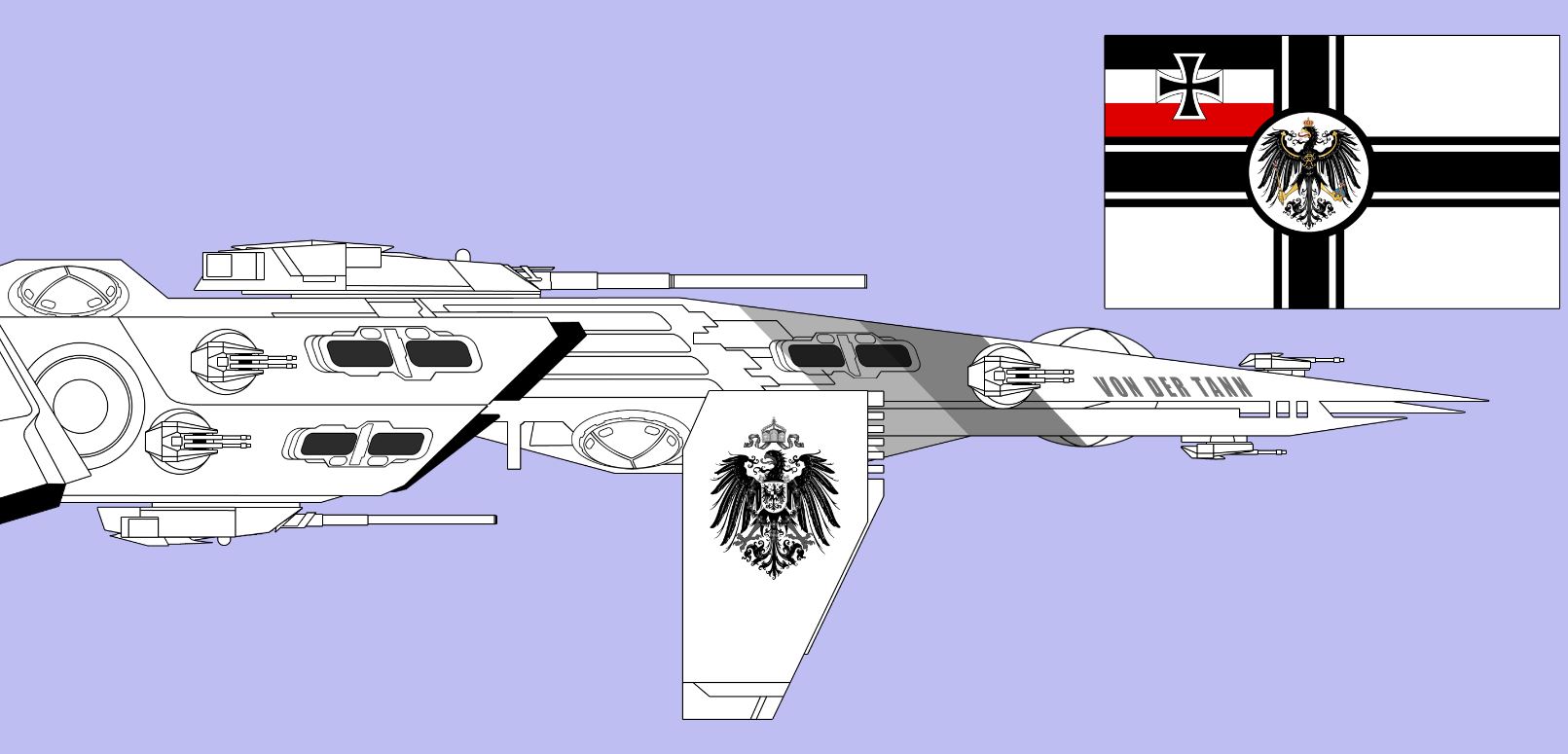
Top view of the primary forward gun deck, with “Anton” 12GW turret and superfiring 6GW secondary battery turret. Again, some 40% of the ship’s weapons are mounted on the ventral “underside” of the ship as well, so the ship can semi-plausibly fight in a 3D combat environment.
Note the mass drivers are on large pylons (those are probably about the size of a five-story building) so the guns have the best possible field of fire against enemy fighters, bombers, missiles, or torpedoes no matter which direction from which they might be approaching.
More maneuvering thrusters, more shield projectors (port and starboard bow mountings).
The only thing left now is to see how well this ship does in combat! 😀
Designing "German" Pocket Battleship
KMS Von der Tann (KS-1208)
Scharnhorst-class pocket battleship
Imperial Prussian Navy - Psi Serpentis and Duchess Annabel’s War
Design and Roll-Out
So as some of you who are following this project may know, my friend @aras (Alex) had something of a rough afternoon at our last big session of Darkstar. In a furious battle against my Russians and my girlfriend @gladesrunner (Jenn) Chinese and British, Alex lost two of his very best ships in near-simultaneous explosions. Of course losing battles is half the game, but normally you don’t lose a ship outright (starships are often “crippled” and can then eventually be repaired) – much less two.
Fortunately, two things mitigated the sting of this outcome. One, both his captains made their escape and survival rolls, so although the ships are gone, the commanders can continue their careers. Two, his main commander (formerly of the Prussian Leopold class heavy cruiser Franz Josef) has accrued just enough campaign points to get himself promoted into a new ship anyway.
He’s decided to take the plunge, and get his commander the very first “player-character” earned battleship in the history of Darkstar.
Of course, as the game designer and the guy running this campaign (Duchess Annabel’s War), it’s up to me to get his new class of ship ready for play. I’ve had this Prussian “pocket battleship” class ready to go for some time now, but I’ve never really playtested it before, and some of the master root math in the Excel spreadsheets that drive starships construction (and calculate scenario point cost) has changed in the years since I first designed this class, so I wanted to tweak this design, dust it off, and get it ready to go.
DESIGN CONCEPT:
The Scharnhorst class is the product of a recent effort within the Imperial Prussian Kriegsmarine to redress its overabundance on super-heavy, super-gunned, and very slow “dreadnought” style warships. Quite the opposite, the Scharnhorsts are fast, agile raiders, able to easily keep pace with virtually any known heavy cruiser and even older light cruisers. Its three triple-turreted Henschel-Krupp EGK-5100 12-gigawatt rail cannons give it an awesome punch for a ship its size, their threat further accented by the Atlas Elektronik EG-3000 targeting and sensor array. While the Scharnhorst’s 6 gigawatt rail gun secondary armament is curiously old, these guns are still more than suitable to finish off crippled freighters or tankers.
Essentially, the Scharnhorst was envisioned as a ship that could outrun anything it could not outfight. Accordingly, the captain of a Scharnhorst would be very well advised not to engage in pitched battle with a “true” battleship. At just 349,000 tons, Scharnhorsts are outweighed by at least 35% by even “light” battleships like American Colorado class or the British Repulse class battle cruiser. Note the scout ships carried to find enemy convoys, and the extended storage to support long raiding cruises and marines for boarding actions. All the same, the Scharnhorst’s protection is relatively light for a battleship. Indeed, along its aft sections, the ECM and gravitic shielding are weaker even than those of some light cruisers.
SHIPS IN CLASS:
KS-1201 — KMS Scharnhorst — 2502, New Wilhelmshaven, 61 Cygni
KS-1202 — KMS Gneisenau — 2505, Moltke Orbital Staryards, Earth
KS-1203 — KMS Graf Spee — 2506, Kiel Staryards, Vega Epsilon
KS-1204 — KMS Stauffenberg — 2508, New Wilhelmshaven, 61 Cygni
KS-1205 — KMS Graf Zeppelin — 2510, Moltke Orbital Staryards, Earth
KS-1206 — KMS Seydlitz — 2512, Kiel Staryards, Vega Epsilon
KS-1207 — KMS Preussen — 2514, New Wilhelmshaven, 61 Cygni
KS-1208 — KMS Von der Tann — 2516, Moltke Orbital Staryards, Earth
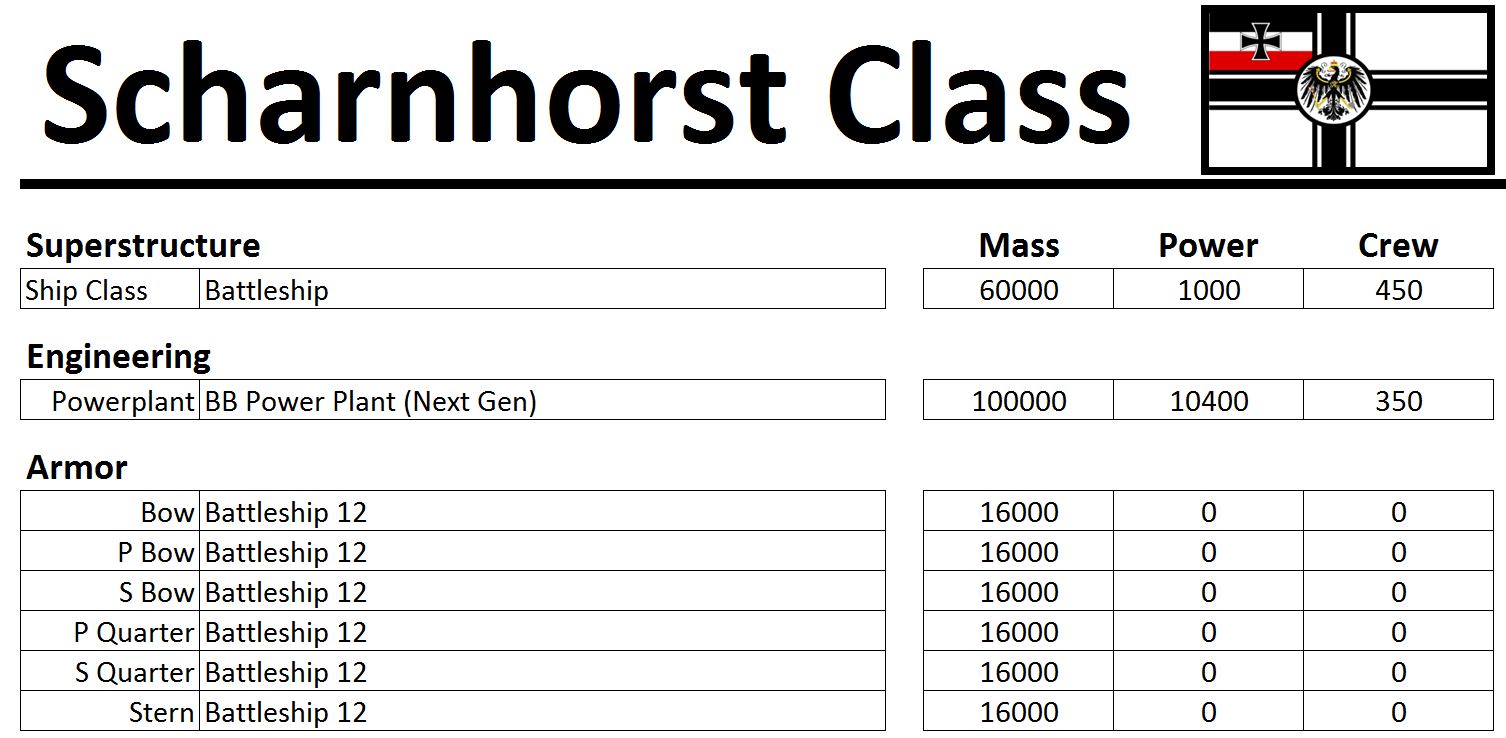
So first thing to brush up on is the ship hull and superstructure and engines. Mass, power, and crew are standard for the “battleship” warship type, and basically gets the design on the “battleship” damage and component chart (which is huge).
Two changes – the engines are now “next gen” which gives a 4% boost in available power (10400 up from 10000). Trust me, the way these spreadsheets work out this is a massive boost – as it should be since it adds 40 points to the ship’s point cost (the full price for a standard destroyer).
The other change is less fortunate – the armor ratings. In previous editions in the game, “partial armor” was possible (the game was much more granular to the point of unplayability). The Scharnhorst class had partial armor which save tens of thousands of tons of weight which allowed her to pack a huge punch and still be freakishly fast (at least for a battleship).
This design feature is no longer allowed, so I had to bump up the Scharnhost to full armor rating, which has admittedly slowed her waaaay down.
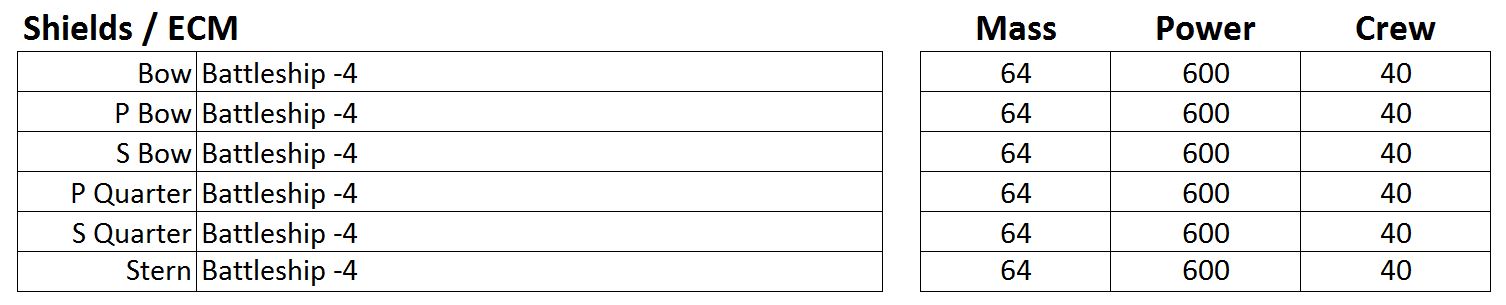
ECM and gravitic shielding are pretty standard. A rating of “4” is pretty usual for a warship, although a little weak for a battleship. Still, this ECM and shielding suite draws 3600 total power, that’s almost the total power output of a complete destroyer.
Okay, now it’s time for some fun stuff … and some very hard choices. I’m talking about the weapons load out, where that armor adjustment forced to me to make some very tough subtractions here. I was hoping the “next gen” engineering upgrade mentioned above would have allowed me to kick these 12-GW rail guns up to 13-GW, but there’s no way in hell that’s happening. In fact, I had to also remove her two triple-bank of Type IV “Sternjaeger” (Star Hunter) torpedo tubes.
Furthermore, I had to reduce the the mass driver loud-out from 48 total guns to 42 (these are small, 35mm point-defense guns to shoot down enemy fighters, bombers, missiles, torpedoes and the like.
These sacrifices, however, not only allowed me to keep the ship “legal” in the new system, but also add a nice back-up array of 6-GW rail guns for secondary armament, nice for finishing off crippled British freighters and the like. 😀
If there are any data geeks out there, the way these work is in the Type column, data validation drop-downs allow you to select weapons types from a whole menu of over 200 weapons types and calibers from a master root sheet tucked in the back of the workbook. This way you don’t have to type the name of the weapons.
This is important because the spelling and format has to be exactly right, since it reads off a VLOOKUP and IF/AND function coming off that same root sheet for mass, power, and crew requirements. These are automatically multiplied out by the number of weapons you select in the Guns column (note each of these turrets have three guns, etc.). which are also pulled off data validation drop-downs.
Long story short, these sheets do all the arithmetic for you.

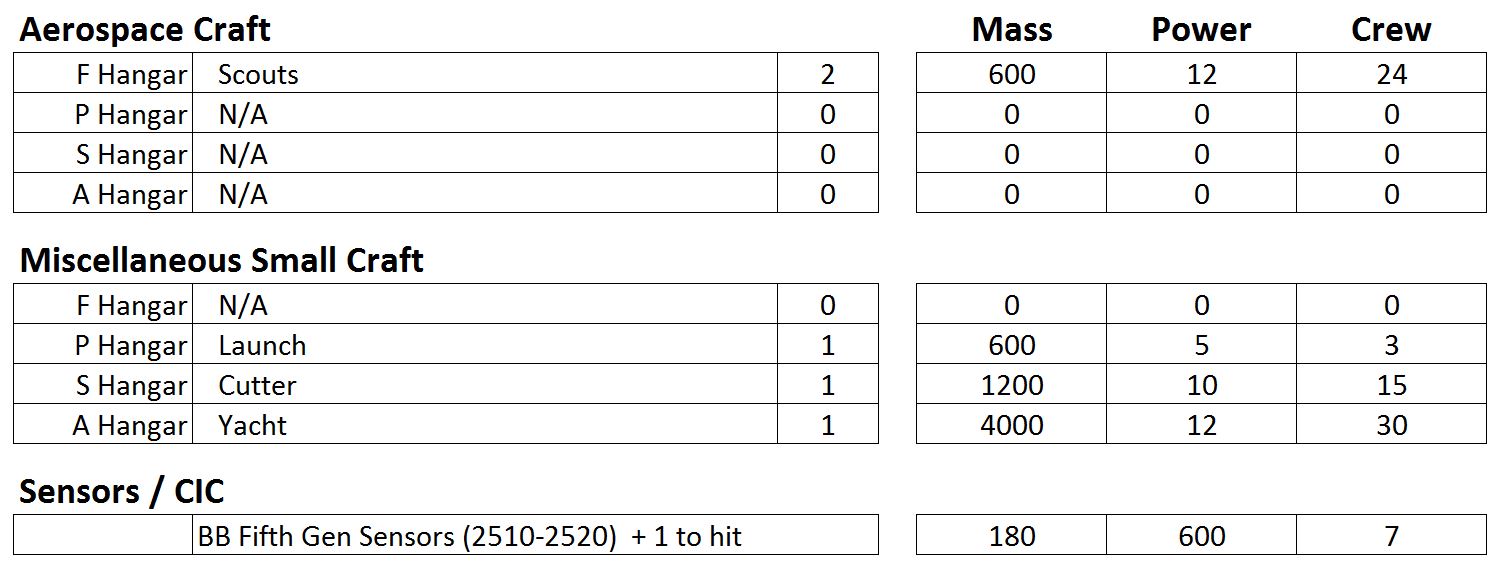
Secondary systems. We like scouts, cutters, yachts, and launches so these ships can do business like real warships, there are no “transporters” in this universe and these are the kind of small craft these ships carried in “blue water” navies.
Obviously, on a ship like the Japanese Akagi class, American Lexington class, and British Ark Royal class supercarriers – or Russian Zhukov class planetary assault ships, this part of the ship design sheet gets a lot more complex.
Perhaps most important, however, is the “BB Fifth Gen Sensors (+1)” – note that is a very expensive system. It gives ALL weapons for this ship a +1 to hit, which is actually pretty serious. Given that with many engagement ranges, the BTH is maybe 8 on a d10, and you subtract enemy ECM / Gravitic Shielding from that for your final number to hit (usually a 4 or 5), this leaves you with a 3 or 4 on a d10 to hit with each weapon. If you get a +1 on that, you’re getting an effective 25%-33% bonus to hit with EVERY gun on your ship, which for the Scharnhorst class is pretty important.
These kinds of bonus especially help with long-range shooting, which ships like the Scharnhorst class really prefer, engaging with those long-reaching 12-GW rail guns at 3500+ km, pelting down enemy armor before they even have a chance to respond.
Odd and ends. Marines (boarding can be very much a thing in this game), passengers, cargo, etc.
Finally at the bottom we have the freakishly expensive 10th-magnitude Darkstar wave for the ship’s FTL. Usually battleships have a 9th-magnitude Darkstar wave for FTL, because they get geometrically more expensive in weight and especially power consumption as the class gets bigger and bigger (and battleships are of course so very big).
But this helps keep the Scharnhost as a “raider” – able to travel at much faster FTL speeds than any other battleship class on record (she pushes x300 c, most battleships only do x160 c). So if enemy scouts, corvettes, or pickets detect her in a certain star system, the potential “threat bubble” she poses to enemy fleets, commerce, shipping lanes, and orbital installations is much, much wider.
Finally we get to the “proof in the pudding,” – the THRUST of the ship. This drives how the ship moves on the table top, how she maneuvers, acellerates, decelerates, turns, rolls initiative, everything.
It’s the the total mass of the ship, divided by the remaining available power. This comes out to a ratio, which gets rounded to the nearest whole number. Clearly we’re aiming for a 3.5 here, so we wind up with a thrust of 4.
For context, this is ridiculously fast for a battleship. This is a “ninja battleship” – which is what we were aiming for in the ship design concept. Most battleships have a 2. American “Pacific Pattern” fast battleships have a 3, as do British Repulse class battlecruisers. This baby has a 4, allowing her to outmaneuver and outrun some heavy cruisers.
And with the “SLD engineering / thrust” upgrade that Alex has with his commander (purchased with xp-style “campaign points) this baby will have a thrust of FIVE. That’s absolutely nuts for a warship of this class. She’ll be outrunning heavy cruisers, and keeping up with light cruisers, and with good initiative rolls, even keeping pace with some destroyers.
But again, she’s also a lightweight. Armor is only standard, shielding is light, and those guns, while scary for a heavy cruiser, are actually quite puny for a battleship.