






A tale of two worlds




Recommendations: 551
About the Project
Victorian Science Fiction is one of my favourite periods, if you can call it such. We have played many games set in our alternative history. To sum up our setting is based sometime after War of the Worlds. After the Martians were defeated on Earth mankind started to make numerous breakthroughs. Large flying ships called Aeronef rule the skies. Man has reached Mars and has spread its influence over the lost and ancient civilisations that live there...
Related Genre: Steampunk
This Project is On Hold
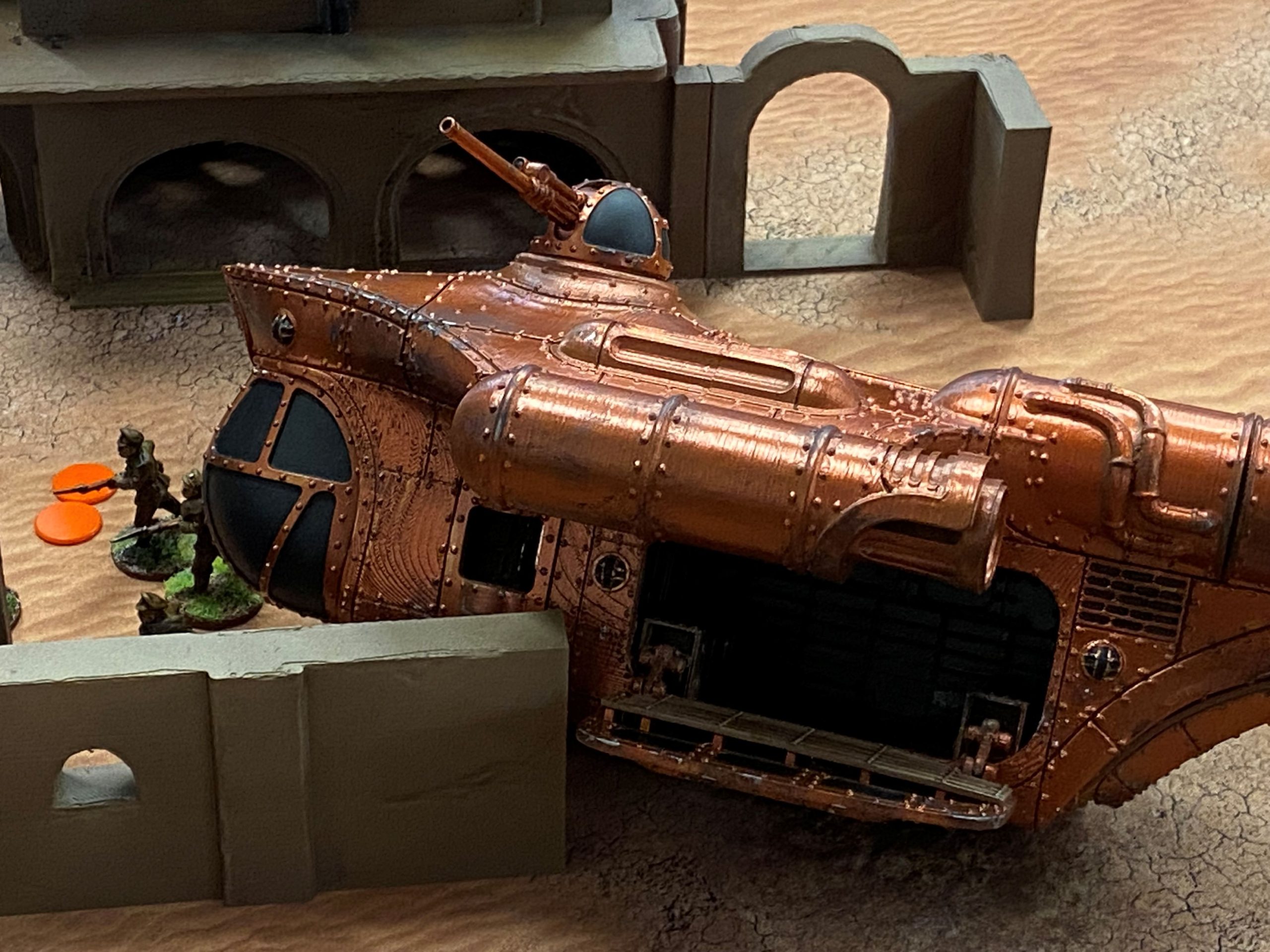
Copper Hawk Down
Background
As the great powers of Earth continue their expansion across Mars, tensions between the colonial powers grow with every passing year. British, Russian and Prussian settlements spread across the planet, each seeking influence, resources and strategic advantage.
Far from the established colonies, deep within the Great Desert, lies Al-Kharim.
Once a prosperous Drune trading town, Al-Kharim served as a stopping point for caravans crossing the vast seas of sand. Over time, the trade routes shifted, and the settlement was abandoned. Though empty, the town remains remarkably intact. Rows of sandstone buildings line narrow streets while silent market squares sit untouched beneath layers of dust.
The town’s only inhabitants are the Termigons.
For generations, the creatures have occupied the cellars, wells and underground chambers beneath the settlement. Travellers speak of strange lights in empty windows and shapes moving through deserted streets after sunset.
Most avoid the town entirely.
Recently, however, Russian intelligence uncovered evidence that Prussian agents had arranged a secret meeting with representatives of the Mechanoids within Al-Kharim. The purpose of the meeting remains unknown, but any alliance between the Prussian Empire and the machine race could threaten every human settlement on Mars.
Determined to discover the truth, Colonel Viktor Sokolov launches a covert operation.
The Mission
A Russian force consisting of infantry, Cossack cavalry and the armoured steam-car Tsarevich advances towards Al-Kharim under cover of darkness.
Their objective is to locate the meeting, capture any Prussian officers involved and recover evidence of contact with the Mechanoids.
The Russians arrive just as negotiations are taking place within one of the abandoned caravan houses.
A brief but violent firefight breaks out amongst the empty streets. Several Prussian officers are captured, and valuable documents are seized. With their mission apparently successful, the Russians begin withdrawing from the town before enemy reinforcements can arrive.
Then disaster strikes.
Overhead, the Imperial Russian aerial cruiser Copper Hawk circles the settlement, providing reconnaissance and communications support. Hidden Prussian artillery positioned beyond the town opens fire.
One shell tears through the vessel’s hull.
Flames spread rapidly through the craft as it loses altitude.
Moments later, the Copper Hawk crashes into the centre of Al-Kharim, scattering burning wreckage across the abandoned streets and trapping much of her crew amongst the buildings.
The Race to the Wreck
The mission changes immediately.
Russian commanders order their forces back into the town to rescue the surviving crew.
The crew of the Copper Hawk carry military dispatches, cypher codes and intelligence gathered during the operation. Losing them would be a serious blow to Russian interests on Mars.
Prussian forces move towards the crash site as well. Recovering the crew or the documents they carry could reveal how much the Russians have learned about their dealings with the Mechanoids.
The abandoned town becomes the centre of a desperate struggle.
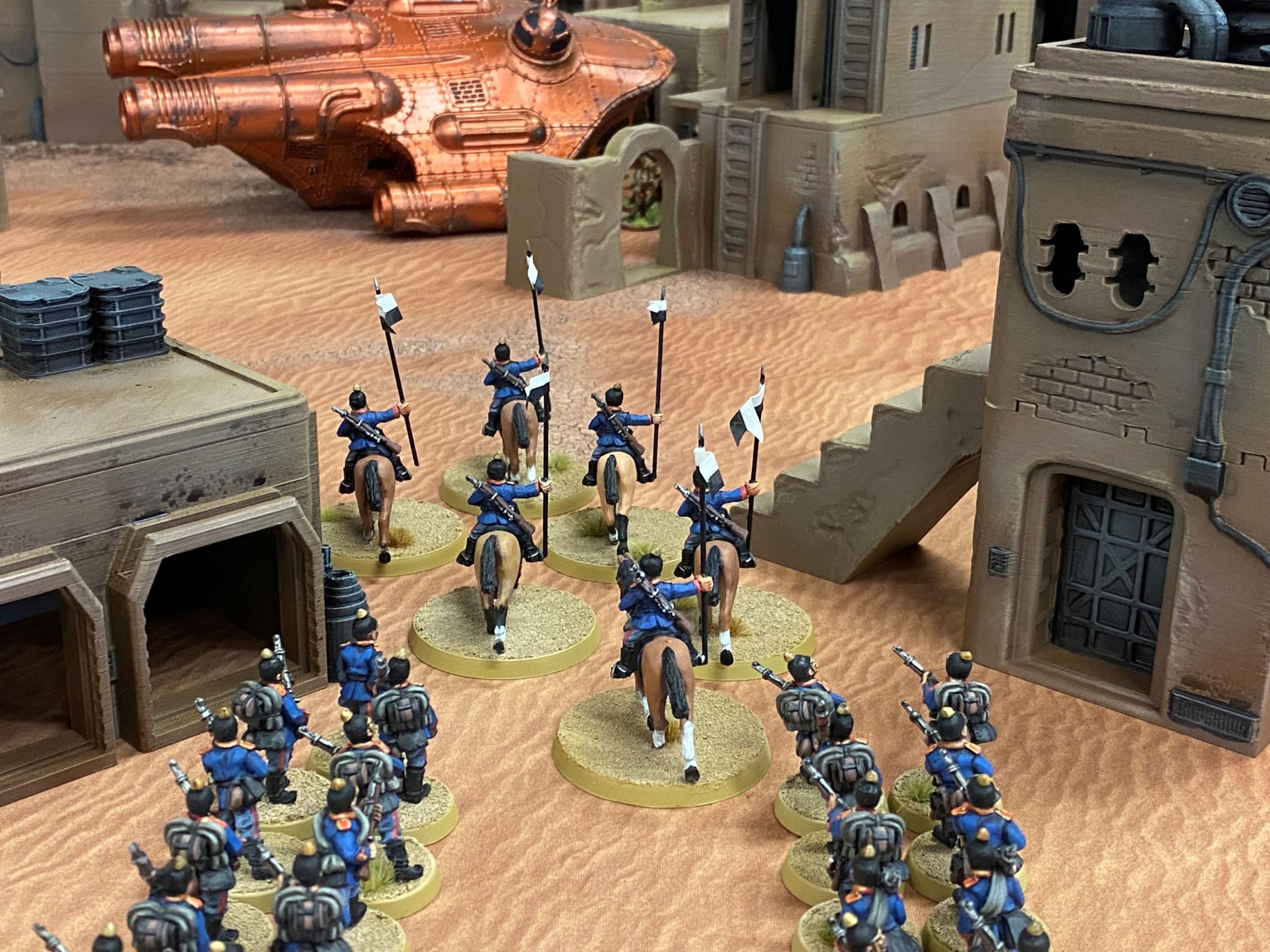
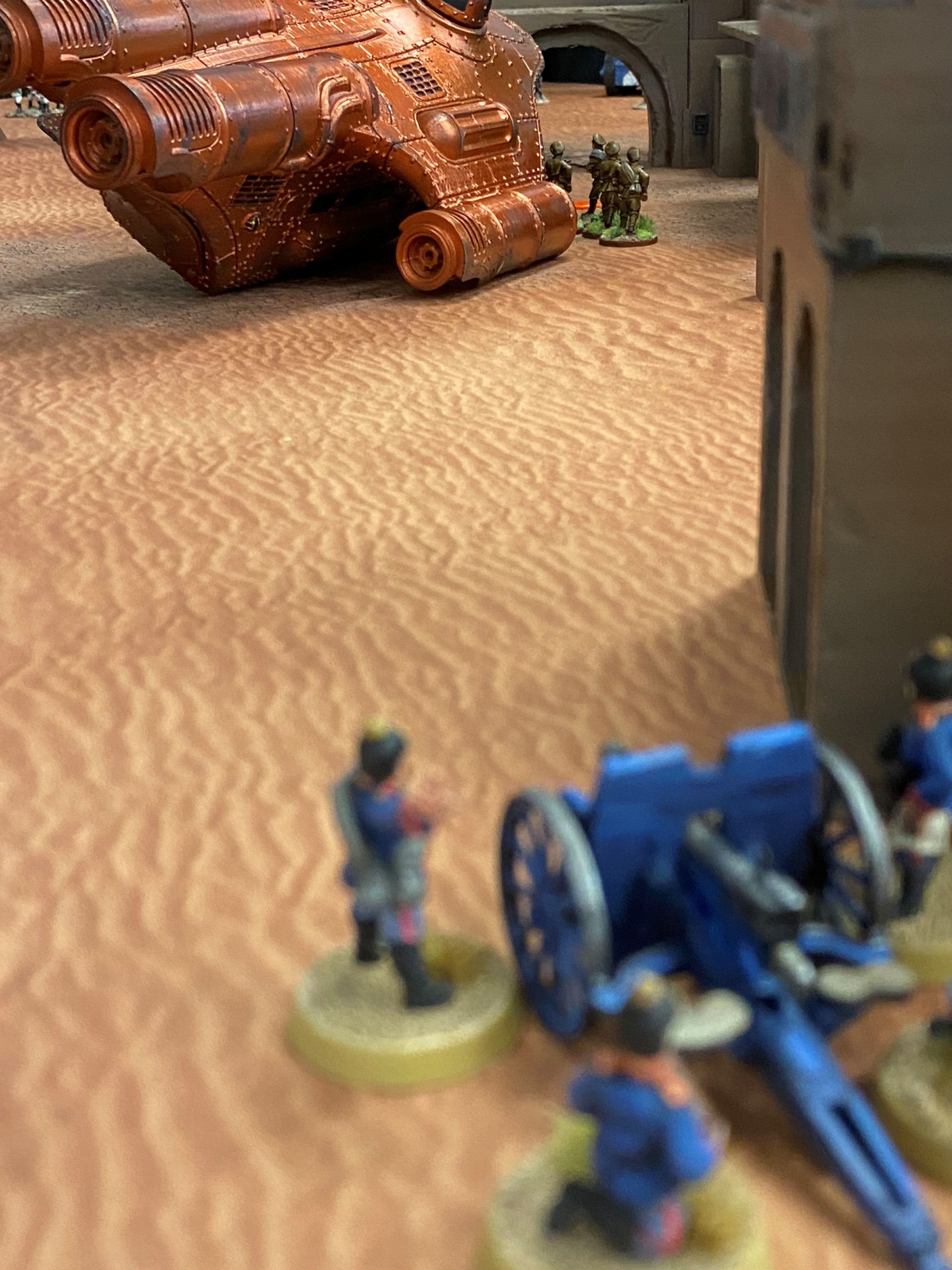
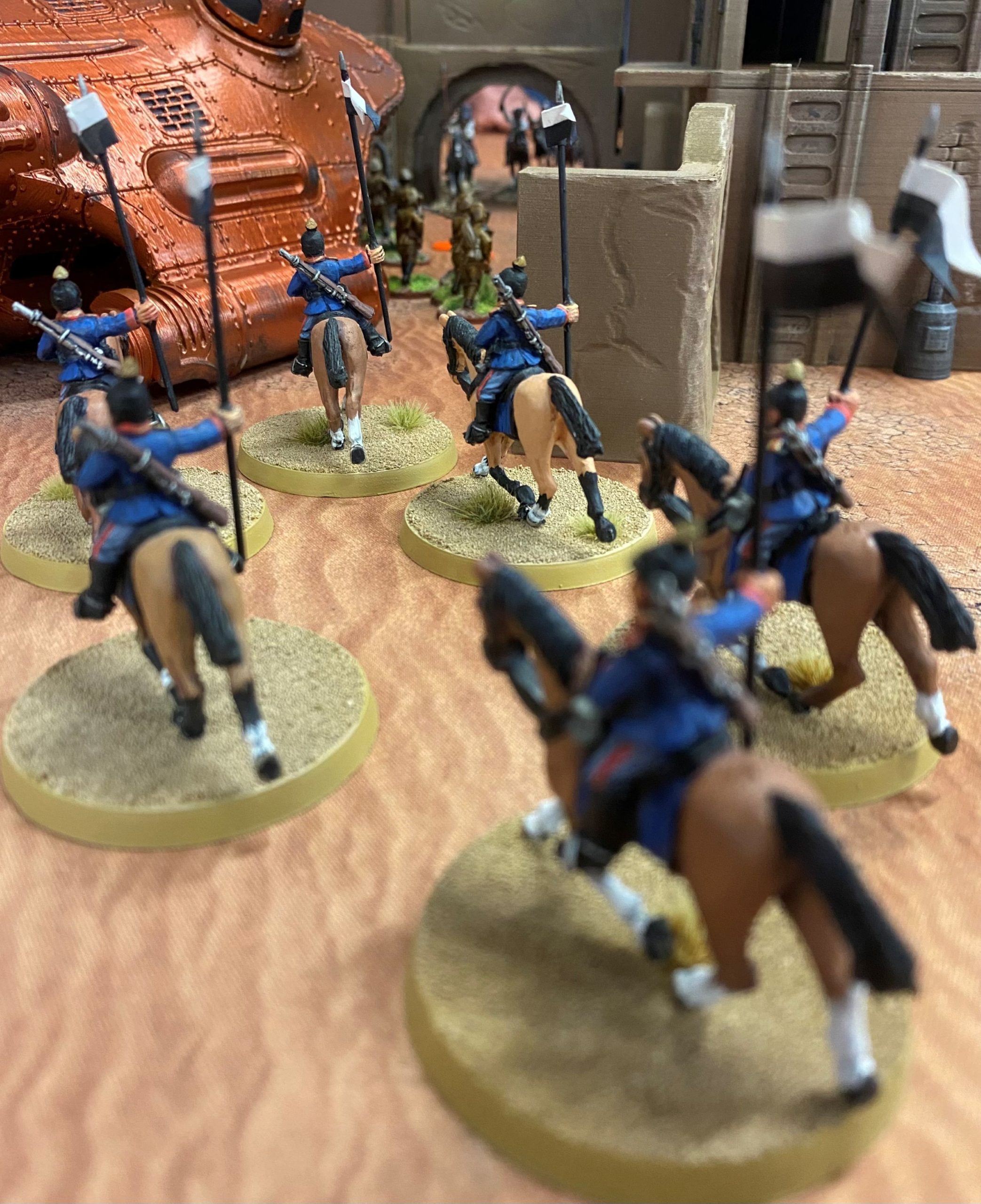
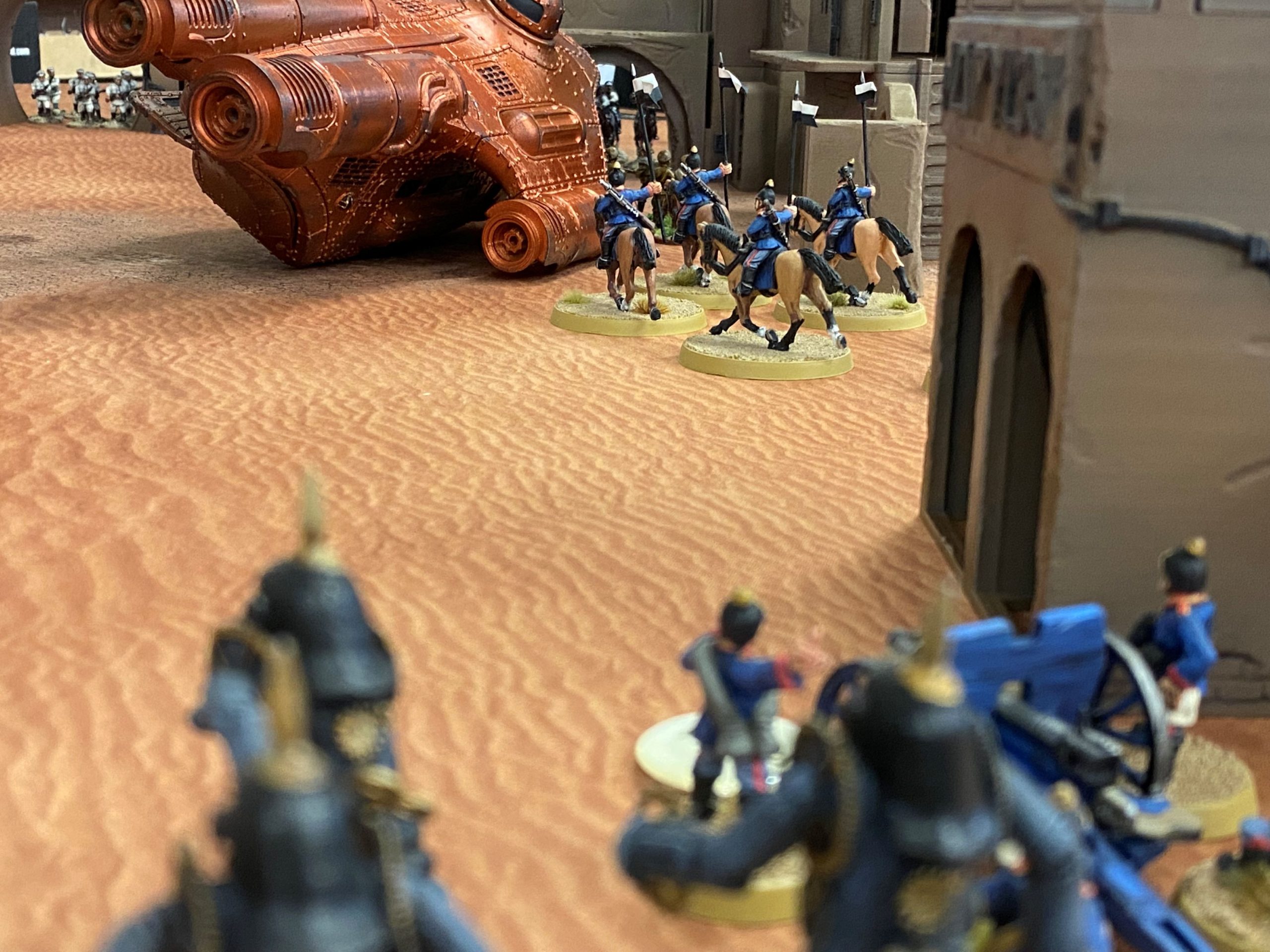
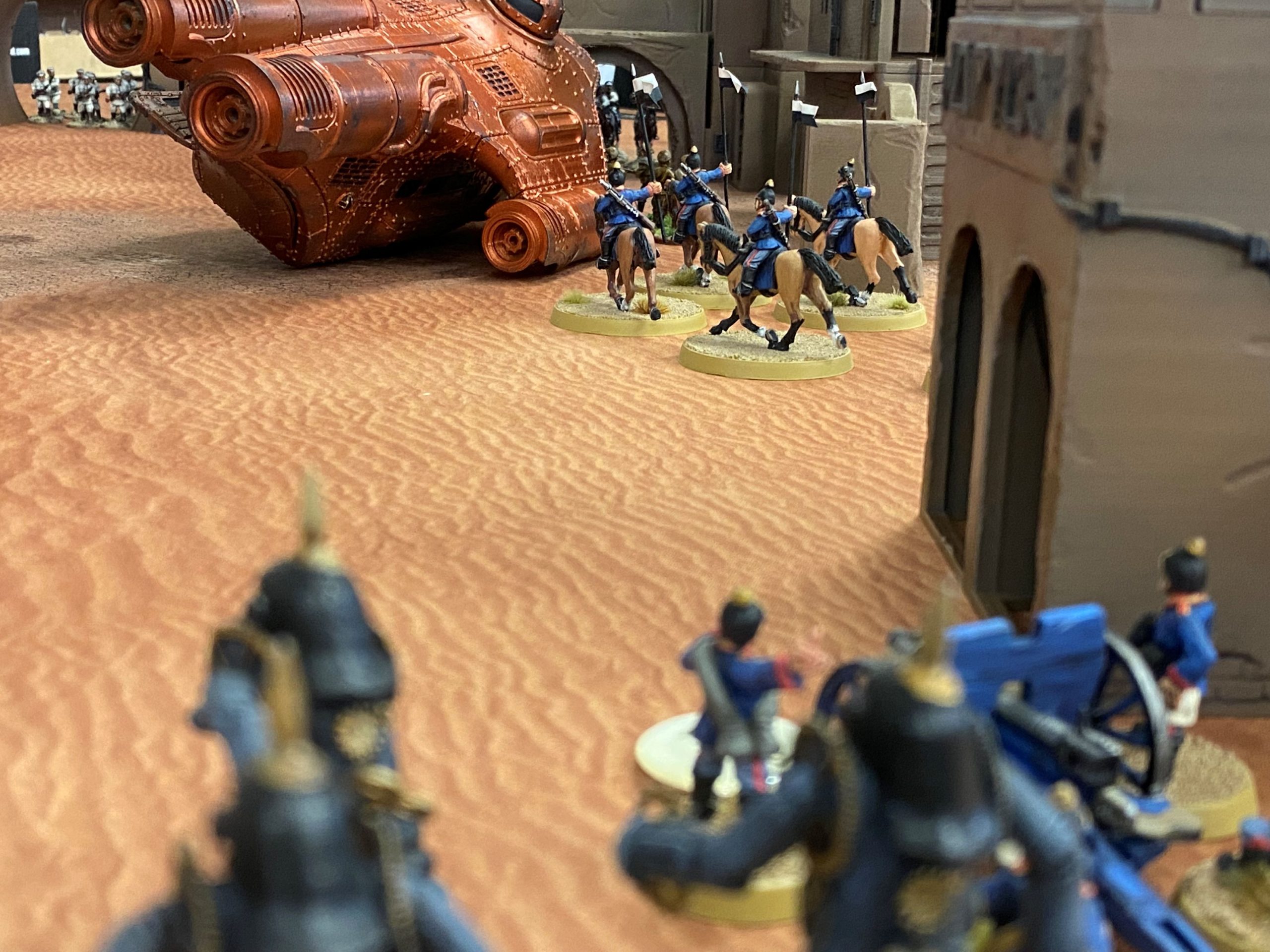
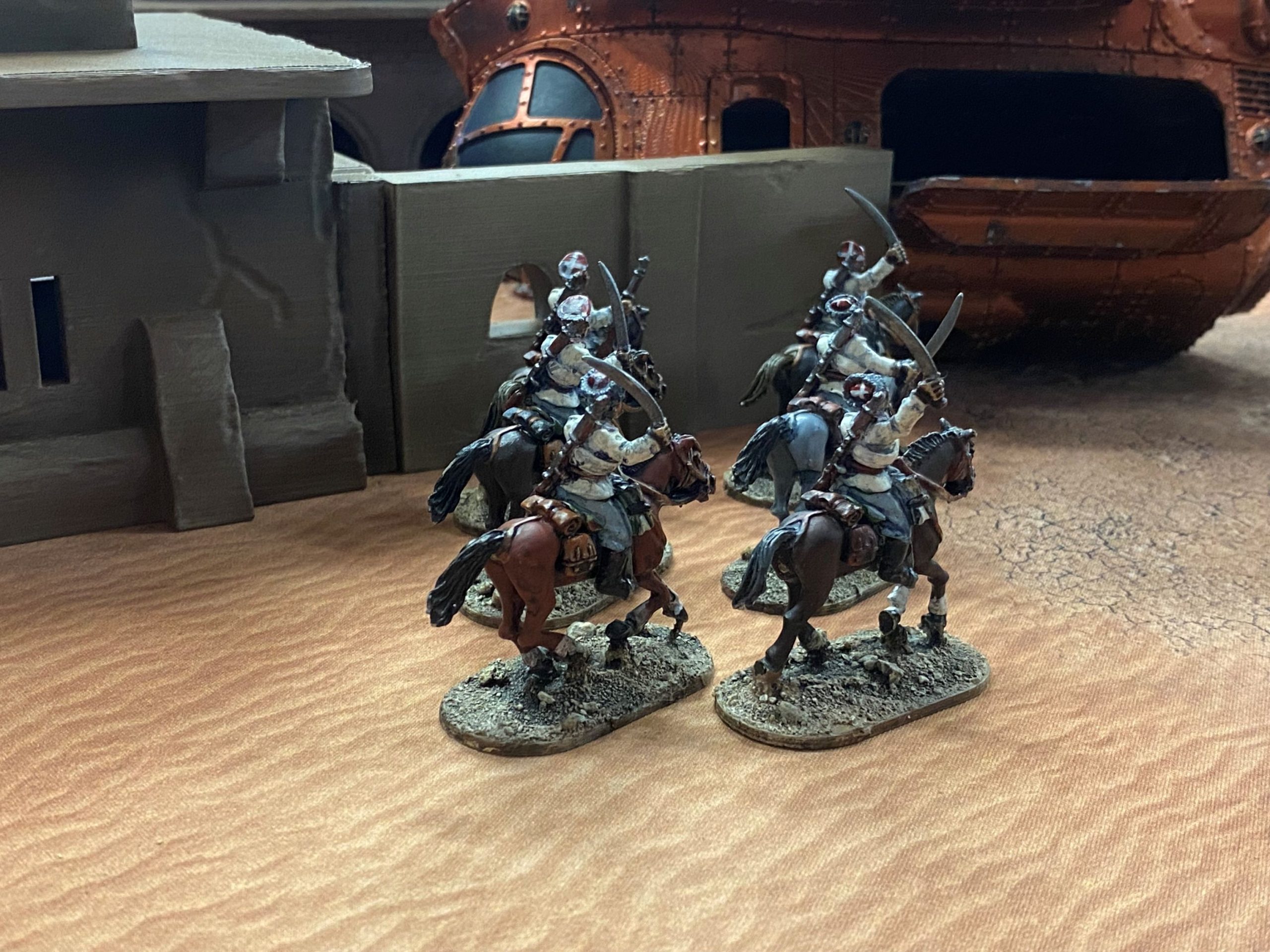
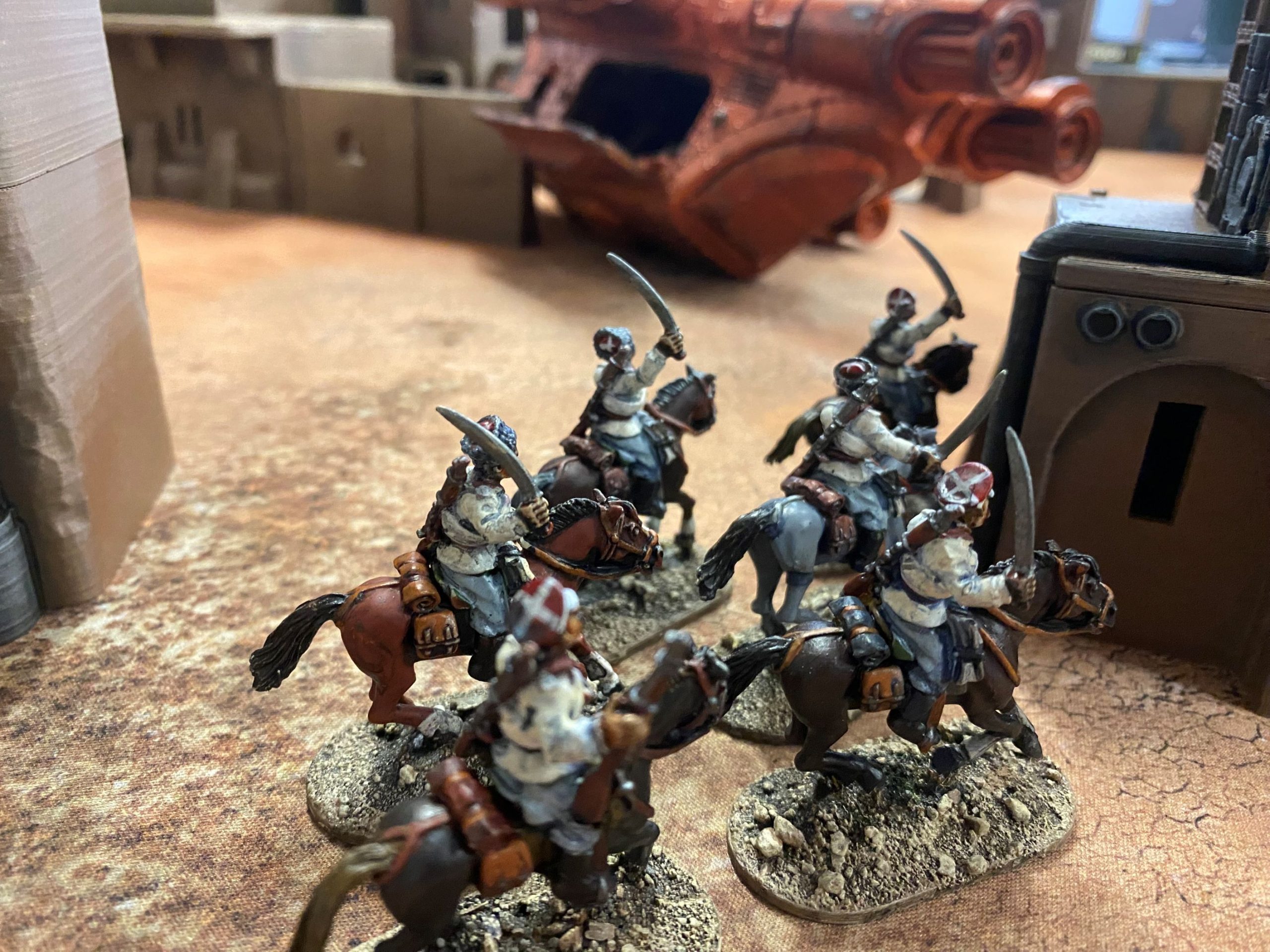
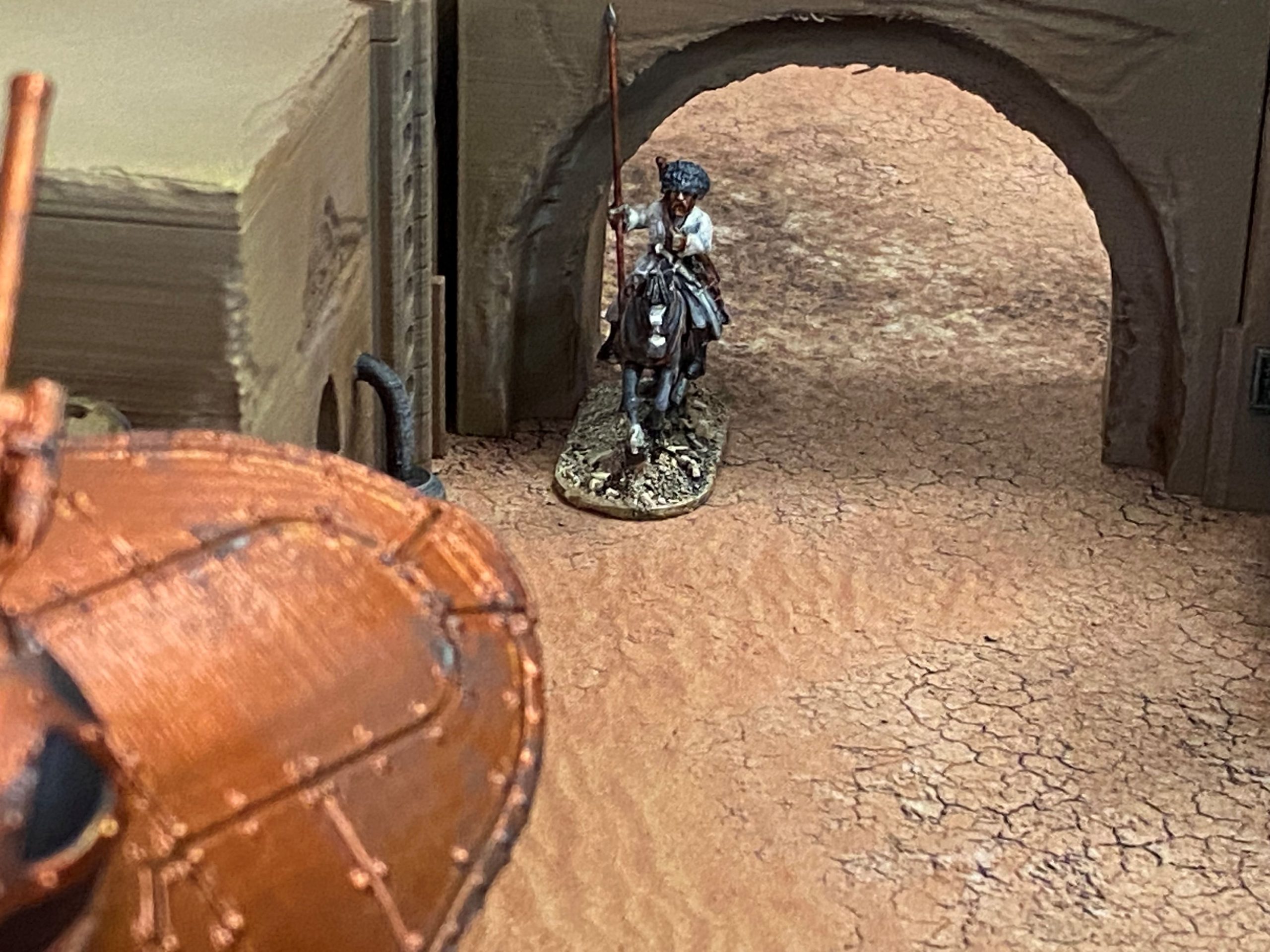
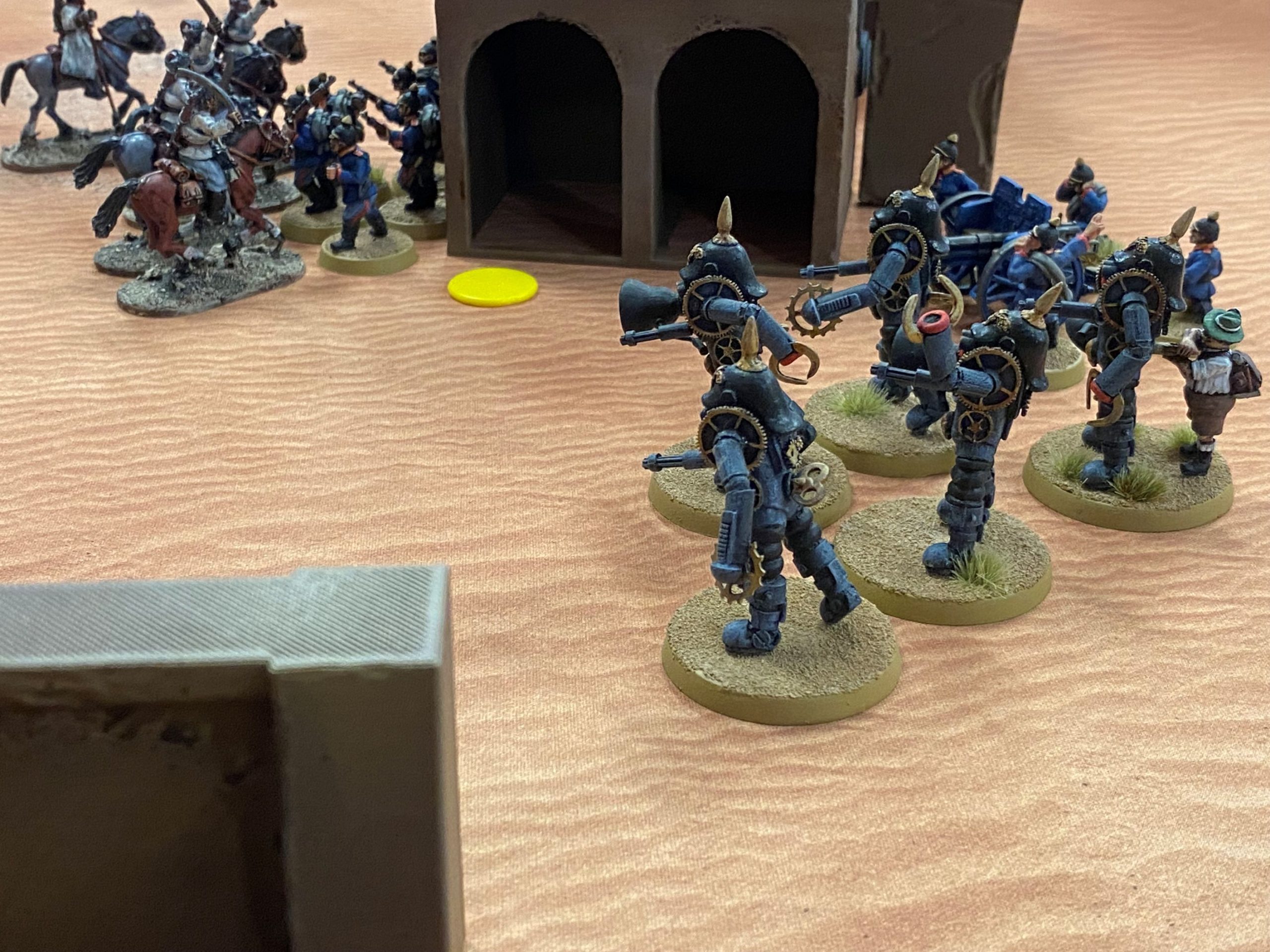
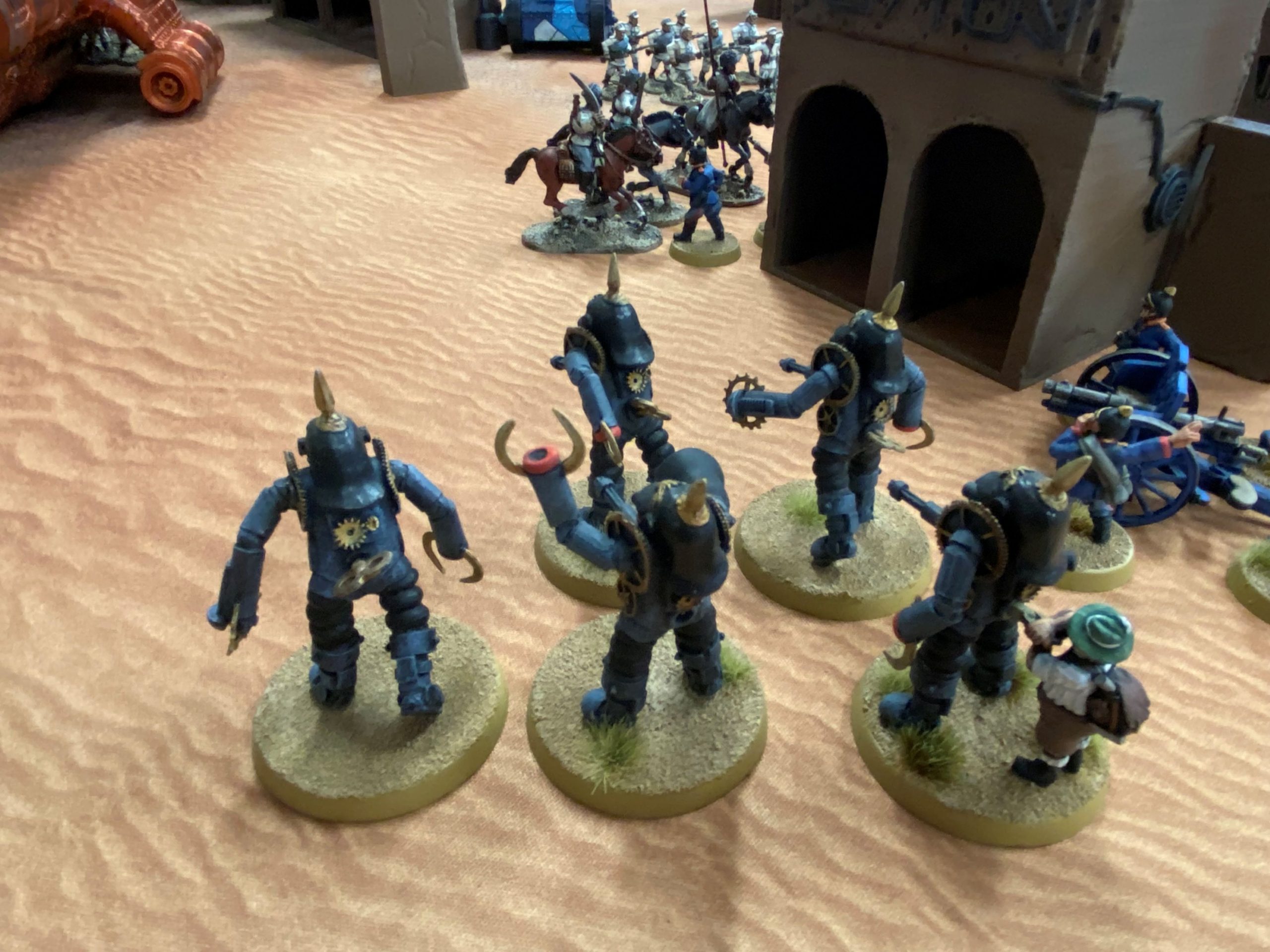
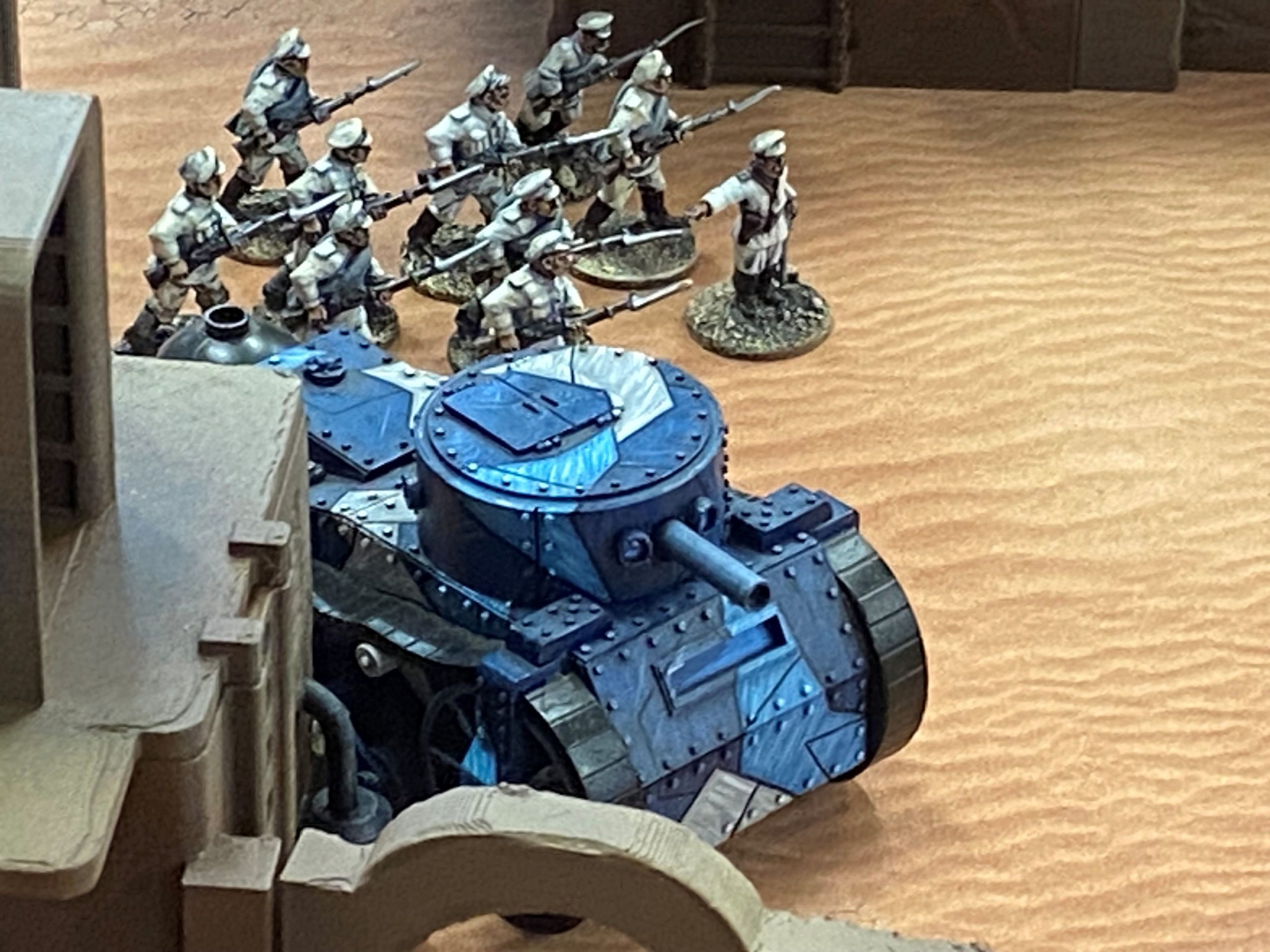
After Action Report:
As the burning wreck of the Iron Courier settled amongst the abandoned streets of Al-Kharim, Prussian forces converged on the crash site with remarkable speed. Trapped beneath the twisted hull, the surviving Russian airmen could do little more than take cover as rifle fire and shell fragments rained down around them.
The Russian response was swift. Colonel Sokolov ordered an immediate counter-attack, and squadrons of Cossacks thundered into the deserted town in a desperate attempt to relieve the stranded crew before they were overwhelmed.
Prussian artillery maintained a relentless bombardment of the wreck, each salvo tearing more debris from the shattered airship. Nearby, the Prussian Clockwork Clanks faltered as dust and damage brought their intricate mechanisms to a halt. Their accompanying Hungarian wind-up merchants worked frantically under fire, winding gears and replacing broken springs in a determined effort to return the mechanical soldiers to the fight.
Sensing an opportunity, the Prussian Uhlans lowered their lances and charged directly at the wreckage. The Russian naval crew, armed only with revolvers and carbines, fought with remarkable courage. Though hopelessly outmatched, they held the cavalry at bay just long enough for the Cossacks to burst into the melee. Sabres flashed amongst the wreckage as the Russian horsemen swept away the last of the Prussian lancers.
Seizing the initiative, the Cossacks pressed their attack, crashing into the advancing Prussian infantry before they could reform their lines. Fierce fighting erupted throughout the abandoned settlement as Russian infantry joined the assault.
Yet victory came at a terrible cost.
The Prussian artillery never ceased its bombardment. One devastating barrage struck the shattered Iron Courier, burying the remaining survivors beneath splintered timbers and burning wreckage. By the time the Russians secured the crash site, every member of the airship’s crew had been killed.
The Prussian force was eventually driven from Al-Kharim, leaving the Russians in possession of the battlefield. It was, however, a hollow victory. The wreck was secured, but the men they had fought so desperately to rescue lay dead beneath the smoking remains of the Iron Courier.
As the exhausted Russians gathered their wounded and prepared to leave the silent desert town, none noticed the movement in the empty buildings that lined the streets. Behind darkened windows and within shadowed doorways, countless pairs of cold, cannibalistic eyes watched their every move. Patient and unblinking, the Termigons had witnessed the entire battle. They cared nothing for the quarrels of empires—only that the day’s fighting had left Al-Kharim well supplied with fresh meat.
The infiltration of New Brighton
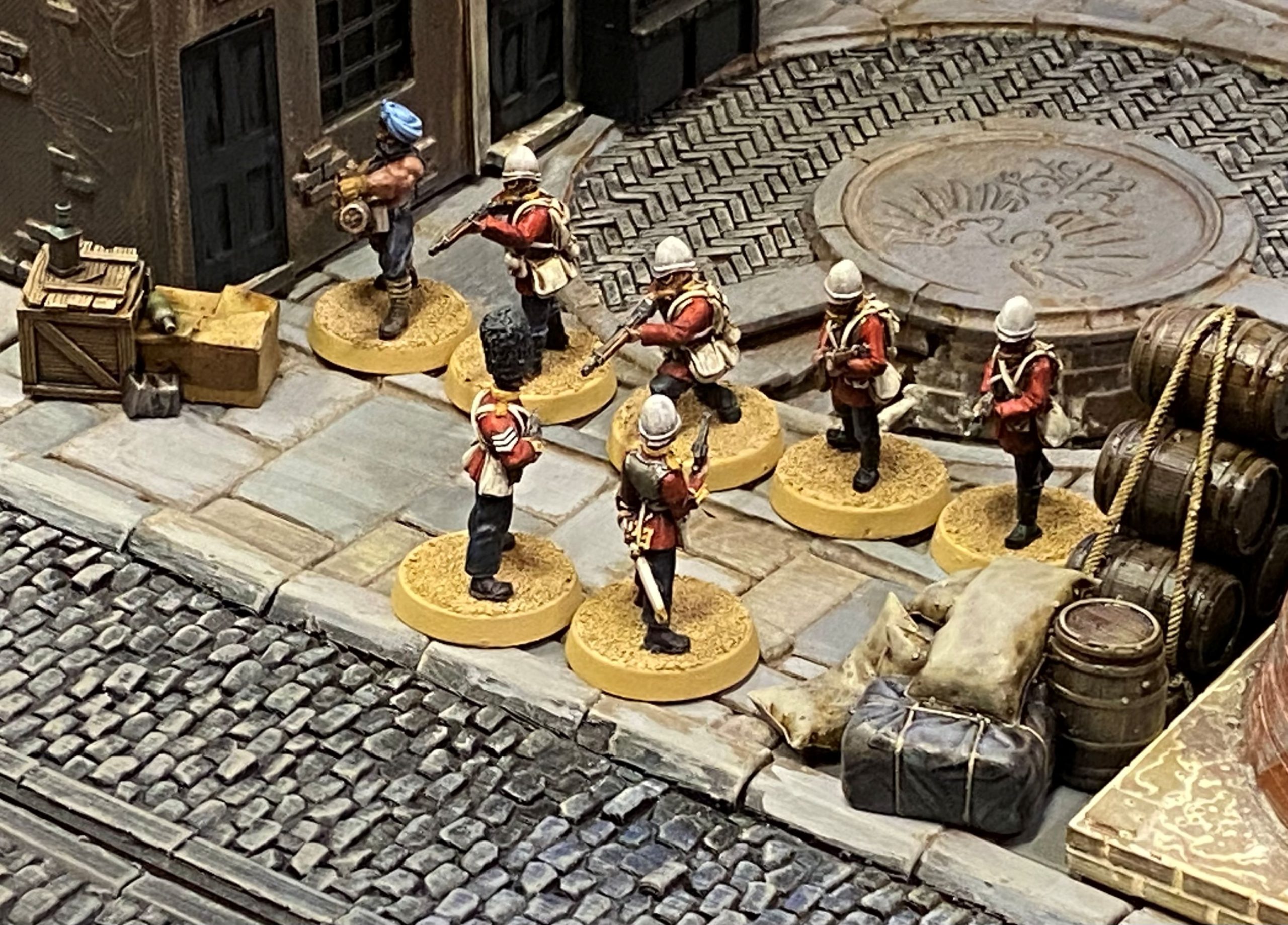
The warehouse district of New Brighton, Mars – a sprawling labyrinth of iron-framed storehouses, canal docks, and soot-blackened brick—sits beneath a dim, rust-coloured sky.
Gas lamps flicker against the creeping red fog, and somewhere beneath the cobbles, unseen things move.
At the centre of it all stands Warehouse 57, housing a secret shipment of volatile aether-crystals. A small detachment of British soldiers has been assigned to guard the site. However, they are being inspected tonight.
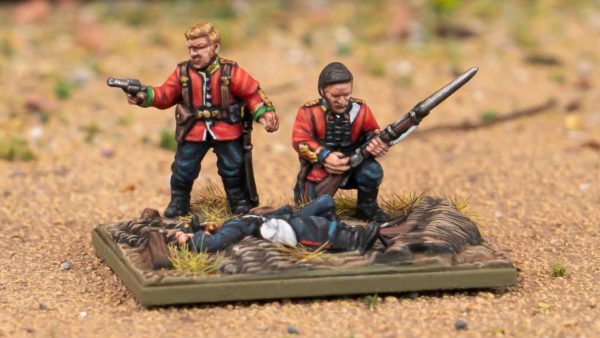
Regimental Sergeant Major (RSM) Perry Mason paces back and forth in front of the line with razor-edged precision. Boots are scrutinised, rifles examined, and every man is expected to meet his uncompromising standards.
The soldiers stand rigid—more afraid of earning Mason’s wrath than any unseen threat. But beneath their feet, something has already breached the city.
The excavation tunnels beneath the city—long abandoned—have been disturbed. From below, the Termigons have emerged: pale, sinewy, and ravenous cave-dwellers drawn by the strange energies of the crystals… or perhaps by the scent of flesh.
They have expanded their vast tunnel networks and forced their way into New Brighton’s sewer system, turning it into a hidden web of movement beneath the city streets.
They are no longer distant horrors of the Martian deep. They are already among the district’s foundations.
At the same time, a covert Prussian expeditionary force, led by Hauptmann Dieter Voss, has infiltrated the city. Their objective: seize the aether-crystals for the Kaiser’s scientists.
As Mason’s inspection reaches its crescendo, the illusion of order shatters and all hell breaks loose.
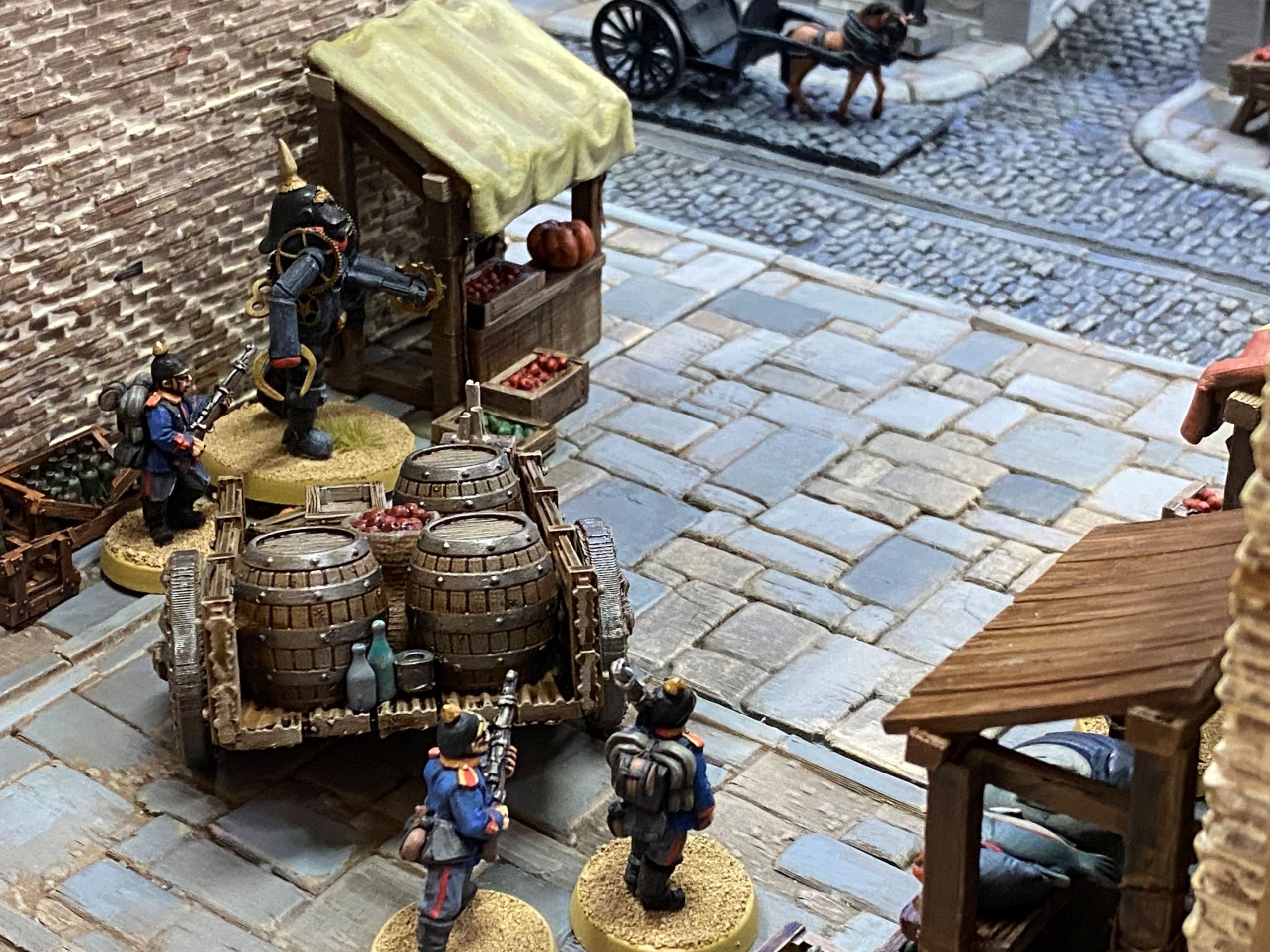
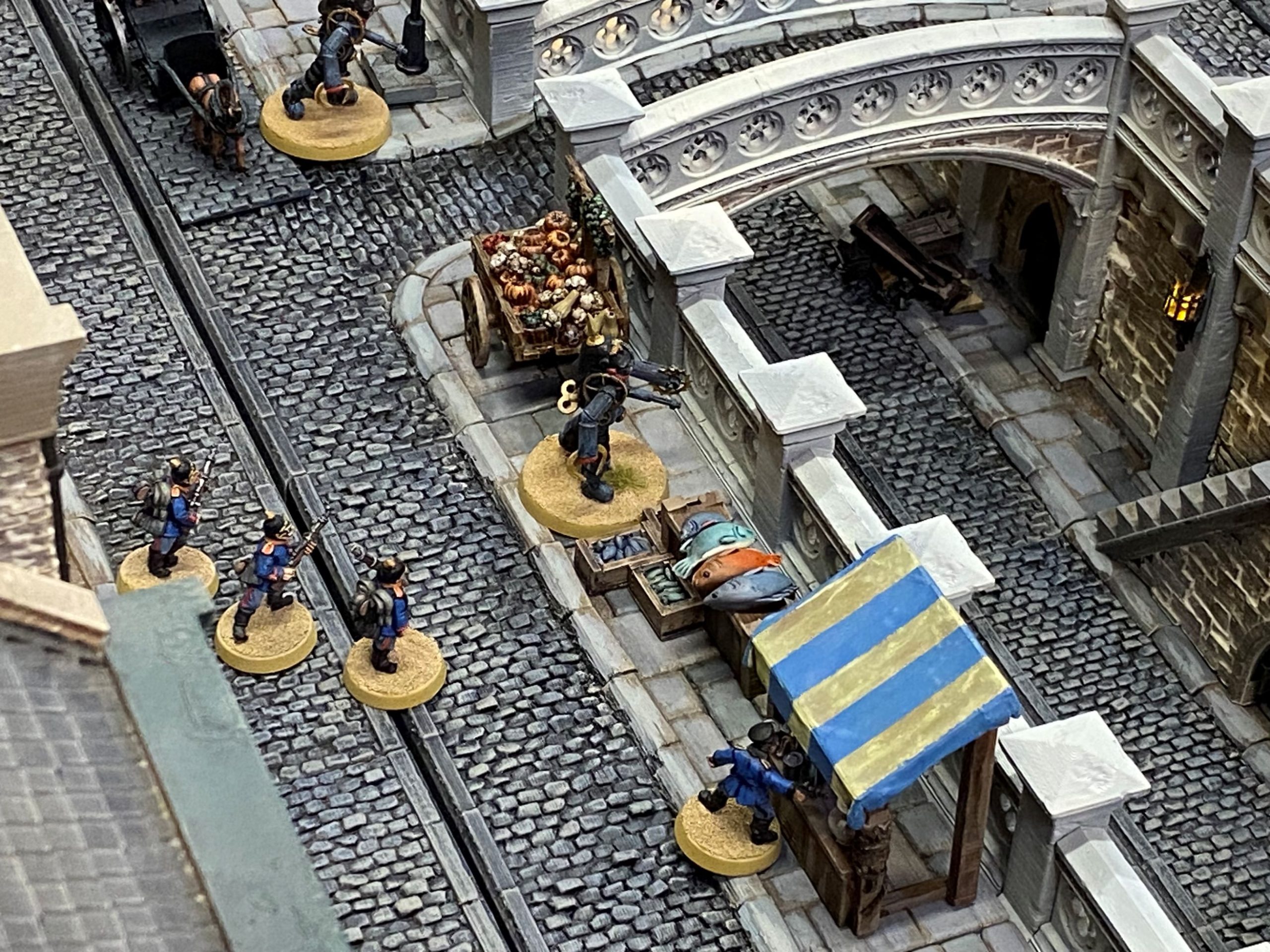
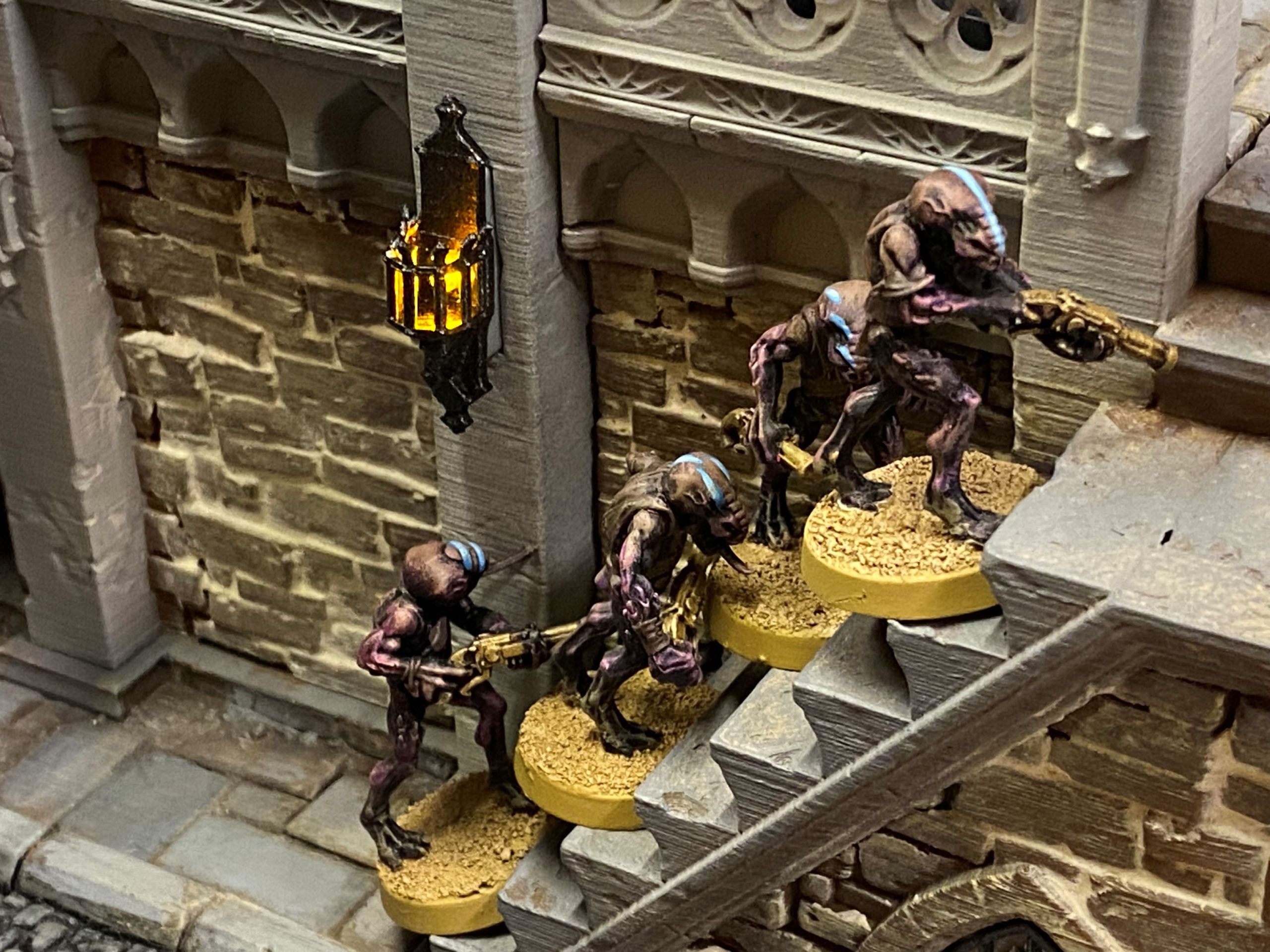
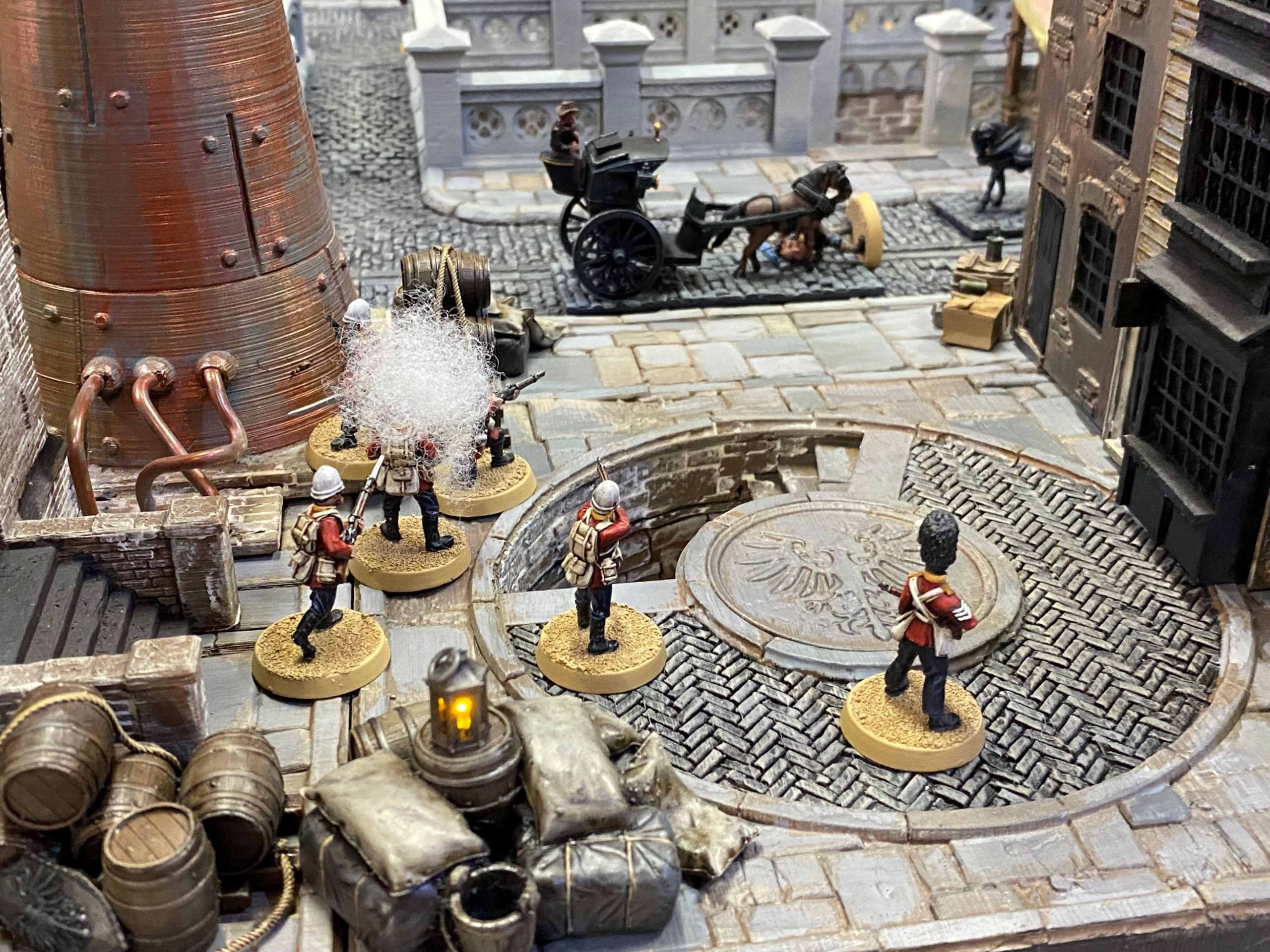
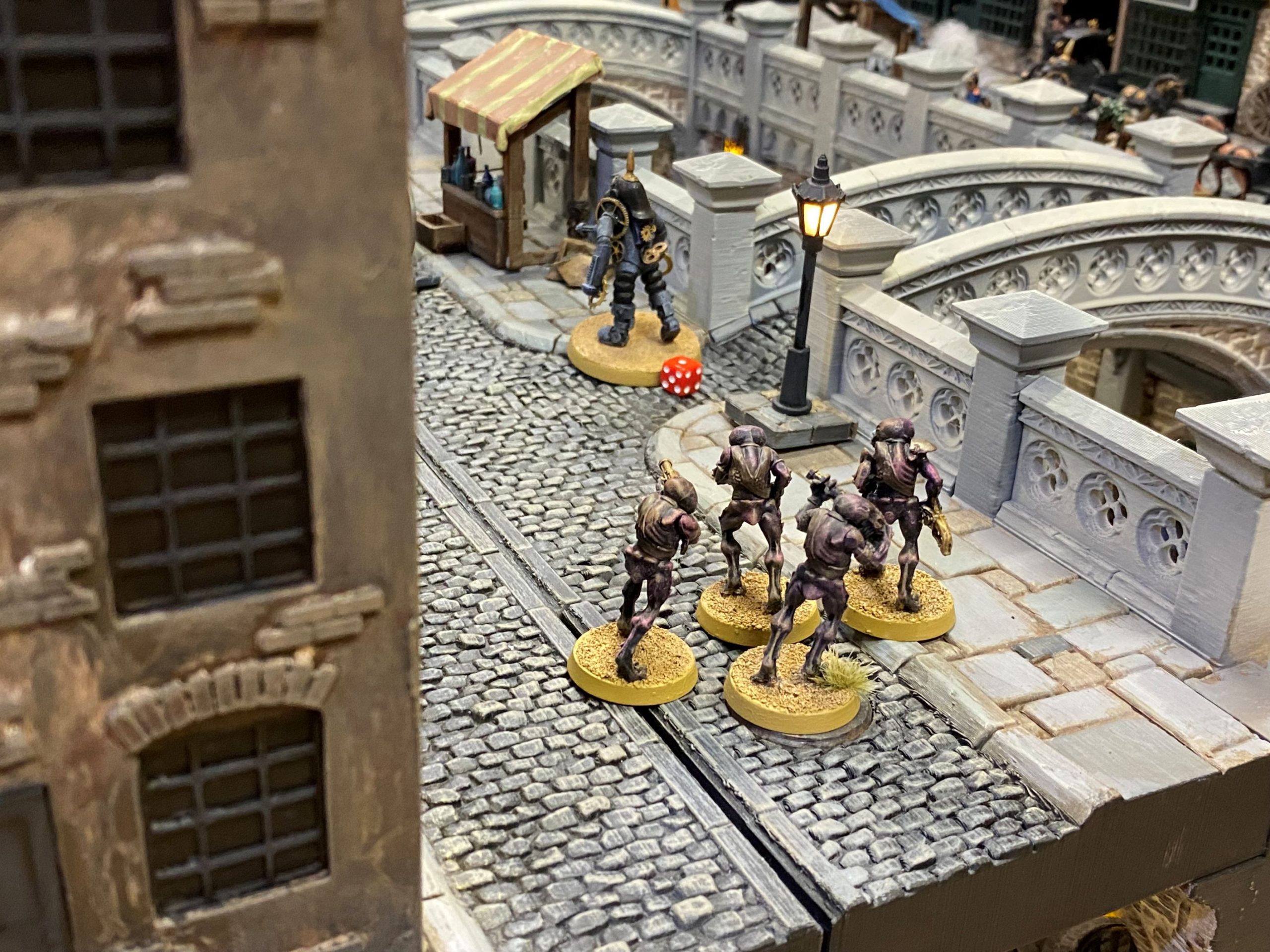
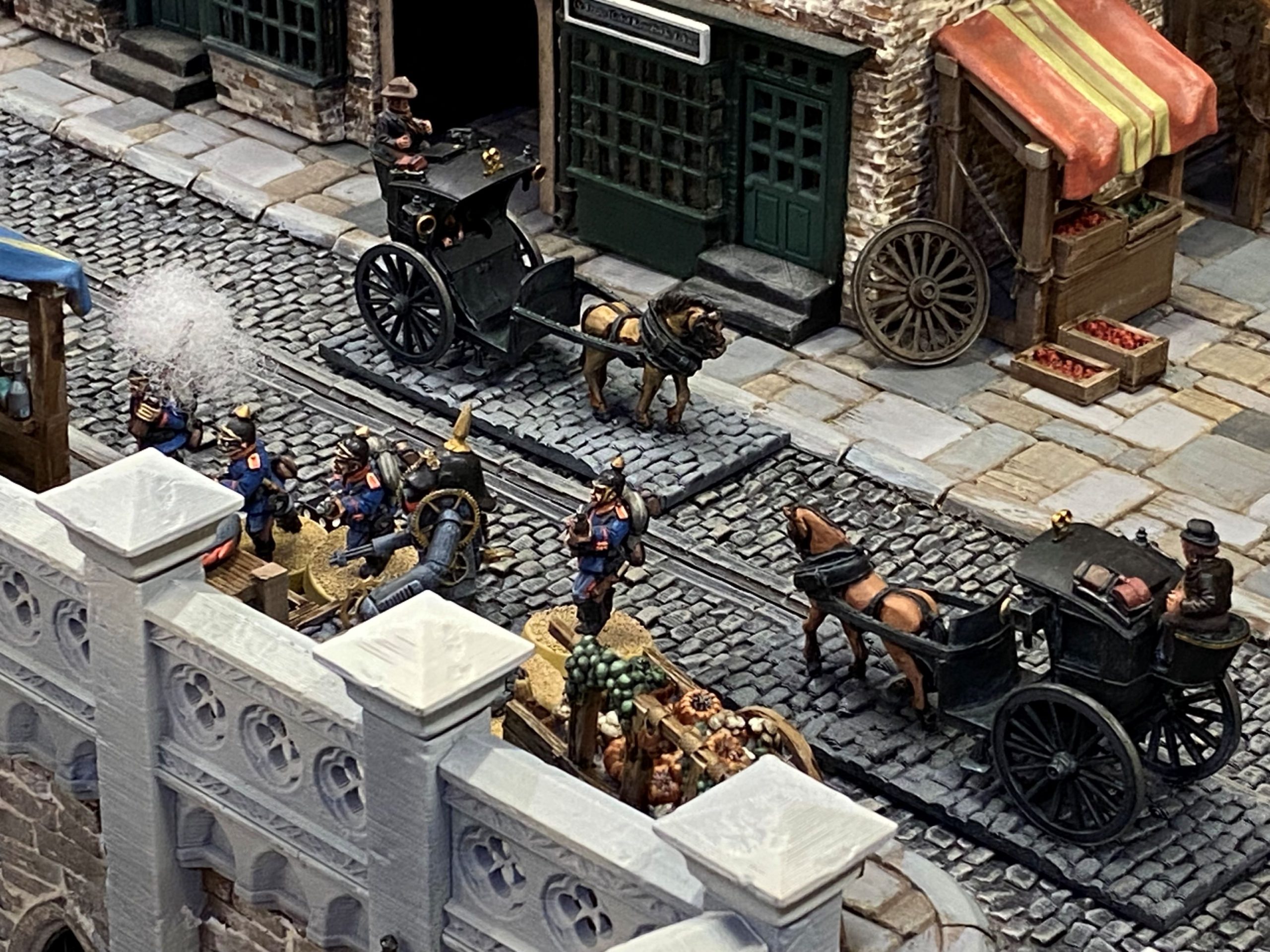
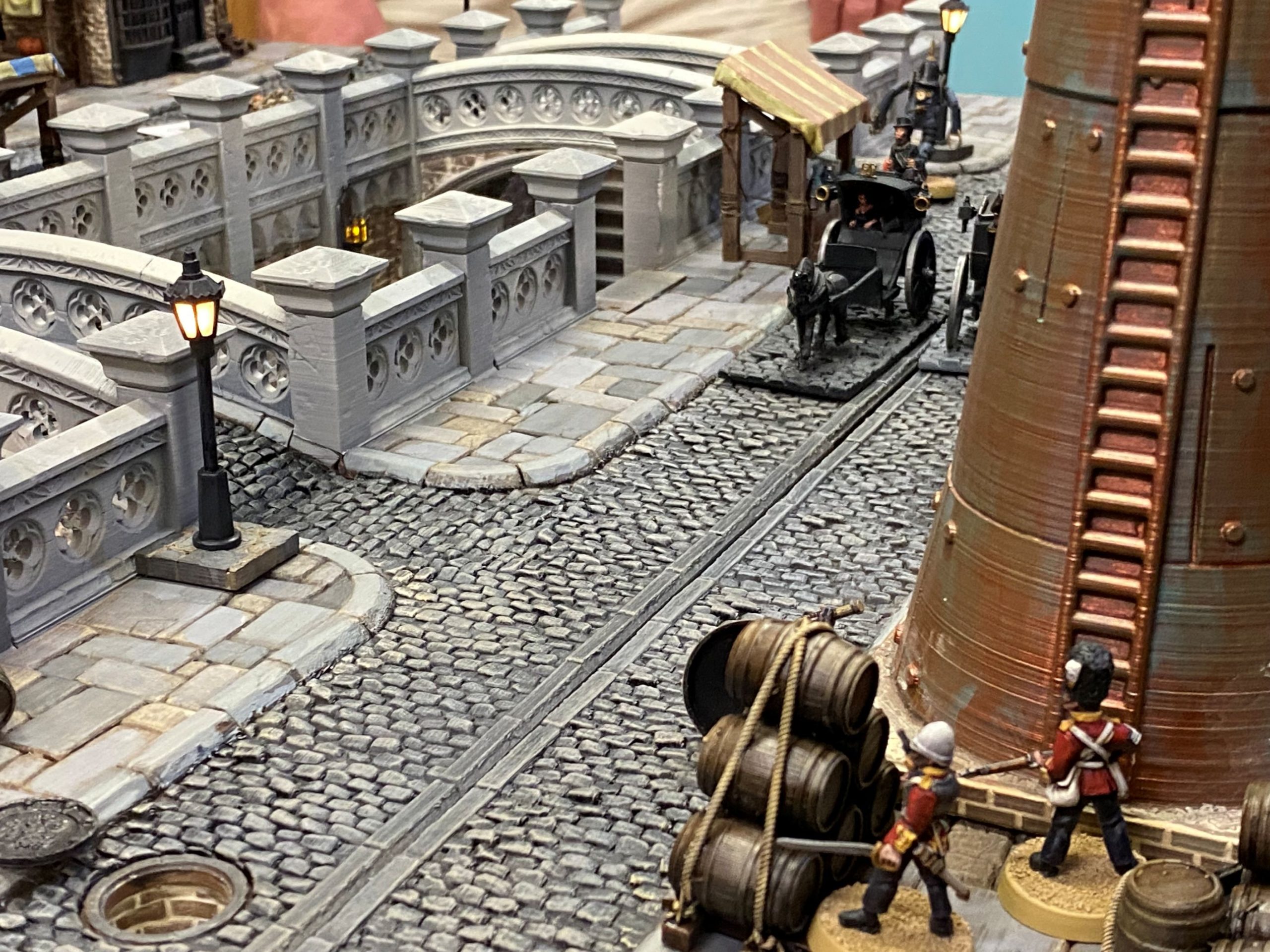
The warehouse erupted into chaos.
Mason’s bark of “Stand fast!” cut through the din as the cobbles split open and Termigons boiled up from the sewers like pale, screaming smoke. Bayonets flashed in the gaslight. The small detachment of British soldiers, drilled to perfection by Mason’s wrath, formed a ragged square around Warehouse 57 and met the surge with steel and discipline. They fought like men cornered with nothing left to lose—volley fire cracking, boots locked, every missed shot answered with a rifle butt to sinew and bone.
Above the shrieks and gunfire, the two Clockwork Clanks came alive. One lurched forward, pistons hissing, and tore into the seething tide of Termigons as they spilt from the drains. Gears ground. Steam vented. Each brass fist came down like a judgment, pulping the cave-dwellers before they could reach the aether-crystals. The second Clank, key winding down into the dark—a silent, useless sentinel as the battle raged past it.
Hauptmann Voss and his Prussians surged from the fog, dark uniforms stark against the rust-coloured sky. They came for the crystals, carbines spitting. For a heartbeat, three forces collided in the narrow street. The Termigons didn’t care who bled. They took Voss’s men first—dragging a pair of Prussians screaming into the shadows, their jaws closing on throats. A young British private went down beside them, pulled beneath the cobbles before Mason could reach him. The Termigons’ fury was indiscriminate and costly.
The losses sobered Voss. His expeditionary force was already decimated, caught between British discipline and Martian hunger. Then the sound rolled over the rooftops: marching boots, distant but growing. More British reinforcements, drawn by the gunfire and the roar of the Clank’s machine gun.
Voss snarled an order. The surviving Prussians broke off, melting back into the red fog with empty hands and fewer men than they’d arrived with. They vanished between the warehouses, leaving only boot prints and blood on the bricks.
Silence didn’t follow. From beneath the streets came the screams of the injured British, Prussian, and Termigon alike—being dragged down into the tunnel-web below. A fate worse than death, swallowed by the foundations of New Brighton as the red fog curled over Warehouse 57 once more.
Mason stood among his battered men, breath steaming in the cold. The aether-crystals still pulsed behind him, untouched. He looked down at the shattered cobbles, then at the stationary Clank.
“Secure the perimeter,” he said quietly. “And someone fetch a bloody key.”
______________________________
For this game, we tried out Glorious Adventures in the Age of Steam.
I rather liked this set of rules, and it played pretty well. I think going forward, we would probably use the ‘Bigger Battles’ additional rules to accommodate units.
All in all, a fun rules set and one I am keen to play again.
Termigons
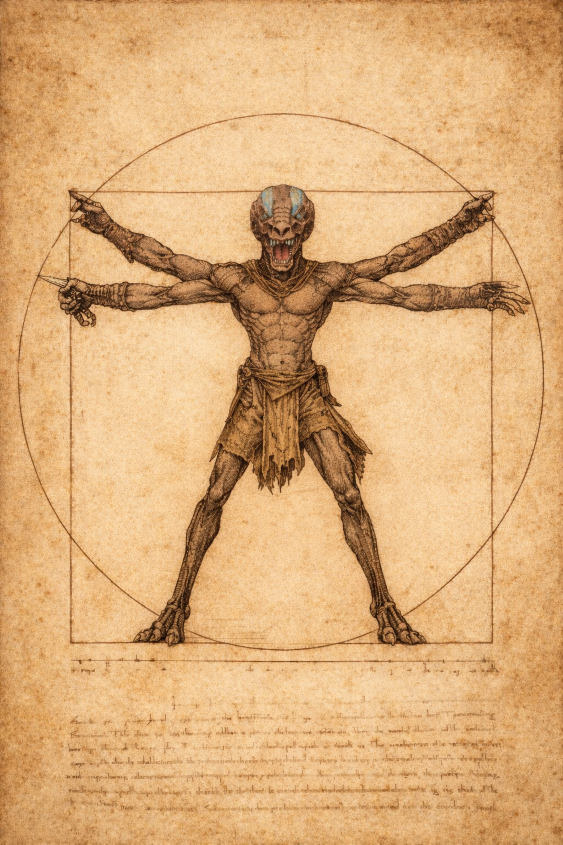
The Termigons – Fallen Children of the Nool
Long before the tunnels of Mars crawled with cannibal kings, there were the Nool—a gentle and contemplative race who tended the Astral Paddy Fields, vast, luminous terraces said to exist between the physical and the immaterial. They were caretakers, not conquerors. Their civilisation was quiet, patient, and deeply attuned to unseen currents of existence.
That world is gone.
Whether through war, cosmic collapse, or slow decay, the Nool were driven from their fields and forced beneath the Martian surface. In the endless dark, something in them changed.
____________________
General Overview
The Termigons are a degenerate, cannibalistic species that dwell within the vast tunnel networks beneath the surface of Mars—particularly beneath settlements such as New Brighton. Their warrens stretch through natural caverns, abandoned mining shafts, and long-forgotten sewer systems, forming a sprawling underworld few surface-dwellers truly understand.
Physically, Termigons are lean and sinewy, with elongated limbs adapted for scrambling through tight passages and uneven rock. Their hunched posture and powerful grip allow them to climb, cling, and ambush with unsettling speed. Their alien heads—marked by predatory jaws and cold, luminous eyes—make them terrifying in the dark, where they are most at home.
Despite their fearsome appearance, Termigons are inherently cowardly creatures. Alone or outmatched, they skulk in the shadows, avoiding direct confrontation. However, when they gather in numbers, their behaviour changes dramatically. Packs of Termigons become frenzied and bold, overwhelming prey through sheer weight of bodies, chittering war-cries echoing through the tunnels.
They are cannibalistic opportunists, feeding on anything they can drag into the dark—enemy, ally, or their own wounded. This has led to a brutal, survival-of-the-fittest culture where weakness is swiftly culled, and strength is measured only by one’s ability to endure and consume.
____________________
Degeneration into the Termigons
Cut off from light, harmony, and the astral rhythms that once sustained them, the Nool devolved into the creatures now known as Termigons.
Their transformation was not merely physical—but spiritual.
Life in perpetual darkness has twisted the Termigons into divergent forms:
- Sightless Strains
Some Termigons have completely lost their eyes—smooth, sealed flesh where vision once was.
These creatures navigate using an unnerving combination of:- Acute scent tracking
- Sensitivity to vibration
- A suspected sixth sense—perhaps electromagnetic or psychic in nature
- In the dark, they are often more dangerous than their sighted kin.
- Shadow-Sighted Strains
Others retain their eyes, adapted for low-light conditions:- Excellent vision in darkness and gloom
- Severely impaired in bright light—often recoiling, blinking, or becoming erratic
____________________
Cannibals of the Martian Underways
The Termigons are a towering, subterranean species that infest the tunnel networks beneath Mars. Standing between 7 and 9 feet tall—with most looming at around 8 feet—they are gaunt yet powerful creatures, all sinew, bone, and predatory instinct.
They dwell beneath the surface of cities like New Brighton, spreading through sewers, collapsed mine shafts, and natural caverns, forming a labyrinthine underworld that festers just below civilisation.
___________________
Behaviour
Despite their imposing size, Termigons are fundamentally cowardly.
- They avoid fair fights whenever possible
- They stalk, observe, and wait
- Only when they outnumber or surround their prey do they attack
Once committed, however, they descend into feral pack violence, tearing victims apart in a frenzy of claws, teeth, and crude weapons.
Their cannibalistic nature is absolute:
- The dead are eaten
- The wounded are eaten
- The weak are eaten
This has resulted in a brutal internal hierarchy where survival alone defines worth.
____________________
Beasts of the Underways
In their long exile, the Termigons have not remained alone.
They have tamed and bred nightmare creatures that dwell in the deep:
- Blind, burrowing predators
- Chitinous tunnel-stalkers
- Pale, many-limbed horrors adapted to the same murk
These creatures serve as:
- War-beasts
- Guardians of brood chambers
- Living tools for excavation and siege
____________________
The Cities Beneath – Termite Kingdoms
The Termigons now inhabit vast, organic tunnel-cities—often described as termite mounds inverted into the earth.
These underground realms are:
- Labyrinthine and ever-expanding
- Carved through rock, bone, and ancient infrastructure
- Lit dimly by phosphorescent fungi and chemical glow—the so-called phosphorous murk
Each city is ruled by a clan or brood, locked in constant territorial conflict.
____________________
Endless War Below
Most Termigon existence is consumed byinternal warfare.
- Kingdom fights kingdom
- Brood fights brood
- Expansion is survival
These wars are savage, fought in:
- Flooded tunnels
- Collapsing caverns
- Narrow choke-points slick with blood and fungal slime
Victory brings food, territory, and breeding rights. Defeat means consumption.
____________________
The Rising Threat
For generations, the Termigons have been largely contained by their own infighting.
But this is changing.
From time to time, a strong clan leader emerges—one capable not only of domination, but of vision.
These leaders:
- Unite rival broods (through fear or consumption)
- Push expansion beyond traditional boundaries
- Turn their gaze upward… and outward
____________________
Weapons of the Underways
Termigon armaments reflect their brutal environment:
Vicious Knives
- Crude but deadly blades, often chipped or serrated
- Used for stabbing, hooking, and tearing in close quarters
- Frequently fashioned from scrap metal, bone, or salvaged tools
Martian Stump-Gun
A signature weapon of the species:
- A short-barrelled, shotgun-like firearm
- Brutal, unreliable, and devastating at close range
- Fires scattershot, scrap, or improvised ammunition
- Perfectly suited to:
- Tunnel ambushes
- Corridor fighting
- Sudden point-blank engagements
The Stump-Gun is less a precision weapon and more a tool of overwhelming violence—exactly how the Termigons prefer to fight.
____________________
The Southern Pressure
In the southern reaches of their realm, Termigon tunnel-networks are beginning to intersect with the holdings of the Drune.
There, at the edges of civilisation:
- Outposts vanish overnight
- Caravanserai are found emptied, blood-stained, and silent
- Survivors speak of towering shapes emerging from the ground
What was once a hidden menace is becoming something far more dangerous.
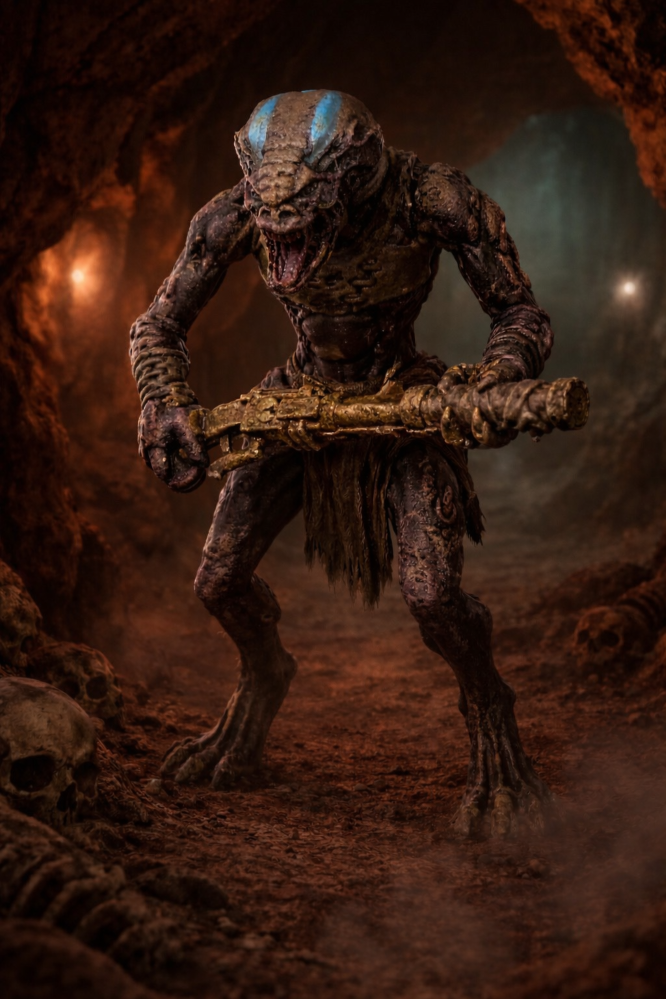
The models for these are made from Games Workshop Kroot Bodies with Genestealer heads. The guns have been cut down to represent the shotgun-style weapons in our fluff that they carry.
The Battle of the Sands. Conclusion
The Battle of the Sands.
Conclusion.
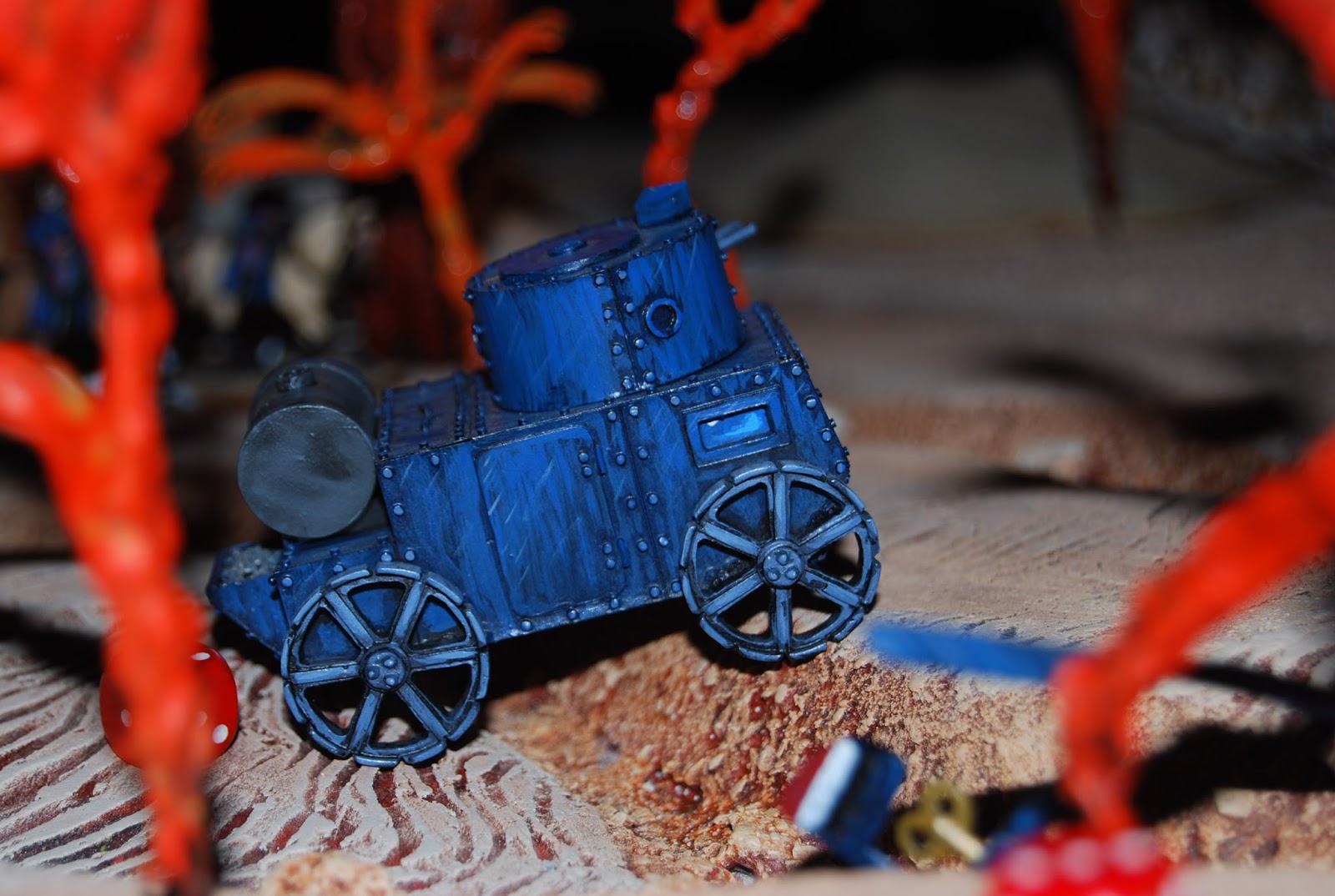
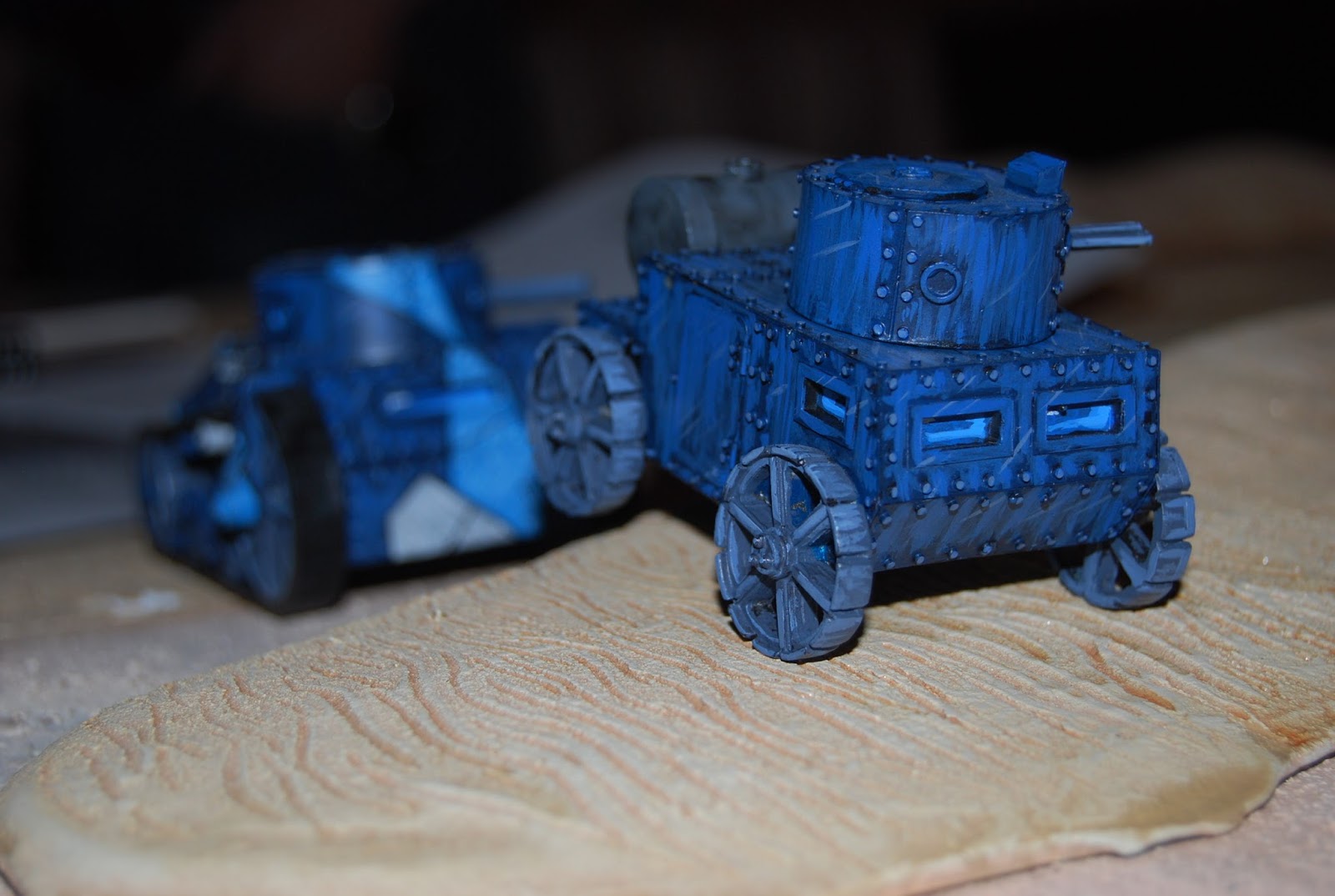
This was a victory to the British but at a very high cost. Although all their armour had in fact survived their cavalry was completely wiped out and their infantry suffered huge losses (including those cowardly Scots…no oatcakes for them). The Rhinox were experiments which worked fairly well though need tweaking some. I think that one day we’ll need to do an armour only battle as these pieces tend to stay fairly static to allow them to fire, and with turrets they become firing platforms trying to take out the more nimble units of cavalry and infantry.


The Battle of the Sands. Part Two
The Battle of the Sands.
Part Two
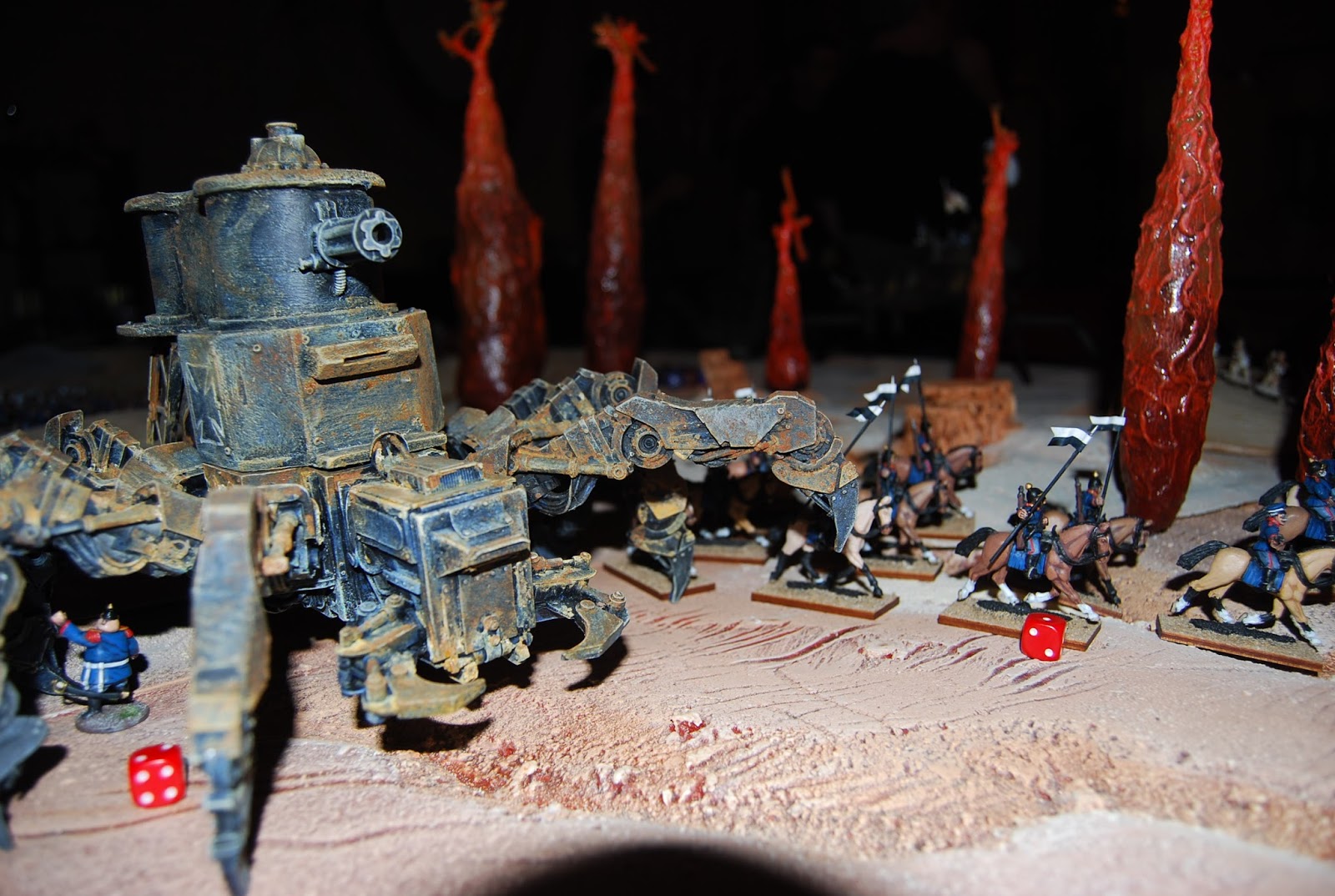
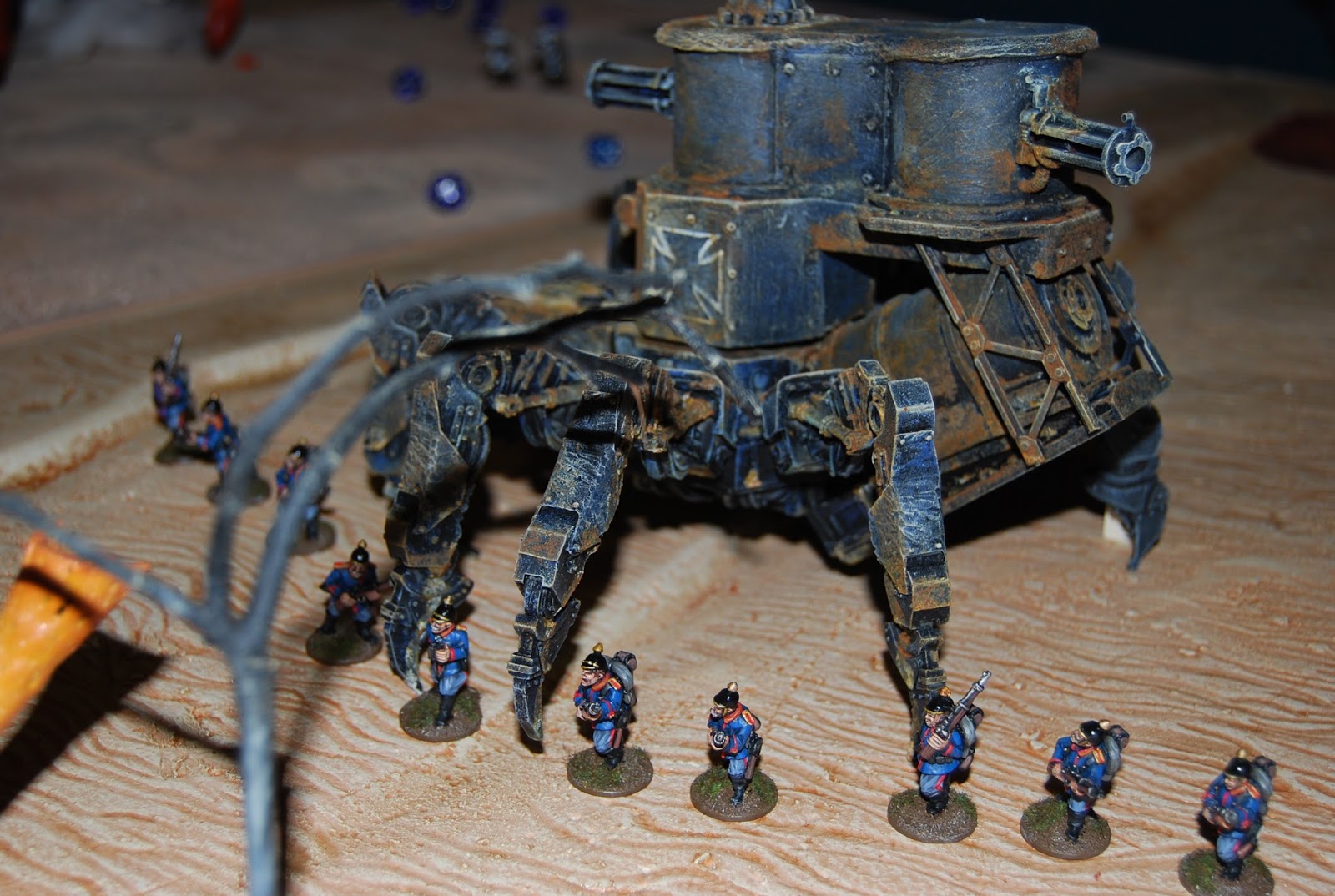
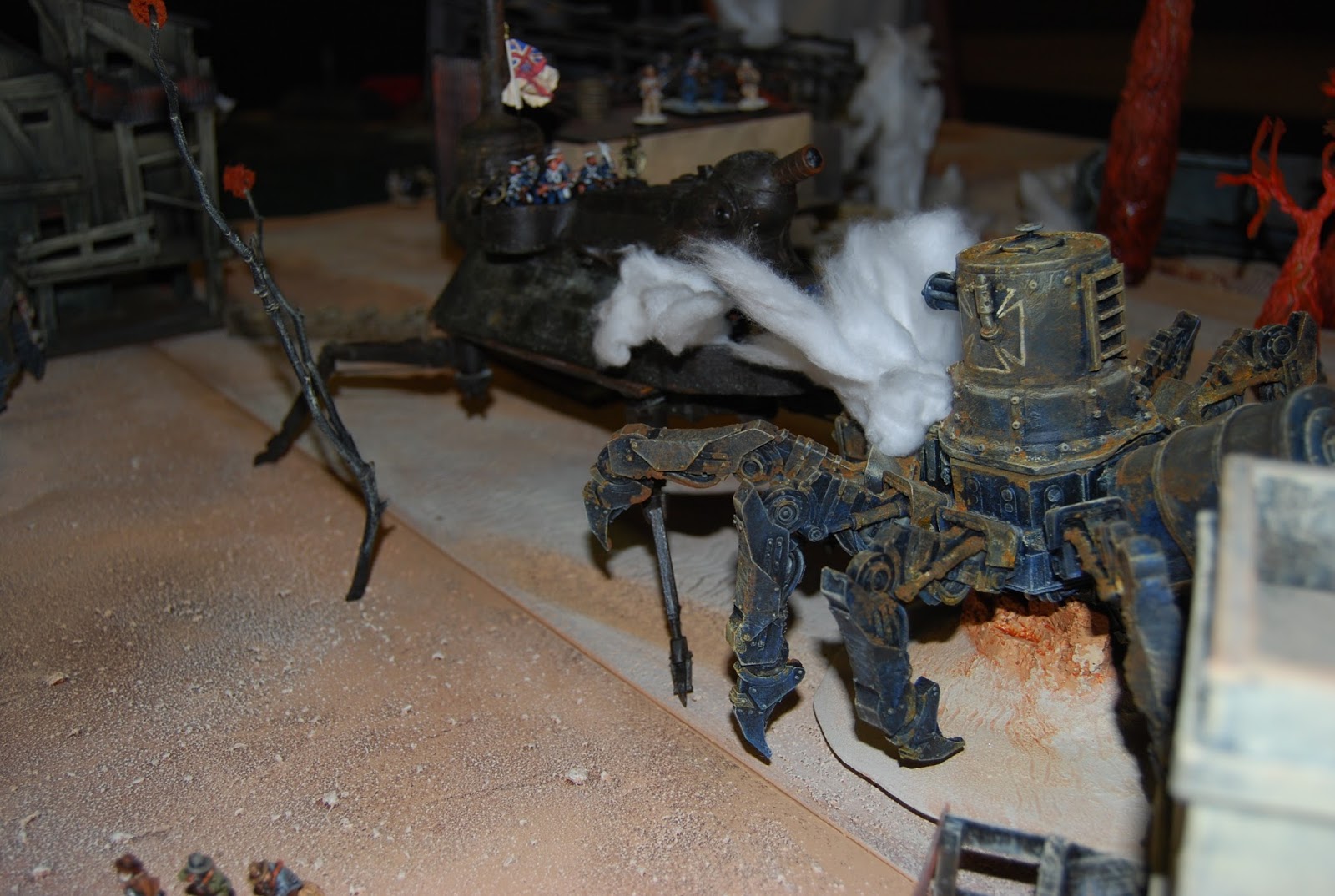
The Prussians meanwhile had decided to leave their spider tank in situ and use the twin turret mounted Gatling Cannons to sweep across the infantry and armoured cars, with their smaller armoured cars advancing to more tactical positions. Both the Orca and the Pob took hits, and a number of the highlanders fell into the dust.
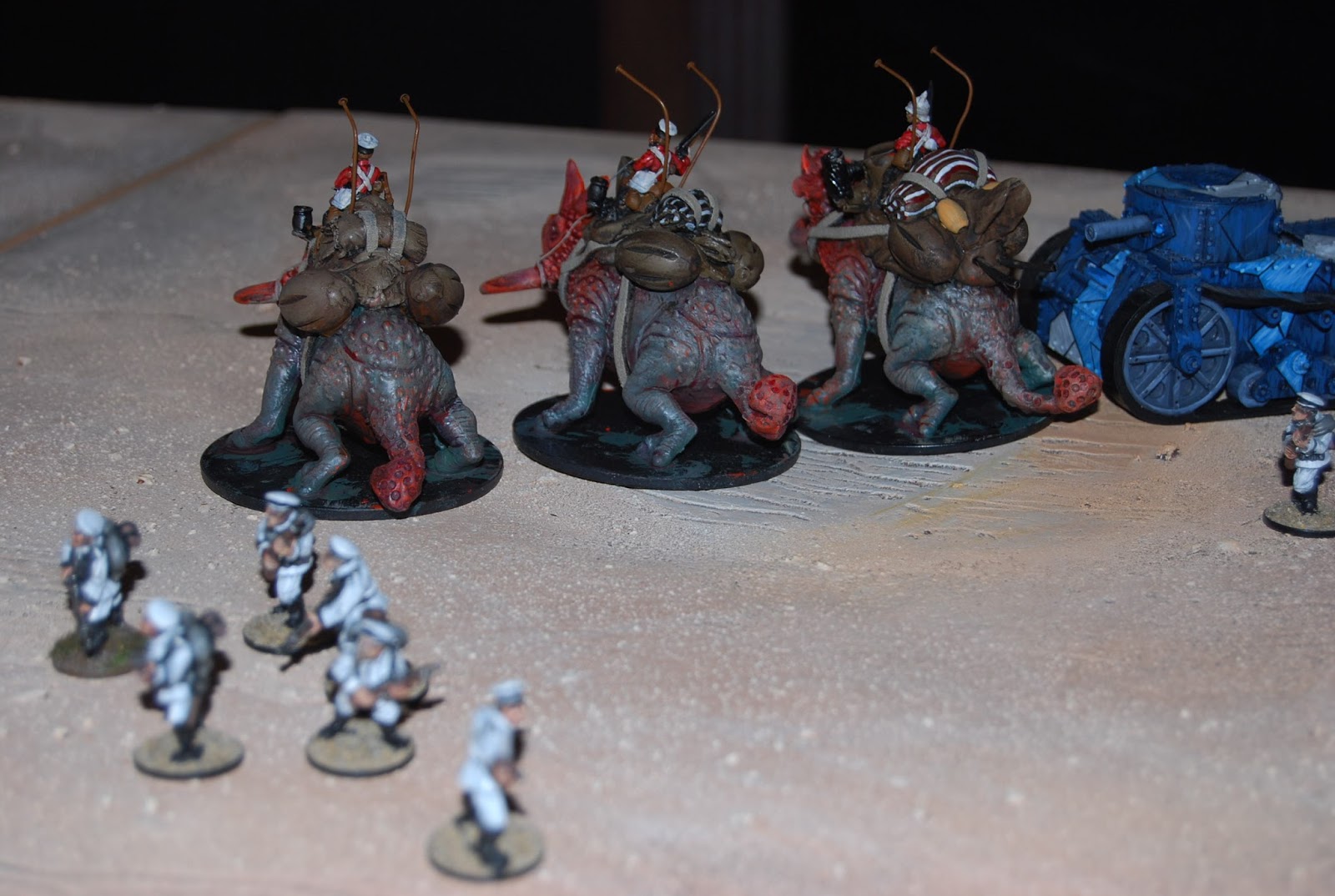
Back with the Rhinox, Captain Grey managed to goad his mount into a furious charge…which completed! All three of the beasts charged through the ranks of the Marztruppen, who tried their best to get out of the way of four tonnes of potential sausage. Half the unit did not manage this feat and many were simply crushed. The Rhinox halted at the end of their charge distance…but right adjacent to the Prussian tanks! Not a good place to be.
Meanwhile the Prussian regulars led by the infamous and rather portly Hero Count Heinrich Helmutsson were dashing through the floatwoods towards the Berkshires. The Hephaestus managed her sustain role and the gunner rolled a 1 to hit. ‘Hurrah!’ cried the navy, as the shell landed slap in the middle of the wave of advancing blue.
Back on the British left flank, those sneaky fliers had used the Creekbed for cover before launching a vicious attack on their rear, leaving half the unit dead as their machine guns cackled away.

In reply they managed to destroy most of the fliers and the single remaining model decided he’s had enough. However, their attention had been distracted by the fliers for long enough to mask the advance of the remaining cavalry, who crashed into them. A furious melee ensued in which the surviving Prussian cavalry officer managed to keep his men from fleeing and kill the Scots officer. Seeing their leader killed the Highlanders decided to call it quits and left the table. Now only a single armoured car and the heavily damaged walker held the left, although the Prussians had too few men left to press their advantage. In the centre meanwhile the Berkshires met with the depleted ranks of the Prussians. Their greater numbers took their toll, as did getting the initiative. However, the remaining seven Prussians remained true to their great leader and returned quite a devastating volley that forced the British back into cover.
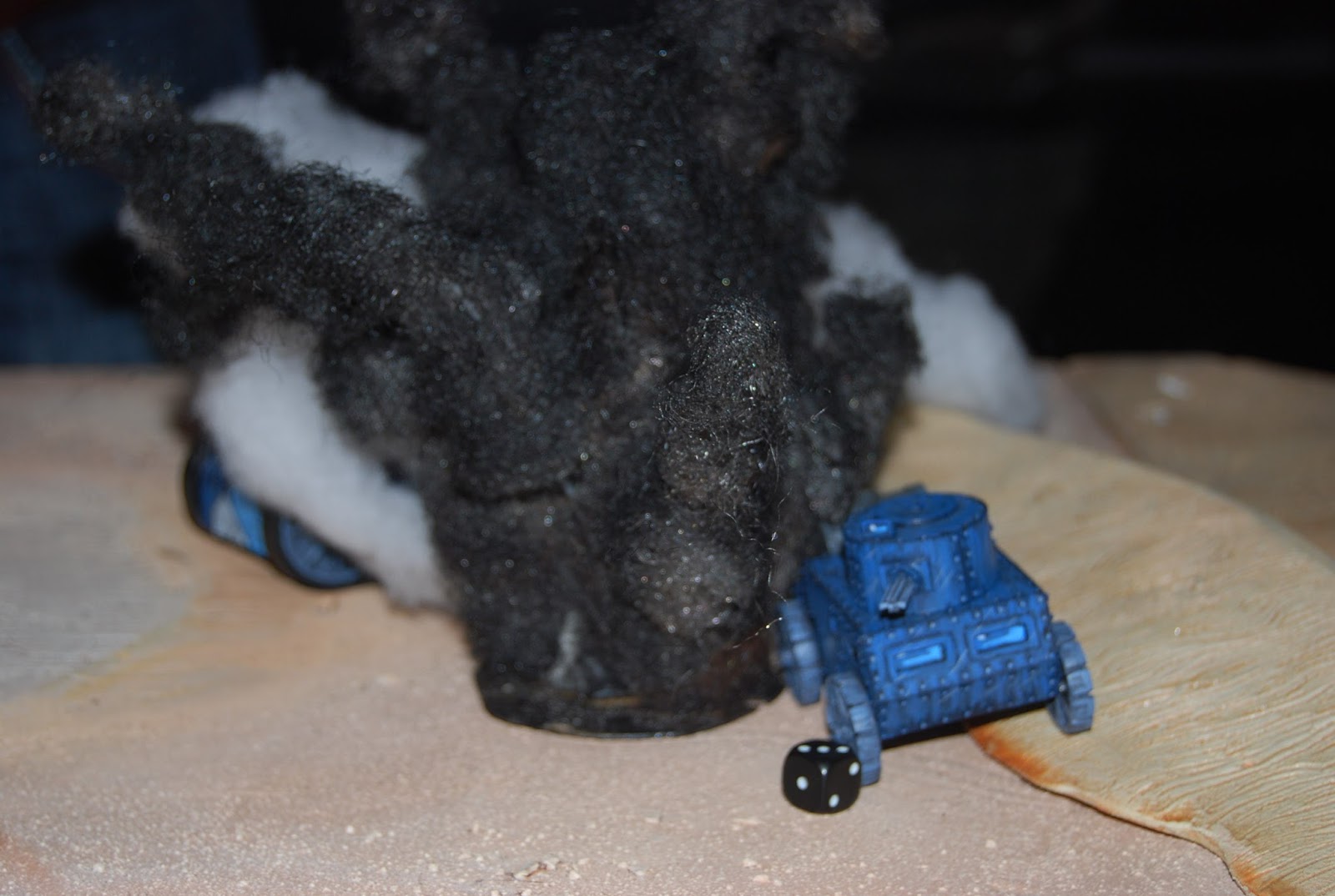
However, the epic that was being played out was on the right side of the table. The Rhinox, taking an entire turn to turn around were shot at by the remaining soldiers (those unflattened ones anyway). One of the shots got lucky, disabling one of the Rhinox tails and reducing the armour value of another, while another shot managed to blow up the Naptha tank on the side of Captain Grey’s beast. The Hero managed to make his save roll and landed a few feet away from the Prussian main tank, still on his feet, to polite clapping. Wiping his rather singed moustache, he leapt for what remained of his saddle to re-mount. Just as he did this the main tank fired at point blank range into his beast. Surely they could not miss…but they did! We were playing in this game a method of working out where failed shots landed..and this one landed only a few feet away from the tank, catching itself in its own blast radius and knocking it out of action! The beast also took extra damage but managed to stay on its feet and Grey had survived a second time! Luckily the remaining armoured car was trading shots with the Pib, which was racing (well, ambling gently) to the aid of the captain and his men. Who in the meantime had charged for a second time through the surviving soldiers.
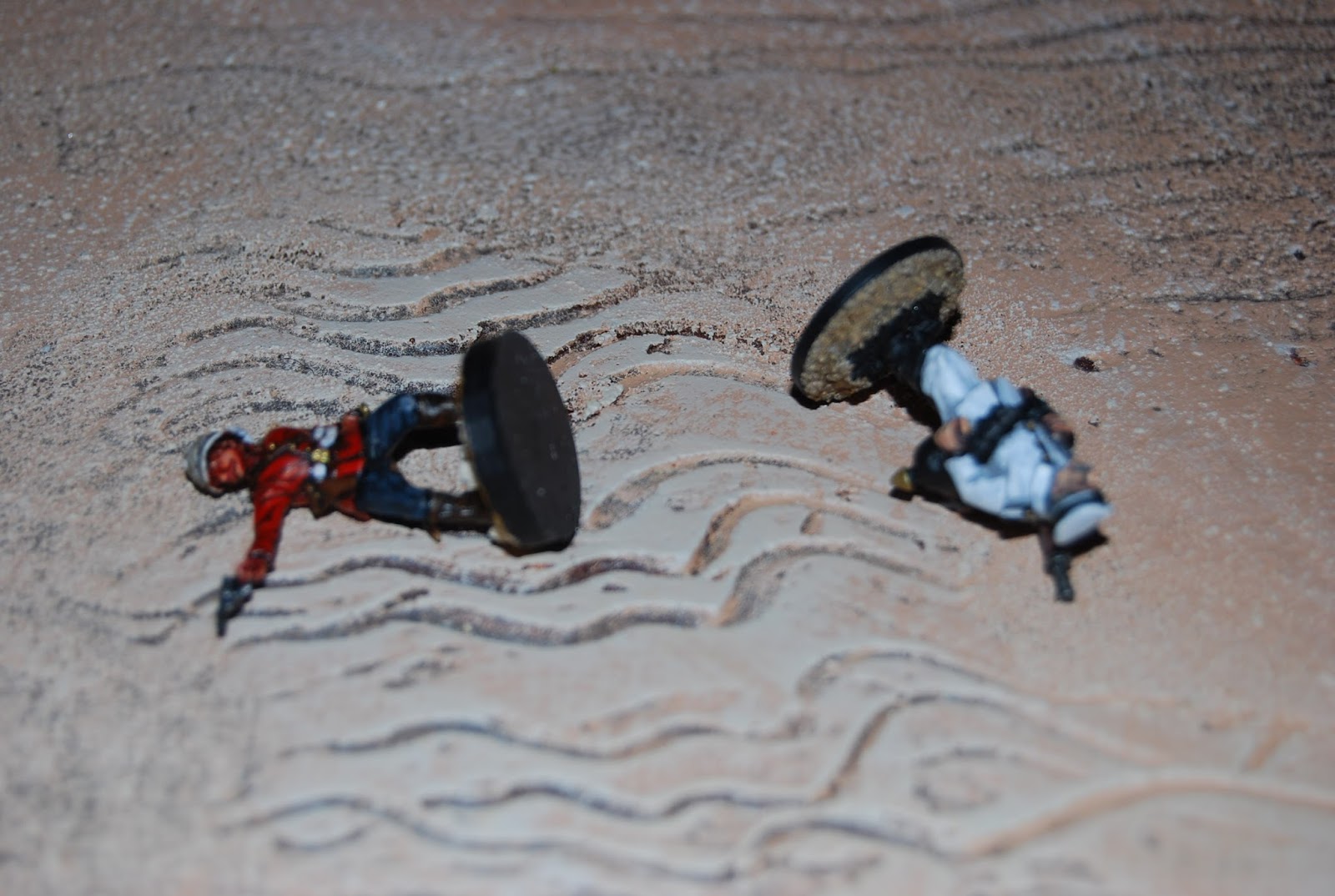
Men and beast fell until all that remained were the Marztruppen captain and one of his men, battling it out with fist and sabre with our wounded hero, who by this time had survived another detonation from his mount (which had finally killed it) and two sword thrusts. Grey parried and thrust his sword through the breastplate of the German leader and swivelled to receive and give the killing blow from his last opponent. Both forces on the flank had completely wiped each other out!
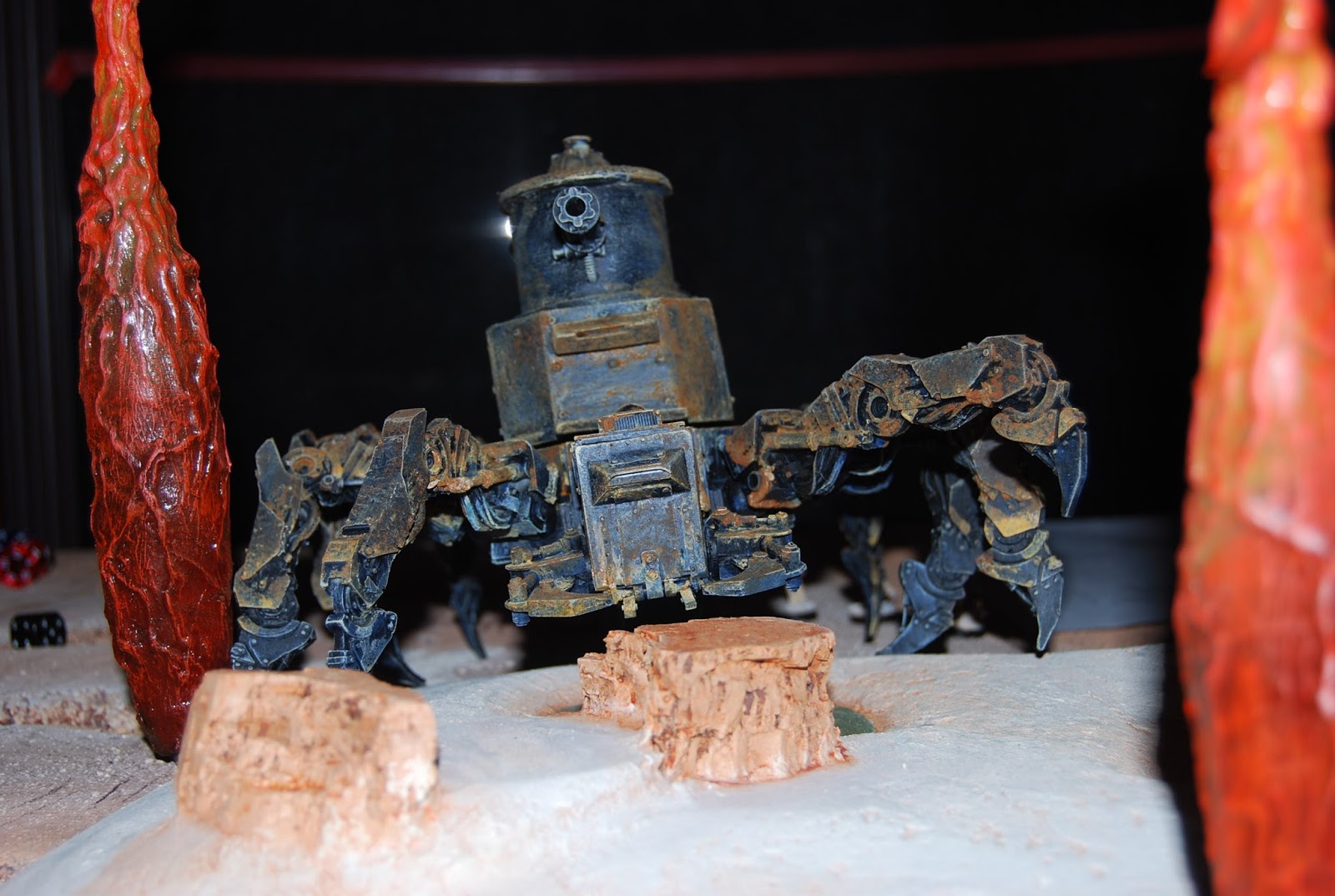
Things were starting to look bad for the Prussians. Their last cavalry wiped out by the rattling guns of the Pob and their armoured penny farthing lying gently sizzling before the Orca (whose flamethrower had finally worked), their last hope was inflicting damage with their spider tank. Heinrich
Helmutsson led a last desperate (well, as he was the only remaining man in his unit) charge at the lumbering Hephaestus to be finally picked off by the rifles and Gatling gun of the ship’s crew. The end was in sight. The remaining Berkshires attacked the legs of the Spider which at last turned to face the British. But with its commander and driver killed in the barrage of fire aimed at it, it surrendered.
The Battle of the Sands. Part One
The Battle of the Sands.
Part One.
Captain Grey of the Heavies shifted his weight in the saddle to ease his old wound as his Rhinox made use of its time to chew a redweed bush beneath him. He could hear the beasts copious teeth making short work of a plant with all the softness of barbed wire and wondered, not for the first time, what the inside of his stomach must look like. He slowly turned the field telescope around the low hills, but there was still too much dust to see clearly. This filthy wind had kicked up so much dust in the past few days that the steam conveyances were seizing up. He could hear their tortured joints behind him as they struggled to maintain their pace. Only the Rhinox seemed not to care much, whatever the weather threw at them
Their mission had begun three weeks before. Using hit and run tactics it was hoped to break up the Prussian advance while the different columns had yet to converge in their attack on New Brighton. It was clear that the British Imperial force was much too small to hold but a small section of line around the bastion of the city, making it far too vulnerable to short range nef bombing and siege artillery. If the supply lines could be cut or severely hampered then at least it might buy some time for reinforcements to arrive from Britain and her allies the Russian and Confederate States.
Several flying columns had been sent out, including Greys. And so far their mission had been very successful. Four Prussian supply columns had been destroyed including a large artillery unit, and a further large unit had been forced to make a retreat. But their position was becoming increasingly tenuous and the hunter was becoming the hunted. They had been spotted yesterday by a Prussian nef patrol and had already evaded one force sent to find them, though mainly by entering the sandstorm which they were just emerging from. Their only hope now was to get back to their lines as swiftly as possible.
Sergeant Norris emerged from around the crags in front of Captain Grey and pulled his Rhinox to a panting halt.
“Waterhole sir..about a kilometre away. It looks like the one the Drune marked out for us sir…has the cleft rocks just like they described”
“Very well sergeant. Signal the column to advance. I daresay we could use the water…even these fellows” he said, looking down as yet another redbush disappeared into the gaping maw of his riding beast. His mount began a guttural growl as his brain registered the presence of the other Rhinox, fearing possibly the theft of his redbush. Grey gave him a whack with his iron poker. Best not let them start fighting. They were placid beasts, on the whole, and as long distance mounts through this land they could not be beaten. But heaven and earth would not stop a Rhinox that had decided to charge at something. Grey had once seen one of his troopers frantically clinging on as his mount had hit and turned over an armoured car belonging to the Duke of Cambridge’s light infantry. No-one had told the poor fellows about the colour green….
The pale sun was starting to grow weaker in the sky as the British column limped into the oasis. The dust was settling now, enabling the men to take their dust masks off and wipe them. Lieutenant Hughes of the armoured car brigade was just about able to see the long row of hills to his north for the first time in two days. He raised his periscope and turned his turret while opening the hatch to let at least a little fresh air into the cauldron that was the HMMS Pib. His hand froze. There, not two hundred meters away was another column. Long rows of soldiers, cavalry and tanks. The Prussians!
For a full twenty seconds the two columns, travelling in different directions, looked on at each other before recognition set in. Then there was a brief moment of almost silence when all that could be heard was the thumping regularity of steam boilers and wheezing pistons.
Then, all hell broke loose.
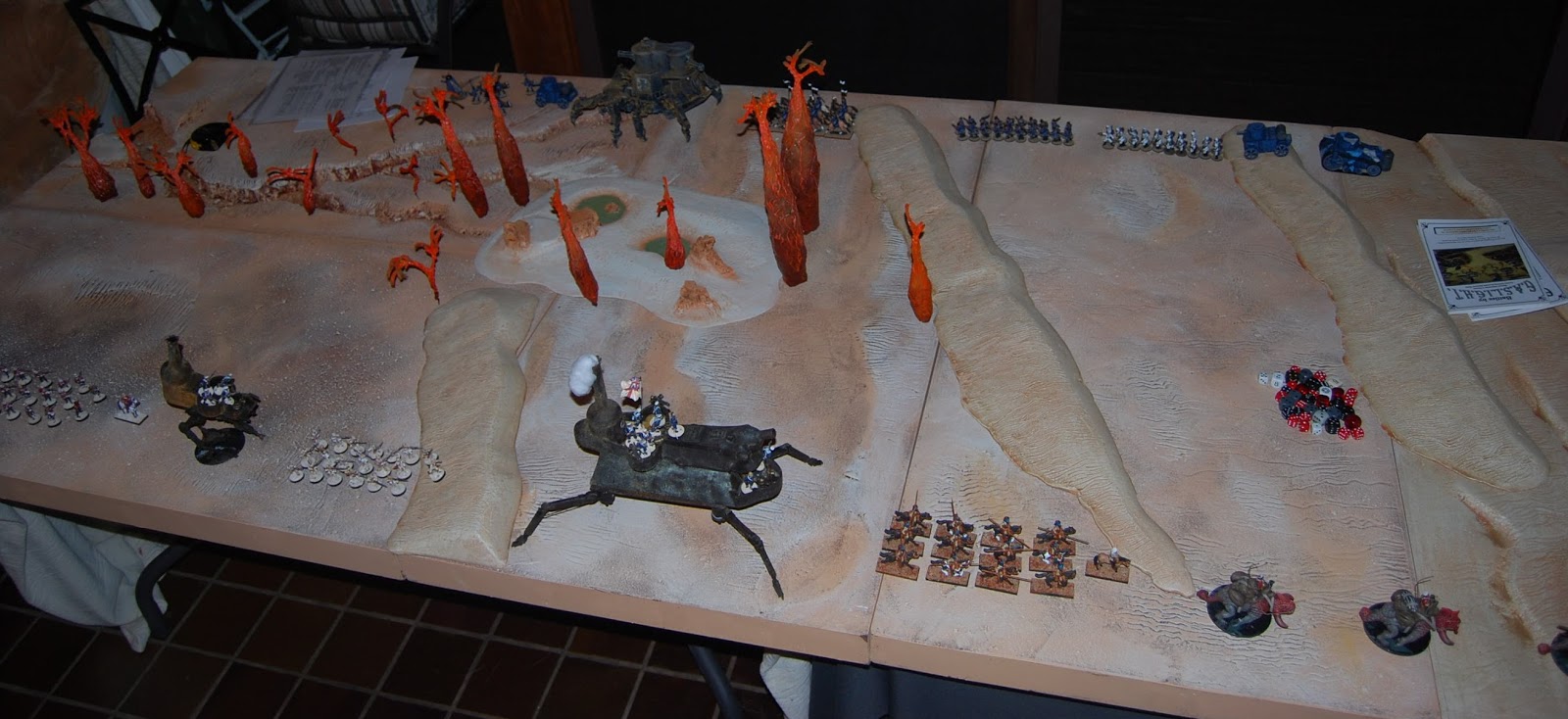
Well a mighty pickle the British had got themselves into, moving alongside a Prussian column in a sandstorm and not seeing their adversaries until you could chuck a haggis in their nearest funnel.
The British forces on the nearest table edge are led by the indomitable HMMS Pib (a rather nice Ironclad armoured car), followed by the lumbering and temperamental Rhinox patrol led by Captain Grey. Following them the 58th Poobah Lancers, the rather rusty four legged HMMS Hephaestus, a platoon of the Berkshires, the bipedal HMMS Orca with its rather nasty flamethrower, a platoon of highlanders and lastly Pib’s cousin HMMS Pob.
On the Prussian side a party of his heli-troops are scouting ahead, followed by an armoured car, the monstrous spider tank with twin turrets, a large group of Lancers, forty infantry, another armoured car and a medium tank.
In the first turn most of our steam armour managed to break down, although some did manage to about face. This left it up to the infantry and cavalry to start the proceedings. The Berkshires raced up onto the dunes running parallel to their adversaries so they might get a clear view.
They were in time to see the glorious, colourful and ultimately FINAL charge of the Poobah Lancers as the massed ranks of forty infantry including the elite Marztruppen opened fire. Wiped out to a man!
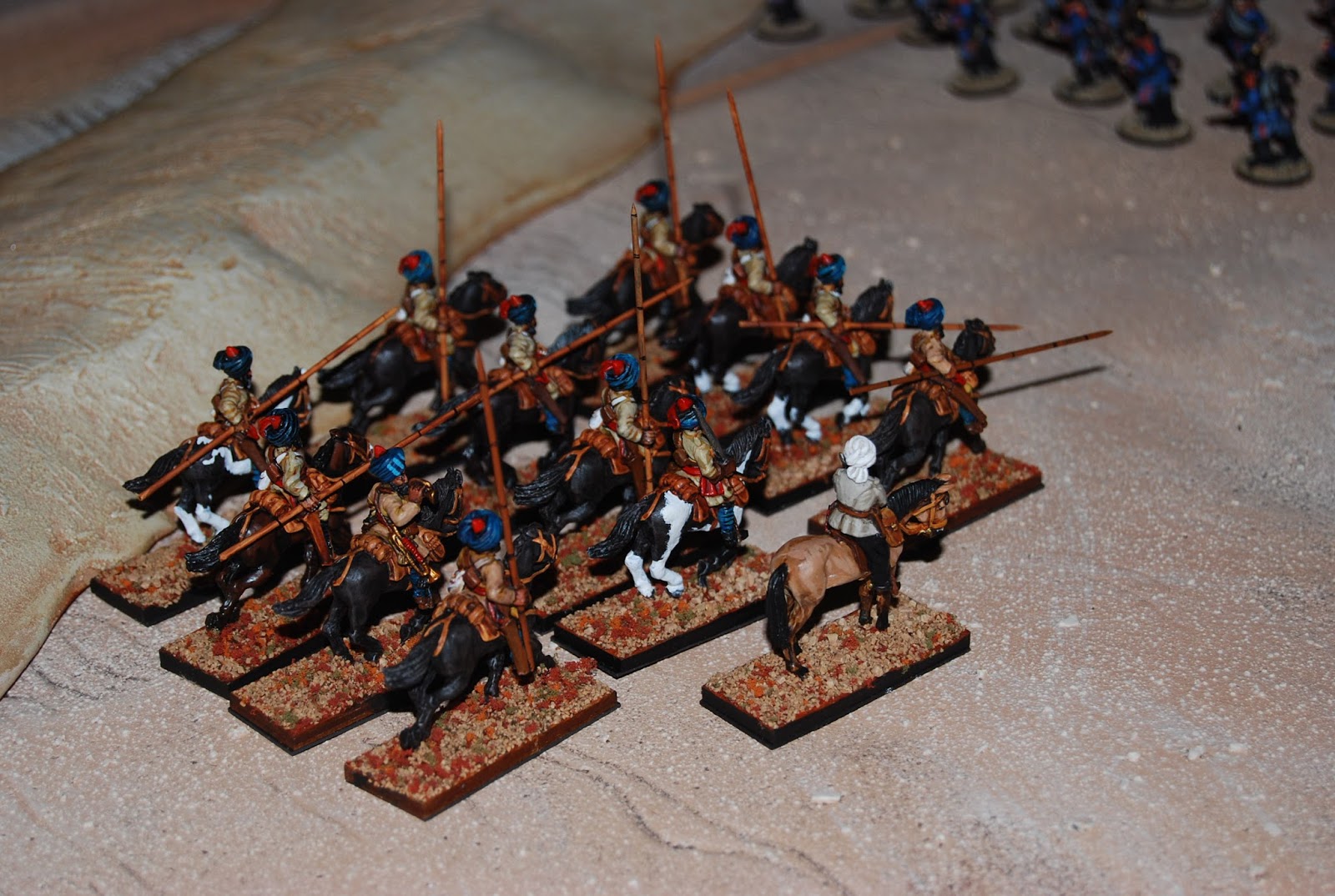
Meanwhile, Captain Grey had only just managed to control his beasts and was following in the footsteps of the doomed lancers, whose sacrifice had at least managed to get his unit into charge range next turn.
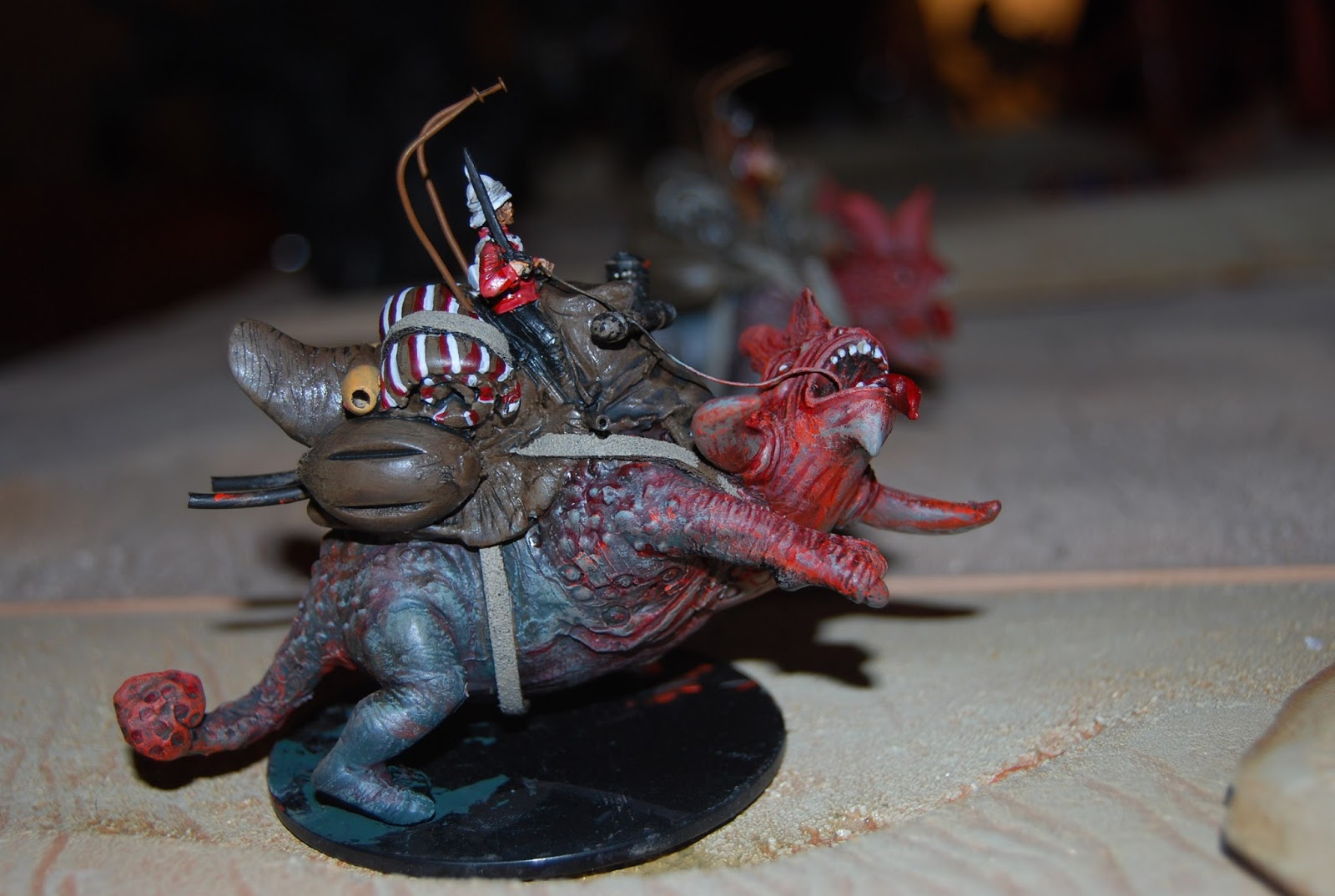
If only the beasts would be goaded by the green rag!
Meanwhile the Prussian lancers, oblivious to the carnage inflicted on their opposite numbers, rushed through a gap in the oasis floatwood trees to charge the unit of highlanders who had taken up firing positions along a dried creek bed , covered by the Pob.
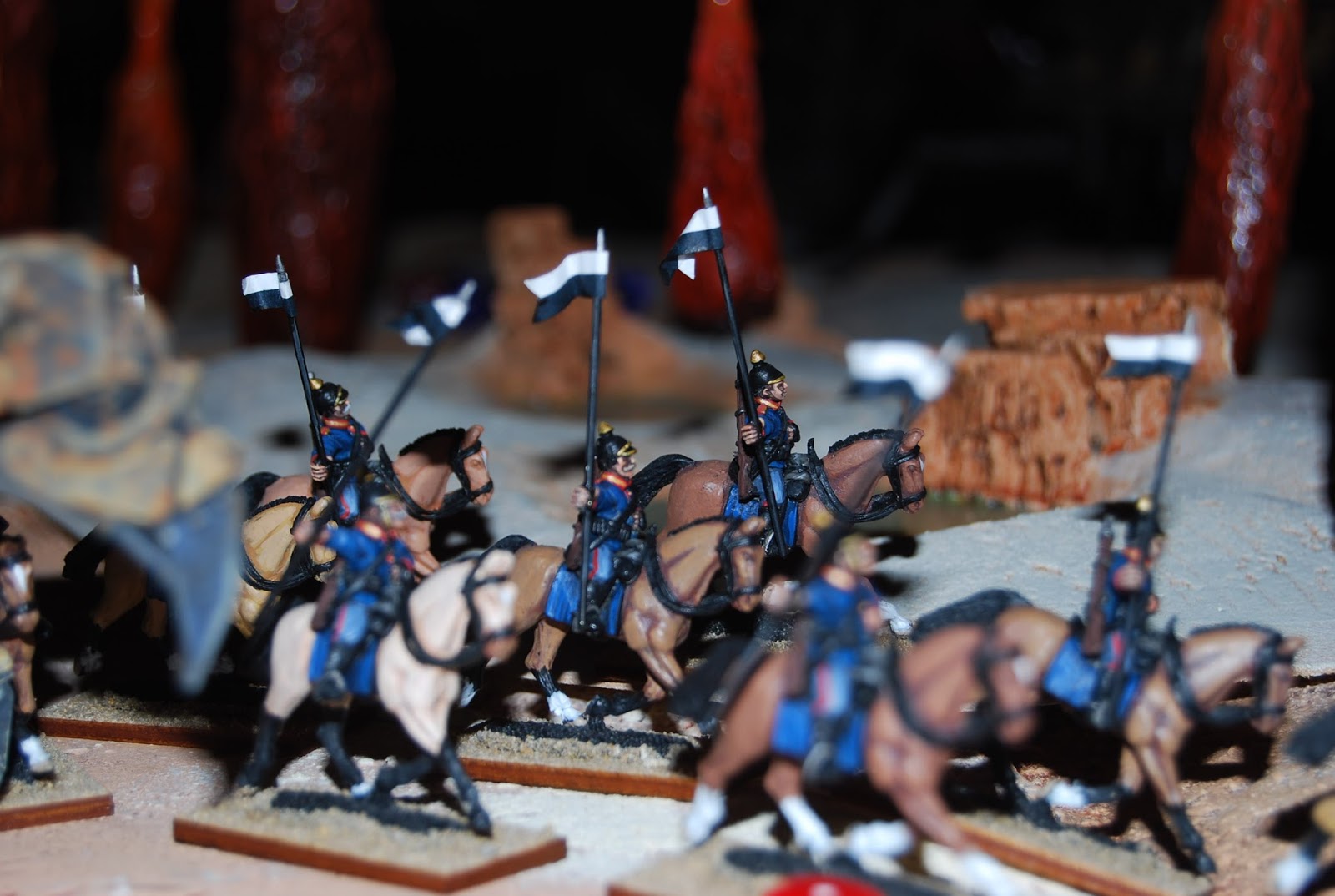
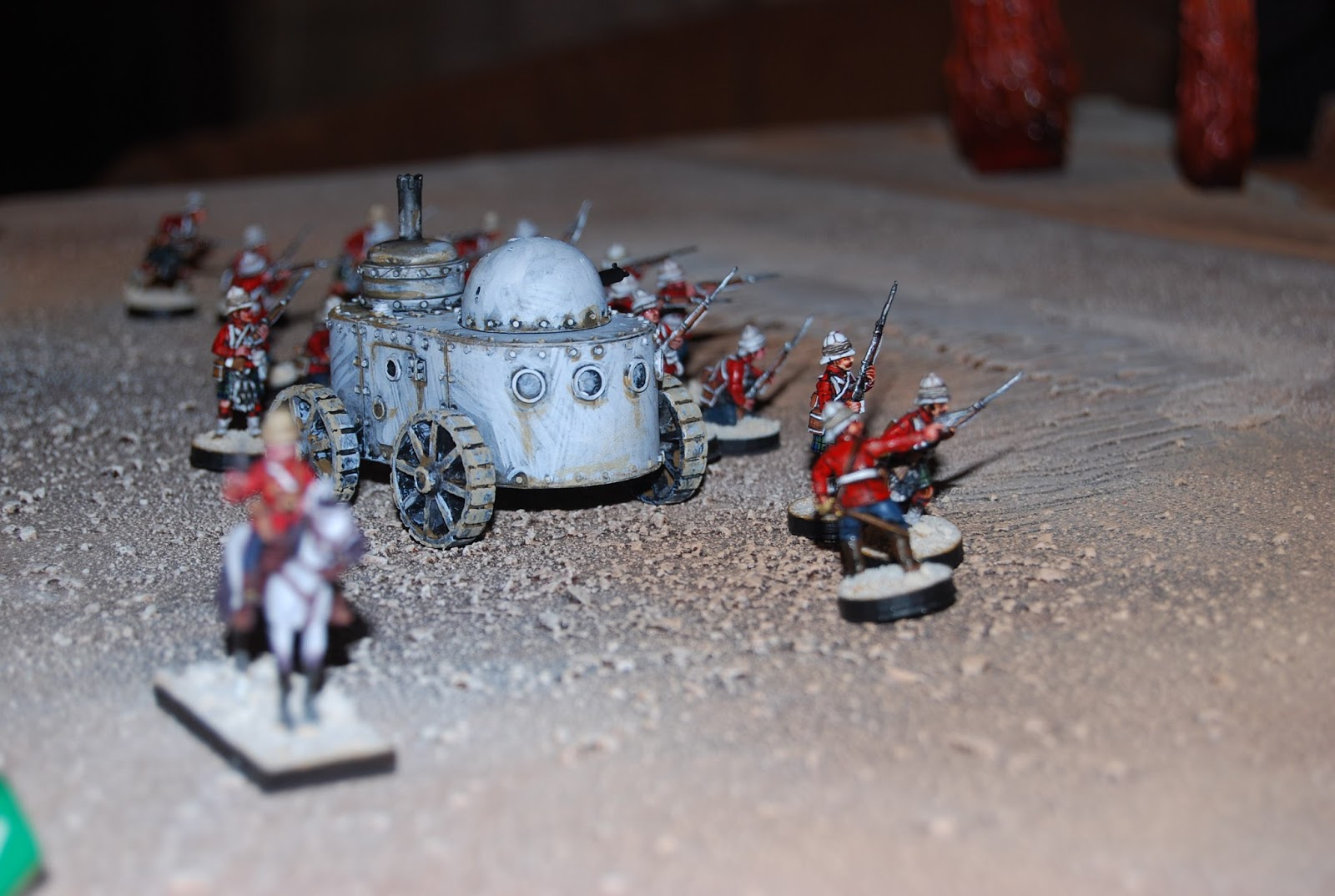
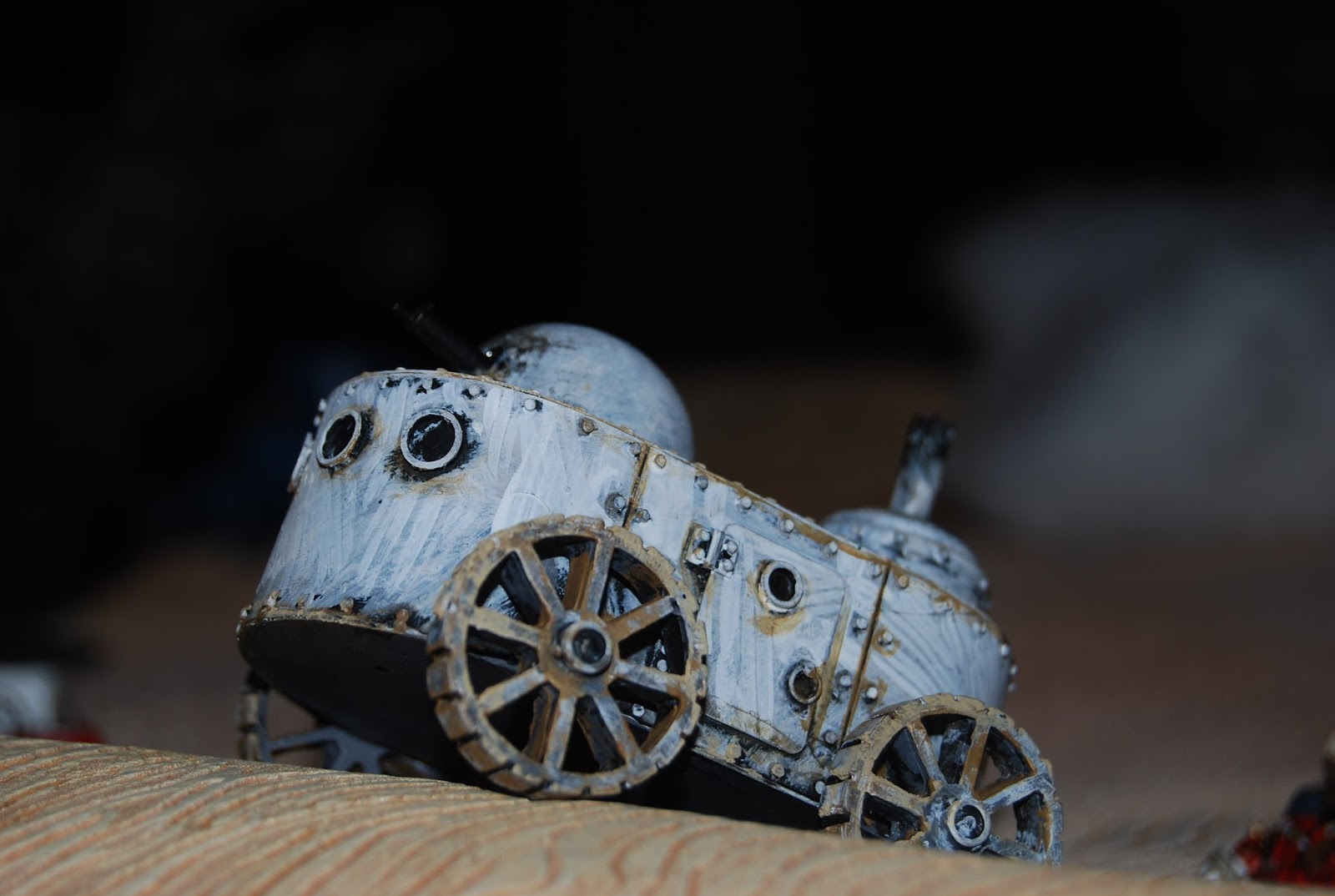
Oh dear! A short distance roll meant that they didn’t quite make it. And the doughty Scots got off a volley, crashing into horses, pickelhaubes and floatwood trees. Horsemen and their mounts tumbled into the creek. The unit however was far from obliterated and the three officers had all managed to remain in the saddle leading their men.
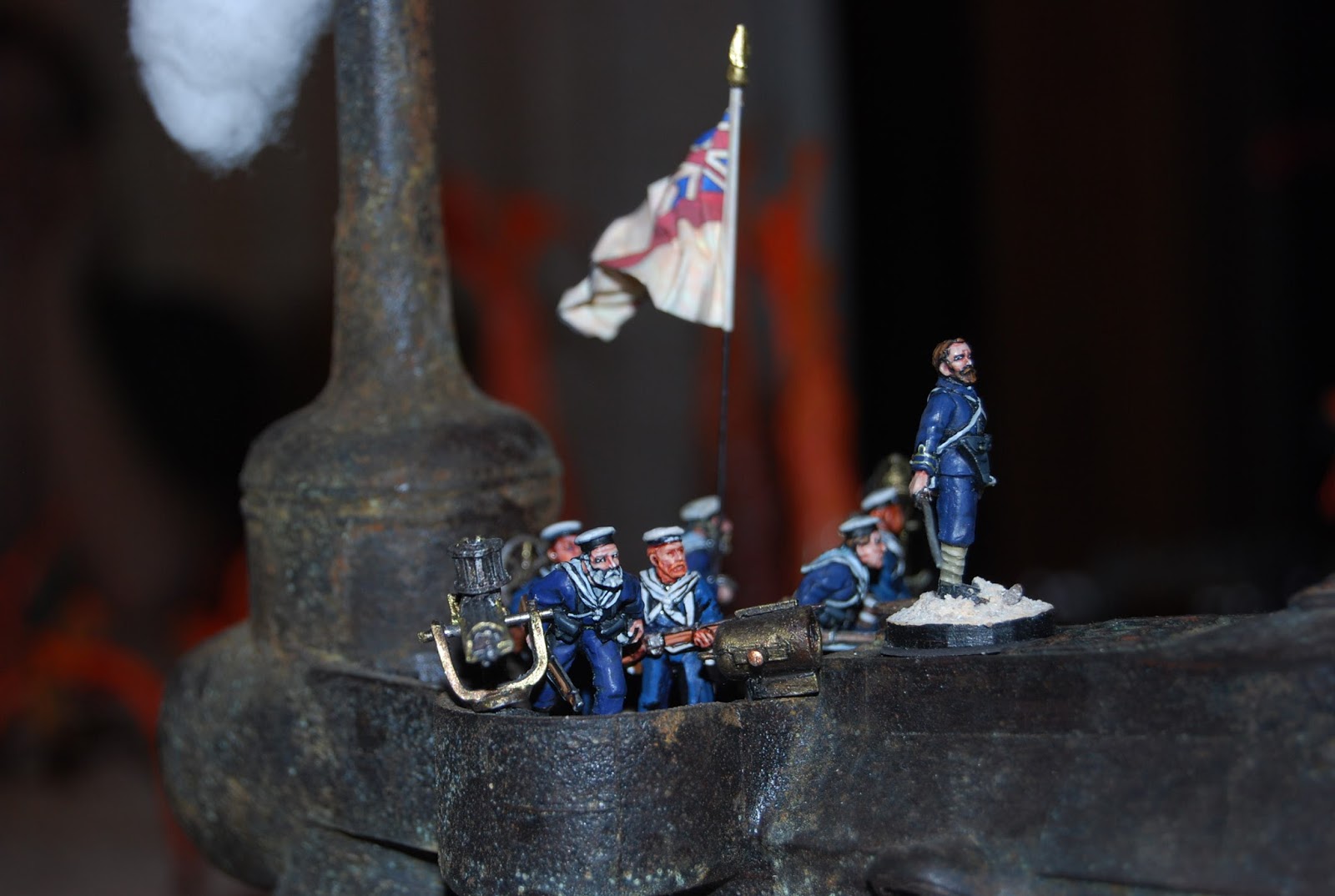
Meanwhile the British had finally managed to start up the Hephaestus but their first shot was a miserable one as Commander Huntleigh-Burns could attest to as he viewed it from the top deck.
The Battle of Horst's Ferry. Conclusion
The Battle of Horst’s Ferry.
Conclusion.
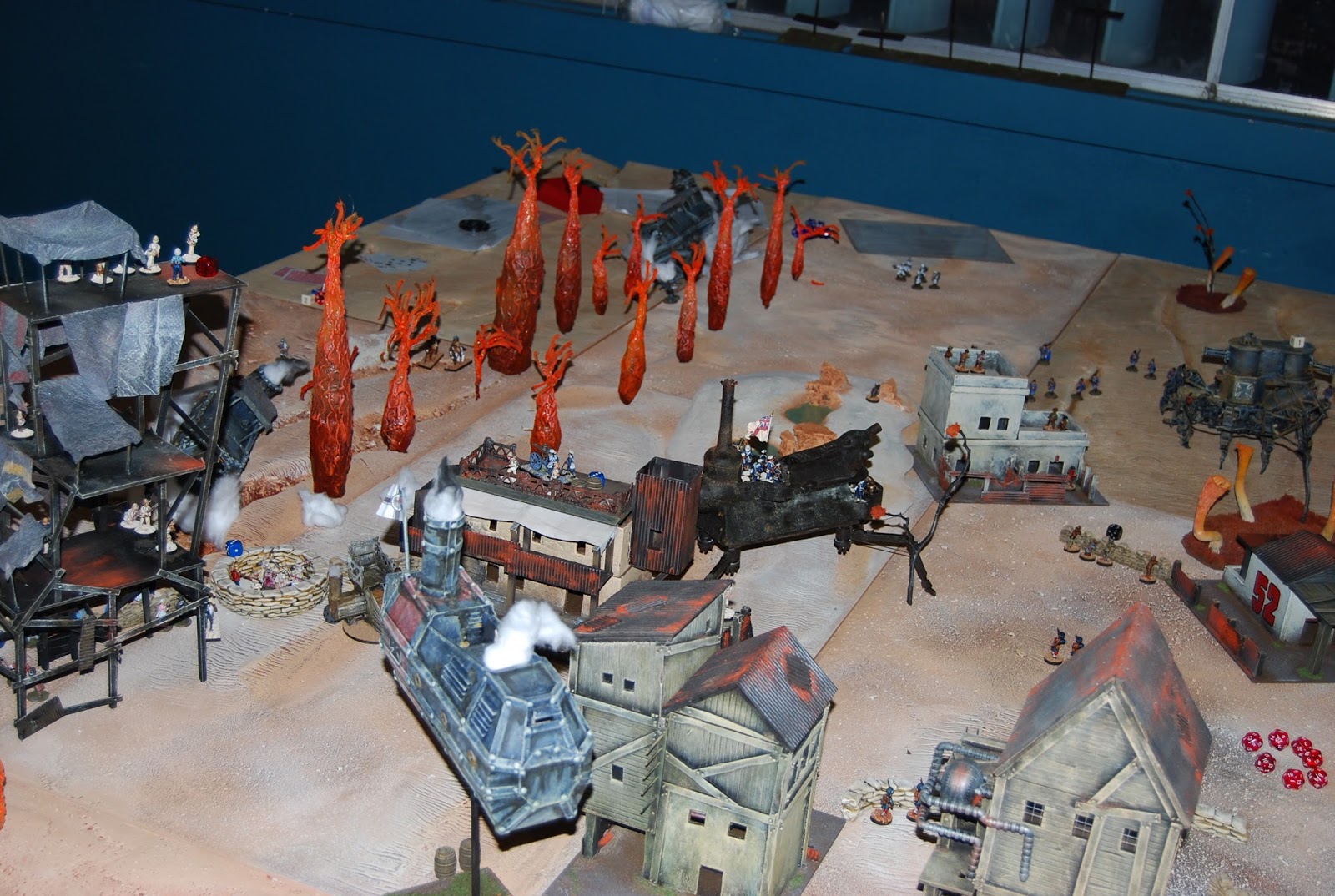
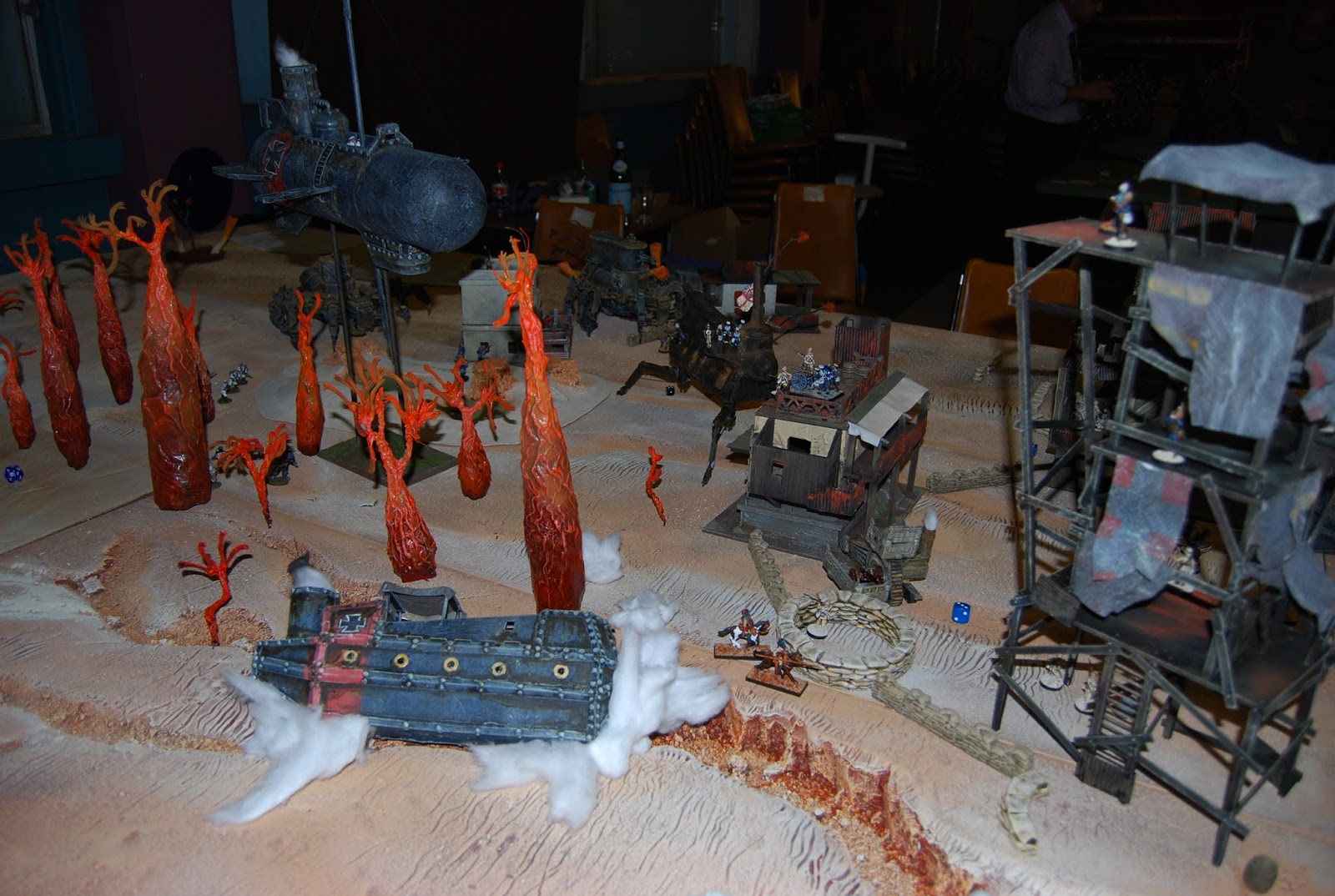
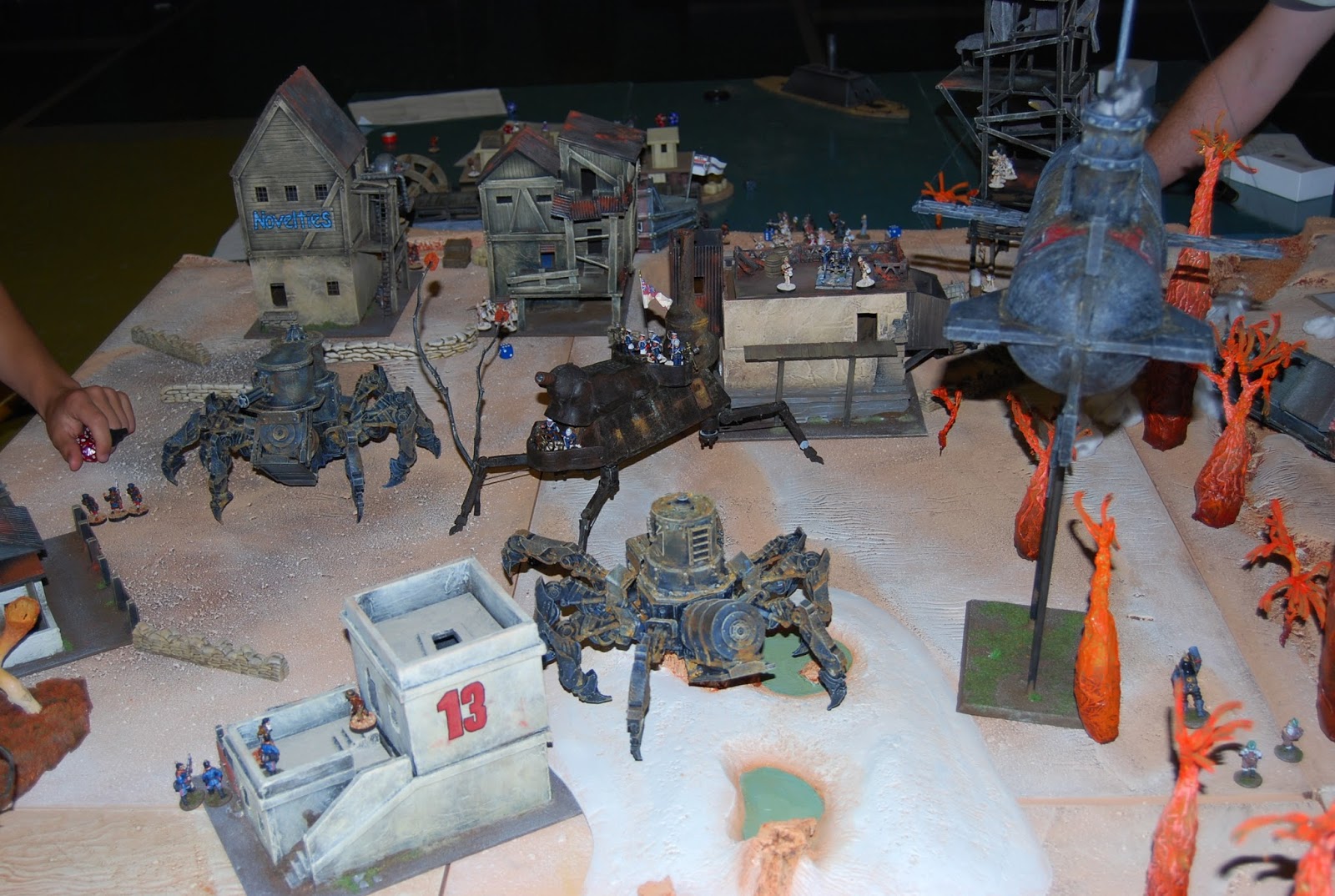
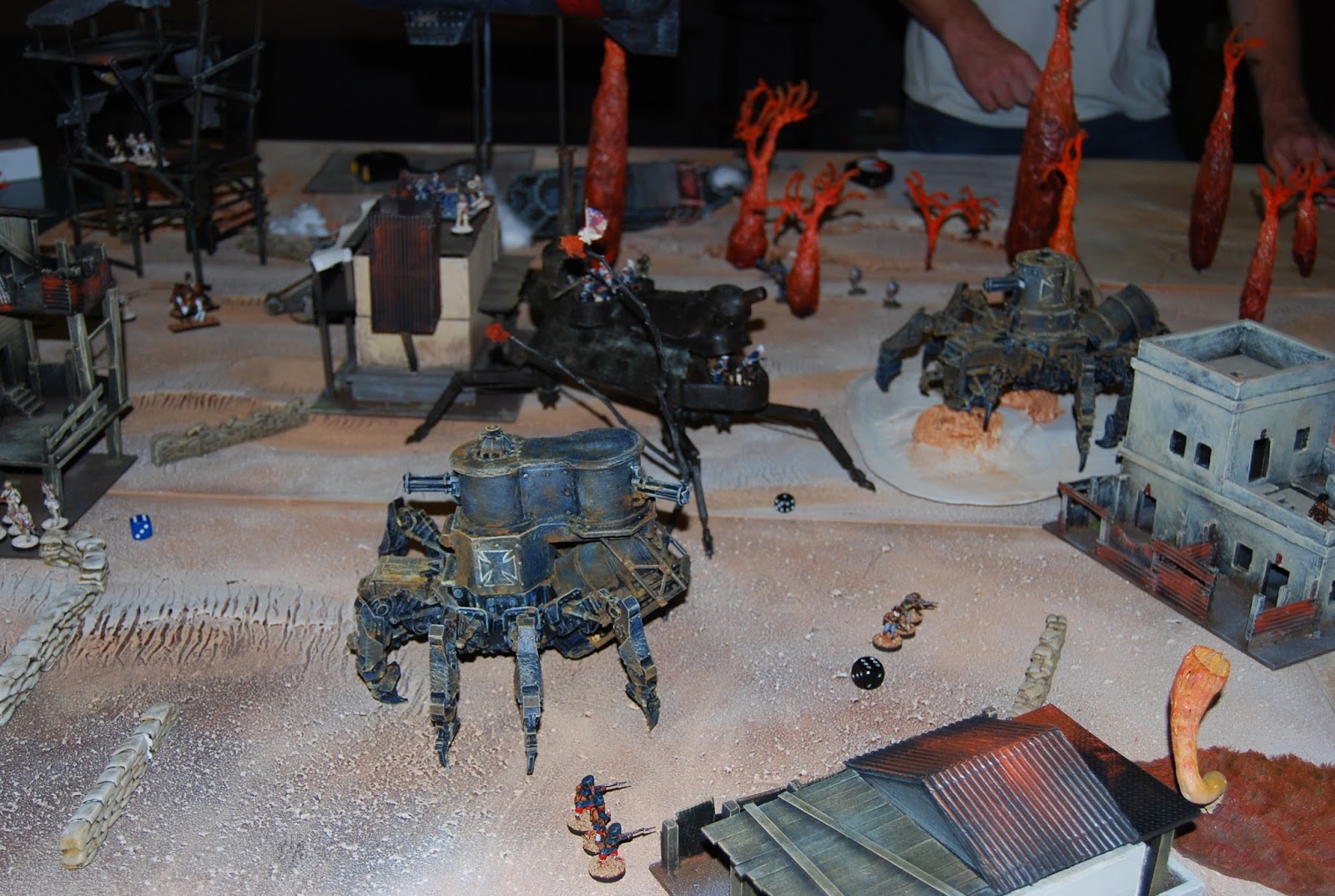
Well a draw I suppose. The Prussians got to destroy the tower and caused a good deal of terror but the majority of the refugees and soldiers escaped, along with some very valuable prisoners. It was great fun to finally get some aerial ships going as well as cavalry as it really moved the game along quickly and presented many new angles of attack (and considerations for defence). It was really hard getting the balance of forces right for this one with the Prussian side having a lot of armour and air ability and the Brits having a lot of well dug in rifles. These certainly stopped the Prussian infantry pretty well but were fairly powerless with the big beasties…probably just how it should have been.


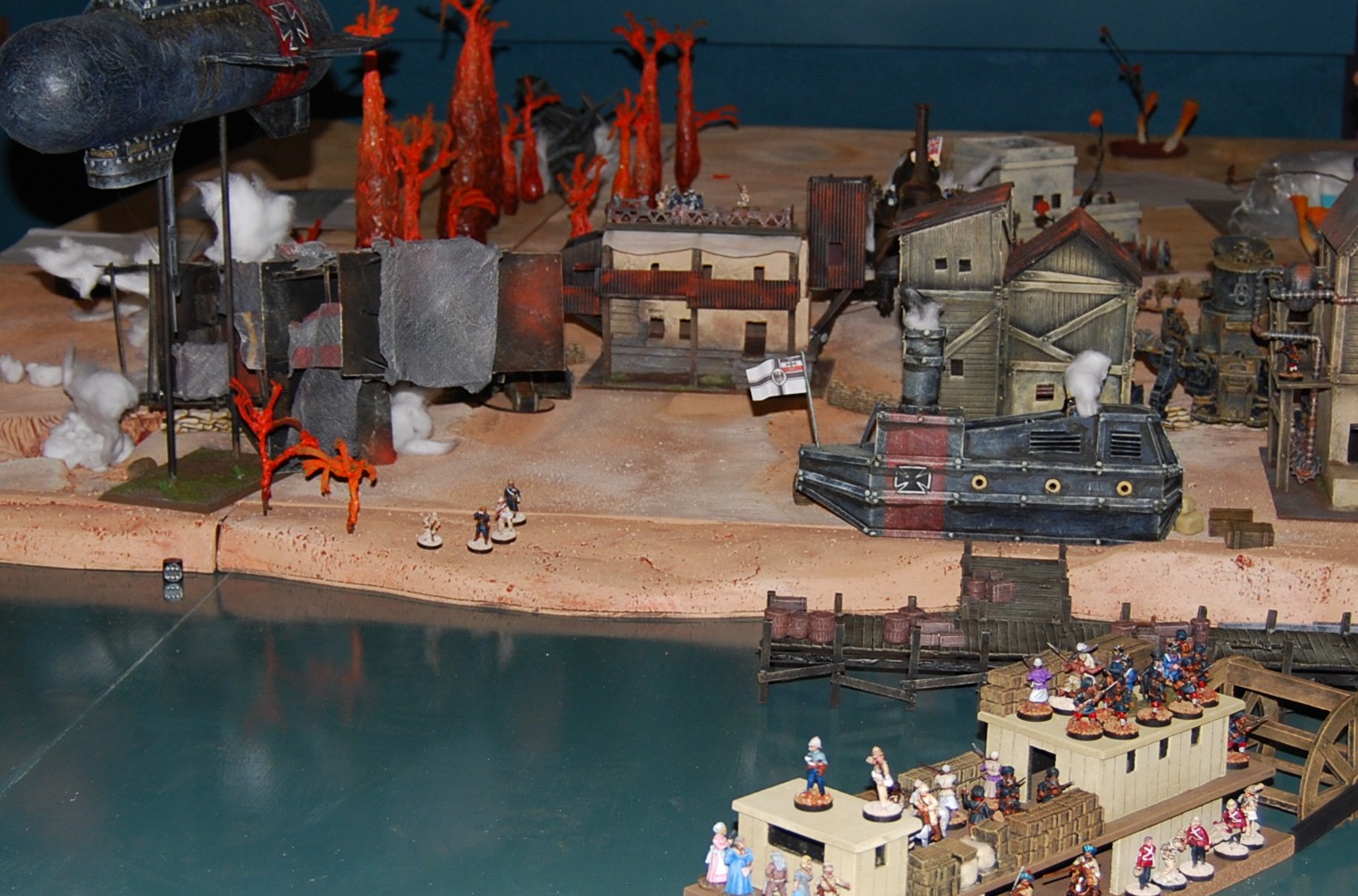
The Battle of Horst's Ferry. Part Two
The Battle of Horst’s Ferry.
Part Two.
A great cheer went up from the defenders, only to be stifled as they saw the looming shape of the zeppelin bomber appear!
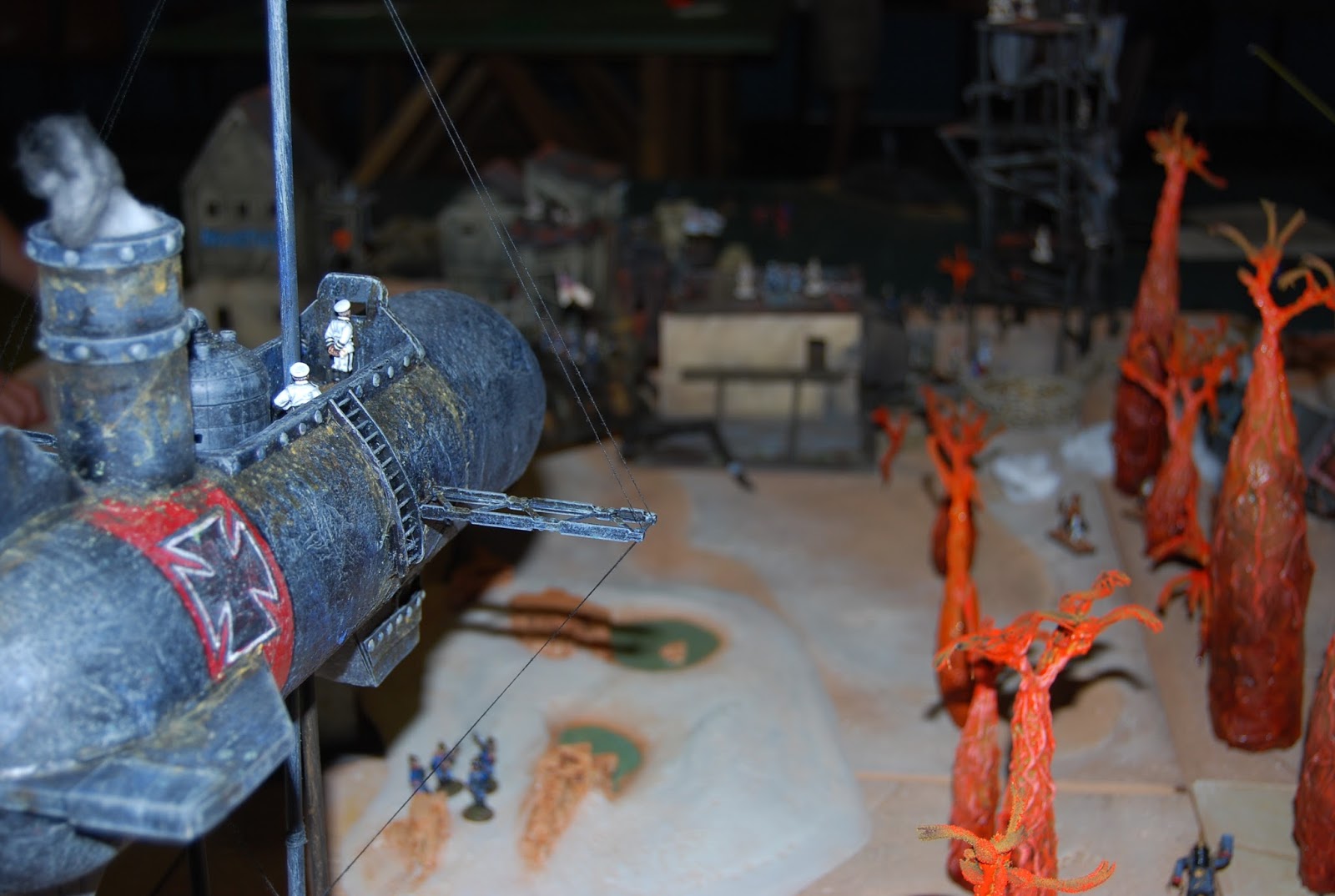
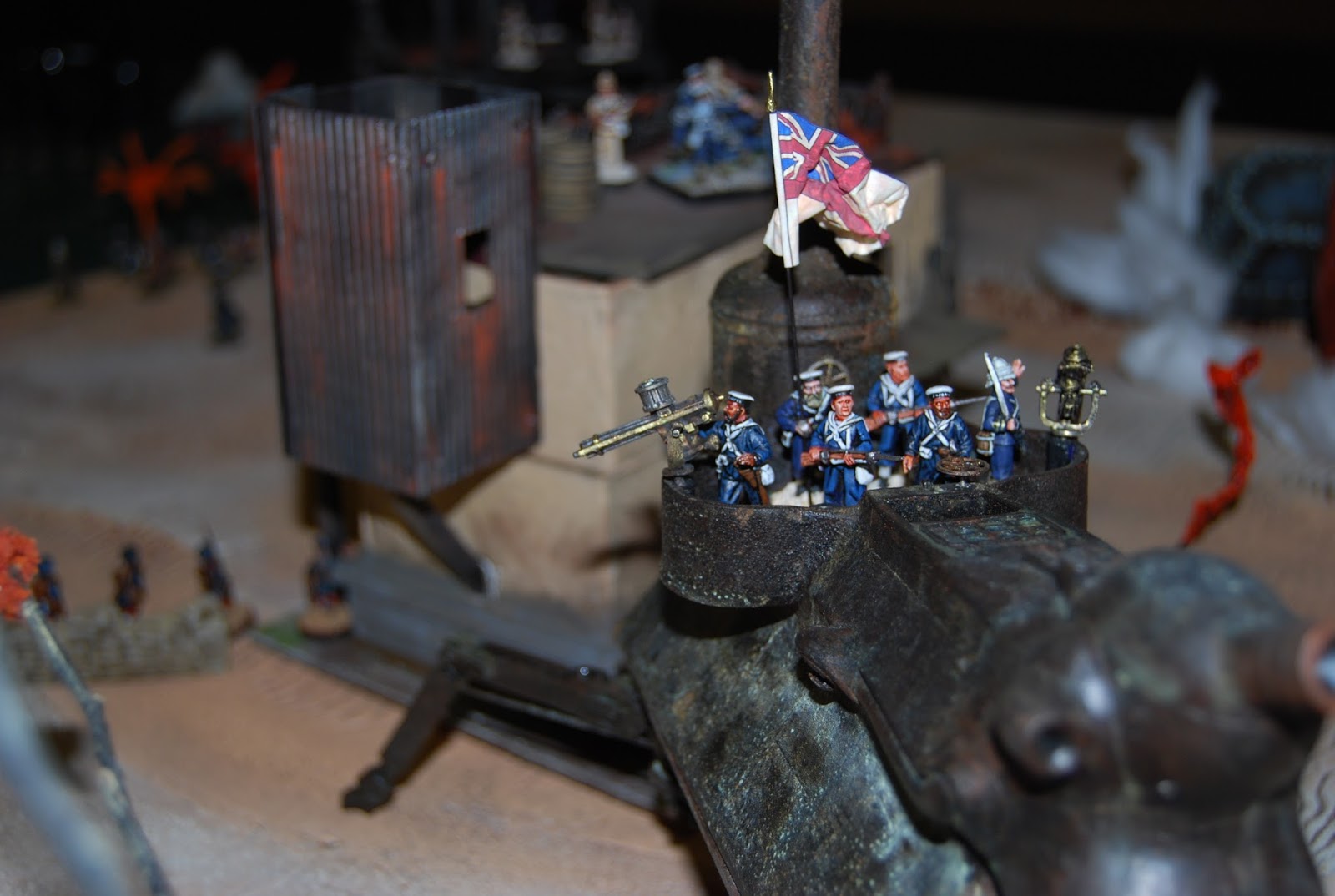
HMMS Elgar’s crew had some luck with their Gatling gun (they had fired the RA crew by this point) in damaging the front weapon of the lead spider but disaster struck as their engine conked out! Unable to use their main weapon, the crew valiantly swept the approaching Prussian units with their machine guns as behind them units began to fall back.
The last of the attack ships swept by the semaphore tower, small arms fire bouncing off it as it approached. The British would have loved to have tried to board men by jumping off the semaphore tower into the hull but the movement dice didn’t allow it!
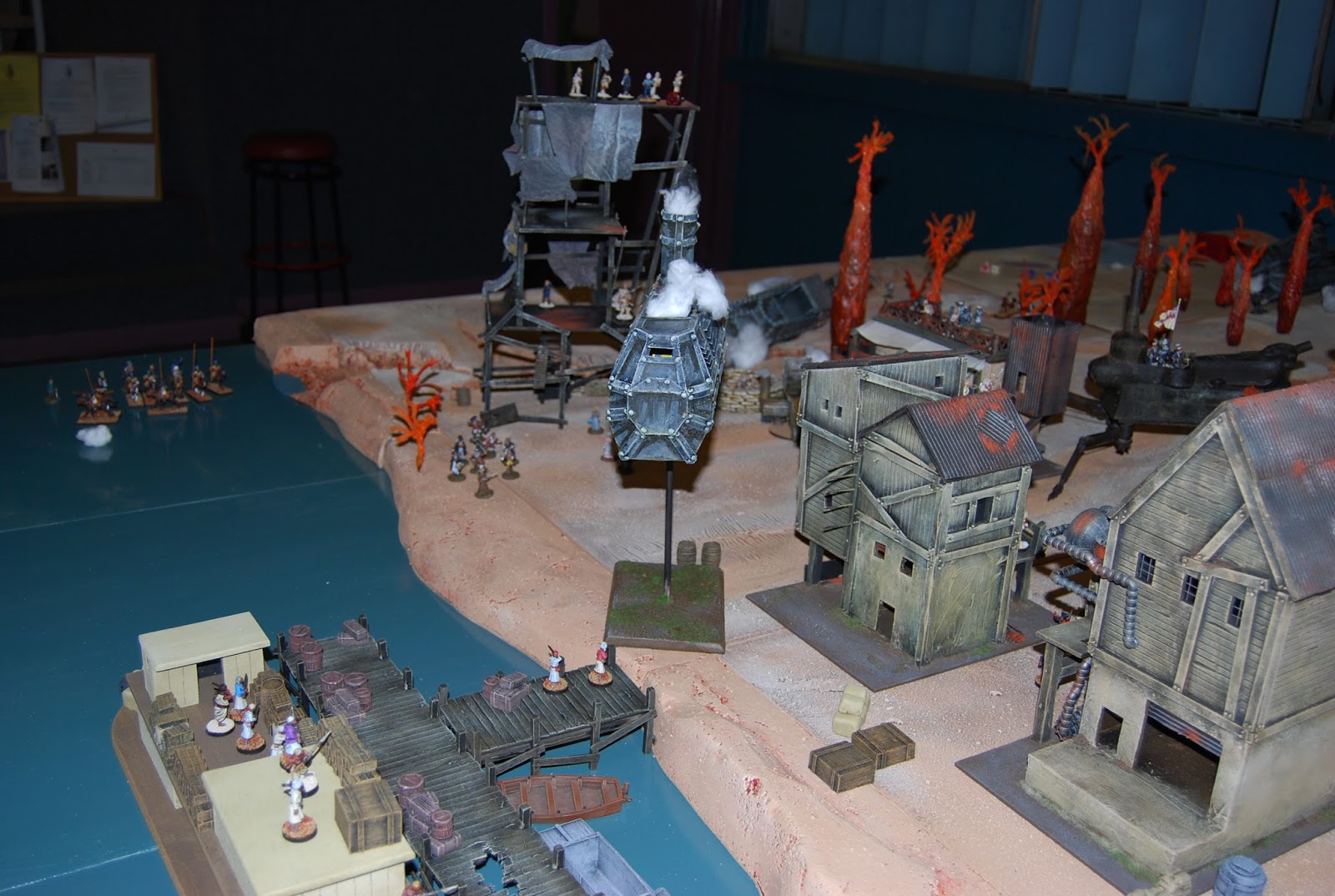

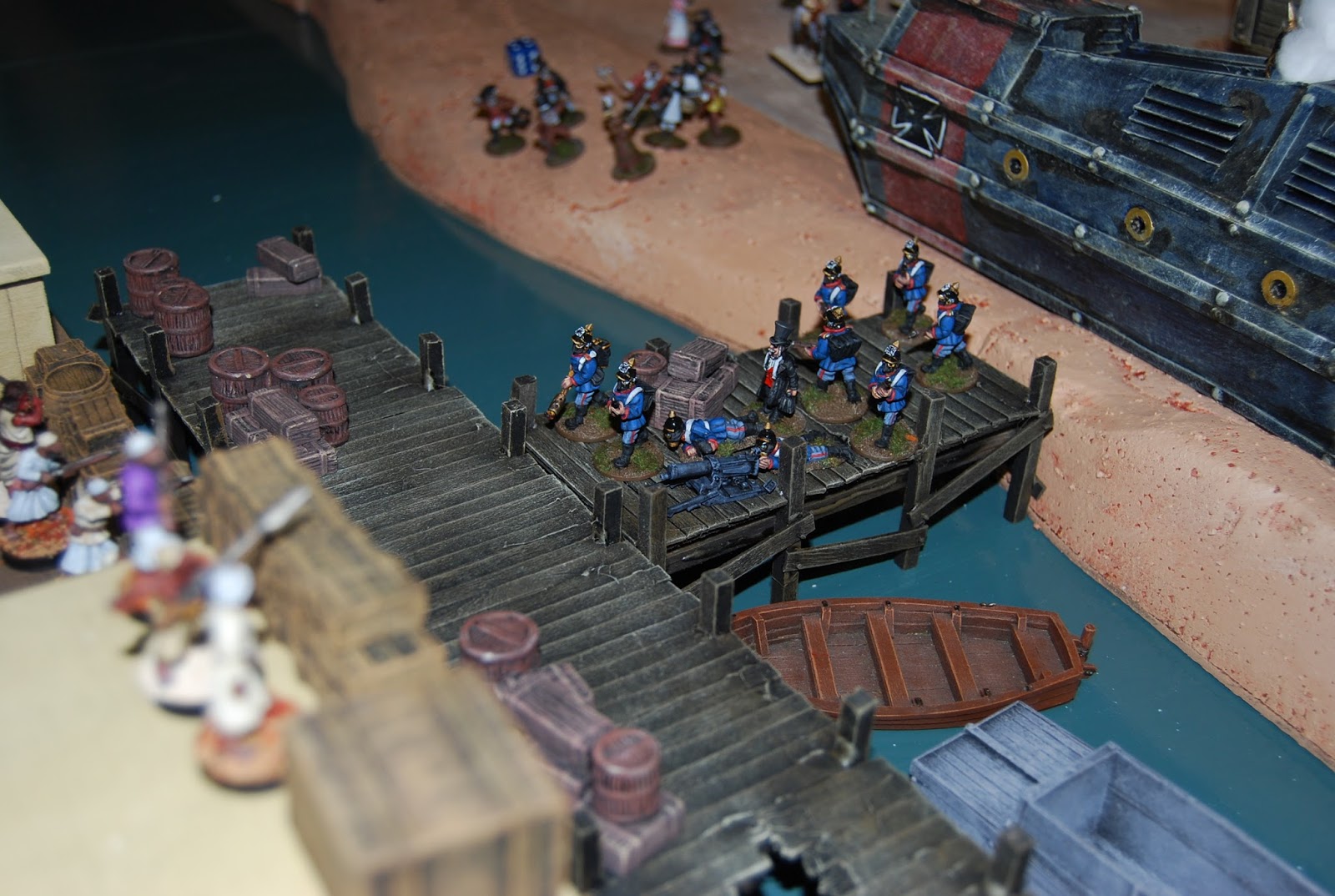
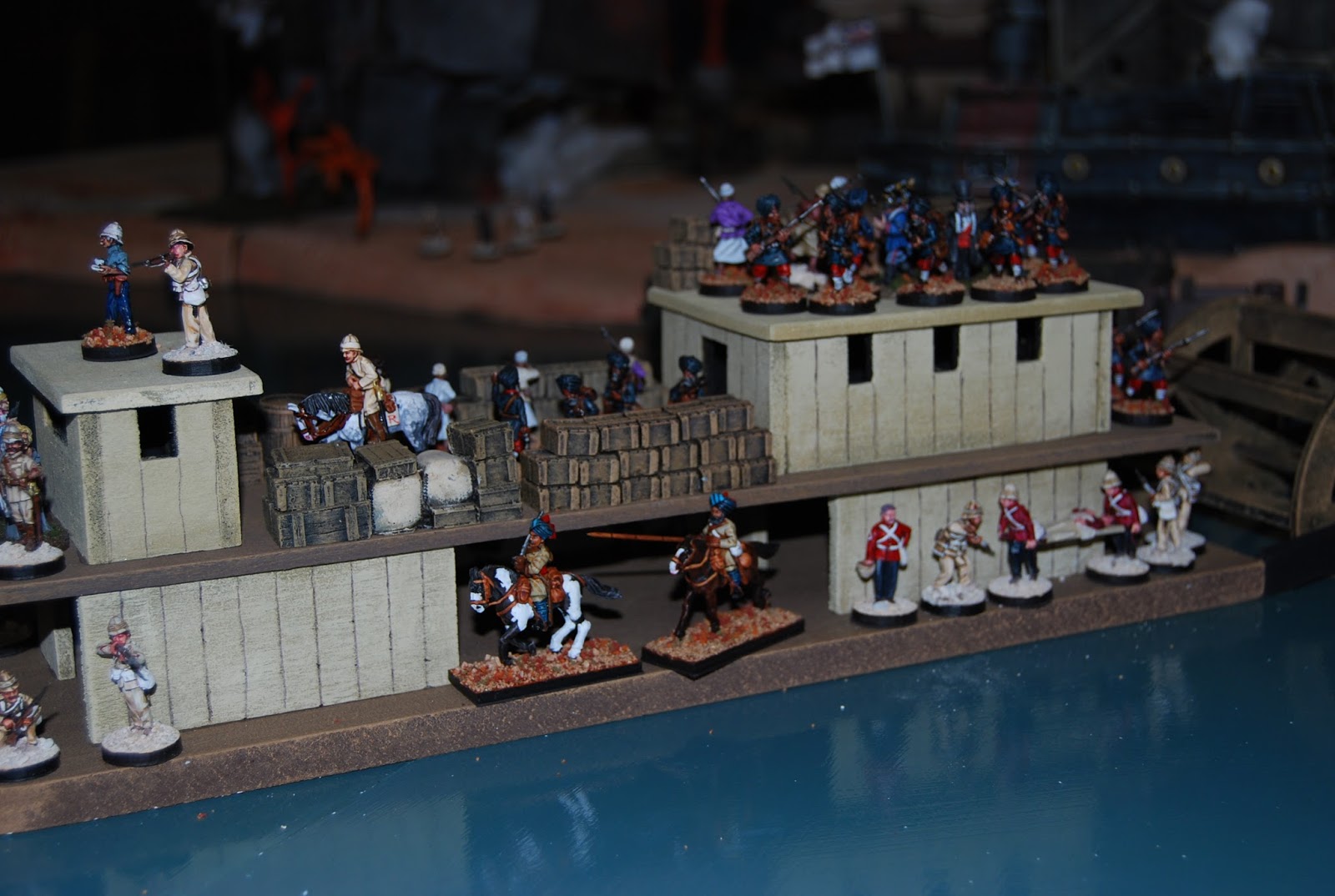
However, the ship then landed just adjacent to the ferry ramp ready to disgorge hordes (well, a dozen or so) crack troops and a secretive agent! The refugees who by this time had almost reached the ramp milled around in horror as they saw their escape route blocked and got in the way of the Berkshires and Bombay infantry trying to get to the ship, led by the Corporal astride a horse he’d ‘borrowed’.
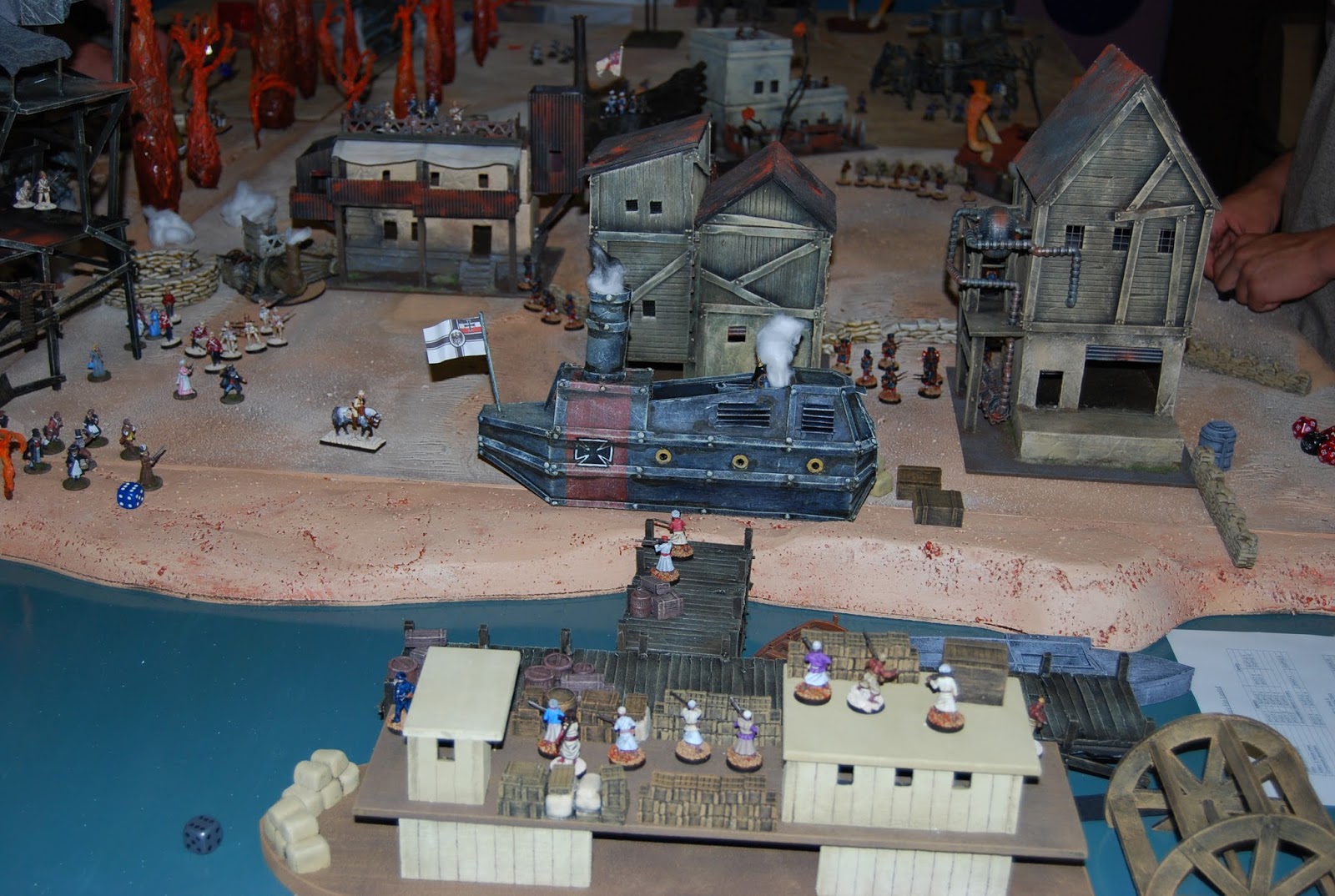
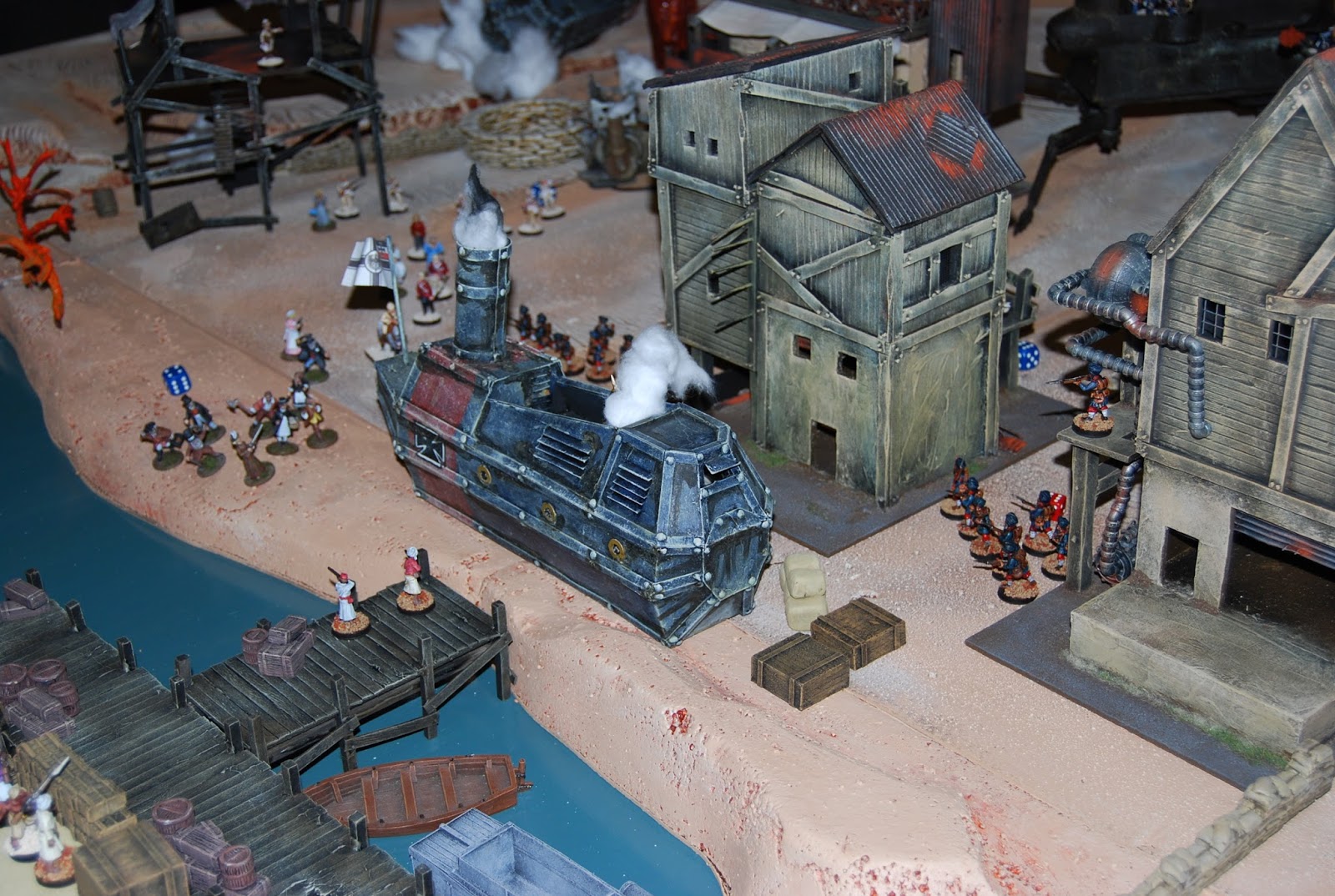
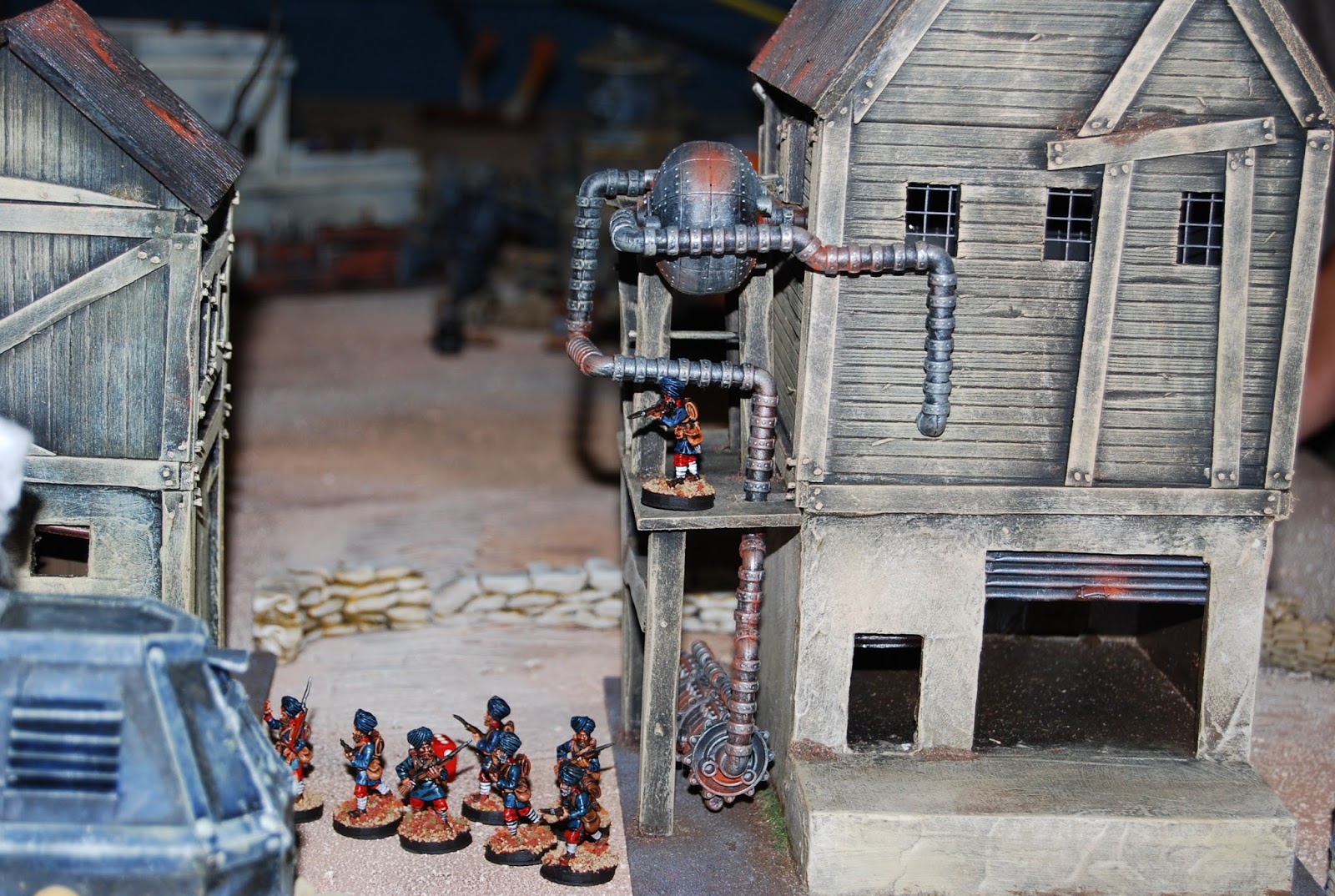
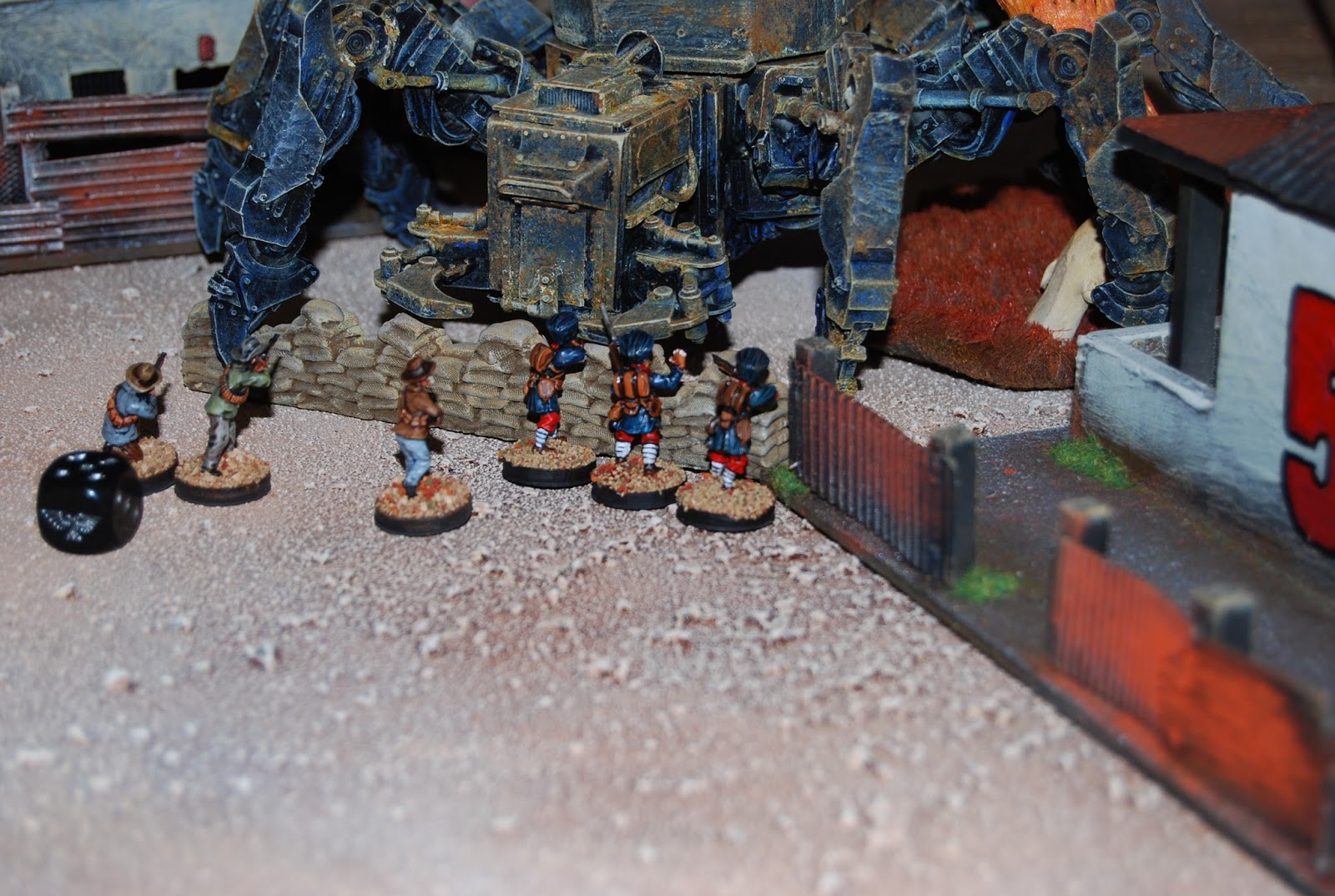
Meanwhile the bomber approached nearer as the Prussian infantry began their breakthrough with the second spider tank, and met the second line of defence at the rear of the ferry buildings. The Prussian assault troops leapt from their landed craft across the ramp, sweeping the ferry with flamethrowers that killed most of the crew, including Captain Shamrock. Luckily massed fire from a small unit of Indian infantry and the remaining crew killed enough of them to force their surrender. While they were taken prisoner and herded onto the boat (including the secret agent..) in front of an avalanche of refugees , soldiers and horses the remaining rear-guard poured everything they had at the bomber. “Java’ Thwaites put down his cup for only the second time that morning and pulled his signalling pistol slowly from a pouch.
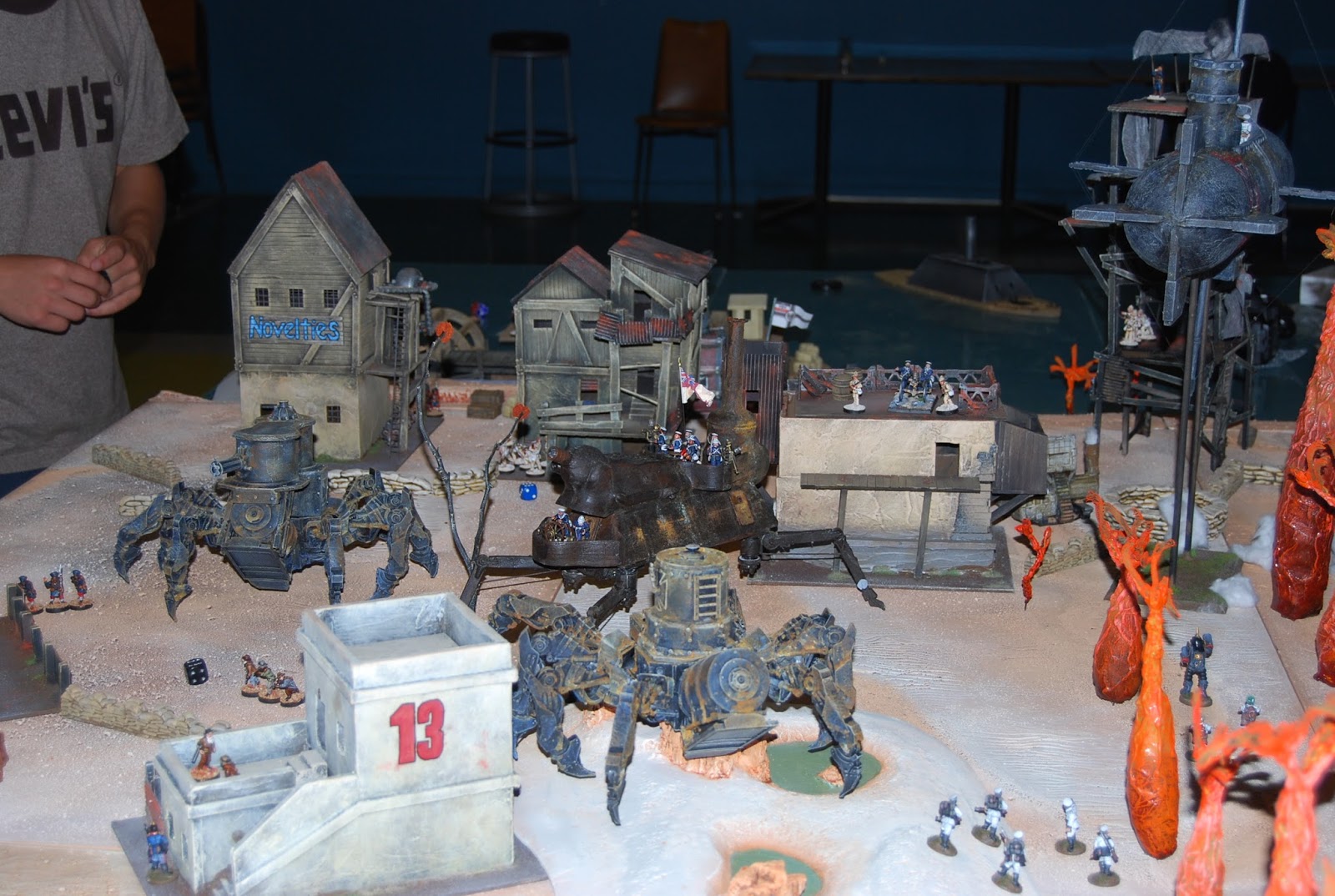
The bomber came closer and obviously was about to ram as he fired into the ship, his phosphor flare setting two crew alight but alas not saving Semaphore tower 21, which with the great noise of tearing steel girders and splintering wood fell sideways over into the canal. The falling wreckage killing a number of the remaining rear-guard as they fled, firing over their shoulders.
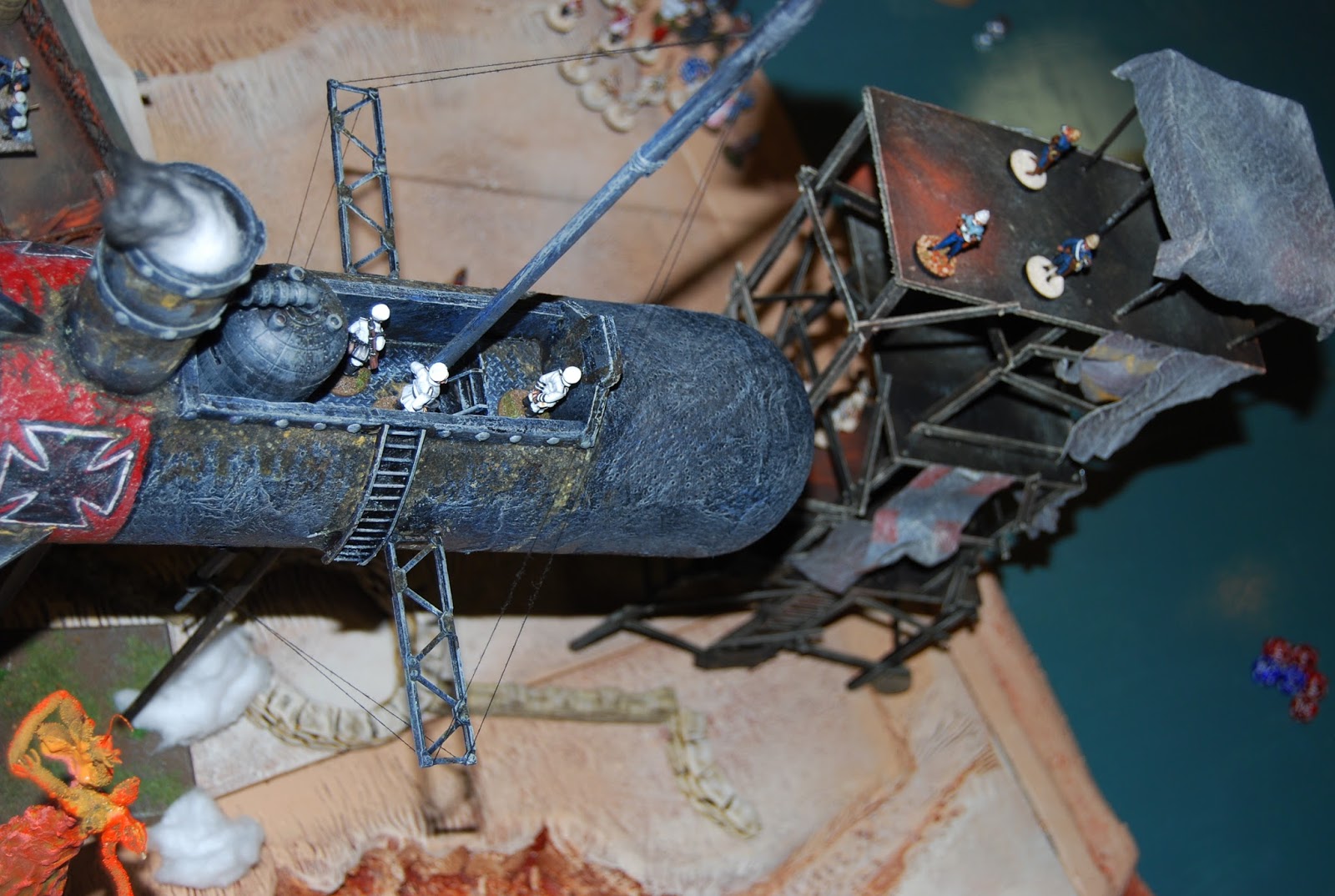
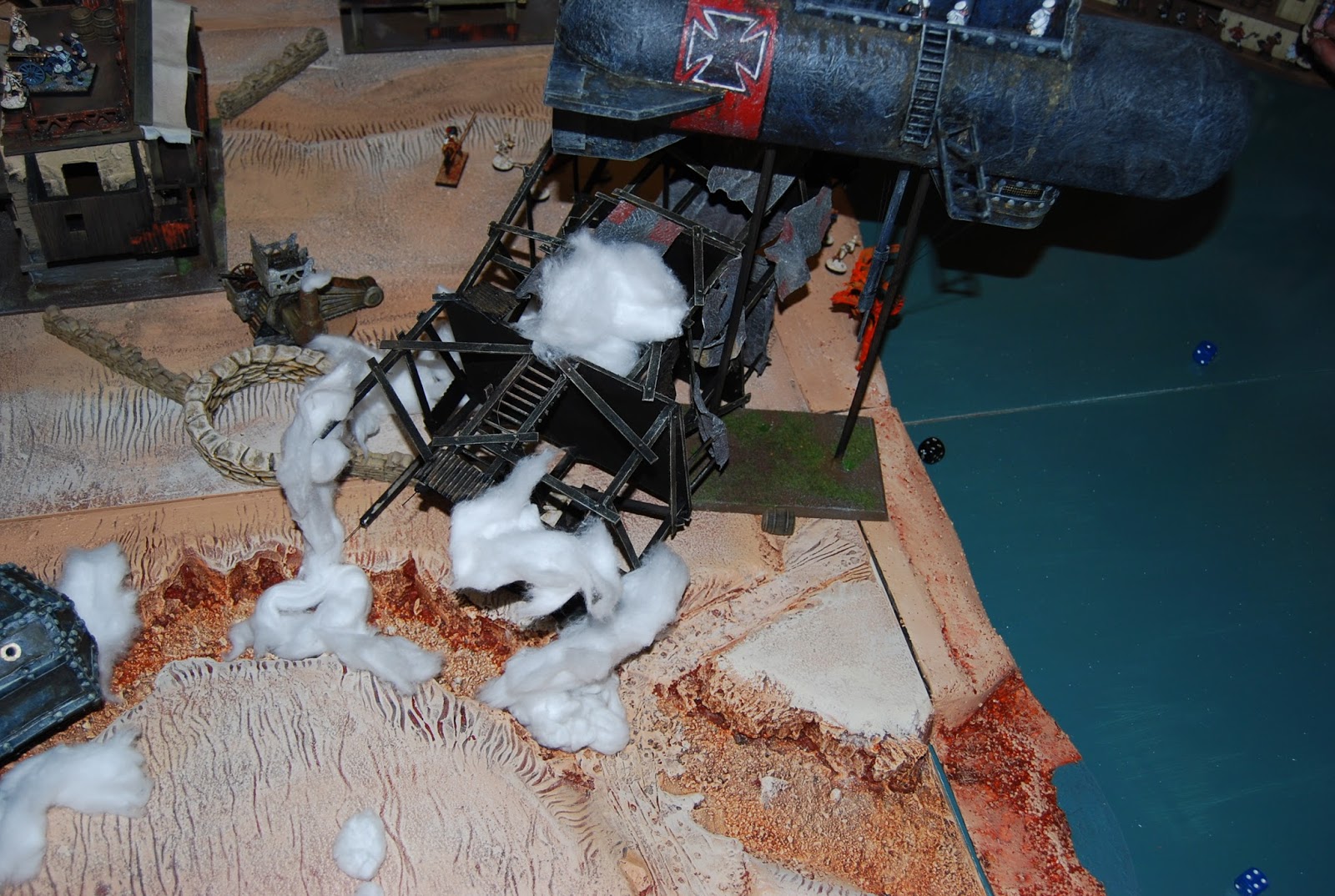
The last of the refugees aboard and as many of the soldiers who could get to the ship in time, the ferry departed intact. None of the settlers had survived the assault and the Indians had been quite hard hit too. None of the naval brigade managed to escape, as HMMS Elgar and the first Spider mutually destroyed each other.
However, climbing aboard the ferry having survived a tremendous dive into the canal was signaller Thwaites, still clutching his best china cup. He had however lost the matching saucer…so the gloves were really off now.
![Battle It Out In The Early War With New Flames Of War Set [Updated]](https://images.beastsofwar.com/2026/10/fow-barbarossa-cover-600-338.jpg)